© Associated Asia Research Foundation (AARF)
A Monthly Double-Blind Peer Reviewed Refereed Open Access International e-Journal - Included in the International Serial Directories.
Page | 15
KNOWLEDGE AND ATTITUDE ABOUT CHICKENPOX VACCINE
AMONG MOTHERSOF UNDER FIVE CHILDREN IN SELECTED
AREAS OF TAMIL NADU
`
Mrs. Swapna M K.
Assistant Professor, Amity College of Nursing, Amity university , Gurgaon
Introduction
Chickenpox is highly infectious disease caused by one Varicella Zooster Virus belongs to the group of herpes viruses. There are many different types of herpes virus, but one feature which they all have is that they lie dormant in the body after the initial infection, and can reactivate much later. The disease caused by the reactivation of the chickenpox virus is known as shingles and it may occur when the immune system is run down. Chickenpox is highly contagious. Like most viral infections, the chickenpox virus is transmitted from person to person by droplet spread, e.g. Sneezing, and by close contact with an infected person such as touching the fluid oozing from the blisters or using the infected persons clothes or towels. A variety of skin infection may occur in children in the school age group. As children are inquisitive and mobile, they come into contact with a variety of people and animals. The close proximity in the school setting provides opportunity to be exposed to infectious agents (viruses, bacteria, fungus, insects and animals) in addition; children tend to share personal items. Chickenpox occurs worldwide and is endemic in large cities. Outbreaks occur sporadically, usually in areas with large groups of susceptible children. It affects all races and both sexes equally. It can occur at any age, but it is most common among children between age group 2 to 8 Years.
Most children will contact chickenpox when they are young and it is usually a mild illness in
International Research Journal of Natural and Applied Sciences
ISSN: (2349-4077) Impact Factor- 5.46, Volume 5, Issue 5, May 2018 Website- www.aarf.asia, Email : [email protected] , [email protected]
© Associated Asia Research Foundation (AARF)
A Monthly Double-Blind Peer Reviewed Refereed Open Access International e-Journal - Included in the International Serial Directories.
Page | 16 children; though can be more serious in teenagers and adults. The incubation period is from 14 to 21 days. The child is infectious from about two days before the rash appears until all the spots have dried up which can take up to ten days. Most people get chickenpox at least once in their lifetime. If you have had chickenpox before it is very unlikely that you would get it again. The infection produces antibodies that help in fight with virus, if it attacks again. The infection is mild in children but the severity increases in adults and pregnant women. The best way to prevent varicella is through vaccination. Most health experts recommend that all children of 12 months age and older who have not had chicken pox get one dose at 12 to 15 months and a second, booster dose at 4 to 6 years old. Adolescents and adults who are not already immune to the chickenpox virus need two doses at least 4 weeks apart. The varicella vaccine has been shown to be 95 % effective in preventing moderate to severe infection, and 70 to 90 % against mild infection. Varicella isn't necessarily a mild illness, and it's important for parents to know that choosing not to vaccinate their children not only places their child at risk for infection requiring medical care, but also places members of the community at risk
While checking previous researches, we found out a lot of misperception of parents toward the chicken pox vaccine in specific. More than four out of 10 children in Tamil Nadu don’t receive the recommended dosage of vaccine that can protect them from preventable diseases such as measles, mumps, rubella, whooping cough and chicken pox, according to data released by the Union health ministry.
The state, which covered more than 80% of its children, including migrants, now covers just 56.2% of children, according to the fourth edition of the district-level household survey by the Indian Institution of Population Studies. Doctors say the fall in vaccine coverage has pushed the state into a full-blown health crisis.
© Associated Asia Research Foundation (AARF)
A Monthly Double-Blind Peer Reviewed Refereed Open Access International e-Journal - Included in the International Serial Directories.
Page | 17 assess the knowledge and awareness about Chickenpox Vaccine among mothers of underfive children.
Objectives
1. To assess the Knowledge about the Chicken pox vaccine among Mothers of Underfive children
2. To assess the attitude about the Chicken pox vaccine among Mothers of Under five children
Methodology
The descriptive research design was used for the study. The non probability convenience sampling was adopted to collect the data. This study assessed about the level of Knowledge regarding Prevention and management of chickenpox and also the attitude of mothers about the chickenpox vaccination. Purposive sampling technique is used for this study and Sample Mothers, who have Children below5 years of age and within the age group 25-45 years The sample consists of 60 mothers of Under five Children. The tool was developed by the researcher with the guidance of experts.
The questionnaire contained three sections,
Demographic Variables
Knowledge about chickenpox Vaccines Attitude towards chicken pox vaccines
© Associated Asia Research Foundation (AARF)
A Monthly Double-Blind Peer Reviewed Refereed Open Access International e-Journal - Included in the International Serial Directories.
Page | 18
Results
Assessment of Knowledge Score on Chickenpox Vaccine among mothers of Underfive
children
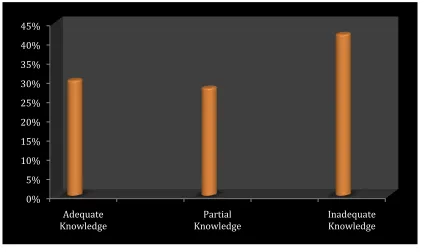
Table. No : 1Knowledge Score on Chickenpox Vaccine among mothers of Underfive children
Knowledge level Percentage
Adequate 30%
Partial 28%
[image:4.595.98.454.181.281.2]Inadequate 42%
Figure : 1 Knowledge Score on Chickenpox Vaccine among mothers of Underfive children
0% 5% 10% 15% 20% 25% 30% 35% 40% 45%
Adequate
[image:4.595.70.494.361.613.2]© Associated Asia Research Foundation (AARF)
A Monthly Double-Blind Peer Reviewed Refereed Open Access International e-Journal - Included in the International Serial Directories.
Page | 19 Table.No:2 Attitude on Chickenpox Vaccine among mothers of Underfive children
Attitude level Percentage
Positive 48%
Negative 52%
Figure.No:2 Attitude on Chickenpox Vaccine among mothers of Underfive children
Discussions
The non- experimental, descriptive design was adopted for the present study. Convenient sampling technique was used to select the samples. The data was collected from 60 mothers of Under five Children from using a structured questionnaire and observational checklist. The present study revealed that the Out of 100 mothers 30% of mothers have adequate knowledge ,28% of mothers have partial knowledge and 42% of mothers have Inadequate knowledge. The mothers have negative attitude towards the chicken pox vaccines and its benefits as it is basically filled with lots of myths related to the vaccines.
46% 47% 48% 49% 50% 51% 52% 53%
© Associated Asia Research Foundation (AARF)
A Monthly Double-Blind Peer Reviewed Refereed Open Access International e-Journal - Included in the International Serial Directories.
Page | 20
Conclusions
The main preventive strategies can be maintained in order to avoid complications of Chickenpox etc... The nurse during her practice in hospitals or even in the community field can play her magnificent role in eliminating the darkness of public ignorance about Chickenpox. They can also help the mothers in the effective management of Chickenpox among children.
Reference
1. Wikipedia the free encyclopedia. Article related to chickenpox. Available from URL: http://www.en.wikepedia.org
2. Heather, Brannon.M.D. Varicella viral infection. J. Dermatology 2010. 22:332-343. [5] Jason’s. Glanz, David.L. Parental refusal of varicella vaccination. J. Sciencedirect. 2010, 164(1):66-70.
3. Kristine.M.sevaryn. Chickenpox vaccine.2005, Availablefrom URL:
http://www.ncbi.nlm.nih.gov/pubmed
4. Article related to country statistics. Available from URL: http://www.wrong diagnosis.com.
5. A.S. Girija, M. Rafeeque, K.P.Abdurchman. Neurological complications of chickenpox. Available from URL: http://www.ncbi.nlm.nih.gov/pubmed.
6. De Wals P, Blackburnm M, Guay M. Burden of chickenpox on families. Can j infect dis, 2001; 12(1):27-32. Available from URL: http://www.ncbi.nlm.nih.gov.
7. Annchen W.A, Daryl’s, Wissler. Postpartum mothers knowledge, attitude and trust
regarding vaccination. Volume12, Sno-6,766-773. Available from URL: http://www.springlink.com
8. M.C. Dendrick, M.W.Lau J, Alstons. Potential utilization of varicella vaccine in prevention during pregnancy. Volume 55, Issue 1, 64-67. Available from URL: http://linking hub Elsevier.com.
9. JesseyElizebath Joseph et.,al., (2013)International journal of Advanced Nursing Studies