R E S E A R C H
Open Access
V-singular values of rectangular tensors and
their applications
Jun He
1*, Yanmin Liu
1, Guangjun Xu
1and Gang Liu
2*Correspondence:
1School of Mathematics, Zunyi
Normal College, Zunyi, P.R. China Full list of author information is available at the end of the article
Abstract
The positive definiteness of rectangular tensors has wide applications in solid mechanics and quantum physics. By modifying the existing definition of singular value for rectangular tensors, some V-singular value inclusion sets for rectangular tensors with positive diagonal entries are established to provide verifiable sufficient conditions for the positive definiteness of rectangular tensors. In addition, an upper bound for the largest V-singular value of nonnegative rectangular tensors is provided.
MSC: 15A18; 15A42; 15A69
Keywords: Rectangular tensors; V-singular value; Inclusion set; Positive definiteness
1 Introduction
Let R(C) be the real (complex) field, p, q, m, n be positive integers,m,n≥2, [n] =
{1, 2, . . . ,n}. A (p,q)th order (m× n)-dimensional real rectangular tensor, denoted by A= (ai1...ipj1...jq)∈R[p;q;m;n], is defined as follows:
ai1...ipj1...jq∈R, i1, . . . ,ip∈[m],j1, . . . ,jq∈[n].
Whenp=q= 1,Ais simply a realm×nrectangular matrix. Ais called nonnegative ifai1...ipj1...jq≥0, denoted byA∈R
[p;q;m;n]
+ . We say thatAis a real partially symmetric rectangular tensor ifai1...ipj1...jq is invariant under any permutation of indices amongi1, . . . ,ipand any permutation of indices amongj1, . . . ,jq, i.e.,
aπ(i1...ip)σ(j1...jq)=ai1...ipj1...jq, π∈Sp,σ∈Sq, whereSris the permutation group ofrindices.
For any vectorsx∈Cm,y∈Cn, letAxp–1yqbe a vector inCmsuch that
Axp–1yq i=
m
i2,...,ip=1
n
j1,...,jq=1
aii2...ipj1...jqxi2· · ·xipyj1· · ·yjq,
wherei∈[m]. LetAxpyq–1be a vector inCnsuch that
Axpyq–1
j= m
i1,...,ip=1
n
j2,...,jq=1
ai1i2...ipjj2...jqxi1· · ·xipyj2· · ·yjq,
where j∈[n]. If there exist a numberλ∈C, vectorsx∈Cm\{0}, andy∈Cn\{0} such
that
⎧ ⎨ ⎩
Axp–1yq=λx[l–1],
Axpyq–1=λy[l–1], (1)
wherex[α]= [xα
1, . . . ,xαn]T andl=p+q, thenλis called thesingular valueofA, and (x,y)
is theleft and right eigenvector pairofA, associated withλ. Ifλ∈R,x∈Rm, andy∈Rn,
then we say thatλis anH-singular valueofA, and (x,y) is theleft and right H-eigenvector pairassociated withλ; see [1–4].
We call Aanelasticity tensor, ifp=q= 2,m=n= 2 or 3, andA is a real partially symmetric rectangular tensor. WhenAis an elasticity tensor, the strong ellipticity con-dition holds if and only if A is positive definite, the strong ellipticity condition plays an important role in the theory of elasticity [5, 6]. By introducing the H-singular val-ues of a partially symmetric tensor, Chang et al. [1] provided a necessary and sufficient condition for the positive definiteness of a partially symmetric rectangular tensor as fol-lows.
Theorem 1([1]) Suppose thatA∈R[p;q;m;n]is a partially symmetric rectangular tensor,p and q are even.ThenAis positive definite,i.e.,
f(x,y) =Axpyq=
m
i1,...,ip=1
n
j1,...,jq=1
ai1...ipj1...jqxi1· · ·xipyj1· · ·yjq> 0 (2)
for all nonzero vectors x∈Rm,y∈Rnif and only if all of its H-singular values are positive.
In 2005, Qi obtained a Geršgorin-type H-eigenvalue localization set for real symmet-ric tensors, which is useful in verifying the positive definiteness of square tensorA[7,8]. And then some improved results are given in [9–12]. Recently, the problem of singular value inclusion sets for rectangular tensors became an important topic [13–15]. Unfortu-nately, these singular value inclusion sets of rectangular tensors cannot be used to verify the positive definiteness of a rectangular tensor.
Inspired by the above, in Sect.2, we intend to introduce the definition of V-singular value for a rectangular tensor and study its properties. In Sect.3, we give some V-singular value inclusion sets for rectangular tensors with positive diagonal entries. As applications, we give an upper bound for the largest V-singular value of nonnegative rectangular tensors in Sect.4, and sufficient conditions of the positive definiteness for rectangular tensors are also provided in Sect.5.
2 V-singular values of rectangular tensors
Definition 1 LetA∈R[p;q;m;n],p,q≥2. If there exist a numberλ∈R, vectorsx∈Rm\{0},
andy∈Rn\{0}such that
⎧ ⎪ ⎪ ⎪ ⎪ ⎪ ⎨ ⎪ ⎪ ⎪ ⎪ ⎪ ⎩
Axp–1yq=λx[p–1], Axpyq–1=λy[q–1],
m i=1x
p i = 1, n j=1y
q j = 1,
(3)
thenλis called the V-singular value ofA, and (x,y) is the left and right eigenvector pair ofAassociated withλ.
Remark1 When p= 2,q= 2, our definition is the same as the M-eigenvalue which is introduced in [16].
Remark2 Whenpis even andqis even, our definition can be viewed as a special case of thelk,s-singular value which is introduced in [4]. However, when one ofp,qis odd, the
definition of V-singular value is different from thelk,s-singular value.
Theorem 2 LetA∈R[p;q;m;n].We have the following conclusions:
(a) Ifxandyare left and right eigenvectors ofA,associated with a V-singular valueλof
A,then
λ=f(x,y) =Axpyq.
(b) Whenpis odd andqis odd,then(λ, –x, –y),(–λ, –x,y),and(–λ,x, –y)are also V-singular values and their associated eigenvectors ofA.
(c) Whenpis odd andqis even,then(λ,x, –y),(–λ, –x,y),and(–λ, –x, –y)are also V-singular values and their associated eigenvectors ofA.
(d) Whenpis even andqis even,then(λ, –x, –y),(λ, –x,y),and(λ,x, –y)are also V-singular values and their associated eigenvectors ofA.
Proof By the first equation of (3), we have
f(x,y) =Axpyq=λxp–1Tx=λ
m
i=1 xpi =λ.
By the second equation of (3), we have
f(x,y) =Axpyq=λyq–1Ty=λ
n
j=1 yqj =λ.
We thus have conclusion (a).
3 V-singular value inclusion sets for rectangular tensors with positive diagonal entries
Letσ(A) be the set containing all V-singular values ofA= (ai1...ipj1...jq)∈R
[p;q;m;n]. We call
the entriesai...ij...j(i∈[m],j∈[n]) diagonal, and other entries are called off-diagonal. In
this section, some new V-singular value inclusion sets are given to locate all V-singular values of rectangular tensors with positive diagonal entries.
Theorem 3 ConsiderA= (ai1...ipj1...jq)∈R[p;q;m;n] with positive diagonal entries,p and q even,and={(j1, . . . ,jq) : (1, . . . , 1), . . . , (n, . . . ,n)}.Then
σ(A)⊆Γ1(A) =
i∈[m]
z∈R:|z–αi| ≤Ri(A) +αi–αi
,
wheremini∈[m]{ai...i1...1, . . . ,ai...in...n}=αi,maxi∈[m]{ai...i1...1, . . . ,ai...in...n}=αi,
Ri(A) = m
i2,...,ip=1
n
j1,...,jq=1,
(j1,...,jq) /∈
|aii2...ipj1...jq|+γi,
γi=max k∈[n]
m
i2,...,ip=1,
(i2,...,ip)=(i,...,i)
|aii2...ipk...k|
.
Proof Assume thatλ is a V-singular value ofA, x= (xi)mi=1∈Rm\{0} and y= (yj)nj=1 ∈ Rn\{0}are the corresponding left and right eigenvectors. Let|x
s|=maxi∈[m]{|xi|}. Then |xs| = 0. Thesth equation ofAxp–1yq=λx[p–1]is
λxps–1=
m
i2,...,ip=1
n
j1,...,jq=1
asi2...ipj1...jqxi2· · ·xipyj1· · ·yjq
=
m
i2,...,ip=1, (i2,...,ip)=(s,...,s)
n
j1,...,jq=1, (j1,...,jq)∈
asi2...ipj1...jqxi2· · ·xipyj1· · ·yjq
+
m
i2,...,ip=1,
(i2,...,ip)=(s,...,s)
n
j1,...,jq=1,
(j1,...,jq) /∈
asi2...ipj1...jqxi2· · ·xipyj1· · ·yjq
+
m
i2,...,ip=1,
(i2,...,ip)=(s,...,s)
n
j1,...,jq=1,
(j1,...,jq) /∈
asi2...ipj1...jqxi2· · ·xipyj1· · ·yjq
+
m
i2,...,ip=1,
i2,...,ip=s,...,s
n
j1,...,jq=1, (j1,...,jq)∈
asi2...ipj1...jqxi2· · ·xipyj1· · ·yjq,
which can be rewritten as
λ–as...s1...1yq1+· · ·+as...sn...nyqn
=
m
i2,...,ip=1,
(i2,...,ip)=(s,...,s)
n
j1,...,jq=1, (j1,...,jq) /∈
asi2...ipj1...jqxi2· · ·xipyj1· · ·yjq
+
m
i2,...,ip=1,
(i2,...,ip)=(s,...,s)
n
j1,...,jq=1,
(j1,...,jq) /∈
asi2...ipj1...jqxi2· · ·xipyj1· · ·yjq
+
m
i2,...,ip=1,
i2,...,ip=s,...,s
n
j1,...,jq=1, (j1,...,jq)∈
asi2...ipj1...jqxi2· · ·xipyj1· · ·yjq.
Therefore,
λ–αs
yq1+· · ·+yqnxps–1
=
m
i2,...,ip=1,
(i2,...,ip)=(s,...,s)
n
j1,...,jq=1, (j1,...,jq) /∈
asi2...ipj1...jqxi2· · ·xipyj1· · ·yjq
+
m
i2,...,ip=1,
(i2,...,ip)=(s,...,s)
n
j1,...,jq=1,
(j1,...,jq) /∈
asi2...ipj1...jqxi2· · ·xipyj1· · ·yjq
+
m
i2,...,ip=1,
(i2,...,ip)=(s,...,s)
n
j1,...,jq=1,
(j1,...,jq)∈
asi2...ipj1...jqxi2· · ·xipyj1· · ·yjq
+ (as...s1...1–αs)xps–1y q
1+· · ·+ (as...sn...n–αs)xps–1yqn.
By taking absolute values on both sides and the fact that nj=1yqj = 1,qis even, we have
|λ–αs|xps–1≤ m
i2,...,ip=1,
(i2,...,ip)=(s,...,s)
n
j1,...,jq=1,
(j1,...,jq) /∈
|asi2...ipj1...jq||xi2| · · ·|xip||yj1| · · · |yjq|
+
m
i2,...,ip=1,
(i2,...,ip)=(s,...,s)
n
j1,...,jq=1, (j1,...,jq) /∈
|asi2...ipj1...jq||xi2| · · ·|xip||yj1| · · · |yjq|
+
m
i2,...,ip=1,
(i2,...,ip)=(s,...,s)
n
j1,...,jq=1, (j1,...,jq)∈
|asi2...ipj1...jq||xi2| · · ·|xip||yj1| · · · |yjq|
+|as...s1...1–αs|xps–1y q
1+· · ·+|as...sn...n–αs|xps–1yqn
≤ m
i2,...,ip=1,
(i2,...,ip)=(s,...,s)
n
j1,...,jq=1,
(j1,...,jq) /∈
|asi2...ipj1...jq||xi2| · · ·|xip||yj1| · · · |yjq|
+
m
i2,...,ip=1,
(i2,...,ip)=(s,...,s)
n
j1,...,jq=1, (j1,...,jq) /∈
+
m
i2,...,ip=1,
(i2,...,ip)=(s,...,s)
n
j1,...,jq=1, (j1,...,jq)∈
|asi2...ipj1...jq||xi2| · · ·|xip||yj1| · · · |yjq|
+ (αs–αs)
yq1+· · ·+yqnxps–1.
Note that
m
i2,...,ip=1,
(i2,...,ip)=(s,...,s)
n
j1,...,jq=1,
(j1,...,jq)∈
|asi2...ipj1...jq||xi2| · · ·|xip||yj1| · · · |yjq|
≤
m
i2,...,ip=1,
(i2,...,ip)=(s,...,s)
|asi2...ip1...1|y
q
1+· · ·+
m
i2,...,ip=1,
(i2,...,ip)=(s,...,s)
|asi2...ipn...n|y
q n
xps–1
≤max k∈[n]
m
i2,...,ip=1,
(i2,...,ip)=(s,...,s)
|asi2...ipk...k|
yq1+· · ·+yq nxps–1
=max k∈[n]
m
i2,...,ip=1,
(i2,...,ip)=(s,...,s)
|asi2...ipk...k|
xps–1.
Then,
|λ–αs|xsp–1≤Rs(A)xps–1+ (αs–αs)xps–1. (4)
Dividing|xs|on both sides of (4) yields
|λ–αs| ≤Rs(A) + (αs–αs). (5)
Thusσ(A)⊆Γ1(A). This completes the proof.
Similarly, using the formsAxpyq–1=λy[q–1]and m i=1x
p
i = 1, we can get the following
V-singular value interval.
Theorem 4 ConsiderA= (ai1...ipj1...jq)∈R[p;q;m;n] with positive diagonal entries,p and q even,andΩ={(i1, . . . ,ip) : (1, . . . , 1), . . . , (m, . . . ,m)}.Then
σ(A)⊆Γ2(A) =
j∈[n]
z∈R:|z–βj| ≤Cj(A) +βj–βj
,
whereminj∈[n]{a1...1j...j, . . . ,am...mj...j}=βj,maxj∈[n]{a1...1j...j, . . . ,am...mj...j}=βj,
Cj(A) = m
i1,...,ip=1,
(i1,...,ip) /∈Ω
n
j2,...,jq=1
|ai1...ipjj2...jq|+δj,
δj=max k∈[m]
n
j2,...,jq=1, (j2,...,jq)=(j,...,j)
|ak...kjj2...jq|
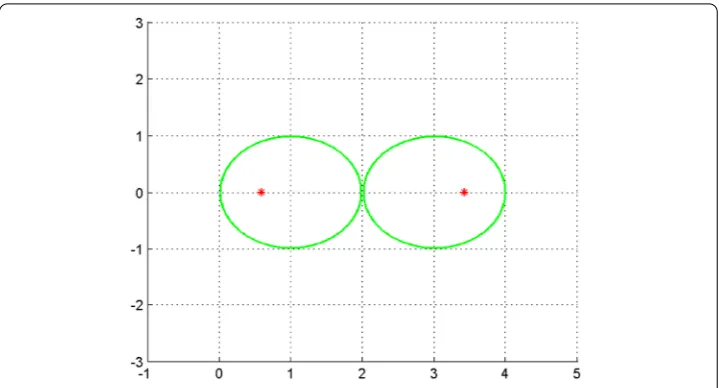
Figure 1The V-singular value inclusion set(A) and the exact V-singular values
By Theorems3 and4, we can get an inclusion set to locate all V-singular value of a rectangular tensor.
Corollary 1 ConsiderA= (ai1...ipj1...jq)∈R
[p;q;m;n]with positive diagonal entries,as well as
p and q even.Then
σ(A)⊆Γ(A) =Γ1(A)∩Γ2(A).
Example1 Let us consider the rectangular tensorA∈R[2;4;2;2]with
a111111=a112222= 1, a221111=a222222= 3,
a121111=a122222=a211111=a212222= –1,
and otherai1i2j1...j4= 0.
The V-singular value inclusion setΓ(A) and the exact V-singular values are drawn in Fig.1, whereΓ(A) is represented by solid boundary, and the exact V-singular values are plotted by “*”. It is easy to see thatσ(A) ={2±√2} ⊆Γ(A), that is,Γ(A) can capture all V-singular values ofA.
4 Nonnegative rectangular tensors
In this section, we give some results for the V-singular value of nonnegative rectangular tensors. The following definition for irreducibility has been introduced in [17].
Definition 2 The square tensorAis called reducible if there exists a nonempty proper index subsetJ⊂ {1, 2, . . . ,n}such thatai1,i2,...,im= 0,∀i1∈J,∀i2, . . . ,im∈/J. IfAis not re-ducible, then we callAirreducible.
tensor is irreducible. For anyj∈[n], letA(·,j) = (ai1...ipj...j) be apth orderm-dimensional square tensor. For anyi∈[m], letA(·,i) = (ai...ij1...jq) be aqth ordern-dimensional square tensor.
Definition 3([1]) A nonnegative rectangular tensorAis called irreducible if all the square tensorsA(·,j),j∈[n], andA(·,i),i∈[m], are irreducible.
Denote byλmax(A) the maximal V-singular value ofA∈R[p;q;m;n]. Then
λmax(A) =max
Axpyq, m
i=1 xpi = 1,
n
j=1 yqj = 1
.
And we call
ρV(A) =max
|λ|:λ∈σ(A)
the largest V-singular value ofA. We have the following result.
Theorem 5 LetA= (ai1...ipj1...jq)∈R [p;q;m;n]
+ .Then,ρV(A) =λmax(A), and there is a pair
of nonnegative eigenvectors corresponding toρV(A).Furthermore,ifAis irreducible,then
ρV(A) =λmax(A),and there is a pair of positive eigenvectors corresponding toρV(A).
Proof Assume thatλis a V-singular value ofA,x= (xi)mi=1∈Rmandy= (yj)nj=1∈Rnare the corresponding left and right eigenvectors. Thenλ=Axpyqand, by the nonnegativity
of the entries ofA, we have
|λ| ≤λmax(A).
Next, we consider the eigenvectors ofρV(A). Assume thatλmax(A) is the maximal
V-singular value ofA,μandνare the corresponding left and right eigenvectors, and one of μorνis not a nonnegative vector. Then we have
λmax(A) =Aμpνq≤Aμpνq≤λmax(A),
which impliesλmax(A) =A|μp||νq|. Therefore,|μ|and|ν|are the left and right
nonnega-tive eigenvectors corresponding toλmax(A).
IfAis irreducible, by Lemma 2 in [1],A|μp–1||νq| = 0,A|μp||νq–1| = 0, that is to say,
|μ|> 0 and|ν|> 0.
Hence, the proof is completed.
From Theorem5, we obtain the the following corollary.
Corollary 2 LetA∈R+[p;q;m;n].Then,
ρV(A) =max
Axpyq, m
i=1 xpi = 1,
n
j=1 yqj = 1
.
Lemma 1 LetA∈R+[p;q;m;n].Then,
ρV(A)≥ max
i∈[m],j∈[n]{ai...ij...j}.
Proof Leteibe anm-dimensional real vector, whoseith entry is 1, and others are 0, also
letejbe ann-dimensional real vector, whosejth entry is 1 and others are 0. Hence, from
Corollary2,
ρ(A)≥Aei· · ·eiej· · ·ej=ai...ij...j,
for anyi∈[m],j∈[n]. This meansρ(A)≥maxi∈[m],j∈[n]{ai...ij...j}.
Based on Theorem5, an upper bound for the largest V-singular value of nonnegative rectangular tensors is given.
Theorem 6 LetA∈R[p;q;m;n]be nonnegative.Then,
ρV(A)≤min
max i∈[m]
Ri(A) +αi
,max j∈[n]
Cj(A) +βj
.
Proof BecauseρV(A) is a V-singular value of A,x= (xi)mi=1 ∈Rm\{0} andy= (yj)nj=1 ∈ Rn\{0} are the corresponding left and right eigenvectors. From Theorem 5, we have
x,y≥0. Letxs=maxi∈[m]{xi}. Thenxs> 0. Thesth equation ofAxp–1yq=λx[p–1]is
ρV(A)xps–1 = m
i2,...,ip=1
n
j1,...,jq=1
asi2...ipj1...jqxi2· · ·xipyj1· · ·yjq
=
m
i2,...,ip=1,
(i2,...,ip)=(s,...,s)
n
j1,...,jq=1,
(j1,...,jq)∈
asi2...ipj1...jqxi2· · ·xipyj1· · ·yjq
+
m
i2,...,ip=1,
(i2,...,ip)=(s,...,s)
n
j1,...,jq=1,
(j1,...,jq)∈
asi2...ipj1...jqxi2· · ·xipyj1· · ·yjq
+
m
i2,...,ip=1
n
j1,...,jq=1, (j1,...,jq) /∈
asi2...ipj1...jqxi2· · ·xipyj1· · ·yjq
≤Rs(A)xsp–1+αsxps–1.
Then,
ρV(A)≤Rs(A) +αs.
Similarly, let yt =maxj∈[n]{yj}. Thenyt > 0. Considering thetth equation ofAxpyq–1=
λy[q–1], we can get
ρV(A)≤Ct(A) +βt.
Example2 Let us consider the rectangular tensorA∈R[2;4;2;2]with
a111111=a112222= 3, a221111=a222222= 3,
a121111=a122222=a211111=a212222= 1,
and otherai1i2j1...j4= 0.
By Theorem6, we have
ρV(A)≤4.
In fact,ρV(A) = 4.
Example3 Let us consider the rectangular tensorA∈R[3;2;2;2]with
a11111=a11122= 3, a22211=a22222= 3,
a11211=a11222= 1, a21111=a21122= 1,
and otherai1i2i3j1j2= 0.
By Theorem6, we have
ρV(A)≤4.
In fact,ρV(A) = 4.
5 Positive definiteness of rectangular tensors
In this section, we provide some verifiable sufficient conditions for the positive definite-ness of rectangular tensors. We have the following theorem.
Theorem 7 Suppose thatA∈R[p;q;m;n]is a partially symmetric rectangular tensor,p and q are even.Then,
(a) There exist V-singular value ofAand associated left and right eigenvectors. (b) Ais positive definite if and only if all of its V-singular values are positive.
Proof Consider the following optimization problem:
min
f(x,y) =Axpyq:
m
i=1 xpi = 1,
n
j=1 yqj = 1
. (6)
The objective functionf(x,y) is continuous in variablesxandy. Whenpandqare even, the feasible set{(x,y)∈Rm×Rn: m
i=1x
p i = 1,
n j=1y
q
j = 1}is compact. Then, there exist
vectorsx∗ andy∗ that solve the optimization problem with the minimal objective value
By the Lagrangian multiplier method, for the optimal solution (x∗,y∗), there exist
mul-tipliersλandμsuch that
⎧ ⎪ ⎪ ⎪ ⎪ ⎪ ⎨ ⎪ ⎪ ⎪ ⎪ ⎪ ⎩
Axp–1
∗ yq∗=λx[∗p–1], Axp
∗yq∗–1=μy[∗q–1],
m i=1(x∗)
p i = 1, n
j=1(y∗)
q j = 1,
and then we haveλ=μ=λ∗=Axp∗yq∗. Therefore,λ∗,x∗ andy∗satisfy the conditions of
Definition1. This proves existence.
Whenpandqare even,Ais positive definite if and only if the optimal objective function value of (6) is positive. Suppose that every V-singular value ofAis positive. By the proof for (a),λ∗,x∗andy∗are the optimal solution of (6), andλ∗is a V-singular value ofA. That is to say,λ∗> 0. Hence,Ais positive definite.
On the other hand, suppose thatAis positive definite. Letλbe a V-singular value ofA, xandybe a left and right eigenvectors ofAassociated withλ. Iff(x,y) > 0, by Theorem2, we haveλ> 0.
The proof is completed.
Two sufficient conditions for the positive definiteness of partially symmetric rectangular tensors are obtained. First, we need the following lemma.
Lemma 2 Suppose thatA∈R[p;q;m;n] is a partially symmetric rectangular tensor,and p and q are even.IfAis positive definite,then
ai...ij...j> 0, i∈[m],j∈[n].
Proof Leteibe anm-dimensional real vector, whoseith entry is 1 and others are 0, also let
ejbe ann-dimensional real vector, whosejth entry is 1 and others are 0. Since the partially
symmetric rectangular tensorAis positive definite,
Aei· · ·eiej· · ·ej=ai...ij...j> 0,
for anyi∈[m],j∈[n].
Theorem 8 LetA∈R[p;q;m;n]be a partially symmetric rectangular tensor,p and q even,
and ai...i1...1=· · ·=ai...in...n=αi> 0,i∈[m].If for all i∈[m],
αi>Ri(A),
thenAis positive definite.
Proof Assume thatλ≤0 is a V-singular value ofA. From Theorem3, we haveλ∈Γ1(A), hence, there isi0∈[m] such that
Fromαi0> 0 for alli0∈[m], we get
|λ–αi0| ≥αi0>Ri0(A).
This is a contradiction. Hence,λ> 0. Then, the partially symmetric rectangular tensorA
is positive definite.
Similarly to the proof of Theorem8, we can get the following result.
Theorem 9 LetA∈R[p;q;m;n]be a partially symmetric rectangular tensor,p and q even, and a1...1j...j=· · ·=am...mj...j=βj> 0,j∈[n].If for all j∈[n],
βj>Cj(A),
thenAis positive definite.
Theorem 10 LetA∈R[p;q;m;n] be a partially symmetric rectangular tensor with positive diagonal entries,p and q even,and
min
i∈[m]{ai...i1...1, . . . ,ai...in...n}=αi, minj∈[n]{a1...1j...j, . . . ,am...mj...j}=βj.
AssumeB1andB2are partially symmetric rectangular tensors whose(i1. . .ipj1. . .jq)th
en-tries are respectively defined as follows:
(B1)i1...ipj1...jq=
⎧ ⎨ ⎩
bi...i1...1=· · ·=bi...in...n=αi, i∈[m],
ai1...ipj1...jq, otherwise,
(7)
and
(B2)i1...ipj1...jq=
⎧ ⎨ ⎩
b1...1j...j=· · ·=bm...mj...j=βj, j∈[n],
ai1...ipj1...jq, otherwise.
(8)
IfB1(orB2)is positive definite,thenAis positive definite.
Proof Letx∈Rm,y∈Rnbe two nonzero vectors. SinceB1is positive definite, from the
definition of positive definite partially symmetric rectangular tensor, we have
B1xpyq> 0.
Then, we have
Axpyq=B1xpyq+ i∈[m],j∈[n]
(ai...ij...j–bi...ij...j)xpiy q j > 0.
IfB2is positive definite, then
B2xpyq> 0.
Then, we have
Axpyq=B2xpyq+ i∈[m],j∈[n]
(ai...ij...j–bi...ij...j)xpiy q j > 0.
ThusAis positive definite.
By Theorem 8,9 and10, we have the following sufficient conditions for the positive definiteness of partially symmetric rectangular tensors.
Theorem 11 LetA∈R[p;q;m;n] be a partially symmetric rectangular tensor with positive diagonal entries,p and q even,and
min
i∈[m]{ai...i1...1, . . . ,ai...in...n}=αi, minj∈[n]{a1...1j...j, . . . ,am...mj...j}=βj.
If for all i∈[m],j∈[n],
αi>Ri(A),
or
βj>Cj(A),
thenAis positive definite.
Based on the above theorem, we introduce the definition of strictly diagonally domi-nated (SDD) partially symmetric rectangular tensors.
Definition 4 LetA∈R[p;q;m;n]be a partially symmetric rectangular tensor with positive
diagonal entries,pandqeven, and
min
i∈[m]{ai...i1...1, . . . ,ai...in...n}=αi, minj∈[n]{a1...1j...j, . . . ,am...mj...j}=βj.
Then, the partially symmetric rectangular tensorAis called strictly diagonally dominated (SDD), if for alli∈[m],j∈[n],
αi>Ri(A),
or
Example4 Let us consider the rectangular tensorA∈R[2;4;2;2]with
a111111=a112222=a221111=a222222= 1.1,
a121111=a122222=a211111=a212222= –1,
and otherai1i2j1...j4= 0.
It can be verified thatAsatisfies all the conditions of Theorem11, i.e.,Ais an SDD partially symmetric rectangular tensor. Hence, from Theorem11,Ais a positive definite rectangular tensor. In fact, the V-singular values ofAare 2.1 and 0.1. From the definition of positive definite partially symmetric rectangular tensors,Ais positive definite.
Example5 Let us consider the rectangular tensorA∈R[2;6;2;2]with
a11111111=a11222222=a22111111=a22222222= 2,
a12111111=a12222222=a21111111=a21222222= 1.9,
and otherai1i2j1...j6= 0.
It can be verified thatAsatisfies all the conditions of Theorem11, i.e.,Ais an SDD partially symmetric rectangular tensor. Hence, from Theorem11,Ais a positive definite rectangular tensor. In fact, the V-singular values ofAare 3.9 and 0.1. From the definition of positive definite partially symmetric rectangular tensors,Ais positive definite.
6 Conclusions
In this paper, we introduce the definition of V-singular value for rectangular tensors and obtain some V-singular value inclusion sets for rectangular tensors with positive diagonal entries, an upper bound for the largest V-singular value of nonnegative rectangular tensors is also given. As applications, some sufficient conditions for the positive definiteness of partially symmetric rectangular tensors are obtained. These conditions only depend on the elements of partially symmetric rectangular tensors and thus can be easily verified. At last, we introduce the definition of SDD partially symmetric rectangular tensor and show that the SDD partially symmetric rectangular tensor is positive definite.
Acknowledgements
The author would like to thank anonymous referees for encouraging and critical comments and suggestions that definitely led to improvements of the original manuscript.
Funding
This work is supported by National Natural Science Foundations of China (11661084, 71461027); Science and Technology Foundation of Guizhou province (Qian Ke He Ji Chu [2016]1161, [2017]1201); Guizhou Province Natural Science Foundation in China (Qian Jiao He KY [2016]255); Innovative talent team in Guizhou Province (Qian Ke He Pingtai Rencai [2016]5619); High-level innovative talents of Guizhou Province (Zun Ke He Ren Cai [2017]8); The doctoral scientific research foundation of Zunyi Normal College (BS [2015]09).
Availability of data and materials
The datasets generated during and/or analyzed during the current study are available from the corresponding author upon request.
Competing interests
The authors declare that they have no competing interests.
Authors’ contributions
Author details
1School of Mathematics, Zunyi Normal College, Zunyi, P.R. China.2School of Applied Mathematics, Chengdu University of
Information Technology, Chengdu, P.R. China.
Publisher’s Note
Springer Nature remains neutral with regard to jurisdictional claims in published maps and institutional affiliations.
Received: 23 November 2018 Accepted: 21 March 2019
References
1. Chang, K., Qi, L., Zhou, G.: Singular values of a real rectangular tensor. J. Math. Anal. Appl.370, 284–294 (2010) 2. Zhou, G., Caccetta, L., Qi, L.: Convergence of an algorithm for the largest singular value of a nonnegative rectangular
tensor. Linear Algebra Appl.438, 959–968 (2013)
3. Zhang, L.: Linear convergence of an algorithm for largest singular value of a nonnegative rectangular tensor. Front. Math. China8, 141–153 (2013)
4. Ling, C., Qi, L.:lk,s-Singular values and spectral radius of rectangular tensors. Front. Math. China8, 63–83 (2013) 5. Chirita, S., Danescu, A., Ciarletta, M.: On the strong ellipticity of the anisotropic linearly elastic materials. J. Elast.87,
1–27 (2007)
6. Han, D., Dai, H., Qi, L.: Conditions for strong ellipticity of anisotropic elastic materials. J. Elast.97, 1–13 (2009) 7. Qi, L.: Eigenvalues of a real supersymmetric tensor. J. Symb. Comput.40, 1302–1324 (2005)
8. Qi, L., Luo, Z.: Tensor Analysis Spectral Theory and Special Tensors. SIAM, Philadelphia (2017)
9. Li, C., Li, Y., Kong, X.: New eigenvalue inclusion sets for tensors. Numer. Linear Algebra Appl.21, 39–50 (2014) 10. Li, C., Li, Y.: An eigenvalue localization set for tensors with applications to determine the positive (semi-)definiteness
of tensors. Linear Multilinear Algebra64, 587–601 (2016)
11. Li, C., Zhou, J., Li, Y.: A new Brauer-type eigenvalue localization set for tensors. Linear Multilinear Algebra64, 727–736 (2016)
12. Li, C., Jiao, A., Li, Y.: Ans-type eigenvalue localization set for tensors. Linear Algebra Appl.493, 469–483 (2016) 13. Zhao, J., Li, C.: Singular value inclusion sets for rectangular tensors. Linear Multilinear Algebra66, 1333–1350 (2018) 14. Zhao, J.: Two new singular value inclusion sets for rectangular tensors. Linear Multilinear Algebra (2018)
15. Yao, H., Zhang, C., Lei, L., Bu, C.: Singular value inclusion sets of rectangular tensors. Linear Algebra Appl. (2018) 16. Wang, Y., Qi, L., Zhang, X.: A practical method for computing the largest m-eigenvalue of a fourth-order partially
symmetric tensor. Numer. Linear Algebra Appl.16, 589–601 (2009)
17. Chang, K., Pearson, K., Zhang, T.: Perron–Frobenius theorem for nonnegative tensors. Front. Math. China6, 507–520 (2008)