2019 International Conference on Computer Intelligent Systems and Network Remote Control (CISNRC 2019) ISBN: 978-1-60595-651-0
Triple Generative Adversarial Networks Based
Weather Classification Model for Short-Term
Photovoltaic Power Forecasting
Yicheng Zhang, Ailing Zheng and Wen Yu
ABSTRACT
The challenge in the photovoltaic power (PV) forecasting is insufficiency of measuring dataset, especially for the extreme weather conditions. To alleviate this issue, Triple generative adversarial networks (Triple-GAN) based weather classification model is presented to predict short-term PV solar energy in a semi-supervised manner. The simulation results demonstrate that Triple-GAN can improve diversity of the data and capture the intrinsic features of the measuring weather data. Meanwhile, the accuracy of weather classification is improved and the weather classification model is robust for short-term PV forecasting.
KEYWORDS
Triple-GAN, Photovoltaic Power Forecasting, Weather Classification.
INTRODUCTION
Photovoltaic (PV) energy is one of the most significant and cleanest renewable resources since it is free cost and easily accessible. However, the characteristics of intermittence and fluctuation natures of PV solar energy have severe impact on the stable of the entire gird system. Thus accurate weather forecasting can mitigate the potential risk of high penetration rate. Recently weather classification model has been regarded as a significant role for enhancing the prediction accuracy[3, 4]. In addition, appropriate weather classification models fit for different weather conditions and can improve the prediction accuracy indeed, especially for the imbalance training data. However, few studies have focused on the weather classification. Since the extreme weather types are difficult to measure and obtain, the data of rare weather is scarce and will definitely cause the performance of PV forecasting deteriorate. Thus, imbalanced training data is a challenge for weather classification.
Recent advances in deep learning[1] have an explosive popularity in classification, which shows a potential to learn the discriminative representations of data by incorporating the feature extraction into the task learning process. Especially Generative
________________________________________
Yicheng Zhang, Ailing Zheng, Wen Yu*
Institute for Renewable Energy Analysis China Resource Power Shenzhen, China Institute for Renewable Energy Analysis China Resource Power Shenzhen, China
adversarial networks (GAN)[2] has attracted a lot of attention as it is capable of generating data without modelling the probability density function explicitly. It is intelligent for discriminator to incorporate unlabeled samples into training and impose higher order consistency by utilizing the adversarial loss. GAN has proven to be feasible in data augmentation, image-to-image translation, and semi-supervised learning (SSL). Our primary goal is to leverage triple-GAN to capture grid topology features of the daily solar irradiance data for weather classification in a semi-supervised manner. A novel Triple generative adversarial networks (Triple-GAN) has been developed. The generated data which capture the intrinsic features by resembling real historical weather date increases the diversity of generated samples. Balanced training data is able to describe the mapping relationship between different weather statuses without bias. Therefore, Triple-GAN is inherently suitable for improving the quality of generated weather data, balancing the amount of data in each weather type, and further enhancing the accuracy of weather classification model.
PROBLEM STATEMENT
Many generative models are developed in the literature. For instance, Douzas and Bacao (2018) presented a generative model titled “Random Oversampling (RO)”, which can generate new data efficiently but the training samples may lead to overfitting problems[3]. An approach of Synthetic Minority Over-sampling Technique (SMOTE)[4] is proposed to mitigate the overfitting problem, the datasets are balanced by simply up-sampling the rare class and down-sampling the majority class. However, the noisy is brought in SMOTE and lead to none-linear separation in the feature space since the boundary between minority and majority class is not often obvious.
Deep generative models (DGMs) are capable of capturing the underlying distributions of the data and generate new samples to resemble the realistic one. Over the last few years, significant progress has been made on generating realistic images by utilizing Generative Adversarial Nets (GANs)[2, 6, 7]. GAN is formulated as a two-player game, where the generator G takes a random noise z as input and try to produce a sample G(z) which looks like the real one as much as possible while the discriminator D identifies whether the sample comes from the generator G or the true data distribution p(x). Both G and D can be represented as deep neural networks and the objective function is to solve a minimax problem:
~ ( )
~ ( )
min max ( , ) [log( ( ))]
[log(1 ( ( )))]
z
G D x p x
z p z
U D G E D x
E D G z
(1)
Where p zz( ) is a simple distribution uniform or normal, and U
· represents the utilities. Given a generator G and the distribution pg learnt by G, the optimal discriminator is D x
P x
/
pg
x P x
, and the global equilibrium of this
corresponding to the fake data generated by the generator is added to the categorical discriminator for semi-supervised learning. There are two issues in existing GANs for semi-supervised learning:(1) the generator and the discriminator (which also acts as the classifier) may not be optimal simultaneously[5]; and(2) the generator cannot make use of class label information and thus the semantics of the generated samples can’t be controlled. To alleviate these issues, we exploit Triple-GAN, a flexible three-player framework for weather classification in a semi-supervised manner.
MAIN PART
TRIPLE GENERATIVE ADVERSARIAL NETS
Inspired by[5], Triple-GAN is illustrated in Figure 1, Triple-GAN consists of three components:a classifier,a generator,and a discriminator. (1)a classifier approximately
characterizes the conditional distribution p y xc( | )p y x( | ) ; (2) a generator characterizes the conditional distribution in the opposite direction p x yg( | )p x y( | );
and(3) a discriminator solely distinguishes whether the data-label pair x y, comes
from the true distribution P x y , . P x
is the true data distribution of input irradiancedata and P y
is denoted as the distribution of labels on annotated data. In thethree-player game, sample x is drawn from real data distribution P x
, classifier produces alabel y given x following the conditional distributionp y xc( | ). Therefore,the data-label pair is a sample from the joint distribution p x yc( , )p x p y x( ) c( | ). In the same manner, a fake input-label pair can be generated from Generator by y ~ (y)p
distribution and then drawing x y| ~ p x yg( | ) ; hence form the joint distributionp x yg( , )p y p x y( ) g( | ). For p x yg( | ) , we assume that x is transformed from the latent variables z given the label y x, G y z z ; , ~p zz( ) where p zz( ) is a simple distribution, here we use standard normal throughout the paper. Then, the fake
Figure 1. An illustration of Triple-GAN.
, ( , )~ ( , )
( , )~ ( , )
( , )~ ( , )
min max ( , , ) [log ( , )]
[log(1 ( , ))]
(1 ) [log(1 ( ( , ), ))]
c
g
C G D x y p x y x y p x y
x y p x y
U C G D E D x y
E D x y
E D G y z y
(2)
where C, G, and Dis an individual network represented by vectorizing layers with parameters c, g, and d respectively; E
· denotes the expectation operator;
,
D x y denotes the probability that data-label pair came from the true data
distribution;(0,1) is a parameter controlling the relative significance of generation and classification, and it is fixed as 0.5 in the experiments. The three-player game defined in Equation (1) reaches its equilibrium if and only ifp x y( , )p x yc( , ) (1 )p x yg( , ). The equilibrium implies that if one of classifier
and generator goes towards the true data distribution, the other will also tend to true data distribution, which remedy the competing problem of the conventional two-player GAN. The equilibrium of U C G D
, ,
is achieved if and onlyifp x y( , )p x yg( , ) p x yc( , ). Both classifier and generator will achieve the optimum
simultaneously when they both converge to the true data distribution during the training process.
The discriminator loss is defined as:
,
,
,
loss log ,
log 1 ,
(1 ) log 1 ,
d d
c c
g g
d d x y
c c x y
g g x y
D D x y
D x y
D x y
(3)
,
loss | log 1 ,
c c
c c c c c
x y
C p y x D x y
(4)
The classifier loss is defined as:
,
loss (1 ) log 1 ,
g g
g g x y
G
D x y(5)
The cross-entropy loss of real labelled data distribution is defined as E( , )~ ( , )x y p x y
logp y xc( | )
, which is equivalent to model the KL-divergence between P x yc
,
and P x y
,
. As noted above, there is a lack of training dataset withrespect to the extreme weather types. The generator can resemble such synthesis data with respect to the rare weather type for data augmentation purpose. The cross-entropy loss of synthesis data from class-conditional generator is defined as:
= log ( | )
g
p c
E p y x , which optimizes classifier on the samples produced by
generator in a supervised way. is the weight hyper-parameter fixed as 0.05 throughout the paper. Intuitively, a good generator can produce meaningful data-label pair beyond the scope of training set as auxiliary information for classifier, which will improve the weather forecasting performance, and vice versa, a good classifier will boost the performance of generator. As a result, both classifier and class-conditional generator can improve mutually. Moreover, the discriminator can utilize the label information of the unlabeled data through the classifier and then assist the generator to generate correct data-label pairs, which could alleviate mode collapse problem and is more likely to reach Nash equilibrium. Furthermore, minimizing RP with respect to
classifier is equivalent to minimizing DKL
p x yg( , ) ( , )p x yc
. Note that directly minimizing DKL
p x y p x yg( , ) c( , )
is infeasible since the unknown likelihood ratiop x yg( , ) /p x yc( , ) cannot be computed directly.THE EVALUATION OF WEATHER CLASSIFICATION MODELS
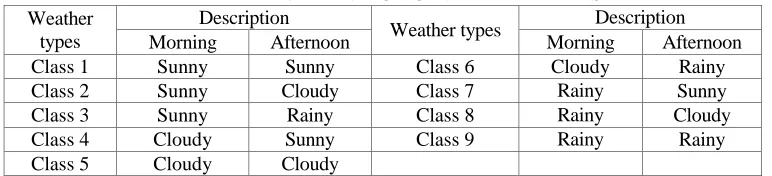
TABLE I. DEFINITION OF WEATHER TYPES. Weather
types
Description
[image:6.612.106.492.63.151.2]Weather types Description Morning Afternoon Morning Afternoon Class 1 Sunny Sunny Class 6 Cloudy Rainy Class 2 Sunny Cloudy Class 7 Rainy Sunny Class 3 Sunny Rainy Class 8 Rainy Cloudy Class 4 Cloudy Sunny Class 9 Rainy Rainy Class 5 Cloudy Cloudy
TABLE II. THE DISTRIBUTION OF NINE WEATHER TYPES IN TRAINING DATASET AND TESTING DATASET.
Training dataset Testing dataset Samples Ratio Samples Ratio Class1 225 30.82% 110 30.14% Class2 91 12.47% 45 12.33% Class3 38 5.21% 18 4.93% Class4 39 5.34% 25 6.85% Class5 75 10.27% 35 9.59% Class6 19 2.60% 10 2.74% Class7 19 2.60% 11 3.01% Class8 25 3.42% 12 3.29% Class9 199 27.26% 99 27.12%
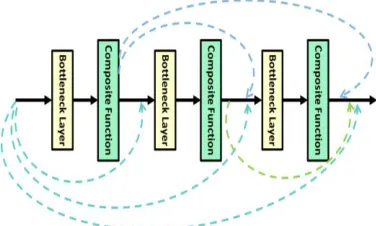
After data preprocessing and adding class labels corresponding to 9 weather types, the normalized solar irradiance data are fed into Triple-GAN. The input irradiance data is one-dimensional grid data at fixed time intervals. Meanwhile, irradiance is affected by some meteorological factors such as wind speed, wind direction, and cloud cover. In order to capture such complex factors, we modify the Triple-GAN with the following 4 significant improvements:(1)2D transposed convolution is utilized in Generator to generate irradiance data.(2) DenseNet[10] is adopted in both classifier and discriminator to extract local features. (3) With respect to generator, the condition variable y can either be concatenated with the random noise z in the first layer or be added in the subsequent layers as additional channels. In our study, we adopt the later one.(4) As suggested by Radford et al.[7], we also add Batch Normalization (BN) to both the discriminator and the generator in Triple-GAN model to prevent generator from collapsing to a single point. However, adding BN to all layers causes model instabilities. Therefore, we also avoid using BN in the last output layer of generator and the first input layer of discriminator as they suggest.
Figure 2. DenseNet Workflow.
The proposed Triple GAN architecture is trained on NOAA dataset from scratch in an end-to-end manner. Our model was implemented by TensorFlow and scikit-learn. It was run on NVIDIA GeForce GTX 1080 GPU. The initial learning rate is 0.01, and it will decrease to 0.001 at 75 epochs and 0.0001 at 110 epochs. A weight decay of 0.0001 has been applied for all the weights, and a Nesterov momentum[11] of 0.9 without dampening has been used in our model. The validation accuracy will be evaluated once for each training epoch. In addition, we set the batch size as 7, and the number of epochs as 150. The loss is not triggered until the number of epoches reach a threshold that the generator start to produce meaningful data. Here the threshold is set as 120, and P is set as 0.05.
TABLEIII.THEDISTRIBUTIONOFNINEWEATHERTYPESINTRAININGDATASET ANDTESTINGDATASET.
GAN/CNN2D WGANGP/CNN2D Triple-GAN/CNN2D PA UA PA UA PA UA Class1 1.000 0.961 1.000 0.867 1.000 0.990 Class2 0.550 0.941 0.800 0.815 0.875 0.946 Class3 0.462 0.909 0.769 0.545 0.846 0.917 Class4 0.211 0.727 0.421 0.571 0.632 0.857 Class5 0.556 0.615 0.593 0.441 0.667 0.692 Class6 0.200 0.429 0.600 0.500 0.800 0.667 Class7 0.200 0.667 0.400 0.250 0.600 0.500 Class8 0.714 0.750 0.429 0.714 0.571 1.000 Class9 0.846 0.753 0.938 0.753 0.954 0.838
OA 0.753 0.842 0.858
[image:7.612.114.483.401.555.2]weather type, thus the bias caused by imbalance data distribution is alleviated, and the classification results are boosted.
CONCLUSION AND FUTURE WORK
In this paper,we exploit the Triple-GAN for more accurate weather classification to further improve the performance of PV power forecasting. DenseNet architecture is utilized in classifier and discriminator of Triple-GAN to mitigate the gradient vanish problem. Extensive experimental evaluations on the NOAA database validate the effectiveness on significant classification performance improvement in the context of imbalanced data with respect to 9 weather types. The results also indicate that Triple-GAN can improve diversity of data to alleviate bias caused by imbalance data distribution.
ACKNOWLEDGMENT
This work was supported by the Overseas Study Program of Guangzhou Elite Project (GEP) in China.
Corresponding author: Wen Yu
REFERENCES
1. L. Y, B. Y, and H. G, “Deep learning,” Nature, no. 521, pp. 436–444, 2015.
2. I. Goodfellow, J. Pouget-Abadie, M. Mirza, B. Xu, D. Warde-Farley, S. Ozair, A. Courville, and Y. Bengio, “Generative adversarial nets,” in Advances in Neural Information Processing Systems 27, Z. Ghahramani, M. Welling, C. Cortes, N. D. Lawrence, and K. Q. Weinberger, Eds. Curran Associates, Inc., 2014, pp. 2672–2680.
3. Douzas G, Bacao F., “Effective data generation for imbalanced learning using conditional generative adversarial networks,” Expert Systems with Applications, 2018, pp. 464-471. 4. Chawla NV, Bowyer KW, Hall LO., “SMOTE: synthetic minority over-sampling technique,”
Journal of Artificial Intelligence Research, 2002, pp. 321–357.
5. C. LI, T. Xu, J. Zhu, and B. Zhang, “Triple generative adversarial nets,” in Advances in Neural Information Processing Systems 30, 2017, pp. 4088–4098.
6. T. Salimans, I. Goodfellow, W. Zaremba, V. Cheung, A. Radford, X. Chen, and X. Chen, “Improved techniques for training GANs,” in Advances in Neural Information Processing Systems 29, D. D. Lee, M. Sugiyama, U. V. Luxburg, I. Guyon, and R. Garnett, Eds. Curran Associates, Inc., 2016, pp. 2234–2242.
7. Alec Radford, Luke Metz, and Soumith Chintala. Unsupervised representation learning with deep convolutional generative adversarial networks. arXiv preprint arXiv:1511.06434, 2015. 8. Diederik P Kingma, Shakir Mohamed, Danilo Jimenez Rezende, and Max Welling.
Semisupervised learning with deep generative models. In NIPS, 2014.
9. Augustus Odena. Semi-supervised learning with generative adversarial networks. arXiv preprint arXiv:1606.01583, 2016.
10. G. Huang, Z. Liu, L. van der Maaten, and K. Q. Weinberger, “Densely connected convolutional networks,” in Proceedings of the IEEE Conference on Computer Vision and Pattern Recognition, 2017.