ISSN: 1992-8645 www.jatit.org E-ISSN: 1817-3195
EFFECT ANALYSIS OF INFORMATIZATION LEVEL TO
GREEN PROCESS INNOVATION IN MANUFACTURING
ENTERPRISES
1, 2KEXIN BI, 1QUANZHEN BAO, 1DI FENG
1
School of Economics & Management, Harbin Engineering University, Harbin150001, Heilongjiang, China
2School of Management, Harbin University of Science and Technology, Harbin150080, Heilongjiang,
China
ABSTRACT
The relationship between information technology and innovation has been well studied. Based on extant literature, and the data from 264 manufacturing enterprises in China, we proposed the corresponding hypothesis of informatization level to green process innovation, and tested the hypotheses by Structural Equation Model (SEM) together with software AMOS7.0. The results of the study revealed that: the informatization level had positive correlation with green resource selection process innovation, green machining process innovation, green packaging process innovation, but did not effect the green recycling process innovation. This paper presents theoretical and empirical evidence of the impact of informatization level to green process innovation, and has interesting implications for operation management research and practices. These results may contribute to better decision-making towards the implementing information technology practices.
Keywords: Manufacturing Enterprises, Informatization Level, Green Process Innovation
1. INTRODUCTION
As the rapid development of information technology, informatization has become an important part of manufacture enterprises. Informatization broaden and enrich the enterprise resources[1, 2], and CIMS (Computer Integrated Manufacturing Systems), AM (Agile Manufacturing), FMS (Flexible Manufacture System), CAM (Computer Aided Manufacturing), CAE (Computer Aided Engineering), PDM (Product Data Management) and other such kinds of advanced manufacturing systems and technology had been widely used in manufacturing enterprises. And green process innovation, as the significant means to low carbon economy, has become the focus of manufacturing enterprises. At the same time, the impact of informatization level to green process innovation also becomes the hot-spot issues.
In these years, information technology become widely used in green manufacturing [3], especially in product life cycle assessment and green design, like Simapro LCA, GaBi, Eco-design and other such kinds of software. The informatization level has been well studied. In Motohashi’s comparative study of the information technology and management of Japanese, American and Korean
enterprises, he divided the information organization structure into inside and outside two parts[4]. Jian Fu Zhang and etc. studied the enterprise informatization evaluation model from current status of enterprise informatization, the production management characteristics and the system functional requirements three aspects[5].
Kexin and etc. divided green process innovation into clean production technical innovation and end-of-pipe technical innovation, and selected output, labor and human input as variables[13]. Li Wanhong and etc. in her paper of power resources of process innovation, divided the process innovation into process equipment innovation, process technical innovation and process management innovation[14].
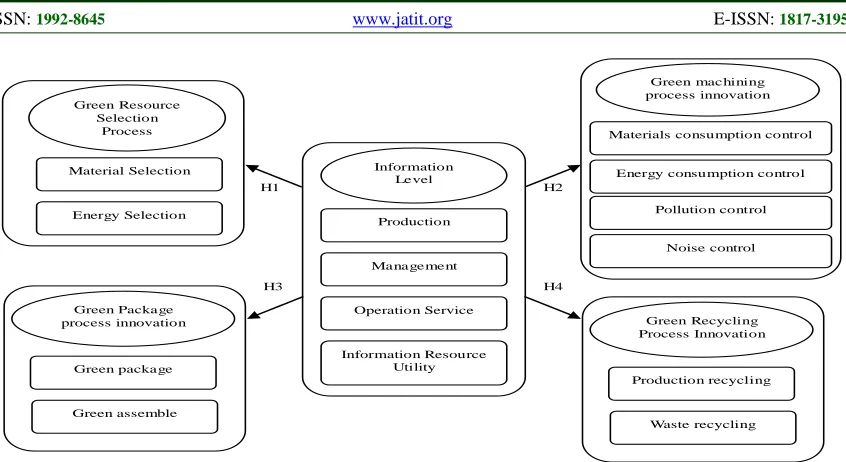
Until now, the study of the impact of informatization level to green process innovation is still blank. In this paper, based on the existing research, we divided the green process innovation into green resource selection process innovation, green machining process innovation, green packaging process innovation and green recycling process innovation four parts. Based on the collecting data, we use Structural Equation Model (SEM) together with software AMOS7.0 to test the four hypotheses, in order to reveal the impact of informatization level to green process innovation in manufacturing enterprises.
2. RESEARCH HYPOTHESES
2.1Informatization Level and Green Resource
Selection Process Innovation
Alves, C., studied the development of procedural guidelines for how ecodesign concepts would be introduced to the selection of material, and pointed out that the importance of the introduction of environmental parameters by information technology since the beginning of the project[15]. Mohamad T. Araji pointed out that using sustainable soft materials during the manufacturing process would result in environment benefits, particularly with the production, specification and usage of proper materials[16]. Therefore, based on the above theoretical analysis, this paper puts forward:
Hypothesis H1: informatization level (IL) has a positive role in promoting green resource process innovation (GRPI).
2.2 Informatization Level and Green Machining Process Innovation
Green machining process innovation is the core parts of green process innovation. Many scholars believe developing new machining strategies able to support environmental protection[17]. Information technology, such as lean production, agile manufacturing, virtual manufacturing and digital manufacturing, has been widely used in the manufacturing process. In this paper, based on the above principles of green process innovation definition, we divide green machining process
innovation into materials consumption control, energy consumption control, pollution control and noise control four parts, and study the influence from informatization level. Therefore, based on the above theoretical analysis, this paper puts forward:
Hypothesis H2: informatization level (IL) has a positive role in promoting green resource process innovation (GRPI).
2.3Informatization Level and Green Packaging
Process Innovation
Jasim Ahmed presents a review on polylactide with focus on its chemistry, synthesis, properties, and applications, and discussed its green feature for packaging[18]. Zheng Junli studied the low-carbon packaging, and showed two ways that environmental packaging plays a catalytic role of low-carbon logistics[19]. In this paper, we classify green packaging process innovation into green packaging process innovation and green assemble process innovation two parts. Therefore, based on the above theoretical analysis, this paper puts forward:
Hypothesis H3: informatization level (IL) has a positive role in promoting green packaging process innovation (GPPI).
2.4 Informatization Level and Green Recycling Process Innovation
Shams Rahman proposed a framework for end-of-life(EOL) computer recycling operations, and identified critical factors for implementing EOL computer recycling operations and investigated the causal relationship among the factors influencing computer recycling operation in reverse supply chains[20]. In this paper, we divide green recycling process innovation into production recycling and waste recycling two parts. Therefore, based on the above theoretical analysis, this paper puts forward:
Hypothesis H4: informatization level (IL) has a positive role in promoting green recycling process innovation (GRPI).
ISSN: 1992-8645 www.jatit.org E-ISSN: 1817-3195
Figure 1: Theory Model Of The Impact Of Informatization Level To Green Process Innovation
3. DATA ANALYSIS AND RESEARCH
RESULTS
3.1Questionnaire Design and Data Collection
3.1.1Questionnaire design
The data of this paper were collected by a questionnaire survey. Most of the questions are objective choices, except the personal information and the basic information of the enterprises, all other questions are designed to assessed using a five point Likert scale, ranging from “1=very poor” to “5=very good”. The survey consists of two parts: the first part is the basic information of the survey respondents and the enterprise, and the second part is texting terms of the impact of informatization level to green process innovation.
3.1.2Data collection
We picked out 430 manufacture enterprises as respondents, and got 311 questionnaires back. In order to ensure the validity of the samples, we screened the questionnaires by the following standard: 1. three and above questions had been answered; 2. 15 questions are the same answer. At last, the number of effective questionnaires were 264, 61.4%of the total number of the samples.
3.2Data Analysis
3.2.1Descriptive analysis of the sample structure
The investigating items including the industry the enterprise belongs to, the enterprise nature, and the gender, age, education level and position of the interviewee.
For the personal information, 53.7% were man, and most of the survey respondents are 23-29,
which proportion is 60.3%, and the bachelor degree is dominated by 65.4%. The proportion of junior employee is 30.9%, while the middle is 32.7%. 38.9% of the interviewees had worked for less than two years, while 36.5% for three to five years.
For the enterprises information, the first part is electronic equipment and instruments machinery industry, which proportion is 25.4%, and followed by food, textile clothing, tobacco, beverage and general equipment industry. And private-owned percentage is 62.4%, followed by state-owned and foreign-funded, whose percentage are 23.1% and 10.9% separately. 35.4% of the enterprises had established for five to ten years, and 26.9% for two to four years.
3.3Data Analysis
3.3.1Reliability analysis
In this paper, we use SPSS17.0 to analysis the reliability, in order to text the consistency and stability of the questions. The result of total Cronbach’s α is 0.875(>0.7), which indicates the high reliability. The Cronbach’s α of information level (IL), green resource selection process innovation (GRSPI), green machining process innovation (GMPI), green packaging process innovation (GPPI) and green material recycling process innovation (GMRPI) are 0.793, 0.811, 0.868, 0.706 and 0.801 separately, which means the high consistency and high reliability.
3.3.2Validity analysis
The confirmatory factor analysis in the structure equation model (SEM) is applied to the index system for the verification analysis. After the
H4 H3
H2 H1
Production
Management
Operation Service
Information Resource Utility Information
Level
Green Recycling Process Innovation
Production recycling
Waste recycling Green Resource
Selection Process
Material Selection
Energy Selection
Green Package process innovation
Green package
Green assemble
Green machining process innovation
Materials consumption control
Energy consumption control
Pollution control
calculation of SPSS17.0, the KMO value of the sample data is 0.876(>0.5), and for the Bartlett’s test of sphericity, χ2=1035.670 notable under p< 0.001, thus the factor analysis could be used. At the same time, we got the result of fit test of the whole model asχ2 /d.f =1.908, CFI = 0.964, NFI = 0.942, TLI = 0.951,RMSEA= 0.049, RMR=0.036. Comparing with the normal standard (CFI, NFI, TLI>0.90, RMSEA, RMR< 0.1), the construct validities are verified. The SEM path figure is shown in figure 2.
4. HYPOTHESIS TESTING AND RESULTS
ANALYSIS
4.1Hypothesis Testing
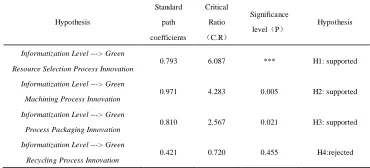
Tab.1 Path Coefficients And Hypothesis Test
Hypothesis Standard path coefficients Critical Ratio (C.R)
Significance level(P) Hypothesis
Informatization Level ---> Green
Resource Selection Process Innovation
0.793 6.087 *** H1: supported
Informatization Level ---> Green
Machining Process Innovation
0.971 4.283 0.005 H2: supported
Informatization Level ---> Green
Process Packaging Innovation
0.810 2.567 0.021 H3: supported
Informatization Level ---> Green
Recycling Process Innovation 0.421 0.720 0.455 H4:rejected
NOTE:*** P<0.05
In this paper, we use the C.R (Critical Ratio) in Amos7.0 to test the significance of the parameters, and determine whether the path hypothesis is supported by the survey data according to the path coefficient of significant conditions. The results are shown in table 1.
According to table 1, the three of the four hypotheses are supported by the survey data, which means the informatization level affects most parts of green process innovation. And the impact to green machining process innovation is the biggest, whose standard path coefficients is 0.97, and the impact to green resource selection process innovation is the smallest, whose standard path coefficients is 0.793. Besides, since the informatization level positively affect these three parts of green process innovation, higher the informatization level betters the green resource selection process innovation, green machining process innovation, green packaging process innovation. H4 is the only hypothesis which is rejected. GRSPI GRPI GMPI IL P e6 1 1 M e7 1 OS e8 1 IRU e9 1 ES e18 1 1 MS e19 1 MCC e10 1 1 ECC e11 1 WR e14 1 1 PR e15 1 e1 1 e2 1 e4 1 e5 1 GPPI e3 1 GA e16 1 1 GP e17 1
PC 1 e12
NC e13
[image:4.612.101.286.299.383.2]1
Figure 2: SEM Path Figure
4.2Results Analysis
In this part, we will deeply study the reasons which lead to the above results. This is practical for the green process innovation in the manufacturing enterprises, but also important for the innovation theory.
4.2.1The impact of informatization level to
green resource selection process innovation According to the hypothesis testing results, informatization level has directly positive effects to green resource selection process innovation. In practical, the manufacturing enterprise could set up material and energy databases. When more and more data are collected, there are more options for green process design, and it is better for the green process innovation. Therefore, the manufacturing enterprises should improve their informatization level in order to improve green process innovation.
4.2.2The impact of informatization level to
green machining process innovation
Among the three supported hypothesis, the standard path coefficient of H2 is the maximum (0.971). It shows the infromatization level has significant impact on green machining process innovation. In fact, the advanced manufacturing technology has been introduced into the production process, as we mentioned at the beginning, CIMS, AM, FMS, CAM, CAE, PDM and other such kind of technology has improved the machining process. They are also suitable for green machining process innovation, while the only difference is they are green-oriented information technology.
4.2.3The impact of informatization level to
green packaging process innovation
ISSN: 1992-8645 www.jatit.org E-ISSN: 1817-3195
automation, also including collecting information. Therefore, the manufacturing enterprises should pay attention to the information utilization in the green packing process, in order to improve the green process innovation.
4.2.4The impact of informatization level to
green recycling process innovation
H4 is the only rejected hypothesis during the four, which means it does not existing direct relationship between informatization level and green recycling process innovation. There are many reasons could lead to this result. It could be caused by the defect of the questionnaire, or the manufacturing enterprises haven’t introduced the information technology into recycling process. It needs further study.
5. CONCLUSION
Based on the literature review, we discussed the impact of informatization level to green process innovation in manufacturing enterprise. We set up a theory model based on Structural Equation Model (SEM), and analyzed the data, which collected by questionnaires, with Amos7.0 software.
The hypothesis test shows the informatization level has directly positive impact to green resource selection process innovation, green machining process innovation and green packaging process innovation, but does not relates to the green recycling process innovation. Therefore, for the manufacturing enterprises, through improving the informatization level of production, management, operation service and information resource utilization, the green process innovation will also be improved.
This paper fills the theory blank of study of the impact of informatization level to green process innovation in manufacturing enterprise, and also shows the measures of promoting green process innovation by improving informatization. However, there would be some study defects, such as the design of the questionnaires, the classification of informatization level and green process innovation, which will be revised in the future study.
A
CKNOWLEDGEMENTSThis work was supported by National Science Foundation of China (71273073, 71073041 and 70873024), Natural Science Foundation for the Youth (71202037), National Ministry of Education Doctoral Fund (200802171067), National Soft Science Research Program (2012GXS4D080), Heilongjiang Provincial Education Department
Humanities and Social Sciences Project (11544054), Heilongjiang Province Philosophy Social Science Research Project (11E111), and Heilongjiang Provincial Natural Science Foundation (G201210) .
REFERENCES:
[1] S. B. Anandhi, “Resource-based perspective on information technology capability and on firm performance: an empirical investigation”, MIS Quarterly, Vol. 24, No. 1, 2000, pp. 169-196. [2] N. Melville, K. Kraemer, V. Gurbaxani,
“Review: information technology and organizational performance: an invegrative model of IT business value”, MIS Quarterly, Vol. 28, No. 2, 2004, pp. 283-322.
[3] Kexin Bi, Di Feng. Power source of process innovation organization evolution in manufacturing enterprises: the impact of informationization, International Review on
Computers and Software, Vol. 7, No. 4, 2012,
pp. 1728-1736.
[4] K. Motohashi, “A Comparative Analysis of Japanese, U.S., and Korean Firms on IT and Management”, RIETI Discussion Paper Series
07-E-047, 2007.
[5] J. F. Zhang, Z. J. Wu, P. F. Feng, D. W. Yu, “Evaluation systems and methods of enterprise informatization and its application”, Expert Systems with Applications, Vol. 38, No. 7, 2011. pp. 8938-8948.
[6] M. Frondel, J. Horbach, and K. Rennings, “End-of-pipe or cleaner production? An empirical comparison of environmental innovation decisions across OECD countries”,
Business Strategy and the Environment, Vol. 8, No. 16, 2007, pp. 571-584.
[7] Frondel, M., Horbach, J., Rennings, K.,, “What triggers environmental management and innovation? Empirical evidence for Germany”,
Ecological Economics, 2008.
[8] M. Wagner, “On the relationship between environmental management, environmental innovation and patenting: evidence from German manufacturing firms”, Research Policy, Vol. 36, No. 10, 2007, pp. 1587-1602.
[9] M. Wagner, “Empirical influence of environment al management on innovation: evidence from Europe”, Ecological Economics, Vol. 66, No. 2-3, 2008, pp. 392-402.
Data Sources”, University of Applied Sciences Anhalt, Vol. 37, No. 1, 2008, pp. 163-173. [11] A. Ziegler, J. S. Nogareda, “Environmental
management systems and technological environmental innovations: Exploring the causal relationship”, Research Policy, Vol. 38, No. 5, 2009, pp. 885-893.
[12] A. Ziegler, K. Rennings, “Determinants of environmental innovations in Germany: do organizational measures matter? A discrete choice analysis at the firm level”, Discussion
Paper 04-30. 2004: ZEW, Mannheim.
[13] B. Kexin, Y. Chaojun, H, Ping, “Research on the Impact of FDI on the Green Process Innovation of Chinese Manufacturing Industries: An Empirical Analysis Based on the Panel Data”, China Soft Science, No. 9, 2011, pp. 172-180.
[14] L. Wanhong, B. Kexin, C. Xia, “The process innovation power sources in manufacturing enterprises based on IT driver”, Science
Research Management, No. 12, 2011, pp. 17-24.
[15] C. Alves, P. M. C. Ferrao, M. Freitas, A. J. Silva, S. M. Luz, “Sustainable design procedure: The role of composite materials to combine mechanical and environmental features for agricultural machines”, Materials and Design, Vol. 30, No.10, 2009, pp. 4060-4068. [16] M. T. Araji and S. A. Shakour, “Realizing the
environmental impact of soft materials: Criteria for utilization and design specification”,
Materials and Design, Vol. 43, 2013, pp. 560-571.
[17] O. Avram, I. Stroud, and P. Xirouchakis, “A multi-criteria decision method for sustainability assessment of the use phase of machine tool systems”, The International Journal of
Advanced Manufacturing Technology, Vol.53,
No. 5-8, 2011, pp. 811-828.
[18] J. Ahmed, S. K. Varshney, “Polylactides-chemistry, properties and green packaging technology: a review”, International Journal of Food Properties, Vol.14, No. 1, 2011, pp. 37-58.
[19] Li, Z., “Influence of the Environmental Packaging on Low-Carbon Logistics”, Applied Mechanics and Materials, Vol.200, 2012, pp. 42-47.
[20] S. Rahman and N. Subramanian, “Factors for implementing end-of-life computer recycling operations in reverse supply chains”,