DESIGNING A MULTIPURPOSE EDR201A05 BASED
HIGHLY ELECTRICAL ENERGY EFFICIENT AUTOMATIC
IRRIGATOR SYSTEM PROVIDING CONTINUOUS CROP
NOURISHING AND OPTIMAL UTILIZATION OF WATER
RESOURCES
1
P. MICHAEL PREETAM RAJ, 2HARI KISHORE KAKARLA, 3RAKESH TIRUPATHI,
4
P.SALEEM AKRAM, 5T.ANJI REDDY
1Assistant Professor, Department of ECE, KL University, Vijayawada
2Associate Professor, Department of ECE, KL University, Vijayawada
3,4,5Assistant Professor, Department of ECE, KL University, Vijayawada
E-mail: [email protected], [email protected], [email protected], 4
ABSTRACT
Automatic water pumping system is extremely required for effective usage of water resources in various areas such as irrigation for crops. In this paper, an Automatic Irrigator (AI) system which can save water wastage by controlled water pumping thus provides very high energy efficiency is presented. The system has its ability to automatically control the turning on and off of the motor, based on the water level, thus maintaining a controlled water level. The stunning feature of this system can be to provide solutions for the varying water requirements of the crops at different stages during the growth process by considering a micro-controller based approach to automatically maintain the varying levels of waters as per requirements. Also several other applications of this proposed system exists such as water level control in water tanks, maintaining ground water level, etc., thus usable for multiple applications, by making slight modifications to the system. The proposed system based on EDR201A05 makes use of only a single 5V DC supply to control, based on the conductive property of water, a motor which can pump water. The proposed system is also extremely attractive because of its simplicity, controllability, and low cost. This system can also automatically sends the pumping motors into idle state during rainy days saving power and water.
Keywords: AI, Controlled water pumping, EDR201A05, Automatic water pumping system, Data
Acquisition device myDAQ, LabVIEW
1. INTRODUCTION
It is a well-known fact that all crops require water to grow and produce yields. Water requirements of crops are different at different stages of their growth. If that varying requirement is strictly met, optimal irrigation can be achieved. A graph indicating the water (i.e. water level) requirements for a tomato crop, at various stages during its growth period, is shown in Figure 5. Our proposed system is extremely essential mechanism for automatic irrigation as it provides only the accurate water requirement for the crop. This saves electrical, water resources and human monitoring at the best possible level. Automatic irrigators are
Journal of Theoretical and Applied Information Technology 20th June 2015. Vol.76. No.2
© 2005 - 2015 JATIT & LLS. All rights reserved.
ISSN: 1992-8645 www.jatit.org E-ISSN: 1817-3195
crops and its requirements. A new power system
using renewable energy which is suitable for small islands is proposed in [4] which can be used as improvements in terms of energy and control. A description of a hybrid system with detailed simulation results which supports its feasibility is given in [5], which has the drawback of only the maximum power considerations. Impact of prices of electricity on energy and groundwater demand management is shown in [6], which gives the importance of water and electrical resources. The farmers being quite rational in their decisions given the problematic context of making choices is presented in [7], exposing the requirements of the farmers. Principal sources of electrical energy being exploited are shown in [8], gives the estimation of the amount of electrical energy that can be generated and thus indicates the necessity of accurate power consumption. Our system calculates the estimated electrical energy and water required by a crop during its entire growth period. Electricity for irrigation pump-sets and its importance is highlighted in [9], giving the necessity for accurate and efficient electricity usage. It is found that from sustainability point of view, the smallest net size will have the most competitive size for farm fields, as for knowledge-based enterprises is concerned[10], which can be considered as one of the parameter of requirement that a crop has. A microcontroller based automatic irrigation system model of variable rate is presented in [11], to which our system additionally includes crop safety and the corresponding automatic motor control. A microcontroller-based water quantity controller algorithm was proposed considering threshold values of soil moisture and temperature in [12], where electrical efficiency is not given priority. Graph for rice crop water requirements at various stages is shown in Figure 7. [13].
In this paper, a multi-purpose, automatic Irrigator (AI) system is presented. The Irrigation controller device gathers the data of the level of water required and uses it to control the switching state of the motor whenever there is a sudden change in water level above or below a pre-determined value. The information of level of the water to be maintained depends upon the type of crops grown in the area where this proposed system is to be implemented. The entire operation of change of switching happens automatically and within less than a second and thus nearly ideal irrigation is maintained. This proposed system can be
implemented in various models such as using an overhead tank, direct pumping from bore wells, ground water level controller, continuous nourishing of flower plants implemented in pots, etc. This proposed system is proved to eliminate the need for human intervention saving labor, time and water wastage. There is no need of using any sophisticated devices such as microcontrollers, interfacing, etc. to act as the brain of the system and thus the system is proved to be simple and extremely cost efficient as only the conductive behavioral property of water is used as the controlling master-mind. A brief introduction of details of this proposed system oriented in highlighting its merits is given in Section 2. In Section 3 a sample application of this system which proves its efficiency is provided. The practical applications of the overall system are for saving water, especially during rainy days, providing best usage of water resources, saving manual monitoring, interferences and efforts. Also it can be considered for a wide range of applications where proper water resources utilization is of highest priority and frequent water supply monitoring is not possible. Conclusion is presented in Section 4.
2. PROBLEM FORMULATION
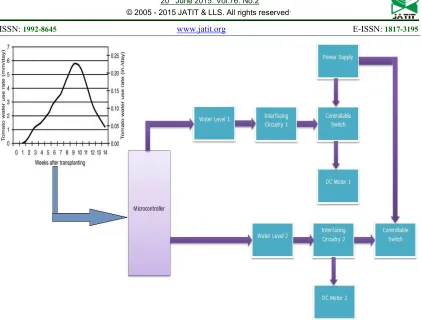
Figure 1: Block diagram of the Automatic Irrigator System.
.
3. PROBLEM SOLUTIONS
My proposed system meets all the above mentioned challenges. This proposed system also provides continuous nourishing for crops and saves water wastage by controlling the water pumping so that it is done only under essential circumstances, simultaneously saving the power consumption for pumping water as unnecessary pumping is avoided and thus it is proved that this system provides very high efficiency. The current existing system does not meet the complete modulating requirements of crop simultaneously saving several mentioned resources.
If the proposed system in this paper was not used, and irrigation was to be done then there would be wastage of electricity and water resources at a very high amount. As my proposed system doesn’t include complicated controlling circuitry, it is proved that the overall cost of the implementation of this system is very low. The fact that only a small number of components are used in this system proves the simplicity of this system. The main challenge of an AI is that it should support the
components used shown in Figure 2 all respond within seconds it is also proved that this system operates at real time. This proposed system is easily compatible for any irrigation system and conditions. There are several methods of controlled water pumping in Automatic Irrigator systems. One method is maintaining a fixed level of water by using a mechanism of controlling a single motor which pumps water (into the field) when water level is low and stops once the specified level is reached. This type of Automatic Irrigation is suitable for the cases where there is no or sufficiently low rainfall. A smart modification to the previously described system is used to save the crops during rainy days.
Journal of Theoretical and Applied Information Technology 20th June 2015. Vol.76. No.2
© 2005 - 2015 JATIT & LLS. All rights reserved.
ISSN: 1992-8645 www.jatit.org E-ISSN: 1817-3195
Irrigator system not sensing and sensing the water
levels respectively, which can be used to control the ON condition of the motor.
Table 1: Conditions of water level and Corresponding Motor Running Status
S.No Water
level Motor Status
Approxi--mate Time
1. High
ON (to pump out, for example, water during
floods)
0.18 S
2. Low OFF 0.7 S
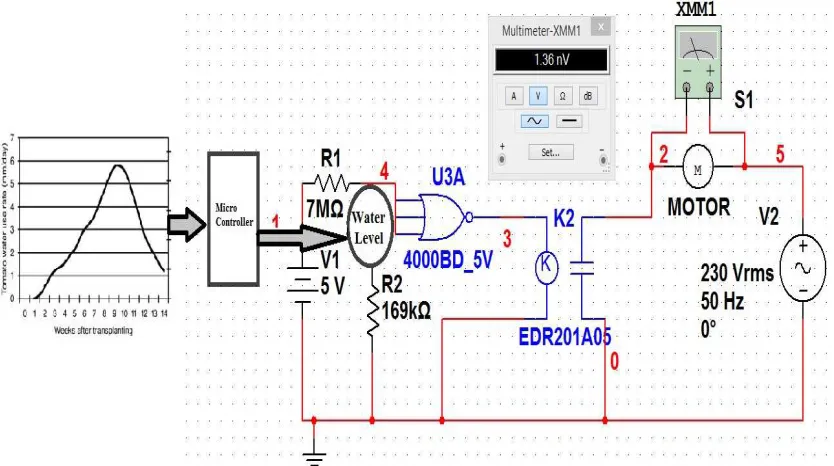
[image:4.595.88.505.340.573.2]The 169k resistor shown is the resistance of water. The 1.382nV shown in Figure 2 indicates that the motor is in off condition as the power supply given to it is nearly 0V, when the water level is low (169k unconnected), i.e., below a predetermined level. The 229.924V shown in Figure 3 indicates that the motor is in on condition as the power supply given to it is nearly 230V, when the water level is high (169k connected), i.e., above a predetermined level. This is shown in Table 1. The 169k resistance of water can be obtained by using a multi-meter as shown in Figure 4. Different values can be obtained based on different conditions.
Figure 3: Snap shot of simulation result corresponding to high water level.
Figure 4: Measurement of resistance of water.
[image:5.595.307.507.416.605.2]The special arrangement made, as described in Figure 2 and Figure 3 can be used to pump out water from the farming fields during heavy rains, so as to save the crops. The varying water level requirements for tomato crop are shown in Figure 5[14].
Figure 5: Varying water level requirements for Tomato.
[image:5.595.88.291.429.617.2]Journal of Theoretical and Applied Information Technology 20th June 2015. Vol.76. No.2
© 2005 - 2015 JATIT & LLS. All rights reserved.
[image:6.595.88.305.106.293.2]ISSN: 1992-8645 www.jatit.org E-ISSN: 1817-3195
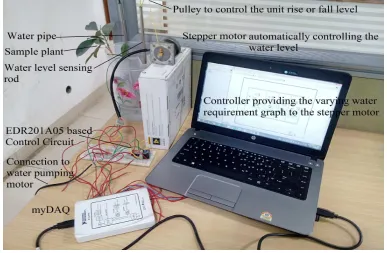
Figure 6: Sample result of the implemented system.
4. CONCLUSION
In this work an automatic irrigator system, which is proved to primarily provide safeties for crops during floods is provided. The main stunning feature of this system is that it provided accurate and required modulating water supply saving every resource to the best effect. Another stunning feature of this system is that it automatically sends the motor into ON state during floods to pump out water to keep the crops safe. Another fantastic feature of this system is that it also automatically turns the motors OFF, when the rains are providing sufficient water for the crops and, even when there are no rains. The third magnificent feature of this system is that it can be modified based on applications, for example to pump water during drought conditions and complete automation and control can be obtained if two motors are used. This is proved to provide a tremendous amount of savings in electrical energy, water resources and man power, which are having very high values at all times. The system also gives its users a wide range of options, in terms of the maintenance of crops. This or a certain modification of this system can be used to solve an infinite number of irrigation problems based on applications. Thus there is always this cool advantage of not having an additional necessity of any maintenance costs relating irrigation. As per the aspect of simplicity of this system, use of bulky control systems and power supply requirement thereof is avoided as the system is smartly balanced with simple elements and is therefore least costly. Thus it is proved that this system provides the best possible improvements in terms of costs, safety, and simplicity.
5. IMPLIMENTATION DETAILS
In the implemented system shown in Figure 8, a Laptop having LabVIEW, with myDAQ connected, is used as the master controller to provide the exact amount of water required by the crop, based on the data provided by the graph shown in Figure 5. Stepper motor is used to provide and maintain the desired level of water by simply modulating the level of water sensing rod via a pulley, by its rotations. myDAQ is used to send the data required to control the rotations of stepper motor. Thus water level modulation, where the message signal is the graph in Figure 5, is achieved. When this modulating water level is reached, that signal is given to the EDR201A05 which controls the ON state of the water supplying motor supplying the water. A small sample plant is used for prototyping this work.
6. FUTURE SCOPE
[image:7.595.106.493.467.720.2]
Journal of Theoretical and Applied Information Technology 20th June 2015. Vol.76. No.2
© 2005 - 2015 JATIT & LLS. All rights reserved.
ISSN: 1992-8645 www.jatit.org E-ISSN: 1817-3195
REFRENCES:
[1] Rossi, C., Erten, E., Paddy-“Rice Monitoring Using TanDEM-X”, IEEE Transactions on Geoscience and Remote Sensing, Vol.53, No.2, 2014, pp. 900-910.
[2] Hmidet, A., Hasnaoui, O., Dhifaoui, R., “Digital control of MPPT structures for water pumping systems”, 7th IET International Conference on Power Electronics, Machines and Drives, 2014, pp. 1-7.
[3] Huang, J., Wang, H., Dai, Q., Han, D., “Analysis of NDVI Data for Crop Identification and Yield Estimation”, IEEE Journal of Selected Topics in Applied Earth Observations and Remote Sensing, Vol.7, No.11, 2014. [4] Senjyu,T., Nakaji, T., Uezato, K., Funabashi,
T., “A Hybrid Power System Using Alternative Energy Facilities in Isolated Island”, IEEE Transactions on Energy Conversion, Vol.20, No.2, 2005.
[5] Ahmed, N. A., Miyatake, M., “A Stand-Alone Hybrid Generation System Combining Solar Photovoltaic and Wind Turbine with Simple Maximum Power Point Tracking Control”, In Conf Rec. IEEE IPEMC, 2006.
[6] Dinesh Kumar. M, “Impact of electricity prices and volumetric water allocation on energy and groundwater demand management”, Analysis from western India Energy Policy, Vol. 33, 2005, pp. 39-51.
[7] Dubash, N.K., “The Electricity-Groundwater Conundrum: Case for a Political Solution to a Political Problem”, Economic and Political Weekly, Vol.42, No.52, 2007, pp. 45-55. [8] Boyle, G. “Renewable: power for a sustainable
future”, In Oxford, 2004.
[9] Howes, S., Murgai, R., Karnataka: “Incidence of Agricultural Power Subsidies” An Estimate, Economic and Political Weekly, Vol. 38, 2003, pp. 1533-1535.
[10] Gerard D’Souza, John Ikerd, “Small Farms and Sustainable Development: Is Small More Sustainable?”, Journal of Agricultural and Applied Economics, Vol. 28, 1996, pp. 73-83. [11] Uddin, J., Reza, S.M.T., Newaz, Q., Uddin, J.,
“Automated irrigation system using solar power”, 7th International Conference on Electrical & Computer Engineering (ICECE),
2012, pp. 228-231.
[12] Gutierrez, J., Biologicas del Noroeste, Villa-Medina, J.F., Nieto-Garibay, A., Porta-Gandara,
M.A., “Automated Irrigation System Using a Wireless Sensor Network and GPRS Module”,
IEEE Transactions on Instrumentation and Measurement, Vol.63, No.1, 2013, pp. 166-176. [13] W. Hundertmark ,T. Facon “Options for
effective rice water management” - Sustainable rice production for food security Proceedings of the 20th Session of the International Rice Commission, Bangkok, Thailand, 23-26 July 2002.
[14]http://www.omafra.gov.on.ca/CropOp/en/genera