SCHEDULING TECHNIQUES IN ON-DEMAND GRID AS A
SERVICE CLOUD: A REVIEW
1SHAFI’I MUHAMMAD ABDULHAMID, 2MUHAMMAD SHAFIE ABD LATIFF AND 3MOHAMMED BAKRI BASHIR
13PhD Scholar, Faculty of Computing, Universiti Teknologi Malaysia, 81310 Skudai, Johor, Malaysia. 2Assoc Prof, Faculty of Computing, Universiti Teknologi Malaysia, 81310 Skudai, Johor, Malaysia. 1Lecturer, Department of Cyber Security Science, Federal University of Technology Minna, Nigeria.
E-Mail: [email protected], [email protected], [email protected] and
ABSTRACT
The Infrastructure as a service (IaaS) Cloud is a customer oriented cloud environment that offers user with computing infrastructures on-demand to be used based on the Cloud computing paradigm of pay-per-use. When the IaaS is now utilized to build a traditional Grid network within the cloud environment, it is now called an on-demand Grid as a service (GaaS) Cloud. In the on-demand GaaS Cloud, a user may use hundred of thousand of Grid nodes to implement a job, therefore manual scheduling is not a feasible scheduling solution. The main objective of this review is to study the various concepts and scheduling algorithms used for the on-demand GaaS Cloud in relation to the scheduling parameters used by existing researches. We also survey the Cloud infrastructures, Grid middlewares and the issues addressed by different researchers in the past within this domain of research. Our contribution will thus be of assistance in understanding the key scheduling algorithms and parameters for potential future enhancements in this evolving area of research.
Keywords: Cloud Computing, GaaS Cloud, On-Demand Grid, On-Demand GaaS Cloud, IaaS Cloud, Virtualization
1. INTRODUCTION
These days, Cloud Computing is broadly utilized to deliver services over the cyberspace for both technical and economical purposes. The quantity of Cloud-based services is constantly increasing robustly in the last few years, and therefore improved the complexity of the infrastructures behind these services. In order to appropriately control and supervise such multifaceted infrastructures effective and efficient monitoring and scheduling is continuously needed [1]. The technology is rapidly emerging and moving towards the direction of becoming the de facto standard of internet computing, storage and accommodating infrastructures, platforms and software both in the industries and the academia. The huge scalability prospects offered by cloud infrastructures can be easily harnessed not only for services and applications hosting but also as an on-demand grid computing resource.
On-demand computing is a paradigm whereby computing resources are made available to customers as at when needed. It is an easy
solution for organisations that require a very large number of computing resources, in other to reduce the total time to solution, and may not be able to afford the costs of hardware. Specifically, these hardware costs increases when the required computing resources are provided by specialized systems, like the High Performance Computing resources used for Grid and Cloud computing.
11 on-demand, it implies that the Cloud service is now called Grid as a Service (GaaS) Cloud.
VIRTUAL INFRASTRUCTURE
VMM VMM VMM
«uses»
VM VM VM VM VM VM VM VM VM
Grid Middleware
File Transfer Protocol
Resource Management
Security Information Discovery and Monitoring
Data Management Scheduling Module
Users Interaction Interface
[image:2.595.91.285.160.434.2]Host Host Host
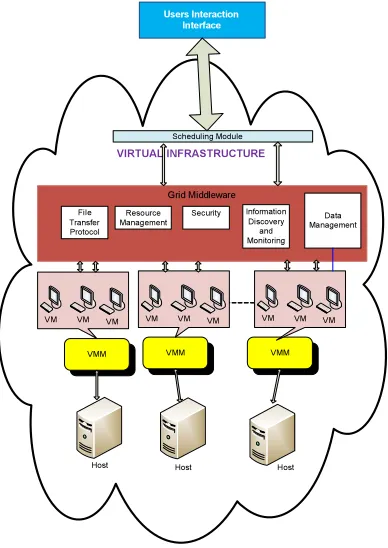
Fig. 1: Virtual Infrastructural Cloud For On-Demand Gaaas
Fig. 1 above shows a typical architecture of the on-demand GaaS Cloud. The virtual machine manager (VMM) otherwise known as the hypervisor is hosted within some high capacity physical storage systems. The VMM is used to host and monitor the Cloud virtual machine (VM) nodes built within the Cloud computing environment. To build the GaaS, the VM nodes are now used to configure a typical Grid computing network using a Grid middleware. What makes a Grid computing environment is just the Grid middleware and without it, what you have is just a simple computer network. Therefore, ones the Grid middleware (e.g. Globus, DIET-Solve, Condor, Askalon, etc) is built with the VM nodes, this platform can be issued to Grid user on-demand with the help of the pay per use Cloud computing paradigm. Even though, most Grid middlewares have in-built schedulers, it has been observed that it did not perform well in this present setup because of some new conditions that has been introduced. This is attributed to the reason why many researchers surveyed in this paper proposed new scheduling techniques for the on-demand Grid as a service Cloud.
In conventional scheduling, a middle control decision maker is always there ready with all the appropriate information about the issues, therefore requested to obtain a solution that completes all the required side constraints, optimizing an overall performance condition. The setup of the on-demand GaaS Cloud environment is such that conditional decisions are taken by a number of autonomous components and the components may be aiming at optimizing their own objectives rather than the performance of the structure in total [2]. Entities in the on-demand GaaS Cloud setup are self-interested and always ready to distribute their resources. The on-demand GaaS Cloud environment calls for models and algorithms that take the premeditated activities of individual entities into account, and concurrently keep track of all the overall performance of the structure.
The main aim of this survey is to focus on the various concepts, tools, parameters and scheduling techniques used for on-demand Grid as a service Cloud. Section II discusses the related works. Section III discusses the existing scheduling algorithms used in on-demand GaaS Cloud. The section IV presents a detailed discussion of the scheduling techniques tabulated earlier. While the section V tabulated the scheduling metric parameters used in researches presented in this review. The section VI concludes the paper with a summary of our contributions and future works.
2. RELATED WORKS
Cloud environment but overlooked scheduling as an important Cloud issue are [4-9].
One of the important scheduling surveys in the Cloud computing domain was done by Vijindra and Shenai [10]. The research surveyed the comprehensive method of several types of scheduling techniques in Cloud computing environment, which also includes the workflow scheduling as well as the Grid scheduling. The paper also gives a detailed idea about Grid, Cloud and workflow scheduling. Bala and Chana [11] also reviewed several types of workflow scheduling techniques and tabulated a range of metric parameters along with tools, scheduling factors, scheduling algorithms, method and environment. And then shows that, existing workflow scheduling models does not take in to account parameters like reliability and availability.
Mandloi and Gupta [12] reviewed many proposed optimization algorithms for process scheduling in grid computing such as ant colony optimization algorithm, genetic algorithm and fuzzy logic. They showed that these optimization techniques decreased the amount of failure and execution time of the grid system. The research paper discusses many different methods of grid computing related to resource allocation and task scheduling based on meta-heuristic function. Pandey and Buyya [13] surveyed a number of scheduling workflow application based on multi-source parallel data retrieval in distributed systems. The paper proposed to leverage the presence of replicated data sources, retrieve data in parallel from multiple sites and therefore attained time-efficient schedules.They came up with two multi-source data-retrieval-based scheduling heuristic that allocates mutually dependent jobs to compute resources based on both data retrieval time and
task-computation time. They also showed that the heuristic generates time-efficient schedules that are more enhanced than the existing heuristic-based techniques for scheduling application workflows. Other researches that surveyed different scheduling algorithms within the Grid environment or Cloud environment or both includes [14-19]. It is important to point out that these scheduling algorithms have not been tested in the Grid as a service Cloud environment as some specific parameters are peculiar to such environment.
Barone, et al. [20] presented a research work titled “GaaS: Customized Grids in the Clouds” which attempt to eliminate the paradigm mismatch between Cloud and Grid Computing environments, enabling the utilization of Cloud-provided resources with well-established Grid-like interfaces, circumvent the need for clients to discover new resources access and use models. The projected method was tested by developing a prototype implementation and its integration in a working Grid environment. Even though this research was the first to appropriately use the acronym “GaaS”, but the research work did not consider any scheduling algorithm that will fit into this new approach. Other related researches are to include [2, 21-25] and also those tabulated below.
3.EXISTING SCHEDULING ALGORITHMS USED IN ON-DEMAND GAAS CLOUD
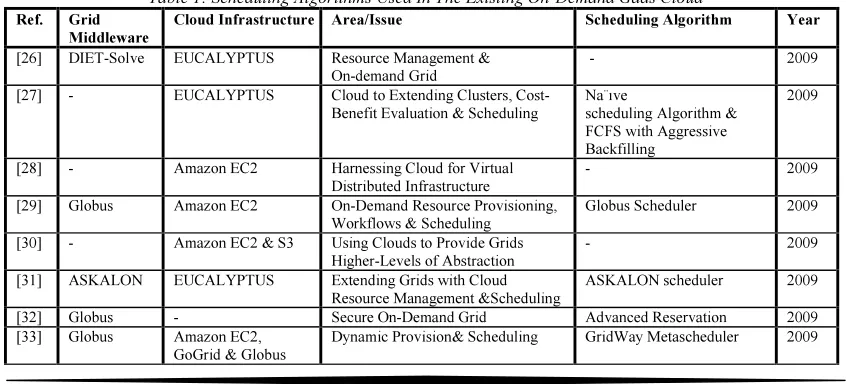
[image:3.595.85.508.570.762.2]Table 1 below presents a survey of scheduling algorithms, Grid middlewares and Cloud infrastructures established in the area of on-demand Grid as a service (GaaS) cloud. A detailed discussion of these systems and the issues addressed by the outlined researches are also discussed from the table.
Table 1: Scheduling Algorithms Used In The Existing On-Demand Gaas Cloud Ref. Grid
Middleware
Cloud Infrastructure Area/Issue Scheduling Algorithm Year
[26] DIET-Solve EUCALYPTUS Resource Management &
On-demand Grid - 2009
[27] - EUCALYPTUS Cloud to Extending Clusters,
Cost-Benefit Evaluation & Scheduling
Na¨ıve
scheduling Algorithm & FCFS with Aggressive Backfilling
2009
[28] - Amazon EC2 Harnessing Cloud for Virtual
Distributed Infrastructure
- 2009
[29] Globus Amazon EC2 On-Demand Resource Provisioning,
Workflows & Scheduling
Globus Scheduler 2009
[30] - Amazon EC2 & S3 Using Clouds to Provide Grids
Higher-Levels of Abstraction
- 2009
[31] ASKALON EUCALYPTUS Extending Grids with Cloud
Resource Management &Scheduling
ASKALON scheduler 2009
[32] Globus - Secure On-Demand Grid Advanced Reservation 2009
[33] Globus Amazon EC2,
13 Nimbus
[34] - Amazon EC2 On-Demand Resource, Pattern
Matching & auto-scaling algorithms - 2010
[35] - Amazon EC2 &
EUCALYPTUS
cost-benefit analysis & Job scheduling ·
Backfilling, Naïve, Shortest queue, Weighted queue& Selective Algorithms
2010
[36] Globus Amazon EC2 On-Demand Grid Resource
Provisioning& Scheduling policies - 2010
[37] Globus & Condor
- Cloud on Grid, Provisioning,
Autonomic leasing & Scheduling
Condor Scheduler & Naive
Greedy Watchdog
Algorithm
2010
[38] Globus - Self-provisioned clouds on the grid,
Scheduling Simple greedy scheduling algorithm 2010
[39] Globus Amazon EC2 On-Demand Grid on Cloud - 2010
[40] GridSAM Amazon EC2 & Eucalyptus
Provide Virtual Distributed Environments &On-Demand Grid
- 2010
[41] - - Scheduling Grid Applications on
Clouds
Task & Virtual Machine Scheduler using DAG
2010
[42] GEMBus Composable Services
Architecture (CSA)
On-Demand Provisioning of Cloud and Grid
- 2011
[43] Condor Amazon EC2 &
Nimbus
HPC, grid & Cloud Computing & Scheduling
Deadline-based &best-effort jobs Scheduling
2011
[44] Globus Nimbus Grid Resource Provisioning &
Scheduling
Meta-scheduling 2011
[45] Condor, Nimrod & Sun Grid Engine
Amazon EC2 &
Google App Engine Grids, Clouds, and Virtualization - 2011
[46] Globus/GRA
M, GumboGrid & Condor
Amazon EC2, Nimbus & Eucalyptus
Application-Level Interoperability Across Grids and Clouds with SAGA
- 2011
[47] Globus Amazon EC2 Architectures & on-demand
provisioning Meta-scheduling 2011
[48] - CICA GRID solution On-Demand cloud - 2012
[49] - Eucalyptus Integrated Provisioning of
Cloud and Grid Resources
Workload and resource management systems (WRMSs)
2012
[50] Condor RESERVOIR project On-demand cloud provisioning - 2012
[51] DIET-Solve Nimbus & Eucalyptus
Clouds to scale grid resources & economic model
- 2012
[52] Condor & Bonjour Grid
Grid5000 On-demand Self-Configurable
Desktop Grid
Condor, Boinc and Xtreweb job schedulers
2012
[53] - Grid5000 On-Demand VM Multi-Deployments
in IaaS Clouds - 2013
[54] Globus Eucalyptus Extending Grid Infrastructure Using
Cloud Computing - 2013
[55] Globus Nimbus Cloud Grid Security and
performance evaluation - 2013
[20] gLite-EMI OpenNebula GaaS Cloud - 2013
[2] Globus - Decentralized Resource Scheduling
in Grid/Cloud Computing
Combinatorial Allocation Problem &Proposed an Adequate Economic-Based Optimization Model &
Winner Determination
Algorithm
2013
Key: - (not specified)
4. DISCUSSION
Researches in this domain of on-demand Grid as a service Cloud started within the year 2009. A number of searches [26-33] tries to address different issues with different nomenclatures within this domain of research. While some of these
scheduling. They also used the Na¨ıve scheduling Algorithm & FCFS with Aggressive Backfilling in solving the resource scheduling problems. The research paper [32] presented a new approach for enabling Grid clients to independently install and use custom software on demand using an image creation station. The Advanced Reservation scheduling algorithm was used for resource scheduling purposes. Some of the researches that defend on the in-built Grid schedulers includes [29, 31, 33] which uses; Globus scheduler, ASKALON scheduler and GridWay Metascheduler respectively. Other papers in this area that addressed other issues but failed tackle resource scheduling problem, either by developing a scheduling algorithm or by stating a scheduler used includes [26, 28, 30].
The year 2010 saw more researches coming out in this domain of research addressing different areas of concern as it can be seen from the Table 1 above. In an attempt to improve their previous work a year before, [35] evaluated the cost benefit of seven (7) scheduling algorithms used by organisations that operates a cluster managed by virtual machine technology and requests to make use of resources from a remote IaaS Cloud provider to decrease the response time of its user requirements. Among other algorithms used in this work are; the Backfilling, Naïve, Shortest queue, weighted queue and Selective scheduling algorithms. The paper [37] presented an autonomic Cloud on the Grid system in addressing provisioning issues and also presented a scheduling strategy in tackling that. The Naive Greedy Watchdog algorithm was used in solving the job scheduling issue that arose from this new setup.
Also [38] presented a self-provisioned clouds on
the grid in a virtual organisation clusters (VOC). A Simple greedy scheduling algorithm was also used in this work. Another very import scheduling research in this domain was [41], that introduced a scheduler for grid applications in clouds that account for not only resource demands, but also software requirements of the applications. It also accounts for network link availability that was generally ignored in the previous works of grid scheduling. The scheduler that was designed in this work was the Task and Virtual Machine Scheduler using Directed Acyclic Graphs (DAG). Other researches that are worth mentioning but failed to address scheduling issues are [34, 36, 39, 40].
From the Table 1 above, in the year 2011 another research titled “
Hybrid computing—
where HPC meets grid and cloud computing
”was carried out [43]. The researchers argued for architecture that will merge the advantages of
HPC, Grid and Cloud computing technologies. And then named the building blocks of this design, Elastic Cluster which they described the model and showed how it can be used to achieve efficient and expected execution of HPC workloads. The deadline-based and best-effort jobs scheduling algorithms were used in the research. The Meta-scheduling strategy was also used in [44, 47] to address issues related to Grid resource provisioning, architectures and on-demand grid provisioning respectively. Other researches that addressed the issue of grid provisioning but failed to consider scheduling are; [42] which presented the on-demand provisioning of Grid in cloud system, [45] that explained the concept of Grid, Cloud and virtualization, and [46] that also explained the application-level interoperability across Grids and Clouds with SAGA.
As it can be seen from the Table 1 above, in 2012 a Eucalyptus was used [49] to demonstrate an architecture that supported the integration of the diverse computing models and infrastructures for the dynamic on-demand provisioning of resources from various providers as an interconnected aggregate, leveraging the service-based architecture. The paper also, proposed a design aimed at endorsing a flexible, modular, workflow-based computing model for e-Science. The workload and resource management systems (WRMSs) algorithm was used in the research. The Condor and Bonjour Grid [52] was used with Condor, Boinc and Xtreweb job schedulers in the work titled “A Self-Configurable Desktop Grid System On-demand”. Other similar researches to includes; [48, 50] which addressed issues related to on-demand cloud provisioning and [51] which addressed issues related to Clouds computing to scale grid resources and its economic model.
15 use of Cloud-provided resources with well-established Grid-like interfaces, avoiding the need for clients to learn new resources access and use models. The proposed approach is validated through the development of a prototype implementation and its integration in a working Grid environment. The gLite-EMI and OpenNebula were used as Grid and Cloud infrastructures respectably. Other similar researches in the same domain explained the On-Demand VM Multi-Deployments in IaaS Clouds[53], extending Grid infrastructure using
Cloud Computing [54] and Cloud/Grid security and performance evaluation [55].
5. SCHEDULING PARAMETERS USED
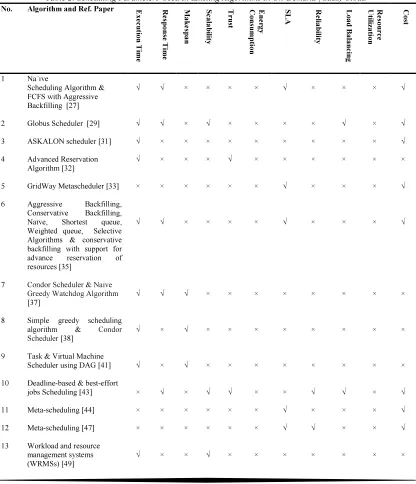
[image:6.595.92.508.280.764.2]From the scheduling algorithms used in this domain of research (i.e. on-demand GaaS Cloud), a scheduling strategy can be implemented with different parameters. The Table 2 below shows the scheduling algorithms and the corresponding scheduling parameters used in previous researches.
Table 2: Scheduling Parameters Used In Existing Algorithms In On-Demand (Gaas) Cloud No. Algorithm and Ref. Paper Ex
e
c
u
tion
T
im
e
R
e
sp
on
se
T
im
e
M
a
k
e
sp
an
S
c
al
ab
ili
ty
T
r
u
st
E
n
e
rg
y
C
on
su
m
p
ti
on
S
L
A
R
e
liab
ili
ty
L
o
ad
B
al
an
c
in
g
R
e
sou
r
c
e
U
ti
liz
at
ion
C
os
t
1 Na¨ıve
Scheduling Algorithm & FCFS with Aggressive Backfilling [27]
√ √ × × × × √ × × × √
2 Globus Scheduler [29] √ √ × √ × × × × √ × √
3 ASKALON scheduler [31] √ × × × × × × × × × √
4 Advanced Reservation
Algorithm [32] √ × × × √ × × × × × ×
5 GridWay Metascheduler [33] × × × × × × √ × × × √
6 Aggressive Backfilling,
Conservative Backfilling, Naïve, Shortest queue, Weighted queue, Selective Algorithms & conservative backfilling with support for advance reservation of resources [35]
√ √ × × × × √ × × × √
7 Condor Scheduler & Naive Greedy Watchdog Algorithm
[37]
√ √ √ × × × × × × × ×
8 Simple greedy scheduling algorithm & Condor Scheduler [38]
√ × √ × × × × × × × ×
9 Task & Virtual Machine
Scheduler using DAG [41] √ × √ × × × × × × × ×
10 Deadline-based & best-effort
jobs Scheduling [43] × √ × √ √ × × √ √ × √
11 Meta-scheduling [44] × × × × × × √ × × × √
12 Meta-scheduling [47] × × × × × × √ √ × × √
13 Workload and resource management systems (WRMSs) [49]
14 Condor, Boinc and Xtreweb
job schedulers [52] √ × × × × × × × × × ×
15 Combinatorial Allocation Problem &Proposed an Adequate Economic-Based Optimization Model &
Winner Determination
Algorithm [2]
√ × × × × × × × × √ √
6. CONCLUSION
The on-demand Grid as a service (GaaS) Cloud is one of the many services of the user oriented cloud computing technology in which client faces virtualized Grid resources be accessed on-demand. The GaaS takes advantage of the pay-as-you-use paradigm of the Cloud technology to task users for the Grid resources they use. In this review paper, we survey the various research works carried out within this domain to identify the different scheduling algorithms that had been used for on-demand GaaS Cloud (as it can be seen in Table 1 above).
Our main contribution in this work was presented in Table 2 above, which shows the exiting scheduling parameters that had been used to couple a framework for the resource allocation, job distribution and scheduling schemes in the on-demand GaaS Cloud. The scheduling framework should take into account the customer input constraints such as execution cost, execution time, response time, energy consumption, makespan, scalability, trust, SLA, reliability, load balancing and resource utilization. It has been revealed that none of the proposed scheduling algorithms reviewed here fulfill the entire scheduling parameter requirements. However, that is not unexpected as the area of “on-demand GaaS cloud” is still in its
early stages and again considering all the parameters in one framework will only make the scheme very complex. This paper thus helps to understand the key scheduling algorithms and parameters for possible future enhancements in this area of evolving research.
REFERENCES:
[1] G. Aceto, A. Botta, W. de Donato, and A. Pescapè, "Cloud monitoring: A survey,"
Computer Networks, 2013.
[2] R. a. O. Abu-Rukba, "Decentralized Resource Scheduling in Grid/Cloud Computing," 2013.
[3] S. M. Abdulhamid, S. A. L. Muhammad, and M. B. Bashir, "On-Demand Grid Provisioning Using Cloud Infrastructures and Related Virtualization Tools: A Survey and Taxonomy," International Journal of Advanced Studies in Computer Science & Engineering, vol. 3, 2014. [4] V. Chang, G. Wills, and D. De Roure, "A
review of cloud business models and sustainability," in Cloud Computing (CLOUD), 2010 IEEE 3rd International Conference on, 2010, pp. 43-50.
[5] F. Hu, M. Qiu, J. Li, T. Grant, D. Taylor, S. McCaleb, et al., "A Review on cloud computing: Design challenges in Architecture and Security," Journal of Computing and Information Technology,
vol. 19, pp. 25–55, 2011.
[6] W. Kim, "Cloud Computing: Today and Tomorrow," Journal of Object Technology, vol. 8, p. 66, 2009.
[7] M. P. Rad, A. S. Badashian, M. A. Delcheh, and M. Alipour, "Cloud Platforms: A Quick Survey," 2012. [8] L. Wang, G. Von Laszewski, A. Younge,
X. He, M. Kunze, J. Tao, et al., "Cloud computing: a perspective study," New Generation Computing, vol. 28, pp. 137-146, 2010.
[9] P. T. Endo, G. E. Gonçalves, J. Kelner, and D. Sadok, "A Survey on Open-source Cloud Computing Solutions."
[10] Vijindra and S. Shenai, "Survey on Scheduling Issues in Cloud Computing,"
17 [11] A. Bala and I. Chana, "A survey of
various workflow scheduling algorithms in cloud environment," in IJCA Proceedings on 2nd National Conference on Information and Communication Technology NCICT, New York, USA, 2011, pp. 26-30.
[12] S. Mandloi and H. Gupta, "A Review of Resource Allocation and Task scheduling for Computational Grids based on Meta-heuristic Function," IJRCCT, vol. 2, pp. 099-102, 2013.
[13] S. Pandey and R. Buyya, "Scheduling Workflow Applications Based on Multi-source Parallel Data Retrieval in Distributed Computing Networks,"
Computer Journal, vol. 55, pp. 1288-1308, Nov 2012.
[14] S. B. Zhong and Z. S. He, "The Scheduling Algorithm of Grid Task Based on PSO and Cloud Model," Advanced Measurement and Test, Parts 1 and 2, vol. 439-440, pp. 1487-1492, 2010.
[15] S. Abrishami and M. Naghibzadeh, "Deadline-constrained workflow scheduling in software as a service Cloud," Scientia Iranica, vol. 19, pp. 680-689, 2012.
[16] S. Abrishami, M. Naghibzadeh, and D. H. J. Epema, "Deadline-constrained workflow scheduling algorithms for Infrastructure as a Service Clouds,"
Future Generation Computer Systems-the International Journal of Grid Computing and Escience, vol. 29, pp. 158-169, Jan 2013.
[17] D. Adami, C. Callegari, S. Giordano, and M. Pagano, "A Hybrid Multidimensional Algorithm for Network-aware Resource Scheduling in Clouds and Grids," 2012 Ieee International Conference on Communications (ICC), 2012.
[18] T. L. Chen, C. H. Hsu, and S. C. Chen, "Scheduling of Job Combination and Dispatching Strategy for Grid and Cloud System," Advances in Grid and Pervasive Computing, Proceedings, vol. 6104, pp. 612-621, 2010.
[19] H. B. Liu, A. Abraham, V. Snasel, and S. McLoone, "Swarm scheduling approaches for work-flow applications with security constraints in distributed data-intensive computing environments," Information Sciences, vol. 192, pp. 228-243, Jun 1 2012.
[20] G. B. Barone, R. Bifulco, V. Boccia, D. Bottalico, R. Canonico, and L. Carracciuolo, "GaaS: Customized grids in the clouds," vol. 7640 LNCS, ed, 2013, pp. 577-586.
[21] M. B. Belgacem, H. Hafsi, and N. Abdennadher, "A Hybrid Grid/Cloud Distributed Platform: A Case Study," in
Grid and Pervasive Computing, ed: Springer, 2013, pp. 162-169.
[22] R. Buyya and R. Ranjan, "Special section: Federated resource management in grid and cloud computing systems," Future Generation Computer Systems, vol. 26, pp. 1189-1191, 10, 2010.
[23] N. C. Chu and K. E. Barker, "Dynamic Role Lease Authorization for a Grid/Cloud," in ICT and Knowledge Engineering (ICT & Knowledge Engineering), 2012 10th International Conference on, 2012, pp. 63-70.
[24] F. C. de Gouveia, R. Good, T. Magedanz, and N. Ventura, "The use of NGN/IMS for Cloud and Grid Services Control and Management," 2010.
[25] S. M. Abdulhamid, O. S. Adebayo, D. O. Ugiomoh, and M. D. AbdulMalik, "The Design and Development of Real-Time E-Voting System in Nigeria with Emphasis on Security and Result Veracity,"
International Journal of Computer Network and Information Security, vol. 5, pp. 9-18, 2013.
[26] E. Caron, F. Desprez, D. Loureiro, and A. Muresan, "Cloud computing resource management through a grid middleware: A case study with DIET and eucalyptus," in Cloud Computing, 2009. CLOUD'09. IEEE International Conference on, 2009, pp. 151-154.
[27] M. D. De Assunção, A. Di Costanzo, and R. Buyya, "Evaluating the cost-benefit of using cloud computing to extend the capacity of clusters," in Proceedings of the 18th ACM international symposium on High performance distributed computing, 2009, pp. 141-150.
[28] A. Di Costanzo, M. D. De Assuncao, and R. Buyya, "Harnessing cloud technologies for a virtualized distributed computing infrastructure," Internet Computing, IEEE,
vol. 13, pp. 24-33, 2009.
Cluster Computing and the Grid, 2009. CCGRID'09. 9th IEEE/ACM International Symposium on, 2009, pp. 140-147. [30] S. Jha, A. Merzky, and G. Fox, "Using
clouds to provide grids with higher levels of abstraction and explicit support for usage modes," Concurrency and Computation: Practice and Experience,
vol. 21, pp. 1087-1108, 2009.
[31] S. Ostermann, R. Prodan, and T. Fahringer, "Extending grids with cloud resource management for scientific computing," in Grid Computing, 2009 10th IEEE/ACM International Conference on, 2009, pp. 42-49.
[32] M. Smith, M. Schmidt, N. Fallenbeck, T. Dörnemann, C. Schridde, and B. Freisleben, "Secure on-demand grid computing," Future Generation Computer Systems, vol. 25, pp. 315-325, 2009. [33] C. Vázquez, E. Huedo, R. S. Montero, and
I. M. Llorente, "Dynamic provision of computing resources from grid infrastructures and cloud providers," in
Grid and Pervasive Computing Conference, 2009. GPC'09. Workshops at the, 2009, pp. 113-120.
[34] E. Caron, F. Desprez, and A. Muresan, "Forecasting for grid and cloud computing on-demand resources based on pattern matching," in Cloud Computing Technology and Science (CloudCom), 2010 IEEE Second International Conference on, 2010, pp. 456-463. [35] M. D. de Assunção, A. di Costanzo, and
R. Buyya, "A cost-benefit analysis of using cloud computing to extend the capacity of clusters," Cluster Computing,
vol. 13, pp. 335-347, 2010.
[36] I. M. Llorente, R. Moreno-Vozmediano, and R. S. Montero, "Cloud computing for on-demand grid resource provisioning,"
Advances in Parallel Computing, vol. 18, pp. 177-191, 2010.
[37] M. A. Murphy, L. Abraham, M. Fenn, and S. Goasguen, "Autonomic clouds on the grid," Journal of Grid Computing, vol. 8, pp. 1-18, 2010.
[38] M. A. Murphy and S. Goasguen, "Virtual Organization Clusters: Self-provisioned clouds on the grid," Future Generation Computer Systems, vol. 26, pp. 1271-1281, 2010.
[39] W. Toorop and A. van Hoof, "On Demand Grid on Cloud," 2010.
[40] L. Wang, G. von Laszewski, M. Kunze, J. Tao, and J. Dayal, "Provide Virtual Distributed Environments for Grid computing on demand," Advances in Engineering Software, vol. 41, pp. 213-219, 2010.
[41] C. G. Chaves, D. M. Batista, and N. L. S. da Fonseca, "Scheduling Grid Applications on Clouds," 2010 Ieee Global Telecommunications Conference Globecom 2010, 2010.
[42] Y. Demchenko, C. De Laat, J. Van Der Ham, M. Ghijsen, V. Yakovenko, and M. Cristea, "On-demand provisioning of Cloud and Grid based infrastructure services for collaborative projects and groups," 2011, pp. 134-142.
[43] G. Mateescu, W. Gentzsch, and C. J. Ribbens, "Hybrid computing—where HPC meets grid and cloud computing,"
Future Generation Computer Systems,
vol. 27, pp. 440-453, 2011.
[44] C. Vázquez, E. Huedo, R. S. Montero, and I. M. Llorente, "On the use of clouds for grid resource provisioning," Future Generation Computer Systems, vol. 27, pp. 600-605, 2011.
[45] M. Cafaro and G. Aloisio, Grids, Clouds, and Virtualization: Springer, 2011. [46] S. Jha, A. Luckow, A. Merzky, M. Erdely,
and S. Sehgal, "Application-Level Interoperability Across Grids and Clouds," in Grids, Clouds and Virtualization, ed: Springer, 2011, pp. 199-229.
[47] E. Huedo, R. Moreno-Vozmediano, R. S. Montero, and I. M. Llorente, "Architectures for Enhancing Grid Infrastructures with Cloud Computing," in
Grids, Clouds and Virtualization, ed: Springer, 2011, pp. 55-69.
[48] M. Alvarez, A. Fernandez-Montes, J. Ortega, and L. Gonzalez-Abril, "THE CICA GRID: A Cloud Computing Infraestructure on demand with Open Source Technologies," 2012.
[49] A. Bosin, "An SOA-based model for the integrated provisioning of cloud and grid resources," Adv. Soft. Eng., vol. 2012, pp. 12-12, 2012.
19 [51] L. Rodero-Merino, E. Caron, A. Muresan,
and F. Desprez, "Using clouds to scale grid resources: An economic model,"
Future Generation Computer Systems,
vol. 28, pp. 633-646, 2012.
[52] W. Saad, H. Abbes, C. Cerin, and M. Jemni, "A Self-Configurable Desktop Grid System On-Demand," in P2P, Parallel, Grid, Cloud and Internet Computing (3PGCIC), 2012 Seventh International Conference on, 2012, pp. 196-203.
[53] B. Nicolae and M. Rafique, "Leveraging Collaborative Content Exchange for On-Demand VM Multi-Deployments in IaaS Clouds," in Euro-Par'13: 19th International Euro-Par Conference on Parallel Processing, 2013.
[54] N. M. K. Varma and E. Choi, "Extending Grid Infrastructure Using Cloud Computing," in Ubiquitous Information Technologies and Applications, ed: Springer, 2013, pp. 507-516.
[55] V. Casola, A. Cuomo, M. Rak, and U. Villano, "The CloudGrid approach: Security analysis and performance evaluation," Future Generation Computer Systems, vol. 29, pp. 387-401, 2013. [56] S. M. R. Al Masud, "An Extended and