U P D A T E
Open Access
A meta-analysis of temporal changes of
response in the placebo arm of surgical
randomized controlled trials: an update
Karolina A. Wartolowska
1,2*†, Stephen Gerry
2,4†, Benjamin G. Feakins
3, Gary S. Collins
2,4, Jonathan Cook
1,2,
Andrew Judge
1,2,5and Andrew J. Carr
1,2Abstract
Background:Temporal changes in the placebo arm of randomized controlled trials (RCTs) have not been thoroughly investigated, despite the fact that results of RCTs depend on the comparison between arms.
Methods:In this update of our earlier systematic review and meta-analysis, we set out to investigate the effect of assessment time and number of visits on the magnitude of change from baseline in the placebo arm of these trials. We used linear mixed-effects models to account for within-trial correlations.
Results:Across all 47 trials the magnitude of response in the placebo arm did not change with time (β= -0.0070, 95% CI -0.024, 0.010) or visit (β= -0.033, 95% CI -0.082, 0.017) and remained significantly different from baseline for at least 12 months or seven follow-up visits. Change in the placebo arm in trials with subjective outcomes was large (β0= 0.68, 95% CI 0.53, 0.82) and relatively constant across time (β= -0.0042, 95% CI -0.024, 0.016) and visit (β= -0.029, 95% CI -0.089, 0.031), whereas in trials with objective outcomes the response was smaller (β0= 0.28, 95% CI 0.11, 0.46) and diminished with time (β= -0.030, 95% CI -0.050, -0.010), but not with visit (β= -0.099, 95% CI -0.30, 0.11). For trials with assessed outcomes, there was no significant effect of time (β= -0.0071, 95% CI -0.026, 0.011) or visit (β= -0.032, 95% CI -0.33, 0.26); however, these results should be interpreted with caution due to the small number of studies, and high clinical heterogeneity between studies. In trials with pain as an outcome, the improvement was significant (β0= 0.91, 95% CI 0.75, 1.07), but there was no effect of time (β= -0.013, 95% CI -0.06, 0.03) or visit (β= -0.045, 95% CI -0.16, 0.069), and pain ratings remained significantly different from baseline for 12 months or seven visits.
Conclusions: These results are consistent with our previous findings. In trials with subjective outcomes response in the placebo arm remains large and relatively constant for at least a year, which is interesting considering that this is an effect of a single application of an invasive procedure. The lack of effect of time and visit number on subjective outcomes raises further questions regarding whether the observed response is the result of placebo effect or the result of bias.
Keywords: Surgery, Placebos, Randomized controlled trials, Systematic review, Meta-analysis
* Correspondence:[email protected]
Karolina A. Wartolowska and Stephen Gerry are joint first authors.
†Equal contributors
1NIHR Oxford Musculoskeletal Biomedical Research Unit, Old Road, OX3 7LD
Oxford, UK
2Botnar Institute of Musculoskeletal Sciences, Nuffield Department of
Orthopaedics, Rheumatology and Musculoskeletal Sciences, University of Oxford, Old Road, OX3 7LD Oxford, UK
Full list of author information is available at the end of the article
Background
There is conflicting evidence regarding the change in magnitude of placebo response in randomized controlled trials (RCTs). Several studies have demonstrated that values in the placebo arm remain different from baseline for the duration of the follow up [1–3]. However, there is no consensus as to whether placebo response does [4–6] or does not [4, 7] significantly change with time, and as to whether placebo response has a time-effect curve with a peak and carry-over effect [2, 8]. Experimental studies, specifically designed to investigate temporal changes after placebo administration, typically use a very short obser-vation time, e.g., under an hour [9, 10], so their results provide little insight into what happens in clinical trials, in which the follow up lasts weeks or months.
In the previous paper [3], we used data from our earlier systematic review of surgical RCTs with a pla-cebo arm [11] to determine the effect of time on the effect size of the primary outcome at the primary as-sessment time point. [3] We observed that the effect in the placebo arm remained significantly different from baseline throughout blinded follow up, but that the timing of the assessment did not appear to affect the magnitude of effect.
Typically, meta-analyses focus on the effect size at the primary assessment time point and treat it as a single outcome measure of treatment efficacy; how-ever, trials often report outcomes at multiple follow-up visits. In this paper, we have assessed the temporal characteristics of changes in the placebo arm using a meta-analysis of within-and between-study changes across all outcome time points for all analyzed surgi-cal RCTs. Our aim was to verify the findings from our earlier paper by incorporating the data from all reported follow-up visits, accounting for within-study and between-study correlations, and to investigate the effect of the outcome type and number of visits on temporal changes in the placebo arm of surgical RCTs.
Methods
Search strategy, eligibility and data extraction
The details of the search strategy and data extraction have been published previously [11]. In brief, we searched the databases of MEDLINE, EMBASE, CENTRAL, and Clini-calTrials.gov for placebo-controlled RCTs investigating the efficacy of a surgical intervention. The databases were searched from their inception to October 2015.
Surgical intervention was defined as “any interven-tional procedure that changed the anatomy and required a skin incision or the use of endoscopic techniques. Dental studies and invasive procedures used to deliver a pharmacological substance or stem cells, or that aimed to alleviate symptoms by modulation, stimulation or
denervation were excluded”. Placebo was defined as “sham surgery, or an imitation procedure intended to mimic the active intervention; including the scenario where a scope was inserted and nothing was done, but patients were sedated or under general anesthesia and could not distinguish whether or not they underwent the actual surgery”[11].
We only included trials that reported continuous data and presented data in a form that made it possible to calculate an effect size. From each eligible study, we ex-tracted the lead author’s surname, the publication year, the number and timing of each treatment and follow-up visit, the primary outcome, and the mean and stand-ard deviation (SD) of the primary outcome in the pla-cebo arm of each trial. Outcomes were classified as “subjective”, i.e., patient-reported and depending on the patients’ perceptions and cooperation, “assessed”, i.e., subjective ratings judged by external assessors or “ ob-jective”, i.e., measured using devices or laboratory tests and independent of patients’ or observers’ perceptions, for example, weight. As most of the literature on placebo effect is related to pain studies, we also extracted data on pain outcomes, irrespective of whether these were primary or secondary outcomes, for a secondary analysis.
Study effect sizes were quantified as within-arm standardized mean differences (SMDs) between baseline and follow-up values using the Cohen’s d method [12]. A pretest-posttest correlation coefficient (r) of 0.5 was used to calculate the standard error of each SMD [3]. Where necessary, SMDs were sign-flipped to ensure that improvement was consistently presented as a reduction in SMD.
Model for analysis of multiple time points
criteria. When assessing the benefit of additional fixed and random effect terms, model parameters were estimated using maximum likelihood. Restricted maximum likeli-hood estimation was used when fitting the final model. Each observation was weighted according to the inverse variance of the study measures at each time point. To ac-count for the within-study correlation of observations a first-order continuous auto-regressive (CAR1) covariance structure was used, which accounts for the irregular time periods between measurements. In the scenario where ob-servations are equally spaced, this is identical to a first-order autoregressive (AR1) structure.
In analyzing the effect of the timing of all reported follow-up visits on SMDs within the placebo arm of surgi-cal RCTs, the intention was to look for changes that might not have been present when only the primary assessment time point was analyzed [3]. As the type of outcome has been demonstrated to have an effect on the magnitude of response in the placebo arm, we also investigated temporal changes after subgrouping trials by outcome type [3, 15]. In this case, a separate model was fitted for each subgroup (subjective, assessed and objective). We also performed meta-analyses using visit number (instead of time from baseline) as a fixed effect to investigate the effect of repeated assessments. Finally, as most of the literature on placebo is related to placebo analgesia, we analyzed temporal changes only within trials in which pain was the outcome. For the analysis of some subgroups (assessed and objective outcomes) only a small number of stud-ies were available, and model convergence was not satisfactory; in these cases, a simpler random-intercept-only model was fitted.
In all cases, a linear term for time was found to be suf-ficient for both the fixed and random parts of the model; that is, adding higher-order polynomial terms did not improve the model fit. We chose to weight each obser-vation by its inverse variance; however, removing this weighting from the models did not change any of the conclusions. Analyses were limited to 12-month follow up and to seven follow-up visits due to the small num-ber of trials with more visits and longer follow-up pe-riods. All meta-analyses were performed using SAS software version 9.4 (SAS Institute Inc., Cary, NC, USA) using the“mixed”and“sgplot”procedures.
Results
Study selection and characteristics
Information on the search strategy, Preferred Reporting Items for Systematic Reviews and Meta-Analyses (PRISMA) flow diagram, and characteristics of the identi-fied and included trials have been reported previously [3], with an abridged version presented in Additional file 1. A total of 47 trials, involving 1744 participants, were eligible for inclusion. The median duration of
blinded follow up was 6 months, with an interquartile range (IQR) of 3 − 12 months. The median number of blinded visits was 1 (IQR 1−3).
Main findings
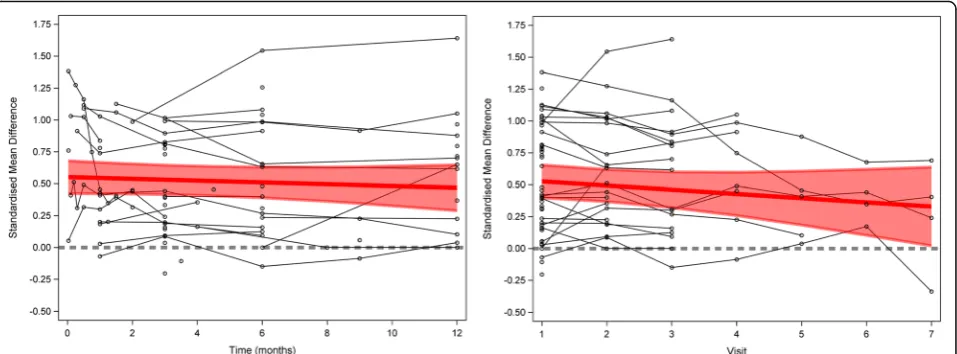
Across all analyzed surgical RCTs, the magnitude of pla-cebo response did not diminish with time or visit, and remained significantly different from baseline for the duration of the trial (Fig. 1, Tables 1 and 2).
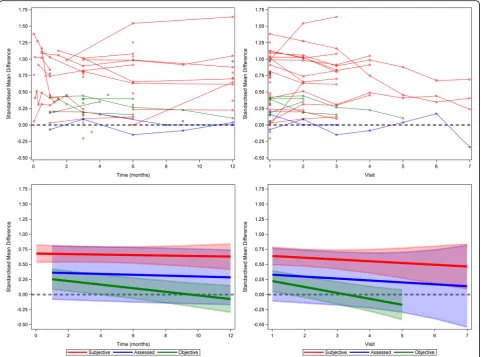
When trials were subdivided by outcome type, time was associated with statistically significant decreases in placebo response in trials with objective outcomes. For trials with subjective outcomes, neither time nor visit were significantly associated with change in placebo re-sponse; however, the response remained large and sig-nificantly different from baseline for at least 12 months. Neither time nor visit were significantly associated with the magnitude of placebo response in trials with assessed outcomes, but few studies were included in this analysis (Fig. 2, Tables 3 and 4).
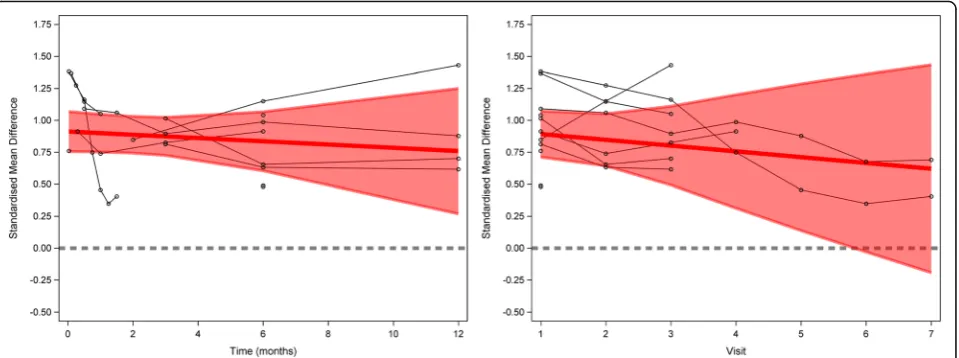
In analyses limited to trials with pain as the outcome, the effects of time and visit were not significant (Fig. 3, Tables 5 and 6).
Discussion Main findings
To the best of our knowledge, this is the first meta-analysis modelling longitudinal changes in the magnitude of effect in the placebo arm of surgical RCTs across all follow-up visits. This study supports our earlier findings that, across all analyzed trials, the magnitude of placebo response does not significantly change with time; it also shows that placebo response does not change with the number of visits. However, when trials were subdivided by outcome type, for trials with subjective outcomes, the re-sponse in the placebo arm remained large and relatively constant for at least 12 months or seven visits, while for trials with objective outcomes, the improvement in the placebo arm diminished with time but not with follow-up visits. It should be noted that, unlike pharmaceutical trials, in which there may be multiple applications of a placebo regimen, all but three trials analyzed in this study used a “one-off”placebo intervention (Additional file 1).
Strengths and limitations
The main strength of this paper is that, unlike our previous analysis, we investigated the effect of time and visit number across all follow-up visits. The main limitation of this study is the paucity of data; both in the form of the number of eli-gible studies, and the number of observations per study.
one trial included a non-intervention group [17]. Ana-lyses were limited to the assessment of “placebo re-sponse”, i.e., the total change in the placebo arm between the baseline and follow-up visits. As a conse-quence of this, the magnitude of response may be af-fected by factors that are not related to placebo intervention itself, such as regression to the mean, fluc-tuations in disease severity, spontaneous improvement or report bias.
Seventy-nine percent of the trials used or allowed the use of standard or rescue medication [3]; therefore, some of the effect observed in the placebo group may be the result of concomitant pharmacological treatment or life-style modifications. We did not include any information about concomitant medication in our analysis because of the limited reporting of this characteristic in the ana-lyzed trials.
Analyses were based on summary data, as reported by the authors of each trial. This limited the power of our analyses and did not allow us to investigate the effect of patient-related factors; therefore, we were unable to draw inference about individual patient responses (sig-nificant relationships at the population level may not hold true at the individual level and vice versa, i.e., the ecological fallacy).
The statistical modelling carried out in this study re-lied on several choices and assumptions. We chose to
use SMDs for the outcome measure, as the reported out-come types and measures were heterogeneous, rendering standardization necessary to combine results. In a study with baseline and multiple follow-up outcome assess-ments, we would typically adjust for the magnitude of the outcome at baseline, but this was not appropriate here. There is also the possibility that the standard error of each study estimate was not appropriately accounted for, since the baseline value was incorporated in the SMD and the weighting at each time point; however, re-moving the weighting from the model made little differ-ence to the findings.
Interpretation
This study confirms our previous findings that placebo response does not seem to have a response-curve and that it persists for at least 12 months [3].
[image:4.595.60.539.88.265.2]The“longevity”of placebo response has been reported previously [1, 2] and has been interpreted by some au-thors as regression to the mean [18–20]. In this study, we could not investigate whether placebo response was caused by regression to the mean because of the lack of information on the true population mean for the out-come measures. However, regression to the mean could explain many of the characteristics of placebo response, for example, that it tends to be larger for more extreme values and for more unreliable measures. [20].
Table 2The effect of visit on placebo response across all trials
Outcome type
Intercept Coefficient
[image:4.595.305.542.689.732.2]β0(95% CI) Pvalue β(95% CI) Pvalue All 0.56 (0.42, 0.71) <0.0001 -0.033 (-0.082, 0.017) 0.16
Table 1The effect of time (in months) on placebo response across all trials
Outcome type
Intercept Coefficient
β0(95% CI) Pvalue β(95% CI) Pvalue All 0.55 (0.42, 0.68) <0.0001 -0.0070 (-0.024, 0.010) 0.40
[image:4.595.56.291.690.731.2]Using longitudinal analysis showed that outcome type affects not only the magnitude of response in the pla-cebo arm, but also its temporal changes; with the effect on objective outcomes decreasing with time, and the ef-fect on subjective outcomes, including pain, not chan-ging with time and remaining significantly different from baseline values. This is in line with the results of our ori-ginal paper [3]. Findings in previously published studies, investigating temporal changes in the placebo arm have been inconsistent. Some studies reported that the effect
[image:5.595.58.540.88.445.2]of time is not significant [4] or that trial duration may explain some of the variation in improvement [21]. A meta-analysis of acupuncture trials [2], showed a peak in placebo response at 12 weeks with a subsequent drop at 52 weeks; however, the follow-up visits were divided into six groups according to the assessment timing, allowing a different number of trials to contribute to the effect in each group. Kaptchuk et al. [5] reported a continuous reduction in pain over 8 weeks in a sham acupuncture trial; however, they re-applied the treatment throughout
Table 3The effect of time (in months) on placebo response across all trials, by outcome type
Outcome type
Intercept Coefficient
β0(95% CI) Pvalue β(95% CI) Pvalue Subjective 0.68 (0.53, 0.82) <0.0001 -0.0042 (-0.024, 0.016) 0.67
Assessed 0.37 (-0.070, 0.81) 0.086 -0.0071 (-0.026, 0.011) 0.38
Objective 0.28(0.11, 0.46) 0.0037 -0.030 (-0.050, -0.010) 0.0084
Table 4The effect of visit on placebo response across all trials, by outcome type
Outcome type
Intercept Coefficient
β0(95% CI) Pvalue β(95% CI) Pvalue Subjective 0.67 (0.50, 0.83) <0.0001 -0.029 (-0.089, 0.031) 0.28
Assessed 0.36 (-0.079, 0.80) 0.091 -0.032 (-0.33, 0.26) 0.51
[image:5.595.56.292.662.731.2] [image:5.595.304.540.662.731.2]the study, and it is known that administering treatment multiple times reinforces the placebo effect [22].
In our meta-analysis, visit number did not have a sig-nificant effect on the magnitude of placebo response. This contradicts the findings of Vase et al., who reported that a larger number of face-to-face visits was associated with a larger placebo response [23]. However, Vase et al. used individual patient data from several pharmaco-logical trials, in which a placebo was administered multiple times during the trial, whereas we analyzed trial-level data from surgical trials, which tend to involve a“one-off”intervention.
Some of the improvement in the placebo arm might have been related to the effect of concomitant treatment. One plausible explanation for improvement is the use of rescue medications, such as pain-killers, or the introduc-tion of lifestyle modificaintroduc-tions, such as diet. Another pos-sible explanation is that patients who were allowed to continue their standard pharmacological treatments throughout the trial might have improved due to better adherence to these treatments when in the trial.
Implications
There are two main implications of this study. First, for the researchers and clinicians designing placebo-controlled tri-als of invasive procedures using subjective outcomes, it is useful to know that the effect in the placebo arm does not
seem to change significantly with time. This is important because in a placebo-controlled trial treatment effect is measured as the difference between the change in the active and placebo arms. Second, patients report significant improvement for a prolonged period of time after a single surgical placebo intervention, i.e., a procedure chosen to have no active therapeutic effect. Therefore, surgeons and therapists should be aware that large and sustained improvement in subjective outcomes after a procedure does not always mean that the crucial surgical element of the treatment is effective.
Conclusions
This study found that for surgical RCTs with subjective outcomes, the effect size in the placebo arm persists for at least a year, and does not significantly diminish with follow-up visits. Only in trials with objective out-comes did the magnitude of placebo response diminish with time, but not with number of visits. These find-ings further reinforce the value of controlling for potential bias, especially in trials with a subjective key outcome. Further research is needed to explore the extent to which the observed response in the placebo arm is explained by response bias and other potential sources of bias.
Fig. 3Meta-analysis of placebo response in trials with pain as the primary outcome.Left panelshows analysis across all time points.Right panel
shows analysis across all visits. Thethick linerefers to the study average trend over time, i.e., the fixed effects part of the model. Theshaded area
[image:6.595.60.540.88.267.2]is the 95% confidence interval. Thethick grey dashed linerepresents the line of null effect
Table 5The effect of time (in months) on placebo response in trials with pain as the outcome
Outcome Intercept Coefficient
[image:6.595.54.291.691.731.2]β0(95% CI) Pvalue β(95% CI) Pvalue Pain 0.91 (0.75, 1.07) <0.0001 -0.013 (-0.06, 0.03) 0.48
Table 6The effect of visit on placebo response in trials with pain as the outcome
Outcome Intercept Coefficient
[image:6.595.304.538.691.731.2]Additional file
Additional file 1:Characteristics of surgical randomized controlled trials with a placebo arm included in this analysis. (PDF 47 kb)
Funding
This study was funded by the NIHR Oxford Musculoskeletal Biomedical Research Unit. The funders had no role in study design, data collection and analysis, decision to publish or preparation of the manuscript.
Availability of data and materials
The datasets supporting the conclusions of this article are included within the article.
Authors’contributions
KAW, AJ, BGF, JC, GSC and AJC conceived and designed the study. KAW, SG, BGF, AJ, JC and GSC designed the statistical analysis. KAW, SG, BGF, GSC, JC and AJ analyzed the data. KAW drafted the manuscript and is the guarantor of the study. KAW, SG, BGF, GSC, JC, AJ and AJC contributed to the writing of the manuscript and critically revised the manuscript for important intellectual content. All authors agree with the manuscript’s results and conclusions. All authors read and approved the final manuscript.
Ethics approval and consent to participate
Not applicable.
Consent for publication
Not applicable.
Competing interests
KAW, JC, AJ and AJC are involved in a placebo-controlled surgical trial on shoulder pain (NCT01623011).
Publisher’s Note
Springer Nature remains neutral with regard to jurisdictional claims in published maps and institutional affiliations.
Author details
1NIHR Oxford Musculoskeletal Biomedical Research Unit, Old Road, OX3 7LD
Oxford, UK.2Botnar Institute of Musculoskeletal Sciences, Nuffield Department of Orthopaedics, Rheumatology and Musculoskeletal Sciences, University of Oxford, Old Road, OX3 7LD Oxford, UK.3Nuffield Department of Primary Care Health Sciences, University of Oxford, Woodstock Road, OX2 6GG Oxford, UK.4Centre for Statistics in Medicine, University of Oxford, Windmill Road, OX3 7LD Oxford, UK.5MRC Lifecourse Epidemiology Unit, University of Southampton, University Road, SO17 1BJ Southampton, UK.
Received: 13 April 2017 Accepted: 27 June 2017
References
1. Rana JS, Mannam A, Donnell-Fink L, et al. Longevity of the placebo effect in the therapeutic angiogenesis and laser myocardial revascularization trials in patients with coronary heart disease. Am J Cardiol. 2005;95:1456–9. doi:10.1016/j.amjcard.2005.02.013.
2. Koog YH, Jung WY. Time course of placebo effect of acupuncture on pain: a systematic review. ISRN Pain. 2012;2013:1–8. doi:10.1155/2013/204108. 3. Wartolowska KA, Feakins BG, Collins GS, et al. The magnitude and temporal
changes of response in the placebo arm of surgical randomized controlled trials - a systematic review and meta-analysis. Trials. 2016;17:589. doi:10.1186/s13063-016-1720-7.
4. Walach H, Maidhof C. Is the placebo effect dependent on time? In: Kirsch I, editor. Expectancy, experience, and behavior. Washington, DC: American Psychological Association; 1999. p. 321–32.
5. Kaptchuk TJ, Stason WB, Davis RB, et al. Sham device v inert pill: randomised controlled trial of two placebo treatments. BMJ. 2006;332:391–7. doi:10.1136/bmj.38726.603310.55.
6. Agid O, Siu CO, Potkin SG, et al. Meta-regression analysis of placebo response in antipsychotic trials, 1970–2010. Am J Psychiatry. 2013;170:1335–44. doi:10.1176/appi.ajp.2013.12030315.
7. Curie A, Yang K, Kirsch I, et al. Placebo responses in genetically determined intellectual disability: a meta-analysis. PLoS One. 2015;10:1–16. doi:10.1371/ journal.pone.0133316.
8. Turner JA, Deyo RA, Loeser JD, et al. The importance of placebo effects in pain treatment and research. JAMA. 1994;271:1609–14. doi:10.1001/jama. 1994.03510440069036.
9. Vase L, Robinson ME, Verne GN, et al. The contributions of suggestion, desire, and expectation to placebo effects in irritable bowel syndrome patients. An empirical investigation. Pain. 2003;105:17–25.
10. Levine JD. Role of pain in placebo analgesia. PNAS. 1979;76:3528–31. 11. Wartolowska K, Judge A, Hopewell S, et al. Use of placebo controls in the
evaluation of surgery: systematic review. BMJ. 2014;348:g3253. doi:10.1136/ bmj.g3253.
12. Higgins JPT, Green S (editors). Cochrane Handbook for Systematic Reviews of Interventions Version 5.1.0 [updated March 2011]. The Cochrane Collaboration, 2011. Available from http://handbook.cochrane.org. 13. Ishak KJ, Platt RW, Joseph L, et al. Meta-analysis of longitudinal studies. Clin
Trials. 2007;7:525–39.
14. Brown H, Prescott R. Applied mixed models in medicine. 3rd ed. United Kingdom: Wiley; 2015. http://onlinelibrary.wiley.com/book/10.1002/ 9781118778210.
15. Hróbjartsson A, Gøtzsche PC. Is the placebo powerless? An analysis of clinical trials comparing placebo with no treatment. N Engl J Med. 2001;344:1594–602. doi:10.1056/NEJM200105243442106.
16. Ernst E, Resch KL. Concept of true and perceived placebo effects. BMJ. 1995;311:551–3. doi:10.1136/bmj.311.7004.551.
17. Schwartz MP, Wellink H, Gooszen HG, et al. Endoscopic gastroplication for the treatment of gastro-oesophageal reflux disease: a randomised, sham-controlled trial. Gut. 2007;56:20–8. doi:10.1136/gut.2006.096842. 18. Rück A, Sylvén C.‘Improvement’in the placebo group could be due to
regression to the mean as well as to sociobiologic factors. Am J Cardiol. 2006;97:152–3. doi:10.1016/j.amjcard.2005.08.015.
19. Morton V, Torgerson DJ. Regression to the mean: treatment effect without the intervention. J Eval Clin Pract. 2005;11:59–65. doi:10.1111/j.1365-2753. 2004.00505.x.
20. McDonald CJ, Mazzuca SA, McCabe GP. How much of the placebo‘effect’is really statistical regression? Stat Med. 1983;2:417–27. doi:10.1002/sim. 4780020401.
21. Walach H, Sadaghiani C, Dehm C, et al. The therapeutic effect of clinical trials: understanding placebo response rates in clinical trials - a secondary analysis. BMC Med Res Methodol. 2005;5:26. doi:10.1186/1471-2288-5-26. 22. Colloca L, Petrovic P, Wager TD, et al. How the number of learning trials affects placebo and nocebo responses. Pain. 2010;151:430–9. doi:10.1016/j. pain.2010.08.007.
23. Vase L, Vollert J, Finnerup NB, et al. Predictors of the placebo analgesia response in randomized controlled trials of chronic pain: a meta-analysis of the individual data from nine industrially sponsored trials. Pain. 2015;156:1795–802. doi:10.1097/j.pain.0000000000000217.
• We accept pre-submission inquiries
• Our selector tool helps you to find the most relevant journal
• We provide round the clock customer support
• Convenient online submission
• Thorough peer review
• Inclusion in PubMed and all major indexing services
• Maximum visibility for your research
Submit your manuscript at www.biomedcentral.com/submit