Journal of Theoretical and Applied Information Technology 20th February 2016. Vol.84. No.2
© 2005 - 2016 JATIT & LLS. All rights reserved.
ISSN: 1992-8645 www.jatit.org E-ISSN: 1817-3195
AN OVERVIEW OF CONTENT-BASED IMAGE RETRIEVAL
TECHNIQUES
1ABEER ESA A M ALOMAIRI, 2GHAZALI SULONG
1, 2
UTM-IRDA Digital Media Centre (MaGIC-X), Faculty of Computing, University Technology
Malaysia, 81310 Skudai, Johor Bahru, Malaysia
E-mail: [email protected], [email protected]
ABSTRACT
Content based image retrieval (CBIR) depends on several factors, such as, feature extraction method (the usage of appropriate features in CBIR), similarity measurement method and mathematical transform (chosen to calculate effective features), feedback usage and etc. All these factors are important in CBIR to enhance image retrieval accuracy and effort. An efficient retrieval mechanism can be achieved by improving some of its influencing factors. For this purpose, this paper provides a brief review of the factors that have an impact (positive or negative) on the CBIR. The usage of low-level image features such as shape, texture and color are assembling information from an image for recuperation. In this paper, various spectral methods of texture features extraction are discussed. In addition, all the current methods of demonstrating image texture features in the modern literature have been investigated for the purpose to achieve the research’s aim (to discover the most adequate features in CBIR that support image retrieval quality and retrieve the relevant images to the query image ). This paper also addresses the shortcomings of one spectral approach and the solutions provided by another approach for finding the most effective approach in texture feature representation.
Keywords: Image retrieval, Texture feature, Low level features, Features extraction, Features influencing
factors, spectral features, DCT, DWT,GFT .
1. INTRODUCTION
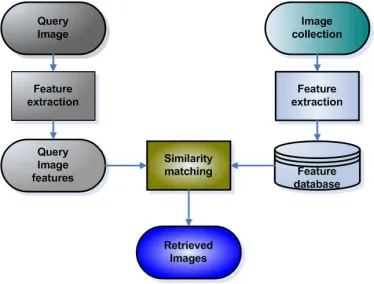
[image:1.612.324.511.542.684.2]There are many large resources on the web sites, which are used by users to create and store images. An efficient way for management and search these images is highly demanded. Therefore, finding efficient image retrieval mechanisms has become a wide area of research interest. Image retrieval method searches and retrieves images from large image databases [1]. A simplified general model of a content-based image retrieval (CBIR) system based on query-by-example (QBE) is presented in Figure 1.
For the last few decades, researchers have been working on image retrieval processes and made important developments in two domains, i.e. text based image retrieval (TBIR) and (CBIR).
According to TBIR method, users use keyword or description to the images as query for the retrieval relevant images to the keyword. Text based retrieval has several disadvantages. First of all, there are more chances of errors in labeling by
different annotators according to their
understandings about image contents. For example, an image consisting of grass and flowers might be
labeled as either ‘grass’ or ‘flower’ or ‘nature’ by different people. Second, the process is subjective because too much time is consumed in annotating each image in large databases [1]. Third, the process of image tagging in large databases is highly error prone. These all lead to the result that TBIR cannot achieve high level of efficiency and effectiveness.
Figure 1: CBIR model (simple and general system)
ISSN: 1992-8645 www.jatit.org E-ISSN: 1817-3195 1990’s the term CBIR was originated [1]. CBIR is
an automated technique, in which the input is an image as query while the output is a set of images similar to the input or query. Low-level image features like texture, color, and shape are extracted from the database images to define them in terms of their features. Images of the same category are expected to have similar characteristics. Thus, on
the basis image features when similarity
measurement is performed, the retrieval
performance achieved high level of peformance.
CBIR has many merits over the traditional text based retrieval. Due to the use of the visual contents of the query image in CBIR [1], more efficient and effective way to find relevant images than text based annotations searching. In addition, CBIR also eliminated the time wasted in manual annotation process of text based approach. These merits motivated the researchers to employ the CBIR technique.
Among the low level image features, texture has been shown to be effective and objective in CBIR. A variety of techniques have been developed for extracting texture features, broadly classified into the spatial and spectral methods. The spatial approaches mostly rely on statistical calculations of the image. Unfortunately, these statistic techniques are sensitive to image noise and have insufficient number of features [4]. On the other hand, spectral methods of texture analysis are robust to noise. The discrete cosine transform [5], multiresolution (MR) methods such as, Gabor filters [6-8] and wavelet transform [9-11] for texture representation are used by the spectral approaches. The problem of these spectral methods is that edge information of an image are not effectively captured and this main reason for searching a more effective multi-resolution spectral approaches to overcome the edge problem.
In CBIR system the important issues are [1]
• Image database selection
• Similarity measure
•Evaluation of the retrieval process and
performance
• Image features extraction (Low-level).
In the next section, we describe the use and effects of these factors on CBIR with reference to recent research.
2. IMAGE DATABASE SELECTION
To ensure the quality of research it is necessary to select a proper dataset as it plays an important role in the CBIR performance. Based on the research objectives, choosing a proper database is necessary to establish a relevant analysis of various CBIR techniques.
For any database, it is important to determine the ground truth, on the basis of which retrieval is performed and performance is measured. Size and variety are other two properties of a database, which also affects the retrieval outcome. If the database size is large consisting of multivariate images, a good retrieval result ensures the acceptance of the database as well as the implied method as a standard. Retrieval result varies significantly by selecting different databases as the ground truth definition, size, and variety of the databases are different. From recent literature, we find a subset of Corel database [22] that has been mostly used by the retrieval systems for color images and the Brodatz database [23] has been taken as a standard of texture analysis and texture studies [7, 24- 27]. For the Brodatz album, the ground truth is, there are 112 categories of textures each of which consists of 16 similar but non-overlapping textures. This database contains both man-made and natural textures, so the large collection of diverse varieties of textures is a good source of texture based retrieval study. Brodatz database has already been used in many texture based image retrieval [7, 15, 25, 28, 29] to benchmark the CBIR performances. For all these reasons Brodatz database is appropriate for texture based CBIR and texture analysis.
3. SIMILARITY MEASUREMENT
Once features are extracted from all the images including in the database and from the query image, the similarity measurement becomes the crucial issue in CBIR.
Similarity measurement, the process to find the difference or similarity between the images of the database and the input or query image using their features. The database image list is then sorted based on distance ascending order against the query image and the same pattern is followed during retrieval of the images. There are various methods of calculating this distance, such as the,
Jeffrey-Divergence, Kullback-Leibler divergence,
Journal of Theoretical and Applied Information Technology 20th February 2016. Vol.84. No.2
© 2005 - 2016 JATIT & LLS. All rights reserved.
ISSN: 1992-8645 www.jatit.org E-ISSN: 1817-3195 The L2 distance, also known as Euclidean
distance, is one variety of the Minkowski- Form distance [1]. In many CBIR approaches the L2 distance is used. It is applicable when the image feature vector elements are equally important and the feature vectors are independent of one another. The Euclidean distance has been used in shape-based CBIR [30], retrieval using wavelet transform [11], color and texture image retrieval using weighted wavelet descriptor [10], Netra region is based on color, texture, shape and spatial location information, i.e. means that regional based system of image retrival [31], etc. Therefore, Euclidean distance has been taken as a standard to similarity measurement in CBIR process.
4. EVALUATION METHODS OF CBIR
PERFORMANCE
The degree of retrieval accuracy achieved by a system is important to know about its performance. If the accuracy is satisfactory and the technique’s results are promising then the technique can be used as benchmark. In CBIR, the statistical metrics precision-recall to note or validate the retrival accuracy and is widely used measurement method. Mostly, recent literature [6, 32-34] for measuring the performance of image retrieval used precision-recall. Precision “P” is the ratio of the retrieved relevant images (Number), i.e. “r” to the all the retrieved images (Number), i.e. “n” from the database [1]. Precision is used for measuring the retrieval accuracy as shown in equation 2.1.
Recall, “R” is the ratio between the retrieved relevant images (Number), i.e., “r” to the total the relevant images (Number), i.e. “m”, in the whole database. Mathematically expressed as equation 2.2.
The value of precision fall with the rise of recall value. A system is said to be ideal, if the precision and recall values remain high. However, no such image retrieval system exists which gives the mentioned accuracy. Precision-recall pair is a good standard of performance evaluation and when the database type is known then this pair find out good results, which are meaningful. Those data sets
which were collected by the users by themselves using user generated images, the results are varying due to different human concepts of image classification.
5. FEATURES IN CBIR (LOW-LEVEL)
A number of low-level image features can be extracted from an image. Detailed study on image features are presented in [1, 35]. Some commonly used low-level image features in recent literature includes the application of color, texture, shape, spatial location, etc. Some CBIR approaches use a combination of more than one low-level feature to improve retrieval performance. In this section we briefly describe the features used in recent CBIR researches and their impacts.
5.1 Color
Color is one of the most prominent visible properties of an image and each pixel of image contains a different value for color. As human vision perception can easily distinguish different colors, application of color features has widely been accepted in numerous CBIR applications. Before generation of a color descriptor, it is necessary to define a suitable color space. From the recent literature, we find HSV or HSL or HSB, YCrCb, CIE-L*u*v*, CIE-L*a*b* are popularly used in CBIR [10, 16, 32, 36-38].
Journal of Theoretical and Applied Information Technology 20th February 2016. Vol.84. No.2
© 2005 - 2016 JATIT & LLS. All rights reserved.
ISSN: 1992-8645 www.jatit.org E-ISSN: 1817-3195 Another low-level feature that can easily be
identified by human is shape. Often, using color and texture features combined make it harder to distinguish the shape of separate objects in an image. Eventually, it becomes difficult to define the shape clearly. Shape descriptions can be of two types, i.e. region based and boundary based [1]. The shape description based on boundary considers the shape of the outer boundary only, includes the application of Fourier shape descriptors, finite element models, polygonal approximation and rectilinear shapes. Region-based shape description, which considers the entire region of a defined shape, includes moment invariants to translation, rotation and scale [1]. Fourier descriptors have been used in 2-D shape classification and have performed better than autoregressive modeling based shape descriptor [41]. Usually the shape features are useful after segmenting the image. Due to the difficulties related to using robust and accurate segmentation algorithm, only limited applications of shape features are found in CBIR.
5.2 Spatial Location
Spatial location helps to resolve the ambiguity in defining objects in an image or defining difference between images due to color and texture similarity [1]. Sometimes blue sky and sea may possess the same texture and color histogram, thereby making it difficult to distinguish them. The ambiguity can be resolved when the word ‘top’ is used for sky and ‘bottom’ is used for sea to specify their spatial location.
5.3 Texture
Texture is visually a prominent property of an image. Texture (low-level feature) plays a vital role in CBIR and classification. It is difficult to define a texture. All the natural images have different kinds of objects. The careful observation of these objects within the image shows that they have different surface patterns. More simply, the texture is defined as the surface pattern of an object in the image or all the image’s pattern on its surface. e.g, the repetition of patterns (similar) on some objects like brick built wall, some objects have directional patterns like a grass field and some objects contain no regular patterns like soil, fractal and sky. Identical texture patterns occur when dealing with similar images, thus, for CBIR the texture features are essential.
[image:4.612.325.519.74.253.2]According to the categorization of approaches used for texture feature extraction are spanned on only two domains, i.e. spatial domain and spectral domain. The classification of texture features presented diagrammatically in Fig. 2 .
Figure 2: Classification of texture features extraction methods
Methods based on spectral domain like the multi-resolution simultaneous autoregressive model [44] Gabor filters [14, 43], multi-resolution wavelet [42], and discrete cosine transform [5], are luckily unsusceptible to noise. As a result, the mentioned transforms have been used for representation of image textures extensively. Candès and Donoho have developed a new multi-resolution, which is the discrete curvelet transform, [12] and in an image highlights the edges successfully. DCT [19], is effectively used for de-noising the images. Spectral domain texture features in CBIR have been extensively used because of the superiority of these features over spatial methods.
In the next section, the most popular spectral domain approaches of texture features extraction are discussed.
6. SPECTRAL FEATURES
Spectral approaches already used in CBIR for texture feature extraction are discussed under this topic. As compare to human in distinguishing two different images, a machine needs a lot of image discriminatory information to be pre-processed and
stored to become automatic system. The
mathematical transform is used in many spectral
approaches to find the prominent texture
characteristics of an image. There are many effective transforms for texture features extraction, which are discussed next and their acceptance in CBIR approaches is elaborated.
6.1 Fourier Transform (FT)
Journal of Theoretical and Applied Information Technology 20th February 2016. Vol.84. No.2
© 2005 - 2016 JATIT & LLS. All rights reserved.
ISSN: 1992-8645 www.jatit.org E-ISSN: 1817-3195 presented in the discrete Fourier transform as
through equation 2.3 [45]:
Where, for an M × N image the x= 0,1, 2,...,M −1 and y = 0,1, 2,..., N −1.
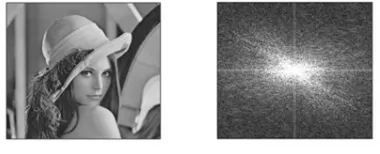
The pattern information of an image are collected from frequency components through the Fourier transform easily as presented in Fig. 3.
Figure 3: (Left) Lena image (512x512 Original), (right) its FT
The texture features of an image at specific location are represented by frequency components in the FT. Images which are used in CBIR have high frequency components and these are the main distinguishing factors in extraction of texture features. Thus, the specific locations frequency information are required for distinguishing images in CBIR. However, FT only captures the global spectral features but the exact location information of these features are not provided [46].
Texture pattern information are not properly provided by the Fourier transform in 2-D space. In the Fourier domain two images having completely different contents have similar patterns as shown in Fig.4. The Fourier spectra have similar patterns in Fig.4 (a) and (b) while the original images are different. In CBIR process the spectral pattern presented in Fig.4. (a) and (b) are considered similar while human perception can differentiate them easily.
Figure 4: (a, b) Original image (left) and Fournier transform (right)
Therefore, Fourier transform is functional only when spectral features of the signal are taken into consideration but not their exact location of
occurrence. It has been used to extract the shape features for the purpose of image retrieval [41]. However, in using texture for content based image retrieval, the frequency components and the exact location of the different frequencies are equally important in distinguishing images. Thus, for texture based CBIR the Fourier transforms are not applicable directly in.
6.2 Discrete Cosine Transform (DCT)
In the same way as discrete FT obtained the DCT coefficients are obtained by transforming a signal or an image from spatial domain to frequency domain for different purposes in image processing. Suppose a 2-D discrete cosine transform of an image f (x, y) of size n× n is defined as given in equation 2.4 [5]:
Where u, v = 0, 1, 2… n-1.
DCT for image and video compression is an effective technique. The reason behind the DCT popularity for data compression is that it preserves the image energy in the low frequency [47]. DCT can be found in different approaches for texture, color and shape features extraction [48]. Similar to FT, the local feature’s details are ignored by the DCT while extracting the texture features. Therefore, for CBIR the DCT approach is not suitable.
6.3 Gabor Filters Transform (GFT)
GFT demonstrates the edges of an image effectively using multiple orientations and scales, which makes it a good multi-resolution method. In image processing most frequently used the Gabor filters and mammalian perceptual vision have similar spatial property. GFT builds a filter bank containing Gabor filters with different orientations and scales. Then, the image is convolved with the filters. The Gabor filters transform is defined by the given equation [7]:
[image:5.612.93.290.125.166.2] [image:5.612.100.290.251.328.2] [image:5.612.315.519.278.321.2] [image:5.612.91.297.606.658.2]ISSN: 1992-8645 www.jatit.org E-ISSN: 1817-3195
Where, W represents the modulation frequency and 1/ 2 u x σ = πσ, 1/ 2 v y σ = πσ. The rotation and dilation of the mother Gabor wavelet can be resulted in same Gabor filters [7]:
Where a >1, θ = nπ / K, K represents total orientations. The parameters a, u σ and v σ can be defined as [7]:
6.4 Discrete Wavelet Transform
Wavelet transform is introduced with the advancement in multiresolution transform research. Discrete wavelet transform is one of the most promising multiresolution approaches used in CBIR. It has the advantage of a time-frequency representation of signals where Fourier transform is only frequency localized. The location, at which a frequency component of an image exists, is important as it draws the discrimination line between images. Given an image f (x, y), its continuous wavelet transform is given by [58]:
Where a wavelet with scale parameter 1 2 a , a and position parameter 1 2 b ,b can be described as follows:
The window size differs at each resolution level, which is unlike the FT and STFT when the wavelet transform is applied to an image. Three detail
images are yielding, presenting the local changes in horizontal, vertical and diagonal direction because the original image is high-pass after applying the discrete wavelet transform. After high-pass filtering the image is then pass from low-pass filtering yielding an approximation image which is again filtered in an identical way to generate high and low frequency subbands at the next lower resolution level. The continued process stops until the complete image is treated or a level is determined as the lowest decomposition. This method is called down sampling.
The whole decomposition process offers an array of DWT coefficients achieved from each subbands at each scale. For the image’s texture patterns the DWT coefficients are examined. Wavelet subbands
obtained from the Lena image using 4
decomposition levels are shown in Fig. 2.
Due to its good image texture representation
capability, wavelet transform have many
applications in image processing, e.g., texture
analysis, CBIR methods [10, 11], texture
classification and image deconvolution. The wavelet transform in [48] yielding much higher texture classification rate and retrieval accuracy
than discrete cosine transform or spatial
Journal of Theoretical and Applied Information Technology 20th February 2016. Vol.84. No.2
© 2005 - 2016 JATIT & LLS. All rights reserved.
ISSN: 1992-8645 www.jatit.org E-ISSN: 1817-3195 levels are expected to contain more texture
discriminating information.
As compared to Gabor filters, the discrete curvelet transform completely covers the spectral plane and contains more scales and orientations in the frequency domain. At each scale in the Gabor filters, the numbers of orientations decreases however, in parallel curvelet transform the orientations are more as the level of resolution surges for the purpose to seized more directional information from high frequency components.
7. CONCLUSION
In this paper, the key issues involved in content based image retrieval are elaborated, i.e. selection of image database, features selection (low-level, i.e., color, texture, shape, spatial location representation, image similarity measurement methods, performance evaluation and the spectral approaches) used in image retrieval based on texture. From the state-of-the-art methods, the effective texture features of an image are investigated. In addition, it is discovered that the combination of image features gives a boost to the outcome of CBIR. To emphasis the discussion on texture, the spatial and the spectral approaches of texture features analysis are discussed to show the superiority between them. It is noted that spectral are superior then spatial texture feature approaches. In addition, an effort has been made to provide an overview of the spectral texture representations
used in latest literature. These texture
representations are presented with their merits and demerits. We also described the applications and performance of these spectral methods in many image retrieval and texture representations. It is concluded that multi-resolution approaches are the most effective in texture features representation. We also found the limitations of Gabor filters and wavelet transforms and as future work suggested that using multi-resolution approach with advance wavelet transform in terms of improving the accuracy for texture based image retrieval.
REFRENCES:
[1] F. Long, H. J. Zhang, and D. D. Feng,
"Fundamentals of Content-based Image
Retrieval," in Multimedia Information
Retrieval and Management, D. Feng Eds,
Springer, 2003.
[2] Accessed http://au.images.search.yahoo.com/ on 09 November, 2008.
[3] "Content-based image retrieval,"
http://en.wikipedia.org/wiki/CBIR.
[4] H. Tamura, S. Mori, and T.Yamawaki, "Texture
Features Corresponding to Visual
Perception," IEEE Trans. on Systems, Man
and Cybernetics, vol. 8(6), pp. 460-473, 1978.
[5] Y. L. Huang, "A Fast Method for Textural
Analysis of DCT-Based Image," Journal of
Information Science and Engineering, vol.
21(1), pp. 181-194, 2005.
[6] L. Chen, G. Lu, and D. S. Zhang, "Effects of Different Gabor Filter Parameters on Image Retrieval by Texture," in Proc. of IEEE 10th International Conference on Multi-Media
Modelling, Australia, 2004, pp. 273-278.
[7] B. S. Manjunath and W. Y. Ma, "Texture Features for Browsing and Retrieval of Image
Data," IEEE Transactions on Pattern Analysis
and Machine Intelligence, vol. 18(8), pp.
837-842, 1996.
[8] B. S. Manjunath et al, "Introduction to MPEG-7," John Wiley & Son Ltd., 2002.
[9] J. Z. Wang, J. Li, and G. Wiederhold, "SIMPLIcity: Semantics-sensitive Integrated Matching for Picture Libraries," IEEE Trans.
Pattern and Machine Intelligence, vol. 23(9),
pp. 947-963, 2001.
[10] S. Bhagavathy and K. Chhabra, "A
Wavelet-based Image Retrieval System," in Technical
Report—ECE278A: Vision Research
Laboratory, University of California,Santa Barbara, 2007.
[11] N. Suematsu, Y. Ishida, A. Hayashi, and T. Kanbara, "Region-Based Image Retrieval
using Wavelet Transform," in Proc. 15th
International Conf. on Vision Interface,
Calgary, Canada, May, 2002, pp. 9-16. [12] E. J. Candès and D. L. Donoho, "Curvelets - a
surprisingly effective nonadaptive
representation for objects with edges," in
Curve and Surface Fitting: Saint-Malo, A.
Cohen, C. Rabut, and L. L. Schumaker, Eds. Nashville, TN: Vanderbilt University Press, 1999.
[13] J.-L. Starck and M. J. Fadili, "Numerical
Issues When Using Wavelets," Encyclopedia
of Complexity and System Science, in press.
[14] J. G. Daugman, "Complete Discrete 2-D Gabor Transforms by Neural Networks for Image
Analysis and Compression," IEEE Trans.
Acoust. Speech, SignalProcessing, vol. 36(7),
ISSN: 1992-8645 www.jatit.org E-ISSN: 1817-3195 [15] D. Zhang, A. Wong, M. Indrawan, and G. Lu,
"Content-based Image Retrieval Using Gabor
Texture Features," in Proc. of First IEEE
Pacific-Rim Conference on Multimedia
(PCM'00), Sydney, Australia, December
13-15 , 2000, pp. 1139-1142.
[16] W.-Y. Ma and H. Zhang, "Benchmarking of Image Features for Content-based Retrieval,"
in Signals, Systems & Computers, 1998.
Conference Record of the Thirty-Second
Asilomar Conference, Pacific Grove, CA,
USA., 1998, pp. 253-257.
[17] M. J. Fadili and J.-L. Starck, "Curvelets and
Ridgelets," Encyclopedia of Complexity and
System Science , in press., 2007.
[18] E. J. Candès, L. Demanet, D. L. Donoho, and L. Ying, "Fast Discrete Curvelet Transforms,"
Multiscale Modeling and Simulation, vol. 5,
pp. 861-899, 2005.
[19] J.-L. Starck, E. J. Candès, and D. L. Donoho,
"The Curvelet Transform for Image
Denoising," IEEE Transactions on Image
Processing, vol. 11(6), pp. 670-684, 2002.
[20] A. Majumdar, "Bangla Basic Character
Recognition Using Digital Curvelet
Transform," Journal of Pattern Recognition
Research, vol. 1, pp. 17-26, 2007.
[21] G. Joutel et al., "Curvelets Based Feature Extraction of handwritten shapes for ancient manuscripts classification," in Proc. of
SPIE-IS&T Electronic Imaging,SPIE, 2007.
[22] http://www.corel.com.
[23] P. Brodatz, "Textures: A Photographic Album
for Artists and Designers," Dover
Publications, 1966.
[24] J. Zhang and T. Tan, "Brief Review of
Invariant Texture Analysis Methods," Pattern
Recognition, vol. 35, pp. 735–747, 2002.
[25] B. S. Manjunath, P. Wu, S. Newsam, and H. D. Shin, "A Texture Descriptor for Browsing and Similarity Retrieval," Signal Processing:
Image Communication, vol. 16(1-2), pp.
33-43, Sep. 2000.
[26] W. K. Leow and S. Y. Lai, "Scale and Orientation-Invariant Texture Matching for
Image Retrieval," in Texture Analysis in
Machine Vision, M. K. Pietikainen, Ed.:
World Scientific, 2000, pp. 151-164.
[27] C.-Y. Chiu, H.-C. Lin, and S.-N. Yang,
"Texture Retrieval with Linguistic
Descriptors," in Proc. of IEEE Pacific Rim
Conf. on Multimedia, 2001, pp. 308- 315.
[28] W. Y. Ma and B. S. Manjunath, "A Comparison of Wavelet Transform Features
for Texture Image Annotation," in IEEE
International Conference on Image
Processing (ICIP), 1995, pp. 256-259.
[29] K. L. Lee and L. H. Chen, "A New Method for Coarse Classification of Textures and Class Weight Estimation for Texture Retrieval,"
Pattern Recognition andImage Analysis, vol.
12, No. 4, pp. 400–410, 2002.
[30] Y. Li, M. J. Kyan, and L. Guan, "Improving Shape-Based CBIR for Natural Image
Content Using a Modified GFD," in 2nd
International Conference on Image Analysis
and Recognition, Toronto, Canada, 2005, pp.
593-600.
[31] W. Y. Ma and B. S. Manjunath, "Netra: A toolbox for navigating large image databases,"
Multimedia Systems, vol. 7, no. 3, pp.
184-198, 1999.
[32] J. R. Smith and S.-F. Chang, "VisualSEEk: A fully automated content-based image query
system," in Proc. of ACM Multimedia, 1996.
[33] Y. Song, W. Wang, and A. Zhang, "Automatic Annotation and Retrieval of Images." vol. 6, no.2: World Wide Web: Internet and Web Information Systems, 2003, pp. 209-231. [34] Z. Lu, S. Li, and H. Burkhardt, "A
Content-Based Image Retrieval Scheme in JPEG
Compressed Domain," International Journal
of Innovative Computing, Information and
Control, vol. 2(4), pp. 831-839, 2006.
[35] Y. Rui, T. S. Huang, and S. F. Chang, "Image Retrieval: Current Techniques, Promising
Directions, and Open Issues," Journal of
Visual Communication and Image
Representation, vol. 10(4), pp. 39-62, 1999.
[36] P. S. Hiremath and J. Pujari, "Content Based Image Retrieval using Color, Texture and
Shape features," in 15th International
Conference on Advanced Computing and
Communications (ADCOM), 2007, pp.
780-784.
[37] Z. Xue, S. Antani, L. R. Long, J. Jeronimo, and G. R. Thoma, "Investigating CBIR Techniques for Cervicographic Images," in
Proceedings of the 2007 Annual Symposium
of the American Medical Information
Association (AMIA), Chicago, IL, 2007, pp.
826-830.
[38] Z. Katol, T.-C. Pong, and S. G. Qiang,
"Unsupervised Segmentation of Color
Textured Images Using a Multi-layer MRF
Journal of Theoretical and Applied Information Technology 20th February 2016. Vol.84. No.2
© 2005 - 2016 JATIT & LLS. All rights reserved.
ISSN: 1992-8645 www.jatit.org E-ISSN: 1817-3195
Conference on Image Processing (ICIP),
September 2003, pp. 961-964.
[39] J. D. Foley, A. V. Dam, S. K. Feiner, and J. F. Hughes, "Computer graphics: principles and practice," 2nd ed, M. Reading, Addison-Wesley, Ed., 1990.
[40] A. K. Jain, "Fundamentals of Digital Image Processing," E. Cliffs, Ed.: Prentice Hall, 1989.
[41] H. Kauppinen, T. Seppanen, and M. Pietikainen, "An Experimental Comparison of Autoregressive and Fourier-Based Descriptors
in 2D Shape Classification," IEEE
Transaction on Pattern Analysis and Machine
Intelligence, vol. 17, no. 2,, pp. 201- 207,
1995.
[42] S. G. Mallat, "A Theory for Multiresolution
Signal Decomposition: The Wavelet
Representation," IEEE Transactions on
Pattern Analysis and Machine Intelligence,
vol. 11, no. 7, pp. 674-693, July 1989. [43] A. K. Jain and F. Farroknia, "Unsupervised
texture segmentation using Gabor filters,"
Pattern Recognition, vol. 24, No.12, pp.
1167-1186, 1991.
[44] J. Mao and A. K. Jain, "Texture Classification and Segmentation Using Multiresolution
Simultaneous Autoregressive Models,"
Pattern Recognition, vol. 25, No. 2, pp.
173-188, 1992.
[45] R. C. Gonzalez, R. E. Woods, and S. L. Eddins, Digital Image Processing Using MATLAB: Pearson Prentice Hall, 2004. [46] Y. Li, X. Chen, X. Fu, and S. Belkasim,
"Multi-Level Discrete Cosine Transform for Content-Based Image Retrieval by Support
Vector Machines," in International
Conference on Image Processing (ICIP),
2007, pp. 21-24.
[47] C. W. Ngo, T. C. Pong, and R. T. Chin, "Exploiting Image Indexing Techniques in
DCT Domain," Pattern Recognition, vol.
34(9), pp. 1841-1851, September 2001.