675
PROBABILISTIC DISTRIBUTED ALGORITHM FOR
MINIMUM SPANNING TREE CONSTRUCTION
1ISMAIL HIND, 2EL MEHDI STOUTI, 3ABDELAAZIZ EL HIBAOUI, 4ALI DAHMANI FS– Abdelmalek Essaâdi University
P.O. Box. 2121 M’Hannech II 93030 Tetuan Morocco
E-mail: 1[email protected], 2[email protected], 3[email protected], 4[email protected]
ABSTRACT
In this paper we introduce and analyze a probabilistic distributed algorithm for minimum spanning tree
construction. Our algorithm is based firstly on the handshake algorithm that produces firstly k sub-spanning
trees, where k is the size of the maximal matching produced. Secondly, the merged step of our algorithm is
executed in a distributed manner and following some roles to reduce the total number of those sub-spanning
from k to 1. We proof that the residual graph is acyclic and all vertices belong to it. A detailed analysis of
the number of exchanged messages is carried on to validate the effectiveness of our algorithm.
Keywords: Distributed Algorithms, Randomized Algorithm Analysis, Handshake, Maximal Matching, Minimum Spanning Tree Construction.
1. INTRODUCTION
The minimum spanning tree problem is a
well-known combinatorial optimization problem
concerned in linking all the vertices of an undirected and connected graph without creating any cycle. The methods for finding a minimum spanning tree have played a central role in the design of computer algorithm [1].
The earliest known algorithm for finding a minimum spanning tree (MST) was given by Otakar Borüvka back in 1926 [2]. In every step of the algorithm each vertex selects its smallest adjacent edge. These edges are added to the MST without creating any cycle.
Kruskal's algorithm was given by Joseph Kruskal in 1956 [3]. It creates a forest where each vertex in the graph is initially a separate tree. For each edge (u, v) in sorted order, this algorithm does the
following: If the vertices u and v belong to two
different trees, then add (u, v) to the forest,
combining two trees into a single tree. It proceeds until all the edges have been processed.
Prim's algorithm was conceived by Robert Prim in 1957 [4]. It starts from an arbitrary vertex, and builds upon a single partial minimum spanning tree, at each step adding an edge connecting the vertex nearest to, but not already in the current partial
minimum spanning tree. It grows until the tree spans all the vertices in the input graph.
In this paper, we present and analyze a probabilistic distributed algorithm to construct a minimum spanning tree without a specific criterion. Our algorithm is based on the handshake algorithm presented in [5] which is a probabilistic distributed algorithm for finding a maximal matching.
We consider that all edges, where the handshakes are occurred, are in the minimum spanning tree. Those edges constitute the base for our algorithm to construct a minimum spanning tree. In a distributed manner, we join those edges and all the isolated vertices in a connected graph avoiding any cycle. The residual graph is the minimum spanning tree that we are looking for.
676
2. DEFINITIONS AND MODEL
2.1 Definitions and notations
In graph theory, given a graph G=(V,E), a
matching M in G is a set of pairwise non-adjacent
edges; that is, no two edges share a common vertex
where V is the set of all the vertices of G and E is
the set of the edges linking those vertices.
A vertex is matched (or saturated) if it is an endpoint of one of the edges in the matching. Otherwise the vertex is unmatched [6].
A maximal matching is a matching M of a graph G with the property that if any edge not in M is
added to M, it is no longer a matching, that is, M is
maximal if it is not a proper subset of any other
matching in graph G. In other words, a matching M
of a graph G is maximal if every edge in G has a
non-empty intersection with at least one edge in M.
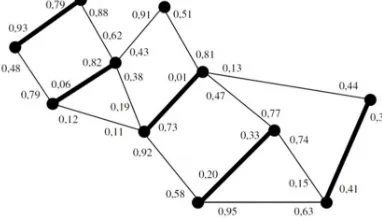
[image:2.595.297.511.76.257.2]The following figure shows an example of maximal matching (edges in bold) in the graph.
Figure 1: Example Of Maximal Matching Where The Endpoints Of The Bold Edges Are Matched.
On the other side, a spanning tree T of a
connected and undirected graph G is a tree
composed by all vertices and a sub-set of the set E.
A minimum spanning tree of G is a selection of
edges of G that form a minimum spanning tree [7].
[image:2.595.101.292.401.511.2]That is, every vertex lies in the tree, but no cycles (or loops) are formed. The following figure shows an example of the minimum spanning tree obtained from the graph in Figure 1.
Figure 2: Minimum Spanning Tree Of The Graph Of The Figure 1.
2.2 Model and Assumptions
In this paper, we consider the standard model of communication networks point-to-point [8]-[9]. A network is described by a undirected and connected
graph G=(V,E) where V is the set of all vertices of
G and E is the set of edges linking those vertices. The vertices represent the nodes or network processes, the edges represent the communication links between processes.
We assume that each process has a local unshared memory with a bounded capacity and at least one processor. It can only communicate directly with its neighbours by message exchanges. Also, it is able to distinguish between its ports (i.e. a port from which a message is received or sent). The identities (IP addresses on the Internet) of other processes, in particular those of its neighbours, are unknown (local orientation).
For our study, processes communicate in the network only by message exchanges. The exchange of messages is done without loss or alteration or modification. How exchanges between processes are carried out determines the type of network.
A global clock is common to all processes, and we admit that every event that takes place at a certain time is of zero duration, and we suggest that communications take no time (i.e. the period between the decision of a vertex and notification to its neighbours is equal to 0).
677
3. ALGORITHM
The main aim behind this study is to suggest and analyze a distributed algorithm for creating a minimum spanning tree based on handshake algorithm.
Many researches had trait the maximal matching
problem such as MSZ algorithm [10], Kuhn
algorithm [11], Heuberger algorithm [12] and HS
algorithm [5]. In MSZ algorithm the authors
proposed and analyzed a randomized algorithm to get handshakes between neighbours in an anonymous graph, and they also showed the efficiency of their algorithm in several types of graphs.
In HS algorithm, the authors had introduced and
studied a probabilistic distributed algorithm to find a maximal matching. This algorithm is based on random delays which are generated uniformly in the real interval [0, 1]. A handshake takes place between a pair of neighbour processors if both processors are free at the proposed time.
In our proposed algorithm, we use the HS
algorithm because the expected number of handshakes found by this algorithm is substantially greater than that obtained in other known probabilistic distributed algorithms.
So, our algorithm for finding a minimum spanning tree merges two algorithms. The first one is for finding the handshakes between a set of pairs of vertices, whereas the second one is executed to link the founded handshakes with the isolated vertices to make one acyclic graph. This algorithm can be considered as a distributed various of the Borüvka algorithm [2].
However, we enrich the HS algorithm by some
instructions in order to construct an acyclic graph which links all the handshakes and the remaining
isolated vertices. As proven in [5], the HS
algorithm provides a maximal number of handshakes. The informal description of this algorithm is as follows:
• For a given graph G, each vertex ∈
generates uniformly a random variable for each neighbour. Those random variables generated by a vertex for its neighbours belong to the real interval [0, 1]. They represent the waiting times to get a handshake with its neighbours. The number of waiting times generated by all this vertices is two-times the number of the edges (i.e., one waiting times for each half-edge). The
vertex agenda is the set of all waiting times proposed by this vertex to its neighbours.
• When the clock reaches the smallest time of all
the generated times, a handshake occurs between the vertex that provides this time and the neighbour who is assigned to it. So the two vertices remove all other edges with the other neighbours. Indeed, their neighbours remove from their agendas the times that they offer to these two vertices which had a handshake.
• The algorithm continues to run through the
remaining process equipped with modified agendas until the lap time (unit time) expired. The formal description of our algorithm is given in Algorithm 1.
We define the following parameters for each vertex v ∈ G:
• tu,v the waiting time for a vertex v to get a
handshake with a neighbour u. It is a random variable uniformly chosen by the vertex v in the real interval [0, 1] for a neighbour u.
• Av the agendas of v. It is the set of all values
generated by v to its neighbours.
• , ∪ \ ,, ,. The set of
shared agendas between the two neighbours v
and u.
• the minimum waiting time of the vertex v.
This value is equal to: min .
• the minimum waiting time of all the value
generated by the neighbours u and v. This value
is equal to: min ,.
• , the state of the edge {v, u}, it is a Boolean
variable initiated to false (i.e. the edge {v, u} is not initially in the minimum spanning tree).
When it becomes true, the edge {v, u} is in the
minimum spanning tree.
• the state of the vertex v. If it is true, the
vertex v is in the minimum spanning tree.
• is the set of the minimum waiting times
proposed by vertices. This set is used to be sure that no cycle is formed.
• , 1, 2 the form of the
678 Our algorithm works as follows:
Each vertex v waits until one of the following
events happened:
• If v receives the message 0, ∅, ∅ from
a neighbour u then it removes the value
, from its set .
• If v receives the message 1, ,
from a neighbour u then it changes the states
and ,to true. There is a handshake
between v and u. Consequently, the edge {v, u}
belongs to the minimum spanning tree. In this case, one of the two following cases occurs: 1. If ∈ where min#, $,
then the edge {v, u'} will belong to the
minimum spanning tree. The
message 2, ∅, will be sent
to u' to inform it that the edge {v, u'} will belong to the minimum spanning tree. Then
, affects the value of .
2. Otherwise, v sends the message
3, ∅, to u to give it the option of choosing the edge that will connect
with the edge {v, u} in the minimum
spanning tree. In the same time, v sends the
message 0, ∅, ∅ to others.
• If v receives the message 2, ∅,
from a neighbour u then if ∪
∅,
which means that the edge {v, u} doesn't
construct any cycle, v sends the
message 4, ∅, ∅ to u and changes its
state , to true.
• If v receives the message 3, ∅,
from a neighbour u then v adds the set to
and sends the message 2,
∅,
to a neighbour u' which verify
, .
• If v receives the message 4, ∅, ∅
from a neighbour u then v turns its state , to
true. However, this test is to guarantee that no
cycle will be created by adding the edge {v, u}
to the minimum spanning tree.
• If , and (true then v turns the states
and , to true and sends the
message 1, ,
to u such that
, . In addition, v sends
0, ∅, ∅ to all other neighbours. There is a
handshake between v and u.
• Otherwise (* t = 1 which means that v is an
isolated vertex *), v sends the message
2, ∅, ∅ to u such that , min .
Consequently, v changes its states the states
679
4. ALGORITHM ANALYSES
The algorithm starts by generating uniformly
2|E| real independent random variables in the real
interval [0, 1]: a random variable for each half edge. We assume that (2|E|)! permutations on the set of these real numbers have the same probability. This is the main assumption on which is based the result of our analysis.
In order to maintain this hypothesis, we simply
assume that, for each edge , ∈ , the
algorithm will produce two continuous r.v. ,and
,, we assume that those r.v. associated to the
edges are independents. The probability to generate the same values tends to zero.
The first handshake takes place on an edge
, , if at least one of the two associated
random variables. ,or , is minimal in the
whole graph. Thus, for the first handshake of G,
each edge has the same chance 1/|E| to be chosen.
The attribution of the first handshake on the edge {u, v} implies that the incident edges of the vertices
u and v are removed from the graph except the edge
{u, v}. The algorithm continues to run on the residual graph (preserving the random generation of the remaining edges) until only the edges on the handshakes occur remain.
The number of handshakes in a round is simply the total number of edges on which handshake are
assigned. We denote by N(G) this number. It takes
the value 0 with probability 1 if ) ∅, the value 1
with probability 1 if |E| = 1. Generally, it takes a value of the set of all maximal matching
cardinalities in G, with a certain probability.
4.1 Sub-Spanning Trees
Proposition 4.1: Let G= (V, E) be a graph with |V|=n and |E|=m, the probability to have initially k sub-spanning trees is:
Pr, - భ
∑ Pr, - / 1 , ∀- 1 1,
where G is a residual graph that contains all the
edges of G except e and it incident edges.
4.2 Expected Number of Sub-Spanning Trees
In a randomized distributed algorithm, an important parameter which measures the efficiency is the expected number of events which can take place in a unit of time. We study this parameter for
our new algorithm. So, let ॱ(G) be the
mathematical expectation of N(G) and let 2 a
r.v. that equals 1 if the edge e={v, u} is in the
minimum spanning tree and 0 otherwise, for the edge e in the graph G = (V, E).
Proposition 4.2: Initially, the number of the sub-spanning trees can be written as:
, 3 2
∈
.
Proposition 4.3: The mathematical expectation of the number of sub-spanning trees, noted
4(N(G)), is given by the following formula:
4, 3 -56
,
3 4#2 $.
∈
It is clear that the construction of the spanning
tree of the graph G is done by merging several
sub-spanning trees. The sub-sub-spanning trees are basically produced by the edges where the handshakes are occurred. Initially the number of sub-spanning trees is equal to the number of maximal matching. Through the time the algorithm adds to those sub-spanning trees the isolated vertices and sometimes merges some one of them. In the end of the algorithm all sub-spanning trees are merged on one minimum spanning tree. We recall that the edges that used to merge the handshake edges are not
used in the HS algorithm.
4.3 Minimality Proof
It is easy to see that the spanning tree produced is
minimal. Indeed, the HS algorithm selects the
edges, as a sub-spanning tree, which has the minimum values in the whole graph. However, the second step uses the minimum edges to merge them with the spanning tree. Consequently, the produced spanning tree is minimal.
4.4 Message Complexity
One of the parameters of complexity measures, we found the number of exchanged messages. In the next we will calculate the number of the maximum exchanged messages for the algorithm of the spanning tree construction. The number of exchanged messages depends on each topology. So we will analyze this number in some topologies.
4.4.1 Star Graph
In graph theory, a star graph is a complete
bipartite graph with one internal node and k-1
leaves. Let the graph G=(V, E) be a star graph such
that V represents the set of its vertices and E
680 matching is equal to 1, for odd or even number of vertices.
• For an odd star, let |V|=n and |E|= n-1
where 7 ∈ 8. The cardinal of maximal
matching is equal to 1. So we need exactly
another n-2 edges to reconstruct the minimum
spanning tree.
• For an even star, let |V|=n and |E|=n-1 where
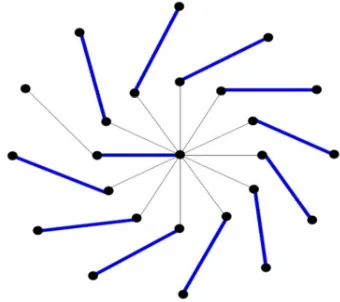
7 ∈ 8. We need exactly n-2 edges to reconstruct the minimal spanning tree since the cardinal of maximum matching is equal to 1. The Figure 3 shows an example of a maximal
[image:6.595.116.284.316.477.2]matching in a star graph with |V|=13.
Figure 3: Example Of A Maximal Matching In A Star Graph.
Proposition 4.4: The upper-bound of the number of maximal exchanged messages in the star graph,
noted ,7, is given by the following formula:
9
,1 0
,2 2
,7 : 27 / 1, ∀7 1 3,
where n is the size of the graph (|V|=n).
Proof: Let the graph G=(V, E) be a star graph (|V|=n, |E|=m) and let ; be the arithmetic
sequence that verify: ; 5, and ; 27 / 1.
For n=3, it is clear that the number of maximal
exchanged messages for |V|=3 is less than or equal
to 5 ,3 : 5. By adding a new vertex this
number will increase by 2. However, for n=4, the
number of maximal exchanged messages
,4 is equal to 7. Let propose now that
,7 : 27 / 1 and prove that ,7 =
1 : 27 = 1. In the worst case by adding a new
vertex to G, the number of maximal exchanged
messages will increase by 2.
So, ,7 = 1 : 27 / 1 = 2 27 = 1 which proves the proposition.
4.4.2 Chain Graph
In graph theory, a chain graph is a sequence of edges that connect a set of vertices which, by most definitions, are all distinct from one to another and they are not creating any cycle. Let the graph G=(V, E) be a chain such that V represents the set
of its vertices and E represents it edges.
We distinguish between several cases:
• For an odd chain, let |V|=n and |E|=n-1 such
that 7 ∈ 8. The cardinal of maximum matching is equal to >
2?. So we need exactly
another >
2?edges to reconstruct the minimum
spanning tree.
• For an even chain, let |V|=n and |E|=n-1 such
that 7 ∈ 8.
- In the bets case the cardinal of maximal
matching is equal to2. So we need exactly
another
2
1
edges to reconstruct theminimum spanning tree.
- In the worst case, the cardinal of maximal
matching is2
1
. So we need exactlyanother 2
edges to reconstruct the minimum
spanning tree.
The Figure 4 presents an example of a maximal
matching in a chain with |V | = 7.
681 Proposition 4.5: The upper-bound of the number of maximal exchanged messages in the chain graph,
noted ,7, is given by the following formula:
@,1 0
,7 : 37 / 4, ∀7 1 2,
where n is the size of the graph (|V| = n).
Proof: Let the graph G = (V, E) be a chain (|V | =
n and |E| = n - 1) and let ; be the arithmetic sequence that verify:
; 2, and ; 37 / 4, ∀7 1 2.
For n=2, it is clear that the number of maximal
exchanged messages for is less than or equal to 2 (,2 : 2). By adding a new vertex this
number will increase by 3. However, for n=3, the
number of maximal exchanged messages (,,)
is equal to 5. Let propose now that ,7 :
37 / 4 and prove that ,7 = 1 : 37 / 1. In the worst case, the addition of a new vertex to G, the number of maximal exchanged messages will
increase by 2. So, ,7 = 1 : 37 / 4 = 3
37 / 1 this proves the proposition.
4.4.3 Ring Graph
In graph theory, a ring is a graph consists of a sequence of vertices starting and ending at the same vertex, with each two consecutive vertices in the sequence adjacent to each other in the graph.
We distinguish between several cases (even, odd, best case, worst case):
• For an odd ring, let |V|=|E|= n, such that
7 ∈ 8. The cardinal of maximum matching is equal to >
2?. So we need exactly another > 2?
edges to reconstruct the spanning tree.
• For an even ring, let |V|=|E|=n, such that
7 ∈ 8. In the bets case, the cardinal of
maximum matching is equal to2 . So we need
exactly another
1
edges to reconstruct thespanning tree.
The Figure 5 shows an example of a maximal
[image:7.595.296.514.75.294.2]matching in a ring with |V| = 5.
Figure 5: Example Of A Maximal Matching In A Ring Graph.
Proposition 4.6: The upper-bound of the number of maximal exchanged messages in the ring graph,
noted ,7, is given by the following formula:
@,1 0
,7 : 47 / 6, ∀7 1 2,
where n is the size of the graph.
4.4.4 Double-Star Graph
Let G=(V, E) be a double-star graph where |V|=n and |E|= n-1. In this case the maximal matching is equal to >
2?. So we need exactly another > 2? edges
to reconstruct the minimum spanning tree.
The Figure 6 presents an example of a maximal
matching in a double-star graph with |V|=25.
[image:7.595.330.500.540.691.2]682 Proposition 4.7: The upper-bound of the number of maximal exchanged messages in a double-star graph, is given by the following formula:
@,1 0
,7 : 37 / 4, ∀7 1 2
where n is the size of the graph.
5. CONCLUSION
In this paper, we have introduced and analyzed a probabilistic distributed algorithm for the minimum spanning tree construction based on a handshake algorithm. According to our algorithm, each vertex executes, firstly, a set of instructions and decides if it is matched or not.
The edges on which the handshakes occurred constitute a set of sub-spanning trees. Moreover, the second step of the proposed algorithm is lunched to merge those sub-spanning trees until reduce their number to one. The residual graph obtained is the minimal spanning tree that we are looking for.
As perspective of this work, we attend to calculate both the lower and upper bounds of the expectation time duration of the minimum spanning tree construction, and this for any type of graph. In addition, we attend to modelize the process of the minimum spanning tree construction by a Markov-chain process in continuous time.
REFRENCES:
[1] Y. Matsumoto, N. Kamiyama, and K. Imai, “An approximation algorithm dependent on edge-coloring number for minimum maximal
matching problem,” Information Processing
Letters, vol. 111, no. 10, pp. 465 – 468, 2011. [2] G. Bergantiños and J. Vidal-Puga, “The folk
solution and Borüvka’s algorithm in minimum
cost spanning tree problems,” Discrete Applied
Mathematics, vol. 159, no. 12, pp. 1279 – 1283, 2011.
[3] Z. Ning and W. Longshu, “The complexity and algorithm for minimum expense spanning
trees,” Procedia Engineering, vol. 29, no. 0, pp.
118 – 122, 2012, 2012 International Workshop on Information and Electronics Engineering. [4] C. Martel, “The expected complexity of prim’s
minimum spanning tree algorithm,” Information
Processing Letters, vol. 81, no. 4, pp. 197 – 201, 2002.
[5] A. El Hibaoui, Y. Métivier, and N. Z. A. Robson, J.M.and Saheb, “Analysis of a randomized dynamic timetable handshake algorithm,” 2009.
[6] R. Diestel, Graph Theory, second
edition,electronic ed. Berlin: Springer, February
2000.
[7] M. C. Golumbic, Algorithmic graph theory and
perfect graphs, 2nd ed. Elsevier, 2004.
[8] G. Tel, Introduction to distributed algorithms. Cambridge University Press, 2000.
[9] C. Lavault, Évaluation des algorithmes distribués
: analyse, complexité, méthodes, ser. Collection
Informatique. Paris: Hermès, 1995 (53-Mayenne.
[10] Y. Métivier, N. Saheb, and A. Zemmari, “Analysis of a randomized rendezvous
algorithm,” Inf. Comput, vol. 184, no. 1, pp.
109–128, 2003.
[11] D. Kühn, D. Osthus, and T. Townsend, “Fractional and integer matchings in uniform
hypergraphs,” European Journal of
Combinatorics, vol. 38, no. 0, pp. 83 – 96, 2014.
[12] C. Heuberger and S. Wagner, “The number of
aximum matchings in a tree,” Discrete