Georgia State University Georgia State University
ScholarWorks @ Georgia State University
ScholarWorks @ Georgia State University
Managerial Sciences Dissertations Department of Managerial Sciences
Summer 8-2010
Opportunistic Adaptation and New Venture Growth: Exploring the
Opportunistic Adaptation and New Venture Growth: Exploring the
Link between Cognition, Action and Growth
Link between Cognition, Action and Growth
Andreea Kiss
Georgia State University
Follow this and additional works at: https://scholarworks.gsu.edu/managerialsci_diss
Part of the Management Sciences and Quantitative Methods Commons
Recommended Citation Recommended Citation
Kiss, Andreea, "Opportunistic Adaptation and New Venture Growth: Exploring the Link between Cognition, Action and Growth." Dissertation, Georgia State University, 2010.
https://scholarworks.gsu.edu/managerialsci_diss/20
Permission to Borrow
In presenting this dissertation as a partial fulfillment of the requirements for an advanced degree from Georgia State University, I agree that the Library of the University shall make it available for inspection and circulation in accordance with its regulations
governing materials of this type. I agree that permission to quote from, or to publish this dissertation may be granted by the author or, in his/her absence, the professor under whose direction it was written or, in his absence, by the Dean of the Robinson College of Business. Such quoting, copying, or publishing must be solely for scholarly purposes and does not involve potential financial gain. It is understood that any copying from or publication of this dissertation which involves potential gain will not be allowed without written permission of the author.
Notice to Borrowers
All dissertations deposited in the Georgia State University Library must be used only in accordance with the stipulations prescribed by the author in the preceding statement.
The author of this dissertation is:
Name: Andreea N. Kiss
Address: J. Mack Robinson College of Business; 35 Broad Street, P.O. BOX 4014, Georgia State University, Atlanta, GA, 30303
The director of this dissertation is:
Pamela S. Barr
Department of Managerial Sciences Robinson College of Business Georgia State University 35 Broad Street, Suite 1020 Atlanta, Georgia 30303
Users of this dissertation not regularly enrolled as students at Georgia State University are required to attest acceptance of the preceding stipulations by signing below. Libraries borrowing this dissertation for the use of their patrons are required to see that each user records here the information requested.
OPPORTUNISTIC ADAPTATION AND NEW VENTURE GROWTH: EXPLORING THE LINK BETWEEN COGNITION, ACTION AND GROWTH
BY
ANDREEA NOEMI KISS
A Dissertation Submitted in Partial Fulfillment of the Requirements for the Degree
of
Doctor of Philosophy
in the Robinson College of Business
of
Georgia State University
GEORGIA STATE UNIVERSITY
ROBINSON COLLEGE OF BUSINESS
Copyright by
ANDREEA NOEMI KISS
ACCEPTANCE
This dissertation was prepared under the direction of the candidate‟s Dissertation
Committee. It has been approved and accepted by all members of that committee, and it has been accepted in partial fulfillment of the requirements for the degree of Doctor in Philosophy in Business Administration in the Robinson College of Business of Georgia State University.
________________________ Dean H. Fenwick Huss Robinson College of Business
Dissertation Committee:
__________________________ Chair Pamela S. Barr
_________________________ Denis A. Gregoire
________________________ Wlliam C. Bogner
_______________________ Edward Rigdon
iv
ACKNOWLEDGEMENT
First, I would like to thank my dissertation chair, Pamela Barr, for her continued
intellectual support and guidance in all aspects related to this dissertation. I would also
like to express my gratitude to the rest of the members of my committee: Denis Gregoire,
William Bogner and Edward Rigdon for their insightful comments and for trusting that I
can accomplish whatever task at hand.
My husband, Tudor Bodea, deserves special recognition for the invaluable moral
and intellectual support he showed me throughout the doctoral program and in particular
during the dissertation process. His technical advice and coding skills have greatly
improved the statistical analyses performed in this dissertation and contributed to the
timely completion of the dissertation.
I would also like to thank my parents and my brother, Dodi, for their warm and
unconditional support in all aspects of my life and, in particular, during the critical times
when I needed help in fulfilling my role as a mother.
I would also like to thank my office-mate, Dave Williams, for his help in the
content analysis process but more importantly for his friendship throughout the trying
PhD years. My gratitude also goes to Olga Petricevic, Vladislav Maksimov and Lucy
McClurg for their help with the categorization task.
I would also like to acknowledge the financial support provided through the
Dean‟s office at the J. Mack Robinson College of Business in the form of the Clyde
Kitchens/Thoben Elrod/Delta Sigma Pi doctoral fellowship.
Finally, I would like to dedicate this dissertation to my son, Victor, and in
v ABSTRACT
OPPORTUNISTIC ADAPTATION AND NEW VENTURE GROWTH: EXPLORING
THE LINK BETWEEN COGNITION, ACTION AND GROWTH
By
ANDREEA NOEMI KISS
30 JUNE, 2010
Committee Chair: Dr. Pamela S. Barr
Major Department: Managerial Sciences
This dissertation introduces the model of opportunistic adaptation to explain new venture
growth. In established firms processes of change and adaptation usually imply a
transition from one steady-state strategy to another and a problem oriented perspective as
firms change in response to potential threats to their current positions. However, in the
context of new ventures, adaptation is less about moving from one existent strategy to
another and more about the entrepreneur‟s effort to reach a steady state for the first time
by continuously experimenting and combining resources in creative and innovative ways.
The model of opportunistic adaptation rests on three key assumptions: 1.) new venture
growth results from actions grounded in an opportunistic (proactive) logic; 2.)
entrepreneurial cognition is viewed as an antecedent to all organizational actions leading
to growth; 3.) the relationship between entrepreneurial cognition and action is influenced
vi qualitative data on new ventures founded between 1996 and 2006 in technology intensive
industries. The results provide partial support for the notion of opportunistic adaptation as
a process in which entrepreneurial cognition, firm and industry related factors are closely
intertwined. The results of the dissertation suggest that some aspects of entrepreneurial
cognition, such as entrepreneurial schema focus have a more direct effect on actions
related to new venture growth than others whose effect is strongly moderated by
contextual influences such as industry growth and social network heterogeneity. This
dissertation also finds that not all types of organizational actions associated with an
opportunity logic lead to new venture growth. Of the three action types included in the
model (fast, diverse and frequent) only action diversity was found to have a positive
impact on new venture growth. Theoretical implications of the study results for both the
literature on new venture growth and the literature on organizational adaptation, as well
vii TABLE OF CONTENTS
CHAPTER I: INTRODUCTION ... 1
CHAPTER II: LITERATURE REVIEW ... 10
2.1 NEW VENTURE GROWTH ... 10
2.1.1 Scholarly Perspectives on New Venture Growth ... 11
2.1.2 The Ecological Perspective ... 12
2.1.3 The Environmental Perspective ... 17
2.1.4 The Strategic Content Perspective ... 20
2.1.5 The Entrepreneur Characteristics Approach ... 22
2.1.6 Forms of New Venture Growth ... 25
2.2 CONCLUSIONS AND RESEARCH QUESTIONS ... 28
2.2.1 Contributions of Existing Research ... 28
2.2.2 Unresolved Research Issues ... 29
CHAPTER III: THEORY DEVELOPMENT. MODEL AND HYPOTHESES ... 33
3.1 ORGANIZATIONAL ADAPTATION ... 33
3.1.1 Models of Adaptation ... 34
3.1.2 The Cognitive View of Organizational Adaptation ... 37
3.2 THE MODEL OF OPPORTUNISTIC ADAPTATION ... 43
3.3 HYPOTHESES ... 45
3.3.1 The Impact of Schema Complexity on Speed, Frequency and Diversity of Organizational Actions ... 45
3.3.2 The Impact of Schema Focus on Speed, Frequency and Diversity of Organizational Actions ... 47
3.3.3 The impact of Proactive Causal Logic on Speed, Frequency and Diversity of Organizational Actions ... 50
3.3.4 The Moderating Effect of Resource Availability on the Influence of Schema Attributes on Organizational Actions ... 53
viii 3.3.6 The Moderating effect of Social Networks on the Influence of Schema
Attributes on Organizational Actions ... 59
3.3.7 The Impact of Speed, Frequency and Diversity of Organizational Actions on New Venture Growth ... 63
3.4 SUMMARY ... 67
CHAPTER IV: RESEARCH METHOD ... 68
4.1 POPULATION AND SAMPLE ... 68
4.2 DATA COLLECTION METHODS ... 72
4.2.1 Data Collection: Entrepreneurial Cognition ... 75
4.2.3 Data Collection: Organizational Actions ... 81
4.3 MEASUREMENT ... 82
4.3.1 Dependent Variables ... 82
4.3.2 Independent Variable ... 85
4.3.3 Moderators ... 87
4.3.4 Control Variables ... 90
4.4 SUMMARY ... 92
CHAPTER V: RESULTS ... 93
5.1 DATA SCREENING AND DESCRIPTIVE STATISTICS ... 93
5.2 TESTS OF HYPOTHESES - INFLUENCE OF ENTREPRENEURIAL COGNITION ON DIVERSITY, FREQUENCY AND SPEED OF ORGANIZATIONAL ACTIONS ... 97
5.3. TESTS OF HYPOTHESES - NEW VENTURE GROWTH ... 105
CHAPTER VI: DISCUSSION ... 108
6.1 DISCUSSION OF THE RESULTS AND THEIR SPECIFIC IMPLICATIONS 108 6.1.1 How do new ventures grow? The model of opportunistic adaptation ... 108
6.1.2 The relationship between entrepreneurial cognition and new organizational actions ... 113
6.1.3 The effect of resource slack, industry growth and social network heterogeneity on the relationship between cognitive characteristics and new venture action... 118
6.2 GENERAL CONTRIBUTIONS ... 126
ix
6.2.2 Contributions to the Organizational Adaptation Literature ... 130
6.2.3 Practical Implications ... 132
6.3 LIMITATIONS AND DIRECTIONS FOR FUTURE RESEARCH ... 133
REFERENCES ... 137
x LIST OF TABLES
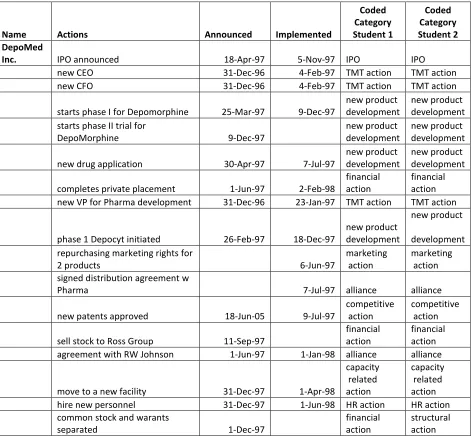
Table 1: Example of causal mapping coding sheet ... 164
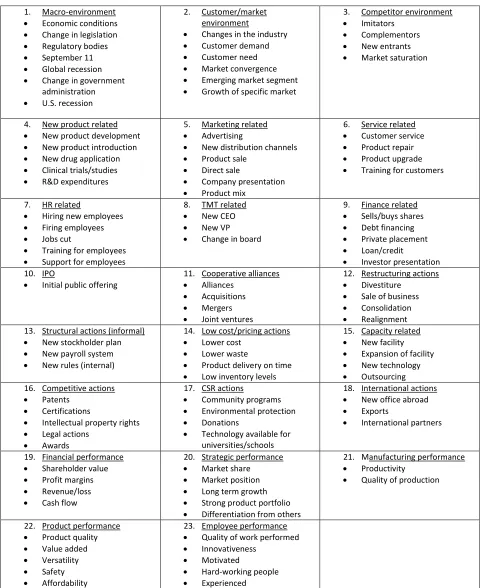
Table 2: Categorization scheme ... 165
Table 3: Example of organizational action coding sheet ... 166
Table 4: Environment, Actions, Performance – Definition of terms ... 168
Table 5: Organizational Actions - Descriptives ... 171
Table 6: Summary of hypotheses ... 172
Table 7:Descriptive statistics and correlations ... 174
Table 8: Direct and moderated effects of schema attributes on organizational actions .. 175
Table 9: Direct effects of organizational actions on sales and employment growth ... 176
xi LIST OF FIGURES
Figure 1: A model of opportunistic adaptation and new venture growth ... 162
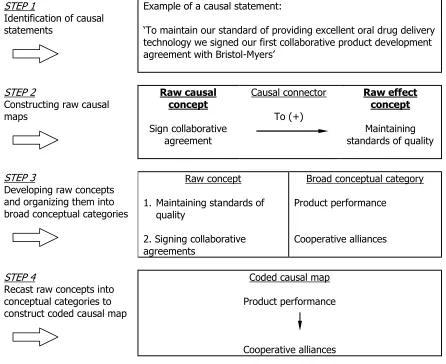
Figure 2: An illustration of the causal mapping procedure (adapted from Nadkarni and
Narayanan, 2007) ... 163
Figure 3: Causal map example ... 167
Figure 4: The effect of industry growth on the relationship between entrepreneurial
schema complexity and diversity of organizational actions ... 178
Figure 5: The effect of industry growth on the relationship between entrepreneurial
schema complexity and frequency of organizational actions ... 178
Figure 6: The effect of industry growth on the relationship between entrepreneurial
schema focus and frequency of organizational actions ... 179
Figure 7: The effect of industry growth on the relationship between proactive causal logic
and frequency of organizational actions ... 179
Figure 8: The effect of social network heterogeneity on the relationship between
complexity of entrepreneurial schema and diversity of organizational actions ... 180
Figure 9: The effect of social network heterogeneity on the relationship between
complexity of entrepreneurial schema and speed of organizational actions ... 180
Figure 10: The effect of social network heterogeneity on the relationship between
entrepreneurial schema focus and diversity of organizational actions ... 181
Figure 11: The effect of social network heterogeneity on the relationship between
entrepreneurial schema focus on speed of organizational actions ... 181
Figure 12: The effect of social network heterogeneity on the relationship between
proactive causal logic and diversity of organizational actions ... 182
Figure 13: The effect of social network heterogeneity on the relationship between
1
CHAPTER I: INTRODUCTION
The topic of new venture growth has emerged as an important area of inquiry in
the last two decades. Achieving growth has different implications for new ventures than it
has for established firms (Gilbert, McDougall and Audretsch, 2006). While established
firms have already achieved a certain level of viability and survival, new ventures face
various types of liabilities stemming from their size, age, and lack of functional and
facilitating mechanisms such as resources which can significantly reduce their chances
for survival and growth (Cooper, Gimeno and Woo, 1991; Gimeno et al, 1997). At the
same time new and small firms face lower likelihoods of survival if growth is not present
(Freeman, Carroll and Hannan, 1983). This often translates into a higher variance of
growth rates at the new venture level as opposed to variance in established firms‟ growth
where growth is often independent of size and age (Gilbert et al. 2006; Sutton, 1997).
This makes the topic of new venture growth particularly interesting to study.
Prior studies have linked new venture growth to factors such as entrepreneur‟s
characteristics, resources, strategy, industry and organizational structure and systems.
Educational background (Sapienza and Grimm, 1997), industry experience (Eisenhardt
and Schoonhoven, 1990; Cooper, Gimeno-Gascon and Woo, 1994) and prior start-up
experiences (Baum et al., 2001) are examples of entrepreneur characteristics that have
been analyzed in the context of new venture growth. Resources such as human and
financial capital (Birley, 1987; Cooper et al., 1994) are considered necessary for
2 establishing a certain level of legitimacy for the new venture (Ostgaard and Birley, 1996).
In addition to individual and firm level factors, the stage of the industry, emerging or
growing markets and industry velocity, have been found to have strong implications for
new venture growth as well (Covin, Slevin and Covin, 1990; Eisenhardt and
Schoonhoven, 1990). Furthermore there is increasing evidence that suggests that strategic
factors (market related, competitive related and managerial) impact the survival and
growth chances of new ventures (Bruderl, Preisendarfer and Ziegler 1992; Lieberman and
Montgomery, 1988). However, studies directly linking strategy types to new venture
growth have mostly produced equivocal results: this prompted scholars to argue for a
contingency or “fit” perspective which takes into account resources and industry
contexts, and which better reflects the relationship between strategy and new venture
growth (Chandler and Hanks, 1994; Eisenhardt and Schoonhoven, 1990)
Despite these advances, a major weakness of prior studies on new venture growth
is a lack of attention to the process leading to it. For example, though decisions made by
entrepreneurs are thought to be important, most empirical studies link entrepreneurial
characteristics or resources directly to growth outcomes. These studies have produced
equivocal results (Gilbert et al, 2006) suggesting that perhaps neither resources nor
strategies affect growth directly (Edelman, Brush and Manolova, 2005) and that other
factors might intervene in the process of new venture growth. In short, the manner
through which elements such as entrepreneurial characteristics, firm resources and
industry characteristic influence the process of new venture growth is poorly understood.
Though process-oriented research has been limited, some recent research has
3 and growth (Bhide, 2000; Cooper, Gimeno and Woo, 1991; Nicholls-Nixon, Cooper and
Woo, 2000; Slevin and Covin, 1997). This research argues for a departure from
ecological approaches and from the planning school rooted in I/O economics in favor of a
focus on internal processes.Adaptation through continuous adjustment of organizational
systems and products has been advanced as a key component of the process of new
venture survival and growth (Covin and Slevin, 1998; Miller, Lant, Milliken and Korn,
1996; Nicholls-Nixon et al. 2000). New ventures face high levels of uncertainty and
ambiguity in their environments, and they have to choose from a continuously changing
(fleeting) set of opportunities. Adaptation at the new venture level can thus be seen as a
process of continuous change (Brown and Eisenhardt, 1997) in which fast and diverse
actions related to a variety of internal and external dimensions could contribute to new
venture growth.
Despite these important conceptual links between adaptation and growth, the
literature on new venture adaptation is still in its infancy; adaptation or flexibility is often
seen as a quality of the entrepreneur (Boccardelli and Magnusson, 2006; Pitt, 2000) or as
an approach through which changes are made to the initial business ideas (Andries and
Debackere, 2006). Aldrich and Martinez (2001: 25) call the lack of understanding of how
young organizations adapt during the process of identifying strategic opportunities “the
weakest point in the field of entrepreneurship”.
Adaptation processes have received a lot of attention in the strategic management
literature where the focus has been on established firms and on explaining why managers
initiate strategic change (Miller and Friesen, 1980; 1982), how the process progresses
4 Ven and Poole, 1995) and the organizational and environmental factors that influence it
(Dutton and Dukerich, 1991; Greve, 1998; Kraatz and Zajac, 2001; Lant and Milliken,
1992). The emphasis on large established firms reveals processes of change and
adaptation that usually imply the transition from one “steady-state strategy to another”
(Nicholls-Nixon et al., 2000 p: 495). These works also imply a problem oriented
perspective: firms change in response to potential threats to their current positions. In the
context of new ventures, adaptation is less about moving from one existent strategy to
another and more about the entrepreneur‟s effort to reach a steady state for the first time
by continuously experimenting and combining resources in creative and innovative ways
(Stevenson, Roberts and Grousbeck, 1985; Woo et al, 1994). Adaptation processes at the
new venture level can thus be seen as grounded in opportunity logic (Bingham and
Eisenhardt, 2008) where growth may result by capturing opportunities faster, sooner and
more effectively than competitors (Eisenhardt and Martin, 2000; West and Meyer, 1997).
In this dissertation I build on the view of adaptation as an opportunistic process
(Bhide, 2000; Bingham and Eisenhardt, 2008; Miller et al., 1996; West and Meyer, 1997)
and investigate its links to new venture growth. Opportunistic adaptation is a concept that
is particularly appropriate for new ventures that are usually surrounded by high levels of
uncertainty and ambiguity (Bhide, 2000). Opportunistic adaptation is driven not by crises
in a firm‟s environment but by the constant search for opportunities and by the day to day
choices entrepreneurs make (Bingham and Eisenhardt, 2008; Brown and Eisenhardt,
1997 Miller et al, 1996). It is a process intrinsic to the entrepreneur (internally motivated)
rather than driven by perceived threats and failures in the external environment.
5 processes because it implies conscious entrepreneurial choices, imaginative variations
and radical choices (Bhide, 2000).
Although previous entrepreneurship research analyzing new venture strategic
behavior has developed firm-level constructs such as entrepreneurial orientation or
entrepreneurial strategic-posture (Covin and Slevin, 1991; Lumpkin and Dess, 1996) in
an attempt to capture a venture‟s propensity to act on market opportunities, these
concepts do not fully capture the extent to which the process of opportunistic adaptation
is dependent on the entrepreneur and his or her interpretation and information processing
capabilities (Cooper et al., 1991; West and Meyer, 1997). The ability to recognize
opportunity and to aggressively pursue it is most often ascribed to individual
entrepreneurs. As such, this ability is fundamentally shaped by entrepreneurs and their
perceptions (Klepper, 2002). Thus, entrepreneurial cognition in general, and more
specifically the entrepreneurs‟ schemas, become particularly important as these are the
direct result of how entrepreneurs experience and interact with the environment.
Furthermore, entrepreneur‟s mental models can be directly linked to entrepreneurial
behavior or action and are an important component in the process of opportunistic
adaptation. Building on previous literature on managerial cognition and adaptation
(Calori et al., 1994; Eden et al., 1992) this dissertation identifies cognitive complexity,
proactive causal logic and focus as three dimensions of entrepreneurial cognition that are
important for opportunistic adaptation.
Building on the above ideas the aim of this dissertation is to develop and test a
process model of new venture growth by explaining the link between entrepreneurial
6 resources, social networks and the environmental context More specifically, this
dissertation hypothesizes that in the context of new firms, growth can be achieved
through opportunistic adaptation. Opportunistic adaptation is seen as a process in which
cognitive attributes such as complexity, focus of entrepreneurial schemas, and proactive
causal logic are linked to specific organizational actions characterized by diversity,
frequency and speed. I hypothesize that this relationship is strongly influenced by factors
such as availability of resources, heterogeneity of social networks and the industry
context.
Expected contributions of the thesis:
1. This study addresses current weaknesses in the new venture growth literature
(Gilbert et al. 2006) related to a lack of focus on the processes leading to growth.
To address this gap, I use opportunistic adaptation as a guiding mechanism to
explain new venture growth. In the opportunistic model of adaptation,
entrepreneurial cognition is seen as an antecedent of organizational actions,
regardless of their characteristics and orientation. By focusing on a variety of
entrepreneurial actions, this study attempts to move away from an exclusive focus
on internally oriented actions or on organic growth (Delmar, Davidsson and
Gartner, 2003) and by examining speed, frequency and diversity of organizational
actions it provides new insights into how new ventures grow over time.
2. This dissertation‟s modeling of the new venture growth process as a function of
the entrepreneur, resources and environmental constraints answers the call of
recent new venture growth literature that argues for the joint consideration of
7 By considering the joint contribution of several distinct growth related factors and
by linking them to entrepreneurial cognition and action this study advances an
integrative model of the new venture growth process that can more fully explain
new venture growth.
3. This dissertation contributes to the organizational adaptation literature by
exploring the mechanisms on which opportunistic adaptation is based. By
investigating how cognition facilitates fast, diverse and experimental actions and
by analyzing several distinct contingencies of this relationship this dissertation
contributes to the emerging stream of the organizational adaptation literature
arguing for opportunistic and experimental adaptation processes as a departure
from traditional reactive models (Bhide, 2000; Brown and Eisenhardt, 1997
Miller et al, 1996; Nicholls-Nixon et al., 2000).
This dissertation is organized as follows. Chapter II provides a review of the
existing theoretical perspectives that have been applied to new venture growth research.
Particular emphasis is devoted to clarifying the need for an integrative model that
incorporates individual, organizational and environmental factors to explain new venture
growth. Chapter II concludes with a summary of existing new venture growth research
and includes a discussion of the research questions addressed by this dissertation.
Chapter III addresses each of the outstanding research questions listed in Chapter
II. In section 3.1 I discuss existing research on organizational adaptation and growth by
highlighting the fact that most of the existing research focuses on reactive models of
organizational adaptation, driven by threats in an organization‟s environment, with a
8 Section 3.1.1 discusses the cognitive view of organizational adaptation and emphasizes
the need to adopt a cognitive perspective if we are to understand differences in the types
of organizational actions that entrepreneurs are likely to initiate and their subsequent
impact on new venture growth.
Section 3.2 introduces the main components of the model of opportunistic
adaptation. Figure 1 presents a graphical depiction of how various attributes of
entrepreneurial schemas shape the organizational actions entrepreneurs are likely to
initiate and considers the joint influence of factors such as resource availability, industry
context and heterogeneity of social networks. Sections 3.2.1, 3.2.2 and 3.2.3 introduce
this dissertation‟s first set of hypotheses linking structural attributes of entrepreneurial
schemas such as complexity, focus and proactive logic to speed, diversity and frequency
of organizational actions. The subsequent sections (3.2.4, 3.2.5 and 3.2.6) recognize the
importance of moderating factors such as resource availability, industry context and
heterogeneity of social networks on the relationships between structural attributes of
entrepreneurial schemas and organizational actions. Section 3.3 summarizes the
hypothesized relationships between the main components of the model of opportunistic
adaptation.
Chapter IV introduces the research sample, data collection methods,
measurement, and analysis used to test the hypotheses introduced in Chapter III. Section
4.1 identifies the population of interest and highlights factors influencing sample
selection. The next section (4.2) describes the data collection methods used as well as the
procedures undertaken to insure the rigor and integrity of the data collection processes.
9 Chapter V presents the data analysis process and the results of the statistical tests
performed. The chapter is organized into three main sections. The first section (5.1)
presents the data screening steps, the second section (5.2) presents the results for the first
set of dependent variables (i.e. diversity, frequency and speed of organizational actions)
and the third section (5.3) presents the results for the second set of dependent variables
(i.e new venture growth).
The last chapter (Chapter VI) provides an overview of the findings presented in
Chapter V and discusses their implications for theory, practice and future research. The
chapter is organized into three parts. In section 6.1, I discuss the results of the study and
their specific implications for management theory. In section 6.2, I discuss the general
implications of the study for theory and practice. Section 6.3 presents limitations of the
10
CHAPTER II: LITERATURE REVIEW
In this chapter I review the various theoretical perspectives associated with new
venture growth. The chapter comprises of two major sections. The first section provides
an overview of the new venture growth literature. The main purpose of this section is to
provide a clear conceptualization of the notion of growth and the factors associated with
it and to summarize the key insights provided by various perspectives on growth. The
second section focuses on unresolved issues in the literature. As such, this last section
introduces the main research questions of the dissertation.
2.1 NEW VENTURE GROWTH
Approximately 600, 000 new ventures are formed in the United States each year.
Most of them are out of business within five years, and only about 3% achieve high
growth (Eckhardt and Shane, 2010). The question of why some new firms grow and most
do not is thus a central question in the field of entrepreneurship (Bhide, 200; Delmar et al.
2003).
Growth is considered the main indicator of venture success (Baum, Locke and
Smith, 2001; Slevin and Covin, 1997; Low and MacMillan, 1988) and has attracted
considerable attention from scholars in entrepreneurship and strategic management
(Delmar et al., 2003; Mata, 1994; Ostgaard and Birley, 1995; Siegel et al., 1993). Of the
issues that are often debated in the literature on new venture growth, two have strong
theoretical and empirical implications for this dissertation. First, is the issue of factors
11 forms and measures associated with it. Each of these issues is discussed in greater detail
in the sections that follow.
2.1.1 Scholarly Perspectives on New Venture Growth
Since the original theory of the growth of the firm (Penrose, 1959) scholars have
suggested that factors both external to the organizations, such as the environment
(Aldrich, 1990) and internal to the organization, such as resources and strategy
(Wernerfelt, 1984; Zahra et al., 2000) explain the reasons for why some firms grow while
others do not.
Growth is particularly important in new ventures. In the absence of growth, new
firms are confronted with a lower likelihood of survival (Freeman, Carroll and Hannan
1983). Despite the importance of growth, new ventures are much less likely than
established firms to achieve it. The higher rates of failure have been linked to a number
of issues that are particular to new ventures. These issues are discussed below as they
appear in each of the major perspectives associated with new venture growth. New
venture growth related perspectives are presented in chronological order but can also be
viewed as introducing different levels of analysis starting with a broad, population level
of analysis and ending with the individual level of analysis. Table A summarizes the
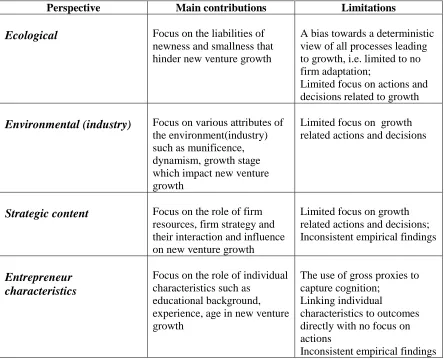
main contributions and limitations of each of the perspectives and the following sections
12 Table A: Different perspectives on new venture growth
Perspective Main contributions Limitations
Ecological Focus on the liabilities of
newness and smallness that hinder new venture growth
A bias towards a deterministic view of all processes leading to growth, i.e. limited to no firm adaptation;
Limited focus on actions and decisions related to growth
Environmental (industry) Focus on various attributes of the environment(industry) such as munificence, dynamism, growth stage which impact new venture growth
Limited focus on growth related actions and decisions
Strategic content Focus on the role of firm resources, firm strategy and their interaction and influence on new venture growth
Limited focus on growth related actions and decisions; Inconsistent empirical findings
Entrepreneur characteristics
Focus on the role of individual characteristics such as
educational background, experience, age in new venture growth
The use of gross proxies to capture cognition;
Linking individual
characteristics to outcomes directly with no focus on actions
Inconsistent empirical findings
2.1.2 The Ecological Perspective
Population ecology models (Carroll, 1983; Freeman and Hannan, 1983; Hannan
and Freeman, 1977; 1984) provide potentially powerful explanations for organizational
birth, evolution and mortality. These models are based on the Darwinian model of
evolution which focuses on variation, selection, and retention. Central issues in this
perspective are the role of structural inertia in constraining adaptation, the classification
of organizational species and the important role of the environment in determining
13 new or changed organizational forms occurs as a result of environmental constraints and
inertia stemming from a firm‟s sunk costs, communication structures, internal politics
and the dominance of institutional norms (Hannan and Freeman, 1977). In the context of
mature, established firms, internal inertial mechanisms are what lead to firms being
selected out. In the context of new ventures, which lack these mechanisms, new venture
age (newness) and size (smallness) become powerful selection mechanisms.
Liability of newness is one of the first concepts associated with both venture
growth and survival, and venture failure (Stinchcombe, 1965). According to
Stinchcombe, liability of newness suggests that new firms fail to grow because of the
lack of resources and capacities that more established organizations have accrued.
Limited resources make new ventures vulnerable to even slight inefficiencies and delays
limiting their ability to shift to more favorable circumstances (Eisenhardt and
Schoonhoven, 1990; Van de Ven, Hudson and Schroeder, 1984).
Liability of newness, and the disproportionately higher likelihood of failure
associated with it (Hannan and Freeman, 1977; 1984) stems from several different areas.
First, new ventures lack routines for efficiently obtaining and using resources, which
translates into a need to develop new organizational roles and systems. New ventures
operate at a disadvantage when compared to existing firms as they must incur costs to
develop these routines or obtain their benefits through outsourcing (Nelson and Winter,
1982; Schoonhoven, Eisenhardt and Lyman, 1990).
Second, new ventures lack a “track record” with external suppliers, buyers and
customers. This lack of history with key constituencies translates into an absence of trust
14 to often rely on relations with partners that they have limited knowledge on (Goldberg,
Cohen and Fiegenbaum., 2003; Stinchcombe, 1965).
Third, the relative scarcity of social capital (Davidsson and Honig, 2003) and the
inability of entrepreneurs to effectively leverage it, because they do not always
understand means-end relationships in their markets, (Van de Ven et al, 1989) also
negatively affect new venture survival chances. Often, social capital is the main link to
those resources necessary for growth and survival () and new ventures operate at a
disadvantage if they engage in entrepreneurial activities without the support that social
linkages provide (Morse, Fowler and Lawrence, 2007). Social networks are the
antecedent to future business networks which are crucial for firm survival and growth
(Dubini and Aldrich, 1991; Johannisson, 1998; Lechner and Dowling, 2003; Raz and
Gloor, 2007). Both strong ties and weak ties are important at first, but in time, weak ties
become more important becasue they offer new growth options in both domestic and
international markets and they do not carry the same constraints and expectations on
entrepreneurs‟ choices as strong ties do (Kiss and Danis, 2008).
Finally, new ventures are also confronted with a lack of financial capital that
makes them more vulnerable to financial stress derived from harsh price competitions or
economic downturns (Oviatt and McDougall, 1994; Vesper, 1990). The norm for new
ventures is thus resource dependency rather than resource sufficiency (Steensma et al.,
2000).
Despite these difficulties, some new ventures do gain access to important
resources that can lead to growth. The two resources examined most often and found to
15 Financial capital influences sales and employment growth in new firms (Cooper et al.,
1994; Lee, Lee and Pennings, 2001) and it allows entrepreneurs to successfully execute
and change strategies. As Zahra and Bogner (2000) showed, access to financial resources
also translates into a greater flexibility to support a variety of strategic options and to
secure subsequent funding from a variety of sources, beyond the personal resources of the
entrepreneurs. Growth can thus be secured through funds borrowed from governmental
institutions (Dahlqvist, Davidsson and Wiklund, 2000), banks or venture capitalists (Lee
et al., 2001) and relatives or friends (Berger and Udell, 1998).
Human capital, or the capabilities and skills of firm employees, allow
entrepreneurs to realize their growth objectives (Chandler and Hanks, 1994). Studies
focusing on the role of human capital in facilitating growth have shown that human
resource needs change as the firm progresses from start-up to mature firm or as the
strategic direction of the firm changes (Birley, 1987; Thakur, 1999). For example, Cardon
(2003) argues that new ventures should rely more on highly skilled workers than mature
firms and should staff ahead of time to sustain expansion.
A second selection mechanism discussed in ecological approaches to growth in
new ventures is the liability of smallness (Carroll, 1983). Ecological studies have
demonstrated that the size of an organization influences its chances of survival and
growth (Aldrich and Auster, 1986). According to Aldrich and Auster (1986) the liability
of smallness emerges from the lack of financial resources and the lack of strong financial
support from creditors due to a heightened perception of risk associated with small size
(Brush, Greene and Hart, 2001). Smallness has also been associated with more acute
16 growth and limited employee support but also an unwillingness to promote and empower
employees due to a limited ability to attract and retain qualified, diverse and competent
personnel (Chowdury and Lang, 1996). Smallness is often coupled with newness but not
all organizations are born small, and the effects of newness on growth and survival are
usually stronger (Aldrich and Auster, 1986); large size does not eliminate liability of
newness.
Previous research has argued that the liabilities of newness and/or smallness can
be mitigated by implementing appropriate organizational systems. For example,
Kazanjian and Drazin (1990) argue that functional specialization is important for growth
because it allows individuals to gain expertise in certain areas and gives them the ability
to handle various circumstances that arise as the firm grows. Functional specialization
has also been associated with higher levels of environmental scanning leading to better
opportunity recognition and more innovative product introductions (Box, White and Barr,
1993; Olson and Bokor, 1995). Flexible, decentralized decision-making structures have
been associated with higher levels of new venture growth (Kazanjian and Drazin, 1990).
As is evidenced in the discussion above, literature in the ecological perspective
has contributed to our understanding of new venture growth by first establishing its
importance for firm survival and then in identifying two major liabilities to the process of
growth – smallness and newness. It has also played an important role in the body of work
that focuses on identifying some of the factors related to growth such as resources, social
networks and organizational systems.
In spite of these important contributions, a major weakness in the ecological
17 to growth. Due to a strong emphasis on inertial mechanisms that inhibit organizational
adaptation, the ecological literature represents a deterministic approach to adaptation and
does not focus on firms that proactively pursue opportunities in their environments. This
results in an incomplete picture of the process associated with new venture growth.
2.1.3 The Environmental Perspective
An accepted tenet in organizational research is that the context or the
environments to which firms need to adapt are multidimensional and pose varying
sources of challenges for organizations (Carter, 1990; Dess and Beard, 1984; Duncan,
1972). These challenges become even more important when added to the liabilities of
newness and smallness that new firms face. Variables such as industry stage or growth,
environmental hostility or geographic location have been advanced as sources of
explanation for variations in new venture growth outcomes. The following sections
discuss each of these dimensions in more detail.
a) Industry growth
Growing or emerging markets have been found to have a significant positive
effect on new venture growth in both early and recent studies on this topic (Brush and
Chaganti, 1998; Covin, Slevin and Covin, 1990; Chandler and Hanks, 1994; Eisenhardt
and Schoonhoven, 1990; McDougall et al., 1994; Robinson and McDougall, 2001).
Growing markets represent munificent environments that allow new firms to secure much
needed resources while also being less taxing on various strategy mistakes new firms are
prone to making. However, a growing or emerging industry is usually not enough to
promote new venture growth; strategic factors play a significant role as well. For example
18 positively related to sales and employment growth while later-stage markets and focused
strategies lead to higher sales growth. New ventures competing in growing environments
have greater opportunities to adapt their products and services to niches in the market that
might lead to growth in sales (Koberg, Uhlenbruck and Sarason, 1996; Siegel et al.,
1993).
b) Environmental hostility
Environmental hostility is another dimension that has been included in studies
that focus on new venture growth (Nicholls-Nixon et al., 2000; Zahra and Bogner, 2000).
Hostility captures the extent to which the firm is threatened by intense interactions with
competitors and volatility in the firm‟s principal industry (Miller and Friesen, 1983). A
hostile environment negatively influences venture employment and market share growth.
High levels of competition in the venture‟s industry (Baum et al., 2001), and its capital
requirements (Robinson and McDougall, 2001) are examples of environmental hostility
dimensions that have been found to have a significant impact on new venture growth.
c) Environmental dynamism
Environmental dynamism reflects both the rate at which the environment changes
and also the extent to which changes are difficult to predict (Dess and Beard, 1984).
These changes are related to entry and exit of competitors, changes in customers‟ needs
or technological shifts that create opportunities and threats and prompt entrepreneurs to
focus on rapid new product introductions (Porter, 1983). For example, Zahra and Bogner
(2000) analyzed the impact of a highly dynamic environment, the software industry, on
19 invested in radical new product introductions and upgrades consistently outperformed
competitors.
d) The local environment
The local environment may also be critical for new venture growth (Romanelli
and Schoonhoven, 2001). An increasing number of studies look at clusters and at the
geographic region as important factors in the process of growth (Folta, Cooper and Baik,
2006; Lechner and Dowling, 2003; Saxenian, 1990; 1994). For example, Folta et al.,
(2006) showed that new firms that compete in high-clustering locations are more likely to
fail than firms competing in other locations because of the added competition they face in
their efforts to procure resources. An inability to procure the resources needed for
survival has a strong impact on subsequent growth. Thus, a geographic location that
facilitates access to these resources becomes extremely attractive.
Others (e.g. Saxenian (1990; 1994); Larson, 1991), however, have shown that
areas like Silicon Valley offer new firms access to financial capital necessary to finance
firm growth that is not available in other regions like inner cities (Porter, 1995) or rural
areas (Green and McNamara, 1987). Cluster regions have also been found to provide
better access to human capital (Hanson, 2000; Porter, 1995 Saxenian, 1994). Highly
skilled workers or workers with specific competences may often be found in cluster
regions. Start-ups that successfully attract these workers can more readily pursue venture
growth objectives (Baum et al., 2001; Chandler and Hanks, 1994; Saxenian, 1990).
All in all the context perspective on new venture growth helps us understand that
new firms cannot be analyzed in dissociation from the environments in which they
20 have been identified as significant influencers of growth related outcomes. Even though
the important impact of these factors has been established, there are some questions left
unanswered as to why the context matters. A process approach that takes into account the
relationship between firm action, the individuals that run it and the environment in which
the firm competes would reveal how contextual variables influence growth related
outcomes. However, process approaches in this stream of the literature are scarce and the
new venture adaptation-growth relationship is thus only partially complete.
2.1.4 The Strategic Content Perspective
The content perspective of new venture growth encompasses works that focus on
the general impact of strategy type (focus, differentiation, low-cost) on new venture
growth, studies that focus on the impact of distinct factors such as resources on new
venture growth, and studies that take contingency based approaches when explaining new
venture growth.
Studies that have considered new venture strategy as a direct factor in the process
of new venture growth have yielded mixed results. For example, Baum, Smith and Locke
(2001) found that low-cost and focused strategies negatively impacted sales and
employment growth in a sample of manufacturing firms, while differentiation strategies
led to positive outcomes on venture sales and employment. These results contradict
earlier studies (e.g. Siegel, Siegel and MacMillan, 1993) which found that focused
strategies yielded the most positive impact on sales growth. These differences in results
seem to stem from the fact that authors use different measures of growth (sales versus
21 effects of strategies on growth whereas others focus on their long-term effects (Gilbert et
al., 2006).
The literature that has considered the impact of slack resources on new venture
growth builds on the seminal work of Penrose (1959). This literature is based on the
assumption that resources controlled by a firm are rarely fully utilized and that the
existent slack creates both incentives and means of expansion. Subsequent empirical
work has offered some support for this assertion by exploring the links between resource
slack and exploratory type of activities (e.g. (Kraatz and Zajac, 2001; Nohria and Gulatti,
1996). However, recent works focusing exclusively on new ventures or small firms argue
that slack has a negative effect on exploration and leads to cautious decision-making, risk
aversion and an administrative approach to firm management as opposed to an
entrepreneurial approach (cf. Mishina, Pollock and Porac, 2004; Tang and Peng, 2003;
Bradley et al., 2010). Still others fail to find any relationships between slack and growth
(Voss et al. 2008).
A different stream of studies suggests that the relationship between growth and
strategy is contingent on factors such as the availability of resources to execute various
strategies (Chandler and Hanks, 1994; Eisenhardt and Schoonhoven, 1990), the stage of
the industry development (McDougall et al., 1994) or the order in which ventures enter
the market and the breadth of their product line (Sandberg and Hofer, 1987). In their
comprehensive study of U.S. semiconductor firms Eisenhardt and Schoonhoven (1990)
show that successful new firm adaptation -as reflected in sales growth- is better explained
through a combination of strategic choice (top-management effects) and environmental
22 The main contribution of the content perspective on our understanding of new
venture growth lies in the fact that it draws attention to the need to take an integrative
approach when explaining new venture growth by simultaneously considering firm and
industry related factors. The content perspective on growth can be viewed as building on
and integrating the ecological and contextual perspectives by often incorporating
variables such as environmental hostility or firm age and size into models that predict
growth. The main weakness of this approach stems from its inconclusive results due to
measurement issues and the reduced explanatory power of strategy variables when
contextual or ecological derived variables are included in the models. These results leave
a host of unanswered questions related to how specific dimensions of the industry and the
firm are linked and influence new venture growth related actions and outcomes. Another
weakness of the content approach is that it provides limited insight in the process of
adaptation that precedes new venture growth by focusing only on a limited range of
industry and firm related factors that influence new venture growth.
2.1.5 The Entrepreneur Characteristics Approach
Prior research on the topic of growth has also examined the role played by the
entrepreneur. In a fashion similar to the upper echelons perspective in which corporations
are regarded as a reflection of their top managers (Hambrick and Mason, 1984), new
ventures are often regarded as extensions of the entrepreneurs. The entrepreneur‟s
personality traits, motivations, attitudes and intentions have all been linked to growth. For
example, personal predispositions such as need for achievement (McClelland, 1965) or
locus of control (Boone, DeBrabander and Van Witteloostujin, 1996; Rotter, 1966) have
23 Early studies linking entrepreneurial characteristics to growth related outcomes
have often produced equivocal or weak results. For example, Johnson‟s (1990)
meta-analysis concluded that need for achievement was one of the most significant trait
predictor of new venture performance, however less than 7% of the variance in new
venture performance was explained by this factor. Traits such as risk-taking propensity
(Brockhaus, 1980) or locus of control (Sexton and Bowman, 1986) had negligible effects
on new venture growth: this prompted scholars to declare the study of entrepreneurs‟
characteristics a dead-end strategy (Gartner, 1989). However, recent studies (e.g. Baum et
al., 2001; Baum and Locke, 2004) show that entrepreneur characteristics have an indirect
rather than a direct impact on the growth of firms.
Factors such as prior related industry experience (Baum et al. 2001; Box et al.,
1993; Cooper, Gimeno-Gascon and Woo, 1994; Eisenhardt and Schoonhoven, 1990;
Siegel et al., 1993), prior start-up experience (Baum et al., 2001; Box et al., 1993) and
educational background (Sapienza and Grimm, 1997) have been shown to have direct
effects on the sales and employment growth of the firm.
Education and background experience are important because they enable
entrepreneurs to obtain and use information and knowledge relevant to the new venture
(Kirzner, 1983) and they provide competencies that influence the decision-making
process (Mullins, 1996; Scherer, Adams and Wiebe, 1989). Prior related experience or
start-up experience provides access to tacit knowledge and capabilities which reduce the
time needed for the new venture to achieve growth (Cooper et al., 1994). Chrisman,
24 and works against the fast adaptation processes that new firms often need to be engaged
in and thus negatively impacts new venture growth.
New ventures are often founded and run by teams of entrepreneurs and team
related characteristics such as tenure, heterogeneity or size have also been investigated in
new venture growth related studies. For example, Eisenhardt and Schoonhoven (1990)
showed that background heterogeneity and the number of the individuals involved in the
founding process are positively related to sales growth. A large team means that
responsibilities are distributed across a greater number of individuals while the
cohesiveness that exists between team members makes communication easier (Ensley,
Pearson and Amason, 2002). Team diversity as a result of differences in age, education
and functional expertise may lead to disagreement regarding goals that need to be
pursued or means to achieve them but may also alleviate the phenomenon of groupthink
(Lant, Milliken and Batra, 1992) and provide interesting, new opportunities for the firms
to pursue (West and Meyer, 1997; Amason et al., 2006; Eisenhardt and Bourgeois, 1988;
1989). Team diversity has also been found to negatively impact decision speed (Miller,
Burke and Glick, 1998) and, to the extent that firms compete in high velocity
environments, might indirectly impact new firm competitiveness (Forbes, 2005).
Taken as a whole, the entrepreneur characteristics approach has the merit of
pointing out several links between individual related variables such as prior experience or
educational background and growth related outcomes. However, linking traits or attitudes
directly to outcomes has lead to weak or inconclusive results thus leaving unanswered
questions regarding the actual influence of individual level variables on new venture
25 the important middle ground made of growth related, organizational actions. As prior
research in strategic management has shown (West and Schwenk, 1996), demographic
characteristics do not always capture managerial (entrepreneurial) mindsets and
alternative approaches that capture mindsets in use are needed. Although entrepreneurial
cognition has been linked to new venture initiation processes, a cognitive approach to the
process through which new ventures grow is currently missing. By including
entrepreneurial cognition in models that use firm and industry level variables to predict
new venture growth, we gain a new appreciation of the nature of relationship between
individual, firm and industry in predicting new venture growth.
2.1.6 Forms of New Venture Growth
The concept of growth is multidimensional in nature (Delmar et al., 2003) and the
heterogeneity of growth outcomes across firms is often attributed in the new venture
growth literature to variations in the type of growth strategies that firms pursue.
Internal or organic growth refers to growth resulting from innovative product and
marketing-related practices that result in the introduction of new products and/or services
(Amason, Shrader and Thompson, 2006; Gilbert et al., 2006). Product innovations refer
to both novel and incremental innovation. Novel product introductions are, however,
more strongly associated with new venture growth performance than incremental
developments (Banbury and Mitchell, 1995; Bruton and Rubanik, 2002). Successful
internal growth at the new venture level is supported by investments in strong
technological capacities and appropriate product development strategies (Siegel et al.,
26 External growth or growth that occurs through acquisitions, reflects an approach
that emphasizes acquisition of competencies and extensions of product and service
offerings through the pursuit of firms in related or complementary markets. High or
rapid-growth ventures in particular, are likely to pursue growth through acquisitions
(Delmar et al., 2003; Hambrick and Crozier, 1985). By acquiring existing firms, new
ventures can benefit from the reputation that the target firms have established in the
market and they can increase their market share (Banbury and Mitchell, 1995). However,
previous research has shown that acquisition activity has a direct impact on growth only
when growth is measured through employment and not necessarily through sales (cf.
Delmar, 2003).
Growth that results from internal or external mechanisms has different outcomes
and, as noted by Penrose (1959), can also impact the speed or regularity with which
growth occurs. Internal growth is more consistent but also slower than external growth.
Internal growth through new product introductions may be immediately reflected in sales
but not necessarily in the firm‟s market share or employment growth. In contrast, external
growth can simultaneously affect growth sales and market share or just employment
growth (Gilbert et al., 2006).
A second type of classification that can be made when investigating new venture
growth is international versus domestic growth (Gilbert et al., 2006). Comparative studies
on this topic are still scarce although there has been an increase in the number of new
ventures that pursue internationalization from inception (e.g. McDougall, 1989) in the
past decades. International activities are seen as important for new venture survival and
27 products abroad (McDougall, 1989; McDougall, Oviatt and Shrader, 1996; Oviatt and
McDougall, 1995). Comparisons of domestic and international new ventures reveal
different impacts on growth outcomes. For example McDougall, Oviatt and Shrader
(1996) found that international new ventures outperformed domestic new ventures in
terms of sales growth but not employment growth. Growth outcomes are also influenced
by the type of market expansion strategies used by new ventures or by the mode of entry
chosen. Market penetration strategies assume that large volumes of products are sold in
the international market by investing in heavy advertising programs and local partners
while market development strategies refer to reactive type of responses in approaching
international markets (Gilbert et al., 2006). Ventures that internationalize through export
and licensing may expect immediate impacts on their sales (Brouthers and Nakos, 2004)
while ventures using foreign direct investment or joint ventures may expect changes in
their employment growth (Zahra and George, 2002). The distinction between
international and domestic expansion is important to fully understand new venture
growth.
In summary, understanding the various forms of growth that firms pursue is
important when building a model of the various antecedents of new venture growth and
linking them to the appropriate growth related outcomes; it allows us to accurately
identify organizational actions and the firm and industry related factors that have the
potential to impact different areas of the firm as captured through different growth
28 2.2 CONCLUSIONS AND RESEARCH QUESTIONS
This chapter outlines and discusses the various perspectives associated with new
venture. Although each of these perspectives reveals key insights, they do not identify the
process associated with new venture growth. As such, existing perspectives are more
valuable for understanding the broad factors that affect growth than for understanding the
complex process that leads to new venture growth. In the next section, I provide a
summary of the key insights emerging from this body of research, then discuss
unresolved research issues and introduce the research questions that direct this
dissertation.
2.2.1 Contributions of Existing Research
First, early studies on this topic, have built on population ecology and
environmental contingency approaches, to identify a series of limitations, such as
liabilities of smallness and newness that new ventures face. These perspectives have
established the important role of growth in building viability for these firms. The focus
on the issues of liability of newness and smallness is important because it provides a
basis from which a range of growth-oriented actions can be assessed and a variety of
growth supporting factors can be identified.
Second, prior research has demonstrated that a host of factors, ranging from
entrepreneurs‟ characteristics to industry context and access to resources and social
networks, influence new venture growth. This body of research is important not just
because it empirically validates several direct links between these factors and new
venture growth, but also because it points to the need to approach the topic of new
29 account the interactive, moderating effects that various factors have on new venture
growth.
Finally, prior studies on this topic have also identified various forms of growth
that new ventures can pursue. Recognizing that different mechanisms are involved in the
organic and domestic processes of growth and in external and international process of
growth is a step towards clearly separating these mechanisms and linking them to various
growth related outcomes. Attempts to explain this impact still yield conflicting results
due to inconsistencies in the measurement approach and suggest that future studies
should focus on linking growth mechanisms with the appropriate growth related
outcomes. More specific research issues that remain to be solved and that can contribute
to the future development of the new venture growth literature are identified in the
following section.
2.2.2 Unresolved Research Issues
As noted earlier in this chapter, one of the goals of research on new venture
growth is to develop models that both describe and predict complex patterns of actions
and factors that contribute to new firm growth. A review of this literature suggests that
although some progress has been made in this direction there remain several unresolved
issues.
First existing research has not succeeded at revealing a holistic, integrative model
that incorporates individual, organizational and environmental factors as determinants of
growth. Although existing research has identified several broad factors that influence new
venture growth, these factors have been studied independently. As a result, we have little
30 predictive model of new venture growth should consider the interplay of individual,
organizational and environmental factors and their relationship to growth related actions.
Second, most research on new venture growth has exhibited a bias toward
ecological models that take a deterministic stance on the growth issue with comparatively
limited interest towards the adaptation process that precedes growth. Therefore, the
literature lacks insight into how individual, organizational and environmental factors
interact to influence specific growth related actions. Although ecological models have
been useful in identifying important liabilities that might hinder adaptive processes at the
new venture level, the context perspective or the entrepreneur characteristics approach
has revealed the existence of factors that might encourage adaptation. This has created a
disconnect between the various perspectives on growth which can only be solved through
an integrative approach.
Finally, prior research has sought to link the effect of the entrepreneur on new
venture growth through the use of gross level proxies for cognition. The equivocal results
associated with this stream of research suggest that the literature still lacks an
appreciation for how cognitive factors shape this process. An explicit focus on various
dimensions of entrepreneurial cognition will allow this dissertation research to examine
the untested assertion that entrepreneurial cognition is at the heart of various
entrepreneurial processes including growth (Mitchell et al., 2004). Research in the
strategic management literature has shown that clear links between cognition and action
exist (Barr et al., 1992; Walsh, 1995); top-managers‟ schemas have been found to
influence the strategies utilized to navigate various competitive landscapes (Day and