Georgia State University
ScholarWorks @ Georgia State University
Educational Policy Studies Dissertations Department of Educational Policy Studies
Spring 5-15-2015
Navigating And Negotiating Identity In The Black
Gay Mecca: Educational And Institutional
Influences That Positively Impact The Life Histories
Of Black Gay Male Youth In Atlanta
Michael Bartone
Follow this and additional works at:https://scholarworks.gsu.edu/eps_diss
This Dissertation is brought to you for free and open access by the Department of Educational Policy Studies at ScholarWorks @ Georgia State University. It has been accepted for inclusion in Educational Policy Studies Dissertations by an authorized administrator of ScholarWorks @ Georgia State University. For more information, please [email protected].
Recommended Citation
ACCEPTANCE
This dissertation, NAVIGATING AND NEGOTIATING IDENTITY IN THE BLACK GAY MECCA: EDUCATIONAL AND INSTITUTIONAL INFLUENCES THAT POSITIVELY IMPACT THE LIFE HISTORIES OF BLACK GAY MALE YOUTH IN ATLANTA, by Michael D. Bartone, was prepared under the direction of the candidate’s Dissertation Advisory Committee. It is accepted by the committee members in partial fulfillment of the requirements for the degree, Doctor of Philosophy, in the College of Education, Georgia State University. The Dissertation Advisory Committee and the student’s Department Chairperson, as
representatives of the faculty, certify that this dissertation has met all standards of excellence and scholarship as determined by the faculty.
_________________________________ Kristen Buras, PhD.
Committee Chair
_________________________________ Joyce E. King, PhD.
Committee Member
_________________________________ Jodi Kaufmann. PhD.
Committee Member
_________________________________ Deron R. Boyles, PhD.
Committee Member
_________________________________ Maura Ryan, PhD.
Committee Member
_________________________________ Date
_________________________________ William Curlette, PhD.
Chairperson, Department of Educational Policy Studies
_________________________________ Paul A. Alberto, PhD.
AUTHOR’S STATEMENT
By presenting this dissertation as a partial fulfillment of the requirements for the advanced degree from Georgia State University, I agree that the library of Georgia State University shall make it available for inspection and circulation in accordance with its regulations governing materials of this type. I agree that permission to quote, to copy from, or to publish this
dissertation may be granted by the professor under whose direction it was written, by the College of Education’s Director of Graduate Studies, or by me. Such quoting, copying, or publishing must be solely for scholarly purposes and will not involve potential financial gain. It is understood that any copying from or publication of this dissertation which involves potential financial gain will not be allowed without my written permission.
NOTICE TO BORROWERS
All dissertations deposited in the Georgia State University library must be used in accordance with the stipulations prescribed by the author in the preceding statement. The author of this
dissertation is:
Michael D. Bartone
Department of Educational Policy Studies College of Education
Georgia State University
The director of this dissertation is:
Dr. Kristen Buras
Department of Educational Policy Studies College of Education
CURRICULUM VITAE
Michael Dominic Bartone
ADDRESS: 4486 Pineridge Cir. Dunwoody, GA 30338
EDUCATION:
PROFESSIONAL EXPERIENCE:
2011-present Graduate Teaching Assistant Georgia State University
2008-2011 Teacher
Civicorps Schools
2007-2008 Educational Consultant
education.com PRESENTATIONS AND PUBLICATIONS:
Bartone, M. (2010). Cultural applications: Ideas for teacher education programs. Perspectives on Urban Education, 7(1), 91-95.
International Congress of Qualitative Inquiry (ICQI). (2015, May).
Black and Gay in the South: I Will Not Be Society’s Stereotype! Champaign, IL. International Congress of Qualitative Inquiry (ICQI.) (2015, May).
Analysis and Interpretation With Narrative Inquiry: The Tensions of Staying True to the Participants’ Story While Utilizing a Critical Race Theoretical Perspective. Champaign, IL.
Ph.D. 2015 Georgia State University
Educational Policy Studies, Social Foundations
MED. 2007 Seattle University
Curriculum & Instruction Elon University
American Educational Research Association (AERA). (2015, April).
“I know my own self worth”: Creating Educational Lessons of Masculinity for African American Male (co-presented with Jennifer Esposito, Myles Irving, Brian Harmon, and
Romero Stokes). Chicago, IL.
Queer Studies Conference (2015, April).“You not gonna hurt my feelings or destroy who I worked so hard to become because I’m not straight:” Influences in the Identity Formation of Black Gay Young Males. Asheville, N.C.
Queer Studies Conference (2015, April). Smartphone Applications for Gay Men: A Place of Exclusion Within a Place of Inclusion. Asheville, N.C.
International Congress of Qualitative Inquiry (ICQI). (2014, May). No Other Races, No Fems Apply: Gay Men’s Smartphone Applications, A Space of Exclusion? Champaign, IL. International Congress of Qualitative Inquiry (ICQI). But Internet and Cell Phone Methodologies
Don’t Fit: A Call for Smartphone Applications Methodology. Champaign, IL.
International Congress of Qualitative Inquiry (ICQI). (2014, May). Youth Definitions of Race and Sexuality via New Social Media (co-presented with David Alexander and Jennifer Young). Champaign, IL.
Southeast Philosophy of Education Society (SEPES). (2014, February). Who Needs Gay-Straight Alliances When There is Jack’d: Creating Underground Safe Spaces for Black Gay Males in High School. Decatur, GA.
Ethnographic and Qualitative Research Conference. (2014, February). Brothers Gonna Work It Out: African American Males’ Perceptions of Manhood (co-presented with Jennifer Esposito, Myles Irving, Brian Harmon, and Romero Stokes). Las Vegas, NV.
International Congress of Qualitative Inquiry (ICQI). (2013, May). Choosing from Lookalikes: The Quagmire of a Student of Qualitative Research Methodology. Champaign, IL. American Educational Research Association (AERA). (2014, April).
The Fight for Black Liberation in Schools: An Oral History of Civil Rights Lawyer Howard Moore, Jr. San Francisco, CA.
PROFESSIONAL SOCIETIES AND ORGANIZATIONS
2011- American Educational Research Association 2011- American Educational Studies Association
NAVIGATING AND NEGOTIATING IDENTITY IN THE BLACK GAY MECCA: EDUCATIONAL AND INSTITUTIONAL INFLUENCES THAT POSITIVELY IMPACT THE
LIFE HISTORIES OF BLACK GAY MALE YOUTH IN ATLANTA by
Michael D. Bartone A Dissertation
Presented in Partial Fulfillment of Requirements for the
Degree of Doctor of Philosophy
in
Educational Policy Studies in
the Department of Educational Policy Studies in the
College of Education Georgia State University
Atlanta, GA 2015
Copyright by Michael D. Bartone
ii ABSTRACT
NAVIGATING AND NEGOTIATING IDENTITY IN THE BLACK GAY MECCA: EDUCATIONAL AND INSTITUTIONAL INFLUENCES THAT POSITIVELY IMPACT THE
LIFE HISTORIES OF BLACK GAY MALE YOUTH IN ATLANTA
Michael D. Bartone
Sexual minority people face a heterosexist society in which they are legally and socially
marginalized. Additionally, Black people face a society where racist attitudes and laws persist, one in which they are dehumanized as "other" in relation to Whites. Furthermore, being a Black
male means confronting a system where, beginning in elementary school, one is frequently deemed deficient or deviant and penalized by racist practices and policies. Very few studies have examined how Black gay males come to understand their intersecting racial and sexual identities
or how they navigate and negotiate life in a White heterosexist society.
This dissertation outlines the current state of sexual minority youth with a focus on Black
gay males and suggests that more must be done to understand the lived experiences of this community within and beyond the schoolhouse, especially in a city such as Atlanta, which is known as a Black gay mecca and where the Black sexual minority community is visible. It is
important to examine how a range of institutional forces, working in tandem with and sometimes against racism and heterosexism, challenge as well as assist Black gay males in forming their
iii
The purpose of the study was to gather the life histories of five young Black sexual
minority males aged 19-24 in metro-Atlanta. I utilized critical race theory and quare theory, which critique endemic racism and heteronormativity, as a lens to understand their life histories within a larger societal context. By probing how numerous social institutions have influenced
young Black male identity formation, including schools, peers, family, church, community-based LGBTQ organizations, and social media, this study presents life histories in a way that provides
a more holistic picture of this community.
Due to the paucity of research focused on how young Black gay males are productively navigating through life, this study offers a distinct contribution by placing their histories front
and center in an attempt to provide a counterstory to deficit-based perspectives. From the participants’ life histories, five factors were found to shape identity formation while navigating
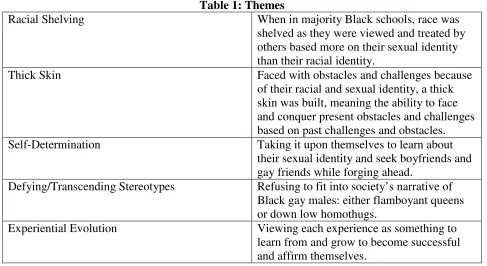
the above institutions: racial shelving (bracketing race in majority-Black environments to
contend with sexual identity issues); thick skin (increasing ability to face and conquer challenges based on negotiation of past challenges); self-determination (taking the initiative to seek
information and relationships to learn about sexual identity, including use of social media); defying/transcending stereotypes (refusing to conform to dominant narratives about Black gay
males); and experiential evolution (understanding that experience translates into growth and self-affirmation). All of these factors address the ways in which the participants have come to
understand, negotiate, accept, and even embrace their intersecting identities.
Additionally, findings are useful because the participants’ life histories have set a foundation for how educators and sexual majority youth can better understand a population
iv
undertake: incorporating Black gay activists and community members into school culture,
providing professional development for teachers on race and heterosexism, developing a comprehensive sex-education curriculum that includes gay students, and implementing a “Who Cares” campaign to mediate peer pressure to conform.
v
DEDICATION
ii
ACKNOWLEDGMENTS
Thank you:
Kristen Buras who put up with my endless emails and talked me off a ledge a time or two. From the moment I met you I knew I found someone whose activism matched mine. Your passion, support, and encouragement have been invaluable to me and will never to be forgotten.
Joyce King, there are no words to express my awe and admiration for you. Every time I am around you I learn something new and am inspired by your words and deeds. Through my work I will continue your call to better humanity and never stop believing in the possibilities.
Deron Boyles, where do I begin? You gave me an opportunity for which I will be forever grateful. Through all of the critiques, and as I sat watching you teach, I began to grow and have tried to model myself after you. I hope I have done you proud and will continue to do you proud and if I do not, well I know you will let me know--to make me better of course!
Jodi Kaufmann whose passion for qualitative research brought me to where I am today, as a burgeoning qualitative researcher. I can only hope I become half the researcher you are. Your support and advice along this journey has meant more to me than you will know.
Maura Ryan who allowed me to express my gay identity without reservation in class even if we did not agree. It has been an honor to work with a queer activist who works tirelessly to advance the cause of all under the queer umbrella, to which I will continue to do.
Sam Daniels, Jose Ferrell, and Holbert White, the best IT people anyone could ask for. You saved me so many times; you know I am forever indebted to you all.
Zion, Tae, Slick Rick, Charlie, and Theodore, this would not have happened without your honesty. Your life histories are inspiring and I am proud and honored to have gotten to know you.
iii
My mom, Erin, Kate, Grandma Bartone, and all seven of my nieces and nephews, you all may not know exactly what I am doing, but your love and support has been needed and never taken for granted.
Connie Black, there are no words to express how much your love and support has meant to me. Trust me when I say, I would not be where I am today without your constant
cheerleading. You are and have always been a true friend.
My friends, my other family. You all have shown me what love means. It was always my hope that one day this shy little kid would find a group of friends that would accept him for all his flaws and you all have done just that. When I needed a break from work you all were there to help me let my hair down and continue my duties as mayor, even when I said I needed to
hibernate. This project is for you all!
Constance, Jane, and Howard Moore who have supported me and treated me like their own family.
To my Italian and Norwegian great-grandparents who sacrificed all they had to come to this country and make a better life for their family.
TABLE OF CONTENTS
List of Tables………...………..vi
Chapter 1: Introduction ... 1
My Narrative: Situating Self in Research ... 2
Statement of the Problem ... 10
Research Questions ... 12
Chapter 2: Literature Review ... 14
Theoretical Perspective ... 14
Critical Race Theory... 16
Quare Theory ... 20
Literature Review ... 22
Challenges Facing Sexual Minority Youth ... 24
Research on Sexual Minority Racially Marginalized Youth ... 27
Masculinity ... 33
Black Males in the United States ... 34
The Black Church ... 39
Sexual Minority Youths’ Narratives ... 44
Gay-Straight Alliances (GSAs) ... 48
Gay-Straight Alliances are Not for Every LGBTQ Student ... 50
Social Media: Computer-Mediated Communications and Social Networking Sites ... 53
Historical Background: National Context ... 56
Atlanta: The Local Context... 58
Television: A Virtual Context ... 60
Chapter 3: Methodology... 64
Narrative Inquiry/Life Histories ... 64
Research Questions ... 69
Participants ... 71
Methods ... 73
Analysis ... 78
Ethical Concerns ... 82
Summary of Overall Strengths and Limitations of the Study ... 85
i
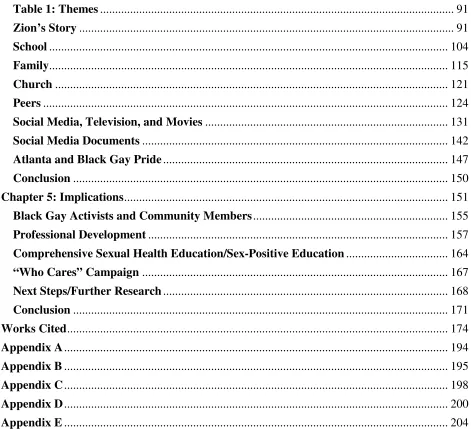
Table 1: Themes ... 91
Zion’s Story ... 91
School ... 104
Family... 115
Church ... 121
Peers ... 124
Social Media, Television, and Movies ... 131
Social Media Documents ... 142
Atlanta and Black Gay Pride ... 147
Conclusion ... 150
Chapter 5: Implications ... 151
Black Gay Activists and Community Members ... 155
Professional Development ... 157
Comprehensive Sexual Health Education/Sex-Positive Education ... 164
“Who Cares” Campaign ... 167
Next Steps/Further Research ... 168
Conclusion ... 171
Works Cited ... 174
Appendix A ... 194
Appendix B ... 195
Appendix C ... 198
Appendix D ... 200
ii
LIST OF TABLES
1
Chapter 1: Introduction
Racism and homophobia. The relationship between them? I think that we don’t want to be forgotten. If you start talking about homophobia inside ethnic communities then we start getting concerned because they’re not looking at the race issues. If we start talking about race issues in the LGBT communities then we’re concerned because they’re not focusing on the fact that we’re gay. You know, there’s that going back and forth.
That has to do with a lot of cultural, the way that we’re brought up. Being part of the Black community I know that most Blacks don’t think that Blacks are gay. “It’s a White thing.” (Kumashiro, 2002, p. 99)
The quote by Kevin Kumashiro’s participant, Christopher, illustrates the tensions felt by
a Black gay man. His intersecting identities (Black, gay, male) and life history converge to create a picture of what he faces in understanding and forming his identity. These intersecting forces also demonstrate how one is forced to understand their identities based on the views of those
within their community. For instance, Christopher has been told by his Black community that a gay identity is a “White thing,” therefore one is “less Black” if they are gay. Conversely,
oftentimes in society, and in the gay community, gay equals White (Berubé, 2003; Han, 2007). According to Kumashiro (2002) these intersecting identities place racially marginalized gays within stereotypic categories where “queer is often racialized and Black is often sexualized” (p.
98, emphasis in original). Additionally, Christopher must understand not only what it means to be Black but what it means to a Black man. Thus, all of the trappings of Black masculinity
converge to provide another layer with which he must grapple in understanding his place in society.
It is from these tensions and intersecting identities that I have examined life histories of
Black gay youth. By ignoring these intersecting identities and how these young males’ communities and institutions shape their identities, we risk becoming color-blind to their
2
been silenced and their lived experiences dehumanized (Ladson-Billings, 2000; Zuberi &
Bonilla-Silva, 2008). The purpose of this research study was to focus on how Black gay youth have negotiated their identities by navigating through myriad social spaces and institutions. Keeping their lived experiences at the center is the mode through which I gained an
understanding of how they have come to be, how they view themselves within a racist,
heterosexist, sexist, and homonegative society. Through their lived experiences, educators and
those studying the Black and gay communities can be informed to have a broader sense of these youth and how to assist them on their journey while not dehumanizing them. Before I begin it is important to provide my own narrative. By doing this, I share my positionality as a researcher
and give the audience an understanding of where I come from and how I relate to this study, which informs my choice of methodology, research questions, and analysis and interpretation.
My Narrative: Situating Self in Research
It's hard to explain. Inherently it's just always been strange, neither here nor there, always somewhat out of place everywhere, ambiguous, without a sense of belonging to touch. Somewhere halfway feeling there's no one completely the same. Standing alone eager to just believe it's good enough to be what you really are, but in your heart, uncertainty forever lies. And you'll always be somewhere on the outside.
Early on, you face the realization you don't have a space where you fit in and recognize youwere born to exist. (Carey, 1997, track 12)
Mariah Carey’s words sum up my life; I always felt on the outside, that I never fit in with the rest of my family or peers. Thus, I open this chapter with my life history, as a middle-class White gay man. It is important to understand my positionality and who I am because the
population I collected life histories from differs from me in several ways. Johnson-Bailey (2004) explains that the researcher’s understanding matters, whether they are an “insider” or “outsider,”
3
and myself and that these differences “occur when there are societal experiences and
circumstances attached to distinct lived positionalities such as class, race, gender, and sexual orientation” (Johnson-Bailey, 2004, p. 126). Therefore, it was essential that I was cognizant of these differences in order to reconstruct and represent their life stories with fidelity.
I grew up comfortably in a White enclave 10 miles outside of Hartford, Connecticut in the suburb of Glastonbury, technically in the section known as South Glastonbury, and did not
have to think of where my next meal was coming from or if my father would lose his job; my mom was a homemaker, so my reality was a mom making lunch for me every day and cooking dinner for us at least six times a week as we all (mom, dad, and two sisters) sat and ate together.
My geographic location explains much of what I knew and understood about people; as of 2012 85% of South Glastonbury’s residents reported being of the “White” race only (United States
Census Bureau, n.d.), and I did not have a Black classmate until the fifth grade.
My father was a third-generation plumber who owned the third-generation family company, but I could never relate to him. He was outgoing and popular, like my two sisters,
athletic in high school, and was very good at what he did for work; many said he was the best around. I was shy, self-conscious, and awkward on the field of any sport; it just was not me no
matter how hard I tried. Additionally, when I would go to work with him I was out of my element, and could not connect with his coworkers as they discussed women and sports. As I began to mature I understood I was not like the other boys; I knew I was gay. The thought of
being gay scared me because gay equaled AIDS and death. Vacationing in Cape Cod I would see openly gay men and just as I would begin to smile in support, I would hear jokes being made by
4
women, spoke with lisps, and were openly flamboyant as they pranced around with rainbow
flags or with another man on their arm? That was my conception of the gay community. How could I come out to my family? President Clinton, who I admired and was mocked for liking, said he would treat LGBT peoples with equality but that did not pan out as promised. Also, in
1992 MTV’s The Real World came on and I was enamored with the openly gay cast member. He was my inspiration, finally a gay man on television who does not have HIV or AIDS, which
changed in 1994 when The Real World San Francisco had an openly gay HIV positive cast member, reminding me that gay does equal HIV and AIDS.
Simultaneous to my journey into understanding my sexuality, which I made sure I hid the
best I could from everyone, although I was always self-conscious that people would find out and that they knew, I also grappled with understanding race and the history of the United States.
While I did not personally know any Black, Brown, Asian, or Indigenous People, I relied on images presented in the media and what I saw when I drove into Hartford to visit with cousins and my great-grandmothers. I had an image of Hartford as, what Leonardo and Hunter (2009)
refer to, a “disorganized jungle.” It was run down and full of people not like me (read Black and impoverished). Every time we drove to Hartford I would be filled with fear and anxiety as we
navigated through the city (and my family lived on the better [read Whiter] side of town). Where did this fear come from? What made Hartford a place that I feared?
Let me put Hartford and Glastonbury into context. In 2007, Hartford was the sixth most
impoverished city in the United States (Somma, 2007). Due to the fact that I saw racially marginalized people, unfamiliar to me as a kid, in Hartford, I equated racially marginalized and
5
the words of Robin Kelley, a “monolithic and debased underclass culture” (as cited in Leonardo
and Hunter, 2009, p. 14). To me, Hartford was a terrible city, rampant with crime. Literally across the Connecticut River is South Glastonbury, a more rural section of Glastonbury, a wealthy White suburb where the estimated 2012 median household income was $118,750 and
home values were $407,000 (United States Census, n.d.b). Glastonbury is far from impoverished, a polar opposite of Hartford. In another example of inequity, the Hartford region is ranked as
having the highest per-capita gross domestic product in the world, which stands at $75,086 (Ro, 2012). This was my reality growing up.
Often I would hear stories of what Hartford used to be like, a grand city with immigrants
living and working together in harmony. While keeping their Italian heritage and pride, it was important for my family to work hard and prove to others (i.e.: English, German, and Irish
Whites) that we Italians were not swarthy thieves, as was so often the narrative propagated of Italians. I heard stories of how my grandparents moved out of the city and into the country to raise their children. The stories continued with coded (“just work hard”) and not so coded (“those
people”) language. In one story I heard how my great-grandparents, who spoke Italian and wrote and spoke very little English, owned and operated their own corner market; they succeeded so
why cannot everyone else? They left because the neighborhood became too dangerous. Story after story I heard negative accounts about Black people and how the city was just not the same (because “others” have taken over and “others” have a bad set of values and drive out the
Italians). Driving into the city with my grandfather I saw what they spoke of. I had no idea of the structural and institutional forces working against racially marginalized people and designed by
6
I knew something was wrong with what I was seeing: who would choose to be
impoverished? The same ideas would come to my head about gay people: who would choose to live in a community where people are denied rights and dying of AIDS?
I went to Elon University [College] in North Carolina for college and immersed myself in
understanding other cultures. Elon was very White and economically privileged, yet I took advantage of getting to know those people who were racially and economically different than
me, either at Elon or in the schools where I worked. During this time I realized the narrative (lazy, thugs, drug dealers…) I had been given about Black people did not hold true. I
encountered successful Black people who came from middle-class and upper-middle-class
backgrounds like myself.
I began to challenge all that had been told to me and what I saw in Hartford. Through
books and personal communications, my mind started to shift. I read, There Are No Children Here: The Story of Two Boys Growing Up in The Other America by Alex Kotlowitz (1992). The
boys in the book were the same age as me, and I could not help but think of their lives and what I
was doing at the time the author followed them; our lives were vastly different. I then thought of children in Hartford who were my age and what they must have been going through while I was
safe at home in South Glastonbury. In 2006, while still going through a transformation and grappling with race, I read The Children In Room E4 by Susan Eaton (2006). The book analyzes school segregation and inequities in Hartford and the surrounding suburbs. It details policies that
help explain why White people, my family, were able to move to the suburbs and make it and why racially marginalized people were not. I got a better glimpse of Hartford, from a critical race
7
family members, but policies were put in place to allow my family to move and create better
opportunities for subsequent generations.
My journey continued when I moved to Atlanta and taught third grade in the racially, ethnically, and religiously diverse town of Clarkston, a town with a large refugee and immigrant
population. I was there during the September 11th attacks and being in a school with a population that was roughly 50% Muslim and having a principal whose husband was a Baptist preacher and
a female assistant principal who was a Christian-turned-Muslim, was one of the best experiences of my life. While in Atlanta I wanted to know more about the Black community. Thus, my journey into Atlanta began with a tour of the Atlanta University Center from a co-worker. This is
a place where she, a Black woman from California, saw the rich civil rights and intellectual history of Black America in its most concrete form. While in Atlanta I found myself at a
crossroads and finally admitted I was gay. I began to associate myself with Black gay males, not from a fetishized point (Hill Collins, 2005; Nagel, 2003), but rather as a way to get to know a culture I had been told was off-limits. Since my move to Atlanta in 2000, my friends, a majority
are Black gay males, and their friends have embraced me. Our conversations run deep and do not shy away from talking about race and the gay community as well as their lived experiences
versus mine. These exchanges have provided me with a glimpse into the Black gay experience, an experience that challenges what I believed growing-up to be a very bleak existence for being Black and gay. For example, often times my friends express ways that their families have dealt
with their sexuality. Almost all of my friends have been open about their sexuality to their families and many have indicated their families ultimately have given them support. Take, for
8
changed and within a year or so his mother began to provide him support and accept his
sexuality. My friends’ narratives challenge this notion that the Black community is more homophobic than the White community (Boykin, 1996). However, it has been important for me to understand the social context in which their narratives have taken place because some of their
families understand that being oppressed is wrong no matter what identity is being oppressed. Concurrently, several have noted that they do not view the gay community as White because in
Atlanta the Black gay community is so large and visible. Instead, many of my friends wish to move away from the “gay equals White” discourse. Their lives push me to grapple with the space I inhabit while understanding their experiences and perspectives can challenge what I
know.
I next moved out to Seattle and then Oakland with a former partner. In Seattle I
encountered a community of Asian people of many different cultures and from numerous
different countries; in turn, I was embraced by many of my students’ families and got to learn the ways of their culture, especially the Samoan culture. In Oakland it was the Latin@ community I
began to understand. While out west I longed to be back in Atlanta and began to read much more about the modern day Civil Rights Movement. From there I tapped into the work of Paulo Freire
(2000) and created units designed to confront and tackle injustice and inequality. As an anti-racist White person, I created units and lessons with my elementary school students that examined the state of racism, classism, sexism, and heterosexism in the United States. I made
sure these lessons had purpose and that the students would carry the lessons of those who fought against injustice with them as they got older. For example, social justice was the guiding theme
9
movement (e.g. farm workers’ and immigrants’ rights or the LGBT movement) that allowed my
students to conceptualize injustice and how collective social action has led to change. Last, I brought this passion to teach issues of race and social justice to a summer session in 2012 at Clark Atlanta University in the Upward Bound program. As the only White person teaching a
course on Civil Rights and race relations, I was met with skepticism, what did I know about these issues? That ended when I engaged in open and critical conversations with my students and
co-workers and acknowledged my White privilege. Additionally, I heard from these colleagues, students, and which is something I hear from Black gay friends and others in the community, that they appreciate how I understand and can discuss my White privilege. All of these experiences
have led me to this point in understanding my White privilege. This has been a process, one that continues as I have gathered and understood the participants’ narratives.
I do not claim to know a Black gay male’s lived experiences. In an effort to illustrate this point, one clear example sticks out when I was living in Oakland. It was roughly 9 p.m. and I was speeding over the Bay Bridge with my former partner, a Black news reporter in the
passenger seat, to make my flight back to Atlanta. I got pulled over on the bridge and was none too pleased. As the White cop approached the car I angrily turned around to the backseat to grab
the proper paperwork. While digging back there the cop did not say a word, did not make a move, and had a slight smile. My partner nervously leaned over to the cop and told him what I was doing. After it was said and done, we were on our way with a ticket and my negative attitude
in high gear, but the conversation I had with him brought me back down. He told me never to do that again because the cop could have pulled his gun. We both stopped for a second and laughed
10
police officer while following the officer’s directions only a year before. That situation, yet
again, reaffirmed why I could never claim to know a Black male’s lived experiences. That said, I do have a sense of what it means to be marginalized due to my sexual orientation. My lived experiences have not been easy. Due to my sexuality and/or because my
former partner is Black, my grandfather disowned me; I did not speak to him for the last three years of his life. Though not surprising, my grandfather was very stubborn, and it hurt because
he was the only immediate male I could look up to since my father died when I was 16. However, his wife, my Italian-born and Catholic abiding grandmother, embraced me beyond belief, and continues to inquire about all aspects of my life. She was angry with me for not
telling her I was gay sooner, but I figured she would be upset and disown me as well. I have learned that asking and telling, sharing stories and life histories, is key to understanding one’s
perspective, no matter how it has been shaped. From this perspective, of inquiring and not assuming, I situate myself in this study.
In the end, after hearing about my Black gay friends’ lives and how it does not always
match the dominant narratives I was taught, and narratives that continue, I am on a journey to know more. If my challenges as a gay man were mediated by my race and class status, I began to
wonder about those experiencing the “double burden” of sexual and racial marginalization. My work is not intended be the final say in the lived experiences of Black gay youth, but rather to let their narratives be placed alongside and challenge those who continue to marginalize and/or
ignore this population through their research.
Statement of the Problem
11
identity and gender non-conforming expression, one of which or both, challenge normative ideas
of sexuality and gender. Finally, imagine walking into a space where your racial identity adds an additional layer to your sexual identity and/or gender non-conforming expression. For many youth this is the reality.
Sexual minority students face oppressive conditions and victimization daily as they enter schools (Espelage & Rao, 2013). While in schools, two instances occurred in North Carolina last
year within a week or two of one another. One young male was told it was his fault he was being bullied because he chose to bring a My Little Pony backpack to school (“Child attempts suicide,” 2014). In another instance, an eleven-year-old North Carolina student tried to commit suicide
due to his love of My Little Pony (Roy, 2014). Only 14 states and the District of Columbia have laws to protect students based on their sexual identity and gender expression (Orr &
Komosa-Hawkins, 2013); Georgia does not have a law protecting these students. Even though the landscape in school is bleak, Jamil, Harper, & Bruce (2013) note that their participants have found ways to mediate these problems and they “found that youth were very creative and
resourceful in the use of educational and informal contexts for the development of their identities” (p. 194). The current study continues that work by eliciting the life histories of the
participants to provide an understanding of how they have negotiated and managed through either negative and/or positive school environments.
For many sexual minority youth schools are viewed as environments where verbal and
physical assaults are not uncommon. Additionally, schools are places where heterosexuality is held up as the standard and norm and the lives of sexual minorities are either ignored or
12
at GSAs for sexual minorities in schools mention the lack of racial diversity in these
organizations (Heck, Lindquist, Stewart, Brennan, & Cochran, 2013; Wooley, 2012). Thus for some racially and ethnically marginalized sexual minority youth, gay-straight alliances do not address issues of race (McCready, 2012; Patton, 2011). By employing a color-blind ideology,
gay-straight alliances may further marginalize Black sexual minority youth and are not places where many seek support, if Black sexual minority youth even want to join a publically visible
alliance. Last, Black sexual minority youth must navigate through understanding their racial identity in tandem with understanding their sexual identity; this is something White sexual minority youth are immune from due to the idea that “whiteness takes center stage and it
becomes synonymous with gay where gay comes to mean white and white comes to mean gay” (Han, 2007, p. 54). While all sexual minority youth must understand their sexual identity in ways
sexual majority youth do not, the issue of race cannot be divorced from how one understands sexual identity; communities have different understandings of sexuality which influence how one contends with their sexual identity (Lemelle & Battle, 2004).
Research Questions
By utilizing narrative inquiry and gathering life histories of five Black gay males between
the ages of 19-24, I probed how they are navigating through schools and society and negotiating and understanding their intersecting identities. In essence, I wanted to know what can be learned from these young males due to the lack of research focusing on their lived experiences and how
they are faring in all aspects of their lives. Five questions guided this study:
• What do the narratives of Black gay youth reveal about the factors that support or
13
• In what ways have the following institutions influenced Black gay youth identity formation: school, family, church, peers, community-based LGBTQ organizations, and social media? To what degree has growing up in Atlanta contributed to identity
formation?
• In what manner have Black gay youth either experienced or created social networks of support?
• To what degree and how have Black gay youth used social media to create networks of support, navigate their intersecting identities, and present themselves?
• What can educators and policymakers learn from narratives of Black gay youth to best support them in their personal, social, and educational growth?
These questions will be returned to in greater detail in chapter 3, but I place them here to give the
reader a frame of reference while reading chapter 2. Additionally, I have chosento focus on the above institutions and understand that the participants could have identified other institutions as relevant, through the semi-structured interviews. I now turn to my theoretical perspective and
14
Chapter 2: Literature Review
In this chapter, I detail the theories relevant to my study as well as the research literature that informs my concerns and questions about the lives of Black gay male youth. I also consider the national context and legal status of sexual minority communities during the period when
participants were growing up; the racial and sexual history of Atlanta; and the virtual context provided by media, all of which has likely contributed to participants' sense of identity.
Combined with insights garnered from research literature and critical theories of race and sexuality, this enabled me to contextualize and analyze the life histories that I gathered. I now turn to a discussion of theory.
Theoretical Perspective
Theoretical perspective is important for it is “the philosophical stance that lies behind our
chosen methodology” (Crotty, 1998, p. 7). Bogdan and Biklin (2006) posit that it is a way of “looking at the world” (p. 24). Therefore, it is important that I lay out the theoretical framework driving this project because it helps determine how I understand and present the participants’
narratives. In this study I employed and relied heavily on a critical race theoretical perspective and utilized a quare theoretical perspective to interpret and comprehend the life histories and
self-presentations of Black gay youth.
Crotty (1998) denotes there is a range of epistemologies that inform one’s philosophical underpinnings of “how we know what we know” (p. 8, emphasis in original). In essence, the
epistemological stance I take informs the theoretical perspectives I have chosen. Conjointly, my theoretical perspectives determine how I have designed this study and what I learned from the
15
take, as a White man, is crucial. Mills (2007) notes that it is important for Whites to recognize
their privilege, especially when doing research with Black communities, because “[T]he white delusion of racial superiority insulates itself against refutation” (p. 19); thus, by acknowledging and owning my racial privilege as a researcher with Black gay male youth, I am able to challenge
Whiteness and create a space for better understanding and valuing the voices and narratives of my Black participants.
For too long White colonizing epistemologies have dominated and been used as
justification to “other” those who are not White, male, and heterosexual (Dunbar, 2008; Hylton, 2009; Parker & Lynn, 2009; Solórzano & Yosso, 2009; Zuberi & Bonilla-Silva, 2008).
Indigenous ways of knowing have been devalued, and as Louis (2007) explains:
We have been pathologised by Western research methods that have found us
deficient either as genetically inferior or culturally deviant for generations. We have been dismembered, objectified and problematised via Western scientific rationality and reason. We have been politically, socially, and economically dominated by colonial forces and marginalised through armed struggle, biased legislation, and educational initiatives and policiesthat promote Western knowledge systems at the expense of our own. (p. 131)
Ladson-Billings (2000) notes that when one’s liminal perspective is heard then that voice and
experience challenges dominant understandings of the group’s lived experiences. While speaking
of “transformative education and research practices in Black education” (King, 2005, p. 5), King
(2005) argues there must be a rehumanization process through which “hegemonic structures” of
knowledge and understanding the world are dismantled because they “impede knowledge” for all
humankind. In other words, colonizing (i.e.: U.S. Western/Eurocentric) epistemologies have
ignored the ways of knowing of myriad groups of people and presented Eurocentric knowledge
as a linear universal entity, and as Asante asserts “[I]t imposes Eurocentric realities as universal”
16
I bring this forth as a way to demonstrate that as a White male I am in the position to,
under the guise of research, perpetuate the devaluation of my participants’ lived experiences as
many scholarly forefathers and foremothers have done. By positioning the participants’ ways of
knowing as valid, the intention is to move toward dismantling Western ways of knowing the
Black gay experience, which will benefit, as King (2005) suggests, all humankind.1 Therefore, it
is from this understanding that I move forward to explain how my theoretical perspectives attend
to the ways of knowing and the life histories of my participants.
Epistemologically I situate myself in social constructionism and standpoint
epistemologies (Harding, 1993; Schwandt, 2000). According to Schwandt (2000), social
constructionists believe that “[W]e do not construct our interpretations in isolation but against a
backdrop of shared understandings, practices, language, and so forth” (p. 197). It is from the
standpoint of the participants against a racist, sexist, classist, and heterosexist society that I
understand their life histories. In other words, because their experiences are formed in relation to
these structural forces, I was attuned to how these structural forces have helped construct their
identity and life history.
Critical Race Theory
Coming out of critical legal studies, critical race theory has been adopted by educators to illuminate the educational experiences of racially marginalized students and to change dominant epistemologies (Crenshaw, 1995; Ladson-Billings, 2000). Taylor (2009) explains that critical
race theory places race at the center when analyzing and understanding a person of color’s experiences. Theorists in this tradition believe that racism is endemic to society and cannot be
17
Black males must be understood within a school system and society, which, for the most part,
does not support Black males (Ferguson, 2001; Giroux, 2006; Lewis, Sullivan, & Bybee, 2006; Spring, 2012).
Edward Taylor (2009) describes critical race theory as “com[ing] from a long tradition of
resistance to the unequal distribution of power and resources along political, economic, racial, and gendered lines” (p. 2). Thus, major guiding tenets of critical race theory that are connected to
this study are: (a) racism is endemic in society, (b) a colorblind ideology should be challenged, (c) attention to intersectionality of multiple identities is necessary, (d) experiential knowledge is valid, and (e) historical contexts of experiences is relevant (Ladson-Billings & Tate, 2006;
Taylor, 2009). First, racism is endemic in society, which effects how racially marginalized people are treated; they must negotiate through challenges that do not affect those who are
racially classified as White. For this study, understanding how racism and negotiating through a White-dominated society affects these males enabled an interpretation of their life histories from a racialized lens. Second, in order to capture their life histories as Black gay males, I had to shed
the colorblind ideology that permeates through the literature. Essentially, ignoring the racial experiences of the participants and analyzing their narratives as equal to White gay youth misses
a key component of their identity formation and self-presentation. Third, the participants have multiple intersecting identities, their sexuality, gender, race, and socio-economic status.
Therefore, their narratives were analyzed and interpreted from a perspective of identifying how
these intersections have shaped their life histories and identities. Fourth, critical race theory argues that one’s experiential knowledge is valid and important for understanding these wider
18
(in the case of this study White and heterosexual) tell a story that is viewed as a story shared by
all groups, when in reality groups on the margins have very different experiences. Last, being attuned to the historical context of events is important when utilizing a critical race theoretical perspective. While this tenet applies to the realm of how “political, legal, and educational
systems” operate (Taylor 2009), I evoked the historical tenet in this study as a way to position the participants’ narratives in a larger context. Accordingly, by juxtaposing their narratives and
ways of identity formation against the national, local, and cultural climate, their narratives were analyzed in a comprehensive manner within a certain historical context.
Critical race theory also places racially marginalized peoples’ narratives in contrast to the
dominant White discourse (Taylor, 2009). Thus, when reviewing and interpreting my participants’ life histories, I paid attention to the reality that racism informed how my
participants negotiated and understood their identity in Atlanta, including how they navigated through and optimistically defied a racialized system, even when they attended majority Black schools. Therefore, any reading of the existing research literature must take into account what is
not being said and who is being left out; much of it is grounded in a colorblind ideology, which erases race and looks at groups as equal instead of understanding that race has been (and
continues to be) a factor in laws, policies, and attitudes, which have shaped society (Leonardo, 2009). In conjunction with understanding racism as normal in the United States, critical race theory also allows one to better understand the intersecting identities, which make up a person’s
total identity (Crenshaw, 1995). For instance, groups cannot be looked at monolithically (e.g., all Black men) because within each group there are other intersecting identities (e.g., sexuality,
19
alliances at school and thus will be successful in school. This idea does not account for race,
ethnicity, religion, or class, because in some cases one’s race and ethnicity contributes to why some racially and ethnically marginalized sexual minority youth do not get involved yet they are still successful (McCready, 2010; Patton, 2011).
A critical race theoretical perspective provides a space to examine these intersecting forces. Black gay youth face intersecting identities because, taking from Crenshaw’s explanation,
Parker and Lynn (2009) explain “race does not exist outside of gender and gender does not exist outside of race” (p. 12). By adding sexuality where gender, sexuality, and race all do not exist outside of one another, I have been able to illuminate how these intersecting forces have
influenced and impacted the participants’ experiences. Cane (2012) explains that for him these intersecting identities are influential because being Black, gay, and a man are not synonymous
and can cause confusion until one reaches a level of acceptance with these intersecting identities. Cane recalls:
I remember walking through Harlem once when I saw a T-shirt…[it] read, “A real
black man is a man who loves God. A real black man is a man who doesn’t deal drugs. A real black man is a man who doesn’t have sex with men.” I was only twenty-one but already secure in my sexual identity at the time…I realized that engaging in homophobia in the black community equaled becoming a “real man.” I rejected that equation. I am black. I am a man (p. 175).
In conclusion, by utilizing a critical race theoretical perspective, the intent was to provide
a reading and analysis of the life histories from an emancipatory point of view. In other words, by interpreting, analyzing, and presenting the participants’ life histories, I followed in the footsteps of critical race theory and in the “emancipatory hopes” that these life histories will
begin to break down systems of marginalization built mostly by and for White heterosexual males (Taylor, 2009). I position their narratives in conjunction with the major tenets of critical
20
dominant discourse about the sexual minority community (Berubé, 2003; Han, 2007). Last, as I
will explain in chapter 3, one of the purposes of narrative inquiry is to promote and bring forth social change (Chase, 2005), something I this study achieves.
Quare Theory
While critical race theory targets race and other forms of oppression, and has bred subsets such as LatCrit, to examine the intersections of one’s Latin@ identity (Huber, 2010), it is not
explicit in its interrogation of sexual minority populations. In conjunction with critical race theory I employed a much lesser known but still valid theoretical perspective of quare studies. Johnson (2005) notes that quare studies “is a theory for gays and lesbians of color” (p. 127)2;
therefore, when I refer to quare studies I am also referring to it as a theory to be used to
understand the embodied lives of Black sexual minority male youth. In defining quare studies, I
quote Johnson at length:
By refocusing our attention on the racialized bodies, experiences, and knowledges of transgendered people, lesbians, gays, and bisexuals of color, quare studies grounds the discursive process of mediated identification and subjectivity in a political praxis that speaks to the material existence of “colored” bodies. While strategically galvanized around identity, quare studies should be committed to interrogating claims that exclude rather than include. I am thinking here of black nationalist claims of “black authenticity” that exclude, categorically, homosexual identities. Blind allegiance to “isms” of any kind is one of the fears of queer
theorists who critique identity politics. Cognizant of that risk, quare studies must not deploy a totalizing and/or homogenous formulation of identity, but rather a
contingent, fragile coalition in the struggle against oppressive forms. (p. 136)
In other words, quare studies acknowledges the embodied existence of Black sexual minority
people, unlike queer theory, and quare studies allows a space for Black sexual minorities within discussions of Blackness because “heterosexuality is no blacker than homosexuality” (Johnson,
21
males’ embodied lived experiences must be included in discussions of experiences of sexual
minority youth and in discussions of Black males in schools because Black gay youths’
experiences are influenced by myriad factors and they cannot be lumped into the same category as their heterosexual or White, Asian, Latino, and/or Indigenous sexual minority peers.
Another aspect of quare studies examines ideas of performance and takes from
performance theory (Johnson, 2005). Quare studies pays attention to how one’s performance, or
presentation of self in this study, is contextual and influenced by social norms. Since this study sought to understand the lived experiences and life histories of Black gay youth, being attuned to how they are performing and presenting themselves within society defined by their multiple
intersecting identities and by society’s definitions placed up on them, was warranted. The intention of this study was to probe how self-presentation and performance occur across the
numerous social institutions in which Black males are situated. Paying attention to how Black gay youths are performing and presenting themselves adds to an understanding of how they are constructing their identity and how events in their lives have influenced their presentations of
self.
While both critical race theory and quare theory are similar, the difference is quare theory
is concerned with juxtaposing itself against queer theory and the disembodied nature of queer theory (Johnson, 2005), where critical race theory is not. Coming out of queer theory, quare studies challenges queer theory and its lack of focus on race, while providing an opportunity to
examine queerness within racialized communities (Johnson, 2005). Quare theory also adds the performance piece to understanding Black gay males. Therefore, quare theory is important
22
Black and gay are integral to their identity. Additionally, their presentation of self more than
likely shifts over time, so paying attention to these shifts throughout their lives becomes
beneficial. Greg, one of Johnson’s (2008) participants, explains that while attending Morehouse in the 1970s, he was very aware of how he presented himself. For Greg, defying masculine
stereotypes and being himself was key to his success at Morehouse:
My grandmother used to tell me this as a young child. You get more bees with honey than with vinegar. So I always used my good looks, my great speech abilities, the swing of my hips, and the command of my flamboyance and my “gayism” and all of that, as a calling card to be able to have all entrée, to be able to succeed as a novelty and to go through the hallowed halls of academia with success. And at Morehouse, it was that way. (p. 420)
Acknowledging how his self-presentation helped him succeed, Greg’s experience highlights how one should consider these actions as thoughtful and conscious rather than unconscious acts. I
now shift focus and review the literature regarding sexual minorities with a focus on the paucity of literature regarding Black gay males.
Literature Review
The focus of this study is on Black gay youth, or young adults, aged 19-24. Therefore, I review the literature on educational experiences for sexual minority youth. Then I focus on Black
lesbian, gay, bisexual, and transgender (LGBT) youth and how their experiences differ from their White LGBT peers. Next, I briefly describe the experiences of Black males in schools because
there is a shared racial experience between sexual majority and minority Black males. I then briefly discuss the Christian Black Church and its relationship within the larger Black
community while honing in on the relationship with its LGBT members. After that I go back to
23
research on social media since I sought to understand the role social media plays in the
participants’ lives.
Before I continue let me define the terms Black, Whiteness, racially marginalized, and sexual minority as I use them throughout this dissertation. I use the term Black to refer to any
person who identifies racially and ethnically as a part of the African diaspora. I hesitate to use the term African American because there are people in this category who are not American
citizens and do not consider themselves American because of their citizenship status but identify as Black because of the racial category assigned to them in the United States or by
self-referencing based on their nation of origin. At this point I want to define the term “Whiteness”
because Black youth (of any sexual orientation and gender) are confronting a racist system where White is at the center (Leonardo, 2009; Omi & Winant, 1994). As Zeus Leonardo (2009) notes,
the discourse of “Whiteness” is grounded in the belief that White is normal and universal where “the white race speak[s] for the human race” (p. 263).
The term racially marginalized refers to any racial group that has been historically,
politically, and economically marginalized by the dominant White race (Omi & Winant, 1994). Since race is a colonizing socially constructed marker, I use it as a way to identify a population
of people that have shared, albeit different, histories of marginalization (Omi & Winant, 1994; Zuberi & Bonilla-Silva, 2008)
There are numerous terms to describe a person’s sexuality; they include, gay, lesbian,
homosexual, heterosexual, queer, and oftentimes the acronym LGBTQIA is used to encompass all people outside of the normative standards.3 For now, I explain why I have chosen to use the
24
though Black men use the moniker (Johnson, 2008; Mayer, Bradford, Makadon, Stall,
Goldhammer, & Landers, 2008). Sexual minority is a term used more often in the literature to encompass the myriad gender and sexual identities one has, an identity which marginalizes them within the dominated heterosexual (sexual majority) society (Mayer et al., 2008). I use the terms
sexual minorities to encompass the LGBTQIA community but gay in reference to my
participants as they identify as gay. Queer is used as an umbrella term to define anyone whose
gender identity and/or sexual identity are considered in opposition to heterosexuality and socially constructed definitions of gender (Jagose, 1996). Placing myself within these terms, I identify as a gay male and rarely use other terms to define myself; I belong to the group of people who find
queer offensive and derogatory (Jagose, 1996). Lastly, in keeping with the researcher’s intent, when citing works from other people I keep the term they use rather than changing it to fit my
definition. This is important to acknowledge because I do not want to impose my definition onto one’s work, which will alter the meaning of their work, as I would not want someone altering my terms to fit their definition, which would alter the meaning of my work.
Challenges Facing Sexual Minority Youth
Sexual minority youth are a part of a society where constricting standards of
heterosexuality, masculinity, and conforming to socially constructed gender roles are celebrated and are the norm (Carbado, 2005; Connell, 1992). Societal norms of sexuality can cause personal tensions on those who do not meet these expectations. Sexual minority youth face a society that
tells them they do not fit the norms of sexuality as dictated by heterosexism. Due to these
constricting standards, life for sexual minority youth in school is problematic and presents issues
25
find that (a) 85% of the youth heard the term “gay” used negatively, (b) 71% heard homophobic
language used in school with 57% hearing teachers using such language, (c) 64% experienced being unsafe, (d) 82% were bullied verbally, and (e) 38% were physically harassed (“pushed or shoved” p. xiv) with 18% being physically abused (“punched, kicked, injured with a weapon” p.
xv). Within school, there is a psychological toll taken on sexual minority youth, whether they are “out” or not to school officials or friends. Kosciw et al. note 56% of sexual minority students
who have lower rates of victimization state they have positive self-esteem, while 39% (those who are victimized based on their sexual orientation identification) and 35% (those who are victimized based on their gender expression) have higher levels of victimization and positive
self-esteem.4 Thus, the more the student is victimized due to their sexual identity and gender non-conforming status, the greater the rates of depression and low self-esteem.
There are several negative academic outcomes for sexual minority youth (Birkett, Espelage, & Koeing, 2009; Russell, Seif, & Truong, 2001). Kosciw et al. (2012) note the rate of skipping school or dropping out of school is higher for those who face any form of victimization;
29.8% skipped a class within the last month the survey was taken and 31.8% skipped a full day of school due to the hostile environment. Birkett, Espelage, & Keoing (2009) point out that
several studies have found sexual minority students to have lower grade point averages than their sexual majority peers. They do note that when the school environment is supportive and positive the rates of negative effects decrease, so more must be done to create safe supportive
environments for all students.
Another challenge facing sexual minority youth rests not only with their peers but also
26
bullying or of unsafe environments (Kosciw et al., 2012; Lugg, 2003; Valenti, 2010). In the
national school climate survey, 60% of the students do not alert faculty and staff of harassment at school (Kosciw et al., 2012). For 37.9% of the students, they doubted alerting school officials would result in any action being taken or that it would end in their favor. In fact, 36.7% of the
students note the incident was ignored by faculty and staff. Others who uphold society’s norms of sexuality and gender conformity thus place blame on the victim when they have done nothing
wrong, but are bullied due to their sexual and/or gender identification.
Schools have become institutions that ignore the lived experiences and multiple
intersecting identities of sexual minority youth while also denying “queer youth, and queer youth
of color in particular, equal opportunity for a rewarding education in an environment that is safe and supportive of their various struggles for identity” (Grady, Marquez, & McLaren, 2012, p.
984).
A challenge sexual minority youth confront comes in the form of state and local policies around sex education. In many parts of the country, excluding the northeastern and western
coastal states, state legislatures and boards of education have pushed through laws, which ban the “promotion of homosexuality” (Hoshall, 2013, p. 222) in schools. Hoshall (2013) examines
seven states (Alabama, Arizona, Mississippi, Oklahoma, South Carolina, Texas, and Utah) where laws have been enacted in which schools are not allowed to discuss homosexuality or if they do they refer to homosexuality as a lifestyle choice. Concomitantly, these states, as well as many
others, promote abstinence-only sex education in which students are taught to wait until marriage to become sexually active and there is very little if any mention of homosexuality (Hoshall,
27
been extended to sexual minority couples. Therefore the youth in these states, where same-sex
marriage is still illegal, are ignored because they cannot be legally married unless they leave their families and home and go to a state, which grants marriages licenses to sexual minority couples. Also, if and when sex between two males and two females is briefly discussed in abstinence-only
lessons, often times it is connected to HIV transmission or is demeaned (Cianciotto & Cahill, 2003). Oftentimes sexual minorities are not discussed in these programs and as one of Fisher’s
(2009) participants notes “[i]t’s like, well, you know, shit, if you aren’t represented when they talk about human sexuality—you’re not human. You can’t be, because you’re not included” (p. 71). For many sexual minority youth, they are ignored and made invisible because policies have
been enacted to promote heterosexuality through refusing to address issues affecting the sexual minority community (Hoshall, 2013). Cris Mayo (2013) sums up how schools teach sexuality in
“subtle and nuanced” ways by addressing how “[S]exuality, especially heterosexuality, is infused throughout lessons, subject areas, extracurricular activities, and general assumptions about school community” (p. 544), yet she explains that teachers must be better versed in sexuality and
that “schools need a more robust sexuality education — one that cares for difference as it is currently understood and aims as well for what comes next (p. 558).”5
Research on Sexual Minority Racially Marginalized Youth
Black male sexual minority adults and youth are oftentimes part of research studies that tie their sexuality to either HIV/AIDS, mental health, and/or grappling with homonegativity or
homophobia within the larger Black community, as if homonegativity and homophobia are not within the White community (Barnes & Meyer, 2012; Foster, Arnold, Rebochook, & Kegeles,
28
without focusing on systemic issues that continue to place this population at risk. In one study
that explored the “ball culture” within the Black male sexual minority community, a community that has been created as a support system in which “houses” and families are created, the study connects this support to how youth are using this system in the face of HIV/AIDS (Arnold &
Bailey, 2009).6 What I view as a positive step in representing the community again falls back into defining Black sexual minority males as a community facing this disease, as if the disease
defines them. There is much more to the community than HIV/AIDS and presenting the community as little more than always fighting stigma and other Black men with the disease, always being on the lookout, does not explore how this community is thriving.
There is a paucity of research studies that focus solely on Black sexual minority youth and young adults (Blackburn, 2005; Gresham, 2009; McCready, 2010; Quinn, 2007). In my
review of the literature, I came across many studies that did not focus on race and where the number of participants identified as a member of a racially marginalized group was very small (Daley, Solomon, Newman, & Mishma, 2008; Glover, Galliger, & Lamere, 2009; Lee, 2002;
Pingle, Bauermeister, Johns, Eisenberg, & Leslie-Santana, 2013); in some of these studies 50% of the participants are White while 50% are “non-White” thus presenting the data as inclusive
but by lumping all racial groups together ignores the differences between each group and the different experiences members of each racial and ethnic group face against the White dominated society. My review of the literature supports the findings by Huang et al. (2009). Huang et al.
conducted a “content analysis of the past decade (1998-2007) of psychological scholarship about lesbian, gay, and bisexual (LGB) people of color” (p. 363). What they found is a scarcity of