Abstract - In this research study, Friction Stir Butt Welds made of dissimilar AA6061 and AA6082 Aluminium alloys are performed with various input welding parameter as welding speed, tool rotation speed and tool Pin Profile which plays a significant role in the assessment of mechanical properties such as impact strength. Using Taguchi, ANOVA and Signal to Noise ratio, influence of FSW process parameters are evaluated and optimum welding condition for maximizing impact strength of the weld joint is determined. The optimum values of process parameter on impact strength are found as welding speed of 115 mm/min, tool rotation speed 1450 rpm and tool Pin Profile of cylindrical threaded (tpi-22) by S/N ratio analysis. Using analysis of variance (ANOVA), the percentage of contribution for Rotational Speed, Welding Speed and Tool Pin Profile on Impact Strength is determined. But welding speed has great influence on Impact Strength of friction stir welded joints of dissimilar Al alloys of AA 6061 and AA 6082.
Index Terms - Dissimilar alloys as AA6061 and AA6082, Friction Stir Welding, S/N Ratio, tool Pin Profile, tool rotation speed, Two-Way ANOVA, welding speed.
I. INTRODUCTION
Friction stir welding is the most important and innovative process in the field of similar or dissimilar metal joining. Friction stir welding tool, having an electro-mechanically or hydraulically auto-adjusting pin. The tool is having a major advancement in design of having a control system that forms a closed-loop feedback system to control the pin. The tool can
Manuscript received April , 2015.
Varinder Singh, M.Tech. Scholar,Mechanical Engg. Department,
BCET, Gurdarspur, PunjabMob. +91-9877300077,
Vidyadhar Biswal, M.Tech. Scholar, Mechanical Dept.,, Punjab Engg.
College, Mohali, Punjab,
Lakshman Singh and Simranjeet Singh, Assistant Professors, Department
of Mechanical Engineering, University Institute of Engineering, Chandigarh University, Mohali, Punjab Mob. +91-8872217007, Japinder Wadhawan, Mechanical engineering, Ludhiana, Punjab
be used to weld plates of different thickness [1-3]. The material flow was asymmetric about the weld centerline, the flow patterns on the advancing & retreating sides were different. Two tool motions, translation and rotation are responsible for the movement of material in a FSW weld. There is no major influence of welding speed ranges of 700 mm/min to 1400 mm/min on the mechanical and fatigue properties of the friction stir weld joints. The friction stir weld joints showed higher static and dynamic strength than MIG-pulse and TIG welds [4-5]. The tensile strength is inversely proportional to the thickness of the work pieces to be welded. The bending strength depends on the thickness of the work pieces to be welded. The mechanical properties such as tensile strength, bending strength and hardness increases by increasing the Tool RPM up to a certain limit and properties start to decrease thereafter. The weld joint could not be formed at too low welding speeds which results in achieving the poor mechanical properties and weld appearance [6-7, 18]. The heat-affected zone consists of relatively large austenite grains and smaller recrystallized grains presented at the grain boundaries and the thermal mechanical affected zone located between the nugget and heat-affected zone that shows a micro-structural transition from the completely refined structure very similar to base material. The screw pitched taper stir pin give the best bonding with good appearance of the weld. There is no defect find with the use of screw pitched taper stir pin with very fine grains at the weld nugget.The material’s ductility achieved the more for 40 and 56 mm/min welding speed with the lowest rotating speed of 500 rpm but start to decrease strongly with increasing rotating speed and the welding speed. A significant grain refinement of the aluminium alloy matrix due to dynamic recrystallization induced by the plastic deformation and frictional heating during welding and a significant reduction
STUDY THE PROCESS PARAMETRIC INFLUENCE ON IMPACT
STRENGTH OF DISSIMILAR FSW JOINT OF AA6061 AND AA6082 BY
USING TAGUCHI S/N RATIO AND ANOVA
VARINDER SINGH
1, LAKSHMAN SINGH
2*, VIDYADHAR BISWAL
3, SIMRANJEET
of the particles size due to the abrasive action of the tool are achieved [8-17]. The hardness in the weld zone obtained lower than that of the base metal and decreased with increasing rotation speed which resulting transverse tensile test indicated that all the joints exhibited lower tensile strength than the base metal and tensile strength of the joints decreased with increasing rotation speed [2]. The intermediate mechanical properties observed in friction stir dissimilar weld joints when compared with each base material. In the tensile tests, failures occurred near by the weld edge line where a minimum value of hardness achieved. The best mechanical properties like tensile strength and fatigue strength are achieved for the weld joints by increasing tool feed rate along with increasing the vertical force. The analysis of results concerning the contact conditions provides interesting data about the evolution of the relative sliding between the shoulder and the material to be welded. The sliding ratio increases with the tool rotational velocity and decreases with the temperature in the vicinity of the tool. The defects present in cast aluminum alloys are eliminated in the area of processing with the use of four-tool pin profiles such as straight cylindrical, tapered cylindrical, threaded cylindrical and square, from which threaded cylindrical pin profiled tool produced metallurgical defect free region [18-24].
Figure1. Schematic diagram of Friction Stir Welding [2] II. EXPERIMENTAL PROCEDURE A. Experimental Material
The materials of Aluminium alloy as AA6061 & AA6082 graded plates are selected for the experimentation with dimensional configuration of 100mm x 50mm x 6mm. The Aluminium alloys of AA6061 & AA6082 graded materials
are having nominal compositions and mechanical properties discussed below in the tables 1, 2, 3 and 4 as:
Table1. Nominal composition of the AA6061 plates
Al Mg Mn Cr Cu Fe Si Ti Zn 95.8-98.6 0.8 -1. 2 Max. 0.15 0.04 -0.3 5 0.15 -0.4 Max . 0.17 0.4-0.8 Max . 0.15 Max . 0.25
Table2. Mechanical properties of the AA6061 plates
Elasticity (E), GPa Tensile strength, MPa Yield strength, MPa Hardness, HV Elongation % 68.9 310 386 107 12
Table3. Nominal composition of the AA6082 plates
Table4. Mechanical properties of the AA6082 plates
Elasticity (E), GPa Tensile strength, MPa Yield strength, MPa Hardness, HV Elongation % 70 340 392 101 11
B. Welding Tool Geometry
The welding tools used in Friction Stir Welding are made of high speed steel discussed their dimensional parameters below in figures 2 as:
a.
(a) Taper Threaded Welding Tool
(b) Cylindrical Threaded Welding Tool (TPI-14)
(c) Cylindrical Threaded Welding Tool (TPI-22)
Figure2. Welding tools (a, b, c) used during friction stir welding Al Mg Mn Cr Cu Fe Si Ti Zn 95.4 - 97.8 0.6- 1.2 0.4- 1.0 Max 0.25 Max 0.1 Max 0.5 0.7- 1.3 Max 0.1 Max 0.2
C. Equipment Used For Conducting The Experimental Work
The CNC vertical milling machine was used for making the weld joints which available at CTR Ludhiana with following specifications such as type of machine - CNC milling machine, Travel capability of x = 1600, y = 800, z = 750, Running speed limit of 30 – 7500 rev/min and load application of 1800 kg. A fixture is generally used to hold the work piece firmly during the welding process. The various forces acting on the work piece are the transverse force that acts parallel to the tool motion, downward and upward forces due to the plunging, torque due to the rotation of the tool and lifting of the tool during welding process respectively.
III. FINAL EXPERIMENTATION
Friction Stir welding method is adopted to carry out the experimental trials by which dissimilar materials of AA6061 and AA6082 welded at three different levels listed in tables 5 shown below as:
Table5. Levels of input welding parameters
Welding levels Tool rotational
speed in RPM Welding speed in mm/min Tool pin profiles types 1 750 115 Taper threaded 2 1100 145 Cylindrical threaded (tpi-22) 3 1450 175 Cylindrical threaded (tpi-14)
After conducting the experimental trials, it has been observed that input parameters like tool rotational speed, welding speed and tool pin profiles have some significant effect on the impact strength of dissimilar materials of AA6061 and AA6082 weld joint.
The Taguchi Method is a multi-stage process, namely, systems design, parameter design, and tolerance design which used to improve the quality of products and processes. In Taguchi's approach, optimum design is determined by using design of experiment principles, and consistency of performance is achieved by carrying out the trial conditions under the influence of the noise factors. Taguchi defines three categories of quality characteristics in the analysis of Signal/Noise ratio, i.e. the lower-the-better, the larger-the-better and the nominal-the-better [2]. That’s why designs of final experiments made for the optimization of process, according to Taguchi’s L9 orthogonal array shown in table 6.
Table6. Taguchi’s L9 orthogonal array for experimental trials
Experimental
Trials Tool rotational speed
(T)
Welding speed (S) Tool pin profiles (P)
1 750 115 Taper threaded 2 750 145 Cylindrical threaded (tpi-14) 3 750 175 Cylindrical threaded (tpi-22) 4 1100 145 Cylindrical threaded (tpi-22) 5 1100 175 Taper threaded 6 1100 115 Cylindrical threaded (tpi-14) 7 1450 175 Cylindrical threaded (tpi-14) 8 1450 115 Cylindrical threaded (tpi-22) 9 1450 145 Taper threaded
IV. RESULTS AND DISCUSSIONS
The welding input parameter ranges taken into account for welding the specimens in experimental trial as tool rotational speed ranges of 750 – 1450 rpm and welding speed ranges of 115 - 175 mm/min. Friction stir welding have been performed on AA6061 and AA6082 dissimilar aluminium alloy metals by using CNC Vertical Machine according to TAGUCHI L-9 orthogonal array method. After welding, prepare the samples for performing impact strength test over IZOD/CHARPY testing machine in order to observe some significant effect of input parameters on the impact strength of dissimilar materials of AA6061 and AA6082 weld joints shown in table 7.
Table7. Observation table of impact strength
Specimen. No Tool rotation speed (T) in RPM Welding speed (S) in mm/min Tool pin profile (P) Impact Strength In KN/mm2 A 800 120 Taper threaded 234 B 800 150 Cylindrical threaded(tpi-22 ) 262 C 800 180 Cylindrical threaded(tpi-14 ) 302.16 D 1100 120 Cylindrical threaded(tpi-22 410
) E 1100 150 Cylindrical threaded(tpi-14 ) 289.40 F 1100 180 Taper threaded 263.1 G 1400 120 Cylindrical threaded(tpi-14 ) 381.51 H 1400 150 Taper threaded 364.90 I 1400 180 Cylindrical threaded(tpi-22 ) 336.50 A. S/N Ratio Analysis
Observed Impact Strength values are analysed with Taguchi S/N ratio and mean value analysis by applying larger is better as quality character.
The Signal-To-Noise ratio for the bigger-the-better is: S/N = -10*log (mean square of the inverse of the response).
S/N = - 10 log
10(1/n ∑1/y
2)
[2]Where n = number of repetitions, y = response of impact strength.
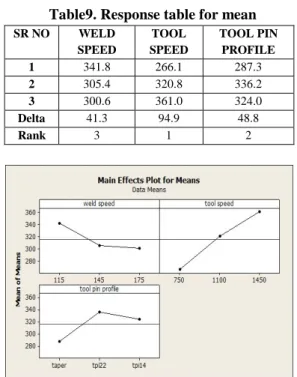
The experimental results were transformed into signal-to-noise (S/N) ratio. In this work, S/N ratios and mean values are calculated for each process parameter in three levels, shown in Table-8 and 9, and figure 3 and 4.
Table8. Response table for S/N ratio
SR NO WELD SPEED TOOL SPEED TOOL PIN PROFILE 1 50.42 48.45 49.01 2 49.61 49.96 50.39 3 49.52 51.14 50.15 Delta .91 2.69 1.38 Rank 3 1 2
Figure3. Main effects plot for S/N ratios
Table9. Response table for mean
SR NO WELD SPEED TOOL SPEED TOOL PIN PROFILE 1 341.8 266.1 287.3 2 305.4 320.8 336.2 3 300.6 361.0 324.0 Delta 41.3 94.9 48.8 Rank 3 1 2
Figure4. Main effects plot for Means
Figure 3 and 4 both predicts the optimum process parameter values of Welding speed (S) 115 mm/min, Tool Rotation speed (N) 1450 rpm, Tool Pin Profile of Cylindrical threaded (tpi-22) to obtained efficient Impact Strength.
B. ANOVA Results
The results of Two Way ANOVA Method on the Welding speed (S), Tool rotation speed (N), Tool Pin Profile and their influence on Impact Strength of weld joint of dissimilar AA6061 and AA6082 are determined by using MINITAB software and its values are shown in table 10.
Table10. Two-way ANOVA: Impact strength versus tool rotational speed, welding speed and tool pin profile
Source Degree of Freedom (DF) Sum of Square (SS) Mean Square (MS) F-ratio Percentage (P) Tool Rotational Speed 2 13621.0 6810.49 2.16 0.23 Welding Speed 2 3050.3 1525.13 0.48 0.72 Tool Pin Profile 2 3895 1947 0.46 0.65 Error 20 8710.7 435.54 Total 26 29277
1. ANOVA Results for Impact Strength
The Percentage Contribution of process parameter values as Tool Rotational Speed of 0.23 %, Welding Speed of 0.72 % and Tool Pin Profile of 0.65 % are determined by using two way ANOVA shown in table 10. It is observed that the
Welding Speed have great influence on Impact Strength of weld joint of dissimilar metals as AA6061 and AA6082.
V. CONCLUSION
All the experimental trials are analyzed under precautionary measures in order to keep the error factors low and optimize the reliable results to produce the efficient weld joint of dissimilar aluminium alloys with friction stir welding technique. Thus, the results obtained in this research study lead to conclusions for friction stir welding of AA6061 and AA6082 dissimilar aluminium alloy materials after analyzing the collected data.
i. The optimal process parameters of Friction Stir Welded joints of dissimilar Aluminium Alloys for Impact Strength are determined by Using Taguchi method and optimum values of the most Influence of process parameter on impact strength of friction stir welded joints of dissimilar Al alloys of AA 6061 and AA 6082 are found as Welding speed (S) of 115 mm/min, Tool Rotation speed (N) 1450 rpm and Tool Pin Profile of Cylindrical threaded (tpi-22).
ii. Using analysis of variance (ANOVA), the percentage of contribution for Rotational Speed, Welding Speed and Tool Pin Profile on Impact Strength is determined. But welding speed has great influence on Impact Strength of friction stir welded joints of dissimilar Al alloys of AA 6061 and AA 6082.
The future scope of the study is discussed as:
Rotational Speed, Welding Speed and Tool Pin Profile variations are taken into account as input parameters in this research study. The other input welding parameters such as heat input and any other type of tool pin profile can be investigated on same as well as on different alloys of aluminium and magnesium. Further Researcher can apply post weld heat treatment on same or different materials to achieve better strength.
VI. ACKNOWLEDGMENT
This whole research work has done under the guidance of Er. Lakshman Singh and Er. Simranjeet Singh as a Assistant Professor, Mechanical Department, Chandigarh University, Gharuan, Mohali who has provided all necessary resources like data book for getting necessary and valuable information
for the completion of this work and learned about the Taguchi as well as ANOVA methods and above all, utmost appreciation to the almighty God for the divine intervention in this endeavor.
VII. REFERENCES
[1] Ding, R. J. and Oelgoetz, P. A. (1999), “Auto-Adjustable Pin Tool for
Friction Stir Welding”. US Patent No. 5,893, pp. 507.
[2] Purushotham, P. and Hema, P. (2014), “Effect of Friction Stir Welding
on Mechanical Properties of Dissimilar Aluminium Aa6061 and Aa2014 Alloy Joints”, International Journal Of Engineering Sciences
& Research Technology, vol. 3, issue 4, pp. 7086-7092.
[3] Kallee, S.W. (2006), "Friction Stir Welding at TWI". The Welding
Institute (TWI). Retrieved 14/04/2009.
[4] Reynolds, A. and Siedel, T. (2001), “Visualization of Material Flow in
AA2195 Friction Stir Welds Using a Marker Insert Technique”,
Metallurgical and Materials Transactions, vol. 32A, pp. 2879–2884.
[5] Ericsson, M. and Sandstorm, R. (2002), “Influence of welding speed
on the fatigue of friction stir welds, and comparison with MIG and TIG”, International Journal of Fatigue, vol. 25, pp. 1379–1387.
[6] Pal, D. (2002), “Experimental study of friction stir welding of
aluminum plates”, M.Tech Thesis, GNDEC.
[7] Singh, B. (2003), “Experimental study of friction stir welding using
copper plates”, M.Tech Thesis, GNDEC.
[8] Zhao, Y., Lin, S., Wu, L. and Qu, F. (2005), “The influence of pin
geometry on bonding and mechanical properties in friction stir weld 2014 Al alloy”, Materials Letters, vol. 59, 23, pp. 2948-2952.
[9] Baruch, L. J., Raju, R. and Balasubramanian, V. (2012), “ Effect of
tool pin profile on microstructure and hardness of friction stir processed aluminum die casting alloy”, European Journal of Scientific
Research, vol. 70, issue 3, pp. 373-385.
[10] Kulekci, M. K., Kaluc, E., Sik, A. and Basturk. O. (2006), “Experimental comparison of MIG and Friction stir welding processes for ENAW-6061-T6 aluminum alloy”, The Arabian
Journal for science and engineering, vol. 35, pp. 321-330.
[11] Cavaliere, P., Squillace, A. and Panella, F. (2006), “Effect of welding parameters on mechanical and micro structural properties of AA6056 joints produced by friction stir welding”, Journal Materials Process
Technology, vol. 180, pp. 364–372.
[12] Ceschini, L., Boromei, I., Minak, G., Morri , A. and Tarterin F. (2006), “Effect of friction stir welding on microstructure, tensile and fatigue properties of the AA7005/10 vol.%Al2O3p composite” Composites
Science and Technology, vol. 67, pp. 605–615.
[13] Adamowask, J. and Szkodo, M. (2007), “Friction stir welds (FSW) of aluminum alloy AW 6082-T6”, Journal of Achievements in
Materials & Manufacturing Engineering, vol. 20, pp. 403-406.
[14] Moreira, P.M.G.P., Santos, T., Tavares, S.M.O., Richter, T.V., Vilaça, P., and Castro, P.M.S.T. (2008), “Mechanical and metallurgical
characterization of friction stir welding joints of AA6061-T6 with AA6082-T”, Materials and Design, vol. 30, pp. 180–187.
[15] Aval H., Serajzadeh S. and Kokabi A.H. (2011), “Evolution of microstructures and mechanical properties in similar and dissimilar friction stir welding of AA5086 and AA6061”, Materials Science
and Engineering vol. 528, pp. 8071– 8083.
[16] Cam, G., Mistikoglu, S., and Pakdil, M. (2009), “Microstructural and Mechanical Characterization of Friction Stir Butt joint Welded 63%Cu - 37% Zn Brass Plate”, Welding Journal, vol. 88, pp. 225-232.
[17] Zhou, L., Liu, H.J. and Liu Q.W. (2010), “Effect of rotation speed on microstructure and mechanical properties of Ti–6Al–4V friction stir welded joints”, Materials and Design, vol. 31, pp. 2631–2636.
[18] Hwang, Y.M., Fan, P.L. and Lin, C.H. (2010), “Experimental study on Friction Stir Welding of copper metals”, Journal of Materials
Processing Technology, vol. 210, pp. 1667–1672.
[19] Kumbhar, N.T. and Bhanumurthy, K. (2008), “Friction stir welding of Al 6061 Alloy”, Asian J. Exp. Science, vol. 22, 2, pp. 63-74.
[20] Jacquin, D., MeesterB. D., Simar, A., Deloison, D., Montheillet, F. and Desrayaud, C. (2010), “A simple Eulerian thermo-mechanical modeling of friction stir welding”, Journal of Materials Processing
Technology, vol. 211, pp. 57–65.
[21] Muruganandam, D., Sreenivasan, K.S. and Kumar, S. R. (2011), “ Study of process parameters in friction stir welding of dissimilar aluminum alloys” International Conference on Industrial
Engineering and Operations Management Kuala Lumpur, Malaysia,
pp. 22-24.
[22] Bagheri, A., Azdast, T. and Doniavi, A. (2012), “An experimental study on mechanical properties of friction stir welded ABS sheets”,
Materials and Design, vol. 43, pp. 402–409.
[23] Gosain, V. (2012), “Effect of process parameters on double- sided friction stir welding joint”, M.Tech Thesis, GNDEC.
[24] Cole E.G., Fehrenbacher A., Duffie N.A., Zinn, M.R., Pfefferkorn F.E., and Ferrier N.J. (2014), “Weld temperature effects during friction stir welding of dissimilar aluminum alloys 6061-t6 and 7075-t6”, International Journal of Advancement and Manufacturing
Technology, vol. 71, pp. 643–652.
AUTHOR’S PROFILE
Er. Varinder Singh has done B.Tech. in Mechanical Engineering from A.C.E.T, Amritsar and is Pursuing Master of Technology in Production Engineering from B.C.E.T, Gurdaspur. He has four years of teaching experience and presently working as Assistant Professor in Mechanical Engineering Department in Chandigarh Polytechnic College, Gharuan, Mohali (PB). Currently, he is doing research in the field of Welding.
Er. Lakshman Singh has done B.Tech. in Mechanical Engineering with degree of honors from MIMIT, Malout affiliated to Punjab Technical University and Master of Technology is completed in Mechanical Engineering from Punjabi University, Patiala. He has past one year teaching experience from Malout Institute of Management and Information Technology, Malout and three months teaching experience at CGC Landran, Mohali. Presently, working as Assistant Professor in Mechanical Engineering Department, Chandigarh University, Gharuan, Mohali. State- Punjab since September, 2013.
Er. Vidyadhar Biswal has done B.Tech. in Mechanical Engineering from RIMT institute of Engg and Technology, Mandi Gobindgarh and pursuing Master of Technology (part time) in Mechanical Engineering from Punjab Technical University, Kapurthala. He has three years teaching experience from Chandigarh University Mohali. His interested area of research is Welding
Er. Simranjeet Singh is master’s of technology in Industrial Design from PEC University of technology, Chandigarh, India. He has done Bachelors in Mechanical Engg From Kurukshetra University, India. Author is Interested in the areas of Ergonomics and Industrial design of products. Author is currently working as assistant professor in Mechanical Engg deptt. In Chandigarh University, Gharuan.
Er. Japinder Wadhawan has done B.Tech. in Mechanical Engineering from RIMIT-IET, Mandi Gobindgarh and is doing Master of Technology in Production Engineering from GNDEC, Ludhiana. He has two years of technical experience of mechanical and one year teaching experience as Assistant Professor in Mechanical Engineering Department, Chadigarh University, Gharuan. Mohali.