2261 ISSN: 2278 – 7798 All Rights Reserved © 2014 IJSETR
Abstract— Concrete block pavements (CBPs) have appearance of solid block with interlocking properties with each others for laying on the surface of road or pedestrian. As per requirement and use there are various sizes, shapes, patterns and designs of the CBPs are available now a days. In this paper we have considered the experimental study for construction of paver blocks with partial replacement of cement with brick kiln dust at concrete mix (CM) 0 %, 5 %, 10 %, 15 %, 20 %, 25 % and 30 % with adding superplasticizer admixture is maximum 2 % of superplasticizer by weight of cement. In this experimental study we considered the compressive strength and water absorption of paver block at 7, 14 and 28 days
.
Index Terms—Brick kiln dust, OPC 43 grade cement, Water absorption and compressive test of paver blocks.
1. INTRODUCTION
History of paver blocks starts from the Holland in fifties where they introduced firstly replacement of paver bricks which had became scarce due to the post-war building construction boom. About in 1990 research and development on the paver blocks started in INDIA by the Central Road Research Institute (CRRI). The standards are then finalized by the Flooring, Wall Finishing and Roof section Committee which approved by Civil Engineering Division Council (CEDC). Application of paver blocks popularity is increasing day by day in the country especially in the metropolitan cities as well as urban and rural areas. In this experiment the work has been done to use of waste brick kiln dust in concrete paver blocks and improvement of the compressive strength.
2. EXPERIMANTAL STUDY
In this experimental study, the experiment is done with the partial replacement of cement with brick kiln industries waste called brick kiln dust at(CM) 0 %, 5 %, 10 %, 15 %, 20 %, 25 % and 30 % in manufacturing of pave blocks and also the effect of admixture called superplasticizer in the manufacturing of paver blocks which is maximum 2 % by weight of the cement. Water absorption and compressive strength of sample paver blocks are done at 7, 14 and 28 days.
3. SELECTION OF MATERIALS 3.1 Brick Klin Dust (BKD)
In INDIA, brick kiln industries are the third largest industry where the coal is used to baking the clay brick. As per population are increasing the growth of brick kilns increasing to fulfill the demand of the clay bricks. But result has some losses in the form of environmental pollution and residue of brick klin called brick klin dust. Large amount of waste is obtained like brick dust, broken pieces and flakes of bricks (brick bat). These wastes are utilized for the low laying areas or dumped as the waste. In this experiment BKD collected from brick klin near Moti Ram, Deoria Road Gorakhpur, India.
Then the physical properties of BKD obtained through experiments in the lab. Experiment result has been shown below:
Table 1: Physical properties of BKD S.
No.
Lab Experiments Result
1 F.M. 3.73
2 Specific gravity 2.35
3.2 Cement
As per concerning IS 15658: 2006 Precast concrete blocks for paving, there are given various types of cement which can be utilized for production of paver blocks. But in this experimental study the OPC 43 Grade cement has been utilized which confirming IS 8112: 1989.
Table 2: Physical properties of OPC 43 Grade cement S.
No.
Lab Experiments Result
1 F.M. 6 % 2 Specific gravity 3.16 3 Compressive strength at 28 days 22.8 4 Normal Consistency 30 % 3.3 Fine aggregate
As per concerning IS 15658: 2006 Fine aggregates shall conform to the requirements of IS 383 both river/quarry sand and stone dust meeting the requirements can be used. In this experiment river sand is used.
Effect of waste brick kiln dust with partial
replacement of cement with adding
superplasticizer in construction of Paver Blocks
Table 3: Physical properties of fine aggregate S.
No.
Lab Experiments Result
1 F.M. 3.27
2 Specific gravity 2.56
3 % age of water absorption 0.82 3.4 Coarse aggregate
3.4.1 As per concerning IS 15658: 2006 coarse aggregate shall conform to the requirement of IS 383. For ensuring durability, the aggregate used for the manufacturing of paver blocks shall be sound and free from honeycombed particles in this experiment.
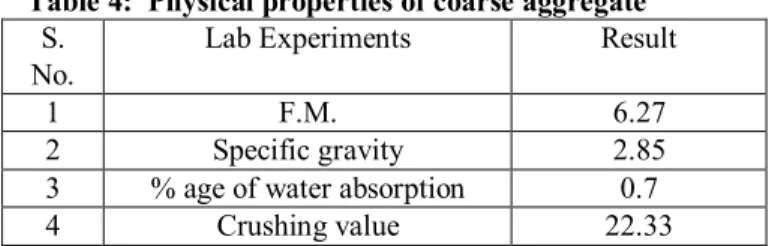
3.4.2 The nominal size of coarse aggregates used in the production of paver block shall be 12 mm. So in this experiment nominal aggregate size is taken 12 mm. Table 4: Physical properties of coarse aggregate
S. No.
Lab Experiments Result
1 F.M. 6.27
2 Specific gravity 2.85
3 % age of water absorption 0.7
4 Crushing value 22.33
3.5 Superplasticizer
As per concerning IS 15658: 2006 admixture shall confirming to IS 9103 and added for specific requirement without affecting the other quality parameter. The superplasticizer used was in the liquid state. We used Superplasticizer Waterproofing Chemical which reduces the ratio of water and cement and it also helps in increasing the slump and work ability.
Table 5: Physical properties of Superplasticizer S.
No.
From manuals Result
1 Appearance brownish liquid
2 specify gravity 1.18-0.05
3 ph value 8.00 to 9.00
4 Normally Dose As per concrete mix design
3.6 Water
The water is used in this experiment for concrete mixing have pH value 7.5 as from lab testing on pH indicator paper. Used water is portable drinking water and free from organic solid materials as confirming to IS 456: 2000.
3.7 Mix proportion
In this experiment trial mix proportion prepared as per IS 10262 : 2009 to carry out by proportion of cement, water, admixture, fine aggregate, coarse aggregate with partial replacement of cement with BKD at
(
CM) 0 %, 5 %, 10 %, 15 %, 20 %, 25 % and 30 % in manufacturing of pave blocks. Compressive result is concluded after 7, 14 and 27 days for the trial mix. Appropriate mix ratio was selected for M 35 grade. Mix ratio for M 35 grade trial was 1:2.54:2.1 and w/cratio taken 0.4.
In this experiment total 84 sample blocks were manufactured to find out the compressive strength of paver blocks with average of 4 samples for each proportion and each day of testing.
Mix proportion with partial replacement is given below in the table 5.
Table 6: Mix proportion S. No . Cemen t % BK D % Wate r % Superplasticiz er by weight of cement, % F.A . % C.A . % 1 100 0 0.40 2 100 100 2 95 5 0.40 2 100 100 3 90 10 0.40 2 100 100 4 85 15 0.40 2 100 100 5 80 20 0.40 2 100 100 5 75 25 0.40 2 100 100 7 70 30 0.40 2 100 100
4. CASTING AND TESTING
Mould of rubber based with size 200 x 160 x 80 mm3 taken
for the preparation of I- shaped sample of paver block. Firstly find out the suitable water cement ratio with adding superplasticizer by workability test. After that deciding the suitable admixture proportion from trial mix for preparing of paver blocks is shown in the table 5. The material required like cement, water, superplasticizer, fine aggregate and coarse aggregate were mixed together as per trial mix proportion. After de-molding from mould samples of paver block were kept in under shade for one day and after that samples were kept in water to analysis of compressive strength through compressive machine and water absorption of the paver blocks.
5. EXPERIMANTAL INVESTIGATION
In this experimental study experimental investigation were done on conventional control paver blocks and varying percentage of cement with BKD at 5%, 10 %, 15 %, 20 %, 25 % and 30 % for paver block were casted at M 35 grade of concrete.
.
5.1 Water Absorption
Water absorption was done at 7, 14 and 28 days of paver block samples. Sample were kept in fully submerged water for 7 days and then taken out from water and taken the saturation weight of each samples after that samples kept in oven drier at temperature 105 ±5 °C. After one day samples are taken out and dry weight of each paver blocks had taken. This procedure of water absorption test was carried out for samples after 14 and 28 days.
5.1.1 Saturation weight (Ww) of paver block
To find out the saturation weight of the sample of the paver blocks, the sample of the paver blocks are kept in the completely immerged in the water at the room temperature for 24±2 hours. After that sample is taken out from the water and leave for 2 minute to drain. Visible water is removed from the sample by damping cloth and after that weight of sample is taken. Weight of the sample paver blocks at each
2263 ISSN: 2278 – 7798 All Rights Reserved © 2014 IJSETR
percentage of replacement of cement with brick kiln dust is taken in kg to nearest value 0.01 kg.
5.1.2 Dry weight (Wd) of paver block
To find out the dry weight of the sample of the paver blocks, the sample of the paver blocks are kept in the ventilated oven at 105±7°C for 24±2 hours. After that sample is taken out from the ventilated oven an interval of 2 hours as incremental of loss not should be greater than 0.2 percent. Weight of the sample paver blocks at each percentage of replacement of cement with brick kiln dust is taken in kg to nearest value 0.01 kg.
5.1.3 Calculation of water absorption of paver block
The percentage of water absorption is calculated as 𝑊𝑝𝑒𝑟𝑐𝑒𝑛𝑡𝑎𝑔𝑒 =𝑊𝑤𝑊−𝑊𝑑
𝑑 × 100 %
Table 7: Water absorption percentages S. N o. NO. of days
Water absorption percentage with different partial replacement of cement (Average of 3
sample) 0 % 5% 10 % 15% 20% 25% 30% 1 7 0.8 7 2.63 2.84 3.92 3.12 2.62 4.47 2 14 1.3 5 3.0 1 3.83 4.30 3.72 3.39 4.59 3 28 2.3 1 3.46 4.47 5.59 4.35 3.98 4.98
Figure 1: Average water absorption at 7 days
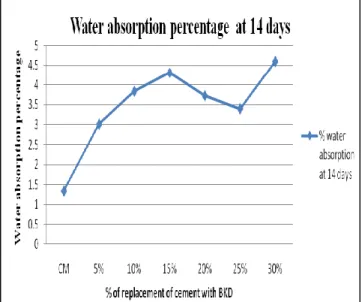
Figure 2: Average water absorption at 14 days
Figure 1: Average water absorption at 7 days
Figure 3: Average water absorption at 28 days
Figure 4: Comparison of Average water absorption at 7, 14 and 28 days
5.2 Compressive Strength of Paver Blocks
The compressive strength of specimen is calculated by dividing the maximum applied load (in N) by the plane area (in mm2).
Compressive strength = maximum applied load (in N)
plane area (in mm2)
5.2.1 Calculation of Actual plane area of Paver Blocks
As per calculation of paver block having I- section shape with dimension 200 x 160 x 80 mm3 have the actual surface plane
area of paver block determined 28000 mm2. This calculation
helped to find out the compressive strength of I shaped paver block.
Table 8: Compressive Strength of Paver Blocks S. No . NO. of day s
Compressive strength of paver block with different partial replacement of cement with BKD (Average of 4 sample) in N/mm2
C
M % 5 10% 15% 20% 25% 30%
1 7 32 35 36 37 33 29 27
2 14 36 38 38 39 33 30 29
3 28 41 40 40 42 34 31 29
Figure 5: Average Compressive strength at 7 days
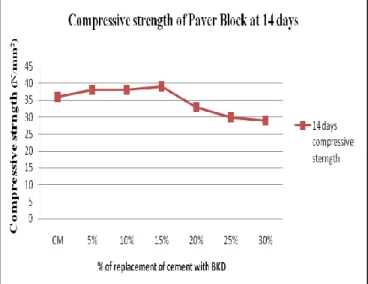
Figure 6: Average Compressive strength at 7 days
Figure 7: Average Compressive strength at 7 days
Figure 8: Comparison of Average Compressive Strength at 7, 14 and 28 days
2265 ISSN: 2278 – 7798 All Rights Reserved © 2014 IJSETR
6. Result and discussions 6.1 Water Absorption result
Water absorption test done as per IS 15658: 2000 for 7, 14, and 28 days. Water absorption percentage has been plotted in figure 1 for 7 days, in figure 2 for 14 days, in figure 3 for 28 days and comparison of water absorption at 7,14 and 28 days shown in figure 4 with replacement of cement with brick kiln dust. In table 6 water absorption percentage is tabulated for 7, 14 and 28 days. As per figure 4 shown that the water absorption percentage is increasing as the number of days increasing and also varying with replacement of cement with brick kiln dust.
6.2 compressive strength
Figure 5, 6 and 7shown the compressive strength of paver blocks at 7, 14 and 28 days of water curing. Figure 8 is showing the comparison of compressive strength of paver blocks at 7, 14 and 28 days with different partial replacement of the cement with brick kiln dust. From the figure graph it can be concluded that the addition of brick kiln dust as partial replacement of the cement with 5 %, 10%, 15 % is reliable to use. So the paver block can be used in light traffic categories and also some part of medium –traffic categories as results have been found. From the figure 8 it has been also conclude that the compressive strength of paver blocks are increasing from the use of 5 % to 15% and the compressive strength is also decreasing from use of above 15 percent of brick kiln dust in the construction of the paver blocks.
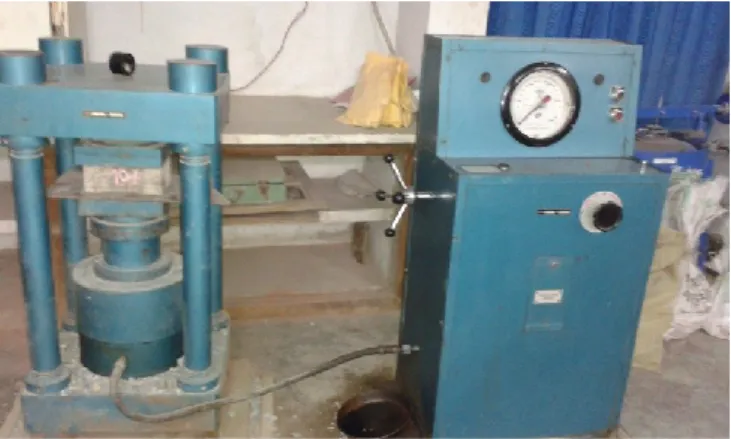
Figure 9: compressive test machine 7. Conclusions
From this experimental study, it can be conclude that brick klin dust utilization up to 15 % maximum as the replacement of cement gives the good and effective result in the construction of the paver blocks. There is also the effect of using superplasticizer which added 2 % by weight of the cement in the concrete mix while making the paver blocks. The utilization of brick kiln dust can give the solution of disposing of it and also make environment free from pollution and give the chance of increasing building construction.
8. REFERENCES
IS 15658:2006, Precast concrete blocks for paving block, Bureau of Indian Standard, New Delhi.
IS: 8112-1989, 43 grade ordinary Portland cement, Bureau of Indian Standard, and New Delhi.
IS: 383-1970 Specification for coarse and fine aggregate from natural sources for concrete (Second Revision), Bureau of Indian Standard, New Delhi.
IS 456-2000, Plain and reinforced concrete – code for practice (Fourth Revision), Bureau of Indian Standard, New Delhi.
Raman,S. N. M., Zain, F. M., Mahmud H. B. & Tan, K. S., “Influence of quarry dust & fly ash on the concrete compressive strength development”. Proc. AEESEAP Int. Conf. 2005.
Hameed, M. S. and Sekar A. S. S. “Properties of green concrete containing quarry rock dust and Marble sludge powder as fine aggregates”, ARPN journal of Engineering and applied Science, Vol.4(4), pp 8389.
Veera Reddy. M reported on “Investigations on stone dust and ceramic scrap as aggregate replacement in concrete” International journal of civil and structural engineering Volume 1, No 3, and 2010 ISSN 0976 – 4399
.
Rao. S. P., Seshagiri Rao. M.V and Sravana, 2002 “Effect of crusher stone dust on some properties of concrete” National conference on advances in construction materials, ACIM, Harmipur, H.P, Pp 196201.
Radhikesh P, Nanda Amiya K. Das and Moharana.N.C 2010 “Stone crusher dust as a fine aggregate in Concrete for paving blocks” Internatinal journal of civil and structural engineering volume 1 , No 3, 2010 ISSN 0976 – 4399.
1Sharda Sharma accomplished B. Tech in Mechanical Engineering from I.E.T. Sitapur in 2010 and has experience of production engineer one year in Automax a unit of Omax in Haryana. Presently pursuing M. Tech (IInd year) in Civil Engineering Department specialization in structural engineering from MMMUT Gorakhpur.
2
Ritesh
Mall completed B. Tech in Mechanical Engineering from I.E.T. Dr. RMLAU, Faizabad in 2009. Presently pursuing M. Tech (IInd year) in CivilEngineering Department specialization in structural engineering from MMMUT Gorakhpur.
3Khalid Raza completed B. Tech in Mechanical Engineering from B.B.I.E.T & R.C, Bulandshahr in 2012. Presently pursuing M. Tech (IInd year) in Civil Engineering Department specialization in structural engineering from MMMUT Gorakhpur.