University of Windsor University of Windsor
Scholarship at UWindsor
Scholarship at UWindsor
Electronic Theses and Dissertations Theses, Dissertations, and Major Papers
4-17-1969
Analysis of plates stiffened by mutually perpendicular ribs of
Analysis of plates stiffened by mutually perpendicular ribs of
variable depths by using the method of finite differences.
variable depths by using the method of finite differences.
Azizul Haque Khondker
University of Windsor
Follow this and additional works at: https://scholar.uwindsor.ca/etd
Recommended Citation Recommended Citation
Khondker, Azizul Haque, "Analysis of plates stiffened by mutually perpendicular ribs of variable depths by using the method of finite differences." (1969). Electronic Theses and Dissertations. 6568.
https://scholar.uwindsor.ca/etd/6568
This online database contains the full-text of PhD dissertations and Masters’ theses of University of Windsor students from 1954 forward. These documents are made available for personal study and research purposes only, in accordance with the Canadian Copyright Act and the Creative Commons license—CC BY-NC-ND (Attribution, Non-Commercial, No Derivative Works). Under this license, works must always be attributed to the copyright holder (original author), cannot be used for any commercial purposes, and may not be altered. Any other use would require the permission of the copyright holder. Students may inquire about withdrawing their dissertation and/or thesis from this database. For additional inquiries, please contact the repository administrator via email
INFORMATION TO USERS
This manuscript has been reproduced from the microfilm master. UMI films
the text directly from the original or copy submitted. Thus, some thesis and
dissertation copies are in typewriter face, while others may be from any type of
computer printer.
The quality of this reproduction is dependent upon the quality of the
copy submitted. Broken or indistinct print, colored or poor quality illustrations
and photographs, print bfeedthrough, substandard margins, and improper
alignment can adversely affect reproduction.
In the unlikely event that the author did not send UMI a complete manuscript
and there are missing pages, these will be noted. Also, if unauthorized
copyright material had to be removed, a note will indicate the deletion.
Oversize materials (e.g., maps, drawings, charts) are reproduced by
sectioning the original, beginning at the upper left-hand comer and continuing
from left to right in equal sections with small overlaps.
ProQuest Information and Learning
300 North Zeeb Road, Ann Arbor, Ml 48106-1346 USA 800-521-0600
UMI’
ANALYSIS OF
PLATES STIFFENED BY MUTUALLY PERPENDICULAR RIBS OF
VARIABLE DEPTHS BY USING THE METHOD OF FINITE DIFFERENCES
A THESIS
Submitted to the Faculty of Graduate Studies
through the Department of Civil Engineering
In Partial Fulfilment of the
Requirements for the Degree of
Master of Applied Science at the
University of Windsor
bY
Azizul Hague Khondker, B.Sc.,Engg.
(Dacca, E.Pakistan, Nov., 1963)
Windsor, Ontario
April, 1969
UMI Number:EC52751
UMI*
UMI Microform EC52751
Copyright 2007 by ProQuest Information and Learning Company. All rights reserved. This microform edition is protected against
unauthorized copying under Title 17, United States Code.
ProQuest Information and Learning Company 789 East Eisenhower Parkway
P.O. Box 1346 Ann Arbor, Ml 48106-1346
APPROVED BY
A - 'f- .
(Kurt Anton Zisch^y D. Sc., Department of Mathematics, Member )
( John B. K e n n e 4 J ^ ^ ^ ^ ^ f i S ^ u i v i T ^ | l n e e r i n g Department, Member )
kcbJ—
George Abdel.-Sa'yedy D r . i n ^ f Civil Engineering Department, Chairman 3
2 4 7 6 1 2 ,
ABSTRACT
This investigation is mainly concerned with the applica
tion of finite difference method to analyse plates stiffened
by mutually perpendicular ribs of variable depths.
The stiffeners are integrally connected to one side of a
thin isotropic slab of constant thickness. The material of the
plate is considered to be perfectly homogeneous and linearly
elastic. Analysis is based on the usual assumptions under
lying the two dimensional flexure theory of a thin elastic
plate.
For orthogonally stiffened plate of constant rigidity in
each direction the solution is usually obtained by using Huber’s
differential equation for ideal orthotropic plates. For the
plate in this investigation having variable depths of the
stiffeners, the Huber equation cannot be used without modifi
cation. Therefore, the solution is approached by the-;es§rgy.
method.
In this investigation the value of apparent torsional
rigidity in the potential energy expression has been taken
from ref. 10; The energy expression of the plate is approxi
mated by using the method of modified central differences.
The function product: obtained in the terms of the deflection
functions of a number of discrete points is minimized.with
respect to the deflection of any interior point to obtain the
difference operator of that particular point. Using appro
priate boundary conditions, difference operator for any point
near the plate boundary has also been derived. After obtaining
all the necessary difference operators, a general matrix equa
tion has been formed and utilized to solve the plate problem.
Prior to the solution of the main plate problem of this
investigation, the validity of the proposed method of solution
has been investigated by solving a plate and a beam problems of
constant and variable rigidities respectively. Comparison of
the solutions with those obtained from other standard methods
has revealed that a considerable discrepancy arises if whole
station (conventional) method of central differences is used
to approximate odd order derivatives. Such a discrepancy has
been avoided by using half station (modified) central differ
ences method.
The values of deflections obtained by using the modified
central differences method are in fair agreement with those
obtained from tests on a steel plate model made from an iso
tropic slab stiffened with mutually perpendicular ribs of
variable depths. Tests were performed under two different
kinds of loadings: (a) A single concentrated and (b) Two equal
concentrated.
From this study it has been clarified that the theory of
equivalent orthotropy in conjunction with the modified central
differences method can be used as a valuable tool in solving
the problem of an orthogonally stiffened plate of variable
rigidity.
TABLE OF CONTENTS
. Page
LIST OF TABLES AND PHOTO PLATES ' i v
LIST OF FIGURES .
ACKNOWLEDGEMENT vvi
INTRODUCTION 1
NOMENCLATURE 3
I. FORMULATION OF.THE PROBLEM 5
A. Plate with Constant Rigidity in Each Direction 5
B. Orthogonally stiffened Plate Reinforced by Ribs
of Variable Rigidity in Each Direction 7
II. METHOD OF SOLUTION S
A. Conventional or Whole Station Method S’
B. Modified or Half Station Method ' S
III. APPLICATION OF THE METHOD OF FINITE DIFFERENCES 10.
A. Application to a Beam Problem with Variable
Rigidity 10
.1. Approximation by using Whole Station
Central Difference Method H
2. Approximation by using Half Station Central Difference Method
B. Application of the Conventional (or Whole Station) Method to an Orthotropic Plate Problem with Constant Rigidity in Each
Direction and Detection of Discrepancy 13
IV. ORTHOGONALLY STIFFENED PLATE WITH RIBS OF
VARIABLE RIGIDITIES IN EACH DIRECTION 18
^A. Derivation of Modified Central Difference Operators Based on the Principle of
Minimum Potential Energy 18
B. Numerical Solution of an Orthogonally Stiffened Plate with Ribs of Variable
Rigidity 22
i
Page
The Solution n 23
a. Distributed Load 24
b. Concentrated Load 25
c. Two-Point Load Symmetrical 25
About the Axes
V. EXPERIMENTAL VARIFICATION OF THE PROBLEM OF AN
ORTHOGONALLY STIFFENED PLATE OF VARIABLE RIGIDITY
A. Description of the Model
B. Supporting Structure
C. Loading Device
1. Concentrated Load Sit the Center
2. Two Concentrated Equal Loads Applied
at (a/3, b/2) and (2a/3, b/2)
D. Testing Method and Recording of Data
DISCUSSION AND CONCLUSION
BIBLIOGRAPHY
APPENDIX - A
1. Modified Central Difference Operators
2. Difference Equations of a Beam of. Variable
Rigidity Under and Uniformly Distributed Load 55
3. Calculation of Deflections of a Beam using
Castigliano’s Second Theorem 56
4. Derivation of the Values of Plate Rigidity
Constants 58
5. Derivation of Equation (20) Based on Energy
Expression (1.21) of Reference [13] 59
6. Application of Difference Equations (20) at ■ •
Mesh Points (9) and (l) of the Plate 61
ii
26
26
26
26
26
27
27
28
30
53
53
Page
APPENDIX - B 62
/ Psae
COMPUTER PROGRAMS
A. Solution of a Beam of Variable Rigidity 62
1. Castigliano's Method 62
2. Modified - 10 Segments 63
3. Non-modified - 10 Segments 67
4.. Modified - 5 Segments 70
-.5. Non-modified t 5 Segments 72
B. Plate of Constant.Rigidity
(Dr. Ando’s Plate Type-B) 74
1. Modified , '74
2. Non-modified 755
C. Plate of Variable Rigidity . 8 0
1. Modified 80
2. Non-modified 85
AUTOBIOGRAPHY . 8 9
iii
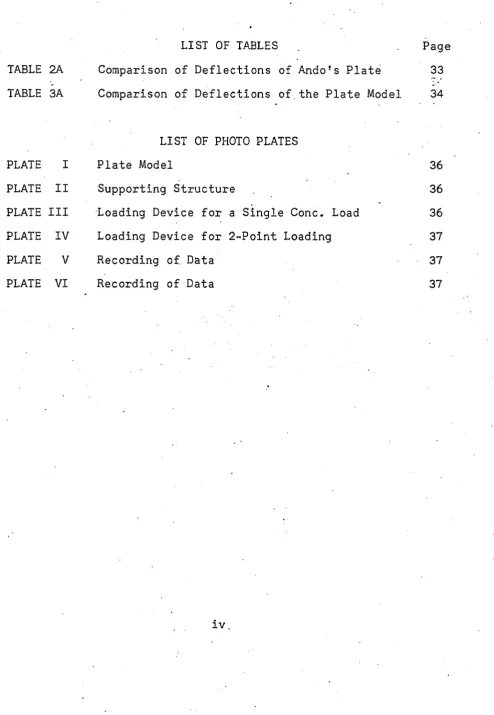
LIST OF TABLES Page
TABLE 2A Comparison of Deflections of Ando's Plate 33
TABLE 3A Comparison of Deflections of.the Plate Model 34
LIST OF PHOTO PLATES
PLATE I Plate Model 36
PLATE II Supporting Structure 36
PLATE III Loading Device for a Single Cone. Load 36
PLATE IV Loading Device for 2-Point Loading 37
PLATE V Recording of Data 37
PLATE VI Recording of Data 37
iv.
LIST OF FIGURES
Figure Pag
1. Differential Element P3§
2. Orthogonally stiffened plate of variable rigidity 37
i 3. Node-point layout of a beam of variable rigidity 3!3
4. Numerical example of a beam of variable rigidity 39
5. Mesh point layout of a plate _ 40
6. Model of the stiffened plate with variable rigidity 41
7. Comparison of 10-segment solution of the beam problem 42
8. Comparison of 5-segment solution of the beam problem 43
9.A. Deflections at pt. 3 of plate model for load at center 44
9.B. Defleptions at pt. 6 of plate model for load at center 45
9.C. Deflections at pt. 9 of plate model for load at center 4'6
10.A. Deflections at pt. 3 of plate model for loads at 8-8^ 47
10.B. Deflections at pt. 6 of plate model for loads at 8-8' 48
10.C. Deflections at pt. 9 of plate model .for loads at 8-8' !49
11. Comparison of deflections of the plate model SO
12. Calibration curve of the Load Cell used for single
conc. load SI
13. Calibration curve of the Load Cell used for 2 pt.
.loading 52
v
ACKNOWLEDGEMENT
The author wishes to express his thanks to Dr.
George Abdel-Sayed for his guidance and encouragement
in the course of making this investigation. The dis
cussion and help of Dr. K.A. Zischka in the derivation
of some, mathematical formulae are greatly appreciated.
Acknowledgement is due to the Computer Center Staff
and to the Staff of the workshop of the Civil Engineer
ing Department.
The financial assistance for this work by the
National Research Council of'Canada is appreciated.
My appreciation is also expressed to Miss
Dianne E. Kimura and Mrs. Germaine Marentette for the
typing of this thesis.
1
INTRODUCTION
An orthogonally stiffened plate is commonly composed of
a thin isotropic plate stiffened on one side with mutually
perpendicular ribs.
In general, bending moment is variable in plates and,
since bending rigidity is a function of depth, it is possible
to reduce the weight of materials.used in a plate by providing
appropriate depth of ribs. Because weight is a very important
factor in the design of aircrafts, space vehicles, and ship-
bottom structures, where orthogonally stiffened plates are
mainly used, plates with variable depth of ribs are gaining
more importance over the ones stiffened with ribs of constant
depth.
The differential equation of an orthotropic plate, first
formulated by Huber H8 ] , is commonly used to solve the problem
of stiffened plates. One of the first suitable solutions of the
Huber differential equation applicable to such plates was pub
lished by Cornelius T5l in 1952, based on the concept of
"equivalent orthotropy".Later, the theory of "equivalent orth-
tropy" gained more importance when Giencke [7] and Massonnet [lO]
formulated the "equivalent rigidity of torsion" on a rational
basis.
Besides them, other authors have contributed to the
further development of both the analytical and experimental
methods of solution of orthogonally stiffened plates. But,
most of them were for plates of constant rigidities. To the
knowledge of the writer, very few works have been done on
2
gonally stiffened plate with variable rigidity.
Based on the method suggested by Witteveen [16^ for
plates of abruptly varying thickness, Aquilino [2] derived
finite difference equations for plates having rib sizes
changeable both ways. These equations are also applicable to
orthogonally arranged beam-gratings of variable sections. But
he did not include the effeat of stresses induced in the middle
plane of the plate. Mazurkiewicz L123 used the method of
Double Fourier series to solve simultaneous bending and com
pression (or tension) problems of rectangular plates reinforced
by ribs of variable rigidities. He assumed that the plate and
the ribs have common axes of bending and disregarded the effect
of shear pressure. Also, his solution is practically applicable
to plates reinforced in one direction by limited number of
stiffeners.
It may be noted that most of the works to date either
did not take middle plane stresses into consideration or is
subject to cumbersome numerical works and convergence difficul
ties. The work presented herein stems from the need for a more
accurate and rapidly converging method of solution for problems
in the theory of orthogonally stiffened plates of variable rib
sizes.
Based on the theorem of minimum potential energy and
using the method of half- station central differences, modified
finite difference equations for a plate with variable rigidity
have been developed for calculations of deflections. Solutions
thus obtained are also verified with experimental results.
NOMENCLATURE
A S = ( > * / ^ ) Aspect ratio
B Flexural rigidity of isotropic slab
B ,B . Orthotropic flexural rigidities per unit
x Y width in x and y directions
B ,B Orthotropic torsional rigidities per
XY Yx unit width in x and y directions
a,b Length and width of the plate
bx,b Spacing of ribs lying parallel to x and
Y y axes respectively
C Torsional rigidity constant
D=_Et/(i-ji*) Isotropic plate constant
DX ,D . ' . Strain rigidities per unit width in x
Y and y directions par
d(y) Depth of ribs in y direction of the
plate model
E . Modulus of Elasticity
ex ,e Eccentricities of the cenbroids of the
Y stiffened plate elements from the middle
surface of the slab in x and y directions
F(x),F(y) Elementary areas in x and y directions of
the plate-rib repeating sections
G Shear Modulus of Rigidity
H. Apparent tortional rigidity of the
orthogonally stiffened plate
Ix Moment of inertia with respect to x axis
K Any interior point
Jt Length of beam
MX,M Bending moments per unit width of cross
Y section in x and y directions
Mxv,Myx Twisting moments per unit width of cross
section about x and y axes
NX,N Normal axial force per unit width of
* cross section along the middle plane
in x and y directions
N ,N ' Shearing forces per unit length on planes
^ ^ perpendicular to x and y axes
q Distributed load i'area or length
^Qx jQv Shear forces per unit length on planes
parallel to z axis but perpendicular to y and x axes respectively
R Region within the contour of plate
boundary
t Thickness of the isotropic slab
U Total potential energy
u,v,w Displacements'in x,y and z directions
respectively
i X)Cy , ^ Unit strain components in x,y and z
directions respectively
Angle of twist per unit length
Distances of node or mesh points in x and y directions respectively
V. Poisson’s ratio
.{/° ■ Radius of curvature
Unit normal stresses on planes perpendi cular to x and y axes respectively
.. 1 Unit shearing stresses on planes perpen
dicular to z axis but parallel to; y and x axes respectively
_< Differentiation with respect to x,y and
xy respectively . .
5.
I. - FORMULATION OF THE PROBLEM
A. Plate With Constant Rigidity In Each Direction
An ideal orthogonally anisotropic (or orthotropic) plate
can be defined as a plate having constant thickness, but dif-
. fererit elastic properties in two mutually perpendicular di
rections..
The small deflection theory of an ideal orthotropic plate
is based on the usual limitations applied to isotropic plates,
for example, deformation of a loaded plate is purely elastic,
follows Hook’s Law and Bernouli’s hypothesis. The small de
flection behaviour of such a plate was first formulated by
Huber 1H1 in the form of the following partial differential
equation:
^ ^ xxz*. + Cxyy + Sj1 “ J , t y y y (l)
where,
.Bx = orthotropic flexural rigidity in x-direction
By = orthotropic flexural rigidity in y-direction
.H = apparent torsional rigidity of an orthotropic plate.
The same form of governing differential equation is also applied
to an orthogonally stiffened plate, since, in such a plate, the
discrete ribs are assumed to be continuously distributed in two
mutually perpendicular directions to yield an "equivalent ortho
tropic structure",.
- "Equivalent orthotropic-.structures" may be defined'in the .
following ways [9] :
(a) The equivalence might be based on the equality of
deflections at similar points within the boundaries of the actual I
and the hypothetical plates.
(b) It might be based on the equality of strain com
ponents or upon minimization of differences of strains at spe
cified points of the actual and hypothetical plates.
(c) It might be based on equality of the strain ener
gies of the actual and hypothetical plates.
Massonnet [10} has shown that the assumption of an equivalent .
orthotropic plate to replace an actual ribbed plate is excel
lent for a plate with symmetrical ribs, provided that the ratios
of stiffener spacings to plate boundary dimensions are small
(bx/a, by/b « l) to ensure approximate homogenity of stiff
ness [9] .• But, for a plate with asymmetrical ribs, such an
• assumption is theoretically imperfect. More exact analysis
shows that an eighth order partial differential equation is
necessary to determine the exact behavior of such a plate.
Since Huber’s differential equation is only of the fourth
order, there exists no Huber-type orthotropic plate rigour-
ously equivalent to the real asymmetrically ribbed plate.
Huber’s equation, unless modified, can only give an' approxi
mate solution of the actual state of stress and strain.
Giencke [7] attempted to solve such a plate problem in
equivalent orthotropy on the basis of Huber’s equation :
where H = B+Bxy.+ Byx + vexeyD + (ex+ey )2 (l-v) (2)
Massonnet pLO} has shown that the apparent torsional ri
gidity, H, in Giencke’s solution, is vastly exaggerated. He
(Massonnet) proposed:
H = B + + v exeyD + (ex+e )2 (l-v) (3)
r 4
In this investigation the value of H as given .in expression (3)'
has been used.
7.
B. Orthogonally Stiffened Plate Reinforced By Ribs Of
Variable Rigidity In Each Direction
If an isotropic plate is reinforced by an orthogonal set
of ribs of variable rigidities in its mutually perpendicular
directions, x and y, (Figs.l & 2), the force equilibrium equa
tions due to a uniformly distributed load, q, can be written as
follows: [10]:
- MxyX- + 5 + My;,!/ =*o cxruLy
- ■ + cV~-° (4,a-c)
where, Mx = - Bx B t J , + e*. o*. C t c , )
: My - -By DyCv^
-M xy= , K ' - ^b -h
M y X~ - [h- V) B + Byx] I*} , zy
Nx = J)st(«;x ‘ e* ^ + 1,P',»J
Ny =
and Nxy=Nyx= ^ 4 ^ +
Introducing the stress-strain relations and the compatibility
conditions in the above fundamental equations, one obtains the
following equation:
xxx* + ®x,xx.^>x.x + By, 5,3
+ V|- ^ > 3 2 ^ ) + { B x y + + * - C ‘ - W + , * . y * * " iuj
+(5xa ^ 7>C ^ y i} + f’yx? *^xsy *“
For simply supported plates, the solution of the above equation
becomes too much involved. Therefore, instead of proceeding
with such an equation, the principle of minimum potential en
ergy has been used for derivation of finite difference operators
as involved in chapter III of this investigation.
II METHOD OF SOLUTION
The boundary value problem in partial, differential equa
tions,. as Involved in this investigation will be solved by using
the method of finite differences. In this method, partial de
rivative is replaced, by an approximating difference operator in
the continuous region in which the solution is desired for a
set of discrete points. This process of replacement yields a
system of simultaneous equations involving the same number of
unknowns. By. solving these equations, when the values for a
finite set of points are available., data for intermediate
points may be obtained by interpolation or any other analytical
method. ' •
The method of finite differences can be applied in the
three different ways' [14, 15? 17 ] ♦
(1) Central Differences
(2) Forward Differences•
(3) Backward Differences , •
Among these three, the most commonly applied is the method of
Central Differences. There are two different formulations of
this method:
A. Conventional or WhoLe Station Method:
A whole station method is one in which derivatives of
function products are expanded first and then the' finite dif
ference approximations are made.
B. Modified or Half Station Method:
In this method finite difference approximations are
made before expanding derivatives of function products.
Whole station method can be conveniently employed to
9
approximate even order differential operators. But for odd
order derivatives which frequently occur in structural pro
blems with non-uniform rigidity, whole station central dif
ference approximation leads to a considerable error, while,
excepting a few cases, half station method always yields
better results.
A comparison of the root-mean square values of the errors
involved in both the methods shows that half station method is
usually superior to whole station method in calculating de
flections and bending curvation's of such structures [3] .
‘ ■ 10
III -.APPLICATION OF THE METHOD OF FINITE DIFFERENCES
.This chapter deals with the application of finite dif
ference method in solving beam and plate problems. In section
1, both the conventional and the modified finite differences
are applied to the problem of a beam with variable rigidity
and the results are varified with those obtained from a solu
tion by using Castigliano’s second theorem. In section 2, the
conventional method of central differences is applied to ap
proximate both the even order and the odd order derivatives in
the equation of an orthotropic plate of constant rigidity in
each direction and the discrepancy arised thereby has been de-
tected and corrected by using half station or modified method.
In the conclusions of sections 1 and 2., the validity of
•application of the method of finite differences, in particular
the modified method, has been discussed and the application of
the method has been further extended to the problem of an ortho
gonally stiffened plate having ribs of variable rigidity in each
direction in section 3.
A - Application To A-Beam Problem With Variable Rigidity
A beam with variable rigidity is a special case of a
two-dimensional plate problem with variable rigidity. If the
derivative with respect to the cartesian coordinate y is put
equai to zero, equation (5) reduces to the differential' equa
tion of a beam having variable rigidity in the direction x and
subjected to a uniformly distributed load, q, as given below:
l**> -XX. — {tyr' (6)
or TR n _ »
/, ■ ' : 11
Equations (6) and (6a) can be approximated by using the
method of whole station and half station central differences in
the following manner:
1 1. Approximation By Using Whole Station Central Dif-
.. ferences: Method For Any Interior Point. K. (Fig.3)
1 = - 4 kJK.+l + ^K+aJ
— + a w K-| “ auv+|+ ‘'“fc+lJ
— 4c* - ZuJK + . (7)
2. Approximation By Using Half Station Central Dif
ferences Method For Any Interior Point. K. (Fig.3)
• q'
* ^ . ^ ^ "1)^-' +BxC<+l>^X+» xx3
' ; v I - l£ - ^ :
<8>
In a similar manner finite difference equations can be
derived for any point near the edge of the beam and appropriate
boundary conditions can be applied to evaluate the deflections
of fictitious external node points in terms of those of the
points of interest. In the case of the simply supported beam,
w(support)= 0
(9a,b) M(support)= 0
For convenience of the reader a number of finite dif
ference equations have been given for both interior and ex
terior points in the Appendix A.
12
Numerical Example:
Deflections at different node points of a simply sup
ported tapered beam (Fig.4), of length i and depth 2b/5 on one
end and 2b on the other, have been calculated by using both
equations (7) and (8) for ten and five segments and the results
are compared with’ those obtained by using Castigliano’s Second
Theorem in Fig. ( 7 respectively.
It is observed that deflections obtained for ten seg
ments by using half station method are very close to those ob
tained by using Castigliano*s Second Theorem. Whereas, whole
station solutions are quite far away from Castigliano*s solu
tion. This also applies for a five segment .solution. A com
parison between Fig. C7)&(8) , shows that in case of half
station method, though deflections by using five segments seem
to be closer to Castigliano*s solution, at some node points
than those by using ten segments; the4pattern of deflections,
in case of ten segment solution, is much closer to Castigliano*s
solution. A comparison between the same Figures also shows
that five segment half station solutions are more accurate than
ten-segment whole station solutions.
From the above results, it is clear that though in case
of conventional finite difference solutions, the use of large
number of segments usually yields more refined results than by
using a fewer number of segments, it is also possible to obtain
results of the same degree of accuracy by using the method of
modified finite differences with a fewer number of segments.
13
So, it can be concluded that using only a few mesh points
and applying the method of modified finite differences as ap
plied in the case of a tapered beam, sufficiently precise solu
tion of deflections of an orthogonally stiffened plate with ribs
of variable rigidities may be obtained. Because such a plate is
nothing but a generalized version of a one-dimensional problem
of a tapered beam.
B - Application Of The Conventional (Or Whole Station)
Method To An Orthotropic Plate Problem With Constant
Rigidity In Each Direction and Detection Of Discre
pancy
If the partial derivatives of the governing differen
tial equation (1) of an orthotropic plate are. approximated by
the conventional finite differencesj the resulting difference
equation may be written in the following form:
-•/fey
- By
4A5(fogA+H)f-[6A5H As\) — B —
ZHS.U |zAS. 44|
(10)
where, As
. .... / .• . : : • ■■•■■■■ i4 .
Instead of using equation (l), if the principle of mini
mum potential energy is utilized, one should end up with the.
same finite difference operator as in equation (10).
'The total potential energy, U, of such a plate, can be
expressed as [l6] : . . •
U =. i *•*“ >**■ + u>* » 3+ ^ ..(11)
If the quantities ^,xx, W , y y a n d W jJCy are approximated by using
the whole station'central differences, equation (ll) reduces to:' -1\ -0* ' -1
1 *w'
\ -*
1 -1
X
3
rv
(11a)
Equation (lla) can be written in the following form:
U = % * \ + J 3~T^ (12)
Retaining only the terms containing the deflection,w^,',
of an interior point, K, (Fig.5), the finite difference expres
sions for the terms T^, T2 , Tg, and.T4 reduce to the following
forms: :
. -1
\»K ■
. i to ^ i. i-n '2<Jkh+
]
+ [U>W ~ 2 + UJA'^
- +[J *. +■ "'?]•+■
Minimizing U with respect -to co.^’ , and putting it equal
to zero:
2JLL s=. *'aii + J J t - = o ( 1 3 )
"ZlJfc COjC, ^je.
the following difference equation for an interior point, K, is
@ht§ined:
ASH/U ■■
-I
A $ < 6 x - H /'a ) - 4 A S B * - 4 A * S x A * W
-AS*/l£>
+ AS H/+ I
By ■
&y~AS
I
Ui= ^7la
(14)
. It is observed that equation (14) does not tally with
equation (10). But instead of taking whole station central dif
ferences, if half station central difference technique is ap
plied, other terms in the potential energy equation (12) remain
the same, while only term, Tg, containing an odd order deriva
tives #,Xy, needs the following modification:
T3 =
*2- H 'X x 'X v —■
<> ■-7
\
(
X
. 1 -1
t
9
to
+ u>c
-- ^ r
+1“ WIH + * 0JM^ - UmI '2'
■ + **Wl ~ ^K+l ~ 1 1 +
•16
■ ^ Minimizing with respect to ■ ’ •
f*""--*■ i w K-» *
‘ ** ‘* 7 i + t + ,' V « » ■** l' V + l J ] ^ ^ )
Replacing the term ^§73^ equation (13) by the right Ka-nd.
side of equation (15), and putting it equal to zero, one. ob
tains'. a finite, difference equation for any interior mesh point
which is same as equation (-10). A comparison of equations (.10)
and (14), shows that the.discrepancy arises due to the fact that
the procedure applied in the conventional central difference
method to obtain approximations for odd order derivatives is not
consistent with that used to obtain even order differences.
Such inconsistencies were also reported by Cyrus and Fulton [3J,
Melin and Robinson [1J , and Chuang [4j .
During-this present investigation, such an inconsistency
was first observed while solving a few test problems of ortho
gonally stiffened plates of constant rigidity, originally
■solved by N.Ando [1] , by using equation (14), had no corre
lation with those obtained by N. Ando. After modified central
' • .17
differences were used to approximate the odd order derivative
as involved in equation (11), both of the difference equations
J
coincided and the deflections obtained by them were fairly
close to those obtained by N. Ando. (Table 2A).
Due to the above facts, in the rest of this investigation
half station (or modified) central difference method has been
utilized to approximate odd order, derivatives. For convenience,
some modified operators are given in the appendix.
I.8
IV - ORTHOGONALLY STIFFENED PLATE WITH RIBS OF
• VARIABLE RIGIDITIES IN EACH DIRECTION
A - Derivation Of Modified Central Difference Operators Based
On The Principle Of Minimum Potential Energy: (Fig.5)
For a given load, q, uniformly distributed over an iso
tropic plate orthogonally stiffened with ribs of variable rigi
dities in each direction, and having no initial' curvature, the
equation (11) for total potential energy at the middle plane
due to bending, torsion and external load can be approximated
over a region, R, as:
11:2= TlA
o-r.
-.X
11
-'0IJ a
»T-U d h T, 4- - T,
tO - s; ^ (/rV
(17)
Expanding the-terms_T_L, T2 , T3, and T4, and retaining
the terms required to minimize each of. them .with respect to the
deflection,, ’ , • of- an interior- point- K, - one obtains,
T! *5. 1
-I _______ ________
H SyiuUAy^ ^6.-2t^n -+ U>K fylK) p
^ Eat*) - 4- ujf> ' C '_________ ■______
‘ ^ ^ V " |
T3 =— +H K . j
LiizLzHrL—lLuij’) s^k
+
-T V ^ X x7Ly - V ---- — --- "
Minimizing U with respect to and putting it-equal to zero,
ie*
T>U _ "ftTi -L-’a n. 2 J L _ = o, 0-h.e. obtains, / 3 £ 0 ^ ; / a o J i c '
vat
?)&
k. - w V"X-j[$;Tl^-tJ ^ k." ]
; + ^ <+l j .
;
■^ ' — -t < J K . + 6 UA A ^
•
^
1 "* “ •■ i
■ * * » ■ ■|'w i
" -! t--40 *■ ^ 1: ;' \
V 1 ^ *■ Wl ^ t «*» *H: j= ^k! .-■” "
---Equation (18) can be written in the following form:
‘ * * * K - i ’ ^ j 'k.---z. .
_ i i t * | - '^ 2 ' \+ ^ it+V j ;•'•'•
+ &s^ k. +i . - * - ^ w - i + ^ i c t t j
+ BEa ^ j w i ' -•Z-w + U> JC |
_ 2-S&y^ j wij . - 2^ - + |
+ SEY .m |^..k .- 1.w ;m; + *>;r. j .
+ ■■*££■ 0. | ^ U-l - ^ (J' T W k,.Y +' ^ '"j .•
-+ BEC b [-^.»i . + Y --^ ^v- j
+ &-SC c ■+ j
-(■ j -
b1
t^+l ^ = ‘V i ^ , '— J20
where, (7Ly/^_)= AS
.BEX =. BxA5v .
BEY = -By... :
- ! ••
• BEC = . -2-H A* ---
----The equation (19) has been derived using equation (ll),
which is based on the condition:
To avoid such a condition one may use the following finite dif
ference equation (Derivation given in the Appendix A):
<
I' i
» T
e*»
,y c >y E
-i 7f A
t
) *
1 >
>/ V *
• z* '
■ V •• 1
fe -«
*0 u
^ =
(20)
where, P= AS B^j^
q= £ As + ^^y(K) ■*" + ^ ^E(“
•t* Bec. -f- 4 3EZ
R = — 11 [By<*)+ B y(K)] - f c E C ^ - B E C ^
: - BE7^
S=— 2 + b/Ck)J ~ BECK.-5ECN •
. . . . - ^EZ|c ~ '
T=-Byt^
U=- By (k)
Y = - 4 Bx CK) - [bec + /*■ ~ BEC(C- & Z
Zi= | B E C fc + BEC^ / 2 + { l B Z K + t e Z A] / z
-Z2= 4
[
beZk21
In the above equation, K, is the interior point where the
derivative is approximated and N and M (Fig.5) are two adjacent
points whose rigidities were also necessary in this approxima
tion. Rigidities for other adjacent points shown by black
circles (®), except for N and M, were not necessary.
Equations (18), (19) or (20) can be applied to an ortho
gonally stiffened plate with variable rigidities .of ribs in-each
direction to get the deflections of- any point within the bound
ary. These equations are based on small deflection theory. All
the assumptions of a thin isotropic plate are also applicable
to them. To apply these equations at the exterior mesh points
of a plate,, suitable boundary conditions have to be applied. In
case of a clamped plate, Lagrange’s Multiplier method may be
used [6]. In case of a free edge, Kirchoff-Love condition may
be applied. For a ,simply supported plate along the entire con
tour, as involved in this investigation, the following condi
tions- are applied:
9= 0 and Mx= 0 at x= 0 and x=a
<4- 0 and My= 0 at y= 0 and y=b
J
Since Mx= - ■b*-c*5jxx- + e* ~ )
and since there is no curvature in the y-direction, ,
and also according to Massonnet's approximation £l0] ,u. = e*6uPX
of the last term in the equation of moment is
equal to zero, and- the zero moment condition reduces to
at x=0 and x=a, and in the y-direction, at y= 0
and y= b. (2l)
In the case of a plate with constant rigidity in each
direction, equation (19) coincides with equation (10).
22
In case of a plate with variable rib-dimensions in the
y-direction only, as used in this investigation, the terms,
esc .. 4- , »
3 E C ^ =r B'EC^ tL- £=_ (approx.)
_ BEt + EEC. . • .
BECc - B E C ^ - ^ (approx.)
B, Numerical Solution of an Orthogonally Stiffened Plate
With Ribs of Variable Rigidity
Introduction
In this section, finite difference solutions by both
whole station (conventional) and half station (modified) methods
have been presented for an isotropic plate (.Fig.6), having di- •
mensions 3 ,x2,x^" and stiffened in the x-direction with five
equally spaced ribs, each having different but constant
stiff-\
ness. In the y-direction, five ribs are used, each of constant
width but depth varying as a half sine wave, d(in ihGhes^ =
1.5(1 + sin2^ ). Width of all stiffness was . Material
used in the solution was hot rolled structural grade steel
having Young's modulus of elasticity, E= 30 x lO^p.s.i., and
Poisson’s ratio, 0.3. The solutions presented herein for the
above plate with simply supported boundary conditions along
the entire contour are under three different conditions of
loading:
(a) Uniformly Distributed Doad, q
(b) A Single Concentrated Load, P, located at center
(c) Two Concentrated Loads, each equal to P/2, located at
(a/3,, b/2 and (2a/3, b/2)
23
Since the loadings considered and the plate geometry are
symetrical about the central axes, only one quadrant of the
plate ,was considered. Fig.(6) shows the layout of the meshes
for application of both the conventional and the modified me
thod of finite difference techniques.
In both .cases, pertinent difference operators in accord
ance with equation (20) are applied for interior mesh points.
(5,6,8,9) and for mesh points near the boundary (l,2,3,4,7).
Boundary conditions (21) are applied-to evaluate the deflection
functions outside the plate boundary, in terms of those within
the boundary and the resulting equations are written in terms
*
of deflections of different interior mesh points. The re
sulting matrix of the above simultaneous equations are solved
with the help of a 1620-11 compiler of the University of Windsor.
To maintain proper accuracy digits up to eight significant fi
gures were taken into consideration.
The Solution
The finite difference operator (20) can be used to solve
the orthogonally stiffened plate shown in Fig.(6) by forming
the general matrix equations in the following way:
' '
A . vJ,= c
(22)
(T)
where, w * wi|»w2,w3,w
,---points 1,2,3,4,... 9 (T)
cv '= cl f c2, c3, c4 ,
.w^, the deflections at mesh
,Cg, the loads acting on
* To 'clarify the application, some of the equations for both in terior and exterior mesh points are given in the appendix.
•V
region 1^, Rg, Rg, ...
and the square matrix A is,
sl-t-p y P P. O • a 0 0 : .
..y (3-T+P y fL- • o a. - o
2.P 2.y • et-T • o R. o 0 u.
. s - Z-, 0 $ r P + U y P s.
A o
■" H, ■ s 2, y 4.+P+U. H •' R.
e>- 2.-£| s • 2P ry 6L+U- 0 X 2 t R ■
T H I o o ' 5-f-R- 2,+Z, o 3.-P y P
- T-f-U. o S+P- y A-+P 9
— o- o TFU, o Zte,+~Q i p 2y
By inverting the co-efficient matrix A and carrying out multi
plication with the vector C, deflections can easily
be computed. In this section three different cases of loading are
considered.
a. Distributed Load
. For• uniformly load of intensity, q, per unit, area,
equation (22) assumes the form:
' w , ■ r
-i ^ z .
* t < 1
<
1
• H
..
..
.
J
where, W ^ = Wg,
1,2,3,.... 9. '
W. 3 ’
(23)
*Wg. =deflections at mesh points
A~^= inverse of the stiffness co-efficient matrix.
■v. .by.- • Coneentrated 1 oad . . .
For a single concentrated; load,. P, at the centre
(mesh point;S), equation (22) assumes'the form:
I I
1
I I
A"*1. o Q
(24)
-1
where, A =same as in equation (23) and the vector W refers to
deflections at mesh points 1,2,3, .... 9.
c. Two-Point Load Symmetrical About The Axes
For xwo concentrated loans each having a magnitude
of p/2 and located at (a/3, b/2) and (2a/3, b/2), (mesh points 8-8)
equation (22) assumes the following form:
r
hOiU
i i i I
** O o o co
c
o
o
. Lp/zX.<7\.*
where, the vector W represents deflections at points 1,2,3,...9
and A ^ is the same as in previous equations.
By using the three equations (23), (24)& (25)
A
the plate problem as described in the introduction of this section
:has been-solved and the results are-given in Table 3.A.
2 4 7 6 1
I26
V EXPERIMENTAL VARIFICATION OF THE PROBLEM OF AN
ORTHOGONALLY STIFFENED PLATE OF VARIABLE RIGIDITY
A. Description Of The Model
i 'The model as described in chapter four, section "B", was
built up from a rectangular plate {4 " x 36" x 24") made of hot
rolled structural steel having Young*s modulus of elasticity,
E = 30 x 106 p.s.i, and Poisson’s ratio, 0.3, and ten 4 ” thick
stiffeners of sizes as shown in Fig.(3.1). The stiffeners were
welded to one' side of the plate to form rectangular meshes, each
having a size of 6" x 4" (centre to centre). To prevent local
warping, the plate used was a little oversized {4 " x 40" x 28")
and the exterior stiffeners were 4" thick. CPhoto plate l)
B. Supporting Structure
The edges of the plate were simply supported on four
polished special machine steel rods of 3/4" diameter. These
rods in return' were supported on a rectangular steel frame
built up with four 15" x 3" x 3/8" channels, the top surface
•of which was specially ground to form uniform support. This
frame was finally supported by four standard steel bases on
the steel floor of the testing structure. (Photo Plate II).
C. •Loading Device
The plate, was tested in the elastic range under two
types of loading:
1. Concentrated Load At The Centre
For this loading, a 40-ton load cell was specially
built at the Central Research Shop and was callibrated with a
Budd Portable type strain indicator and a PCA-300,000 lb.
27
testing machine. (Calibration Curve, Fig. 12). The load was
concentrically applied from the top of the plate by a hydraulic
ram supported under the beam of the testing structure. (Photo
Plate III).
2. Two Concentrated Equal Loads Applied at (a/3.b/2 and
(2a/3.b/2)
For this loading the same ram as in case 1 was used.
Load was applied through a Thawing-Albert 20,000 lb. load cell
(Calibration Curve, Fig.13), on the center of a 5 x 3 x 7/32
I-beam resting on two rollers (12" centre to centre) symmetrical
ly about the axes. The rollers in return were supported on two
3" x 4" grooved steel blocks. Between these two steel blocks and
the surface of the plate two pieces of plywood were placed to re
move any inaccuracy oflloading. (Photo Plate IV).
D. Testing Method and Recording of Data .
Loads in both the cases were applied from a testing mach
ine through a hydraulic ram mounted from the loading beam of the
testing structure. The rate of loading was constantly kept at 6.
Deflections at different points along the transverse axis
was recorded, for both the cases of loading, with the help of extra
/ - 4\
sensitive dial gauges (10 ). Corrections have been incorporated
in the result for the inaccuracy arose due to the vertical de
flections of the supporting structure and the steel floor. To do
this, vertical deflections of supporting structure and the steel
floor were also measured during the application of the load. De
flections in the latter case were measured relative to the floor
adjacent to steel strips. A digital strain indiator was used to
record strains (Photo Plates V and VI).
28
Discussion and Conclusion
Comparison of Fig. 9-11 shows that the experimental
values of deflections for the plate subjected to a single con
centrated load and to a two point loading are respectively
11-.45# (max.) and 18# (max.) higher than those obtained by
using modified finite difference method. Whereas, the solu
tion obtained by using the method of conventional finite dif
ference has hardly any correlation with the experimental so
lution.
The deviation of the theoretical solutions from the
experimental results may be attributed to the following:
A. Calculations of Rigidities
.The effective width of plate used in calculating ri
gidities could be taken about 90# of the full width [13].
Since the coefficient matrix depends on the values of rigidity,
lower rigidities would result in higher deflections. The above
fact is one of the major causes of deviation between theo
retical and experimental results.
B. Experimental and Constructional Inaccuracies of the Model
The model was having uneven initial curvatures in its
neutral planes induced due to welding shrinkage, which gave
rise to unsymmetrical deflections.
To maintain uniform support on all sides, the depths
of ribs, provided over the supports were 1.5 inches, which re
sulted in lower torsional rigidity and higher deflections.
No.foolproof method could be devised to take measure
against such errors in the theoretical investigation.
29
From the foregoing treatment of the subject it has been
clarified that the theory of equivalent orthotropic plate .could
be used to analyse orthogonally stiffened plates having not only
constant rigidity but also variables rigidities.
■ It has also been clarified that the modified central dif
ferences method could be conveniently used to solve problems of
varational calculus with the aid of high speed electronic com
puters. Since in this method, the number of equations or the
time' required- for solutions is considerably less than other
commonly used methods.
j
30
BIBLIOGRAPHY
1. Ando, Noritaka, On the Strength of Orthogonally Stiffened Plate, Report #53, Transportation Research Institute, Tokyo, Japan, (1962).
2. Aquilino,. M., Calcolo Con II Methodo Delle Differenze Finite Pi Lastre Nervate Aventi Dimensioni Transversali
Bruscamente Variabili, Facolta di Architectura, Institute di Technica delle Construzioni, Roma, (1966).
3. Cyrus, N.J., and Fulton, R.E., Accuracy Study of Finite Difference Methods, NASA TN D-4372, National Aero nautics and Space Administration, Washington, D.C.,
(Jan. 1968).
4. Chuang, K.P., Analysis of Cylindrical Shell Roofs by use of Energy, Principles and Finite Differences. Doctoral Dis sertation, pp 54-57, University of Illinois, 111, (1962)
5. Cornelius, W., Die Berechnunq der ebenen Flachen-Trawqwerke mit Hilfe der Theorie der Orthoqonal-anisotropen platte, Stahlbau, vol.21, pp 21-24, 43-48, 60-63, Germany, (1952).
6. Foye, R.L., Difference Equations and Elastic Plates. Doctoral
Dissertation, Department of Engineering Mechanics, Ohio State University, Ohio, (1963).
7. Giencke, E„, Die Grundqleichunqen fur die orthotrope Platte mit exzentrischen Steifen. Der. Stahlbau, Jahrgang 24, Heft 6, Qustavsburg (Hessen), Germany, (1955).
8. Huber, M.T., Probleme der Statik technisch Wichtiqer
Ortho-troper Platten. Warschau. (1929)
9. Huffington Jr., N.J., Theoretical Determination of Rigidity Properties of Orthogonally Stiffened Plates. Journal of Applied Mechanics, Vol. 23, p.15, (1956).
10. Massonnet, Ch., Plaques et cogues cylindriques orthotropes a nervures dissymetriques. Proceedings of the Int'l.
■ Asson. for Bridge and Structural Engineering, Vol. 9,
pp 201-230, Zurich, (1959).
11. Melin, J.W., & Robinson, A.R., The Analysis of the Dynamic Response of an Above Ground Simply Supported Cylindrical
Shell Subjected to Blast Loading. ■ Air Force Special
Weapon Center, S.W.C., TR-61-55, p.23, (Aug. 1961).
12. Mazurkiewicz, Z., Bending and Buckling of Rectangular Plate Reinforced Transversely by Ribs with Variable Rigidities, Bull. Acad. Polon, Sci. Techn., Vol.X, No.8, (1962)
13. Orthotropic Steel Deck Bridges. Design Manual of American Institute of Steel Constructions Inc., (Nov., 1962)
14. Sokolnikoff, I.S., & Redheffer, R.M., Mathematics of
Physics and Modern Engineering, pp 734-736, McGraw-Hill Book Company, New York, (1958j.
15. Shaw, F.S., An Introduction to Relaxation Methods. Dover Publications', New York, (1965).
16. Witteveen, Ir.J., The Analysis of Plates of Abruptly Varying Thickness with the Aid of the Method of Dif
ferences. Heron (English Edn.), #4, (1966). ~
17. Collatz, L., The Numerical Treatment of Differential Equations. 3rd edri., Julius.Springer, Berlin, (1960).
:V
-PLATE-I
PLATE-II
PLATE-III
PHOTOGRAPHIC PLATES
&
t a b l e s
34
. . C O M P A R I S O N O F D E F L E C T I O N S
: M E S H
—.P O IN T S ...
o i (2) (3)
P ER C E N TA G E DIFFERENC E FRCft.CZ) *
W H O L E O R H A L F
S TA TIO N M E T H O D '
(n x m .)
A N D O 'S EXPER/MfNML
values ( mm.)
AHDO’S THEORETICAL
VALUES (TMn,) c n 63)
1 •1995 PATA HOT AVA1LA8LE DATA NAT AVAll-AStE - —
1 ' • 5 5 9 2 i) ■ »• »» »' » 2# -
-3 if »• r» n *• »» -
-A *496« •s’sao - 5 0 0 0 -q.'j -q.i
S •3SOO •2 $ 0 0 - 2 1 . 3 - 2 0 , 0
6 . '498S •iioo ■ 5000 ; - l M - I B . 0
7 *6411 •7200 •6400 - 10.0 - l i . I
* •6893 •7500 •6900 ~ 8 .o - g.c
f ' ' 2 5 2 0 -mire... J 8 71/X. = 25■ZOmn,. 1
V
’ D R . A N D O ' S P L A T Ei .
e O |A W . _
II . r
/ 2 s 4
r ; 7 S
* : r 7 g i d / t / e s c a l c u l a t e d pee o n e
P IT C H B R E A D T H . T O T A L LO AD lo-TCJtt
.UNIFORMLY diStEIBUTEP OH ENTIR.F PLATE
4 CSHOPT.roUS). ET= 3 0 * I0 6 PSI V i * 3 .
e = e / A + Y ) 2 . . Al l o o a a j t it ie s t a k s n
I
A L ‘
J M M E T R IC S Y S T E M fF MEASUREMENTS.
•ioo mflfu
-"t - ^ tn7Tt
I
1
1.. S E C T IO N A A OR B B
A B L E 2 . A
35
DEFLECTION INFLUENCE .C O E FFIC IE N TS
M E S H P O IN T S D I S T R I B U T E D L O A P
« K = . 1 * ...
-C O W -C F W T R A T E D
L O A D P = l # A T P T .9
2 - P O I N T C O N C . l o a d s
P / 2 = 0 . 5 # A T 8 - g
'-1
£
• 1 5 1 9 1 3 0 4 - 0 3 • 3 4 0 2 3 4 1 0 £ - 06 • 3 4 6 1 4 0 7 4 £ - 0 6
2 • 2 4 7 - 9 lf i- ? 5 - G 3 •65228175 & - 0 6 •5? 5 9 4840 E-06
3 ' 1 7 9 9 4 5 5 7 - 0 3 •8l 1 6 5 2 99 £ -06 • 6 5 2 2 8 1 7 0 E-06
4 > 2 3 1 8 7 2 1 4 - 0 3 > 5 4 7 1 0 9 0 2 E - 06 •5 5 3 2 o 5 o 9 E-06
5 > 3 8 3 2 7 0 6 0 - 0 3 •1 0 6 6 4 1 0 4 E - OS • 36148852 E -06 <S • 4 3 4 4 1 0 5 9 - 0 3 • 1 3 7 5 8 6 8 5 E - 0 5 T 0 6 5 4 I0 4 E -O S
7 •2 5 6 2 7 6 5 5 - 0 3 ■6l 5 7 6 5 6 2 E - 06 • 6 o S 4 « 5 ll E-06
8 • 4 2 5 3 5 1 8 5 - 0 3 •1216970A S - O S • II3 2 2 V 9 0 E - 0 ? . 9 > 4 8 2 7 2 . 2 8 1 - 0 3 > /6 4 8 7 9 3 2 E - 05" T l i6 9 7 s S E -oS
F O R . ’ L O C A T I O N O F L O A D S R E F t l T O F I G U R E D
y O U U G ’ S MODULUS OF E L A S T IC IT Y = 3 0 * I 0 & p $ l
POISSON’ S R A T IO = 0 * 3 . A L L LIWEAR MESUKMEWTS ARE..TH IMCHES.
P L A T E BO U M PAR Y S lM P Ly SUPPORTED, DEFLECTIONS W ITH R E SPECT-TO T H E MIDDLE PLANE OF PLATE
TABLE 3.A
FIGURES
36
YX
'XY
i
. FIGURE I
37
- L A
FIGURE 2
Reproduced with permission of the copyright owner. Further reproduction prohibited without permission.
se
-c
-r
ro
A)
B
38
X * ^
T * ^
X __ BEAM
i
.-4) (kt
\ \ .
■3)' Ck- ■2) (K -- 5 <£D (K4- D tK
-<
\T
1
FIGURE 3
39
Ax
E x
-NODE POINTS
FIGURED
40
P L A T E NET LINE
{K-+IJ (K+2)
{P-H)— — (P+2J
,4
K IS AN INTERIOR POINT
FIGURE5
41
1___
B O T T O / A Vl f c W
+y,
1.5
~ 5 ‘
S. ECTIOM k-X in
EI.GURE6
Reproduced with permission o f the copyright owner. Further reproduction prohibited without permission.
E
M
&
E
L
E
V
A
T
M
2,
(i
H
C
H
B
i)
(
S
3
H
D
N
I
)
^
I T i l i
r m
£
M i l1 ,1
! rri i n
3 * / ? ■ * > * S N O J 1 3 3 1 3 3 Q
44
(X
LlI
\— z LlJ
o
o
<
o
q: o Li_
n
o
CL
z
o
f-o
LlI
_i Ll LlI Q
Q“ cr>
L i
£E D-L2 Ll.
v\
i d
tfc O
Z
o o£ o
ID
Z Q-•< u i a!
111
o Q < o j
^.91 x h o n i n j n o u.d3 U 3 <j'
45
'i.\
~ z
u .
U J
a-_ 1
L lI
CM
HONi *. 01 X N 0 I J . 0 3 1 d a a
46
h:>ni jr -o iy s M o i J L ^ a u a a
Reproduced with permission of the copyright owner. Further reproduction prohibited without permission.
L
O
AD
C
EL
L
R
E
A
D
IN
G
"
(
C
A
L
L
I&
R
A
T
IO
N
P
IG
0
R
E
\<
L)
M
F
lG
U
R
E
47
oo
o o
h-<
i f ) Q < O O 2 O O <. d LiJ 04 (T O Ll n o o. h-< i— o LlI LlI Q
- m
■©'
1
</> Lil X o z o B£ o (9 Z 5 < IU Q!
-J J bJ O 0 1 01 in tfl < i z 5 X F
<
O L d Q-3 L2 Li_P—OI X H O N I N l N O I X D 3 U 3 C 3
48 00 I CO
I-<
U) O < o d ~z d o v\ U)<
3 C3 LaJ (Aj ar oLl.
a d -7
o
D_ I-< Z o H O LlI _i LlLlI
q
«N o
CQ - O
LlI
CC 3 L2 Ll VI 111 I s o * 2 «5 2 C> iS (!) U D 2 -J £ UJ tfl J < 1 0 2 5 3 F
X H O M I Ml N O l i ^ 3 1 J 3 d
49 00 I CD 1 -< V A c*
!
o 2 O u <n i-z o fl. £ z o 5 tu 1L 111 Q O OLlJ
or 3 Ll <p Id I 19 Z D < U O' J J |U 0 0 < O J a u to © 2 i X 1
-^ , _ 0 | K H 3 N I N l N 0 U D 3 1 J a a
! i. i$i*V
Z^ASNV^J-H
r_0/x Horn m NQIX03133Q
Reproduced with permission of the copyright owner. Further reproduction prohibited without permission.
F
IG
U
R
E
I