University of Windsor University of Windsor
Scholarship at UWindsor
Scholarship at UWindsor
Electronic Theses and Dissertations Theses, Dissertations, and Major Papers
1-1-1967
The relationship between incidental learning and conditions of
The relationship between incidental learning and conditions of
practice.
practice.
Clair D. Crowley University of Windsor
Follow this and additional works at: https://scholar.uwindsor.ca/etd
Recommended Citation Recommended Citation
Crowley, Clair D., "The relationship between incidental learning and conditions of practice." (1967). Electronic Theses and Dissertations. 6469.
https://scholar.uwindsor.ca/etd/6469
ABD
G O Q M B I Q æ O P y i O T i a S
ty
G L M B D , (O K N lB r
3ki«, A#»G#ptiaalBitmHMkUür<#tMbdao%t 1939
A IBbeal#
9Wbmitt#a to th# fbùulty of Qaw&a&t* GHadie* through tb# Dogortmont of Poyobology In Partial PWlflllmaat of
tb# Saquiraaaate fOr tb# Dogra# of Xaater of Art# at th# Uhiveraity
of %%oa#or
WiaAaor* Ontario, Oanaia
UMI Number: EC52650
INFORMATION TO USERS
The quality of this reproduction is dependent upon the quality of the copy
submitted. Broken or indistinct print, colored or poor quality illustrations and
photographs, print bleed-through, substandard margins, and improper
alignment can adversely affect reproduction.
In the unlikely event that the author did not send a complete manuscript
and there are missing pages, these will be noted. Also, if unauthorized
copyright material had to be removed, a note will indicate the deletion.
UMI
UMI Microform EC52650
Copyright 2008 by ProQuest LLC.
All rights reserved. This microform edition is protected against
unauthorized copying under Title 17, United States Code.
ProQuest LLC 789 E. Eisenhower Parkway
A38351AGB
atuAy iwas un&ertakea to investigate the relationehip
between Inoidental learning end ooadltlone of praotloe*
The subject* used in thle investi r tlon oonelated of etxty grade
nine female high eohocl etu&ente with fifteen student* randomly aaelgned
to eeeh of the following four groupe# the moeeed practice group with
irrelevant stimuli, the eoeeed prwotiee group without irrelevant
stimuli, the distributed pr&otioe group with irrelevant stimuli, and
the dietributed practice group without irrelevant stimuli* All the
eubjeot* were instructed to learn a list of nonsense syllables presented
on a memory druat* Thoy iwere given thirty trials on the above Inten
tional task* The irrelevant stimuli consisted of ten different Geomet
rical figures arranged so that a different geometrical figure appeared
in the memory drum window to the right of each nonsense syllable, A
record iwas kept of the number of nonsense syllables correctly antici
pated by all subject# for each trial* the subjects making up the two
experimental groups were toctwd for incidental learning of the geomet
rical figure* immediately after the thirtieth anticipation trial on the
memory drum* Incidental learning was tested by the method* of free
recall and serial recall*
A t-te#t revealed that mo significant difference wo* obtained in
the amount of Incidental looming under massed practice condition# a*
a slgnlfloant difference in the amount of nonaonse syllables learned
under distributed practice ^s compared to the amount learned under
paamoB
$b* author wl*b#* to expreea hie gratitude to Dr, J, B* Oollagaa
for hie direotioa and guidanoe, which made the execution of tbia atudy
pceeible. Be i# elee indebted to Dr* A* A. 8mith, whose euggeetione
were beneficial in enalyming the data# finally he expreeee* hie thanke
to Dr# B# A# Belling for hie contribution ao a reader*
pasmcB .
LI8T OP T&3&BB
LIST OP PIGD3B8
Ohepter I
n
:DRB%«XKMHKm , , . ,
BeokBPeuad and Belated Beeearoh # Theeiet&eel Beekgreund * »
Gonaluelon , # * #
oeeeareh Mmdinge , * #
Inhibition end Pnaetioe Oonditione
Swmery # * # .
Perfemmanae and Prootioe Condition#
Suemary # , # ,
Bktinotion and Praotioe Condition#
Sommeey . . , ,
Verbal Learning and Preetiee Condition#
Sumaeey # # , #
condition# of Praotloe Effeotiog Leem &n
Bmemery « * # ,
Inhibition and Betoroal Stimuli *
Summary . . , ,
Inoidental Learning Beeearoh ,
Summary . , # ,
BetnfOroing Effect# of Kovel Stimuli
Soemary , # # *
Sumeary of Beeearoh finding# * Outline of the Problem , # ,
aKPSBIHBBTaL DBSIOK . # .
Selection and Desorietlon of Subjeoto t&eWukl , * # ,
Criterion of Learning , *
. * ,
Analyei* of Oeeulte * .
# # # # Peg# iv vii viii
i n LTS
I?
V
DISOQSSIOW OF &ÜSÜLT8
3QMMART ABD COBOLOSIJKS
S m m r y . # Ccmclweion# ,
APFBSDIX A
Appamix B
APPMDIX 0
APi'iamiX D
BIBLIOGBAPEI .
VITA AOOTORIS *
Cbroaalogloal di aad I*Q* 8**%**
Pilot Study *
Intentional learaiag
looldoatal leaaili
vi
97
112
112
114
U 6
118
125
l a
129
% b l # P a #
1 ACkagaadkwmof t&w Mbaa asubar of 3:1*1* to laarn a Bba##n** Syllable li*t under M***ȉ and Diatrlbutad
Practice ♦ # * » , * 82
2 Aaalyel* of Varlaoo# of the laaralag of Beaeao#*
Syllable* # # # # # * 92
) A Ooaparlaon of Intentional learning between ]**##*&
*ad Dletaibutad Group# * # * ,
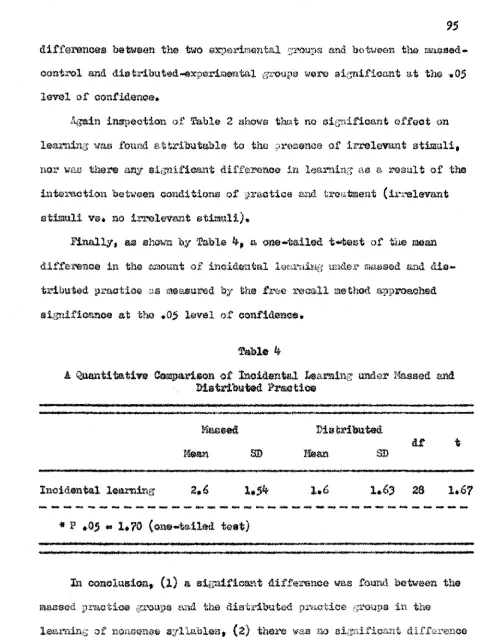
4 A Quantitative Ooaporieon of Incidental Learning under Maeeêd and Dletributed Practice . .
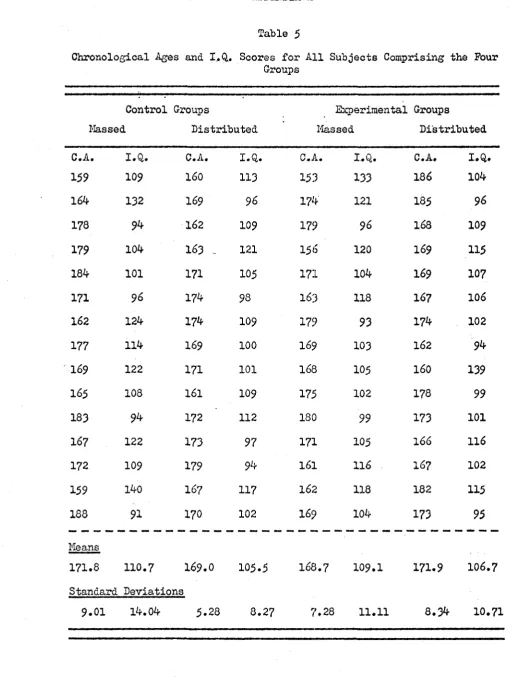
5 Ohremological Age# and 1,0» Score# for All Subject*
OOnprieing the Pour Group# $ , , , 3UUS
6 A Conpariaeo of the Kean I,Q* Score# , # » 117
7 Bunker of Bbneene# Syllable# Correctly Anticipated during Trial# 1 to 39 under Kaaeed Practice
Oondltlon# * # # # » 118
8 Bunbop of Boneene# Syllable# Correctly Anticipated during Trial# 1 to 39 under Dietributed Praotio#
Gcndltlone # # * * # # 121
9 Incidental Learning under Naaeed and Dletributod Preotlo* by Ppe# aeoall of Geometrical Plgure# and Bacall of Serial Poeitlon of Geometrical
Rgure# * # # # # # 128
U 3 T OP P13ü%as
RLgur# P a #
1 Baan auaber of moneeaae ayllablaa anticipated by tha four group# (m&aaed praotioo group without Irrelevant attmull, meaaed praotloa group with irrelevant atlmull, distributed praotioo group without Irrelevant otluull, dletributod praotloe group with irrelevant uti^ull) per lblodk4>f
trial# * * , * , # <ML
2 Ooeparloon of learning under maaaod and distributed praotioo in the preoonoe and abeonoe of Irrelevant
etlmll , # # , . » 94
) Moan number of noneeoao syllablaa aotloipatod by the massed and distributed practise groupe of
the pilot study , , * # * 134
4 Bean number of nonsense syllables anticipated by
the control groups of the inaln study . . 125
5 Mean number of nonsense syllable* anticipated by
the experimental group* of the main study * 126
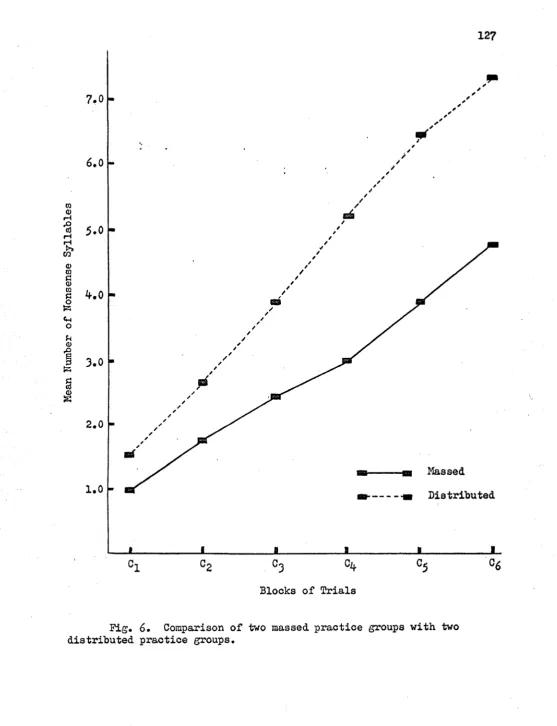
6 Comparison of two masaed practice group* with
two distributed praotloe group* # , # 12?
The aoaoept of "iahlbltioa* a* defined belov ha# bee* postulated
to t&* difference# la reflex behavior, th* perforaa&o# of motor,
p#yo&&*aotar *a& verbal task* wa&er oooditiOB# of *aae#d and distributed
praotio# (Pavlov, 1927# i, 1$4); Borland, 1996a# Woodworth aod
Bohloeberg, 195&# Byeeaok, 1957*)+ More apeolfloally, Bull, Bovlaad,
Bo*#, Ball, Perkiaa and Fltdb {l? o), Bull ('*43), Woodworth and
3ohlo#ber# (
1954
), aad Ua&erweod (1357) we* »& inhibition oonatroot toaooount for differaaoe* in perf&rmane# with aerial verbal learning
under m&eaed and distributed pr&otioe, although Underwood tend* to favor
&n interfere*#* iaterpretetiOA* &l*o Bull *t *1 {l94o). Hall (1943),
Woodworth and debloebarg (1954) and Eyeenek (1957) make uae of an
inhibition footer la #%pl*iaiB# the pheooaoaoD of ramlnlaoano# whloh
tend# to be a by product of gassed pr&otiee, Raalnleoenoe i# defined
a# the "*roo*ll or tcoo piition, without iut.' VOAi,. overt praotioo.,- of
item# previoualy learned but not reoall&bl# » an iaeroweat in »
prao-tioed *ot after a period of nonpraotio*** (Boglieh & English, I
/5
,9#457)# Sbg&lah and Ebgliah (1958, p*3#2) doflB* iahibitian a#
"reatpainiag or atopping a proooe# from oeattauiaG, or preventing a
prooeea from atortia#, although the usual etimolu# la preeont# a hyp*"
a
Inhibition le a&ld to bo more gulokly aad dlaBlp&tad a&r*
slowly under ooBdltloa* of oeaaeà praotlo* &a eompared to digtrlbuted
praetlao ooa<lem## aa a result perfarGgae# la g&aa&ally superior
QBd#r &l*trlb&tea pr&otlce* Thla lohl<loa la OaMaidercd to be &
o&gAtlv* drive alall&r to fatigue, and ie aaaool&t d with & teadoRoy
to emold. perfarmimg th* taak giving rise tc % $&aativ* drive (Boll,
1143)* In t&* present study loblbltioa vili o* aaeomed to exist If a
ei&alfioaRt atatiatloal dlffereooe la th# awmber of aoaeeaae syllabise
learned oader massed end dietriboted practise oaa be demoaetrated,
!Myer* sad Biller (1954) believe that performaooa of a aoBOtonou* task
give* riee to feelio&e of boredom aod 81an*#r (1953) bold# that tbs
len@*r *8 orfsaio* peroeivea a atiBolwe+objeot th% greater the amount
of etimwlu# satiation (boredoa*lika sffoot) built up to it, and as a
result the organies will toad to avoid thl# etimwlus &Bd seek cut
different stimuli* A mogmebat similar theory is held by ]W#mtgc8ery
(195&),
If a greater dsgre# of iahibltica (futlgue) and/or stimula* satiation
(b@r#d@&) is bailt up when perforeiBg a task under massed practice
oOBditiosa than uader distributed practice ooaditioaa, this inhibitory
atat# will be associated with a need to seek a change, i*c# a need to
search for novel or new ^tfnuli* It i* postulated la the present study
that tbs above condition* of ta&k pcrfoamanos will lead to a relatively
greater degree of incidental learning* Incidental learning in the
present study will b* iwh&t Postman (1964, p*l&7) describe# as Type II
incidental learning* Be state#*
Instruction*# Hi* retention for those feature* of the situation which ore not relevant to the task speolflsd in the original Inatruotiono dofinoo the ooouat of inci dental looming, and the nooauro obtained will a m l n be a function of the test#
The irrelevant stimuli of the present etudy will have no diroot
relation to the stimuli which the subjects have been instructed to
learn, i*s» they will belong to the olase of Type II incidental learning
which Postman reform to as "extrinsic" to the "experimenter-defined
loomin task#" By presenting subject* with an opportunity to observe
novel stimuli While perforoin# a task under maseed or distributed
practice condition#, it 1* predicted that under magscd practice condi
tion* the subjects will be able to recall aad/6r recognise more novel
stimuli (incidental learning ivill be greater)# Tha present ctudy 1*
BAOKOBOURD A H D RELATED aBSBW&GB
Theoretical Baek&rouBi
A* m#Btloa@d la tha general Introduatioa, attaapta to explain th#
differential effect* of messed and epaeed practice largely appeal to
#089 interfering or inhibitory condition that weaken* quickly with reet,
The concept of inhibition le 1 . >rtant for this etudy as it is aeeumed
that an Inhibitory-like effect will be generated by the method of
pre-eentiag the experimental ottmull to the subject* of this study# The
above assumption is based on the fact that the conditions of practice
used in the present study are eomewhat similar to those used in other
studies which produced certain effects which expsrimsotofe have explained
by making nee of an inhibitory concept* The theoretical background for
the present study ha# to do largely with a theory of inhibition outlined
by Byssnck (1957)* Inasmuch as ByosBOk#* theory developed from Bull**
inhibition theory and certain modification* of it, and also because
Byesnok uses certain concept* of Bull#*, a brief overview of Hull#*
theory along with modification* will be presented, before relating the
present study to gyesnok#* outline#
Habit (sBr) a* outlined by Bhll (1943) is said to exist when an
association between a etimalu* and a response ha* been developed a* a
result of a number of reinforced repetition* of a *ti*ulu*-re*pon*e
strength of th# hsbit, i.e. tha etrongtb of the ettanlus-eesponss
aaeoolatioa, is inferred fro# the relation between the number of
rein-foroea repetitions of th# stimalua-respon## ssqweooe ##& th* probability
that the reapana# will be *llelt#& on presentation of tha stimulus*
Tb# symbol sBr (reaction potential) ie used to represent the performans#
of a habit# Bull conceptualise# such condition# a# need for oxygen,
food and ##%, etc, as basic drive# (b)* In Bull*# theory the agsumptlon
is mad* that habit and drive interact multlplioatively resulting in
performance# Th* equation describing this relationship is# #8r « f(#Br)
% f(b)* Bull also postulate# two type# cf Inhibition, vis#, reactive
inhibition (ir) and conditioned inhibition (sir) which are in competition
with reaction potential* When combined they are called inhibitory
potential; and when a sufficient amount exist# it can make ineffective
th* existing habit# aeactive inhibition ie similar to pain or tirodne##,
built up gradually through the occurrence of similar responses. A# a
result it tends to prevent th* future occurrence of this response and
therefore inhibit# reaction potential (sErj# Due to the discomfort that
take# place when fatigue is present th* reactive inhibition act# as a
iwkgxttiv# dkrive tfhiidh ifbgwi asmdiwaed bgr ia&aotiiritar ojT ta&e pcrtioolar
response, give# rise to reinforcement of ncnrespondtng (conditioned
inhibition, sir). The summation of sir and Ir produce# a general state
of inhibition (ir)# Bbll inoludss Ir omd sir in his basic formula as
indicated# sBr # (D X s8r) * (I* + sir),
When Ir is subtracted from sBr, what is left is referred to as th*
affective reactioa potential (sBr)# Bhll (l943f p#2@4) states* *Th#
6
i* actually available for the evocation of action
(a), 1#
the reactionpotential (eBr) lee* tha total inhibitory potential (If)," Bia equation
for the above ie tha following* #Sr * *Br - Ir
,&oooriiag to Ball, the antecedent ooniltioa loading to tha production
of reactive iBhibitiao ie the eeownt of work
(v)
required in performingth# particular reopen##. Concerning thie, Bÿeenck (1957, p*55) etat»#*
"In e*i»ing upon thi# *wcrk# explanation of reactive inhibition, which
had originally been advanced by Mowrer (l943) and Hiller (lp4l), Bull
TWB# enabled to keep his theory *pcfipherali8t* in oontradietinotion to
the Pavlovien concept of Inhibition, which i# central," In regard# to
th# above type of central inhibition a# opposed to a strictly peripheral
form of ihhibitidn, ayseook (1957, 9*56*57) desoribse it &e follows#
The term central , , # mean# anywhere within th* central asrvcu# #y#tc* fro* a point separated by at least on# iqyBap## from th# receptor organ on th# on# side, tc^a ]point *#parat#d by at least one synapse fro* th# effeotor organ on th# other. It is quit* possible, of oour##, that additional to this central type of inhibition such fectcrs a# muscular fatigue, receptor adaptation, and sc forth ploy a part in many of the phenomena dioouosed under th# heading of inhibition,
Tbs validity of Bull#* Inhibition theory is questioned fro* two
directions, First, logical contradictions within the theory Itoelf and
second, soo# #%p#ria#ats present result# which are unfavorable to th*
theory* In the latter cas# Ellis (1953) lists a number of studies which
faibto confirm the view that inhibition is a function of work and
instead suggssktbat Ir, i,e, rsactivs inhibition, is independent of
effort. In another study by Amman# (1955)* * good dsal of reaotiv#
inhibition was built up oven though tbs task involved was mainly a
task wa# tracing a line from ana runbor to the next la a aeriaa*
Again, it i* very unlikely that the work hypotheel* or peripheral
origin of Inhibition can be offered aa an explanation of an experiment
don* by Borland and Kurte (1951), Unlur twelve eubjeot# who were given
the tack of learning liete of noneeaee syllables by the aerial antici
pation method, the above author# oboervod tnat when the eubjeot# were
required to do addition problem# juat previous to the learning of the
syllable#, a greater amount of "raalnisoenos" occurred than when the
subject# were not required to do the above addition problems. In
explaining the phenoosBoa of roainlBcenoo #om# authors, Eysenck (l957)
and Bovlond (1936b) for example, emphaslae the role of inhibition. In
th# above mentioned experiment (Borland and Burts, 1951), the fact that
more reminiscence occurred for the llet of nonsense syllables which was
preceded by the addition problems, suggest# that this combination of
tasks produced a greater accumulation of inhibition which dlasipated
after a short interval of time, hence the greater amount of reminiscence*
On tbs other hand less reminiscence took place when a rest interval was
inserted between tbs addition task and the serial learning of nonssns#
syllables which suggest# that tbs acoumulatad inhibition built up fbom
the addition task wo# allowed to dissipate, The smaller amount of
remlniscsncs which did occur reflects tie dissipation of the smaller
amount of inhibition accumulated from the serial learning of nonsense
syllables. It would be very difficult to attribut# the inhibition
implied in the above differential amounts of reminiscence to a physical
work hypothesis,
8
explanation of roaotiv* Inhibition ie iaplied In Irion and Guatafeo&'a
(
1952
) study# Bubjeoto wero required to perform on a pursuit rotorunder massed praotioo fOr five minutes» Immediately after performing
this task half of the subjects practised for a further five minutes but
this time using the other hand, The control group la the meantime va#
given a five minute rest period before bain: required to practise the
same task with their other hand* Tha results shoved that th* control
group performed significantly better with their other hand than th*
group which did not receive a rest ^^riod, The detrimental effects of
massed practice carried over from on* band to th* other and did not
localise in the hand muscles used in the first five minute task# On#
explanation is that inhibition area* from an origin other than just a
peripheral one; otherwise the inhibition vould have been expootcd to
have been limited in location to the nuscles used in th* first five
mim*tes#
Other evidence which appears to question Bull** work response
produced inhibition theory is found in a number of classical conditioning
experiment# carried out by Pavlov and his co-workers, Portinent to the
above Is the phenomenon of "subsero" extinction# The extinction of a
classical conditioned response ooours by rcpouL^dly presenting the
conditioned stimulus to an organism (dog) without the unconditioned
stimulus until twu conditioned response ie no lon/ur ulloited by the
ooadltlooed stimulus# The conditioned stimulus 1# the "bri&inally
ineffective stimulus for a given response that, by th* experimental
procedure cf conditlonln -, has become capable of eliciting that response*.
experimental proeedur* wherein two stimuli are presented in oloee temporal proximity. One of them has a reflex or previously enquired oooneotlon with a certain response, whereas the other ie not an adequate stimulus to the
response in question, Consequent upon such paired pres entation of the two stimuli, usually many times repeated, the second stimulus acquires the potentiality of evoking a response very like the response provoked by the other stimulus. The first-mentioned stimulus is called the unconditioned stimulus, the eeccnd-oentloned is the con ditioned stimulus, Th# original response is the uncon ditioned response, the newly acquired response for the conditioned stimulus is the conditioned response^» (Boglisb & Shgiish, 1958, p.10?)*
Pavlov (
1927
) showed that one# extinction of a conditioned responsehas taken place (to the point that It completely disappears) by tbs
method of presenting th# conditioned stimulus repeatedly in the absence
cf reinforcement (unconditioned stimulus), the potential evocation of
th# conditioned response can be diminished still further by continuing
to present the conditioned stimulus to the organism without reinforce
ment ("subserc" extinction). During this continued presentation of the
conditioned stimulus th# conditioned response is still not elicited*
Thle further diminishing of the potential evocation of the conditioned
response 1# shown when the conditioned response is teeted for "sponta
neous recovery*. When a conditioned response has been extir uiahed, It
can often he elloiwoU a win after a period of rest, th a response
strength 1# diminished. This phenomenon is referred to as spontaneous
recovery. It is fbund that th# conditioned response observed in "spon
taneous recovery", after a period of rest, is much weaker under
"sub-sero" extinction conditions than under th# usual extinction conditions,
thus demoastretin that response+produoed inhibition is not the only
10
Farther, S#w*rd and Levy (19&9) conditioned rata to obtain food la
a goal box at the end of a runway by travelling an elevated pathway
from a etarttn# platfora to a #aal platform. After conditioning, one
group of rata waa placed dirootly in t& box when it was empty of
food and permitted to eae that the reinforcement was no longer there.
They war» left in the goal box for two oinutoa* The control r&ta were
placed in a neutral box % for two mlnatea, Thl* treataent vaa applied
five timea to each group* The following day both groupe were given
extinction triala# Extinction wac conaidored to have occurred when th#
eubjeot remained in the etarting box A for &a Ion# am three minute*.
The group that had been able to *#@ before hand that the food woe no
longer In the goal box extingulmhed aignificantly more quickly than th#
control group* Thie experiment *u:co9tad that the eight of the empty
goal box contributed to the extinction of the conditioned running
respona# without the oiroaiem bovin# to emit the running ,vn@e,
Thea# reaulte were offered aa support for a #ign*l#arnin# interpretation
and ###m to oppose Bull*# response-produced inhibition theory of
res-pen## deoremsnt#
Critic# have also attacked certain inconsistencies or weakness##
in Hull## inhibition theory Itself, For loBtaaoe, Oagood (1953) criti
cise# Hull*# inhibition theory bccaua# he oubtraets both Ir, th#
fbtlgq@*producQd inhibition and #Ir, the conditioned Inhibition, fkom
tb# reaction potential sEr instead cf from the habit strength, sHp#
Gonoeruiag the above* Osgood (1953# p*347) states*
learned habit strength* In other worda, habite &re never unlearned* I* thl* paradoxloal? C%* nay envia*#* her* a cluttering up of the peyche
with
outooded habita, but with our eeanty knowledge of the neural nature of habit, thla need not be dlaturblnc# Remaining within Hull*a general framework. It atlli oould be aaaumed that #Ir, am & negative habit phenomenon, aubtraota directly from aHr,a
positive habit phenomenon (indeed It @eea# reasonable that the tendanoy not to make a raaponee ahould be the reelprooal of th* tendenoy to make that roeponee, that the strengthening of the former ohould oc the earn* thing a* the weakening of the latter). Pktiguo+produoed Inhi bition, Ir, would etill euaaate olgebraloally with *Br, elnoe both are performance construct#.Eyeeack le etill not satisfied with this change loaemuoh a# Bull
has Ir, which eymbollaea » negative drive, subtracting from performanc#
(sBr)* Be refera to a paper done by Gwynne Jones (1958) In which Jones
makes positive suggestion* on how Bull'* theory might be made Internally
more consistent. The changes he euggeats are a* follows* subtract
negative drive (ir) fro* positive drive (D) and multiply the existing
drive remaining, whether positive or negative, by the remainder which
results from subtracting conditioned inhibition (*lr), a negative habit,
from the existing positive habit (sBr), Bow the net reaction potential
(*8r) become# equal to th# product arising from multiplying the above
remaining drive, after subtraction, by th# above remaining habit after
subtraction, Jones* formulation of th# above prooes* is*
#Br - f[(D Ir) I (sBr - elr)^
Eysenck accapting the above formulation of Jones refuses to use
th# symbol Ir because of it* previous connection with peripheral phenom
enon and its being traditionally dependent on amount of work performed.
Be ie alec opposed to it because cf its additive algebraic relationship
to conditioned inhibition. Be therefore, conceptualizes Ir as & nega
12
drive he symbolisée this aa (D*) and his formula in expanded fora ie#
#âr # f(D+ X #Bk) + f(D+ X elr) + 2(2- X #8r) + f(D* % *Ir)
The above formula expressed verbally has the following asaaing* The
effective reaction potential la equal to positive drive (food depriva
tion, etc#) multiplied by positive habit (a stimulus-responae connection
developed through a number cf reinforced repetitions), plus positive
drive multiplied by nsGotlve habit (habit of not respou . ), plus
negative drive (leading to the cesoation of activity) multiplied by
positive habit, plus negative drive multiplied by negative habit*
Ocn-earning the above formula Eysenck (1957, p,58) states#
Bach cf the four terms in this equation contain# tha product cf a drive and a habit, and these products ,gge additive and produce effective reaction potential #8r. It should be noted, of course, IhaL D- is a negative drive, i*e* a drive leading to the cessation of activity, and that sir is a negative habit of not responding*
Thus, while D* X sKr would give rise to a positive sBr, 2- ;& sBr would give rise to a negative perforoanos, i*s* a failure to react* Of particular interest in this con nection is the last term in the equation* Both D- and sir have a negative sign, ec that their product should be positive, i*e* a negative drive in conjunction with a negative habit should produce a positive reaction# The phenomenon of disinhlbitlon may be tentatively thought to fall under this coteicry*
Bsferring to the above expected positive reaction which Eysenck
holds will occur iwhsn D- is multiplied by sir, Jones (1958, p,130)
states*
was predomiaaat) "acquired definite exolt&tory propertlea",
Eysenck (1957) diaouaaee the changée that occur in behavior ae
learning develop#* E# follow# quite closely Kimble*# (1949, 1952)
extension of Bull*# theory in which Kimble treat# of th# growth of
reactive inhibition* Kimble describee reactive inhibition a# a nega
tive drive very eimiler to the avoidance of pain* All reaponee# that
are effortful produce thie inhibition whether the particular roeponeo#
are reinforced or otherwiee, and reat interval# allow the Inhibition to
dieeipate* 8ino* reactive inhibition 1# a negative drive, Kimble
auggeat# that Ir incrcaeea to the point when it cancel# out or neutral
ise# positive drive (aubjeot*# motivation to perform th* task). At
thi# point a reet p#w#e will automatically occur* Eysenck refer# to
the above a# an involuntary reet pan##* During this reet pan## Ir will
decrease leaving D+ relatively stronger. Once D+ become# aigoifioantly
stronger performance once again u.cu/u, The equation deaeribia the
above i# a# follow*:
(9+ % WUrj + (B- X eWr)
Th# duration cf the re#t pane* ie & fhnotion cf th* speed at which Ir
dissipate#. When Ir is slGOifioaatly reduced the organism begin# per
forming the particular task it ha# been motivated to do and this per
formance will coatlBue until a sufficient degree of Ir is built up and
once again neutralises the positive drive (D+), In regards to the
present study it is assumed that during the oeaaatlon cf performance
(D- balance# D+) the organism performs some other rospcn#* (voluntarily
14
It la to be expeotod th&t the oeatr&l inhibition theory outlined
by Eyeenok would predict th&t (a) when etlauli are preeented to an
organiem repeatedly, over a certain length of time (maeeed presentation)
or (b) when an organisa prnotiaea a relatively new activity under
meaeed practice condition*, performance will be Inferior than if the
above situation* were interrupted by reet intervals (distributed prac
tice)# It would follow from Ey*enak*e outline that negative drive
D-would accumulate mors quickly under massed practice than under spaced
practice# The reason for t i* i* that a certain amount of D- would
diseipste during th* reet interval* under distributed practice but with
massed practice tbi* dissipation of D* would be hijbl/ improbable* A#
a result D- would eventually reach the point when it was equal to D+,
Yariou# *%p*rlm*atar* will be mentioned who ease to support tb*
contention that inhibition build# up when an organism repeatedly per
forms a task especially under masoed conditions. Following this,
experiments will be presented whioh generally indicate that performano#
Is superior when distributed practice is used as compared to massed
practice as would be expected from the inhibition theory just outlined#
Superior performance under distributed practice can mean, dependin. on
tbs particular activity being observed, fewer errors emitted in reaohing
criterion, less trials to reach a criterion of performance, more verbal
stimuli learned within a given tias Interval or number of trials, a
greater number of correct motor responses emitted la a certain period
cf time or number of trials, and a greater facility in eliciting a
conditioned reflex* A short discussion on whether it 1* the performance
and/or learning of a task which is effected by massed and distributed
practice will follow the above outline of experiments.
Imbibition and Practice Conditions
Oa&ood (1953# p*50?) states* "Most theorise Assigned to account for
the superiority of distributed practio# over massed practice postulate
soma interfsriaa or inhibitory process that dissipates with rest**
Pavlov (
1927
) observed that th* strength of conditioned reflexes can be16
iMWdbmMkl
0
v*n though the rGlnforola? utimulua 1# atlll being applied.Pavlov reaaonad that the conditioned atiaull# when proaeated over a
prolonged period of tla# and especially when applied under maaeed praa*
tic* oondltione, i.e. with brief time intervale between preeent&tlona,
become inhibiting in their effect of eliciting the conditioned refler.
In epeekin# about bo* a weakened reflex may be helped to recover
its strength, JPavlov make# several euggeetlooa, such aa not using the
conditioned stimulus & large number of times in any one experiment and
preferably uwin? It only onoe* When a particular experiment require#
that the conditioned stimulus be used a large number of times Pavlov
suggests that th$ elicitation of the conditioned response be interrupted
for a few days* In ehcrt, h# appear# to be suggesting using distributsd
practice»
Woodworth and SWbloeberg (193&* p#788) also make use of the concept
of inhibition» For instance, they state» "The work decrement often
aeeo in maaeed trials, * » # can be laid to the accumulation of inhibi
tion#»" gyeenok (1937) also explains the difference in performance
under massed end distributed practice by a theory of inhibition# In
addition. Bull ot #1 (l94o) make use of an inhibitory construct in
explaining the differential effect# of massed and distributed practice
in rote learning#
In conclusion, a number 4&f authors account for the differential
effect# of massed and distributed practice by stressing the part played
The following etudiea demonatr&te on the whole that dietributed
practice under varicue conditlona and in numerous learning altuatlone
loads to superior performance than massed practice* leuba and Byde
(
1905
) studied the effect of varying rest intervale while learning totranscribe Bogllsh prose into German script* The time intervale used
were 12, 34, 48 end 72 hour# with length of practice kept constant,
])uring the initial period of learning the 24«hour rest intervale proved
most effective while at the later stage of learning tbs 48*bour interval
proved nest beneficial* The I2*hcur interval was the least beneficial.
Using a code substitution task, Pyle (ipl)) discovered that a 24-bour
interval interpolated between trials was more effective than masosd
praotlo#* This state of affaire held true with trials of 13, 30, 43,
and 60 minutes in length* The same author found that a group of
third-grade children given on arithmetic learning task, did much better when
given 10 minutes of practice each day for 10 consecutive days than
another group which worked on the task for two l@*miBute periods, twice
dally OB five consecutive days* loi (l930)$ using a perceptual motor
task compared result# obtained under massed practice with results
obtained under distributed practice. It was found that two forme of
distributed practice (one minute interval and 34 hour interval between
trials) led to superior results than did the massed practice condition,
18
latervala of oo* minute wore very nearly oo benefiol*! aa interval# of
00
* day, Bardy*8 (1930) aubjeoto performed @a a otylu* mas* betterwith eborter and longer period# of rest than with rest period# of
moderate length* Be aleo found that short practice periods interpo
lated between rests of different length* give rise to résulta which
are superior to those obtained when longer praotioe period# are ueed.
In addition* Travis (1937) oompared the outooB* of using 3 minute, 20
minute, 4, 8,
72
, and 130 hour rest période after a number of sessionsfollowing one after another of 3 ainutee of oontinuou* practice on the
pursuit-osoillator* The 20 minute reot period proved to be the moat
benefioial, The result# observed under the 3-miBUte rest interval were
the next beet, Jane* (l930), using children a* subject# in an experl*
mont on the oondltioned galvanic akin reopen**, discovered that, when
the conditioned and unconditioned otimulua were given in massed pres
entations, the corrsepoBding responses were weakened in atrength but
recovered after an interval of on* day intervened before any mors stim
uli were applied, Bbmphrey# (l94o) u#io& the conditioned eyelid
reepon#*, discovered that hi# subjects acquired this response f&stsr
when 60 seconds rather than
30
seconda wo# used a# trial intervals.In still another study using a motor performance task, Travis (1939)
demcnetrated that the meet efficient learning 1# obtained when longer
practice period# are amaoolatcd with longer reat periods, Finally, in
an experiment where the task ws# rapid manipulation of small peg#,
Kimble and Bilodeau (1949), observed that deoreaaing the time spent
working on the t&ak play# a more important part in improving learning
Oouatl#*# other otu&lea have boon performed and they aa well a*
the
0808
cited here, fCr the acet part, present evidence auagcstingthat for meet paychomotcr task* ooae distributed practice lo batter
than a atriotly maaaed practice wituatlon, TariablcB $uoh &e
differ-#0908
in Gubjecta, nothode, taske, etc* sad the interaction botweenthese lead to varicue complications when on attempt ie :&ado to compare
experiment* and arrive at reliable oooolueicnc about how dlatributicn
of pr&otice aaeociatea with or interacts with the condition* or vari
Bxtlaotioa #ad Practice Oonditioa*
Tgaaing now to the effect which maealn# of trial* ha# on
axtlmo-tioB, It 1# to he noted that Pavlov (1927) ob&erved that extinction of
a claeeioal condltloaea response take# place more quickly when trial#
are relatively m&seed than when they are spaced# The phrase, "internal
inhibition", was coined hy Pavlov to label the phenomenon of ^^udual
weakening of the conditioned reflex and it# final dieappearano# a# a
reeult of tba continual presentation of the conditioned etiBulu# in
the aheenoe of the unconditioned atimulus, Beoauee of the faot that
the conditioned reflex recover# to acme extent after a re#t interval
(#pontan#cu9 recovery)# Pavlov deduced that an underlying prooec# of
inhibition existed, Beferrlo# to extinction of a conditioned reflex
by oaaaed trial#, Pavlov (1927, #fl) state#*
it T#a# ###B that a repetition of the non*reinfcroed con ditioned stimulus waa necaeaary to produce a sufficient summation of the inhibitory after-effect for complete experimental extinction, and It 1# reasonable to supposa
that the shorter the interval# between aucceuaivo repeti tions of the stimulus the more quickly will the required IntouBlty of the inhibitory procese be obtained, Thio alec w%a found to be the case* As a result of rciotl-ticna of experimental extinction on the earn# animal the sere level of a fresh extinction of the reflex la reached more rapidly, Tbi# shows that Inhibition Ilk# excitation
is facilitated by repetition*
Speaking of extinction curve* Bovland (1936a) distinguishes between
two type# - the first la a continuoua decrease In the strength of a con
ditioned response in the absence of reinforcement* This decrease occur#
quickly early in extlnqtion ao& gradually slow# down a* extinotlon
proceed** The other kind of extinction curve display* an early rie#
in the strength of the conditioned response oolnoidlog with the second
or third trial of extinction* The author offers the explanation that
Bumerou* repetition* of reinforcement load to bive adaptation or
what he term* a* "inhibition of reinforcement"* Be alec au&geste that
when the reinforcing stiaulue 1@ withheld & dlaiahibiti^, effectiwould
ocour resulting in an increase of the conditioned response on the
eeoond or third extinction trial# Hbvland deduces that "inhibition of
reinforcement" would be greater with an increase in the amount of massed
rei&foroemente. Be also predicta that with distribution of
reinfOrcs-ments, inhibition arising from relnforoeaent would be dleBipated during
the interval between reinforcements, Tbl* would be demonstrated by the
absence of on early rlee in the curve of extinction which ordinarily
would occur from dieinhibltlon* Being in an experiment, human subject#
and the galvanic reaction as the conditioned response, a IGOO cycle
tone as the conditioned stimulus and an electric shock aa the uncondi
tioned stimulus, Bovland** hypotheses were successively demonstrated,
Phrtbermore, Gagne (1941) obtained results supporting Howland's proposal
that increased response strength on the second oxtiaotlon trial is due
to the dying away of inhibition which occurred a* a result of massing
acquisition trials* Being rats a* subjects In two experiments, Qagne
studied the Influence of distributed practice on acquisition and extinc
tion rate of a conditioned operant response. Bis experimental results
show a progressive inoresee in rate of acquisition shea the interval
22
tended to ooour fhater under the maaeod trial*. Bowever, oonfidenoe
in the relationship between exttnotioB rate and maaeed trial* euggeeted
by thl* atody 1* limited beoanee different amount* of reioforoement
were need in experiment one sad due to the Inhibition of relaforoemeat
effect occurring in both experiment one end two# In addition, Gagne
(1941, p$2GB) etatee. In regard* to the above relationship*
The interpretation of the data of our experiment in thie manner, however, le aubjeot to the condition that the
*1% group* began extinction at entirely different level* of reeponee magnitude. Tbeae initial difference* in the curve of extinction may cbeoure the relationship between trial intervale and rate of extinction, to eome extent#
likewise, Bilg&rd and Marquis (1933), using do a a* their experimental
subjects, found that extinction of the conditioned eye lid response was
acre rapid in a group where 6o extinction trial# were used each day,
than that which was observed in a single dog when 10 extinction trials
were presented per day*
In contradiction to Pevlcv*# contention that massed trials lead to
quicker extinction than spaced trials. Porter (1938) was unable to find
any significant difference in the extinction rate of a running response
in rate when 10 minute*, 3 minuta* end a few second* were the time
intervale inserted between extinction trialo* The asm* author (1939)
established conditioned eyelid responses to the onset of a visual
stimulus (light), founded on the uaccBditia&od response to a :puff of
air iapio&in# upon the oornss, of tbs left ays# Extinction trials took
place by presenting the conditioned stimulus in the abeenoe of the
unconditioned stimulus (reinforcement), thirty seconds after the last
a# the between etiauluo intervale during tba extlaotiaa of the condi
tioned eyelid reepone#. Porter warn unable to find any algnifloant
differeno* in the time it took for extinction to take place# Attempting
to explain why Porter** expérimenta did not ehow any eignlfloant differ
ence in rate of extinction under various intertrial intervals, Bsynold#
(
1943
) holds that this is most likely duo to the faot that relativelymassed conditions were used durlAj original conditioning# asyoolds,
in an expsriBsnt where the response used was eyelid closure, the condi
tioned stimulus was a click sad the unconditioned stimulus a puff of
air directed against tbs cornea, disocvsred that when distributed
trials were used during conditioning, extinction occurred more rapidly
under massed conditions than under spaced condition*. On the other
hand when conditioning occurred by massed practice no significant differ"
SBC* in extinction rats was observed when the results under maased and
distributed coaditica# were compared*
Adding further support to the previous contention of Pavlov#* that
massed trials lead to quicker extinction than spaced trials, Bohrer
(
1947
), using as subjects albino rats, found that the rate of experimental extinction of an instrumental conditioned response was mere
rapid under' messed conditions than under diotributsd conditions#
Bow-ever, h* observed no significant difference in extinction rats under
the above conditions when the subjects had only a small number (ton)
of original reinforcements# This seems to imply that a habit must be
at a certain minimal strength before massed conditions prove superior
to distributed conditions in achieving a lore rapid rate of extinction#
34
ver* trained to rua down an alloy 1& ao&roh of food, found that whan
dietributod aoo«r@lnforoed trial* were used extinction occurred signifi
cantly more quickly than under massed extinction triale* The f&eter
extinction under distributed extinction triale occurred only for the
group which underwent training with uaseed trials* However, for the
group conditioned under spaced trial#, there was a tendency for spaced
extinction to be faster tut this tendency was not significant* The
reeult* of this experiment, although contradictory to that of Rohrer's
(
1947
) and Seynclde* (1943), seem to suggest as Reynolds* did that rateof extinction hoe same relationship to the length of the Int^ irial
Interval used in original conditioning and whether a similar or different
intcrtrial interval 1# used during extinction* Greater resistance to
extinction tends to occur when the sea* intertrial interval is used in
both original learning and the extlnoLion process*
In an effort to shed further ll;bt on this topic, Teiobner (193%)
performed an experiment attemptiu; to find out first, whether rate of
extinction is a fb&otlcn of the tine period utilised between trial#
during the extinction procedure, and seooadly, to discover whether
extinction rat# ha# some relationship to the tins Interval inserted
between the trial# durin; ori in&l learn* # He used male hooded rate
in on instrumental learning situation* Bis experimental result# suggeet
that the longer the Intertrlol interval the more quickly the response
io etrengthened; secondly, extinction resistance, when other thing# are
held constant, 1# greater when the intcrtrial tie# period 1# the seme
during extinction and conditioning than when this Interval i@ dissimilar
to ooour more qwlokly by mai extinction trials than by apaoing them,
An additional study in which f Xu i ,U.n were u*»& a* aubjeota wa*
performed by Stanley (1932), with the aim of explaining the
oontradio-tory experimental reaulte obtained by earlier experiment* oonoemlng
the relationship of extinction r ,tc and length of Intortrlal interval,
Thie etudy attempted to do three - firat, to obtain evidence
on the effect of dietributed triale on extinction rato - "a situation
where both vigor and oorreot reaponae meaeureg of extinction are avail
able"; (Stanley, 19J2, p*230); eeoondly, to dieoovar the rate of extinc
tion under distributed condition# using a# meaaurca reeponee vigor and
correct reaponee, while at the a&ae time removing frustration arising
from withholding reward, This, the author attempted to do by reducing
the primary drive of hunger through aatiatlng the subjects befbre the
presentation of extinction trials* Finally, an attempt was made to
discover "whether a shift from massed training trials to spaced extinc
tion trials, and vio# versa, produced any generalisation decrement*
(Stanley, 1932, P#230), Th# results were as follows* - the running
time of the massed-massed group was sigBifio&ntly faoter than the
massed-spaaed group, but there was no significant difference in running
time between the spaoed-spaoed group and apaoed-aasaed group, Using
"oorreot rums" as a measure, there wae a significant difference between
the spaoed-apaosd and tbs spaosd-maesed group in favor of the former
but no significant difference was obtained between the aaased-spaoed
group and the massed-maassd group, Oonoeming the above results
Stanley (l932, p,237) states*
the running time data (frustration extinction) confirm
26
Sheffield*# (
1930
) fiadln# that ouaaed extinction trial* produce loan deoremest Uu:' ai'tooJ extinction trials In term# of a vigor meaauro of puTTormanco, Qowever, the equally significant differ In the oppoeit# direction with correct run# a# tbo ^^Mauro, indloatoa that the generality of the Sheffield finii:' la li mited (a) to extinction in a reotrictivu citu^blon (l*e#$ & atraight ulley citu&lion), and (b) to ^ r^latlvaly no'n^oclfio, and presumably c drlvo, Botauro of pwrfcraanco in the looG raat/iatlve ait^ation (i,o,, vl of runui:: to either loal box in a T-wuze)#In regard# to that part of the experiment where extinction occurred
when the primary hunger drive woe absent (the presumed non-frustrating
extinction), no oljnlfio&nt dlfferenoe in rate of extinction waa
obtained between the massed and spaced extinction trial condition#.
The author note# that thio 1# not oonelstcnt with what might be pre
dicted from Pavlov*# iutemul inhibition theory and Bull*# reactive
inhibition theory. In summary h# airtj# (Stanley, 1932, p,239)#
the## data and the ov*v«all pattern of moaeed-epaoed difference# broken down according to distribution of acquisition trial# oonfbm to expectation# baaed on the factor of frustration-produced drive and the factor of ##aerali*ati@n decrement due to shifting from one
inter-trial interval during acquisition to another during extinction. In thie respect the data arc comparable, in general, to previous findings, but not in line with con clusion# fro* extinction theories which assume that
response decrement during extinction is a direct function of internal or response-produced inhibition (or f&tlgu#) which dissipates with tins*
Speaking about the concept of Toneralisation decrement, Bilgard
and Marquis (I
96
I, p*293) stats:extinction. Tb* gmnaaaliaation-deoremmat hypotheala Bt***#e8 this iaterpretatiaa,
Th* above author# again state (l961, p,294)#
Th# eea**allaati*a«d*of@B#at hypotheela together with th# ooaoept of re#pom##«*roduoed stimuli, muggamt# a mor# detailed aaalyel* of the effect qpoa extiaotlon of the dietrlbutlan of extinction trial*» # , * Chengtng the degree of dletrihutloa fbr extinction, or for further practice, would lead to a change in the level of reeponee-produced atimwlation and, therefore, to a loe# of reeponee etrength through generalisation-decrement*
A m megz
Tba moat common result appear# to ha fOr maeeed practice to produce
1*8# rG8letamee to extinction# Bcwevez^ ** *u stated by the experiment#
of aeyncld* (l943), achrer (1947), Sheffield (IPJO), Telohner (1932) and
Stanley (1932), an impartant factor which play# a part in whether maeeed
trial* lead to faetcr extinction 1* what trial intervale were ueed in
the previous oonditionim trial## These experiment# indicated that an
increase in extinction reeletanoe tends to take place when the aome time
interval 1# ueed during extinction trials a# during conditioning, and
any change# made in the experimental arrangement, such aa different
trial interval length, from the conditioning situation to the extinction
situation will tend to lead to footer extinction. The généralisation*
docreosnt hypothceie nuageet# that the above tendency i# due to stimuli
change# which lessen generalisation from the conditioning process to the
%*pbal Le&PBi&g mad Paaotio* Genditlon*
A number of etu&i*# dealing with verbal learning, especially
t&Q#* experimeato using aoaseaae syllable material, will be presented
os further evldeaoe of the applicability and generality of tb* pre
viously outlined inhiblLijn theory end to show that verbal learning i#
also differentially affected by maeeed and distributed ]praetloe, (Dagood
(1933, p#3Q&), in hie review of the literature on moasod and distrib
uted praotioe, states#
line might expect that relatively homogeneous tasks (com posed of similar port activities) would benefit aors from distributed practice* Gsrrett (1940) presents dots remotely relevant to this hypothesis# be found that simple repetitious tasks, like eode«leamiag, benefited more from distribution of trial# then did complex, diffi
cult tasks, such os learning an artificial language* If we may consider relatively meaningless materials like nonsense syllables and three-place digits to be more homcgenoous (i#e* less well differentiate^ than meaning ful and logically related materials like prose and poetry, then a number of additional studies would testify to the importance of thie variable, lyon (1914), for example found the learning of nonBens* syllableo and digits to be facilitated by distribution of practice, but the learning of pros# and poetry was not*
iWoodworth and Sohlosborg's (1934) review is generally in agreement
with Oegood## in regarde to nonsense syllables but disagrees in regards
to prose* The above author# (1934, p*?90) stats that 4&n interval of
a day or longer ha# br^n found superior to maeaod trials in memorising
a list of oonaense syllabise or of numbers (Ebbingbaue, 1833; fisrea,
1913; Pmrktns, 1914) or in learn*n the substance of a pros# passage
(aogilsh, VelboiB, & Killian, 1934).*
Ae mentioned earlier in the paper moaeed pr&otio* ewppoaedly
produo#* negative drive. I.e. D- (inhibition) which ie not given time
to dieeipate, thua having
a
negative effect on performance. On theother hand, distributed practice allows D- to dissipate during the
rest intervals thus leading to superior performance. If * rest pause
is introduced after the period of massed practice, this should enable
D* to dissipate, while leaving sGr unaffeoted; performance after the
rest pause should therefore now be superior to performance before the
rest pause. The amount of increase in performance (reminiscence) would
be a direct aeaeure of the negative drive generated during the massed
practice# In the case of learning nonsense syllables very little, if
any^ reminiscence occur* with distributed practice and with the passage
of time some of the difference induced by aaaecd and distributed
practice disappears, i.e. the massed practice group performs more like
tbs distributed practice group. Turning now to verbal learning experi
ment* where nonsense syllable# are the stimuli preeented for learning,
a fair amount of evidence cam be found which tend* to support the
inhibition theory disouoeed earlier. Fbr instance, Bovland (1936b)
studied the reminiscence phenomenon by requifdag thirty*two subject#
to Icaro twelve nonsense syllables per day for 16 day# by the antici
pation method. The presentation rate was one noneense syllable every
two seconds. In order to control fCr rehearsal, the subject# were
given color# to name between each distributed practice trial and fCr
a twoHminute interval of time after learning. It wa* found that more
30
trials la the group that had a two-olaute time period inserted between
learning and testing, ae compared to the group which v&e teated for
retention immediately after learning* The group whloh learned by
maaaed pr&otloe showed a al&nifloantly greater improvement in both
recall aooree and number of trial* to relearn after the twQ4*ioute reet
period, than did the distributed practice group* Thie greater improve
ment of the massed practice group mi rats that during the two minute
rest period the greater amount of inhibition built up under maased
praotloe was allowed to dissipate* By increasing the interval between
each syllable presentation from two seconds to four seoonds, it was
deaonBtr&ted that tbs difficulty ourve became oi rnifioantly smaller and
no reminiscence was obtained for massed or distributed practice*
Bovland suggests that a likely explanation would be that some inhibi
tion has dlRelpated under the above condition*
In another experiment by Bcvl&nd (l93&a), reoinisoeBoe was found
to be significantly greater when a rest pause of two minutes followed
learning of a nonsense syllabi# list by massed practice, a# compared to
the reainisoenoe obtained when teotin# was donc by recall and relearning
immediately after original learning. It was also discovered that it
took sigoifiosntly less trials to learn the list of syllables by dis
tributed practise and no reminieosnoe was obtained under the above
practice condition when testing for recall was done following the rest
period, as compared to a small degree of reminiscence (small when
compared to the amount obtained under maased practice) obtained when
recall waa immediate* These results are presented by Hbvland in support
experiment* under maeeed praotloe condition*.
Again Bovland (l938b), ooopared the effect on remlnleoenoe by
pre-eentlag syllable* at two rate* of epeed (two-second and four-eaoond
rat#) by the antlolpation method. It took #1 nlfloaatly lee# trial#
to learn to criterion with the fowr-eeooBd rate than the two-aeoond rate.
When a r@#t pane# vae introduced after learning at the two-##cond rat#,
a Ü
1
niflcaat amount of reainlaoeoo# a* measured by recall and relearningwa* observed* Bcwever, reminieoùnc# with the four-aeoond rate of pres
entation was found to be signlfiomtly lower, implying that there was
leas inhibition aooumulated under the slower presentation of stimuli*
In another experiment, Bovland (l938o) fbund that m&assd practice
under a four-second presentation r&te required leas trials to learn to
criterion than a two-second presentation rats. Again distributed
practio* led to a reduction in the mean nuaber of learning trials at
the two-secoad presentation rate, but with tbs four-second presentation
rate distribution was much lee# effective* The result# of this experi
ment are consistent with the Inhibition explanation presented by th*
author in the previously mentioned studies* In still another study of
distributed and massed practise, Ho/land (l940b) used throe different
lengths of monssns* syllabi# lists sad had hi# subjects (32 oolleg#
students) learn to a Gri^^rlon of on* perfect run thruu;h each list by
massed and distributed pr.otioe. The results showed that with all list
lengths distributed practlcs led to faster learning than massed praotios,
and «8 the length of the list becsm# longer the number of trials to
reach the criterion level by distributed praotio# became prcgrscsively
32
iDa Ibi# earlier study Bovland (1938a) relate* theme result* to the
oonoept of inhibition*
$b*#e experiment* were deaigned to teat a aaaber of postulate*
contained in a theory developed by Hull# Bovland and other* (1940),
INany of these postulat#* pertain to an inhibition oonstruot* Heferring
to this oonstruot Bovlaod (l938a, p»304) etatee* "The aaaot nature of
thia inhibition i* still undetermined, but as a part of a oonosptual
system it is a useful oonstruot," A quotation from Underwood** (1932,
P$@3) investigation gives further information about the above theory
and th* form of inhibition with which it is concerned* B* states*
"The portion of theory which deal* with the present problem postulates
a form of inhibition whloh generates during learning sad dissipates
with rest* (in its essential properties this inhibition is vary com
parable to that sailed reactive inhibition)**
A great deal of rather techaiesl experimentation has been don* by
Underwood and his associates on the relationship between distribution
of practice and various conditions prevailing in rote verbal learning,
Underwood found that distributed practice facilitates tbs learning of
serial lists of nonaenee syllable* under certain conditions* For
inutc^oe, it was discovered (Underwood, 1932#) that with nonsense syl
lable list# of low lutra-list similarity distributed practice (a 30
second and a 60 second rewt interval between trials) led to mors rapid
learning of th* above lists than massed practice* In addition, Under
wood (l932b) demonstrated that aerial nonsense syllable liste of three
different d a of iatralist similarity were learned faster by dis