University of Windsor University of Windsor
Scholarship at UWindsor
Scholarship at UWindsor
Electronic Theses and Dissertations Theses, Dissertations, and Major Papers
2018
Exploring Effect Moderation In Our Understanding of Hand
Exploring Effect Moderation In Our Understanding of Hand
Hygiene Predictors
Hygiene Predictors
Amanda Emily McEwen
University of Windsor
Follow this and additional works at: https://scholar.uwindsor.ca/etd
Recommended Citation Recommended Citation
McEwen, Amanda Emily, "Exploring Effect Moderation In Our Understanding of Hand Hygiene Predictors" (2018). Electronic Theses and Dissertations. 7382.
https://scholar.uwindsor.ca/etd/7382
This online database contains the full-text of PhD dissertations and Masters’ theses of University of Windsor students from 1954 forward. These documents are made available for personal study and research purposes only, in accordance with the Canadian Copyright Act and the Creative Commons license—CC BY-NC-ND (Attribution, Non-Commercial, No Derivative Works). Under this license, works must always be attributed to the copyright holder (original author), cannot be used for any commercial purposes, and may not be altered. Any other use would require the permission of the copyright holder. Students may inquire about withdrawing their dissertation and/or thesis from this database. For additional inquiries, please contact the repository administrator via email
Exploring Effect Moderation
In Our Understanding of Hand Hygiene Predictors
By:
Amanda McEwen
A Thesis
Submitted to the Faculty of Graduate Studies through the Faculty of Nursing
in Partial Fulfillment of the Requirements for the Degree of Master of Science in Nursing
at the University of Windsor
Windsor, Ontario, Canada
2017
Exploring Effect Moderation
In Our Understanding of Hand Hygiene Predictors
by
Amanda McEwen
APPROVED BY:
______________________________________________ T. Loughead
Faculty of Human Kinetics
______________________________________________ M. El-Masri
Faculty of Nursing
______________________________________________ S. Fox, Advisor
Faculty of Nursing
iii
DECLARATION OF ORIGINALITY
I hereby certify that I am the sole author of this thesis and that no part of this thesis
has been published or submitted for publication.
I certify that, to the best of my knowledge, my thesis does not infringe upon
anyone’s copyright nor violate any proprietary rights and that any ideas, techniques,
quotations, or any other material from the work of other people included in my thesis,
published or otherwise, are fully acknowledged in accordance with the standard
referencing practices. Furthermore, to the extent that I have included copyrighted material
that surpasses the bounds of fair dealing within the meaning of the Canada Copyright Act,
I certify that I have obtained a written permission from the copyright owner(s) to include
such material(s) in my thesis and have included copies of such copyright clearances to my
appendix.
I declare that this is a true copy of my thesis, including any final revisions, as
approved by my thesis committee and the Graduate Studies office, and that this thesis has
iv ABSTRACT
Although a multitude of factors affecting hand hygiene (HH) adherence have been
investigated in the literature, limited research has specifically explored the moderating/
interaction effects among these factors. A secondary analysis of pooled self-reported HH
adherence data, collected for two previous Canadian studies, was conducted to explore
the presence of such interaction effects. Within a combined sample of 465 physician and
nursing student participants, 67.1% were deemed adherent, with self-reported
performance of HH before and after every patient contact at a minimum of 90% of the
time.
Gender was found to moderate the relationship between forgetfulness and HH
adherence within the merged dataset. Perceived forgetfulness significantly decreased HH
adherence among male respondents only. In addition, perceived busyness was found to
moderate the relationship between forgetfulness and HH adherence among nursing
students. Forgetfulness decreased HH adherence, but only for those nursing students who
did not perceive busyness as a factor impacting their HH adherence.
The study findings highlight the need to explore moderation/interaction effects to
enrich our understanding of factors affecting HH, enabling more effective, targeted
v
DEDICATION
I dedicate my thesis to my children, Megan and Gavin. I hope my love for
lifelong learning and graduate studies journey has inspired you to overcome any
challenges life has in store. Never stop chasing your dreams! I am so very proud of both
of you and hope I have also made you proud. I love you most.
I would also like to dedicate this thesis to my mother, Linda Patrick. You have
always been my inspiration and fiercest supporter. You are an amazing example of a
mother, nurse, educator, and researcher – which I continue to aspire to. Thank you for
your unconditional love and support and for keeping me motivated through various
vi
ACKNOWLEDGEMENTS
I would first like to acknowledge the members of my thesis committee. Thank
you to Dr. Susan Fox for her role as my advisor. Her attention to detail, timely feedback,
and continued support and encouragement will always be appreciated. I would like to
also thank her for her careful review of my thesis with revisions and guidance that have
strengthened my writing. Thank you to Dr. Maher El-Masri, for originally serving as my
advisor, then my internal reader. I will forever be grateful for his passion for research
and statistics, expertise, and guidance throughout this process (especially with the data
analysis and results interpretation). I also thank him for facilitating use of the original
physicians study dataset and for the inspiration and guidance in developing my research
question and methodology. Mostly, I would like to thank him for his unwavering support
and patience throughout my graduate school and thesis journey. Thank you again to both
Drs. Fox and El-Masri for originally fostering my love for and involvement in research as
their undergraduate research assistant over 10 years ago. I feel very fortunate to have had
them both as mentors and thesis committee members.
Thank you to Dr. Todd Loughead for his continued support and encouragement
since the very first email I sent him. I appreciate his eagerness to serve on my thesis
committee as external reader, his passion for research, expertise, and supportive
feedback.
I would also like to acknowledge the entire University of Windsor Faculty of
Nursing for their continued support and encouragement throughout my undergraduate
and graduate nursing journeys. Thank you also to the Faculty of Graduate Studies for
vii
A special thank you to Anne Foote for her support and encouragement in granting
me permission to use her original nursing students dataset within my study.
I would like to thank my family and friends for their continued support, patience,
and understanding throughout this process. I would like to especially acknowledge my
parents, brothers, and sister for their encouragement and belief in me, especially during
moments of self-doubt.
I would also like to acknowledge Christine Hamilton, Melissa Harris, Barbara
Trojniak, and Laura Van Dam. I will forever cherish our friendships and cannot thank
them enough for their encouragement and support. Thank you also to Victoria Young
and Christine Priest. I greatly appreciate their friendship, support, patience, and
understanding. I thank them for giving me much needed breaks from schoolwork, which
helped me persevere through the most challenging moments.
A special thank you to my thesis support team: Sarah Lopez, Donna Manlongat,
and Fabrice Mowbray. They have been amazing friends and I value and appreciate their
friendship and support through our collective graduate school journeys.
Last but not least, I would like to thank my children, Megan and Gavin, and
husband, Andrew McEwen for supporting me throughout this long journey. I cannot
thank them enough for their patience and encouragement throughout this process. I
recognize how challenging this was for the three of them, especially my husband, as I
tried to balance family life with work and school commitments and deadlines. I will
viii
TABLE OF CONTENTS
DECLARATION OF ORIGINALITY ... iii
ABSTRACT ... iv
DEDICATION ...v
ACKNOWLEDGEMENTS ... vi
LIST OF TABLES ...x
LIST OF FIGURES ... xi
LIST OF APPENDICES ... xii
INTRODUCTION...1
Theoretical Framework ...1
LITERATURE REVIEW ...3
METHODOLOGY ...6
Research Design...6
Sample and Setting ...6
Definition of HH Adherence ...7
Data Analysis ...7
RESULTS ...8
DISCUSSION ...23
Moderation ...23
Main Effects ...24
Implications...27
Limitations ...31
Conclusion ...32
ix
APPENDICES ...43
Appendix A ...43
Appendix B ...55
x
LIST OF TABLES
Table 1. Step 1: Chi-square Comparisons of Self-perceived HH Adherence and
Non-adherence ...9
Table 2. Step 2: Stepwise Logistic Regression Depicting Independent Predictors of HH Adherence Within Merged Dataset – Main Effects Only...11
Table 3. Step 3: Logistic Regression Results Depicting Interaction Effects Among All Datasets………...12
Table 4. Hierarchical Logistic Regression - Significance of Variables: Main Effects then Interaction Term ………...18
Table 5. Step 4: Stepwise Logistic Regression Depicting Independent Predictors of HH Adherence Within Merged Dataset – Final Model After Adding Interaction Terms to Main Effects ……….….20
Table 6. Stepwise Logistic Regression Depicting Independent Predictors of HH
Adherence Within Physician Dataset (Budimir-Hussey et al., 2013) – Final Model After Adding Interaction Terms to Main Effects ………...20
Table 7. Stepwise Logistic Regression Depicting Independent Predictors of HH Adherence Within Nursing Students Dataset (Foote & El-Masri, 2016) – Final Model After Adding Interaction Terms to Main Effects ………..21
Table 8. Percentage of Hand Hygiene Adherent Participants (a minimum of 90% before and after patient contact) (Merged Dataset) ………..22
xi
LIST OF FIGURES
Figure 1. Scatterplots Illustrating Effect Moderation Among Merged Dataset Variables ...13
Figure 2. Scatterplots Illustrating Effect Moderation Among the Physicians Dataset Variables ...14
xii
LIST OF APPENDICES
Appendix A. Factors associated with hand hygiene adherence classified by study according to level of influence from the Theory of Ecological Perspective (McLeroy, Bibeau, Steckler, and Glanz, 1988) using Pittet (2004) as a guideline ……...43
1
INTRODUCTION
Seeking health care shouldn’t make you sick, yet each year, hundreds of millions
of people worldwide are affected by healthcare-associated infections (HAIs) with an
increased burden experienced by low- and middle-income countries. HAIs result in
deaths, prolonged hospital stays, disability, increased antimicrobial resistance (causing
standard treatments to become ineffective), substantial financial burden for health
systems, and increased costs for patients [World Health Organization (WHO), 2011]. In
Canada, 220,000 patients are infected with HAIs each year, resulting in over 8,000
hospital deaths (Zoutman et al., 2003).
Proper hand hygiene (HH) is the most important practice for prevention of HAIs
(Rosenthal et al., 2015; Whitby et al., 2007) and has a direct impact on patient safety
[Public Health Agency of Canada (PHAC), 2012]. Despite provincial [Ontario Agency
for Health Protection and Promotion (OAHPP), 2014], and international (Boyce & Pittet,
2002; WHO, 2009) recommendations for HH, and a national HH campaign (Canadian
Patient Safety Institute, 2016), HH adherence remains suboptimal worldwide (Jang et al.,
2010; PHAC, 2012). Reported HH adherence rates among acute-care healthcare workers
in Ontario hospitals ranged from 88 to 91% (Health Quality Ontario, 2016), compared to
rates of 20 to 84% among research studies internationally (Azim & McLaws, 2014;
Erasmus et al., 2010; Huis et al., 2012; Korniewicz & El-Masri, 2010; Mayer et al., 2011;
Midturi et al., 2015).
Theoretical Framework
The theory of ecological perspective (McLeroy, Bibeau, Steckler, & Glanz,
2
understanding and modifying HH behaviour (Pittet, 2004; WHO, 2009). Adapted from
Bronfenbrenner’s ecology of human development model (1977), the theory of ecological
perspective (McLeroy et al., 1988) is based on two central tenets that behaviour affects
and is affected by multiple levels of influence; and that behaviour influences and is
influenced by the social environment (McLeroy et al., 1988; WHO, 2009). The theory
views intended patterned behaviour as being determined by five levels of influence: (a)
intrapersonal (individual) factors such as knowledge, attitudes, skills, and beliefs; (b)
interpersonal factors, including informal and formal social support systems/networks; and
groups that provide social identity and role definition (e.g., family, friends, and work
group); (c) institutional factors that include formal and informal operating rules and
regulations, and the availability and access to rules, policies, and procedures (Pittet,
2004); (d) community factors, which are the norms and social networks that exist
between individuals, groups, and organizations, such as a unit or ward in a hospital
(Pittet, 2004), and (e) public policy. This includes local, state (provincial), and national
policies and laws and involves the support of the administration (within the hospital, for
example), who must address infection prevention and control concerns and together
develop strategies to resolve infection transmission, endorse these measures, and
mobilize needed hospital resources (Pittet, 2004). These levels of analysis are highly
interactive. Thus, in order to understand behaviour change, it is useful to examine not
only each level, but the interactions between them (Simons-Morton, McLeroy, &
Wendel, 2012). The theory of ecological perspective is thus ideally suited for examining
3
The theory of ecological perspective (McLeroy et al., 1988) provides guidance in
addressing and understanding various influences on health behaviour; which include not
only individual beliefs and attitudes, but also interpersonal relationships, organizational
and community affiliations, current politics, and cultural connections (Simons-Morton,
McLeroy, and Wendel, 2012). While it has not been used to investigate or modify HH
adherence specifically, Curry and Cole (2001) applied the theory to develop a multilevel,
multidimensional intervention that successfully reduced vancomycin-resistant
enterococcus (VRE) colonization rates among patients in intensive care units in a large
hospital. According to the investigators, the problem required a multifaceted approach to
change behaviour by shifting social norms at multiple levels. Their approach involved
interventions directed at all five levels of influence, which the authors stated was crucial
to their success. The results of this study suggest that changes in health behaviour,
including HH, can be best understood and fostered through analyses of the influences at
each societal level and their interactions, as is the purpose of the theory of ecological
perspective (Simons-Morton, McLeroy, & Wendel, 2012).
LITERATURE REVIEW
The factors affecting HH adherence within this literature review are organized
according to the five levels of the theory of ecological perspective (McLeroy et al.,
1988). The factors in each of the levels are not assumed to be mutually exclusive, and
can therefore belong to one or more levels. Pittet (2004) similarly organized factors
associated with HH adherence according to the theory of ecological perspective. His
classification scheme was used as a guide to organize the factors that were examined in
4
overview of the results of previous studies that examined the potential predictors of HH
adherence that were used in the current study.
Despite some inconsistent findings (Appendix A), the majority of studies support
the conclusion that the following factors are independent predictors of HH adherence:
self-protection; inherent versus elective indications for HH; self-efficacy; presence of HH
auditing and feedback; availability of HH products; workload; forgetfulness; and skin
irritation and dryness. However, there is significant disagreement among the findings of
studies that examined age; gender; professional category; attitude toward HH; HH
knowledge and education;role models, peer pressure, and social influence; type of
hospital unit; and administrative support/institutional safety climate. Although years of
experience and administrative sanctions and rewards have been studied within the
literature, they have not been found to be independent predictors of HH (Appendix A).
To further our understanding of factors that influence HH adherence, it is
important to explore the possible existence of moderating effects. A moderator variable
is a second independent variable that influences the nature of the relationship between an
independent and the dependent variable. Moderating variables are important to consider
whenever a researcher has a reason to believe that the impact of an independent variable
on the dependent variable may be different across different levels of a second
independent variable (i.e., the moderating variable; MacKinnon, 2011). By studying
effect moderators, we will have a better understanding of the true nature of relationships
among variables, enabling the development of interventions that take into account
5
Following a comprehensive review of the literature, only four studies were found
that examined effect moderation as it relates to HH adherence (Allegranzi et al., 2013;
Fuller et al., 2012; Luszczynska & Gunson, 2007; Yardley, Miller, Schlotz, & Little,
2011). Three of these studies explored moderators of the effect of interventions designed
to improve HH adherence in hospitals (Allegranzi et al., 2013; Fuller et al., 2012) or in
the home setting (Yardley, Miller, Schlotz, & Little, 2011), while the remaining study
(Luszczynska & Gunson, 2007) explored moderators affecting predictors of patients
asking medical personnel about HH. None of these studies addressed effect moderation
among individual predictors of HH adherence among healthcare professionals (HCP).
If moderating effects are ignored, we may make misleading conclusions about
study findings. For example, certain interventions may not be effective across the board
in a given population, but may be effective for a subset (e.g., a specific gender, age
group, or professional category) of the population. Exploring moderators is warranted to
improve our understanding of factors affecting HH adherence, thereby enabling
administrators to incorporate more effective, targeted interventions to improve adherence
rates and decrease HAI rates. Thus, to address this gap in research and related
knowledge, the purpose of this study was to explore the moderating/interaction effects
that may exist among predictors of HH adherence. Specifically, a secondary analysis of
pooled HH adherence data from two previous studies (Budimir-Hussey et al., 2013; Foote
& El-Masri, 2016) was conducted to explore the presence of such interaction effects. The
two datasets were combined to explore potential moderators across two different HCP
positions. Testing for moderation was also explored within each of the datasets used in
6
METHODOLOGY
Research Design
Upon clearance to conduct the study by the Research Ethics Board, a secondary
analysis was conducted to explore potential effect moderators influencing HH adherence.
Data for this study were obtained from two descriptive, cross-sectional self-report studies
that investigated HH adherence (Budimir-Hussey et al., 2013; Foote & El-Masri, 2016).
The purpose of the first study by Budimir-Hussey et al. (2013) was to explore
self-reported HH practices and predictors of HH among physicians within a southwestern
Ontario community. The purpose of the study by Foote and El-Masri (2016) was to
investigate self-reported HH practices of undergraduate nursing students enrolled at a
University in southwestern Ontario. Neither study explored effect moderation; which
made them especially suitable for the conduct of this study.
Sample and Setting
The Budimir-Hussey et al. (2013) study sampled 159 physicians from a regional
medical association in southwestern Ontario who had medical practice privileges in local
area hospitals. The study by Foote and El-Masri (2016) included 306 undergraduate
nursing students registered in years two, three, and four of a nursing program in
southwestern Ontario (year one students were excluded due to lack of clinical
experience). G*power 3.1.9.2 (Faul, Erdfelder, Buchner, & Lang, 2009) was used to
calculate the statistical power of this study. Given that both original studies reported
odds ratios (OR) of greater than 2.0 for all independent predictors of HH, power analysis
was calculated based on a conservative effect size (OR = 2.0). Using an OR of 2.0, the
7
based on a two-tailed alpha of .05 (Faul et al., 2009). Thus, with the available sample of
465 participants, statistical power was not an issue.
Definition of HH Adherence
Since this was a secondary data analysis, the study variables were predetermined
by the investigators of the original studies. Budimir-Hussey et al. (2013) and Foote and
El-Masri (2016) defined HH adherence in terms of the proportion of respondents who
reported that they performed HH before and after every patient contact at least 90% of
the time. For consistency, the same operational definition of HH was used in this study;
which is within the commonly reported rate. This rate is higher than the 80% adherence
rate considered by Sax et al. (2007) to indicate good hand hygiene, but more lenient than
the WHO (2009) recommended improvement goal of greater than 95% adherence.
Data Analysis
The SPSS statistical software package (Version 24.0) was used to analyze the
data. Each of the initial databases was subject to screening for statistical assumptions and
completeness of the data by the original investigators. Prior to data analysis, the
combined database was subjected to further screening for violations of bivariate and
multivariate assumptions and to ensure that data merging did not distort the data. All
independent variables within the multivariate analysis were screened for multicollinearity
by examining the standard error (SE) values for the unstandardized coefficients (B), as
recommended by Field (2005). None of the variables in the logistic regression analyses
had a standard error larger than 2.0, excluding the possibility of multicollinearity.
8
1. Descriptive statistics (chi-square analyses) were performed to describe the sample and to compare HH adherers and non-adherers across the study variables.
2. Forward stepwise logistic regression analysis was performed to identify independent predictors associated with HH adherence by entering all variables
with a significance level of p ≤ 0.25 from the univariate analysis (Hosmer &
Lemeshow, 2000). Statistical significance for the logistic regression was
determined based on a 2-tailed α of 0.05 or 95% confidence interval. This step
examined main effects only, ignoring possible interaction.
3. Interaction terms consisting of pairs of variables with a significance level of p ≤ 0.25 ( in the initial [χ2] analysis) were created to explore for possible moderating
effects. Using separate hierarchical logistic regression analyses for each pair of
variables, the main effects were entered in the first block and the interaction terms
were entered in the second block.
4. All significant interactions (p ≤ 0.05) were then added to the main effects models (step 2), one interaction term at a time, using forward stepwise logistic regression.
Steps 2 through 4 above were repeated to explore for potential interactions within the
physician and nursing student databases, using variables with a significance level of p ≤
0.25 after univariate analysis, as identified within the original studies (Budimir-Hussey et
al., 2013; Foote & El-Masri, 2016).
RESULTS
Within the original studies, 159 physicians (Budimir-Hussey et al., 2013) and 306
nursing students (Foote & El-Masri, 2016) completed questionnaires, resulting in a
combined sample of 465 participants. The average age of participants was 32.9 (SD ±
9
=297). Overall, 67.1% (n = 312) of participants were deemed adherent with HH, with
self-reported performance of HH before and after every patient contact at least 90% of
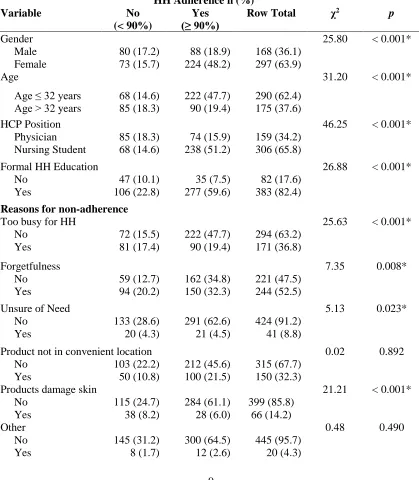
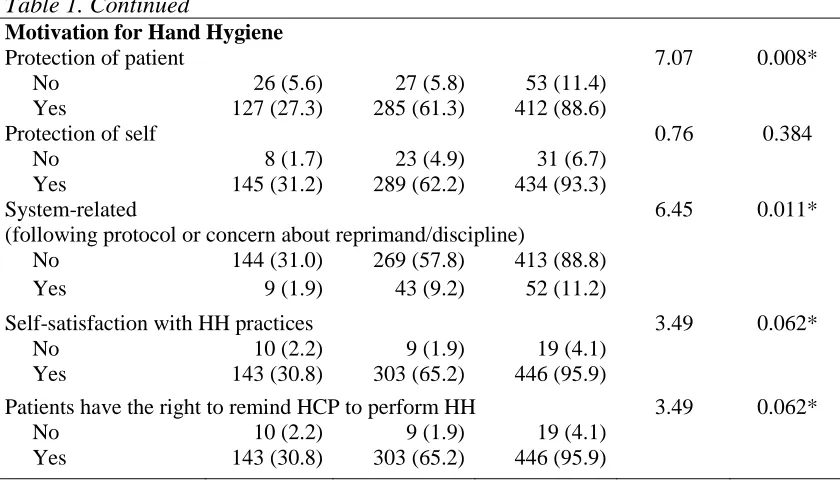
the time. Table 1 shows the demographic characteristics of the combined sample, as well
as the unadjusted chi-square comparisons of HH adherent versus non-adherent
participants for all study variables.
Table 1.
Step 1: Chi-square Comparisons of Self-perceived HH Adherence and Non-adherence.
HH Adherence n (%)
Variable No
(< 90%)
Yes
(≥ 90%) Row Total χ
2 p
Gender 25.80 < 0.001*
Male 80 (17.2) 88 (18.9) 168 (36.1) Female 73 (15.7) 224 (48.2) 297 (63.9)
Age 31.20 < 0.001*
Age ≤ 32 years 68 (14.6) 222 (47.7) 290 (62.4) Age ˃ 32 years 85 (18.3) 90 (19.4) 175 (37.6)
HCP Position 46.25 < 0.001*
Physician 85 (18.3) 74 (15.9) 159 (34.2) Nursing Student 68 (14.6) 238 (51.2) 306 (65.8)
Formal HH Education 26.88 < 0.001*
No 47 (10.1) 35 (7.5) 82 (17.6) Yes 106 (22.8) 277 (59.6) 383 (82.4)
Reasons for non-adherence
Too busy for HH 25.63 < 0.001*
No 72 (15.5) 222 (47.7) 294 (63.2) Yes 81 (17.4) 90 (19.4) 171 (36.8)
Forgetfulness 7.35 0.008*
No 59 (12.7) 162 (34.8) 221 (47.5) Yes 94 (20.2) 150 (32.3) 244 (52.5)
Unsure of Need 5.13 0.023*
No 133 (28.6) 291 (62.6) 424 (91.2)
Yes 20 (4.3) 21 (4.5) 41 (8.8)
Product not in convenient location 0.02 0.892
No 103 (22.2) 212 (45.6) 315 (67.7) Yes 50 (10.8) 100 (21.5) 150 (32.3)
Products damage skin 21.21 < 0.001*
No 115 (24.7) 284 (61.1) 399 (85.8) Yes 38 (8.2) 28 (6.0) 66 (14.2)
Other 0.48 0.490
No 145 (31.2) 300 (64.5) 445 (95.7)
10
Table 1. Continued
Motivation for Hand Hygiene
Protection of patient 7.07 0.008*
No 26 (5.6) 27 (5.8) 53 (11.4)
Yes 127 (27.3) 285 (61.3) 412 (88.6)
Protection of self 0.76 0.384
No 8 (1.7) 23 (4.9) 31 (6.7)
Yes 145 (31.2) 289 (62.2) 434 (93.3) System-related (following protocol or concern about reprimand/discipline)
6.45 0.011*
No 144 (31.0) 269 (57.8) 413 (88.8)
Yes 9 (1.9) 43 (9.2) 52 (11.2)
Self-satisfaction with HH practices 3.49 0.062*
No 10 (2.2) 9 (1.9) 19 (4.1)
Yes 143 (30.8) 303 (65.2) 446 (95.9)
Patients have the right to remind HCP to perform HH 3.49 0.062*
No 10 (2.2) 9 (1.9) 19 (4.1)
Yes 143 (30.8) 303 (65.2) 446 (95.9)
* = p ≤ 0.25 and included within multivariate analysis.
HH = hand hygiene; HCP = healthcare professional
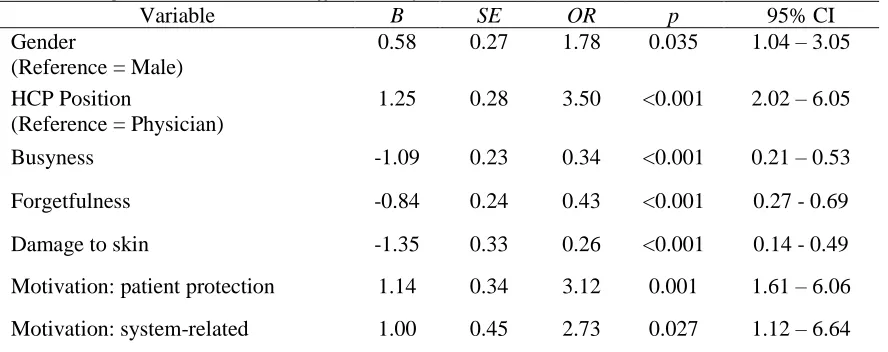
Table 2 displays the results of the multivariate stepwise logistic regression analysis.
These results suggest that the following seven variables were independent predictors of
participant HH adherence: female gender (OR, 1.78; 95% CI, 1.04–3.05), HCP position:
nursing student (OR, 3.50; 95% CI, 2.02–6.05), too busy to perform HH reported as a
reason for non-adherence (OR, 0.34; 95% CI, 0.21–0.53), forgetfulness reported as a
reason for non-adherence (OR, 0.43; 95% CI, 0.27-0.69), the perception that HH products
are damaging to skin (OR, 0.26; 95% CI, 0.14-0.49), patient protection as motivation for
HH (OR, 3.12; 95% CI, 1.61–6.06) and system-related motivation (concern about
reprimand/discipline if HH guidelines not followed/following protocol) (OR, 2.73; 95%
CI, 1.12-6.64). The Cox and Snell R2 and Nagelkerke R2 indicate that the six
independent predictors in the model explain 22.4 to 31.2% of the variance in HH
11 Table 2.
Step 2: Stepwise Logistic Regression Depicting Independent Predictors of HH Adherence Within Merged Dataset – Main Effects Only
Variable B SE OR p 95% CI
Gender
(Reference = Male)
0.58 0.27 1.78 0.035 1.04 – 3.05
HCP Position
(Reference = Physician)
1.25 0.28 3.50 <0.001 2.02 – 6.05
Busyness -1.09 0.23 0.34 <0.001 0.21 – 0.53
Forgetfulness -0.84 0.24 0.43 <0.001 0.27 - 0.69
Damage to skin -1.35 0.33 0.26 <0.001 0.14 - 0.49
Motivation: patient protection 1.14 0.34 3.12 0.001 1.61 – 6.06
Motivation: system-related 1.00 0.45 2.73 0.027 1.12 – 6.64
B = unstandardized regression coefficient; SE = standard error; OR = odds ratio; p = probability of accepting the null hypothesis at α = 0.05; CI = confidence interval.
Refer to the original studies for the results of their univariate and multivariate analyses
(Budimir-Hussey et al., 2013; Foote & El-Masri, 2016).
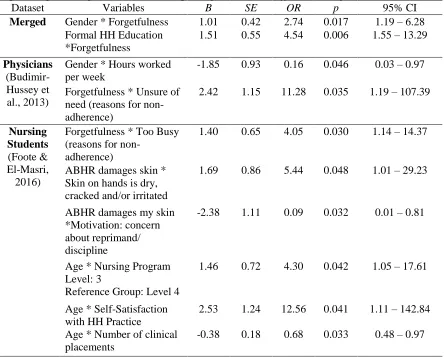
Table 3 presents the logistic regression results depicting effect moderation
(interaction effects) identified within all three datasets: merged; physicians; and nursing
students. Scatterplots depicting interaction effects for the merged data set are displayed
in Figure 1, while the interaction effects in the physician and nursing student databases
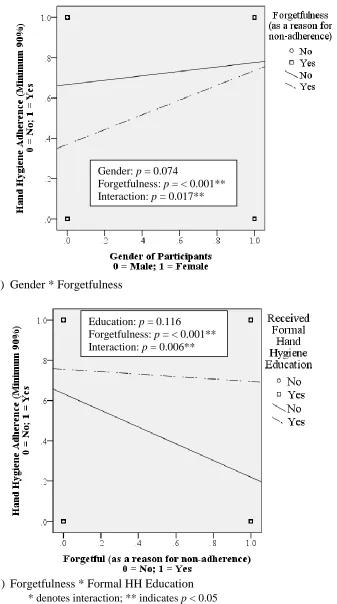
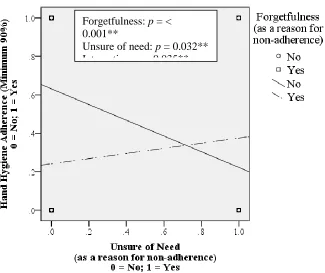
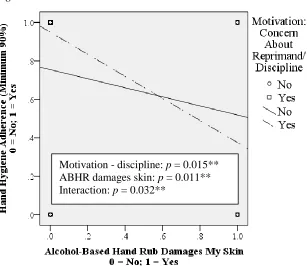
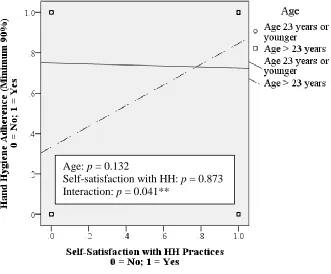
are displayed in Figures 2 and 3, respectively. Please note that within each scatterplot,
the lines of best fit are non-parallel, signifying an interaction effect.
Within the merged dataset, two interaction effects were identified: (a) forgetfulness
(as a reason for non-adherence) with gender (OR, 2.74; 95% CI, 1.19–6.28); and (b)
forgetfulness with received formal HH education (OR, 4.54; 95% CI, 1.55–13.29). Two
interactions were identified in the physician dataset: (a) gender with hours worked per
week (OR, 0.16; 95% CI, 0.03-0.97) and (b) self-reported reasons for non-adherence:
12
3 (and Figure 3), there were six significant interactions in the nursing students dataset: (a)
forgetfulness with too busy (reasons for non-adherence) (OR, 11.28; 95% CI,
1.19-107.39); (b) ABHR damages skin with skin on hands is dry, cracked and/or irritated (OR,
5.44; 95% CI, 1.01–29.23); (c) ABHR damages my skin with motivation: concern about
reprimand/discipline (OR, 0.09; 95% CI, 0.01–0.81); (d) age with nursing program level:
year 3 (OR, 4.30; 95% CI, 1.05–17.61); (e) age with self-satisfaction with HH practice
(OR, 11.00; 95% CI, 1.81–66.91); (f) age with total number of clinical placements (OR,
0.68; 95% CI, 0.48–0.97).
Table 3.
Step 3: Logistic Regression Results Depicting Interaction Effects Among All Datasets
Dataset Variables B SE OR p 95% CI
Merged Gender * Forgetfulness 1.01 0.42 2.74 0.017 1.19 – 6.28 Formal HH Education
*Forgetfulness
1.51 0.55 4.54 0.006 1.55 – 13.29
Physicians
(Budimir-Hussey et al., 2013)
Gender * Hours worked per week
-1.85 0.93 0.16 0.046 0.03 – 0.97
Forgetfulness * Unsure of need (reasons for non-adherence)
2.42 1.15 11.28 0.035 1.19 – 107.39
Nursing Students
(Foote & El-Masri, 2016)
Forgetfulness * Too Busy (reasons for
non-adherence)
1.40 0.65 4.05 0.030 1.14 – 14.37
ABHR damages skin * Skin on hands is dry, cracked and/or irritated
1.69 0.86 5.44 0.048 1.01 – 29.23
ABHR damages my skin *Motivation: concern about reprimand/ discipline
-2.38 1.11 0.09 0.032 0.01 – 0.81
Age * Nursing Program Level: 3
Reference Group: Level 4
1.46 0.72 4.30 0.042 1.05 – 17.61
Age * Self-Satisfaction with HH Practice
2.53 1.24 12.56 0.041 1.11 – 142.84
Age * Number of clinical placements
-0.38 0.18 0.68 0.033 0.48 – 0.97
13 Figure 1.
Scatterplots Illustrating Effect Moderation Among Merged Dataset Variables
a.) Gender * Forgetfulness
b.) Forgetfulness * Formal HH Education * denotes interaction; ** indicates p < 0.05
Gender: p = 0.074
Forgetfulness: p = < 0.001** Interaction: p = 0.017**
Education: p = 0.116
14 Figure 2.
Scatterplots Depicting Effect Moderation Among the Physicians Dataset Variables (Budimir-Hussey et al., 2013)
a.) Gender * Hours worked per week
b.) Forgetfulness * Unsure of need (reasons for non-adherence) * denotes interaction; ** indicates p < 0.05
Gender: p = 0.006** Hours Worked: p = 0.006** Interaction: p = 0.046**
Forgetfulness: p = < 0.001**
15 Figure 3.
Scatterplots Depicting Effect Moderation Among the Nursing Students Dataset Variables (Foote & El-Masri, 2016)
a.) Forgetfulness * Too busy
b.) Alcohol-based hand rub damages my skin (ABHR) * Skin on hands is dry, cracked/irritated
* denotes interaction; ** indicates p < 0.05 Too Busy: p = < 0.001** Forgetfulness: p = 0.002** Interaction: p = 0.030**
16
Figure 3. Continued
c.) ABHR damages my skin * Motivation: concern about reprimand/discipline
d.) Age * Nursing Program Level: Year 3 * denotes interaction; ** indicates p < 0.05
Motivation - discipline: p = 0.015** ABHR damages skin: p = 0.011** Interaction: p = 0.032**
Age: p = 0.606
17
Figure 3. Continued
e.) Age * Self-Satisfaction with HH Practices
f.) Age * Number of clinical placements Age: p = 0.132
Self-satisfaction with HH: p = 0.873 Interaction: p = 0.041**
Age: p = 0.011**
18
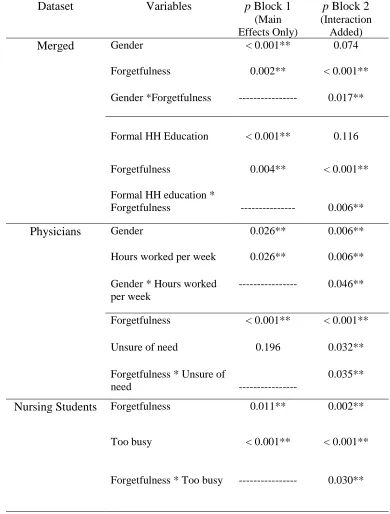
Table 4 displays the results of the separate hierarchical logistic regression
analyses performed for each pair of variables, with the main effects entered in the first
block and the interaction terms entered in the second block.
Table 4.
Hierarchical Logistic Regression - Significance of Variables: Main Effects then Interaction Term
Dataset Variables p Block 1
(Main Effects Only)
p Block 2 (Interaction
Added)
Merged Gender < 0.001** 0.074
Forgetfulness 0.002** < 0.001**
Gender *Forgetfulness --- 0.017**
Formal HH Education < 0.001** 0.116
Forgetfulness 0.004** < 0.001**
Formal HH education *
Forgetfulness --- 0.006**
Physicians Gender 0.026** 0.006**
Hours worked per week 0.026** 0.006**
Gender * Hours worked per week
--- 0.046**
Forgetfulness < 0.001** < 0.001**
Unsure of need 0.196 0.032**
Forgetfulness * Unsure of
need ---
0.035**
Nursing Students Forgetfulness 0.011** 0.002**
Too busy < 0.001** < 0.001**
19
p = probability of accepting the null hypothesis at α = 0.05; ** indicates p < 0.05
For each dataset (merged, physicians, and nursing students), logistic regression
analyses were repeated with the interaction terms included in the original main effect
Table 4. Continued
ABHR damages skin 0.016** 0.002**
Skin on hands is dry, cracked/ irritated
0.154 0.021**
ABHR damages skin * Skin on hands is dry, cracked/irritated
--- 0.048**
ABHR damages skin < 0.001** 0.011**
Motivation: concern about reprimand/ discipline
0.041** 0.015**
ABHR damages skin * Motivation: concern about reprimand/ discipline
--- 0.032**
Age 0.059 0.606
Nursing Program Level: 2 0.008** 0.122
Nursing Program Level: 3 0.005** 0.225
Age * Nursing Program Level: 2
--- 0.999
Age * Nursing Program Level: 3
--- 0.042**
Age 0.103 0.132
Self-satisfaction with HH practice
0.096 0.873
Age * Self-satisfaction with HH practice
--- 0.041**
Age 0.129 0.011**
Number of clinical placements
0.002** 0.046**
Age * Number of clinical placements
20
models. The results of these analyses are presented in Tables 5 (merged dataset), 6
(physician dataset), and 7 (nursing student database).
Table 5.
Step 4: Stepwise Logistic Regression Depicting Independent Predictors of HH Adherence Within Merged Dataset – Final Model After Adding Interaction Terms to Main Effects.
Variable B SE OR p 95% CI
HCP Position (0 = Physician)
1.30 0.26 3.67 <0.001 2.21 – 6.12
Busyness (0 = No)
-1.04 0.23 0.35 <0.001 0.22 – 0.56
Forgetfulness (0 = No)
-1.37 0.31 0.25 <0.001 0.14 – 0.47
Motivation: Patient-protection (0 = No)
1.13 0.34 3.08 0.001 1.60 – 5.96
Motivation: System-related (0 = No)
0.97 0.45 2.64 0.032 1.09 – 6.40
Damage to skin (0 = No)
-1.32 0.32 0.27 <0.001 0.14 – 0.50
Interaction:
Gender * Forgetfulness
0.89 0.35 2.44 0.011 1.23 – 4.84
B = unstandardized regression coefficient; SE = standard error; OR = odds ratio; p = probability of accepting the null hypothesis at α = 0.05; CI = confidence interval.
Table 6.
Stepwise Logistic Regression Depicting Independent Predictors of HH Adherence Within Physician Dataset (Budimir-Hussey et al., 2013) – Final Model After Adding Interaction Terms to Main Effects.
Variable B SE OR p 95% CI
HH Auditing (0 = No)
1.21 0.42 3.37 0.004 1.48 – 7.68
Too busy (0 = No)
-0.90 0.39 0.41 0.021 0.19 – 0.87
Forgetfulness (0 = No)
-1.49 0.41 0.23 < 0.001 0.10 – 0.50
Damages skin (0 = No)
-1.32 0.56 0.27 0.018 0.09 – 0.80
21 Table 7.
Stepwise Logistic Regression Depicting Independent Predictors of HH Adherence Within Nursing Students Dataset (Foote & El-Masri, 2016) – Final Model After Adding
Interaction Terms to Main Effects.
Variable B SE OR p 95% CI
Motivation: concern about discipline if HH guidelines are not followed
1.37 0.54 3.95 0.010 1.38 – 11.32
Number of clinical placements -0.26 0.07 0.77 <0.001 0.67 – 0.89
Barrier: busyness -2.80 0.62 0.06 <0.001 0.02 – 0.21
Barrier: forgetfulness -2.19 0.57 0.11 <0.001 0.04 – 0.34
Barrier: alcohol-based hand rub damages skin
-1.85 0.46 0.16 <0.001 0.06 – 0.39
Interaction:
Busyness * Forgetfulness
2.04 0.72 7.70 0.005 1.86 – 31.80
B = unstandardized regression coefficient; SE = standard error; OR = odds ratio; p = probability of accepting the null hypothesis at α = 0.05; CI = confidence interval.
Of the 10 interaction terms originally identified in the three datasets, two
interactions remained significant: forgetfulness and gender within the merged dataset
(OR, 2.44; 95% CI, 1.23-4.84) and forgetfulness and busyness within the nursing students
dataset (OR, 7.70; 95% CI, 1.86–31.80). See Tables 8 and 9 for cross-tabulations
comparing the percentages of HH adherent participants for each of these significant
22 Table 8.
Percentage of Hand Hygiene Adherent Participants (a minimum of 90% before and after patient contact) (Merged Dataset)
FORGETFULNESS as a reason for
non-adherence
GENDER
Male Female
Yes 37 74
No 67 78
Table 9.
Percentage of Hand Hygiene Adherent Nursing Students (a minimum of 90% before and after patient contact)
FORGETFULNESS as a reason for
non-adherence
BUSYNESS as a reason for non-adherence
Yes No
Yes 57 77
No 61 94
After controlling for interaction effects in the merged dataset, gender was no
longer an independent predictor of HH adherence. The new model, with six independent
predictors explains 23% to 32% of the variance in HH adherence within the combined
sample. Within the physicians dataset (Table 6), the original model remained the same,
with four independent predictors. However, when controlling for interaction effects, this
model explains 22% to 30% of the variance in HH adherence, compared to the original
18% to 24% (Budimir-Hussey et al., 2013). Within the new nursing student model, six
predictors (including the interaction between busyness and forgetfulness) explain 22% to
23
DISCUSSION
This study used a secondary analysis of existing data to explore effect moderation in
the study of HH adherence. Due to the exploratory nature of this study that explored the
existence of many possible main and moderating effects, only significant findings are
discussed. Implications for practice, education, policy, and future research, including
research methodology issues are also discussed.
Moderation
Without hypothesizing potential moderators a priori, pairs of variables were
explored for moderation effects within the original and merged datasets. Prior to
adjusting for potential confounding effects, a total of 10 possible interaction effects were
identified in the three datasets. However, when the interaction effects were added into
their respective (i.e., merged, physician, nursing student) regression models, only two
interactions remained significant: (a) gender moderated the relationship between
forgetfulness and HH adherence among physicians and nursing student participants
(within the merged dataset); and (b) the perception of busyness as a reason for
non-adherence moderated the relationship between perception of forgetfulness as a reason for
non-adherence and HH adherence among nursing students.
Male participants who perceived forgetfulness as a reason for non-adherence had
the lowest self-reported percentage of adherers (37%). This number increased to 67% for
males who did not perceive forgetfulness as a reason for non-adherence. However,
virtually no difference was noted between the proportion of female adherers who
perceived forgetfulness as a reason for non-adherence (74%) versus those who did not
24
In the nursing students dataset, among students who did not perceive forgetfulness
as a reason for non-adherence, self reported HH adherers was a modest 61% in the subset
of students who perceived busyness as a reason for non-adherence, as opposed to an
impressive 94% in the subset of students who did not perceive busyness as a reason for
non-adherence. Not surprisingly, the lowest percentage of adherers (57%) occurred when
students perceived both busyness and forgetfulness as reasons for non-adherence, and
was highest (94%) when neither busyness nor forgetfulness were perceived as such. This
finding indicates that busyness and forgetfulness create a synergistic effect with regard to
their impact on HH adherence. While previous studies have examined the influence of
gender, busyness, and forgetfulness as main effects, this is believed to be the first study to
find interactions between gender and forgetfulness, and between busyness and
forgetfulness. These findings are therefore difficult to discuss within the context of
previous literature. It is interesting to note however, that the interaction between
busyness and forgetfulness was present only in the student database, but disappeared
when the data were combined with the physician database. It is difficult to explain the
reason for this, but it is possible that the merging of databases diluted the interaction
effect, rendering it non-significant. That is, the interaction effect between these two
variables may not have been in the same direction between the two databases.
Main Effects
When comparing the results in the physician database with those reported by
Budimir-Hussey et al. (2013), the same four variables (busyness, forgetfulness, the
perception that HH products damage the skin, and the existence of HH auditing at the
25
interactions were examined. Other researchers have similarly found forgetfulness
(Squires et al., 2014), busyness (Barrett & Randle, 2008; De Wandel, Maes, Labeau,
Vereecken, & Blot, 2010; Erasmus et al., 2010; Knoll, Lautenschlaeger, & Borneff-Lipp,
2010), and concerns about skin damage (Al-Hussami, Darawad, & Almhairat, 2011;
Barrett & Randle, 2008; Darawad, Al-Hussami, Almhairat, & Al-Sutari, 2012; Jang et al.,
2010) to have negative effects on HH adherence; while auditing has previously been
shown to be associated with increased HH adherence (Fuller et al., 2012; Jang et al.,
2010).
Examination of interaction effects in the nursing student database resulted in a
reduction in the number of main effects in comparison to those reported by Foote and
El-Masri (2016). While busyness, forgetfulness, concerns about being disciplined if found
not practising HH, number of clinical placements, and concerns about skin damage
remained as predictors; patient protection as a motivating factor and role modelling by
the clinical instructor were no longer significant. The presence of an interaction effect in
the model could have resulted in a change in the nature of the main effects within the
model.
Forgetfulness, busyness, and concerns about skin damage, all significant
predictors in the original physician and nursing student studies, were similarly related to
HH in the merged database. HH for patient-protection and system-related motivations
(following protocol or concern about discipline/reprimand) both emerged as independent
predictors of adherence in the merged database. These variables were also originally
reported by Foote and El-Masri (2016) as independent predictors within the nursing
(Budimir-26
Hussey et al., 2013). However, previous researchers have reported self-protection as
motivation for HH (Al-Hussami, Darawad, & Almhairat, 2011; Allegranzi et al., 2013;
Budimir-Hussey et al., 2010; Erasmus et al., 2010; Jang et al., 2010; Korniewicz &
El-Masri, 2010; Mertz et al. 2011). However, when comparing reported HH adherence rates
before physical contact with patients, 70% of participants perceived they were adherent
before contact with patients, while 87% of participants reported they were adherent after
patient contact. These rates suggest motivation to perform HH was actually based on
self-perceived risk, rather than for patient protection; a finding more congruent with
current literature.
Professional category emerged as an independent predictor of adherence
(specifically, nursing students were more likely to adhere to HH protocols than were
physicians). Researchers have also demonstrated a positive association between the
nursing profession (compared to other professional groups, including physicians) and HH
adherence (Azim & McLaws, 2014; Erasmus et al., 2010; Mertz et al., 2011; Rosenthal et
al., 2013). However, these studies compared nurses with physicians (and other
professional groups), not nursing students. Caution must also be taken in interpreting
these results as Cole (2009) reported nursing students tend to overestimate their HH
adherence.
Conventional wisdom dictates that we should ensure both main effects are
included within the model when testing an interaction effect. However, due to the
exploratory nature of this study, forward stepwise logistic regression was used to test for
the presence of interaction effects. In doing so, gender no longer remained significant in
27
gender with forgetfulness remains in the final model and tells us more clinically, than the
main effects alone.
Implications
The perception of busyness was an independent predictor of reduced HH
adherence in all three databases, and interacted with forgetfulness to further reduce
adherence in the nursing student database. These findings point to a need to address the
issue of busyness (workload and time constraints) in health care settings, particularly
among nursing students.
One possible implication for management includes ensuring that non-professional
duties unrelated to patient care are eliminated from nurses’ workloads (Knoll et al.,
2010). In addition, education to nursing students should include reinforcing the
relationship between busyness and decreased adherence and the importance of HH in
reducing the transmission of HAIs (Foote & El-Masri, 2016). Education should also
reinforce that the use of alcohol-based hand rub takes less time to use than soap and water
(OAHPP, 2014). This might help mitigate the beliefs of some healthcare professionals
that it’s acceptable to knowingly skip HH during emergency situations and when
workloads are especially heavy (Jang et al., 2010). Education of students should also
review and reinforce all five moments for HH (WHO, 2006), regardless of personal
motivations for performing HH (Whitby et al., 2006).
Interventions to strengthen prioritization and time management skills among
nursing students may help to reduce their sense of busyness, and consequently help
improve their HH adherence. Clinical instructors should also monitor their students’
28
appropriate. Students should be encouraged to honestly communicate to their instructors
if they are feeling too busy to manage their assigned workloads. Nursing students
commonly need help to properly structure their time and manage the work demands of
clinical settings (Cleary & Horsfall, 2011). Further, clinical instructors and nurses need
to model prioritization and ensure that hand hygiene is consistently identified as a high
priority.
In recognition of the importance of remembering or thinking about HH, reminders
in the workplace have been widely included as part of bundled approaches to improving
HH (Akpaka, 2014; Ellingson et al., 2014; Huis et al., 2013; Rosenthal et al., 2013;
Schweizer, et al., 2014), and are considered one of five essential elements of the WHO
multimodal strategy for improvement of HH adherence (2009). Budimir-Hussey et al.
(2010) also reinforced the continued need for visual cues and periodic HH campaigns as
reminders; it is important that efforts such as this continue. To address the issue of
forgetfulness among nursing students, instructors should provide consistent reminders to
their nursing students, and model proper hand hygiene performance (Foote & El-Masri,
2016).
Previous research has demonstrated that performing HH audits can serve as a
reminder to perform HH (Jang et al., 2010) and provide a form of social and professional
pressure to adhere (Budimir-Hussey et al., 2010). Fuller et al. (2012) specifically
recommended the use of audits combined with immediate feedback, including
goal-setting and action planning, as an effective technique for improving HH practices. In
29
gender and forgetfulness, a conscious effort should be made to ensure male healthcare
professionals are included within HH audits.
Lastly, easy and sufficient access to skin-friendly products (De Wandel et al.,
2010), including hand moisturizing products and emollient-containing alcohol-based
hand rubs (OAHPP, 2014), and communication to healthcare professionals about these
products (Budimir-Hussey et al., 2010) are recommended to address skin damage
concerns.
The findings of this study have significant implications for research methodology
as it pertains to the study of HH adherence. As discussed previously, the search for
moderating effects among the predictors of HH adherence is scarce, at best. To deepen
our understanding of how one variable affects another, we need to understand what limits
or enhances an existing relationship, including the circumstances in which the effect
exists (Hayes & Matthes, 2009). It is therefore important to explore moderating variables
whenever there is reason to believe that such moderation exists, and that the impact of an
independent variable on a given outcome will be different across different levels of a
second independent variable. In the case that perfect moderation exists (i.e., an
interaction with no main effect) but is not examined, one may erroneously report that an
independent variable is not associated with an outcome, when in fact it might have had an
association that was moderated by a second independent variable. Without investigating
such effects, important relationships will be missed and our understanding of the true
relationship between the independent variable and the outcome will be concealed
(MacKinnon, 2011). Consequently, testing for moderation effects is of fundamental
30
whenever a researcher theoretically suspects a possible moderator, it must be included
within the analysis as part of the main effects model.
The results of this study also highlight the fact that moderating effects can be
confounded and that, as more variables are added to the analysis, some moderating
effects may cease to exist. In this study, 10 interaction effects were originally identified
based on models built with only two main variables. However, after adjusting for
confounding via logistic regression by adding the interactions effects and their respective
main effects back into larger models that include other independent variables, these
interactions were no longer significant. Had the analysis not included this additional
step, we would have erroneously concluded that all identified moderators were
significant, when in fact most were not. This methodological approach provided a final
model that is more likely to be representative of the true nature of relationships.
More research is needed to guide more targeted interventions to improve and
sustain HH adherence among healthcare workers, including nurses, within acute care.
Improvements in adherence may reduce the transmission of HAIs, thereby reducing
associated morbidity, mortality, and health care costs. Although only two significant
interaction effects were identified within this study, they highlight the importance of
realizing the presence of a third variable isn’t always a confounding effect for which we
should control. A third variable may in fact be a moderator that provides important
information about the subject matter. This is relevant clinically, in understanding that
interventions to improve behaviour may not work the same for everyone. Whenever a
moderator conceptually makes sense, we must consider the possibility of such a
31
Limitations
The inability to verify the accuracy of the data is an inherent limitation of
secondary analysis studies (Johnston, 2014). Further, the self-report nature of the data
carries the possibility of social desirability (Johnson & Fendrich, 2005) and response bias
(Budimir-Hussey et al., 2010), although the assurance of anonymity in both surveys
likely mitigated these effects. Also, this study was limited to the investigation of the
variables in the original databases, and to those that were similar across both databases
(i.e., variables not included in both original databases were excluded from analyses). It is
not clear what other interaction effects may have existed if all conceptually relevant
variables were subject to investigation.
Two separate datasets were pooled to increase the sample size and power of the
current study, while simultaneously exploring professional group as a potential
moderator. However, this merging of data from two relatively unrelated professional
groups may have inadvertently neutralized some interaction effects. This may explain
why the busyness/forgetfulness interaction was not present in the merged database. In
addition, it would have been more appropriate to compare registered nurses to physicians;
however, the researcher was unable to obtain data on HH adherence among registered
nurses. Thus, it is important that future research directly explore moderating effects
among nurses. Regardless, the results of this study (with different interactions identified
within each of the datasets) highlight the importance of studying individual healthcare
professional groups.
In consideration of the limitations of this study, future research using larger
32
factors affecting HH adherence. Researchers should always pay attention to possible
interaction effects, rather than run the risk of drawing misleading conclusions from
incomplete analyses. As this was an exploratory study, potential moderator effects were
not hypothesized prior to analysis. Future studies should use a conceptual framework and
past research to hypothesize and test for possible moderators. According to Bennett
(2000), this is especially warranted when the associations between the independent
variables and outcomes are inconsistent across studies; the levels of a hypothesized
moderator may explain what circumstances strengthen or weaken such a relationship.
This may help clarify the overall lack of concensus among factors affecting hand
hygiene, as reported within the review of the literature. Moving forward, the author
hopes this study helps highlight the importance of exploring more complex statistical
relationships, specifically within HH adherence research. Researchers should further
explore moderators affecting HH to strengthen these preliminary findings and provide
recommendations for future practice, education, and policy.
Conclusion
Exploration of moderation effects may provide a deeper understanding of certain
relationships than studying direct effects alone. Without considering moderator effects in
the data, a researcher may miss more exact explanations of the study phenomenon
(Bennett, 2000). This study was the first to explore potential moderating factors affecting
33 REFERENCES
Akpaka, C. C. (2014). Best practices for hand hygiene compliance by health care
providers in the inpatient setting. American Journal of Infectious Diseases, 10(2),
84-87. Retrieved from http://www.thescipub.com/ajid.toc
Al-Hussami, M., Darawad, M., & Almhairat, I. I. (2011). Predictors of compliance
handwashing practice among healthcare professionals. Healthcare Infection, 16,
79-84. doi:10.1071/HI11004
Allegranzi, B., Gayet-Ageron, A., Damani, N., Bengaly, L., McLaws, L., Moro,
M.-L., . . . Pittet, D. (2013). Global implementation of WHO's multimodal strategy
for improvement of hand hygiene: A quasi-experimental study. The Lancet
Infectious Diseases, 13, 843-851.
doi:http://dx.doi.org/10.1016/S1473-3099(13)70163-4
Azim, S., & McLaws, M.-L. (2014). Doctor, do you have a moment? Medical Journal of
Australia, 200(9), 1-4. doi:10.5694/mja13.11203
Barrett, R., & Randle, J. (2008). Hand hygiene practice: Nursing students' perceptions.
Journal of Clinical Nursing, 17, 1851-1857. doi:doi:
10.1111/j.1365-2702.2007.02215.x
Bennett, J. A. (2000). Focus on research methods - Mediator and moderator variables in
nursing research: Conceptual and statistical differences. Research in Nursing &
Health, 23, 415 - 420.
Boyce, J. M., & Pittet, D. (2002). Guideline for hand hygiene in health-care settings:
Recommendations of the Healthcare Infection Control Practices Advisory
34
Infection Control and Hospital Epidemiology, 23(S12), S3-S40. Retrieved from
http://www.jstor.org/stable/10.1086/503164
Budimir-Hussey, M., Ciprietti, L., Ahmed, F., Tarola, C., Lo, A., & El-Masri, M. (2013).
Exploring physician hand hygiene practices and perceptions in 2
community-based Canadian hospitals. Journal of Patient Safety, 9(3), 140-144.
Canadian Patient Safety Institute. (2016b). Canada's Hand Hygiene Challenge. Retrieved
from
http://www.patientsafetyinstitute.ca/en/About/Programs/HH/Pages/default.aspx
Chou, T., Kerridge, J., Kulkarni, M., Wickman, K., & Malow, J. (2010). Changing the
culture of hand hygiene compliance using a bundle that includes a violation letter.
American Journal of Infection Control, 38, 575-578.
doi:doi:10.1016/j.ajic.2010.01.016
Cleary, M., & Horsfall, J. (2011). Developing students' time management skills in
clinical settings: Practical considerations for busy nursing staff. Journal of
Continuing Education in Nursing, 42(6), 248-249.
doi:10.3928/00220124-20110523-04
Cole, M. (2009). Exploring the hand hygiene competence of student nurses: A case of
flawed self assessment. Nurse Education Today, 29(4), 380-388.
doi:10.1016/j.nedt.2008.10.010
Curry, V. J., & Cole, M. (2001). Applying social and behavioral theory as a template in
35
Darawad, M. W., Al-Hussami, M., Almhairat, I. I., & Al-Sutari, M. (2012). Investigating
Jordanian nurses' handwashing beliefs, attitudes, and compliance. American
Journal of Infection Control, 40, 643-647. doi:10.1016/j.ajic.2011.08.018
De Wandel, D., Maes, L., Labeau, S., Vereecken, C., & Blot, S. (2010). Behavioral
determinants of hand hygiene compliance in intensive care units. American
Journal of Critical Care, 19(3), 230-240. doi:10.4037/ajcc2010892
Dunn-Navarra, A.-M., Cohen, B., Stone, P. W., Pogorzelska, M., Jordan, S., & Larson, E.
(2011). Relationship between systems-level factors and hand hygiene adherence.
Journal of Nursing Care Quality, 26(1), 30-38.
Eiamsitrakoon, T., Apisarnthanarak, A., Nuallaong, W., Khawcharoenporn, T., &
Mundy, L. M. (2013). Hand hygiene behavior: Translating behavioral research
into infection control practice. Infection Control and Hospital Epidemiology,
34(11), 1137-1145. doi:10.1086/673446
Ellingson, K., Haas, J. P., Aiello, A. E., Kusek, L., Maragakis, L. L., Olmsted, R. N., . . .
Yokoe, D. S. (2014, August). SHEA/IDSA practice recommendation: Strategies
to prevent healthcare-associated infections through hand hygiene. Infection
Control and Hospital Epidemiology, 35(8), 937-960. doi:10.1086/677145
El-Masri, M. M. (2012, February). Terminology 101: Confidence intervals: Part 1.
Retrieved from Canadian Nurse:
https://www.canadian-
nurse.com/articles/issues/2012/february-2012/terminology-101-confidence-intervals-part-1
Erasmus, V., Daha, T. J., Brug, H., Hendrik Richardus, J., Behrendt, M. D., Vos, M. C.,
36
hygiene guidelines in hospital care. Infection Control and Hospital Epidemiology,
31(3), 283-294. Retrieved from http://www.jstor.org/stable/10.1086/650451
Faul, F., Erdfelder, E., Buchner, A., & Lang, A.-G. (2009). Statistical power analyses
using G*Power 3.1: Tests for correlation and regression analyses. Behavior
Research Methods, 41(4), 1149-1160. doi:10.3758/BRM.41.4.1149
Field, A. (2005). Discovering statistics using SPSS (2nd ed.). London: SAGE
Publications.
Foote, A., & El-Masri, M. (2016). Self-perceived hand hygiene practices among
undergraduate nursing students. Journal of Research in Nursing, 21, 8-19.
doi:10.1177/1744987115606959
Fuller, C., Michie, S., Savage, J., McAteer, J., Besser, S., Charlett, A., . . . Stone, S.
(2012). The Feedback Intervention Trial (FIT) - Improving hand-hygiene
compliance in UK healthcare workers: A stepped wedge cluster randomised
controlled trial. PLoS ONE, 7(10), e41617. doi:10.1371/journal.pone.0041617
Hayes, A. F., & Matthes, J. (2009). Computational procedures for probing interactions in
OLS and logistic regression: SPSS and SAS implementations. Behavior Research
Methods, 41(3), 924-936. doi:10.3758/BRM.41.3.924
Health Quality Ontario. (2016). Hospital care sector performance: Hand hygiene
compliance (provincial results). Retrieved from Health Quality Ontario:
http://www.hqontario.ca/System-Performance/Hospital-Care-Sector-Performance
Hosmer, D. W., & Lemeshow, S. (2000). Applied logistic regression (2nd ed.). New
37
Huis, A., Schoonhoven, L., Grol, R., Donders, R., Hulscher, M., & van Achterberg, T.
(2013). Impact of a team and leaders-directed strategy to improve nurses'
adherence to hand hygiene guidelines: A cluster randomised trial. International
Journal of Nursing Studies, 50(4), 464-474. doi:10.1016/j.ijnur-stu.2012.08.004
Huis, A., van Achterberg, T., de Bruin, M., Grol, R., Schoonhoven, L., & Hulscher, M.
(2012). A systematic review of hand hygiene improvement strategies: A
behavioural approach. Implementation Science, 7(92), 1-14.
doi:10.1186/1748-5908-7-92
Jang, J.-H., Wu, S., Kirzner, D., Moore, C., Youssef, G., Tong, A., . . . McGeer, A.
(2010). Focus group study of hand hygiene practice among healthcare workers in
a teaching hospital in Toronto, Canada. Infection Control and Hospital
Epidemiology, 31(2), 144-150. doi:10.1086/649792
Jeong, Y. S., & Kim, M. K. (2016). Influencing factors on hand hygiene behavior of
nursing students based on theory of planned behavior: A descriptive survey study.
Nurse Education Today, 36, 159-164. Retrieved from
http://dx.doi.org/10.1016/j.nedt.2015.09.014
Johnson, T., & Fendrich, M. (2005). Modeling sources of self-report bias in a survey of
drug use epidemiology. Annals of Epidemiology, 15(5), 381-389.
doi:10.1016/j.annepidem.2004.09.004
Johnston, M. P. (2014). Secondary data analysis: A method of which the time has come.
Qualitative and Quantitative Methods in Libraries (QQML), 3, 619-626.
Knoll, M., Lautenschlaeger, C., & Borneff-Lipp, M. (2010). The impact of workload on