Real-Time People Counting Method with
Head Localization and Tracking System
Consideration
Ganesh S. Patel, Jaykumar S. Dhage
M. Tech Student, Dept. of CSE, Dr. BAM University/MIT College, Aurangabad (MS), India
Asst. Professor
,
Dept. of CSE, Dr.BAM University/MIT College, Aurangabad (MS), IndiaABSTRACT: The people counting method plays a vital role in marketing research like traffic management, tourists flow, with the help of people counting system it is possible to collect the statistical information of the people present inside the organization's environment so that in the case of an emergency by referring the count of people, proper action can be taken to perform a rescue operation. Initially, people counting process was manually conducted by security guards but the limitation of this approach is that guards may not have attention for 24*7 and required to pay a monthly amount to them.
The counter requires two steps: detection of people and tracking to count people for specified direction. Detection is based on finding people through the application of HOG descriptor and trajectories of people are track by using an iterative method called Meanshift algorithm. Finally, counting system modifies specified direction count based on the direction of trajectories generated by the Meanshift algorithm. Different indoor video sequences are taken from surveillance camera and results obtained with the accuracy ranging from 91% to 100%. Accuracies of the result depend on a number of people crossing the counting zone simultaneously, occlusions, intensity variation in video sequence etc.
KEYWORDS: People counting, Meanshift algorithm, Foreground and background subtraction, HOG.
I. INTRODUCTION
Today people counting system has become very important in many practical applications, for example, video surveillance, tourists flow estimation and pedestrian traffic management people counting is an important term in security providing organizations because the security system needs to take care of people and originations property. Considering scope in security field, lots of work is done in people counting system. Today more research is published to resolve the problem of people counting using a video camera. People counting help into the security or people management. Several ways to implement people counting are as follows. To implement people counting [5] matlab Simulink programming tool is used and it tries to measure and compare its accuracy with another system using laser beam sensor. Indoor scenes are more difficult than outdoor for counting people because of slightly moving people and occlusion. For this propose [1] head-shoulder detection based crowd counting framework for indoor scenes is used. On the off chance that huge measure of individuals is going ahead railroad station then they have to oversee high stream rate. There are many problems like shadow elimination, dynamic background and also occlusion.
II.RELATED WORK
A people counter is [1] a gadget used to tally the quantity of people on foot strolling through an entryway or hall. More often than not, this framework is utilized at the passage of an assembling so that the aggregate number of guests can be recorded. In this proposed system real time people counting video based on Matlab Simulink programming tool is used. To implement this system each frame is compared with the previous frame using background estimation module and segmentation module. After comparison if blobs are found then tracking and counting module is applied on the frame, else counting process stops. This method is used to implement people counting in indoor scenes. Previously implemented methods not have good performance [1] because of occlusion and randomly changing the indoor environment. Many problems challenge the real application, such as occlusion, shadow elimination, and dynamic background. [2] Many kinds of approaches have been proposed to handle these problems. The approaches can be roughly divided into two categories, one is based on background subtraction and the other is based on pedestrian detection and tracking. Background subtraction-based methods are famous because they are easy to implement and very fast. HOG features have been extended a lot of improvement in the performance of people counting. HOG and LBP features are used to combine improve detection accuracy but performance is less as compared to previous research. The main problem in video detection system is the presence of shadow. Because [4] moving shadow may treat as an object in the video, so to have efficient people counting a robust real-time people tracking and counting incorporating shadow detection and removal is used. In [7] given a counting method in which Counting is done by analyzing a supervised zone composed by a set of frame difference and counting lines method to detect the moving objects. All the above systems give almost satisfactory result when a number of access people are less and the background is fixed. In the case of dynamic background condition such as intensity variations, the impact of moving parts of the scene (e.g. waving leaves) and objects those are moving slowly, a robust background modeling algorithm should be used.
III.APPROACH
The proposed system for people counting mainly consist the steps as shown in fig. 1.In first step foreground detection and edge detection is performed, the second step is for Head detection, in step three tracking is performed finally counting algorithm is applied to count people in a specified direction.
Fig. 1.Flow of Counting System
A. Low-Level Pre-processing 1. Background Modelling
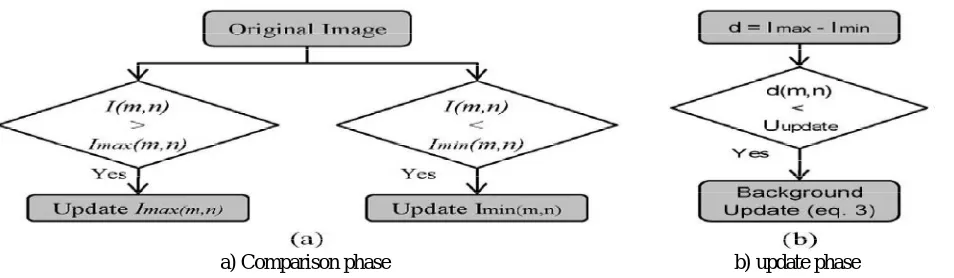
a) Comparison phase b) update phase
Fig. 2.Background modeling
In comparison phase over a certain number of frames min/max intensity values of each pixel of the image is obtained and in update phase background is updated with equation 1 and 2.
( , ) =
( , ) ( , )(1)
( , ) = ( , ) + (1− ) ( , ) (2)
Here (m, n) is pixel value which is to be update and parameter ∝ gives the impact of previous value at k ,
And , .
2. Morphological Operations
To obtain the foreground different morphological operations are applied on difference frame which is obtained by subtracting background from the current frame. The first difference image is the threshold to obtain binary foreground image then second Thresholding Dilation is applied to fill small holes produced by it.
B. People Detection
In our counting system, there are two main steps first is the detection of people and second is tracking. In this people counting method, detection is made through application HOG descriptor on pre-processed frames. In HOG window of Detection is separated into cells of size 4 x4 pixels and each group of 2×2 cells for the usage of integration of all into a block in a sliding fashion. Each cell consists of a 9-bin Histogram of Oriented Gradients (HoG) and each block contains a conterminous vector of all its cells where each of them is represented by a feature vector. A linear SVM classifier is trained by using these features. HOG descriptor for people detection works in two steps in first step different descriptor of objects present in the frame are constructed and in second step SVM support vector machine is used to classify the object into human or animal.
C. Tracking
horizontally across the frame image. Head objects are moved in surveillance area around counting line. According to this, we add a counting region centered on counting line to assist in tracking. As shown in Fig. 2.
Fig.3. Counting line and counting region: (a) horizontal (b) vertical
The proposed head tracking algorithm is stated as follows:
1) Initialization: In the beginning, the algorithm produces a tracking list of head objects and initializes the tracking list to empty.
2) Update: If a head object is detected in a frame image, it will be determined whether to be added to the tracking list or not according to the following rules:
a) Out of counting region or not: If the center of the head object is out of the counting region, it will not be added to the tracking list. Here the center means the center of the bounding rectangle of the head object. The decision rule can be stated as follows:
=
(
ℎ
<
||
ℎ
>
)||(
ℎ
<
||
ℎ
>
)
,
ℎ
(3)
Where H denotes the head object, h x and h y respectively represent x-coordinate and y-coordinate ofcentre of the head object H,L x and R x respectivelyrepresent x-coordinate of left and right border of thecounting region (if vertical), and
U y and D y respectivelyrepresent y-coordinate of up and down border of the counting region (if horizontal).
b) Already in the tracking list or not:If the head object is in the counting region, it will be determined whether it is Already in the tracking list or it is a new head object according to the decision rule as follows:
=
0,
( ,
) >
,
ℎ
.
(4)
Where list H is each head object already in the tracking list ( , ) means the area of overlap between H and Hlist, and T is a threshold to measure degree of overlap. In our experiment, the value of T is set as 1.
3) Meanshift iteration:The Meanshift algorithm is used to calculate new coordinates of each head object in the tracking list. During this process, the algorithm compares the new coordinates with the previous coordinates of the head object. If the Euclidean distance between them is less than a threshold d T or number of iterations is larger than another threshold n T, the algorithm stops the iteration and updates the head object. Finally, the new position of the head object is added to its route list. In our experiment, d T is set to 0.2 and n T is set to 10.
D. Crossing-line Judgment
After the counting line and region are specified, relative locations between a head object and counting line and region Can be determined. Thus, we can use the information to determine the initial moving direction of the head object as Follows:
If the counting line and region is vertical:
=
2
,
<
2
,
>
(5) If the counting line and region is horizontal:
=
2
,
ℎ
<
2
,
ℎ
>
(6)
Where HDis the initial moving direction of the head object, and h _ ini xand h _ ini y respectively represent initial X-coordinate and y-coordinate of the center of the head object. After the initial moving direction of the head object is Determined, we can perform crossing-line judgment using current position of the head object as rules below:
=
2
ℎ
,
=
2
ℎ
ℎ
>
ℎ
2
,
=
ℎ
2
ℎ
<
2
,
=
2
ℎ
>
2
,
=
2
ℎ
<
Where DCis the direction for counting people, and xh, yhrepresent the current x-coordinate and y-coordinate of the centerof the head object H, respectively. If the head objectsatisfies one of the cases listed above, we add count number Corresponding to DCby 1, otherwise, the head object will be discarded.
III. EXPERIMENTS AND RESULTS
1. Experimental setting: An important characteristic of all counting systems is the position and direction of the camera. Thus, these features are analyzed and it is found that camera positioned as shown below figure gives a better view of people head body.
Fig.4.Location and orientation of camera
2. Results of low level pre-processing:
Fig. 5.low level pre-processing
3. Results of People Detection
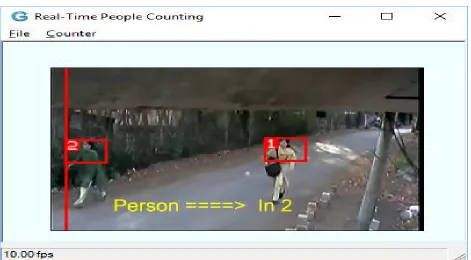
4.Result of People Tracking and Counting
EXISTING SYSTEM
PROPOSED SYSTEM
T1
PRECISION RECALL
MAE
PRECISION RECALL
MAE
F
0.97
0.89
0.41
0.98
0.90
0.32
0.938
T2
0.95
0.91
0.65
0.97
0.96
0.47
0.934
T3
0.97
0.94
0.58
0.98
0.96
0.40
0.945
Graph 1. Existing system Graph 2. Proposed system
As shown in the above figure first gives information about precision, recall, MAE, and F respectively. The F is nothing but weighted harmonic mean:
=
2
∗
∗
+
Is a way to combine precision and recall to obtaining a general quality measure. The algorithm has been codified in C# language using open source libraries emgucv and Aforge.net and executed without any multithreading support.
IV.CONCLUSION
We have used detection and tracking based method to count people at entering place of building. We track people by using blob and cross line judgment. The method involves main two steps. At the detection step, we use head based hog feature to detect the people and at the tracking step, we use Meanshift method. The examination comes about
0 0.2 0.4 0.6 0.8 1 1.2
T1 T2 T3
Precision Recall MAE 0 0.2 0.4 0.6 0.8 1 1.2
T1 T2 T3
demonstrate that the strategy proposed in this paper can accomplish a high exactness and can serve the continuous assignment.
REFERENCES
1.Jun Luo, JinqiaoWang, HuazhongXu, HanqingLu Real-time people counting for indoor scenes. E-mail addresses: [email protected] (J. Luo),[email protected] (J. Wang), [email protected] (H. Xu),Accepted 30 October 2015
2.Jingyu Liu Jiazheng Liu Mengyang Zhang. A Detection And Tracking Based Method For Real-time People Counting. [email protected]/13/$31.00 © 2013 IEEE
3.Frantisek Galcık and Radoslav Gargalık .Real-Time Depth Map Based People Counting. J. Blanc-Talon et al. (Eds.): ACIVS 2013, LNCS 8192,
pp. 330–341, 2013. Springer International Publishing Switzerland 2013.
4.J. L. Raheja, Sishir Kalita, Pallab Jyoti Dutta, Solanki Lovendra A Robust Real-Time People tracking and Counting incorporating shadow detection and removal International Journal of Computer Applications (0975 – 8887) Volume 46– No.4, May 2012
5.Satoshi Yoshinaga, Atsushi Shimada, Rinichiro Taniguchi Real-time people counting using blob descriptor Kyushu University, 744, Motooka, Nishi-Ku, Fukuoka, 819-0395 Japan Received November 13, 2009; revised December 4, 2009; accepted December 10, 2009
6.Supervisors: Jon Y. Hardeberg, Faouzi Alaya Cheikh, Pierre Gouton Real-Time People Counting system using Video Camera. Master of Computer Science, Image and Artificial Intelligence 2007
7.Javer, B., Bertaa, M., Feranando, B., “Real-Time People Counting Using MultiLines”, IEEE Computer Society, pp. 159-162, 2008.
8. Bin Li, Jian Zhang, Zheng Zhang, Yong Xu Bio-Computing Research Center, Shenzhen Graduate School, Harbin Institute of Technology, China A People Counting Method Based on Head Detection and Tracking 978-1-4799-5711-8/14/$31.00 ©2014 IEEE
9. Jorge García, Alfredo Gardel, Ignacio Bravo, José Luis Lázaro, Miguel Martínez, and David Rodríguez Directional People Counter Based on Head TrackingIEEE TRANSACTIONS ON INDUSTRIAL ELECTRONICS, VOL. 60, NO. 9, SEPTEMBER 2013
10. Antoni B. Chan, Nuno Vasconcelos Counting People With Low-Level Features and Bayesian Regression IEEE transactions on image processing, vol. 21, no. 4, April 2012
11.Ya-Li Hou, Grantham K. H. Pang, People Counting and Human Detection in a Challenging Situation IEEE transactions on systems, man, and cybernetics—part a: systems and humans, vol. 41, no. 1, January 2011
12. N. Dalal and B. Triggs, \Histograms of oriented gradients for human detection," 2006.