Abstract
KU, YU-CHENG. Essays on Multivariate Stochastic Volatility Models Using Wishart Processes:
A General Discussion and Dimension Reduction by Latent Factor Structures. (Under the
direction of Peter Bloomfield.)
This dissertation consists of three essays. The first (Chapter 1) gives a general
discus-sion of modeling dynamic correlations in multivariate stochastic volatility (MSV) models using
Wishart processes. We explore the nonlinear relationship between the intertemporal sensitiv-ity parameter and the covariance/correlation structure of the series of interest. Moreover, we
prove concavity of the univariate log posteriors of the persistence parameter and of the degrees
of freedom. Consequently, instead of using a grid sampler or the adaptive rejection Metropolis sampling, we can directly apply adaptive rejection sampling (ARS) to draw samples from these
complicated densities, which is more efficient provided that log-concavity is assured.
More-over, we suggest using the Sherman-Morrison-Woodbury (SMW) formula in the update of the correlation matrices. Our empirical study shows that ARS together with SMW formula can
considerably improve MCMC efficiency. Other issues about the assessment of hyperparameters
and model parameterizations for this type of models are also discussed. Since the Wishart pro-cess plays the key role in this dissertation, it is essential to correctly generate random Wishart
matrices for model estimation. Unfortunately, however, most (if not all) statistical software
packages do not treat the generation of random Wishart matrices in a correct manner. For this reason, in the second essay (Chapter 2), based on Gyndikin’s theorem and Bartlett’s
decomposi-tion, the OX package “WishPack” is developed for generating random Wishart/inverse-Wishart matrices. To make the package more complete, the density functions for the Wishart and
in-verse Wishart distributions are also provided. The most important feature of this package is
that it takes into account the singular Wishart matrices and distributions, since they have been well defined and are useful in practical problems. In the final essay (Chapter 3), to provide a
parsimonious model for high-dimensional data, a dynamic correlation factor MSV (DCFMSV)
model is proposed in which the evolution of the factor correlations is characterized by Wishart processes. The most advantageous feature of this model compared to existing models is that
it retains the latent factor structure and therefore has more model flexibility. The estimation
c
Copyright 2010 by Yu-Cheng Ku
Essays on Multivariate Stochastic Volatility Models Using Wishart Processes: A General Discussion and Dimension Reduction by Latent Factor Structures
by Yu-Cheng Ku
A dissertation submitted to the Graduate Faculty of North Carolina State University
in partial fulfillment of the requirements for the Degree of
Doctor of Philosophy
Statistics
Raleigh, North Carolina
2010
APPROVED BY:
Ronald Gallant Sujit Ghosh
Min Kang Brian Reich
Biography
Ku, Yu-Cheng was born in Taichung, Taiwan. In 2006, he came to North Carolina State
University to pursue his doctorate degree in Statistics. During the doctoral program, he interned in Fannie Mae at Washington D.C. as a risk analyst in the Department of Credit Risk Oversight
in 2008. He did his second internship as a data analyst in the Headquarter of Customer
and Business Insights of GlaxoSmithKline (GSK) at Durham, NC in 2010. Those valuable experiences taught him how statistical methods can help solve real business problems.
In his academic community, he has presented in international conferences for multiple times
and was invited to referee papers for several journals, includingJournal of Econometrics.
Out-side of school he loves to travel. For the past four years he has traveled seven countries across
Asia, Europe, and North America. Also, he traveled more than thirty states including Hawaii
and ten National Parks of the U.S. He will finish his Ph.D. with a Math minor in 2010. After which, he will serve as a postdoctoral fellow to continue his research career at the Australian
Acknowledgements
First I would like to give my deepest gratitude to my advisor, Dr. Bloomfield, for his
inspi-rational guidance with endless patience. I am also grateful to my advisory committee of Drs. Gallant, Ghosh, Kang, and Reich, not only for their valuable suggestions and help, but also for
their leading me to know the areas of computing, modern statistical theories, Bayesian
Table of Contents
List of Tables . . . vi
List of Figures . . . vii
Chapter 1 Modeling Dynamic Correlations in Wishart Multivariate Stochas-tic Volatility Models . . . 1
1.1 Introduction . . . 1
1.2 Model Implication . . . 3
1.2.1 Intertemporal Parameter and the Variance-Covariance Structures . . . 4
1.2.2 Intertemporal Parameter and Correlations . . . 7
1.2.3 Model Parameters vs. Correlation . . . 9
1.3 MCMC Estimation . . . 10
1.3.1 Likelihoods and Joint Posteriors . . . 11
1.3.2 Log-concavity of the Full Conditional ofd . . . 12
1.3.3 Log-concavity of the Full Conditional ofk . . . 15
1.3.4 Use of Sherman-Morrison-Woodbury Formula . . . 18
1.3.5 Hyperparameter Assessment for the Degrees of Freedom . . . 18
1.3.6 The Scale Matrix of the Wishart Distribution . . . 18
1.4 Empirical Study . . . 20
1.4.1 Improving MCMC Efficiency . . . 20
1.4.2 Marginal v.s. Joint Behaviors . . . 23
1.5 Conclusion . . . 26
Chapter 2 On Random Wishart Matrices. . . 27
2.1 Introduction . . . 27
2.2 Motivation . . . 28
2.2.1 Problems in Existing Statistical Packages . . . 29
2.3 Generating Wishart Random Matrices with Fractional df . . . 34
2.3.1 Non-singular Wishart Matrices . . . 34
2.3.2 Wishart Matrices with Singularity . . . 35
2.3.3 A Note on Odell-Feiveson’s Algorithm . . . 38
Chapter 3 Latent Structures in Dynamic Correlation Multivariate Stochastic
Volatility Models . . . 40
3.1 Introduction . . . 40
3.2 The Dynamic Correlation Structure in FMSV Models . . . 41
3.3 The Algorithm . . . 46
3.3.1 Likelihood . . . 46
3.3.2 Choice of priors . . . 47
3.3.3 Full Conditionals . . . 48
3.3.4 Identification . . . 51
3.3.5 MCMC Sampler . . . 52
3.4 Simulation Examples . . . 53
3.4.1 One-factor Model . . . 53
3.4.2 Two-factor Model . . . 58
3.4.3 Dynamic vs. Constant Correlation . . . 66
3.5 Empirical Data Analysis . . . 69
3.5.1 The Order of the Input Data . . . 71
3.5.2 Three Factor Model . . . 72
3.5.3 Sensitivity to Number of Factors and Other Issues . . . 81
3.6 Discussion and Future Research . . . 84
List of Tables
Table 1.1 Mean absolute error of correlation estimates using different specifications. 19
Table 1.2 Mean absolute error of VaR using different specifications. . . 19
Table 1.3 Comparison results of ARS+SMW v.s. ARMS+No SMW. . . 21
Table 1.4 Output of ARS + SMW . . . 22
Table 1.5 Output of ARMS + No SMW. . . 22
Table 1.6 Pearson correlations of the four return series. . . 25
Table 1.7 DJIA-HSI bivariate model estimates. . . 25
Table 1.8 HSI-KOSPI bivariate model estimates. . . 25
Table 2.1 MCMC results using the integer and the fractional df parameters, respec-tively. . . 30
Table 2.2 Hellinger distance betweenf1 and f2 with df =k and k+α, respectively. 33 Table 3.1 Estimates for the one-factor model. . . 57
Table 3.2 Estimates for the two-factor model. . . 60
Table 3.3 MAEρ, first run. . . 68
Table 3.4 MAEρ, second run. . . 68
Table 3.5 MAEVaR, first run. . . . 68
Table 3.6 MAEVaR, second run. . . . 68
List of Figures
Figure 1.1 E log|Qt+1|vs. a∗21 . . . 6
Figure 1.2 Average correlation levels vs. a∗21 . . . 8
Figure 1.3 Model parameters vs. Correlations in A&M’s WIC model. . . 10
Figure 1.4 logp(d|·) and the second order difference. . . 12
Figure 1.5 trA−1(logQt−1)2Qd/t−21Q −1 t Q d/2 t−1 and tr (logQt−1)2 forp= 2. . . 15
Figure 1.6 The plot of logp(k|·). . . 17
Figure 1.7 The plot of dkd22logp(k|·) for differentp. . . 17
Figure 1.8 Dow Jones v.s. Hang Seng and Hang Seng v.s. KOSPI . . . 24
Figure 2.1 Trace plots of k and |A|from the simulation of A&M’s WIC model. . . 31
Figure 2.2 Hellinger distance between f1 andf2. . . 33
Figure 2.3 Histograms of χ21,χ22,χ23, and χ24 for non-singular Wishart. . . 36
Figure 2.4 Q-Q plots and K-S test results of χ21, χ22, χ23, and χ24 for non-singular Wishart. . . 36
Figure 2.5 Histograms of χ2 1,χ22,χ23, and χ24 for singular Wishart. . . 37
Figure 2.6 Q-Q plots and K-S test results of χ21,χ22,χ23, andχ24 for singular Wishart. 37 Figure 2.7 Histograms of χ21,χ22,χ23, and χ24 using incorrectly specifieddf. . . 38
Figure 3.1 The ten simulated observable series. . . 44
Figure 3.2 The underlying common factors and the time-varying factor correlations. 45 Figure 3.3 Trace plots of factor loadings – one-factor model. . . 54
Figure 3.4 Trace plots of idiosyncratic variances – one-factor model. . . 54
Figure 3.5 Trace plots of SV parameters – one-factor model. . . 55
Figure 3.6 Full conditionals of factor loadings – one-factor model. . . 55
Figure 3.7 Full conditionals of idiosyncratic variances – one-factor model. . . 56
Figure 3.8 Full conditionals of SV parameters – one-factor model. . . 56
Figure 3.9 Factor correlation and VaR estimates – two-factor model. . . 59
Figure 3.10 Trace plots of factor loadingsB1– two-factor model. . . 61
Figure 3.11 Trace plots of factor loadingsB2– two-factor model. . . 61
Figure 3.12 Trace plots of idiosyncratic variances – two-factor model. . . 62
Figure 3.13 Trace plots of SV parameters – two-factor model. . . 62
Figure 3.14 Trace plots of correlation parameters – two-factor model. . . 63
Figure 3.15 Full conditionals of factor loadingsB1– two-factor model. . . 63
Figure 3.17 Full conditionals of idiosyncratic variances – two-factor model. . . 64
Figure 3.18 Full conditionals of SV parameters – two-factor model. . . 65
Figure 3.19 Full conditionals of correlation parameters – two-factor model. . . 65
Figure 3.20 Time series plot of the original data. . . 70
Figure 3.21 Factor correlations – three-factor model for real data. . . 74
Figure 3.22 Trace plots of factor loadingsB1 – three-factor model for real data. . . . 75
Figure 3.23 Trace plots of factor loadingsB2 – three-factor model for real data. . . . 75
Figure 3.24 Trace plots of factor loadingsB3 – three-factor model for real data. . . . 76
Figure 3.25 Trace plots of idiosyncratic variances – three-factor model for real data. 76 Figure 3.26 Trace plots of SV parameters – three-factor model for real data. . . 77
Figure 3.27 Trace plots of correlation parameters – three-factor model for real data. 77 Figure 3.28 Full conditionals of factor loadingsB1 – three-factor model for real data. 78 Figure 3.29 Full conditionals of factor loadingsB2 – three-factor model for real data. 78 Figure 3.30 Full conditionals of factor loadingsB3 – three-factor model for real data. 79 Figure 3.31 Full conditionals of idiosyncratic variances – three-factor model for real data. . . 79
Figure 3.32 Full conditionals of SV parameters – three-factor model for real data. . 80
Figure 3.33 Full conditionals of correlation parameters – three-factor model for real data. . . 80
Chapter 1
Modeling Dynamic Correlations in
Wishart Multivariate Stochastic
Volatility Models
1.1
Introduction
Modeling covariance and correlation structures is a central issue in financial studies and other
ar-eas. Considerable empirical evidence has shown that asset correlations are not stable over time;
this is widely known as the“correlation breakdown” phenomenon (Rey, 2000)[34]. As a result, relaxation of the correlation constancy has become essential, and the development in modeling
time-varying correlations has grown at a rapid pace. Recently, in the Multivariate Stochastic
Volatility (MSV) literature, several models have been proposed to characterize the evolution of the covariance matrices using Wishart-based processes. Gourieroux et al. (2009)[15] introduced
the Wishart autoregressive (WAR) model constructed from the scatter matrix process. Besides,
Gourieroux (2006)[14] introduced the continuous time WAR process as the direct multivariate extension of the Cox-Ingersoll-Ross (CIR) model.
Different from the WAR process of Gourieroux et al. (2009)[15], the models proposed
by Philipov and Glickman (2006; henceforth P&G)[32] and Asai and McAleer (2009; A&M hereafter)[3] adopt inverted Wishart specification for the covariance matrices. Following A&M,
this class of models is termed the “Wishart Inverse Covariance” (WIC). With this
normal-inverted Wishart setting, inference and model estimation can be implemented using Bayesian Markov chain Monte Carlo (MCMC) approaches.
The WIC models of P&G and A&M have simple structures and are proven to be useful
sensitivity parameter, A−1, are often small compared to the diagonal entries, but the
corre-sponding mean correlation estimates are quite large. This interesting phenomenon has not yet been explored in the WIC context and will be explained in the paper.
Since the WIC model for time series data is built upon latent variables and its estimation is
done through MCMC techniques, the computation is usually expensive. This is not favorable for practitioners because the model estimates may be needed to be updated on a weekly or
even daily basis. Therefore, from a practical point of view, the efficiency of the sampling
algorithm is a crucial concern. In the WIC models, both the univariate persistence parameter and the degrees of freedom (df) have complicated conditional posteriors, and hence sampling
from these densities requires additional efforts. P&G suggests a grid sampler while A&M uses
the Adaptive Rejection Metropolis Sampling (ARMS) of Gilks et al. (1995)[12]. In this article, we show that the conditional posterior densities of the above two scalar parameters are actually
log-concave, and hence the Adaptive Rejection Sampling (ARS) of Gilks (1992)[13] may be a
better alternative in this context.
Another technique to improve MCMC efficiency in the WIC model is the use of
Sherman-Morrison-Woodbury (SMW) formula. Due to the normal-inverted Wishart specification, in
the MCMC updates of the covariance matrices, we will come into a special form in which SMW formula is particularly useful. Geweke and Zhou (1996)[11] suggest using this formula
for estimating the covariance matrix of the unknown systematic factors. The main reason that they adopt SMW formula is that the inversion of a matrix can be calculated through a
much lower dimensional one. Differently, for the WIC model, the main advantage of using
SMW formula is that the update of the scale matrices for the Wishart posterior densities can be effected simply by perturbing previously computed results, and the computation is thus
reduced.
The rest of the paper is organized as follows. In Section 1.2 we explore the mechanism of how the intertemporal sensitivity parameter affects the covariance and correlation structure.
Section 1.3 discusses the implementation issue about the MCMC estimation in the WIC model.
1.2
Model Implication
We first review P&G’s and A&M’s WIC models for the p×1 asset returns yt. The model
introduced by P&G has the following simple structure:
yt|Σt∼Np(0,Σt), Σ−t1|ν,St−1∼Wp(Σ−t1|ν,St−1),
where
St−1 =
1
νA
1
2 Σ−1
t−1
d
A12 (1.1)
is the scale parameter andν is the degrees of freedom for the Wishart distribution, respectively.
The scalardis a persistence parameter which accounts for the overall relationship. The matrix
Σt−1 is the covariance matrix of returns at time t−1, and A is the intertemporal sensitivity
parameter matrix which is symmetric and positive definite.
On the other hand, A&M’s WIC model allows for independent univariate stochastic
volatil-ity (SV) equations, which is given by
yt=Vt1/2t,
Vt1/2 = diag(eh1t/2, ..., ehpt/2),
ht+1=µ+φ◦ht+ηt,
where the operator◦ is the elementwise product, and
t
ηt !
ht∼N2p(0,Ut), Ut=
Pt 0
0 Pη !
.
We can see that, hit = log Var(yit|hit), i = 1, .., p, are the log volatilities of the returns, and
ht follows an first-order vector autoregressive process. For identification purpose, the diagonal
elements ofPt must be one, which meansPtis a correlation matrix. The correlation evolution
is defined by standardizing the {Qt} sequence
Pt=Q∗−t 1QtQ∗−t 1,
where
Qt=
q11 · · · q1p
..
. . .. ...
is a sequence of augmented positive definite matrices, and
Q∗t = diag(√q11, ...,√qpp).
The matrix sequence {Qt}is governed by Wishart processes, specifically,
Q−t1|k,St−1 ∼Wp(k,St−1),
St−1 =
1
kQ
−d/2
t−1 AQ
−d/2
t−1 , (1.2)
wherekand St−1 are the df and the time-varying scale matrix parameter of the Wishart
distri-bution, respectively. The scalardis the persistence parameter, which accounts for the memory
of the {Qt} process. The matrixA is the intertemporal sensitivity parameter which is a
sym-metric positive definite matrix, and the matrixQ−t−d/12 is defined by the spectral decomposition.
One can observe that, from the settings (1.1) and (1.2), a common feature of the WIC model is that the scale matrix comes into the Wishart processes via the intertemporal sensitivity
parameterA. An interpretation of the matrix A−1 is given in A&G. As a further exploration,
we find that the A−1 also plays an important role in determining the average level of the
covariance/correlation of the asset returns, which is not discussed in both P&G’s and A&M’s
works. To provide a heuristic, yet clear explanation of how the off-diagonal elements of A−1
affect the covariance/correlation structure, in this section we solely examine the simplest case
where the number of series p = 2.Let a∗11 and a∗22 be the upper and lower diagonal entries of
A−1, respectively, anda∗21=a∗12 denote the off-diagonal elements.
1.2.1 Intertemporal Parameter and the Variance-Covariance Structures
We begin with A&M’s dynamic correlation MSV model setting (1.2). First of all, notice that
in this setting, the correlation matrix at time tis obtained by the standardization
Pt=Q∗−t 1QtQ∗−t 1,
and therefore the matrixQt can be regarded as a “covariance matrix”. By construction,
E Q−t+11 |St
=kSt=Q−td/2AQ
−d/2
t .
When k is large, the variability of the random variable becomes very small, and therefore we
are led to the approximation
By stationarity assumption, ast→ ∞,Qt→Q∞≡Q, which implies that
Q−1≈Q−d/2AQ−d/2.
This in turn gives the important approximation
Q≈ A−1
1
1−d. (1.3)
Approximation (1.3) refers to a large sample and large df relationship. In financial
econo-metric modelling, the number of observations tis often large. Also, in real applications, the df
kis usually large enough to make (1.3) hold good. From (1.3), fortandkbeing large, we have
E log|Qt+1| ≈log|Q|= E log
(A−1)1−1d
= 1
1−dlog
a∗11a∗22−(a∗21)2 .
(1.4)
Approximation (1.4) reveals that the expectation of the log-determinant of Qt+1 is a
non-linear function of a∗21. We can also derive this relationship by using an autoregression (AR)
representation. Specifically, A&M’s setting implies that Qt+1 = kQd/t 2A−1/2Ξ
−1
t A−1/2Q d/2
t ,
by which we obtain
log|Qt+1|= log|kA−1|+dlog|Qt|+ log|Ξ−t1|
=
t X
j=0
log k2|A−1|
·djlog |Ξt−j|−1
+dt+1log|Q0|,
whereΞt
iid
∼Wm(k,I) and Q0 =I by assumption. It follows that
E log|Qt+1|=
t X
j=0
2 logk+ log|A−1|
− t X
j=0
djE log|Ξt−j| t→∞
= 1
1−d
2 logk−
ψ(k) +ψ(k−1) + log
a∗11a∗22−(a∗21)2 ,
(1.5)
where ψ(·) is the digamma function. It is known that ψ(x) is asymptotically equivalent to
logx and the rate is actually very fast, e.g., when x is merely 10, we have ψ(10) = 2.25 and
log 10 = 2.30. As a result, generally,kshall be large enough such that logk≈ψ(k)≈ψ(k−1).
Taking this digamma-logarithm approximation into (1.5), the following can be derived
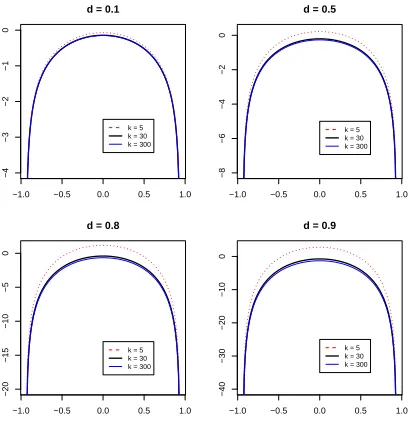
E log|Q| ≈ 1
1−dlog
−1.0 −0.5 0.0 0.5 1.0
−4
−3
−2
−1
0
a21
d = 0.1
k = 5 k = 30 k = 300
−1.0 −0.5 0.0 0.5 1.0
−8
−6
−4
−2
0
a21
d = 0.5
k = 5 k = 30 k = 300
−1.0 −0.5 0.0 0.5 1.0
−20
−15
−10
−5
0
d = 0.8
k = 5 k = 30 k = 300
−1.0 −0.5 0.0 0.5 1.0
−40
−30
−20
−10
0
d = 0.9
k = 5 k = 30 k = 300
Figure 1.1: E log|Qt+1|vs. a∗21
which is exactly (1.4). Figure 1.1 shows this relationship under different combinations ofdand
k. Here a∗11= 0.916 and a∗22= 0.953, which are taken from A&M’s result for Nikkei and Hang
Seng. Also notice that the positivity of A−1 implies that a∗21 ≤ a∗11a∗22. It is clear that a∗21
affects the expectation of the log-determinant of the covariance matrix via a nonlinear channel.
This implies that, when fitting the model, we should pay more attention to the explanation of the relationship between the return covariances/correlations and the intertemporal sensitivity
parameter. We will see this again later.
The conclusion above also applies to P&G’s WIC model. To see this, we can use a similar
argument. In the setting (1.1), for botht andν large enough, we have
Σ−∞1 ≡Σ−1 =A1/2Σ−dA1/2,
whereA1/2 is defined by Cholesky decomposition. A valid solution to this equation is
Σ=A− 1
(1−d),
1.2.2 Intertemporal Parameter and Correlations
Approximation (1.3) also implies how correlation structures are related to the intertemporal
sensitivity parameter. Here we illustrate the mechanism using the simplest 2×2 case. Again,
starting with A&M’s model, for a 2×2 matrix parameterA−1, by definition we can derive its
eigenvalues
λ1 =λ1(a∗21) = a
∗
11+a∗22
2 +
1 2
q
(a∗11−a∗22)2+ 4(a∗
22)2,
λ2 =λ2(a∗21) = a
∗
11+a∗22
2 −
1 2
q
(a∗11−a∗22)2+ 4(a∗
22)2,
and the eigenvectors
v1 =v1(a∗21) = (−a
∗
21, a
∗
11−λ1)T,
v2 =v2(a∗21) = (−a∗21, a∗11−λ2)T.
Hence, by spectral decomposition, we have the expression
A−1 1
1−d =
2
X
j=1
λ−j(1−d)vjvjT
= λ
−(1−d) 1
kv1k2
a∗212 a∗21(λ1−a∗11)
a∗21(λ1−a∗11) (λ1−a∗11)2
!
+λ
−(1−d) 2
kv2k2
a∗212 a∗21(λ2−a∗11)
a∗21(λ2−a∗11) (λ2−a∗11)2
!
.
Now, using approximation (1.3), we can write the correlationρ as a function of a∗21:
ρ≡ p [Q]2,1
[Q]1,1[Q]2,2
(a∗21)≈
L1(λ1−a∗11) +L2(λ2−a∗11)
(L1+L2)
L1(λ1−a∗11)2+L2(λ2−a∗11)2
, (1.6)
where [.]i,j is the (i, j)th entry of the matrix inside the bracket, and
L1 =L1(a∗21) =
λ−1(1−d)
kv1k2
(a∗21), L2 =L2(a∗21) =
λ−2(1−d)
kv2k2
(a∗21).
From (1.6), it is readily seen that a∗21 governs the correlation structure in a nonlinear way.
Approximation (1.6) is important and useful, as it directly connects the correlation and the
intertemporal sensitivity parameter for a bivariate model. To verify this, we conduct a simula-tion study. Still, borrowing the results from Table 7(a) of A&M, we set the true parameters
d= 0.8, k = 30, A−1 = 0.916 a
∗
21 a∗21 0.953
!
.
−1.0 −0.5 0.0 0.5 1.0
−1.0
−0.5
0.0
0.5
1.0
a21
*
ρ
● ● ● ● ●
● ●
● ●
● ●
● ● ● ●
ρ = 0.32, A&M's result.
Figure 1.2: Average correlation levels vs. a∗21
t= 1,2, ..., T = 500,using A&M’s WIC specification. Then, we obtain the correlation matrices
Pt by applying the standardization procedure given in A&M’s formula (4). Finally, for each
a∗21,we calculate the mean sample correlations
¯ ˆ
ρ= 1
T
T X
t=1
[Pt]2,1.
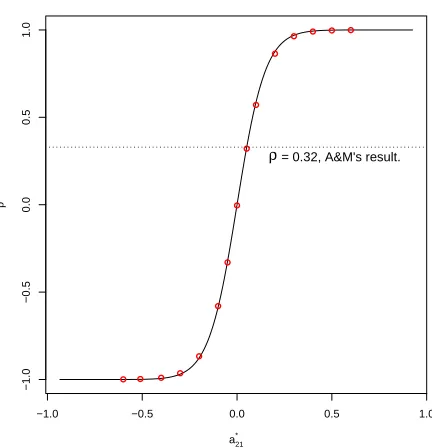
The relationship implied by (1.6) can therefore be verified by comparing the theoretical and the sample values. Figure 1.2 shows the simulation results. The red circles are the mean sample
correlations and the solid curve is the theoretical ρ given by (1.6). We can see that the red
circles are all located on the curve, which means that the relationship between the correlation and the intertemporal sensitivity parameter can be well explained by (1.6). From Figure 1.2 we
can also observe that, whena∗21 = 0.05,all the parameters are approximately the same as the
model estimates in Table 7(a) of A&M; in this case, the mean sample correlation is about 0.3, which coincides the average level of the correlation estimates given in Figure 3 of A&M. This
further verifies the plausibility of (1.6). Since all the above results can also be derived from
P&G’s setup in a parallel manner, equation (1.6) also applies to P&G’s WIC model.
One should also notice that, in the WIC model, due to the nonlinear relationship, a small
to be very careful in explaining the estimation results. For instance, in Figure 1.2, a∗21 = 0.05
implies a modest correlation (which equals to 0.3). Whena∗21 is changed from 0.05 to 0.1, this
increment looks small and we might think it makes no difference; however, in fact, it leads the
correlation to jump from 0.3 to 0.5, which can be regarded as a fairly strong correlation.
1.2.3 Model Parameters vs. Correlation
For the WIC models, the model form does not clearly reveal the relationship between the parameters and the correlations. To study the question, in this section we conduct a visual
analysis using A&M’s model with two-dimensional simulated data. For each parameter we set two very different values so that by contrast we can observe how the correlation behavior is
governed by the parameters. Specifically, the data generating process (DGP) are given by
h1,t+1= 0.98h1t+η1t,
h2,t+1= 0.95h2t+η2t,
η1t
η2t !
∼N
"
0
0
#
,
"
0.1662 0
0 0.2602
#!
, and vt= (v1t, v2t)0 ∼N(0,Pt),
where Pt, as defined previously, is the correlation matrix obtained by standardization of Qt.
For the correlation level, let A−12,1=a∗ and set the parameters of interest as
a∗H = 0.10, dH = 0.95, kH = 100;
a∗L= 0.02, dL= 0.05, kL= 5.
It is obvious that the difference in the settings ofdandkare large, whereas for a∗ it may seem
small. However, recall in last section we have shown that the mean level of the correlation
is highly nonlinear in the off-diagonal elements of A−1, and therefore the difference between
a∗ = 0.02 and a∗ = 0.10 shall be large enough to simulate very different correlation patterns.
As each parameter has two levels, we have 23 = 8 combinations in total. For one combination
we simulate a sample of sizeT = 500. Figure 1.3 shows the simulated data.
It is quite clear that the correlation patterns are so different under different settings. Let’s
begin with the role ofa∗, which is explored in detail in Section 1.2. We can find that, givendand
k held equal, a∗ determines the average level of the correlation. This is particularly apparent
in the bottom four graphs of Figure 1.3 where the correlations appear to be constant. When
a∗= 0.1, the mean correlation is approximately 0.1, whilea∗ = 0.02, the mean correlation level
goes down to as low as 0. This pattern is consistent with what we showed in last section. Next,
0 200 400 600 800 1000
0.0
0.4
0.8
a* = 0.1 , d = 0.95 , k = 100
0 200 400 600 800 1000
−0.5
0.0
0.5
1.0
a* = 0.1 , d = 0.95 , k = 5
0 200 400 600 800 1000
−0.3
0.0
0.2
0.4
a* = 0.1 , d = 0.05 , k = 100
0 200 400 600 800 1000
−1.0
0.0
1.0
a* = 0.1 , d = 0.05 , k = 5
0 200 400 600 800 1000
−0.5
0.0
0.5
a* = 0.02 , d = 0.95 , k = 100
0 200 400 600 800 1000
−1.0
0.0
1.0
a* = 0.02 , d = 0.95 , k = 5
0 200 400 600 800 1000
−0.3
0.0
0.2
a* = 0.02 , d = 0.05 , k = 100
0 200 400 600 800 1000
−1.0
0.0
1.0
a* = 0.02 , d = 0.05 , k = 5
Figure 1.3: Model parameters vs. Correlations in A&M’s WIC model.
correlations. Finally, we can obviously see that d controls the persistence of the correlations
across time, which has been well explained in P&G and A&M.
1.3
MCMC Estimation
This section focuses on the MCMC implementation issue in the WIC models. Some general problems are explored. The first is the efficiency, a major concern when applying MCMC
methodology. We show that, although looking complicated, the posterior densities of the per-sistence parameter and the df parameter are log-concave. Consequently, instead of using ARMS,
we can apply ARS to draw samples in each MCMC sweep. There are two advantages of using
to perform the Metropolis step, and secondly, we can construct squeezing functions, which
may save function evaluations in each rejection step. Compared to grid sampler, ARS is more efficient and accurate. In addition to the improvement in sampling procedures, we suggest
exploiting SMW formula in updating the covariance matrices; later we will see that the use
of ARS together with SMW formula can significantly improve MCMC efficiency. The other concern in the WIC model is the choice of priors for the df parameter, as the posterior density
is diffuse and accordingly, the estimation would be sensitive to the prior. Finally, P&G and
A&M use different parameterizations for the scale matrix in the Wishart distribution. It is then natural to ask if one formulation is superior than the other. These questions are also studied
in this section.
1.3.1 Likelihoods and Joint Posteriors
In P&G’s model with setting (1.1), the likelihood function is given by
L(A, d, ν|y)∝ T Y
t=1
Wp(Σ−t1|ν,St−1)Np(yt|Σt)
∝ T Y
t=1
|Σ−t1|1/2exp
−1 2y T tΣ −1
t yt
×|S −1
t−1|
ν
2|Σ−1
t | ν−p−1
2
2νp2 Γp(ν)
exp
−1
2tr S
−1
t−1Σ
−1
t
,
where y = {yt} and Γp(ν) =
Qp
i=1Γ [(ν−i+ 1)/2] with Γ(·) being the gamma function. On
the other hand, for A&M’s model where the independent SV equations are introduced, the estimation requires little more effort. A&M proposed a two-stage estimation procedure. In the
first stage, for the ith series, the errors t are obtained by the standardization t = V
−1/2
t yt,
and in the second stage, we then have the similar likelihood function forA,d, and k:
L(A, d, k|)∝ T Y
t=1
Wp(Q−t1|k,St−1)Np(t|Pt)
∝ T Y
t=1
|Pt−1|1/2exp
−1
2
T tPt−1t
×|S −1
t−1|
k
2|Q−1
t | k−p−1
2
2kp2 Γp(k)
exp
−1
2tr S
−1
t−1Q
−1
t
,
where = {t} and Γp(k) has the same definition as the above. Since the joint posterior is
−1.0 −0.5 0.0 0.5 1.0 −20000 −10000 d log poster ior
p = 2
−1.0 −0.5 0.0 0.5 1.0
−3.0
−2.0
−1.0
d
2nd Order Diff
erence
Maximum = −0.87
−1.0 −0.5 0.0 0.5 1.0
−60000
0
d
log poster
ior
p = 3
−1.0 −0.5 0.0 0.5 1.0
−150
−100
−50
0
d
2nd Order Diff
erence
Maximum = −0.5
−1.0 −0.5 0.0 0.5 1.0
−1e+05
0e+00
d
log poster
ior
p = 4
−1.0 −0.5 0.0 0.5 1.0
−400
−200
0
d
2nd Order Diff
erence
Maximum = −0.82
Figure 1.4: logp(d|·) and the second order difference.
1.3.2 Log-concavity of the Full Conditional of d
The conditional posteriorp(d|·) in P&G’s model is of exactly the same form as that in A&M’s.
Here we adopt A&M’s notation. Given a uniform (-1,1) prior, the posterior density has the form
p(d|·)∝exp
ζd−1
2tr
A−1C−1(d)
I(−1,1)(d),
where ζ = −(k/2)PT
t=1log
Q−t−11
and C−1(d) = k PT
t=1Q
d/2
t−1Q
−1
t Q d/2
t−1. Before proving
log-concavity, we would like to examine the behavior of logp(d|·). Figure 1.4 shows the log posterior
density function ofdand its second order difference as a discrete approximation for ∂d∂22logp(d|·).
The data are simulated from d= 0.8, k = 10, and several arbitrarily chosen A−1. It is very
clear that, for each p, logp(d|·) presents a concave shape and the second order difference is
negative throughout the support (-1,1). This simulation provides convincing visual evidence
for concavity of logp(d|·).
Now, note that, in the log posterior density, the first termζ =−k2PT
t=1log|Q
−1
of d. It vanishes after taking differentiation. The second order derivative is then given by
∂2
∂d2logp(d|·) =−
1 2
T X
t=1
trA−1(logQt−1)2Qd/t−21Q
−1
t Q d/2
t−1
+ 2A−1/2(logQt−1)Qd/t−21Q
−1
t Q d/2
t−1(logQt−1)A−1/2
+Qd/t−21Q−t1Qd/t−21(logQt−1)2A−1
.
(1.7)
Our task boils down to showing that (1.7) is non-positive. SinceA−1/2(logQt−1) is non-singular
andQd/t−21Qt−1Qd/t−21is symmetric and positive definite, the middle term of the summand in (1.7)
is positive definite and thus has a positive trace. Next we would like to explain why the first and the third terms of the summand have nonnegative traces. Since the third term is just the
transpose of the first one, we only need to show that the first matrix product is of nonnegative
trace.
Intuitively, we may want to show that it is positive or nonnegative definite; unfortunately,
this is a stronger result and could be very difficult to prove. A heuristic way is to apply the
expectation equation
EQd/t−21Qt−1Qd/t−21=A,
and by substitution we obtain
Rt≡tr
A−1(logQt−1)2Qd/t−21Q
−1
t Q d/2
t−1
≈trA−1(logQt−1)2A = tr
(logQt−1)2 >0,
(1.8)
since (logQt−1)2 is positive definite.
In addition to the expectation argument, we may verify the trace nonnegativity from an
eigen decomposition point of view. To see this, taking a simple 2×2 case as an example,
suppose that
A−1 = 1 c
c 1
!
; (1.9)
apparently, forc= 0, the matrixA−1 is an identity and thus both its two eigenvalues are equal
to 1. In this case,Rt is reduced to tr
(logQt−1)2Qd/t−21Q
−1
t Q d/2
t−1 ≥0 since the product of two
real-symmetric positive definite matrices has a nonnegative trace.
For another extreme case where c→ ±1, the matrixA−1 will be nearly singular; therefore,
the larger eigenvalue will dominate the other. Our argument is, by letting cchange from−1 to
1, we are in fact going over all possibilities of A−1 from one extreme, the identity matrix, to
another, which is a nearly singular matrix. Consequently, if under all these situations Rt ≥0,
thus (1.7) is positive.
With simulation, Figure 1.5 presents graphic explanations of the expectation argument
stated in (1.8) and the eigen decomposition argument. The sample size is T = 1000, and the
parameters d= 0.8, k= 10; the matrixA−1 is set according to the form given by (1.9).
Top-left, top-right, and bottom-left are the time-series plots for the element c=−0.99, 0, and 0.99,
respectively, where the grey line is the plot ofRt= tr
A−1(logQt−1)2Qd/t−21Q
−1
t Q d/2
t−1 and the
black line is tr(logQt−1)2 . It is readily seen that the two traces are actually positive for allt,
and the mean levels ofRtand of tr
(logQt−1)2 are indeed about the same, althoughRtis more
volatile. As c marches away from zero, i.e. A−1 gets nearly singular,Rt and tr
(logQt−1)2
become more positive. On the other hand, when c = 0, which means A−1 is an identity, the
two traces are both small positive numbers. In any case, it is evident that mean Rt ≈ mean
tr
(logQt−1)2 ≥0. This verifies the plausibility of using (1.8) to hypothesize trace positivity.
Bottom-right is the plot of meanRtover allc∈(−0.99,0.99). The curve is above 0 for every
c, which is a strong evidence of nonnegativity ofRt. Also, the smile shape reflects the fact that
we just mentioned: as A−1 becomes nearly singular, the trace Rt will be more positive, and
vice versa. The reason whyRtis guaranteed to be nonnegative is complicated and unclear, and
this is why it is demonstrated numerically. One may argue that, it is possible that Rt <0 for
some time pointst, but we have to point out that, we never see this happen empirically. Even
if someRt<0, though never happened to us, it will not change positivity of the summand in
(1.7) since the trace sums upRtover allt. The majority ofRt>0 will offset those negativeRt,
if any. Moreover, remember that in (1.7), the second term of the summand is strictly positive,
0 200 400 600 800
0
500
1000
1500
Time c = −0.99
0 200 400 600 800
0
5
10
20
30
Time c = 0
0 200 400 600 800
0
500
1000
Time c = 0.99
●
●
● ● ● ●● ●●●
●●●●●●●●●●●●●●●●●●●●●●●●●●●●●●●●●●●●●●●●●●●●●●●●●●●●●●●●●●●●●●●●●●●●●●●●●●●●●●●●●●●●●●●●●●●●●●●●●●●●●●●●●●●●●●●●●●●●●●●●●●●●●●●●●●●●●●●●●●●●●●●●●●●●●●●●●●●●●●●●●●●●●●●●●●●●●●●●●●●●●● ●●● ● ● ● ●
−1.0 −0.5 0.0 0.5 1.0
0
100
300
500
c
Mean T
race
c∈∈(−0.99, 0.99)
Figure 1.5: trA−1(logQt−1)2Qd/t−21Q
−1
t Q d/2
t−1 and tr
(logQt−1)2 forp= 2.
1.3.3 Log-concavity of the Full Conditional of k
The full conditionals ofkin P&G and in A&M merely differ in the prior part. We can observe
that the prior used in A&M is a special case of that in P&G with the location parameter α
chosen to be 1. In practice, we shall choose α ≥ 1 so that the mass of the density will not
gather up close to zero. To give a unified discussion, we start with the gamma prior having the form:
π(k) = exp(α−1) logk−βk , α≥1, k > p.
the posterior density ofk is then
p(k|·)∝exp
(α−1) logk−βk+T kp
2 log(k/2)−
T k
2 log|A| −T
p X
j=1
log Γ
k+ 1−j
2 ×exp k 2 T X t=1
logQ
d/2
t−1Q
−1
t Q d/2
t−1
−
1
2tr
A−1C−1(k)
.
where C−1(k) = kPT
t=1Q
d/2
t−1Q
−1
t Q d/2
t−1 is the same as C−1 defined previously. In deriving
log-concavity of the full conditional of k, the main difficulty lies in the gamma function. For
the gamma component, letzj ≡ k+12−j, we have
d2
dk2 log Γ(zj) =
1
4ψ1(zj),
where ψ1(zj) is the trigamma function. Using the fact that the trigamma function is strictly
decreasing in its argument and k2 ≥zj,forj= 1, ..., p, we obtain
ψ1
k
2
≤ψ1(zj).
Therefore, the second order derivative of the log conditional posterior is
d2
dk2logp(k|·) =
1 4T p2 k− p X j=1
ψ1(zj)−
α−1
k2
≤ 1
4T p
2
k−ψ1
k
2
− α−1
pk2
.
To complete the proof, we need to show that 2/k−ψ1(k/2)≤0. Takingx=k/2>0,and
applying the inequality (Choi and Wette, 1969)[6]
1
x < ψ1(x),
the result immediately follows. Figure 1.6 is the plot of logp(k|·), which is generated from
simulated data with the mode equal to 30. Figure 1.7 shows the second order derivatives of
0 20 40 60 80 100
−1000
−500
0
k
log poster
ior
Figure 1.6: The plot of logp(k|·).
0 20 40 60 80 100
−257.7
−257.5
−257.3
p = 2
k
0 20 40 60 80 100
−235.6
−235.4
−235.2
p = 3
k
0 20 40 60 80 100
−219.6
−219.4
−219.2
p = 4
k
0 20 40 60 80 100
−207.1
−206.9
−206.7
p = 5
k
1.3.4 Use of Sherman-Morrison-Woodbury Formula
In the estimation for the WIC model, we need to update the covariance matrices in each
iteration. The conditional posterior of the inverted covariance matrix is proportional to a
Wishart distribution with the scale matrix
˜
St−1 = St−−11+xtx0t −1
, t= 1, ..., T,
wherextis the mean-corrected return vector in P&G’s model, while in A&M’s model, it denotes
the series filtered by the univariate stochastic volatility equations.
If we apply SMW formula, the scale matrixS˜t−1 is calculated by
St−−11+xtx0t −1
=St−1−
St−1xtx0tSt−1
1 +x0tSt−1xt
.
Since in each sweep,St−1is known from previous iteration, we can obtainS˜t−1by rank-1 update
rather than by matrix inversion from scratch. Obviously, this is computationally cheaper and hence should be incorporated into the MCMC algorithm.
1.3.5 Hyperparameter Assessment for the Degrees of Freedom
Choosing priors for df is important in the WIC model. We find that, from empirical experience,
the conditional posterior density of df is generally diffuse. We have seen the log posterior of k
in Figure 1.6. It is not hard to see that the density is quite diffuse. Therefore, the inference
is easily affected by the priors. P&G suggest a gamma prior, while A&M adopt the
exponen-tial distribution. However, both P&G and A&M do not mention how to choose reasonable hyperparameters, which is, as a matter of fact, really essential in the model estimation.
As discussed in Section 1.3.3, for the gamma prior used in P&G, we should chooseα≥1 for
practical purposes. The problem is then simplified to the shape. Since the inference is sensitive to the prior distribution, we may want to choose a vague prior to avoid the dominance from
subjective information. This means that we should set hyperparameters regarding the shapes
which can give reasonably flat priors. Our experience suggests that, for β in P&G and λ0 in
A&M, 0.1 to 0.5 would be a reasonable range for these hyperparameters.
1.3.6 The Scale Matrix of the Wishart Distribution
A&M point out that we can possibly use the parameterization
St=
1
k(A
1/2)(Q−1
t−1)
Table 1.1: Mean absolute error of correlation estimates using different specifications.
DGP
Spec. A&M P&G
A&M 0.1680 0.1727
P&G 0.2027 0.1976
Table 1.2: Mean absolute error of VaR using different specifications.
DGP
Spec. A&M P&G
A&M 0.2204 0.2217
P&G 0.2156 0.2182
where A1/2 is defined by Cholesky decomposition. Actually, this is the specification adopted
in P&G’s model. Some questions arise here: what if the “true” DGP is from one specification
but we use the other to fit the data? Does one specification outperform the other under all circumstances? These questions are the main interests in this section.
We compare the two specifications (1.2) and (1.8) using the setting below
h1,t+1= 0.98h1t+η1t, ση1 = 0.166,
h2,t+1= 0.95h2t+η2t, ση2 = 0.260,
A−1 = 1.0 0.1
0.1 1.0
!
, d= 0.8, k = 30.
Two datasets, each with 1000 observations, are generated using (1.2), A&M’s specification,
and (1.8), P&G’s, respectively. Following A&M, the comparison is effected according to two
performance measures based on mean absolute errors (MAE), namely MAEρ and MAEVaR,
which are also defined in A&M Section 3.4. Table 1.1 shows MAEρ results. We can see
that the model with A&M specification has smaller MAE no matter what the true DGP is.
However, as shown in Table 1.2, when MAEVaR is used as the criterion, the model with P&G
specification performs better for both true DGPs. Moreover, we can observe that the mean
1.4
Empirical Study
This section presents a real data application as an illustration of our findings. The dataset,
obtained from Yahoo Finance, contains four series of stock market index returns, namely Dow Jones Industrial Average (DJIA), Hang Seng Index (Hang Seng, HSI), Korea Composite Stock
Price Index (KOSPI), and Taiwan Weighted Stock Index (TAI). The sample period for all series
is 2 July 1997 to 9 November 2009, giving a total T = 452 observations. Following A&M, the
return series are defined as 100×(logPit−logPi,t−1), where Pit is the closing price on week
t for stock market i. The data are fitted with A&M’s model and the study is conducted as
follows.
1.4.1 Improving MCMC Efficiency
The primary interest of this empirical study lies in whether ARS together with SMW formula
can improve MCMC efficiency. First, we estimate the model using ARS plus SMW formula. We denote this by “ARS + SMW.” Then, on the other hand, the model is estimated using
ARMS and usual matrix inversion. This combination is denoted by “ARMS + No SMW. By
comparing these two schemes, we know how much time is saved. For each combination, we run the estimation procedures two times and then take the average time consumed. The OX[8]
programs are run with OX Console version 5.10 on Windows Vista platform, on a machine
equipped with an Intel Core2 Duo 8400 3.0 GHz central processing unit (CPU) and 8 gigabytes random access memory.
Table 1.3 shows the average time used in each combination. We see that, time used in
ARMS + No SMW is more than that in ARS + SMW by 380.12 seconds, which equals to a 12% difference. Evidently this is a considerable improvement. Moreover, as one can expect,
using SMW formula will be more advantageous as the dimension of data increases since the
complexity of usual matrix inversion is growing faster than O(p2).
Next, we examine the MCMC estimates from the combinations ARS+SMW and ARMS
+ No SMW. Notice that here we do not show the fitting results of the univariate stochastic
volatility models since they are not of the main interest. The number of iterations isN =M+L.
The first M draws are discarded and the remaining L are kept for inference. We output the
posterior means, the numerical standard errors (NSE) of the posterior means, the 95% intervals, the relative numerical efficiency (RNE), and the p-values of the convergence diagnostic (CD)
statistics introduced by Geweke (1992)[10]. The NSEs and RNEs are calculated by the function
“numEff” of the R package “bayesm” developed by Rossi, Allenby, and McCulloch (2005)[35],
which use a Bartlett window with a bandwidth of 0.1·L. The 95% intervals are obtained by
the (2.5th, 97.5th) percentiles of the L draws. To be consistent with the NSEs and RNEs,
the analysis, we use N=20,000 andM=10,000, producing a final sample of size L=10,000. As
mentioned in Section 1.3.3, since the posterior of the df parameter is diffuse, we choose the
hyperparameter λ0 = 0.2. The MCMC estimation results are shown in Table 1.4 and Table
1.5, respectively. First note that the estimated d is about 0.4 with significance, implying a
time-varying correlation structure. We can see that the estimation results are quite similar,
with some minor differences inA. In summary, for the two schemes generate similar estimates,
we would prefer ARS+SMW since it is more efficient.
Table 1.3: Comparison results of ARS+SMW v.s. ARMS+No SMW.
Combination Time Elapsed (Sec.)
ARS+SMW 3248.64
Table 1.4: Output of ARS + SMW .
Parameter MEAN NSE 95% Interval RNE CD
a11 1.470 0.11433 (0.796, 2.232) 858.259 0.088
a12 -0.313 0.01210 (-0.452, -0.220) 441.382 0.110
a13 -0.155 0.01019 (-0.283, -0.072) 361.562 0.254
a14 -0.050 0.00379 (-0.137, 0.020) 95.852 0.598
a22 1.108 0.03025 (0.896, 1.308) 674.911 0.052
a23 -0.250 0.01134 (-0.372, -0.155) 409.336 0.124
a24 -0.236 0.00684 (-0.319, -0.160) 273.265 0.154
a33 1.224 0.08610 (0.626, 1.739) 848.412 0.054
a34 -0.269 0.00945 (-0.389, -0.184) 350.349 0.132
a44 1.073 0.03162 (0.859, 1.408) 575.371 0.146
d 0.445 0.01626 (0.308, 0.582) 509.448 0.168
k 11.646 0.30471 (9.548, 14.577) 490.044 0.134
Table 1.5: Output of ARMS + No SMW.
Parameter MEAN NSE 95% Interval RNE CD
a11 0.792 0.03435 (0.569, 1.079) 636.497 0.060
a12 -0.288 0.01762 (-0.433, -0.165) 542.064 0.256
a13 -0.129 0.00425 (-0.196, -0.079) 191.593 0.372
a14 -0.056 0.00365 (-0.114, -0.006) 179.123 0.300
a22 1.683 0.06430 (1.312, 2.206) 647.406 0.058
a23 -0.271 0.01778 (-0.438, -0.139) 512.682 0.208
a24 -0.242 0.01241 (-0.387, -0.135) 378.197 0.148
a33 0.989 0.03705 (0.800, 1.437) 580.692 0.094
a34 -0.233 0.00993 (-0.357, -0.158) 402.822 0.124
a44 0.861 0.03718 (0.597, 1.125) 629.172 0.098
d 0.407 0.02789 (0.207, 0.621) 630.867 0.068
1.4.2 Marginal v.s. Joint Behaviors
In this section, we examine the marginal bivariate model estimations. Table 1.6 gives the
Pearson correlations of the four stock market return series. We can observe that, among the
selected Asian markets, HSI has the highest correlation with DJIA. Hence, the DJIA-HSI pair can be used as the representative for studying American-Asian stock markets. Also, in the
Asian markets, the HSI-KOSPI pair has highest correlation and hence we use it to study Asian
markets. The bivariate models for the two pairs are estimated using MCMC method with
N = 20000 iterations. The first 8000 draws are discarded and the next 12000 are recorded.
The estimates for the two models are given in Table 1.7 and Table 1.8. First of all, notice
that, since in the bivariate case we can study the relationship between A−1 and the mean
sample correlations, we output the estimates fora∗ij = [A−1]ij instead of the estimates for aij.
From Table 1.7 and 1.8, we find it interesting that, for the DJIA-HSI model, the persistence parameter is approximately 0 (the 95% interval widely covers 0), which indicates a constant
correlation by the WIC model implication. This result is different from those shown in Table
1.4 and 1.5, where a dynamic correlation structure is revealed. Moreover, the estimate for the
df parameter k also varies quite a bit in different cases. For the DJIA-HSI bivariate model, k
is merely 8, while for the HSI-KOSPI pair, k has been doubled to 16. More interestingly, the
estimate for k from the full model is in between the two bivariate models. This phenomenon
is different from the discovery in A&M, in which the estimate ofk is larger for the full model
than for all marginal bivariate models. Our explanation is that, the full model is a joint of the
marginal models; consequently, what it presents is the compromise among all different bivariate relationships.
We are also interested in the relationship between the average sample correlations and the
intertemporal sensitivity parameter matrixA−1. These relationships are shown in Figure 1.8.
In the left-hand side plots, the black curves are the function values ofρ(a∗12) given by (1.5) and
the red circles are the “predicted” correlations given the estimates of a∗12. On the right hand
side are the mean sample correlations. We can see that, for the DJIA-HSI bivariate model,
the black curve is a little bit convex, as dis slightly negative (however, we have to emphasize
that it is not statistically different from 0). It is then obviously seen that, because of the zero
persistence, the correlations are shown to be constant. The red circle is exactly located on the black curve, which means that the behavior of the correlations is well captured by equation
(1.5). More importantly, we find that, for the estimate ofa∗12= 1.13, the “predicted” correlation
ρ(a∗12) is about 0.55, which approximately equals to the mean level of the sample correlations
between DJIA and HSI.
On the other hand, for the HSI-KOSPI model, the black curve is slightly concave since
0.0 0.5 1.0 1.5
0.0
0.2
0.4
0.6
0.8
1.0
a21*
ρρ
((
a21
*))
DJIA − HSI pair
●
Time
0 100 200 300 400
0.0
0.2
0.4
0.6
0.8
Dow Jones v.s. Hang Seng
0.0 0.2 0.4 0.6 0.8
0.0
0.2
0.4
0.6
0.8
1.0
a21*
ρρ
((
a21
*))
HSI − KOSPI pair
●
Time
0 100 200 300 400
0.0
0.2
0.4
0.6
0.8
Hang Seng v.s. KOSPI
Figure 1.8: Dow Jones v.s. Hang Seng and Hang Seng v.s. KOSPI
aggregate, the correlations present a constant pattern, but with a careful examination, it is not
hard to find that, actually, the correlations mildly change over time. Like the DJIA-HSI case,
the red circle is perfectly located on the black curve; this again supports the plausibility of
equation (1.5). Likewise, we can observe that, for the estimate of a∗12 = 0.51, the “predicted”
correlation ρ(a∗12) is 0.6, which is about the average level of the sample correlations between
HSI and KOSPI.
The results from the DJIA-HSI and the HSI-KOSPI bivariate models provide empirical
evidence supporting the plausibility of equation (1.5). This also suggests the importance and
practical usefulness of (1.5). We can use this relationship between the correlations and A−1
implied in the marginal bivariate models as a diagnostic check for model adequacy. Specifically,
if the model is fitted correctly, then the values ofρ(a∗12) obtained from the estimateda∗12 should
Table 1.6: Pearson correlations of the four return series.
DJIA HSI KOSPI TAI
DJIA 1.000
HSI 0.553 1.000
KOSPI 0.420 0.566 1.000
TAI 0.370 0.531 0.486 1.000
Table 1.7: DJIA-HSI bivariate model estimates.
Parameter MEAN NSE 95% Interval RNE CD
a∗11 1.491 0.205 (0.654, 3.633) 769.739 0.134
a∗12 1.130 0.094 (0.500, 2.219) 553.129 0.232
a∗22 2.178 0.209 (0.863, 4.652) 701.532 0.082
d -0.194 0.076 (-0.592, 0.353) 862.296 0.129
k 16.231 1.513 (6.282, 34.595) 427.914 0.294
Table 1.8: HSI-KOSPI bivariate model estimates.
Parameter MEAN NSE 95% Interval RNE CD
a∗11 0.636 0.021 (0.448, 0.878) 408.424 0.434
a∗12 0.505 0.040 (0.233, 0.967) 516.407 0.260
a∗22 1.476 0.153 (0.729, 3.220) 631.708 0.102
d 0.138 0.050 (-0.294, 0.566) 548.086 0.134
1.5
Conclusion
In this paper we give a general discussion of the WIC model proposed by P&G and A&M.
We first derive the relationships between the intertemporal sensitivity parameter A−1 and
the covariance/correlation structures in the bivariate cases. This reveals the fact that the
off-diagonal entries ofA−1affect the covariances/correlations through a nonlinear channel. We then
show log-concavity of the univariate posterior densities of the persistence parameter and the df parameter. With log-concavity being assured, we can use ARS as a more efficient sampling
scheme for the MCMC inference. Moreover, we suggest adopting SMW formula in the update of
correlation matrices. This also helps improving MCMC efficiency. Also, we suggest reasonable
values for the hyperparameters α and β for the prior distributions of the df parameter. The
final topic is about the parameterizations used by P&G and A&M. Our simulation study shows that it does not matter which parameterization to use. Both are equally reasonable.
We give an empirical data analysis as a demonstration of our findings. In this study we show
that ARS together with SMW can considerably improve sampling efficiency and hence should be used in the estimation of the WIC model. Marginal bivariate models are also discussed. The
results show that the joint behavior of the series in the full model may be different from the
Chapter 2
On Random Wishart Matrices
2.1
Introduction
Asset correlations are well known to be unstable over time. Therefore, in financial modelling, capturing the dynamic covariance and correlation structure has become a central issue. In the
literature of Multivariate Stochastic Volatility (MSV), several recently proposed models suggest
using Wishart processes to characterize the evolution of covariance matrices. For example, Philipov and Glickman (2006)[32] and Asai and McAleer (2009; henceforth A&M)[3] adopt an
inverse Wishart specification for the covariance matrices, so that statistical inference and model
estimation can be effected through Bayesian Markov chain Monte Carlo (MCMC) methods. Following A&M, this class of models is termed the “Wishart Inverse Covariance” (WIC), and
the Wishart distribution is denotedWp(k,S), wherekis the degrees of freedom (df) parameter,
S is the scale matrix, andp is the dimension ofS.
Since the WIC model for time series data is built upon latent variables and its estimation
relies on MCMC approaches, the computation is expensive. To deal with this type of model, OX[8] would be an ideal choice, as it is fast and it has extensive and well developed packages for
Bayesian inference. A problem arises here: in A&M’s model settings, k is not restricted to be
integer-valued; it could be fractional (non-integer). However, the generation of random Wishart
matrices with a fractionalkis not available in OX. The existing OX function “ranwishart” will
simply take the floor value of any fractional kas the input argument and thus the matrix that
has been sampled is in fact from a Wishart distribution with a integer-valued k, which is not
correct. In such cases, our simulation studies in this chapter show that the estimation will be
seriously misled. To fix the problem in OX, we develop the Wishart package, “WishPack”, in
which fractional df are considered.
One thing to emphasize here is that, by the fact known as Gyndikin’s theorem (see, e.g.,
and non-integer; nevertheless, most existing statistical software packages set the restriction that
k≥p, which is not appropriate and does not cover all possibilities. There is one more drawback
implied in this restriction. Whenkis integer-valued and 0< k < p, the Wishart matrix is known
to be almost surely singular (Uhlig, 1997)[40] and is still well defined. The singular Wishart
matrix can be generated via fairly simple procedures and has shown to be useful in practical
problems, e.g. Konno (2009)[23]. However, with the restriction k ≥ p, generating singular
Wishart matrices becomes impracticable. In summary, according to Gyndikin’s theorem, it is
valid to generate random Wishart matrices with anykbelonging to the Gyndikin set{1,2, ..., p−
1} ∪(p−1,∞), but unfortunately, existent statistical packages such as Matlab “MCMC”[38],
OX, R “MCMCpack”[29], SAS[36], etc., do not treat the generation of random Wishart matrices
in this manner and are therefore incomplete. To correct these mistakes, Wishpack is developed based on Gyndikin’s theorem. This feature has not yet been seen in other statistical packages.
In the recent past, there has been a number of studies of singular Wishart distributions.
The probability density function with respect to Lebesgue measure on an appropriate space is explicitly given by Srivastava (2003)[39]. Practical uses of singular Wishart distributions are
discussed in Uhlig (1997)[40] and Kubokawa and Srivastava (2008)[24], among others. In
re-sponse to those needs, Wishpack also takes into account the singular Wishart densities. Finally, as a parallel product, Wishpack also provides an inverse Wishart generator with fractional df,
and the density function of the inverse Wishart distribution.
The rest of the chapter is organized as follows. In Section 2.2 we motivate the generation
of Wishart matrices with fractional df. The generation of the singular Wishart matrix is also
discussed. Section 2.3 illustrates the algorithm for generating Wishart random matrices with
fractional df by applying Bartlett’s decomposition. A short discussion of another popular
variant, namely the Odell-Feiveson’s (1966)[30] algorithm, is given as well. Some concluding
remarks are summarized in Section 2.4.
2.2
Motivation
Gyndikin’s Theorem (the real matrix case):
Following Graczyk et al. (2003)[16], letV be a positive definite matrix of sizep×pand Θbe
an appropriate symmetricp×pmatrix. Suppose we have i.i.d. random vectorsXi ∼Np(0,V),
then the scatter matrixW = 12Pk
i=1XiXiT has the Laplace transform
Ehetr(ΘW)i= [det(Ip−VΘ)]−k.
The set of values ofksuch that [det(Ip−VΘ)]−kis the Laplace transform of a positive measure
Thus, one can generate random Wishart matrices with any dfk belonging to the Gyndikin set. However, unfortunately, almost all existent statistical packages do not generate random
Wishart matrices according to this theorem and hence do not consider all possible situations.
In this section we will examine these problems.
2.2.1 Problems in Existing Statistical Packages
According to Gyndikin’s theorem, any real number k∈(p−1,∞) can be valid df for a p× p
Wishart matrix; nonetheless, as mentioned in the introduction given in Section 2.1, the
gener-ation of random Wishart matrices with fractionalkis not available in OX. The problem of this
insufficiency is addressed here by a simulation exercise.
Let Wp(·,·) be the Wishart distribution. A&M set the following Wishart process:
Q−t1|k,St−1∼Wp(k,St−1), whereSt−1=
1
kQ
−d/2
t−1 AQ
−d/2
t−1 ,
whereQtis a positive definite matrix, by standardizing which we obtain the correlation matrix
of interest, andkandSt−1are the df and the time-varying scale matrix of the Wishart
distribu-tion, respectively. The matrixAis the intertemporal sensitivity parameter which is symmetric
and positive definite, anddis the persistence parameter, which accounts for the memory of the
matrix process{Qt}. The matrix Q−t−d/12 is defined by the spectral decomposition.
In the MCMC estimation procedure, the full conditionals ofQ−t1 andAare proportional to
the Wishart densities with fractional df ˆkand ˆγ, respectively. To demonstrate why “fractional”
does matter, we begin with the simulation example 3.3 in A&M, in which the sample size
T = 500 and the true parameters are
A= 1 0.3
0.3 1
!−1
= 1.10 −0.33
−0.33 1.10
!
, d= 0.8, k= 10.
Let df denote the set{k,ˆ ˆγ}. Table 2.1 shows the results of the MCMC estimation when df is
taken to be integer-valued and to be fractional, respectively. The 95% intervals are obtained
using the (2.5th, 97.5th) percentiles. Note that for the integer df case, the OX “ranwishart”
function is used, while for the fractional df, we apply WishPack. The MCMC simulation is
conducted with only 1000 iterations since a systematic collapse will occur very soon in the
integer df case. The first 400 draws are discarded and the remaining 600 are kept. Here we
have to emphasize that the purpose of this simulation study is to illustrate the problem, not to
totally misleading for the integer-valueddf. As a result, a systematic failure will happen in this
case due to the repeated incorrect updates. On the other hand, if a fractional df is adopted,
then the MCMC estimation procedure will provide a fairly good result.
Table 2.1: MCMC results using the integer and the fractional df parameters, respectively.
Integer df Fractionaldf
Parameters Mean 95% Interval Mean 95% Interval
a11 0.100 (0.072, 0.148) 1.010 (0.940, 1.092)
a12 -0.027 (-0.053, -0.014) -0.374 (-0.581, -0.255)
a22 0.103 (0.069, 0.155) 1.161 (1.090, 1.239)
d 0.797 (0.728, 0.858) 0.763 (0.638, 0.831)
k 4.955 (4.179, 5.842) 7.574 (5.667, 9.533)
Figure 2.1 shows the trace plots of the entire chains of k and |A|under different types of
df. Here| · | denotes the determinant operator. It is readily seen that, in the integer df case,
|A|goes down to nearly zero within the first 300 iterations and never moves back. This finally
leads us to a systematic error. On the contrary, for the fractionaldf, after the burn-in period,k
and |A|both stay stable around their true levels. This simple simulation clearly demonstrates
the need for the Wishart generator with fractional df in real applications.
From a theoretical point of view, it is of interest to know, how far a Wishart distribution
with integer df is away from the one with fractional df. To measure the difference between the
two distributions, here we calculate the Hellinger distance, as it can be normalized to a 0-1 scale.
The distance can also be viewed as a measure of the effect of misspecifying the df. LetF1andF2
be the Wishart distribution functions with integer and with fractional df, respectively. Also, let
the corresponding probability densities be f1(U) =Wp(U|k, S) and f2(U) =Wp(U|k+α, S),
withα∈[−0.5,0.5].The Hellinger distance can be calculated by
H(F1, F2) =
"
1 2
Z s
dF1 dλk
− s
dF2 dλk
2
dλk #
1 2
=
"
1 2
Z p
f1(u)−pf2(u)
2
du
#12
= (1−ρ)12,
(2.1)