EFFECT OF WORK PROGRAMME IN EXTENSION OF TIME ENTITLEMENT
NOR JALILAH BT IDRIS
A project report submitted in partial fulfillment of the requirement for the award of the degree of
Master of Science in Construction Contract Management
Faculty of Built Environment Universiti Teknologi Malaysia
v
ABSTRACT
The aim of this research is to know how a construction work programme can be a tool in reducing disputes which relate to extension of time (eot). Extension of time entitlement is only granted to the successful claimant (contractor) who had fulfill certain conditions in the application and one of the condition is the claimant had successfully proved that the delay happened was not by his fault, it is either caused by employer or was one of the neutral events.
Therefore it is important for the contractor to have sufficient records and documents about a project’s progress so that he is able to prove the caused of the delay occurred. Unfortunately, most of the contractors failed to do so because they are more focus to the work on site rather than doing the management and documentation work.
It is believed then that by having a proper method of work progamme and updated progress of work can be so helpful in resolving the dispute, even the preparation of it are not required in any of local standard form of contract.
This research are based on literature information about work programme and it will supported by referring to court case where had considered work programme as an important document in judgment. Even there are no specifications of method in preparing a work programme but there are some important elements in the work programme which may contribute to its purpose.
vi
ABSTRAK
Penyelidikan ini adalah bertujuan untuk mengkaji sejauh mana penggunaan perancangan kerja dapat membantu di dalam usaha mengurangkan kesulitan yang timbul daripada tuntutan lanjutan masa. Lanjutan masa hanya dianugerahkan kepada kontraktor yang berjaya membuat tuntutan dengan memenuhi beberapa kriteria, dan kriteria utama ialah membuktikan penyebab bagi kegagalan menyiapkan kerja yang memerlukan lanjutan masa adalah atas kesalahan pemilik ataupun persekitaran semulajadi, bukan atas kesalahan kontraktor.
Oleh yang demikian, kontraktor yang memohon lanjutan masa ini akan berusaha membuktikan bahawa punca kelewatan adalah bukan dari kesalahannya dan dengan ini masalah sering timbul dimana tiada dokumen, rekod atau bukti yang kukuh mengenai pihak yang sepatutnya bertanggungjawab ke atas sesuatu kelewatan aktiviti yang memberi kesan kepada tempoh penyiapan sesuatu projek. Walaubagaimanapun dipercayai bahawa perkara ini dapat diselesaikan dengan mengaplikasikan penggunaan perancangan kerja, meskipun perlaksanaan penggunaannya tidak terkandung di dalam kontrak.
vii
TABLE OF CONTENTS
CHAPTER TITLE PAGE
1 INTRODUCTION 1
1.0 Introduction 1
1.1 Problem Statement 3
1.2 Objectives 4
1.3 Importance of the research 5
1.4 Scope 5
1.5 Methodology 6
2 EXTENSION OF TIME 7
2.0 Introduction 7
2.1 Extension of time provision 8
2.2 Delay 11
2.2.1 Delay caused by employer 14
2.2.2 Delay caused by neutral event 15 2.2.3 Delay caused by contractor 15 2.3 Basis events to establish eot entitlement 19 2.3.1 Time provision in contract 20
2.3.2 Due Diligence 28
2.3.3 Notice of delay 34
viii
CHAPTER TITLE PAGE
3 CONSTRUCTION WORK PROGRAMME 39
3.0 Construction Planning 39
3.1 Definition of work programme 41
3.1.1 Who does project scheduling 42
3.1.2 How is scheduling done? 42
3.2 Purposed of Construction Work Programme 43 3.3 Type of Construction Work Programme 48
3.3.1 Gantt Chart 48
3.3.1.1 Gantt Chart Enhancements 49 3.3.1.2 Gantt Chart Role in Project Planning 50
3.3.2 PERT Chart 50
3.3.2.1 The Network Diagram 51
3.3.2.2 Steps in the PERT Planning Process 52
3.3.2.3 Benefits of PERT 55
3.3.2.4 Limitations 56
3.3.3 Critical Path Method 57
3.3.3.1 Steps in CPM Project Planning 58
3.3.3.2 CPM Limitations 60
ix
CHAPTER TITLE PAGE
4 WORK PROGRAMME AS A BASIS TO
ESTABLISH EOT ENTITLEMENT 67
4.0 Introduction 67
4.1 Work Programme in Standard form of Contract 68
4.1.1 PAM 1998 68
4.1.2 CIDB 2000 69
4.2 How work programme can contribute in eot entitlement 69
4.2.1 Logical Analysis 70
4.2.2 Critical Path Analysis 74
4.2.3 Causal Link 77
4.2.4 Regularly and Diligently 78
4.3 Weakness of Work Programme 79
4.3.1 Variety of methods 80
4.3.2 Contents of work programme 80 4.3.3 Presentation of work programme 81
5 CONCLUSION AND RECOMMENDATION 83
5.1 Introduction 83
5.2 Contribution in dispute resolution 84 5.3 Advantages and Disadvantages of Work Programme 85
5.4 Recommendation 86
5.5 Limitation 87
x
LIST OF TABLE
TABLE NO TITLE PAGE
1 Summary of EOT descriptions 10
2 Contribution of delay 13
xi
LIST OF FIGURE
FIGURE NO TITLE PAGE
1 Research methodology flow 6
2 Alternative emphases in construction planning 41
3 Gantt chart format 48
4 Original bar chart showing technological logic 62
5 Project with variation to building 1 63
6 Project with variation to building 2 63
7 Project with concurrent variation to the two buildings 64 8 Project with variation to building 1 only 65 9 Project evaluate by the addition method 66
xii
LIST OF CASES
PAGE
Amalgamated Building Contractors Ltd v Waltham Holy Cross
UDC [1952] 2 All ER 452 23
Balfour Beatty Construction Limited v The Mayor and Burgess of
the London Borough of Lambeth(2002) 72,77
Barque Quilpue v Brown [1904] 2 QB 264. 24
Bremer Handelsgesellschaft mbh v Vanden Avenne-Izegem
(1978) 2 LLR 109 34
City Inn v Shepherd Construction Ltd [2003] ScotCS 146 36
Codelfa Construction Party Ltd v. State Rail Authority of New
South Wales (1982), 16
Engineering Construction Pte Ltd v Attorney General & Anar
[1997] 3 SLR 989 32
Gaymark Investments v Walter Construction (1999) Northern
Territory Supreme Court 143 35
GLC v Cleveland Bridge (1984) 34 BlR 50. 29
Henry Boot Construction (UK) Ltd v. Malmaison Hotel (Manchester)
xiii
PAGE
Hiap Tian Soon Construction Pte Ltd and Another v Hola Development
Pte Ltd and Another [2003] 1 SLR 667 32
Inserco Ltd v Honeywell Control Systems (1996) 27
John Barker Construction Ltd. v. London Portman Hotel Ltd (1996) 70
Jurong Engineering Ltd v Paccan Building Technology Pte Ltd
[1999] 3 SLR 667 32
Leighton Contractors (Asia) v Stelux Holdings Ltd (2004) 77
London Borough of Merton v Leach (1985) 32 BLR 51 34
Mobil Chemical Co. v Blount Brothers Corp. (1987), 19
Motherwell Bridge Construction Ltd v. Micafil Vakuumtechnik (2002) 75
Peak Construction (Liverpool) Ltd v McKinney Foundations Ltd
(1970) 1 BLR 111 26,35
Rapid Building Group v Ealing Family Housing (1984) 24 BLR 5 25
Sim Chio Huat v Wong Ted Fui [1983] MLJ 151 27
xiv
PAGE
Skanska Construction UK Limited v Egger (Barony) Limited (2004). 81
Thamesa Designs Sdn Bhd v Kuching Hotels Sdn Bhd [1993] 3 MLJ 25 27
The Royal Brompton Hospital NHS Trust v Frederick Alexander
Hammond and others: 74,79
The Royal Brompton Hospital NHS v Watkins Gray International
(UK) (2000) 76
Trident Engineering Company Limited v Mansion Holdings Limited 30
Turner Corporation Ltd (In Provisional Liquidation) v Co-ordinated
Industries Pty Ltd & Ors 1994 NSW LEXIS 35,36
Wells v Army & Navy Co-operative Society Ltd (1902) 86 L.T. 764 28
1
CHAPTER 1
INTRODUCTION
1.0 Background of study
Delay and additional cost in a construction project are an inevitable consequence of the risk and uncertainty associated with the execution of any construction project, which is likely to be unique and prototypical in nature. Whilst the risk is reduces by certainty of design and relevant experience in the construction of similar types of project, it is sadly all too common that the project will not be completed within the agreed time of completion. Due to this scenario, it is important to determine the cause of any events which have potential to be the main cause of the delay which will affect the date of completion.
2 events has caused delay and or is likely to affect the date for completion of the work.
Contract period is a period within which the contractor not only must do the work but it is also a license for the contractor to spend that time carrying out the works. In addition, he may plan and do the work in whatever order he pleases. Although he must make sufficient progress to achieve the completion date, there is nevertheless usually an express obligation for the contractor to proceed regularly and diligently with the work. In order to provide further comfort, the employer usually requires the contractor to provide a programme (construction work programme) at the commencement of the work to show the sequences and timing of the activities involved in the construction of the project in sufficient detail for the S.O or C.A to monitor the progress of the work. It is common to use this construction work programme as a basic model against which to consider the effect of delays.
Nowadays, it is believed that by having a proper construction work programme for a project is a smart way in dealing with incoming disputes, especially disputes on extension of time. In Malaysian standard form of contract, only PAM 98 and CIDB 2000 had stated the requirement of preparing work programme in document contract while PWD 203A is silent about it. It is stated under clause 3.4 of PAM 98 and also in CIDB 2000 under clause 5.1. However, the work programme requirement are debarred by clause 3.5 of the PAM 98 and clause 5.2 of the CIDB 2000 respectively from having any formal significance over contractual obligations. The said clauses dilute the significant of the work programme and its contractual effect arising from any aberrations to the programme
3 1.1 Problem statement
In a construction project, if delay occurred and it is believed that the completion date will be affected, the contractor is responsible to inform the SO or CA in writing, identifying the relevant events which caused the delay. It is stated under clause 23.1 of PAM 98, clause 43 of PWD 203A and also under clause 24.2(a) of CIDB 2000 form. In practice, it was found that the contractor normally will state that the delays occurred was caused by employer or it was a neutral event. Due to this, he is entitled to be granted an extension of time and the employer has no right to liquidated damages if the delay were caused by his action. Therefore, it is important for the parties involved to have a proper documented information about the project progress, thus the question of who caused the delay will be answered. In a construction project, delay is normal, therefore it is important to identify whether the delay has the potential to affect the completion date by determining where the delay lies in the critical path or not. For example, it is the employer’s fault if he failed to give instruction to the supplier to start delivering material to the site, but does this late instruction really lead to the project to be delayed? Of course there are possibilities that some delays only affect the activities and not the entire project or the critical path activities. It can be said that by having a work programme incorporating critical path analysis, parties can’t simply pointing fingers to each other for causing the delay.
Nevertheless, the obligations of the employer’s agent when considering the contractor’s entitlement to an extension of time are usually defined in subjective terms. For example in case of the PAM 98 Standard Form, in accordance with clause 23.2, architect shall consider the relevant events causing delay and by written notice to the contractor give a fair and reasonable extension of time by fixing such later date as the date for completion. The process of forming an opinion and deciding upon what is fair and reasonable are both subjective requirement. To what based it can be said as fair and reasonable extension of time?
4 works. It will also be a strong evidence in any dispute which may arise on issues of responsibilities arising from delay to completion from changes of programme sequences and duration of activities. The words quality work programme is a subjective term which there is no specific method or requirement how a work programme suppose to look like. In Malaysian standard form of contract there are no guideline of how to prepare a work programme. Although Rajoo (1999) in The Malaysian Standard Form of Building Contract (The PAM 1998 Form) had stated
the elements of work programme, it is not defined in any clause in any standard form of contract. He stated that,
..the elements of Work programme is not defined in clause 3.4. As such, it
may take the form of a bar chart, critical path, precedence diagram, schedule,
network analysis or otherwise. A good work programme should show interfaces with
sub-contractors, dated, time frames, activities, stages and more..
Therefore, it is still an issue in this industry the right definition of a good work programme and it had became one of the disadvantages in work programme usage where a good work programme can’t be defined precisely.
1.2 Objectives
There are two objectives of this research which writer wish to achieve.
i. To identify how a construction work programme can contribute in reducing disputes in extension of time.
5 1.3 Importance of the research
This research is meant to highlight the importance of having a quality work programme in construction contract. From the theoretical study, by having a quality up graded and verified work programme, it can be a helpful tool in disputes resolving such as critical path analysis which is a main content in a work programme.
The data and analysis in work programme promised valuable information for identifying and modeling delays and their effect on progress and the use of computerized work programme techniques for proving delay is become a practical requirement nowadays. Nevertheless techniques are being considered by the courts and it is now almost inevitable in litigation involving disputes over the extent of project delays that a programming expert will be appointed. Therefore, it is good for the parties involved in a construction project, especially contractor to have a proper documented record such as work programme as a step to help in reducing disputes in the future, although it is still not a legal requirement in standard form of contract in Malaysia.
1.4 Scope
6 1.5 Methodology
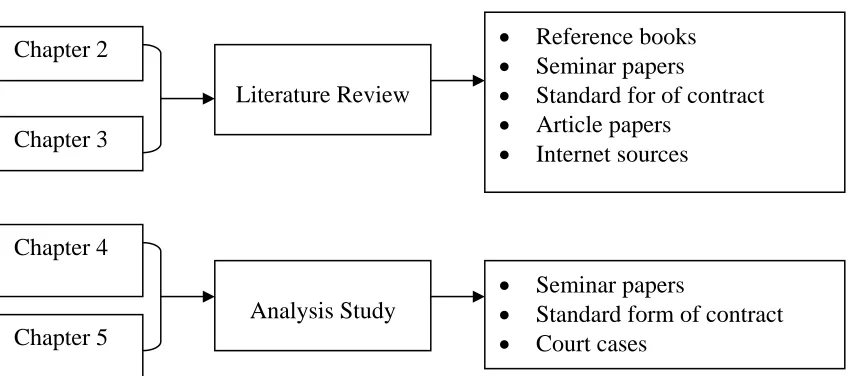
This research methodology is divided into two types of methods. One is mainly referring to the literature review which found in reference books, seminar papers, articles, magazines and also from internet sources. The other method is to analyse the information gained by compare, relate and support the earlier information with standard form of contract and relevant court cases.
Figure 1 : Research Methodology Flow Chapter 2
Literature Review
• Reference books • Seminar papers
• Standard for of contract • Article papers
• Internet sources Chapter 3
Chapter 4
Chapter 5
• Seminar papers
• Standard form of contract • Court cases
REFERENCES
Allan Ashworth (2001), Contractual Procedures in the Construction Industry (4th Edition). Longman.
Barry B. Bramble, Michael T. Callahan (1992). Construction Delay Claims, 2nd Edition. New York: John Wiley & Sons, Inc
Brian Eggleston (1997). Liquidated Damages and Extension of Time in Construction Contract,2nd Edition. London: Blackwell Sciences Ltd.
Dennis F. Turner & Alan Turner (1999). Building Contract Claims and Disputes, 2nd Edition. England: Addison Wesley Longman Limited
Donald Keating (1978). Building Contract, 4th Edition. London: Sweet & Maxwell
Duncan Wallace (1980). Hudson’s Building and Civil Engineering Contract. London : Sweet & Maxwell
Edward M. Willis (1997), Scheduling Construction Projects. New York : John Willey & Sons.
James J. Adrian (1988). Construction Claims – A Quantitative Approach. United State: Prentice-Hall, N.J
Jonathan F. Hutching (1998). Construction Claims Manual for residential Copntractor. NewYork : McGraw-Hill
Keith Pickavance (2000). Delay and Disruption in Construction Contract. London : LLP Reference Publishing
Lim Chong Fong (2004). The Malaysian PWD Form of Construction Contract. Malaysia : Sweet & Maxwell Asia
Michael Mawdesley, William Askew, Michael O’Reilly (1996). Planning and Controlling Construction Projects-The Best Laid Plans. Longman.
Reg Thomas (1993).Construction Contract Claims. London: The Macmillan Press Ltd.
Richard H. Clough, Glenn A. Sears, S. Keoki Sears (2000), Construction Project Management, 4th Edition. New York: John Wiley & Sons, Inc.
Robert A. Rubin, Virginia Fairweather and Sammie D. Guy (1999).Construction Claims Prevention and Resolution, 3rd Edition. New York: John Wiley &
Sons, Inc.
Robert Porter (1980), Building Contract Conditions, London : George Godwin Limited.
Sundra Rajoo (1999).The Malaysian Standard Form of Building Contract (The PAM 1998 Form). Kuala Lumpur: Malayan Law Journal
Vincent Powell-Smith and John Sims (1989). Building Contract Claims. London : BSP Professional Books.