DEVELOPMENT OF NEUTRON SHIELDING MATERIALS FOR HIGH
BURN UP NUCLEAR FUEL STORAGE FACILITIES
Herve Issard,
TN International (AREVA Group),
1, rue des hérons 78180 Montigny le bretonneux, France †Corresponding author : [email protected]
ABSTRACT
In the context of optimisation of nuclear power plants, spent fuel discharged from reactors have higher burn up and consequently have more residual heat. Installations and Storage casks have to withstand the severe temperatures resulting from increasing residual heat of the spent nuclear fuel .
A family of new neutron shielding materials was developed by TN International for spent nuclear fuel in storage facilities and transport/storage casks showing high shielding capabilities for a range of temperature corresponding to the needs.
These materials are composed of a thermosetting resin (vinylester or polyester resins) and mineral fillers (alumine hydrate and zinc borate). The cross linking of the polymer leads to a rigid three-dimensional lattice, solid and resisting to transport conditions, especially the temperatures.
Tests of the neutron shielding materials have been performed to ascertain:
- Shielding/attenuation efficiency in compliance with nuclear site specification, in case of transport compliance with IAEA safety standards TS-R-1 <1>.
- Safe behavior in accident conditions
- Radiation and heat resistance during the period considered : storage (40 years) or transport (depending of transport frequency).
- Quality and homogeneity of the shielding material. - Fire resistance, with self extinction property.
Their shielding ability for neutron radiation is related to a high hydrogen content (for slowing down neutrons) and a high boron content (for absorbing neutrons). Source of hydrogen is organic matrix (resin) and alumine hydrate ; source of boron is zinc borate. Atomic concentrations are equal to 5.1022 at/cm3 for hydrogen and 9.1020 at/cm3 for boron.
The manufacturing process of these materials is easy : it consists in mixing the fillers and pouring at ambient temperature. It allows to obtain any geometry.
Temperature resistance of these materials was evaluated by performing accelerated tests of samples at different temperatures (120°C to 170°C). According to tests results, the range of maximal temperature of use can reach 160°C.
1 Introduction :
Neutron shielding materials are very important for nuclear safety. Their function is to provide the sufficient protection of the public and of the operators, to keep the integrated dose ALARA. The amount of spent fuels and their increased discharge burn up request high performance designs for neutron shielding. Moreover, storage materials used in installations or in radioactive material packaging must withstand higher temperatures. This trend leads to an increase of the thermal load of the materials. The designers need to cope with these new constraints and select neutron shielding materials showing higher thermal resistances.
Innovative formulations of polymer compounds for spent nuclear fuel in storage facilities and transport/storage casks, testing and qualifications were carried out by TN International research and development and have been implemented not only in casks for storage but also in nuclear installations.
2 Neutron shielding material formulation
A high neutron shielding efficiency of a material can be provided by concentrations of Hydrogen and Boron. A high content of these elements leads to a good neutron isolation effect due to atomic concentration of Hydrogen that slows the fast neutrons which are then captured by the high cross section of Boron. With this objective of a high atomic concentration of these elements, the designer looks for an optimum mixing of ingredients showing good chemical composition and density. Assuming that the candidate shielding material shows such sufficient atomic concentrations, the density of the neutron shielding and its total weight may have also to be limited to maintain a good payload for transport. TN International has developed polymer based compounds complying with these specifications. The 3 main products developed are :
Vinylester based : Vyal-B, Polyester based : resin F,
Polyester based with high boron content : BORA.
Concerning the choice of fillers, performance and environment aspects were considered. The compound is made of several ingredients i.e. a resin which is an organic matrix and mineral fillers. The main function of resin is to provide Hydrogen, and the functions of fillers are to provide Hydrogen, Boron and fire resistance property. Aluminium hydrate and zinc borate are both efficient flame retardants.
3 Processability :
Concerning the manufacturing process of neutron shielding materials, as the volumes of these materials may be important, the target is to keep economical process which means a simple and competitive process with low time and equipment costs. The objective is that the manufacturing or assembling operations of the shielding materials should be done preferably at ambient conditions (without post-curing). It is therefore interesting to have a field-castable material with long pot life and low heat generation. The selected process can also guarantee the quality and homogeneity of the shielding material.
As no thermal treatments are necessary, thermosetting resins Vyal-B, resin F or BORA show actual advantages for processability, if the gelling time is correctly chosen and if the exothermal peak is kept in acceptable range (high enough to obtain a total polymerisation) as can be seen in the following curves.
Figure 1 : Polymerisation of resins: Viscosity and temperature curves
Through a direct in situ pouring process the final geometry can be obtained; the other possibility is assembling of blocks. Vinylester or polyester compounds can be machined and be fitted to the installation or equipment by adjustment of neutron shielding blocks.
4 Characterisation methodology
Determination of the properties of neutron shielding materials are necessary to carry out the design and to obtain the design approvals.
General properties are determined through tests : polymerization rate, density, chemical analysis. Mechanical characteristics are measured.
5 General properties
The cross linking ratio or polymerization rate is checked with samples subjected to DSC (Differential Scanning Calorimetry ISO 11357-1). For Vyal-B, atomic concentration of Hydrogen is equal to 5.1022 at/cm3 and to 9.1020 at/cm3 for Boron (average values). The typical value of density of the products are measured with ISO1183-1.
Typical Density of neutron shielding materials:
Vyal B Resin F Bora
density 1,79 1,80 1,76
Table 1 : Values of typical densities of neutron shielding material
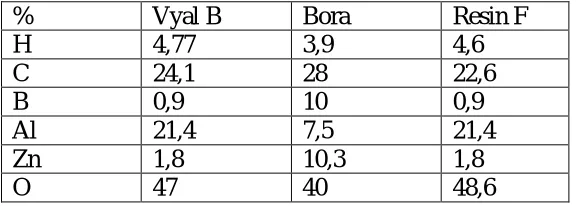
Chemical analysis (Typical values)
% Vyal B Bora Resin F
H 4,77 3,9 4,6
C 24,1 28 22,6
B 0,9 10 0,9
Al 21,4 7,5 21,4
Zn 1,8 10,3 1,8
O 47 40 48,6
Table 2 : Chemical analysis of neutron shielding material
6 Mechanical properties
Mechanical properties: the shielding material shall remain solid when submitted to permanent thermal load of storage conditions and to exposition to heating and cooling (loading/unloading).
Characteristics values
Young modulus 20°C : 4000-5000 MPa
150°C : 1400-1500 MPa
Maximum stress (20°C) 140-150 MPa
Strain (compressive) at max stress (20°C) 6 - 8%
Table 3 : Mechanical properties of neutron shielding material
7 Ageing tests – accelerated tests
In the designs of storage systems (installations or packages) for SNF or vitrified wastes as well, it is recommended to use neutron shielding systems as close as possible to the neutron source to obtain the best efficiency of dose attenuation; but it is not always possible, because the thermal gradient is high (due to the residual heat of SNF or wastes) and consequently the maximum temperatures are too high for the polymeric material. A first metal layer and a special heat transfer design are generally considered . In order to solve this question, the R&D needs to investigate high durability and heat resistance materials, the objective being clear : the shielding/attenuation capacity must not be significantly changed when exposed to high temperature over a long period (40 years). The range of acceptable temperatures of AREVA TN International neutron shielding materials is between 120°C and 160°C.
Ageing tests at different temperatures 150°C, 160°C and 170°C in an oven are performed during the qualification to evaluate the variation of shielding performance. Weight loss during the test are recorded. The tests lasted for 7 months. The selected vinylester and polyester matrix are resistant to heat. The fillers are also resisting to this temperature level . But above 160°C or 170°C, some modifications of the material occur and the loss of weight after 7 months is in the range of several percents.
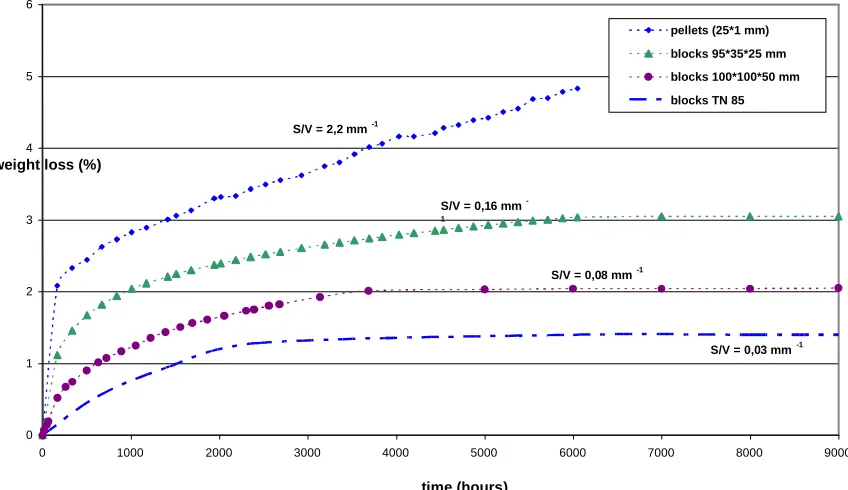
At 160°C and below, the long term behaviour of Vyal-B is good. Different samples characterized by different surface/volume ratios (S/V) were exposed at 160°C for 7 months. The evolution of the weight loss versus the time, represented in figure 2, shows that higher weight loss are observed for smaller samples (for higher surface/volume ratio).
Figure 2 : Weight loss trends for different Vyal B samples exposed at 160°C
0 1 2 3 4 5 6
0 1000 2000 3000 4000 5000 6000 7000 8000 9000
time (hours) weight loss (%)
pellets (25*1 mm)
blocks 95*35*25 mm
blocks 100*100*50 mm
blocks TN 85
S/V = 2,2 mm-1
S/V = 0,16 mm
-1
S/V = 0,08 mm-1
From these tests on small pellets and thick blocks, it has been shown that the mechanism of ageing is located on the surface of the block. The heart of the specimen shows no impact of ageing.
Chemical analysis (hydrogen and boron) were performed on the small samples (Ø = 25 mm ; thickness = 1 mm) exposed for 7 months at 150°C, 160°C and 170°C. The data obtained for different temperatures show a correlation between the evolution of the hydrogen loss and the weight loss.
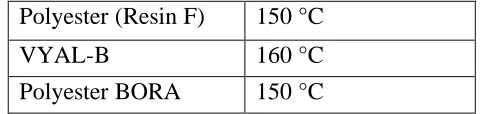
Taking into account the results of ageing tests, a maximum continuous operating temperature is determined (table 4) .
Polyester (Resin F) 150 °C
VYAL-B 160 °C
Polyester BORA 150 °C
Table 4 : Values of maximum continuous operating temperature of neutron shielding material
8 Fire tests
The designs of storage systems for SNF or vitrified wastes must also resist to hypothetical fires, it is therefore necessary to use fire resisting neutron shielding systems. In the case of packaging, fire resistance is specified in IAEA safety standards <1> hypothetical transport accident conditions. For designers, it is generally considered that self extinction property is requested.
Safety requirements for storage systems request that the neutron shielding materials shall not burn or contribute to the fire in any case. In order to address this safety issue, fire tests are performed on AREVA TN International neutron shielding materials.
ISO 5660 fire tests
An experimental evaluation was done in order to check the fire resistance of Vyal-B shielding material with cone calorimeter test (ISO 5660-1) at 800°C. We observed a black char layer and there was a small emission of smoke. Infrared analysis was done on the emitted gas and showed it is not toxic. This is also the same for polyester based materials.
IAEA fire tests:
IAEA safety standards <1> transport accident conditions require that the cask shall resist a fire at 800°C for a duration of 30 minutes, the design shall retain sufficient shielding to ensure that the radiation level at 1m from the surface would not exceed 10 mSv/h.
neutron shielding material is self-extinguishable. A small layer of carbonised resin was observed.
Chemical analysis of hydrogen, boron and zinc were performed on each sample at the surface exposed to the flame and at different distances from this surface.
The results of chemical analysis show that the hydrogen content is affected by the fire until a depth from the surface equal to 15 mm. Boron is not affected by the fire.
Based on the measurements of hydrogen loss, an equivalent thickness of lost resin (100% of hydrogen loss) was determined ; for Vyal-B shielding material, this equivalent thickness was estimated equal to 1,7 mm.
9 Other characteristics : thermal and lixiviation
The other characteristics have been determined for safety analysis (<4> and <5>).
Thermal expansion coefficient :
The thermal expansion coefficient was determined in the temperature range 25°C-250°C by thermo-mechanical analysis (TMA) according to the standard ISO 11359-2.
Two values, mentioned in the table 5, were measured before and after Tg (glass transition temperature 126°C).
.
Vyal-B lineic thermal expansion coefficient
(10-6/K) T < Tg
(25°C - 110°C)
41
T > Tg (140°C - 210°C)
109
Table 5 : Values of the lineic thermal expansion coefficient of Vyal B resin before and after Tg
Thermal conductivity:
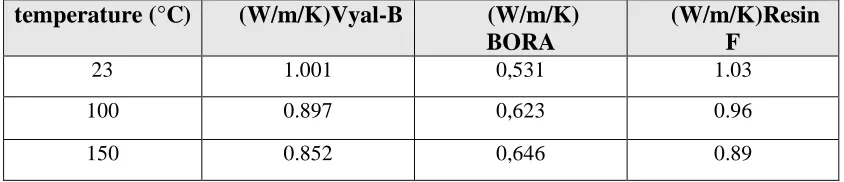
Typical values are given in table 6
temperature (°C) (W/m/K)Vyal-B (W/m/K)
BORA
(W/m/K)Resin F
23 1.001 0,531 1.03
100 0.897 0,623 0.96
150 0.852 0,646 0.89
Table 6 : Values of the thermal conductivity of neutron shielding materials at different temperatures
The specific heat was determined in the temperature range 20°C-250°C by differential scanning calorimetry (DSC) according to the standard ISO FDIS 1357-4. Typical values are given in table 7.
resin specific heat (J/g/°C)
Vinylester (Vyal-B) 1,31
Polyester resin F 1,30
Polyester BORA 1,29
Table 7 : Values of specific heat of neutron shielding materials
Lixiviation :
Lixiviation tests during 1 week in water (representing pool waters) at 194 F have been performed, in a closed circuit and with a flow of 27 cm3/min. Each day 500mL of water were removed from the reactor without refilling. Chemical analysis was performed and the sample was weighed at the beginning and at the end of the test showing that there is no release of element.
10 Irradiation
Radiation degradation of neutron shielding materials
This effect has been measured in real radiation conditions (reference <3>). The mechanisms depend on type of polymer : break of the main chain, cross linking, production of unsaturated bonds and oxidization.
The degradation starts at more than 1015 n/cm2 fast neutron fluence, corresponding to a dose of 106 Gy.
For the radiation degradation of neutron shielding material, we consider that the fluence level for neutron shielding of packages is 1011 n/cm2 for 40 years of continuous use, corresponding to a dose : 103 Gy which is far less than the values given in reference <3>. Therefore, the radiation degradation of neutron shielding of interim storage packages is negligible.
Is there a risk of depletion of Boron 10 in the neutron shielding materials based on polyester or vinylester thermoset resins?
The total neutron capture is less than 1013 atoms/cm3. The initial Boron 10 content of resin is approx 1020 atoms/cm3 . It can be concluded that no Boron 10 depletion can occur.
11 Manufacturing
Different processes are used for manufacturing the shielding material.
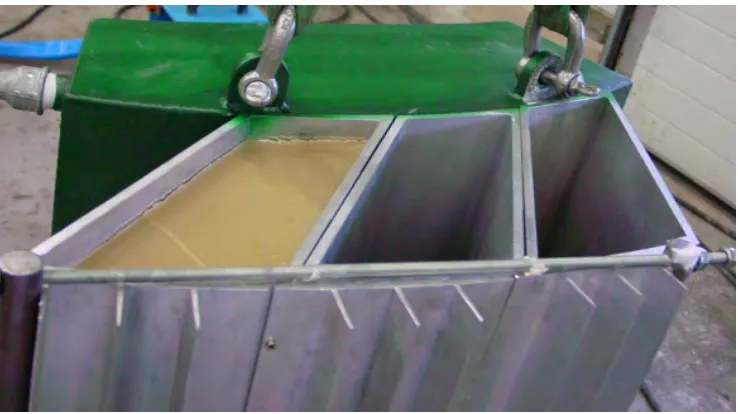
For a transport storage cask neutron shielding material is put in between the body and the external steel envelope. In different designs, it may be poured in metallic compartments or between heat conducting fins.
The field castable process starts from a liquid mixing, it is very flexible and can be easily adapted to the package design and to the workshop. That is why many cask designs have selected this material.
A mock up representing the compartments of the packaging (example in figure 3) is prepared and allow to check quality and homogeneity of the shielding material.
Second possibility: the preparation of shielding elements (blocks).
The other way for manufacturing is to cast elementary blocks and assemble them in the installation or in an storage cask. This process is selected especially for protection barriers in installations around cells, reactor vessels, reactor pools; recently, qualification of such block and assembling procedure has been achieved.
Figure 3 : Mock up for qualification of neutron shielding pouring process in a TN International transport storage cask
For both process, first steps of the manufacturing of shielding material are very similar. For all vinylester based or polyester based neutron shielding material three stages are considered in the process:
Weighing and mixing the different components Degassing of the mix under vacuum
Pouring in a mold or in a compartment of the cask.
Figure 4 : manufacturing and inspection of neutron shielding material in a transport storage cask
To be able to guarantee the conformity of the product, several items are inspected. The measurement of liquid density is done before pouring, according to ISO 2555.
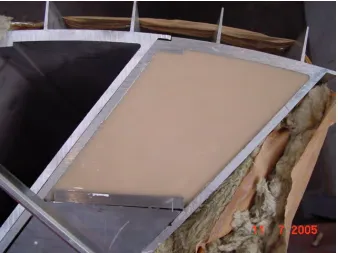
After pouring, the cross linking ratio can be measured by DSC (differential scanning calorimetry ISO 11357-1) density and chemical analysis are done on samples at different height levels. To compare with the model of the safety analysis report, the atomic densities are calculated and checked, taking into account the accuracy of weighing, the impurities of the components and the accuracy of the chemical analysis. Figure 5 shows that a good quality and homogeneity of the shielding material can be obtained.
Polyester resins are used satisfactorily in TN International casks for storage and transport since more than 20 years. In the USA, the TNTM 40 cask or the NUHOMS® transfer cask are both using this type of neutron shielding material.
TN International neutron shielding materials have been qualified for storage casks in European countries. They are also selected in various designs of TN International transport packaging such as the TN 112 for MOX spent fuel transport.
reception of raw materials
weighing
mixing, degassing
measurement of liquid density
pouring
check resin density
density
chemical analysis
Check atomic density height 4 m
Figure 5 : View of compartment filled with neutron shielding material after polymerisation
12 Conclusion
Innovative formulations of neutron shielding materials made with thermoset polymer have been successfully developed. These materials are qualified for use in storage casks in Germany, France, Belgium and other countries and are qualified for use in nuclear installations and equipments.
Vinylester and polyester resin shielding efficiency for neutron radiation are very performing, due to high hydrogen and boron contents. Tests have shown that the fire resistance is good. Durability in temperature is satisfactory and the maximal temperature of use is checked through long term - high temperature tests.
The manufacturing process is easy and leads to a high quality and homogeneity of the shielding material. This process is economical and very flexible. TN International has accumulated a 20 years experience of this family of neutron shielding materials but still improves the formulation to meet the needs for high burn up fuels storage and transport while minimizing the impact on environment.
13 References
<1> IAEA safety standards TS-R-1
<2> Umweltbundesamt: Substituting environmentally relevant flame retardants: assessment fundamentals. Berlin, jun. 2001.
<3> CERN Health and safety division (08-1979) Compilation of radiation damage test data. Part II : thermosetting and thermoplastics resins.
<5> D. Yokoe, H.Taniuchi, H.Akamatsu, J.Shimojo, P. Abadie : “Long term stability and fire resistance of neutron shielding materials, TNTM resin Vyal-B and Kobesh EPR resin”, the 15th symposium on the packaging and transportation of radioactive materials PATRAM 2007, Miami.
<6> Patent WO 03/050822 (19-06-2003) <7> Patent US 7,160,486 (09-01-2007)