University of Windsor
University of Windsor
Scholarship at UWindsor
Scholarship at UWindsor
Electronic Theses and Dissertations
Theses, Dissertations, and Major Papers
1-1-1974
Issues involved in the empirical testing of a multivariate predictive
Issues involved in the empirical testing of a multivariate predictive
system.
system.
Robert T. Forsyth
University of WindsorFollow this and additional works at: https://scholar.uwindsor.ca/etd
Recommended Citation
Recommended Citation
Forsyth, Robert T., "Issues involved in the empirical testing of a multivariate predictive system." (1974). Electronic Theses and Dissertations. 6715.
https://scholar.uwindsor.ca/etd/6715
This online database contains the full-text of PhD dissertations and Masters’ theses of University of Windsor students from 1954 forward. These documents are made available for personal study and research purposes only, in accordance with the Canadian Copyright Act and the Creative Commons license—CC BY-NC-ND (Attribution, Non-Commercial, No Derivative Works). Under this license, works must always be attributed to the copyright holder (original author), cannot be used for any commercial purposes, and may not be altered. Any other use would require the permission of the copyright holder. Students may inquire about withdrawing their dissertation and/or thesis from this database. For additional inquiries, please contact the repository administrator via email
This reproduction is the best copy available.
by
ROBERT T. FORSYTH B.A.,Brock University,1973
A Thesis
Submitted to the Faculty of Graduate Studies through the Department of Psychology in Partial Fulfillment
of the Requirements for the Degree of
Master of Arts at the University of Windsor
Windsor,Ontario,Canada
1974-UMI Number: EC53126
INFORMATION TO USERS
The quality of this reproduction is dependent upon the quality of the copy
submitted. Broken or indistinct print, colored or poor quality illustrations and
photographs, print bleed-through, substandard margins, and improper
alignment can adversely affect reproduction.
In the unlikely event that the author did not send a complete manuscript
and there are missing pages, these will be noted. Also, if unauthorized
copyright material had to be removed, a note will indicate the deletion.
®
UMI
UMI Microform EC53126
Copyright 2009 by ProQuest LLC.
All rights reserved. This microform edition is protected against
unauthorized copying under Title 17, United States Code.
ProQuest LLC
789 E. Eisenhower Parkway
PO Box 1346
Ann Arbor, Ml 48106-1346
Dr.
Dr.
Dr.
Dr.
M. Morf
APPROVED BY:
/ / u ■ ^
/ f i , j i
-H. Minton / f - >
R. Daly
S. Sadava
ii
This study utilized previously collected data from two
samples of 187 and 184 college students to investigate problems
inherent in multivariate data analysis as well as patterns of cannabis
use. The multivariate issues considered were: the effects of the
distributions of the scores of the variables; the use of factor
scores as well as raw data in regression analysis to facilitate
"conceptual cross-validation"; effects of sequential orthogonalization
on regression equations; and the utility of criteria exhibited by
factor analyses and canonical correlations. It was found that in
the field of marijuana research, the usual criterion - frequency of
use, was not suitable both for measuremeant and inferential reasons.
Using canonical analysis two patterns of use were found -- moderate
and abnormal, which were related to social and personality predictors
ACKNOWLEDGEMENTS
I acknowledge the help of the members of my committee:
M. Morf, H. Minton, R. Daly, and S. Sadava.
Appreciation .is
also extended to Marybeth Heilbronn and Larry M. Starr.
Page
ACKNOWLEDGEMENTS ... iv
LIST OF TABLES ... ... vi
LIST OF FIGURES ... vii
Chapter
I INTRODUCTION ... 1II METHOD ... 13
III . RESULTS ... 23
IV . DISCUSSION ... 41
V CONCLUSIONS ... 58
Appendix A Proof for Gamma Scores ... 64
Appendix B Programmes Written for this Thesis ... 65
Appendix C Correlation Matrices ... 67
REFERENCES ... 75
VITA AUCTORIS ... 78
LIST OF TABLES
Table
1 Variables Used , ... 14
2 Univariate Distributions ... .. . . . . 24
3 List of Factors for Functions and Demo. ... 28
4 Factor Loadings of Criteria ... 32
5 Stepwise Multiple Fegression,Raw Scores,Sample 1 . . . . 33
6 * Stepwise Multiple Regression,Raw Scores,Sample 2 . . . . 34
7 Stepwise Multiple Regression,Functions Factors,Sample 1 . . . 35
8 Stepwise Multiple Regression,Functions Factors,Sample 2 . . . 36
9 Stepwise Multiple Regression,Demo. Factors,Sample 1 . . . . . 37
10 Stepwise Multiple Regression,Demo. Factors,Sample 2 38 11 Summary of Multiple Correlations . ... 39
12 Canonical Correlations . . ... 40
vi
Figure Page 1 Simple, Non-Recursive, Social Learning Mo d e l ... 5 2 Scattergrams... . 25
Chapter I Introduction
One of the major aims, if not the only aim of psychology, is useful
and accurate prediction of human behaviour. The approaches used vary
with the particular behaviours studied, ranging from the study of minute
reflexes, to overall life patterns, carrying with them constructs from
conditioned stimuli to self-concept. For behaviour of medium complexity, the social learning approach, developed by Rotter and his colleagues
(eg. Rotter, 1954; Rotter, Chance & Phares, 1972) or a similar approach may be most useful, provided that constructs are made sufficiently clear.
It is the intent of this thesis to operationalize some of these constructs, to investigate methods of testing a predictive system, and to consider
specific issues that pertain to this system and generally to complex multi variate data sets.
In this study the behaviour of interest is marijuana use, specifically
in college students. Studies on the drug have proliferated, perhaps in
keeping with greater public interest in its use and abuse in the last few years. Although much of the literature deals with the physiological and psycho-pharmacological properties of cannabis, the psychological viewpoint
demands an exploration of social and personality correlates and the consequent predictions of who uses the drug, and with what effects. Recent studies
by Jessor (Jessor, Jessor & Finney; 1973) and Sadava (1974b) have had some success in this task, by viewing marijuana use as a functional
behaviour, "caused" by variables both of an interpersonal (environmental)
and of an intrapersonal (personality) nature, and as an ongoing process
1 ; .
changing over time. This conception of the problem may be traced back to Rotter's social learning framework, and a short description of this
approach (based mainly on Applications of a social learning theory of
personality, chapter 1, 1972) would make the later work more meaningful.
Rotter's Social Learning Theory ■ ,f
In general, Rotter's Social Learning Theory utilizes the ideas of
expectancy and the empirical law of effect, as underlying constructs emphas
izing the interaction of the individual and his meaningful environment. Thus, the approach is much more cognitive in nature than most other types
of learning theory. Specific efforts are directed to determmm^ the subject's
perceptions of his goals and his subjective .< expectancy that they will be
fulfilled according to his own past experiences. Needs and goals are social in nature since they are initially fulfilled by others. Behaviour
becomes available if it has led to reinforcement, either directly, or
through observation and modelling. Generalization takes place, with functionally related behavious/reinforcers leading to the same goals/
satisfactions. Cognitions are more important in this theory than others
since the generalization may be of symbols and their referents. The general formula used to predict behaviour is: BP=f(E & RV) where BP is
the probability of the behaviour, relative to other behaviours in the
specific (psychological or perceived) situations; E is the expectancy or subjective probability of a particular reinforcer occurring as a
result of a certain behaviour; and RV, the reinforcement value, is the relative preference for a given reward with expectancies for all rewards
kept constant.
3
college,in relation to peer approval, is a function of the expectancy of the occurance of peer approval, following marijuana smoking in college
and the value of peer approval. This is a specific example, and may be
expanded by including other reinforcements, both positive and negative,
other expectancies etc.
Jessor*s Approach
Jessor has taken Rotter's system, developed in a clinical setting, and applied it to studies on alcohol use (eg. Jessor, Carnan, & Grossman,
1968; Jessor & Finney, 1973). Marijuana use is thought of as "problem
behaviour... considered to be purposeful, goal oriented or functional (pi,
1973)". Variables have been classified into structures and systems by Jessor; a personality system consisting of motivational instigation, belief and personal control structures; a perceived environment system
with these and other behaviours ranging from closely related to "normal".
His methodology consists of administering questionaires at two or more
points in time, using multiple-regression techniques, and gain scores (over time), on social and personal variables to increase "accounted-for"
variance. He was able to assign users and non-users to their respective groups with 73% accuracy and to achieve multiple R's of up to .39 (Jessor,
et al, 1973).
Sadaya's Approach
Sadava's approach has focused in on marijuana use specifically. One
major problem in marijuana research is that while ultimate clinical interest may lie in determining what leads to abuse, research has been defined in
terms of use versus non-use. Even this distinction is made in different ways by various researchers. For instance the category of "light use"
ranges from one to twenty experiences, and there are at least twenty-eight
labels for use patterns (Sadava, 1974a). To cut down this confusion,
Sadava designed a short group of questions, with four stages of use (Sadava,
1972) with the additional stages of non-user and "Have stopped" added (Sadava 1974b). For the non-user and the four user stages this scale has
Guttman-scale type properties. Continuing to refine criteria, Sadava
uses the following measures; frequency of use, time span as a user, contexts of use and adverse consequences of use in a sample comprised of drug users. These measures have average intercorrelations of .23 with a maximum of .54
(Sadava, 1974b), indicating relationships amongst criteria, and the possibility
of patterns of drug use. The complex relationships between behaviour and
predictors may be obscured by a poor choice of criterion. Meaningful correlate may be hidden from our investigation if the criterion is poorly defined, or
if its scale properties are ignored.
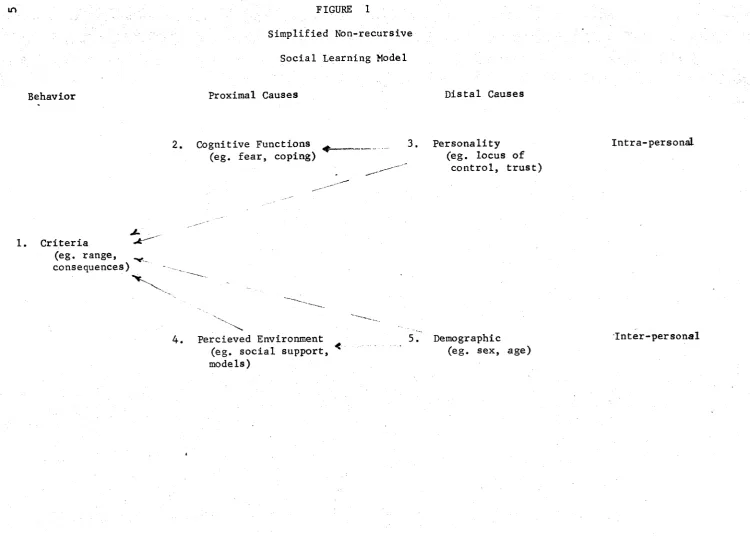
Sadava's schema of variable systems may be seen in Figure 1. The major difference between the systems of Sadava and Jessor is that in the former
cognitive functions are conceptualized as a set of predictors of drug use (by Sadava), and as being predicted by other systems of variables. Using
his system Sadava (1974b) has found multiple R's of up to .62 for variables predicting criteria measured at the same time, and multiple R's up to .58
for longitudinal analyses with samples of drug users. Both Jessor and
Sadava use longitudinal analyses, and often utilize both the scores on
variables at the earlier point in time, and change scores in these variables, to predict behaviour at the second point in time.
Social Learning Theory: Applied to Complex Operations
m FIGURE 1
Simplified Non-recursive
Social Learning Model
Behavior Proximal Causes
Criteria (eg. range, consequences)
2. Cognitive Functions ^ _ (eg. fear, coping)
4. Percieved Environment (eg. social support, models)
Distal Causes
Personality (eg. locus of
control, trust)
Demographic (eg. sex, age)
system that would allow easy manipulation of the large number of variables
and extensive data. Thus the first stage of this thesis is the expression of Sadava's and Jessor's systems in a notation that allows manipulations pf
s
variables in order to deduce and to subject to verification, hypotheses
about relationships between predictors and criteria. This is a necessary step since some of the terms used (eg. 'related structures', 'covary with
other kinds of problem behaviours') and also relationships between
variables (eg. BP=F(E & RV)) are hard to operationalize. Furthermore,
although the underlying principles assume an integrated predictive system, the tendency is to examine concepts and variables in isolation, and with
less than complete thoroughness. Notation
Let B „ be a criterion observation ["section 1 of Figure ll for
qtn L ,
individual n (n=l,...,N) at time t (t-1,...,T) on criterion q (q=l,...,Q) which after appropriate transformations(s) is in Z-score form (Exp (Bq t n )=0,
Var(Bq t n )=l). Similarly, let C ltn(l=l,...,L) be a normalized variable for cognitive functions [section 2 of Figure ; P ^ (m=l,.... ,M) be a normalized variable for personality characteristics (section 3 Figure lj ;
E (k=l,...,K) be a normalized variable for perceived environmental data ktn
^section 4 Figure l j ; and Dstn(s=l,...,S) be a normalized variable for
demographic data (section 5 Figure l~J.
Let A( B q tn) be a normalized variable corresponding to the unpredicted
part (i.e., change over time-delta) of Bqfcn from Bq ^n - Similarly, A ^ l t n ^ ’
7
Let Fr n (B) be the factor score for the r'th factor (r=l,... ,R). for individual n, taken from the B ^ (D).
’ q t n N '
covariance-free part (gamma) of Pm |-n remaining after the variance due to
the E and C variable systems is partialled out, and so on for combinations
of P, E, C and D.
bet R g q g Q p be the multiple correlation between the qth variable of
B and the variables of E, C and P.
Thus using the above notation for measurement tines 1 and 2, it is
hypothesized that an equation of the following general form leads to better
estimations of criteria at time 2 and higher multiple R's than obtained previously:
The score for the n'th person, on the q'th criterion, at time 2, may be estimated from a linear composite comprised of the sum of the variables in each system weighted such that the predictors are orthogonal. Thus in this case, the estimated criterion score is the sum of the factor scores for demographic data weighted by first order correlation coefficients with
Let f ^ C E H C ) denote a normalized variable consisting of that
A
the criterion, plus the sum of the personality factor scores, free of covariance with demographic data, and weighted by the correlations with the criterion, plus the percieved environment factor scores similarly
partialled (of both demographic and personality scores) and weighted, plus cognitive function factor scores treated in the same manner.
Problems with this Predictive System
In the present study several important limitations exist and should be
noted beforehand. Firstly, the model calls for all variables to be normally distributed, zero mean, and unit variance. This condition may not be met
because of several considerations in the scales involved; measures may be nominal or at best polychotomous with very discrete values found for
what may or may not be underlying continuous variables; some variables may be extremely skewed, and even with transformations may not really r e
semble a normal distribution.
A second deviation from the model relates to the fact that the various systems of variables should include all non redundant measures in the
domain of interest. This condition is not fulfilled as: (a) those measures may not at this point in time exist and (b) only a limited subset (hopefully
representative) can be administered in the time permitted.
Another problem exists in that the model is linear in nature whereas either the real or theoretical variables may combine multiplicatively in the form of moderators to other variables, or in other non-linear combinations (eg. curvilinear). This must be kept as a consideration in the research, but as the non-linear models tend to be limited operationally more or less to small numbers of variables, the present work will (hopefully)
9
Other problems exist in the nature of the instruments used and
the type of behaviour studied. In the latter case, marijuana use is,
of course, illegal and therefore responses to questions about its use can
be seen as incriminating. King (1972) reports that anonymous and
identifiable > questionnaires on this subject do not significantly differ
on reported data, however this does not mean there will be no difference between actual behaviour and reported behaviour due to some fear of exposure.
With respect to questionnaire studies in general, we must consider the possibilities of response styles and sets (eg. Jackson, 1967), and also
false content through misconceptions on the part of the subject. The latter is more easily dealt with, in that according to the assumptions of the Rotter, Jessor and Sadava models behaviour is determined by sub
jective expectancies, values, etc. not merely objective facts, and distortion
of this kind do not render the information invalid.
To compare the possible distortion of responses on the questionnaire, it is best to consider that the data have two different logical sequences. The first sequence is that of cognitive functions followed by perceived environment, personality and demographic data, ordered in terms of
decreasing proximity to the behaviour concerned. The subjects' own
perceptions will have the most weight and be least subject to cumulative
response biases.
The second sequence will be that of demographic data, personality, perceived environment, and cognitive function, in decreasing order of objective verifiability, as opposed to proximal subjectivity.
Specific Areas of Investigation
There are four specific issues that must be examined in dealing with
the model. These are: distributional properties of predictor and
criterion variables; the use of raw data vs factor scores; the use of
two sequences of orthoganalization, ie. starting with cognitive functions,
and starting with demographic variables; and the patterns of behaviour criteria.
Distributions of the Variables
It is extremely important that we examine the distributions of scores
on the variables we use before interpreting results from statistical
analyses, since we may be misled by our results if assumptions necessary
to the analysis are not met, or if more useful approaches to data analysis
are ignored due to a lack of information. This warning takes on more importance when the variables haven't been used extensively in other
research, and/or several "non-robust" (requiring stringent assumptions for use and interpretation) statistics such as stepwise regression or canonical
correlation are to be used. For instance, we might have a distribution
with a few extreme values at each end, being correlated with another variable that also has extreme values. If the extreme values "match", there will
be a very high correlation that is not reflected at all by the other
variable pairs. Another possibility is that the two variables have a parabolic relationship, or that one variable is related to the logarithm
of the other. In both cases, the correlations between the variables would be very low, and the true relationships found only by a theoretical or, more likely, an empirical investigation of the univariate and bivariate
frequency distributions of the variables (see Carroll, 1967). As the
first part of the exploration of this model, these distributions will
1 1
Raw Data vs Factor Scores
Since the scales for this investigation were chosen on the basis of availability, or constructed to measure a specific area, there may be
both a large overlap in the domain of measurement, and a great deal of variance "superfluous" to the model. If the variables are of this
nature, the use of a multiple regression technique may lead to different weights for the variable in each sample, even though the particular Under
lying factors don't change from sample to sample. Cooley and Lohnes (1971) point out that "chance" is an important consideration in multivariate
analysis, and since we may have several variables contributing almost the
same variance, chance could determine which variable is chosen (the
covariance with similar variables being partialled out and consequently not appearing as significant). This process may have more importance than
seems readily apparent since we will be influenced in our model building and generalization by the labels or names attached to the "significant"
variables, and may draw the wrong inference about the meaning of a variable's loading on the regression equation.
One solution to this problem is to assure ourselves, prior to the dependence analysis (eg. multiple regression), that we have predictors, whose domains, empirically, do not overlap greatly. This may be achieved
by orthogonalization of our predictors. We may also collapse the number of variables into a smaller number of factors. Using this method, we may substantiate the findings of analyses of raw data, and more easily
infer from the measured variable the underlying trait or cause. Sequence of Data Entry
When orthogonalizing the data sequentially, the first variables may
retain greater meaningful variance than later variables because of the method itself. The last variables will, most likely, have little or no correlation with the criterion, whereas the corresponding original variable may, in reality, be highly related to the criteria. Ideally every variable
should have equal chance to covary with criteria, but this leads to an enormous number of analyses to include each sequential combination. Given
these circumstances, together with the theoretical reasons discussed
previously for the different types of response sets and kinds of verifiability two sequences of orthogonal predictors will be used: Functions- in which
the function variables are entered first (the sequence of proximity); and Demo.- in which the demographic variables are entered first (the objective verifiability order). These sets will be examined to determine what
differences exist due to ordering effects. Criteria Patterns
Considering Sadava's findings (1974b) concerning the relationships between criteria, and the different predictors useful in each case, it is
important to look at the criteria carefully, to examine specifically their
inter-relationships (eg. by factor analysis), and to find out whether different sets of predictors predict different patterns of criteria
(using canonical correlation). Using this information we can evaluate the criteria as to their reliability and usefulness. In addition, a methodology becomes available to ascertain predictive systems for genuine, multidimensioiu
Chapter II Method
Subjects
The •’uestionnairee were filled out by first and second year students enrolled full-time at Brock University, St, Catharines, Ont. in the
1972-73 academic year. Pour hundred and eighty Ss_ completed question-aires in Nov. 1972; and of these 371 filled out the questionnaire in Mar. 1973. The ages of the Ss_ ranged from 16 to 74 but most were under
26. Fifty-five per cent of those responding twice were female.
The group (371) was split into two samples randomly, Sample 1 was 187 Ss_ and Sample 2 was 184. Scores were standardized within samples, but all other estimated parameters-(e.g. correlations, factor loadings, etc.) were obtained from Sample 1 and applied to Sample 2 .
Questionnaire
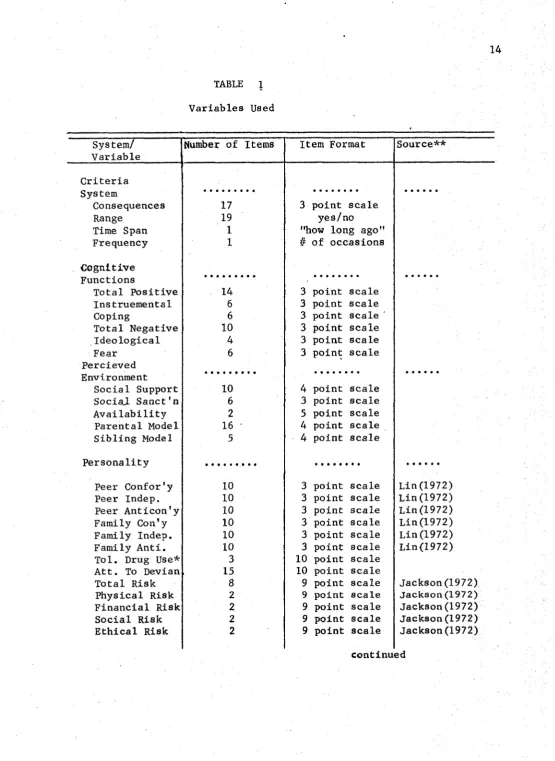
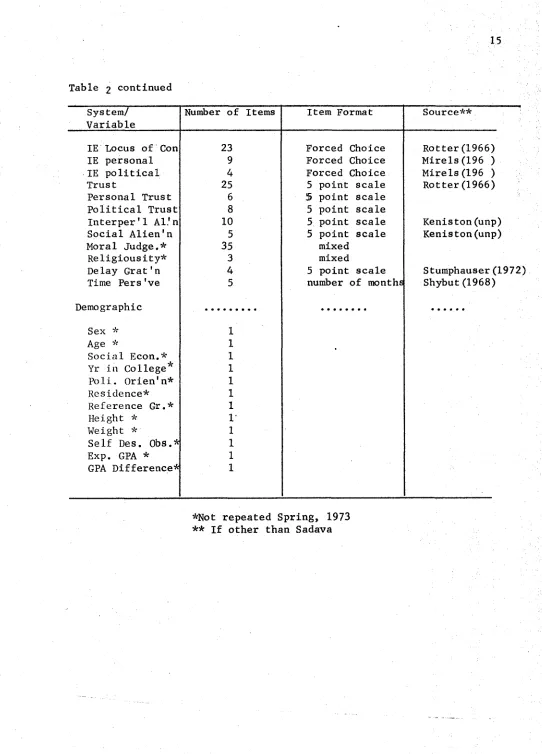
Table 1 lists the scales used, number of items, format and source, if other than Sadava (1972, 1973, 1974b). This table is organized by
variable systems, i.e. behaviour, cognitive functions, -perceived envir onment, personality, and demographic data, and excludes some scales
not used in the present study.
Major Statistics Univariate and Bivariate Distributions
Descriptive statistics and frequency distributions were found for each scale, using data before standardization. Scattergrams were
constructed for ten predictor variables (standardized) with each of the four criterion variables, to give an indication of the types of
13
Variables Used
System/ Variable
Number of Items Item Format Source**
Criteria System
Consequences 17 3 point scale
Range 19 yes/no
Time Span 1 "how long ago"
Frequency 1 # of occasions
Cognitive Functions
Total Positive 14 3 point scale Instruemental 6 3 point scale
Coping 6 3 point scale
Total Negative 10 3 point scale Ideological 4 3 point scale
Fear 6 3 point scale
Percieved Environment
Social Support 10 4 point scale SociaJ. Sanct'n 6 3 point scale Availability 2 5 point scale Parental Model 16 ■ 4 point scale Sibling Model 5 4 point scale Personality
Peer Confor'y 10 3 point scale L i n (1972) Peer Indep. 10 3 point scale Lin (1972) Peer Anticon’y 10 3 point scale L i n (1972) Family C o n ’y 10 3 point scale Lin(1972) Family Indep. 10 3 point scale L i n (1972) Family Anti. 10 3 point scale L i n (1972) Tol. Drug Use* 3 10 point scale
Att. To Devian 15 10 point scale
Total Risk 8 9 point scale Jackson(1972) Physical Risk 2 9 point scale Jackson(1972) Financial Risk 2 9 point scale Jackson(1972) Social Risk 2 9 point scale Jackson(1972) Ethical Risk 2 9 point scale Jackson(1972)
15
Table 2 continued System/
Variable
Number of Items Item Format Source**
IE Locus of Con 23 Forced Choice Rotter (1966) IE personal 9 Forced Choice M i r e l s (196 ) IE political 4 Forced Choice Mirels(196 )
Trust 25 5 point scale Rotter(1966)
Personal Trust 6 5 point scale Political Trust 8 5 point scale
Interper'l Al.'n 10 5 point scale Keniston(unp) Social Alien'n 5 5 point scale Keniston(unp)
Moral Judge.* 35 mixed
Religiousity* 3 mixed
Delay Grat'n 4 5 point scale Stuffiphauser(1972) Time Pers've 5 number of months Shybut(1968)
Demographic
Sex * 1
Age * 1
Social Econ.*
Yr in College* 1
Poli. Orien'n* 1
Residence* 1
Reference Gr.* 1
Height *
Weight *
Self Des. Obs.* 1
Exp. GPA * 1
GPA Difference*
*Not repeated Spring, 1973 ** If other than Sadava
bivariate distributions present in the data.
Orthogonalization of Data
Delta and gamma scores. In order to arrive at a set of mutually independent predictors several types of transformation are needed.
First, we must get an estimate of change-over-time scores. Given two
sets of scores on the same variable, from the same subjects, we can
}
partial out of the later score, the variance accounted for by the score taken at a point earlier in time (e.g. Jessor et al, 1973). Thus, starting with two related scores, we obtain a base score, and an independent estimate of change, a delta (A) score. Delta is estimat
ed by Ferguson's formula t. = (Z^ - r i2Z2)/V^-~r i2 -(1971, p. 387) where Z^ is the score at the first point in time, Z£ is the same subjects'
score at second point in time, and ri2 is the correlation between Z^
and Z2 over all subjects. .
A generalization of the above formula estimates a score that is independent of more than one variable (this may be done across time, as for , or with other scores from a larger test battery). If we wish an estimate of this covariance-free score, a gamma (f*) score, we
may use the following formula;
r
*
1
1.
2 3.
.
<v irlmz„)/Vi-ZrL
<rrx*%
[see appendix A for proof3, where Z is our variable of interest, 1
Z_,...,Zn are the covariates, r is the correlation between the Z,
2’ n lm 1
scores for Zm (m=2 n) over all subjects. These scores will have E(P)-0,VAR(p)-l and will tend to a normal distribution.
1 7
factor scores. Since we are interested in linear composites with the
characteristics of mutual independence, interpretability and complete ness, the proper procedures for this factor analysis are: the use of
unities in the main diagonal; an adaptation of the scree test (see Cattell, 1952, for a discussion of this criterion) to determine the number of factors retained; and a varimax rotation of those factors.
We must use unities in the diagonal instead of estimates of
commun-ality since our data are not being used to infer underlying structure,
but rather, are being described by the factor scores. The question of
establishing the number of variables to be rotated is more complex. It may be resolved by considering the nature of the factor structure
and the communality of a variable. We may tegard communality as the square of a variable's multiple correlation with all the extracted factors. Thus, if each variable has a high communality after a
certain number of factors has been extracted, we may assume that each
of the common and unique factors has been obtained. For example, if
after five factors are extracted, the communality of a variable is .78, there remains to be accounted for, only 22% of the original
variable's variance in all the remaining factors.
We can always (with unities in the diagonal) account for all of the variance by taking as many factors as variables, but we most like ly will have "error" factors, due to faulty measurement, discrete scale values etcetera. A procedure that tends to eliminate these factors is Cattell's scree test (Cattell, 1952). A sharp drop-in eigenvalues after relatively high eigenvalues means the following eigenvalues may be neglected. The original argument by Cattell
recommended both a scree test, and a minium eigenvalue over 1.0,
however, since we are using principal components, the later requirement
may be dropped, and the requirement of high communalities added.
The varimax method of rotation is used so that each factor can
'be most easily identified as related to a few (and if possible only
one) variables. Varimax simplifies factors, as opposed to variables (Mulaik, p.259, 1972), and this means that the "output" of our trans
formation will tend to be more easily interpretable than if we used
either a variable-simplifying or both factor and variable simplifying
rotation.
Stepwise Multiple Regression ,
This technique (SMR) is really a combifiation of regression and factor analysis (Mulaik, p.412, 1972). The first step is to correlate
the criterion with the criterion as the variable in the regression equation. The factor collinear with this variable is extracted from
the predictor matrix, and a residual correlation matrix is obtained. Then the variables (or factors since this factor analysis method-that
of Cholasky [^Mulaik p.412[] maintains a correspondence between factors
and variables),remaining are correlated with the predictor, the
corresponding factor extracted, leaving a residual matrix, and so on.
At each step a variable is added to (in occasional circumstances removed from) the regression equation, and the multiple correlation
is increased.
This process of adding (and/or removing) variables can continue
1 9
regression, the unique factors that do not correlate with the criterion, may be, for practical purposes?considered error. Either error may increase
the multiple correlation, but to such a small extent that, given the probability of measurement error, the predictive utility of the equation is diminished. Cooley and Lohnes (p.56-57, 1971) point out that SMR can capitalize on chance to a large extent, and care must be taken to replicate this procedure on another sample(s). The replicated R may shrink appreciably if too many variables are allowed in the original
equation. For our purposes, we may use an F ratio (or an equivalent
£ test) to determine whether a variable should be added to the equation. This F ratio is computed as the square of the ratio of regression
coefficient and its standard error (SPSS, 1970). Orthogonal Predictor Variables
If the correlation matrix of predictor variables is an identity matrix (i.e. the variables are correlated), the regression equation weights may be obtained directly from simple correlations with the
criterion (Mulaik, p.404, 1972). Furthermore, the square of the multiple correlation is the sum of the squares of the simple correla
tion with the criterion. If we have orthogonal predictor variables, the order of entry of these variables into a stepwise MR is the same
as the rank order of the absolute values of the correlation coeffic ients, and the SMR is not necessary. In practice, a SMR can be useful in these circumstances since the correlation with real data probably will not be an exact identity matrix. Even if our regression weights
are from a non-orthogonal group of predictors, Cooley and Lohnes (p.56, 1971) point out that sample predictor-criterion correlation
coefficients of the first order may yield better predictive utility
than regression weights from more "sophisticated" processes. Canonical Correlation
Stepwise Multiple Regression may be considered a special case of canonical correlation. The problem of canonical correlation is to find
relational^ ps between a set of predictor variables and a set of criterion variables (in SMR we have a set of one criterion variable). In general, we ask if there is a combination of predictors X (a pattern) that has a high correlation with a combination or pattern of criterion Y variables. To do this we find a set of weights for the predictors such that the composite variable (W^) is maximally correlated to a composite variable Yj made up of a weighted combination of the’Y variables. A factor corresponding to is extracted from X which leaves the residuals Xr unrelated to W-^, in the same manner as the residual matrix is found in SMR. The composite V£ is treated in the same way to produce a residual
matrix Y r . This process is repeated producing (usually) m set of weights, where m is the number of variables in the smaller of the predictor and
criteria groups (see Van de Geer, 1971). We must then evaluate the sets of weights called canonical variates to find which are significant. The canonical correlation coefficient Rc can easily be misinterpreted. It is not the correlation or overlap between X and Y but between the linear composites W and V. To evaluate the "overlap" or shared variance of the two sets, we may use a statistic R , a redundancy coefficient
d
discussed by Stewart and Love (1968). For each canonical correlation there are two redundancy coefficients, one for the X variables given
2 1
variables given the composite W from the X variables ( i . e . R d y ) . R d x is calculated as the proportion of variance extracted by the factor (W )
n times the proportion of shared variance (Rc n ) between the factor and
corresponding canonical factor of the other battery (Cooley and Lohnes, p. 170, 1972). Thus we square the weights of the X variables, divide by the number of X variables, and multiply by the canonical correlation
The canonical correlation analysis can be useful in exploring
criterion patterns however it should be used in conjunction with other
measures such as the multiple correlation of each criterion (Cooley and
Lohnes, p.176, 1972), chiefly because of the complexity of the procedure, and the possible misinterpretation of results.
Summary of Programmes an’d Formulae
1. Univariate Distributions - SPSS (1970), subroutine CODEBOOK
2. Bivariate Distributions - BASIS (1971), subroutine Plot.
2
3. Delta Score - Z\z2 ~ ^Z1 " r 12z2 ^ x yi • A Fortran programme was written and an example given in Appendix B.
2
4. Gamma Scores: * (Z1 - (r lmzm )) / r lm * This was done by a Fortran programme in Appendix B.
5. Principal Components Analysis: Both SPSS (1970), subroutine FACTOR,
and SSP factor analysis ( 1970; p.429) were used, with several sets of data run on both to ensure accuracy (identical results to fifth signific
ant digit).
7. Correlation Coefficients. SPSS (1970), subroutine PEARSON CORR was
used and compared to SSP subroutine CORRE.
8. Stepwise Mutiple Regression: SPSS (1970), subroutine REGRESSION, and
SSP programme for stepwise multiple regression (p. 419) were used and
compared.
9. Canonical Correlation: SPSS (1970), subroutine CAN CORR was used,
Chapter III Results
Univariate Distributions
The raw data may be grouped in sets of variables with common forms
of frequency distribution. These distributions seem to approximate: the normal, truncated normal, superimposed two population normal, the Poisson, the rectangular and the dichotomous or binomial distributions.
Table 2 gives examples of variables from each group, descriptive
statistics and type of distribution.
Bivariate Distributions and Correlations
Selected pairs of standardized variables were plotted to check for usual bivariate distributions. None of the distributions seemed
curvilinear (e.g. U shaped). The scattergrams including Range seemed to indicate that extreme values (for Range) were depressing the
correlations, and suggested that correlation with Log (Range) might be considerably higher. Scattergrams are included as Figure 2.
Correlations matrices between the criteria and each of the predictor variables may be found in Appendix C. There is a matrix for each of the Raw, Functions and Demo, modes of analysis for Sample 1 and for Sample 2 .
Transforms
The resulting variables, processed in either direction, i.e., part ial ling out covariance of functions from social, of functions and social from personality etc; and partialling out covariance of demographic from
personality variables etc., were relatively easily identified, having
23
TABLE
Univariate Distributions
t
Central Moments * Type of
Variable**
Mean Variance Skewness Kurtosis Range Quartile ^Distribution
Frequency 17.976 6095.527 10.940 133.106 999 0/0/10 Poisson/ Dichotomous Time Span 19.505 648.855 1.365 1.860 144 0/4/36 Poisson Range 3.585 13.238 2.725 12.793 33 1/2/5 Poisson
Consequen. 31.118 116.599 0.400 -1.095 34 22/30/41 Rectangular Social Supp 19.865 36.436 0.406 -0.572 28 15/20/24 Bimodal Nor.
Avail. 8.435 2.436 -1.382 2.536 8 8/9/10 Trunc. N o r .
Sib. Model 7.557 5.433 1.675 4.733 15 6/7/9 Trunc. Nor. Total Pos. 22.862 27.451 0.491 0.156 28 19/22/26 Trunc. N o r .
Ideo. Neg. 6.470 3.432 0.799 0.159 8 5/6/8 Trunc. Nor. Fam. Conf. 22.849 6.501 • 0.053 0.079 15 21/23/25 Normal Att.To Dev. 36.891 81.661 0.069 0.472 58 31/37/43 Normal
Total Risk 38.192 89.906 0.052 0.010 54 32/38/44 Normal
I.E. 10.593 24.697 -0.014 -0.585 22 7/11/14 Normal Exp. GPA 73.843 42.218 0.511 1.014 41 70/75/80 Disc. Nor. S. D.Obes. 3.114 0.530 -0.047 0.370 4 3/3/4 Normal
Sex 1.445 0.248 0.220 -1.952 1 1/1/2 Dichotomous
* Based on 371 observations
FIGURE 2
2 5
2.00
Peer Conf.
2.00
•1.00 1.20 3.40
Time Span
2.00
Conseq uences
2.00
18 34
Age
continued...
2.00
Neg Funcs
0.00
-
2.00
-1.00 0.10 1.20 2.30
Range
3.40
2.00
Soc Supp
0.00
-2.00
-1.00 U 0 : * * 12.65
2 7
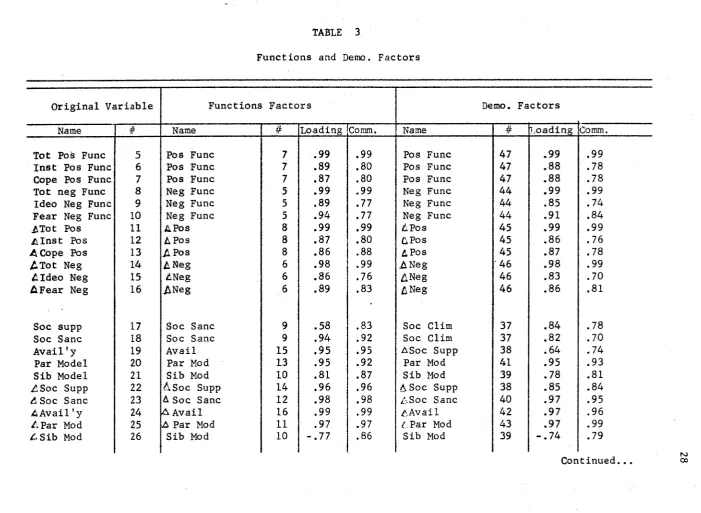
high loadings on principal compenwf,* analyses. Table 3 includes rotated
factor loadings, communalities, and lists new variable names for the two modes of factoring.
Factor Analysis of Behaviour
In both Samples 1 and 2, frequency is unrelated to the other
criteria, with time and range loading together. Table 4 presents
rotated loadings and eigenvalues .
Stepwise Multiple Regression Analysis
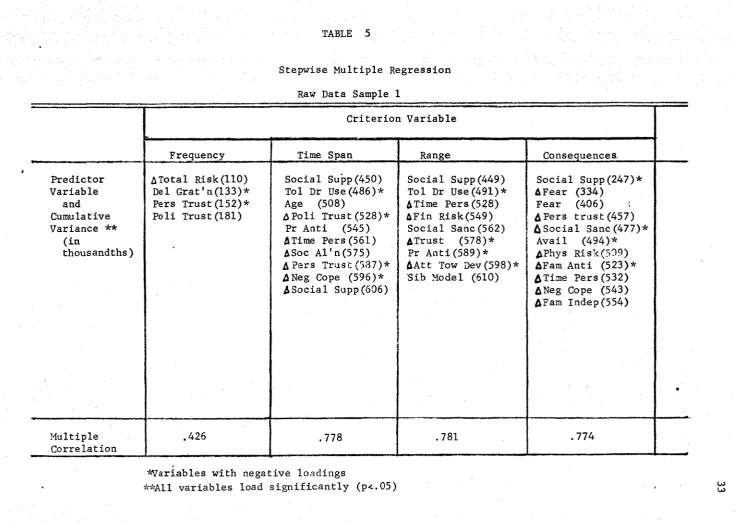
A total of 24 SMR's were calculated. Tables 5 through 10 present
the variables with significant Beta weights, the cumulative variance
in thousandths and the final multiple correlation coefficients Table 11 presents a 2 x 3 x 4 breakdown of these Multiple correlations, and
average correlations (using Fisher's Z transformation) for each
classification.
Canonical Correlations
Five canonical correlations were performed, results for canonical correlation with raw data were not obtained due to the size of the r
matrix and the programmes available. One of the canonical correlations
was meaningless due to a singular matrix resulting in a canonical
correlation greater than 1.0. Table 12 gives the significant canonical
correlations, loadings variables with loadings for each of the four meaningful analyses.
w ith pe rm is si o n of th e co py ri gh t o w ne r. Fu rthe r re production p ro h ib it e d w ith ou t p e rm is s io n .
TABLE 3
Functions and Demo. Factors
Original Variable Functions Factors Demo. Factors
Name # Name # Loading Comm. Name # Loading Comm,
Tot Pos Func 5 Pos Func 7 .99 .99 Pos Func 47 .99 .99 Inst Pos Func 6 Pos Func 7 .89 .80 Pos Func 47 .88 .78 Cope Pos Func 7 Pos Func 7 .87 .80 Pos Func 47 .88 .78 Tot neg Func 8 Neg Func 5 .99 .99 Neg Func 44 .99 .99 Ideo Neg Func 9 Neg Func 5 .89 .77 Neg Func 44 .85 .74 Fear Neg Func 10 Neg Func 5 .94 .77 Neg Func 44 .91 .84
/Tot Pos 11 4 Pos 8 .99 .99 /Pos 45 .99 .99
Alnst Pos 12 4 Pos 8 .87 .80 & Pos 45 .86 .76
A Cope Pos 13 A Pos 8 .86 .88 4 Pos 45 .87 .78
A T o t Neg 14 4 Neg 6 .98 .99 A Neg 46 .98 .99
Aldeo Neg 15 /Neg 6 .86 .76 £ N e g 46 .83 .70
AFear Neg 16 A N e g 6 .89 .83 /Neg 46 .86 .81
Soc supp 17 Soc Sane 9 .58 .83 Soc Clim 37 .84 .78
Soc Sane 18 Soc Sane 9 .94 .92 Soc Clim 37 .82 .70
Avail'y 19 Avail 15 .95 .95 ASoc Supp 38 .64 .74
Par Model 20 Par Mod 13 .95 .92 Par Mod 41 .95 .93
Sib Model 21 Sib Mod 10 .81 .87 Sib Mod 39 .78 .81
A Soc Supp 22 A S o c Supp 14 .96 .96 A S o c Supp 38 .85 .84 A Soc Sane 23 4 Soc Sane 12 .98 .98 ASoc Sane 40 .97 .95
A Avail 'y 24 A Avail 16 .99 .99 AAvail 42 .97 .96
/;Par Mod 25 A Par Mod 11 .97 .97 /Par Mod 43 .97 .99
/•Sib Mod 26 Sib Mod 10 -.77 .86 Sib Mod 39 -.74 .79
R ep ro du ced w ith pe rm is si o n of th e co py ri gh t o w ne r. Fu rthe r re production p ro h ib it e d w ith ou t p e rm is s io n .
Cont * d
Name # Name # Loading Comm. Name # Loading Comm.
Peer Conf 27 Peer Conf 27 .95 .94
Peer Indep 28 Indep 22 .87 .88
Peer Anti 29 Anticonf 21 .85 .80
Fam Conf 30 Fam Conf 30 .93 .92
Fam Indep 31 Indep 22 .87 .87 Fam Indep 29 .98 .99
Fam Anti 32 Anticonf 21 .87 .86 Anticonf 21 .97 .98
Att Tow Dev 33
To I Dr Use 34 Tol Dr Use 27 .96 .95 Tot Risk 35 Tot Risk 20 .90 .87 Phys Risk 36 Tot Risk 20 .91 .87 Fin Risk 37
Soc Risk 38 Soc Risk 20 .98 .99
Eth Risk 39
Tot I-E 40 I-E 17 .94 .95
1-E Pers 41 I-E 17 .85 .89
I-E Poli 42 I-E 17 ' .70 .82 I-E Poli 36 .93 • .96
Tot Tr 43 Poli Tr 26 .91 .90
Pers Tr 44 Pers Tr 22 .90 .91
Poli Tr 45 Poli Tr 26 .90 .89 Poli Tr 31 .97 .99
IP Alien 46
Soc Alien 47 Soc Alien 35 .96 .98
Moral Judg 48
Relig 49 Relig 33 .96 .98
Del Grat'n 50 Del Grat 24 .93 .91 Del Grat 32 .99 .99
Time Pers 51 Time Pers 23 .99 .99
Continued...
C o n t ' d o [U.
ON CO H
0 0 O N O N
m
o n
0 0 v O
on on
rH 00
ON ON
VO ON on os
00 N N ON ON ON
TJ
<D
0
C*H
•Uc
ou
Ctf
C*H
T ) <0O
r-4 < t O
in On ON SfON
vO
ON ON m vO ooon ON in ooo n
oo vo
ON ON ON
^ N sf
W H W VO 00<N CO in in
vo o
CM <0 in M H Hon oo
Q) e to 55 > a) G. FU Q
tu 0) -bi TJ *0 E* to CO
C B O •H •H M
Ms B
M H PS PS e a 4J u *G CO O to 4-1 o 4J tu O put < cn W
< -t3 <3
W W i i M M <J 4
Fi
H
H to -r lFl I- l tu o FM fF,
< S < 1 o o CO
<
to M tu FMI
•H H <3 o uCM s t
00 00
CM O OO OV
oo cn oo o\ m st ov ov 00 H Noo ov av o vo ooov r» oo vO Ov
ot B
T )
to cn oo oo vo vo in ov oo ovn in to vo s t as as vo (O vf oo as as
CM ov
M Nf IN
as in oo ov
IN.
co oo
CM CM co oo co in CM CM CO to as
cm
CM CO S t Ov OV ( O r I H oo oo in in 1-4 CM CM CO
> a) a) 6 to
'S5
oM-4 CO A ! to to C & •H CO CO FI Fi O o 0£S •H *r-i <U a) H H FM FU O H •PS Ps FU
MS (U MS tu 1 CO • r l *H C tS a • n B 4J C a W W r—4 H
O
o MB uo H c SS3<4J *H cno H1 H1 a P*o
sj < <3 <3 -4 4 < \ < <1 <J 4 4 o
CM CO s t in UD IN. oocrv o r—1 CM CO s t uo vo 1**- OO ON
in in in in inm in m vOvO vo VO vo10 vO soV0 vO C
a)
• r l
r-t
<
4
01M
l§i
8
• rlH
'SS (X MS (U * rlC X I u S B B
H < M Fl M
eu
4S CB ‘r l
B X ) U
O B S „ •••
O M -S’ H PS
>
<u
O w
,M co ^ i m 'rl
j B t l l l l W B H M H O -rl. 05 - r l - r l - r l 01 O
PS PS PS rS FM (5 CO
03 w . . •»
j-Ft t-S - r l rS Fs FM . tu p r s «sj C9 O Pi ft < O
B
<U
•H
to
-
M
CO CU
C o n t' d 31 •
n CM Os00 os OnOs OsOS OS
an
On
Os 00 oo h-* 03os 00 03 Os 03 ONOn
o o
6o
a
•rl h*
as
cr< 00 osan
Os CM oo 00 00 r-. *o 00as
on OS OSOn
Os ON ooas
03 ONw « • • • • • • « • • • • o
fi
in o f*"- < f 03 CM in m vO 00 m pH pH pH pH f-4
rH pH
0 <w
32 u UH < m
e <3
U
(U
MM« c a o •rl
ss a> •H •HI <u <u R
N <U CO pH (0MM N N o 04 pH |
■H 60 6a M P <U <D•rl •H o M
C/3 <2 C/3
>*
PmP£j04
CO 05 05m
O 0) pH cx B <0* 05
Fj CM 03 On
On
03On
Osi-MvO vO 03 ONB 00 OSon
On
03On
03 ON CO Os OSOn Co • • • • • • • • «i • • • o o
TJ
M a)
a
CO•rl 03 Os os 00 03 OS pH pH 00 00 1^ co T3 00 os Os Os os 03 03 00 03 Os OS 03 rO
« » • • • • • • • ii • • •
o T5
p C
CO vo cm co iH 03 o VO vO 00 m n* a =»= c o < f s d '< t < t c o M t c o c n < n Nfr CO o •H 4J CO 4J O fH X
r—1 c Crt
pH <u E3
to •H •H
92 CJ M < <4-1
s O PMMM CO
co
a
e> o •H s>53 <u «H •H 0) <U Q
N 0) CO pH CO »M N N o a M
•r4 op 6a M o <0 a) *H •H a x
U
a)CO < t CO S* a.
& Pi
CO 05 05 wO
4JMM
co CO. m vo oo 03 o pH CM CO in 60
=8= c-- h- I-. oo 00 00 00 oo 00 c •H •o 10
■-I
a
CO UM pH4JpH a) <U Pu 43 m pH
CO o •rl
o
3 O •H <3 o Mc
O •< PO O <u M 4-1 4.) P PM • •
w a tJ o 43
H ) O ai
•rl •rl •rl 60 144 TJ <0 X (U ci t-l 01 IH •rl •rl r4 P CO
u
<0 bO o Ms,
01 ai «2 <u a) X M .Q C/3 <2 C/3 ix P5 Oh« be C/3 w O S5TABLE 4
Factor Loadings of Criteria (Varimax Rotation)
Sample Factor
Criterion Initial
Conseq. Range Time Freq.
Eigenvalue
1 -.214 .398 .900 .090 2.284
2 -.016 .293 .101 .975 0.968 One
3 .966 -.192 -.258 -.014 0.522
4 -.147 .848 .336 .202 0.226
1 -.106 .936 .347 .109 2.076 2 -.060 .124 .130 .987 0.870 Two
3 .974 -.113 -.232 -.058 0.727
4 -.189 .309 .900 .105 0.327
One *
1 2
-. 165 .964
.915 -.180
.391 -.252
not
2.089 0.643
3 .209 -.360 -.885
included
0.268
Re pr od uc ed w ith pe rm is si o n of th e co py ri gh t o w ne r. Fu rthe r re production p ro h ib ite d wit ho ut p e rm is s io n .
TABLE 5
Stepwise Multiple Regression Raw Data Sample 1
Criterion Variable
Frequency Time Span Range Consequences
Predictor Variable
and Cumulative Variance **
(in
thousandths)
ATotal Risk(llO) Del Grat'n(133)* Pers Tru s t (152)* Poli Trust (181)
Social S u p p (450) Tol Dr U s e (486)* Age (508)
APoli T r u s t (528)* Pr Anti (545) A Time P e r s (561) ASoc Al'n(575) A Pars T r u s t (587)* A N e g Cope (596)*
ASocial Supp(606)
Social S u p p (449) Tol Dr U s e (491)* ATime P e r s (528) AFin Risk(549)
Social S a n e (562) ATrust (578)*
Pr A n t i (589)* AAtt Tow D e v (598)*
Sib Model (610)
Social S u p p (247)* AFear (334)
Fear (406) APers trust (457) ^ S oci al Sanc(477)*
Avail (494)* APhys R i s k (509) A F a m Anti (523)* ATi m e Pers (532) A N e g Cope (543) A F a m Indep(554)
•
Multiple Correlation
.426 .778 .781 .774
^Variables with negative loadings
w ith pe rm is si o n of th e co py ri gh t o w ne r. Fu rthe r re production p ro h ib it e d w ith ou t p e rm is s io n .
TABLE 6
Stepwise Multiple Regression Raw Data Sample 2
--- *---Criterion Variable
Freq. Time Span Range Conseq.
Predictor Variable and Cumulative Variance** (in Thousandths
Tol.Dr.Use (133)* Grades (132)* ADel. Grat. (177)* Time Persp. (209) Att. Tow. D e v (231) ) AEth. Rk (250) Weight (272)
Social Supp (458) ASocial Supp (512) Age (538) Sex (562) Tol. Dr. U s e (583) ASib. Mod. (599) APar. Mod. (609)
Social Supp (357) Tol.Dr.Use (407) AIP.Al'n (440)* Sex (458) Att. Tow. Dev(473) APeer Conf. (484) ASoc. Supp. (494) A F i n R k . (506)
Social Supp (259)* ASocial Sane.(307)* Soc. Sane. (339)* Alnst. Fn (374) Fin Rk (393)* Yr. in coll. (411)* AAvail. (427)
Self Des; 0bs(442) AEth. Rk (455)
Multiple
Correlation .521 .780 .711 .674
* Variables with negative loadings ** All variables load significantly
R ep ro du ced w ith pe rm is si o n of th e co py ri gh t o w ne r. Fu rthe r re production p ro h ib it e d w ith ou t p e rm is s io n .
TABLE 8
Stepwise Multiple Regression Functions Sample 2
Criterion Variable
Frequency Time Span Range Consequences
Predictor Neg Func (022)* Neg Func (177)* Soc Sane (120) Neg Func (139) Variable** ANeg Func (046)* Soc Sane (293) Neg Func (230)* ASoc Sane (207)* in order of Avail (061) Avail (386) Avail (315) Soc Sane (292)*
entry with dNeg Func (440)* AAlien'n (365)* Avail (331)*
Cumulative Sib Mod (463) ANeg Func (398)* APos Func (360)
Variance A IE (494)* ANon-Conf (412)* ANeg Func (388)
Poli Orien (518) ASoc Supp (427) Del Grat (408)* &Soc Sane (544) Poli Orien (425)*
Age (557)
AEth Rk (567)
IE (577)* «
ASoc Supp (591)
Multiple
Correlation ,246 .769 , 653 .652