A Comparative Performance Analysis of Load
Balancing Policies in Cloud Computing Using
Cloud Analyst
Saurabh Shukla 1, Dr. Deepak Arora 2
P.G. Student, Department of Computer Science & Engineering, Amity University, Lucknow, Uttar Pradesh, India1
Professor, Department of Computer & Engineering, Amity University, Lucknow, Uttar Pradesh, India2
ABSTRACT: Cloud computing is an emerging trend in IT environment which provides a pool of computing resources to customers through Internet. The fundamental principle of cloud computing is to shift the computing done from the local computer in to the network. There is a rapid increase in cloud’s users day by day. So, load balancing is a big issue in cloud computing environment. Load balancing is a method of distributing workload among all nodes to minimize the response time, maximize throughput, provide maximum resource utilization and avoid overload. Many algorithms have been proposed for load balancing in cloud environment. This paper present the performance study of some popular load balancing algorithms based on the parameters: response time and data center processing time using the Cloud Analyst Simulator.
KEYWORDS: Cloud Computing, Load balancing, Cloud Analyst, RR , ESCE, TLB.
I. INTRODUCTION
Cloud computing allows hosting of multiple services on a globally shared resource pool where resources are allocated to services on demand [1]. Cloud computing allows hosting of multiple services on a globally shared resource pool where resources are allocated to services on demand [1]. Resources are requested on-demand without any prior reservation and hence eliminate over provisioning of resources and improve resource utilization. Cloud Computing have different types of capabilities, which includes SaaS (Software as a service), PaaS (Platform as a service), IaaS (Infrastructure as a service).
Virtualization technique plays important role in cloud environment. It provides abstraction of computing element such as hardware, storage and networking. By virtualization, a single machine can be virtualized into number of virtual machines (VMs).Virtualization helps cloud providers by enabling better resource utilization, energy saving and less management overhead [2].
However, there are many issues in cloud computing. Load balancing is one of them. Load balancing is a mechanism that distributes the workload evenly among all the nodes in cloud to avoid a situation where some nodes are overloaded while other nodes are under-loaded or idle [4]. Efficient load balancing algorithm results better response time and data center processing time.
In this paper we present a performance analysis of the current load balancing algorithms. We provide a brief overview of these algorithms and compare these algorithms based on the response time and data center processing time using the simulation tool called Cloud Analyst.
II. EXISTING LOAD BALANCING ALGORITHMS
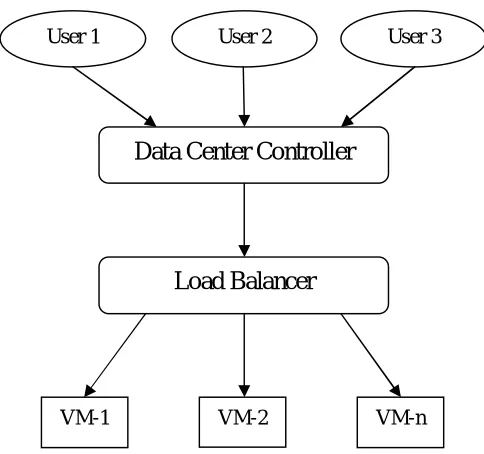
Figure 1. Load Balancing Approach in Cloud Environment
In This paper we are going to analyse three popular load balancing algorithms.
A. Round Robin Algorithm (RR):
Round Robin [3], [7] is the traditional and simplest load balancing technique. Each user request is assigned to the virtual machine (VM) in a round robin manner. Here when the Data Center Controller gets a user request it notifies the RR load balancer to allocate a new VM for processing of that request. RR load balancer picks a VM randomly from the group of VMs and returns this VM id to Data Center Controller for further processing. In this manner the subsequent user request are processed in circular order. This algorithm doesn’t consider the load on different VMs. So, at any point of time some virtual machines may be overloaded and others remain idle or under-loaded.
B. Equally Spread Current Execution Algorithm (ESCE):
This algorithm [3] is also known as Active Monitoring Load Balancing (AMLB) algorithm. This algorithm tries to maintain equal workloads on all the available Virtual machines. Here the ESCE load balancer maintains an index table of VMs as well as the number of requests currently allocated to each VM (initially all VMs have 0 allocations). When the request arrives at Data Center Controller it notifies the ESCE load balancer. ESCE load balancer then parses the index table of VMs from top to bottom and identifies the least loaded VM. If there are more than one VMs are found, the first identifies VM is selected. After finding the least loaded VM, ESCE Load balancer returns the VM id to Data Center Controller. Then the Data Center Controller sends the current request to identified VM as well as acknowledges the ESCE load balancer about the new allocation. After acknowledgement, ESCE load balancer updates the index table by increasing the allocation count by 1 for that VM. When the allocated VM finishes processing the request, it sends the response to Data Center Controller. After receiving the response from that VM, Data Center Controller notifies the ESCE load balancer about the VM de-allocation. Then the ESCE load balancer revise the index table by decreasing the allocation count by 1 for that VM.
C. Throttled Load Balancing Algorithm (TLB):
In this algorithm [3], [7] TLB Load balancer maintains an index table of all VMs along with their current states- Busy or Available (initially all VMs are in available state). When the request arrives at Data Center Controller it queries the TLB load balancer for the allocation of suitable VM. TLB load balancer parse the index table of VMs from top to bottom until the first available VM is identified or the index table is parsed completely. If available VM is found then the TLB load balancer returns the VM id to Data Center Controller. The Data Center Controller sends the current
User 1
Data Center Controller
VM-1
User 2 User 3
Load Balancer
request to identified VM as well as acknowledges the TLB load balancer about the new allocation. After acknowledgement, TLB load balancer revise the index table accordingly. On the other hand, if all the VMs are in Busy state, the TLB load balancer returns -1 to Data Center Controller. The Data Center Controller queues the request. When the VM finishes the request it sends the response to Data Center Controller. After receiving the response from the VM, Data Center Controller notifies the TLB load balancer about the VM de-allocation. Then Data Center Controller checks the queue for waiting request. If it finds the waiting request, it continue.
III.CLOUD ANALYST
It is very difficult and time consuming to analyse the performance of proposed policies in real world environment. In this situation Simulation tools becomes very helpful for users or researcher to test the policies. In order to analyse the performance of the load balancing algorithm discussed above, we use the simulation tool called Cloud Analyst. Cloud Analyst is a GUI based simulation tool derived from CloudSim and extends some of its features [3]. It is based on Java. It separates the simulation experimentation from a programming exercise. It allows users or researchers to perform number of simulation experiments with slight change in parameters.
The basic entities of Cloud Analyst tool are:
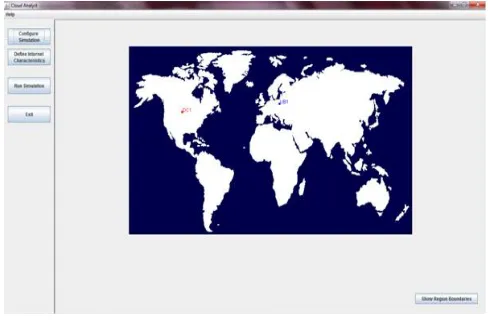
GUI Package – This package is responsible for the graphical user interface. The GUI of Cloud Analyst is shown in figure 2.
Figure 2. GUI of Cloud Analyst
Region – The world is divided into six ‘Regions’. These six regions coincide with six continents in the world.
Internet - This entity is the abstraction for real world internet and models the traffic routing behaviour.
User Base - A User base represent the group of users. The group of users considered as a single unit. Its responsibility is to generate traffic.
Cloud Application Service Broker - This entity models the service broker which is responsible for traffic routing between User bases and Data centers.
Data Center Controller – This entity manages the data center management activities. For example- VM creation and
destruction, routing of client requests to the VM etc.
IV.SIMULATION CONFIGURATION
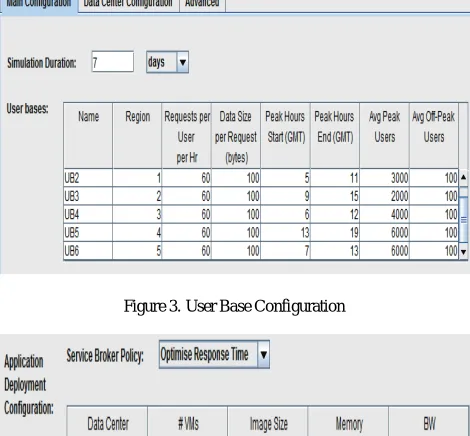
To analyse the various load balancing algorithms, we need to set the configuration of the various components of Cloud Analyst tool. We have set the parameters for user base configuration, application deployment configuration, data center configuration. As shown in figure.3 we have defined six user bases located in six different region of the world. We have taken four data centers i.e. DC1, DC2, DC3, and DC4 having 100, 80, 50, and 25 numbers of VMs respectively. Here VMs having unequal number of processors i.e. DC1 & DC3 having 1 dual core and 1 quad core processors, whereas DC2 having 1 dual core and 2 quad core processors and finally DC4 having 1 dual core, 1 quad core and 1 octa core processors. As shown in figure.6 you can choose a load balancing policy. The duration of the simulation is 7 days (168 hours).
Figure 3. User Base Configuration
Figure 4. Application Deployment Configuration
Figure 6. Load Balancing Policy
V. RESULTS AND ANALYSIS
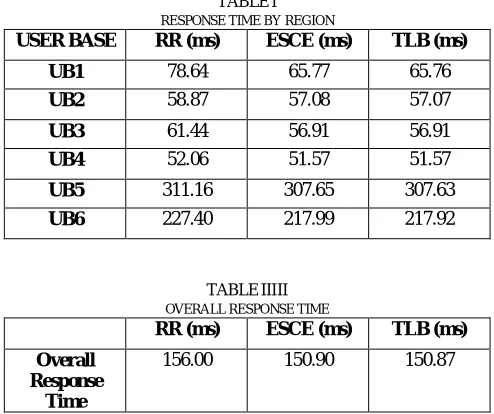
Simulations are conducted for performance analysis of three load balancing policies based on the above defined configuration by Cloud Analyst. The results calculated for the metrics like response time and data center request servicing time in fulfilling the request has been shown in Table I, II, III, IV.
A. Response Time
The response time for each user base and overall response time calculated by Cloud Analyst for each load balancing algorithm as can be seen from the Table I, II.
TABLEI
RESPONSE TIME BY REGION
USER BASE RR (ms) ESCE (ms) TLB (ms)
UB1 78.64 65.77 65.76
UB2 58.87 57.08 57.07
UB3 61.44 56.91 56.91
UB4 52.06 51.57 51.57
UB5 311.16 307.65 307.63
UB6 227.40 217.99 217.92
TABLEIIIII
OVERALL RESPONSE TIME
RR (ms) ESCE (ms) TLB (ms)
Overall Response
Time
156.00 150.90 150.87
B. Data Center Request Servicing Time
TABLEIVVVI
DATA CENTER REQUEST SERVICING TIME
Data Center RR (ms) ESCE (ms) TLB (ms)
DC1 27.95 17.04 17.01
DC2 9.17 7.38 7.36
DC3 11.51 7.56 7.55
DC4 2.36 1.86 1.86
TABLEVIIV
DATA CENTER PROCESSING TIME
RR (ms) ESCE (ms) TLB (ms)
Data Center Processing
Time
14.91 9.62 9.60
VI. CONCLUSION
The biggest issue in cloud based sector is minimization of response time and processing time in order to balance the load and increase the efficiency of business performance with customer satisfaction. Considering these things we have analyse the performance of three popular load balancing algorithm namely, Round Robin (RR), Equally spread current execution (ESCE) and Throttled load balancing (TLB). We have found that the parameters: response time and data center processing time are much better in case of ESCE and TLB when we compared to Round Robin (RR) policy. We have also found that these parameters are almost similar in case of ESCE and TLB algorithms. However, these parameters are slightly better in case of Throttled load balancing (TLB). So, we conclude that Throttled load balancing algorithm is best amongst them.
REFERENCES
1. Rajkumar Buyya, James Broberg, Andrzej Goscinski, CLOUD COMPUTING: Principles and Paradigms, Jhon Wiley & Sons, 2011. 2. J. Sahoo, S. Mohaptra and R. Lath, “Virtualization: A survey on concepts, taxonomy and associate security issues,” ICCNT, IEEE, pp.
222-226, 2010.
3. Cloud Anlyst: A Cloud-Sim-based tool for Modeling and Analysis of Large Scale Cloud Computing Environments. MEDC Project Report Bhathiya Wickremasinghe, 2009.
4. Khiyaita et al. “Load Balancing Cloud Computing: State of Art”, IEEE,2010 .
5. Rajwinder Kaur, Pawan Luthra, “Load Balancing in Cloud Computing,” ACEEE, 2014.
6. R Buyya, R. Ranjan, and R. N. Calheiros, “Modeling And Simulation of Scalable Cloud Computing Environments And the Cloudsim Toolkit: Challenges And Oppurtunities,” Proc. Of The 7th High Performance Computing And Simulation Conference, IEEE Computer Society, 2009.
7. S. Mohapatra, S. Mohanty, K. Smruti Rekha, “A comparison of four popular Heuristics for Load Balancing of Virtual Machines in Cloud Computing,” IJCA Journal, 2013.
8. M. Amar, K. Anurag, K. Rakesh, K. Rupesh, Y. Prashant, “SLA Driven Load Balancing For Web Applications in Cloud Computing Environment”, Information and Knowledge Management, vol. 1, no. 1, pp. 5-13, 2011.
9. S. Ray and A.D. Sarkar, “Execution Analysis of Load Balancing Algorithms in Cloud Computing Environment” International Journal on Cloud Computing: Services and Architecture (IJCCSA), vol. 2, no. 5, pp. 1-13, 2012.
10. T. Desai, and J. Prajapati, “A Survey of Various Load Balancing Techniques And Challenges In Cloud Computing” International Journal of Scientific & Technology Research, Vol. 2, no. 11, pp.158-161, 2013.
11. Z.Chaczko, V. Mahadevan, S.Aslanzadeh, C. Mcdermid. "Availability and load balancing in cloud computing." In International Conference on Computer and Software Modeling IPCSIT, Vol. 14, pp.134-140, 2011.
12. Bhaskar. R, S.R. Deepu, and Dr. B.S. Shylaja, "Dynamic allocation method for efficient load balancing in virtual machines for cloud computing environment." Advanced Computing: An International Journal (ACIJ), Vol.3, No.5, pp. 53-61, 2012.
13. S Jing and K She, “A Novel Model for Load Balancing in Cloud Data Centre” Journal of Convergence Information Technology, Vol. 6, no. 4, pp. 29-38,2011.
14. S. S. Moharana, R. D. Ramesh & D.Powar, “Analysis of Load Balancers in Cloud Computing” International Journal of Computer Science & Engineering (IJCSE), Vol. 2, no. 2, pp. 101-108, 2013.