Vol. 5, Issue 3, March 2017
Design & Implementation of Black Hole
Attack and Prevention using AODV for
Generalized Network
Anjali K.Jadhao, Dr.M.S.Kathane
M. E Student, Dept. of Computer Science & Information Technology, Sanmati Engineering College, Washim,
Maharashtra, India
Principal, Sanmati Engineering College, Washim, Maharashtra, India
ABSTRACT: AODV is a routing protocol that is designed for MANET and it is using the on-demand method to establish the routes between nodes .The main benefits of this protocol is establishments of desired routes to the destination. When the source node requires and it keeps the routes as long as they are needed . A black hole attack is a common attack that can be accured in AODV protocols. In this kind of attack, the attacker can uses one or more malicious nodes which advertise themselves in the network by setting a zero metric to all the destinations causes all the nodes towards the data packets to these malicious nodes. The AODV is vulnerable against the black hole attacks due to having centric property. Where all the nodes to have share their routing tables for each other.
A black hole attack is a severe attack that can be easily employed against routing in mobile ad-hoc networks. A black hole is a malicious node that falsely replies for any route requests without having active route to specified destination and drops all the receiving packets.
The Proposed Method PL2 has the modification done in AODV protocol for ensuring the security against the Black hole attack using NS2 Simulation.
I. INTRODUCTION
A network is a collection of two or more than two nodes or computer system which are connected together through wires or wireless. Wired network are those network in which computer devices attached with each other with the help of wire. The wire is used as medium of communication for transmitting data from one point of the network to other point of the network. Wireless networks are gaining popularity to its peak today, as the user wants wireless connectivity irrespective of their geographic position. Wireless Networks enable users to communicate and transfer data with each other without any wired medium between them. The general network is the network that is included LAN and WAN types of networks. These networks are mostly used in schools, colleges and organizations etc.
One of the main active attacks is Black hole attack which takes place in network layer. In Black hole attack, a
malicious node or group of malicious node drop the entire packets between source to destination .In this project, we attempt in analysing and upgrading the security of the AODV routing protocol against Black hole attack. AODV is an on demand, dynamic routing protocol and consumes less bandwidth than table driven protocol. Protecting against Black hole attack, additional commands are included in AODV.
II. LITERATURE SURVEY
Sun B et al [1] used neighbourhood based method to detect malicious node in the network. In detection procedure neighbourhood set of information is collected, further collected information is used to determine whether there Black hole attack exists. In response procedure source node sends Modify-Route-Entry (MRI) control packet to destination node to build a correct path by modifying entries of intermediate nodes. This simulation fails to detect forged fake RREPs.
Tamilselvan T [2] proposed a solution based on time based threshold detection scheme. The main concept is setting timer for collecting all other RREQ from other nodes after receiving the first request. Collect Route Reply Table is used to store the packet’s sequence number and the received time. In Route Discovery, the validity of route is checked based on the arrival time of the first request and the threshold value. This simulation shows that a higher packet delivery ratio is obtained and end to end delay might be increased when the malicious node is away from the source node.
Djenouri D et al [3] proposed a solution based on Random two hops ACK and Bayesian detection scheme. In monitor phase two hop ACK used to check the reliability of the intermediate node. In detection and removal process, Bayesian approach is used for node accusation. This simulation is efficient for all types of packet drops and has reduced overhead. This solution is not suitable for multiple Black hole attack.
DPRAODV [4] scheme has Detection, Prevention and Reactive AODV scheme. The solution is based on the validity of the RREP sequence number. If the RREP sequence number is higher than threshold value, that node is added to the Blacklist. Further receive reply from that malicious node is ignored. This simulation shows that improved packet delivery ratio at the cost of higher routing overhead.
Tsou Po-Chun et al [5] designed unique solution named Bait DSR based on Hybrid Routing scheme. Initially the source node sends Bait RREQ, having destination address which does not exist. This bait RREQ can attract the forged RREP and can remove Black hole nodes. This simulation results show increased packet delivery ratio and acceptable overhead.
III. OVERVIEW OF AODV PROTOCOL
The Ad-hoc on demand Distance Vector routing algorithm is a designed for ad hoc mobile network. It’s a routing protocol i.e. determine the appropriate path from the source to destination. The AODV is capable to route both unicast and multicast. These protocols are broadly divided into two categories [9].
a) Table-driven routing protocols or proactive routing protocol.
b) Source-initiated on-demand driven routing protocols or reactive routine protocol.
Table-driven routing protocols are also known as proactive routing protocols. The proactive routing protocol are maintain table of all routing information. These protocols desire to maintain unique, exact and all routing information in the network. All the nodes exchange routing information periodically and also there is even a minor change in the network topology and thus, every node in the network maintains one or more routing table are stores routing information about every other node in the network [10]. Source-initiated on demand driven routing protocols are also known as reactive routine protocol. AODV is a reactive routing protocol used to search a route between source and destination and establish new route and give new route path. In this order it is manage route and different types of link is establish, information are exchange. Its find route when necessary [11]. The drawback of this routing protocol is delay due to route discovery.
Source Address Request ID Source Sequence number Destination Address Destination Sequence Number Hop count
Fig.1 RREQ format
Source Address Destination Address Destination Sequence Number Hop count Life time
Vol. 5, Issue 3, March 2017
Each mobile node in the network can get to know its neighbourhood by using periodic HELLO messages [8]. HELLO messages are used to inform the neighbouring node that the link is still alive and never be forwarded [9].
IV. BLACK HOLE ATTACK
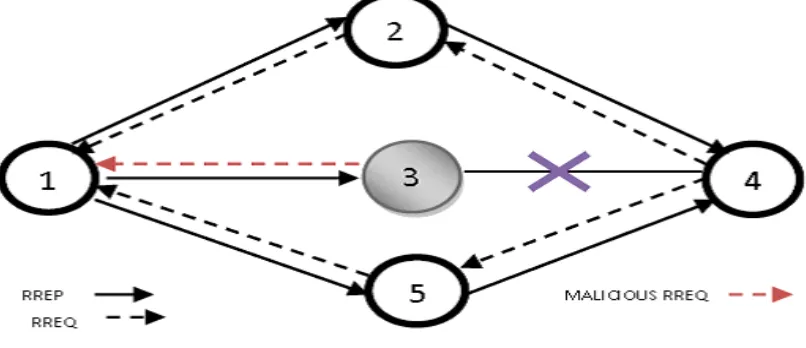
Black hole attack is a Denial-Of –Service attack that could easily happen in wireless network.To carryout Black hole attack in the network, a malicious node waits for the neighbouring node to send RREQ messages [10][11]. After getting RREQ messages, it sends fake RREP at once, as it has route over destination without checking routing table by assigning high sequence number. So requesting node assumes that Route Discovery process is completed and starts transmitting data packets over that malicious node, without knowing about malicious activity. Black node drops the incoming entire packets between the source to destination, instead of transmitting to destination. As a result the source and destination node unable to communicate with each other. Since AODV treats RREP messages having higher sequence number to be fresher, the malicious node always send the RREP having higher sequence number [12].
Fig.3 Black Hole Attack
An example is shown as Figure 1, node 1 represents the source node and node 4 represents the destination node. Node 3 is a malicious node who replies the RREQ packet sent from source node, and sends a false response that it has the shortest route towards the destination node. Therefore node 1 judges the route discovery process with completion, and starts transmission of data packets to node 3. As mentioned above, a malicious node probably drops the packets. As a result, node 3 is able to misroute the packets easily, and the network operation is suffered from this problem.
V. PROPOSED METHOD—PL2 METHOD
PL2 method is PreLude, PostLude method. The proposed solution is an enhancement of the original AODV routing protocol to find a secure routes and prevent Black hole attack on Generalised network . The Major concept is based on time and neighbourhood parameters. This method first check for malicious activity exists, and then starts detect and remove the Black hole nodes. Route discovery is same as original AODV, but when sending data packets, prelude and postlude messages are added.
Detection of Black Hole Activity
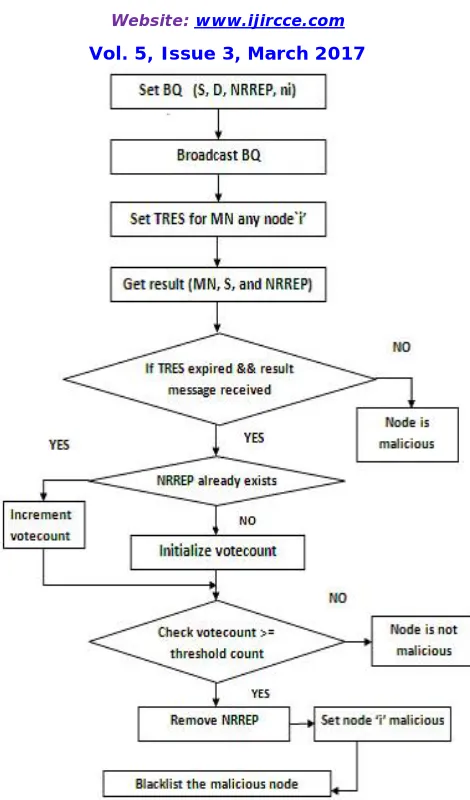
(D, S, d_count) message from destination node after receiving data. ni is the number of data in particular block i and d_count is the number of data received by destination node. If source node not receive postlude message within timeout period TS, malicious activities are confirmed in the network. Windowing mechanism used to reduce the end to end delay and data loss. Detailed processes are as shown in flowchart Fig.5.
Black Hole Removal Process
In Black hole removal process, source node sends query BQ (S, D, NRREP, ni) to monitor node to find out malicious node. NRREP is the ID of the node sending RREP to source. In response monitor nodes sends back result to source node. If source node receives result before a particular time TRES, predicted that the particular monitor node itself is a malicious node. So Source node depends on other monitor node’s results to build a secured path. Based on monitor nodes result, source node starts votecount. Votecount is a count, for not forwarding the data packets of the particular node, when it receives from other node. If votecount of the particular node is greater than the threshold value, the source node confirms that the node as a Black hole node and will be listed in Blacklist. Threshold value is a variable depends on the size of the network. As source node knows the location of the Black hole nodes, it ignores the RREPs from these nodes. The flow chart for detailed process is as shown in Fig.4.
Vol. 5, Issue 3, March 2017
Fig.5. Flow Chart for Black Hole Removal
PARAMETER VALUE
AREA 1000 * 1000
Simulation Time 60s
No. Of Nodes 15
Traffic Model CBR
Protocol AODV
No. Of Attackers 3
Drop Rate 1 Mbps
Packet Size 512 bytes
Performance Metrics Throughput &
PacketDrop.
Fig.6. Network Simulator-2
VI. SIMULATION AND ANALYSIS
The simulation has been carried out using NS-2.35. In ns2, two languages are used, tcl-tool command language as front end and c++ as back end .The user writes in tcl script, are interpreted by network simulator and give two output files. They are NAM and tr files.NAM is for visual animation of output and tr is the large text trace file consists of simulation Results. In this simulation15 nodes are considered in the terrain area of 1000x1000. Malicious activity in the network is assumed as a 1 Black hole nodes are included in the simulation. Simulation parameters are considered as shown in the Table.1 Performance of AODV can be analyzed by different simulation metrics such as packet delivery ratio and throughput etc.
Packet Delivery ratio
It is a ratio of total number of packets received by the destination node to the total number of packets sent by
the source node. PDR simply describes the level of delivered data.
Σ Number of data packets received
PDR = ---
Σ Number of data packets sent
Fig.7 Packet Delivery Ratio
In fig.7 shows that PDR of the proposed PL2 method is higher than AODV with Black holes. As Black holes induce packets drop, the PDR of original AODV decreases with increase in number of nodes.
Throughput
80
85
90
95
5
15
20
30
P
ack
et
del
ivery
rat
io (
%)
Number of nodes
Packet Delivery Ratio
Vol. 5, Issue 3, March 2017
The number of bits received over the time difference between the first and the last received packets. Throughput graph is plotted by varying number of nodes. Presence of malicious node in the network is degrading the performance of AODV. In fig.9 shows that the proposed PL2 method has good throughput comparably 10% higher than original AODV with Black hole attack and throughput decreases as increase in number of nodes.
Fig.9 Throughput
VI. CONCLUSION AND FUTURE WORK
In this paper, we proposed PL2 method.PL2 is a source, neighbour, time based and modified AODV routing protocol to mitigate Black hole attack. We simulated our proposed solution using ns-2 and compared our modified AODV with original AODV in terms of packet delivery ratio and throughput. Simulation results shows that the proposed method has good performance against Black hole attack and not much overhead. This solution holds good for gray hole attack also. In our future work, we may propose a feasible solution which will strengthen original AODV against multiple Black hole attack.
REFERENCES
[1] Sun B, Guan Y, Chen J, Pooch UW, “Detecting Black-hole Attack in Mobile Ad Hoc Networks”, 5th European Personal Mobile Communications Conference, Glasgow, United Kingdom, . 22-25 April 2003.
[2] Tamilselvan L,Sankaranarayanan V, “Prevention of Blackhole Attack in MANET”, International Conference on Wireless Broadband and Ultra Wideband Communications, Sydney, Australia, 27-30 August 2007.
[3] Djenouri D,Badache N, “ Struggling Against Selfishness and Black Hole Attacks in MANETs”,Wireless Communications and Mobile Computing, 2008.
[4] Raj PN ,Swadas PB, , “DPRAODV: A Dynamic learning System against Blackhole Attack in AODV based MANET”, International Journal of Computer Science Issue,vol.2,pp.54-59 ,2009.
[5] Tsou P-C, Chang J-M, Lin Y-H, Chao H-C, Chen J-L, “ Developing a BDSR Scheme to Avoid Black Hole Attack Based on Proactive and Reactive Architecture in MANETs”, Paper presented at the 13th International Conference on Advanced Communication Technology, Phoenix Park, Korea, pp.755-760, Feb. 13-16, 2011.
[6] Nisarg Gandhewer and Rahila Patel, “Performance Evaluation of AODV protocol in MANET using NS2 simulator”, 2nd National Conference on Information and communication Technology (NCICT) 2011, Proceeding published in International Journal of Computer Applications (IJCA). [7] Hilmani Yadav, Rakesh kumar, “A Review of Black Hole Attack in MANET”, International Journal of Engineering Research and Applications, vol.2, issue.3, pp.1126-1131, may-june 2010.
[8] Umang S, Reddy BVR, Honda MN, “ Enhanced Intrusion Detection System for Malicious Node Detection in Ad Hoc Routing Protocols using Minimal Energy Consumption”,IETCommunications,vol.4,Issue.17,pp.2084-2094, 2009.
[9] EA Mary Anita and Vasudevan V, “Black Hole Attack Prevention in Multicast Routing Protocol for Mobile Adhoc Networks using Certificate Changing”,International Journal of Computer Applications,vol.1, issue.12,pp.21-28, 2010.
0
20
40
60
80
5
10 15 20 25
Th
ro
u
gh
p
u
t
in
k
b
p
s
Number of nodes
MobileAd Hoc Networks by Dynamic Learning Method”, International Journal of Network Security,vol.5,no.3,pp.338-346,2007.
[11] Ajay Sharma “Performance Evaluation of AODV under Black hole attack in MANET using NS2 simulator” ISSN: 2278 – 1323 International Journal of Advanced Research in Computer Engineering & Technology (IJARCET) Volume 1, Issue 8, October 2012