AMRAN RASLI
NOR AKMAR NORDIN
RACHEL TAN
SAZLINA AZWA SANUSI
CONSUMER ACCEPTANCE OF A
NEW PRODUCT: FOOD PACKAGING
USING A SMART BIO-SWITCH CONCEPT
3
INTRODUCTION
In the past twenty years, the use of plastic packaging has grown remarkably, because of its convenience for manufacturing, handling and daily usage. In particular, multilayer barrier packaging has challenged metal and glass for a longer shelf life in food packaging, because of its barrier properties as well as its versatility and convenience. For this reason, this barrier packaging market has grown rapidly, and represents about 2% of the Gross National Product of most developed countries (Ahvenainen, 2003).
Modern food packaging no longer has just a passive role in protecting and marketing the product. It increasingly has an active role in processing, preserving and in retaining the safety and quality of food throughout the distribution process. In order to improve the performance of packaging in meeting these varied demands,
innovatively modified and controlled-atmosphere packaging, active
and smart packaging systems are being developed, tested and optimized in laboratories around the world (Ahvenainen, 2003).
There are many types of active packaging widely used in
Europe such as oxygen scavenger packaging, time-temperature
varieties of food production and Malaysian consumers prefer to use plastic as packaging tools, active packaging is asuitable technology to be implemented and has big potential in commercialization.
Active packaging is intended to sense internal or external environmental changes and modify internal packaging environment by modifying its own properties. Therefore, the goals of active packaging is to extend the shelf life of contained food and beverages products either to remove oxygen or to prevent it from entering the
in-package environment.
What is termed “smart packaging” could present a different case. It has not been the subject of such strained attempts to
define the nature of the concept. It is merely presented as a class
of materials “designed to monitor the condition of the food” (Heckman, 2005). Thus, presumably, such materials would serve no ordinarily protective purpose in the food packaging (i.e., would not help protect against contamination or adulteration of the food) other than to provide notice if the food had been spoiled or was otherwise adversely affected.
A revolutionary active-smart packaging using a bio-switch
concept is a combination technology of biodegradable polymer,
antimicrobial control releaser and pH-color indicator from
Anthocyanidin extracts which was developed and had attracted attention from the industry. According to Muhamad (2007) the
active-smart packaging using a bio-switch concept is able to detect
the degree of continuous natural fermentation in food products or
the spoilage of non-fermented food by microorganisms or chemical reaction by pH color changes. The first combination of active-smart packaging technology by combining antimicrobial agent and pH-color indicator with suitable compatibility makes the bio-switch
One reason for the slow progress may have been the anticipated consumer concerns of these new applications (Muhamad, 2007). However, this technology can be implemented widely in order to extend shelf life, increase the safety assurance and provide better preservation as well as ensure the stability and freshness of
the foods. Active-smart plastic film formulation for packaging will
be enhanced by upgrading its functions. Hence, the value of the
active-smart packaging using a bio-switch concept will be increased
and the product will be more useful than the existing technologies. As with any new product launch or line extension, it is critical during the early stages to monitor the acceptance amongst
consumers with regards to the active-smart packaging using a bio-switch concept. Early indications are needed to allow for
fine-tuning of the marketing mix in order to maximize initial sales opportunities and establish a solid foundation for growth. As such this study was conducted to assess consumers’ reaction to smart
bio-switch packaging as compared to the traditional packaging. The study seeks to identify which market position should the smart
bio-switch packaging focus on and what factors affect the consumers’ perceptions.
Because new technologies such as active packaging are complex and an element of uncertainty exists in the minds of decision makers with respect to the successful adoption of them, people form attitudes and intentions toward trying to learn to use the new technology prior to initiating efforts directed at using them. Attitudes towards usage
and intentions to use may be ill-formed or lacking in conviction or
METHODOLOGY
The Delphi method was used in the study as it is a systematic
interactive method for obtaining opinions on smart bio-switch
packaging based on feedback from a panel comprising of 12 independent experts. The carefully selected experts are requested to answer a carefully structured questionnaire that seek to identify
factors affecting the consumers’ perceptions regarding smart bio-switch packaging in the first round. The first round was able to
uncover the following factors: performance, features, reliability, conformance, durability, aesthetics and perceived quality.
After the first round, an anonymous summary of experts’
opinions from the previous round as well as the reasons they provided for their judgments are presented (Rowe and Wright, 2001). Thus, participants are encouraged to revise their earlier answers in light of the replies of other members of the group. It is believed that during this process the range of the answers will decrease and the group will converge towards the “correct” answer. However, problem arose due to the attrition of experts whereby only 9 experts continued in the second round of the Delphi Method.
The Delphi Method is arrived at after achieving a consensus
or stability of results. For the Delphi method, a non-parametric analysis using Kendall’s coefficient was utilised. The research
hypothesis is that there is consistency in ranking by the experts based
on the factors deemed as important for smart bio-switch packaging. The Kendall’s Coefficients of Concordance (W) will be tested for statistical significance by observing the p-value and comparing the Chi-square test statistics with the critical value.
After the completion of the Delphi Method, content analysis and expert opinions were used to determine the market positioning
of the smart bio-switch packaging. For this purpose, a number of
marketing experts from various institutions of higher education. Based on a review of literature, critical information regarding properties and cost of packaging material, availability of raw material, safety and environmental features are provided to ascertain the position of various packaging options within the perceptual map.
FACTORS DEEMED AS IMPORTANT FOR SMART BIO-SWITCH PACKAGING
The first round of the Delphi Method uncovered 7 factors and 14 attributes deemed as important for the success of the smart
bio-switch packaging in the market: (1) Performance (extend shelf life of the food than traditional food packaging; and monitor condition of packaged food to give information about the quality of the food),
(2) Features (price of the smart bio-switch packaging: and freshness of food in the smart bio-switch packaging), (3) Reliability (ability to
protect the food from any kind of microbe and chemical adulteration, oxygen, light, and water vapour; and ability to guarantee the safety and
cleanliness of the food packaged), (4) Conformance (the adherence of Bio-Switch packaging from the perspective of biodegradability; and the suitability of Bio-Switch packaging for various types of food
products i.e., liquid or solid), (5) Durability (high ability to absorb maximum load; and high ability to withstand stress), (6) Aesthetics (attractive from the indicator label design; and attractive from the other packaging methods), and (7) Perceived Quality (willingness
of consumers to switch to Bio-Switch packaging because of the value for money; and consumer usage of Bio-Switch packaging for environmental considerations). The information obtained in the first
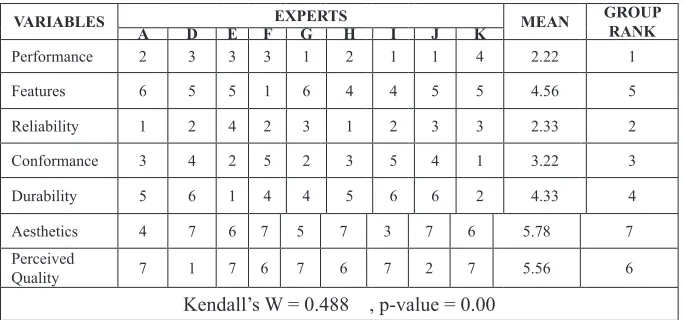
round was conveyed for the second round of the Delphi Method. Based on the results of the second round of the Delphi
scored ranking was 0.448 and 0.00 respectively. Since the p-value was less than 0.05, the findings are deemed to be significant implying
that the ranking of the 9 experts are consistent (refer Figure 1).
Figure 1: Round 2 Survey Results for Delphi Method
VARIABLES EXPERTS MEAN GROUP RANK
A D E F G H I J K
Performance 2 3 3 3 1 2 1 1 4 2.22 1
Features 6 5 5 1 6 4 4 5 5 4.56 5
Reliability 1 2 4 2 3 1 2 3 3 2.33 2
Conformance 3 4 2 5 2 3 5 4 1 3.22 3
Durability 5 6 1 4 4 5 6 6 2 4.33 4
Aesthetics 4 7 6 7 5 7 3 7 6 5.78 7
Perceived
Quality 7 1 7 6 7 6 7 2 7 5.56 6
Kendall’s W = 0.488 , p-value = 0.00
MARKET POSITIONING FOR SMART BIO-SWITCH PACKAGING
The content analysis was used to construct a perceptual map in
order to position smart bio-switch packaging against other forms
of packaging. The information obtained will help to select market target strategies and determine how to position the product for a market target (Cravens and Piercy, 2003).
allows the consumer to see the product, but is fragile and breakable. However, the single biggest factor limiting the use of glass as a food packaging material is its price.
Plastics are finite barriers to permeation and this property
manifests in the forms of gas transfer (e.g., oxygen penetration of
packages), gain or loss moisture, and absorption of flavor and aroma
bodies. Some food compounds, such as aromatic oils, may attack some plastics. The low densities of plastics may produce unique handling challenges on lines designed originally for glass and steel (Brown, 1992).
In addition, the content analysis was able to uncover new techniques such as oxygen packaging, active and smart packaging
methods. Although there are many benefits to the safety and quality of
food products using an oxygen scavenger, there are facts that should be considered when determining its application. One precaution for oxygen scavenger packaging is the prevention of anaerobic pathogen proliferation. Product developers must thoroughly investigate the food system with which they are intending to use oxygen scavengers. Studies have been done with oxygen scavengers that show pathogens such as Clostridium botulinium Type E surviving in an oxygen scavenger environment (Rooney, Chapter 6). The real risk is that the normal aerobic spoilage organisms that act as indicators for the consumer are not present because of the lack of oxygen in the package. Consumers could potentially eat a product with a pathogen unknowingly if other hurdle technology is not applied to the product (Kaufman et. al, 2000).
types of micro-organisms present in food will be different from the
same food packaged in a conventional manner (Robertson, 2006).
Antimicrobial films that only inhibit spoilage in micro-organisms
without affecting the growth of pathogenic bacteria will also raise food safety concerns.
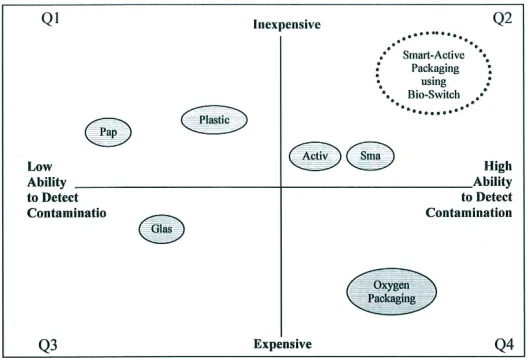
Based on the aforementioned information and taking into consideration the availability of raw material, risk and the
manufacturing costs, a focus group session involving five marketing
experts and practitioners were conducted to develop a perceptual map of all possible packing options. After two hours of intense
sessions, a finalised perceptual map was developed as shown in
Figure 2.
The marketing experts viewed that the perception map should focus on two dimensions: food safety within the package and price of the end product. After taking into consideration all the
information provided, the smart bio-switch packaging is positioned
in the second quadrant (Q2). The vacuum in the second quadrant has the greatest potential to appeal due to its lower cost and high ability to detect contamination.
CONCLUSION
The development of the smart bio-switch packaging as a new
entrant into the packaging industry holds much promise. It has the potential to be the perfect substitute to the existing product offered in the packaging industry, or a discontinuous innovation that could
revolutionise the whole industry (McDermott and Handfield, 1997). Its eco-friendliness due to its bio-degradability and pricing
attractiveness coupled with its ability to detect contamination makes
the smart bio-switch packaging a very viable business proposition
with tremendous potential to venture into the export market.
Based on the mean ranking from the Delphi Method, the ranking
of dimensions based on importance for smart bio-switch packaging is
as follows: performance, reliability, conformance, durability, features,
perceived quality and aesthetics. This finding implies that the experts view that performance is the most important dimension in Smart
Bio-Switch packaging as compared to the traditional packaging, while aesthetics is the least important dimension.
This finding is consistent with several dimensions of quality
proposed by Garvin (1987). From the perspective of performance,
the smart bio-switch packaging fulfills its primary role as a packaging
option and has “extra” features as illustrated in the perception map.
In addition, the smart bio-switch packaging is perceived as reliable and conforms to pre-established standards. Finally, the smart
RECOMMENDATIONS
Though the smart bio-switch packaging appears to be an attractive
proposition to the food packaging industry, a precautionary approach is strongly recommended as numerous studies have shown the high failure rate of new product development (Cooper, 1999). As such, McDermott (2000) proposes the “probe and learn” process whereby companies developed their products by probing potential markets with early versions of the products, learning from the probes, and probing again. In effect, they ran a series of market experiments— introducing prototypes into a variety of market segments. This process, as described, understands the nature of emerging markets and uncertain technology. According to McDermott (2000), probes are simply “feelers” to get a better sense of the market. From the outset, it is viewed as an iterative
process, with the goal of the first several attempts to learn as much
as possible about the market so that later attempts might be more on target. Adherence to the aforementioned recommendation could
ensure a better success rate for the introduction of the smart
bio-switch packaging into the market.
REFERENCES
Ahvenainen, R. (2003), Novel Food Packaging Techniques. CRC Press Boca Raton Boston New York.
Bagozzi R., Coronel F. F. and Rosa J. J. (1998). Marketing Management. Prentice Hall.
Brown, W. E. (1992). Plastics in Food Packaging: Properties, Design, and Fabrication. Boca Raton, FL: Taylor & Francis/ CRC Press.
Management, Vol. 16 pp.115-33.
Cravens D. W. and Piercy N. F. (2003). Strategic Management. 7th
ed. New York: McGraw-Hill Companies, Inc.
Garvin, D. G. (1987). Competing on the Eight Dimensions of Quality. Harvard Business Review. Vol. 65 No.6, pp.101-109. Heckman J. (2005). Active and Intelligent Packaging - A European
Anomoly. [online] http://www.packaginglaw.com/index_fcn. cfm?id=38
Hurme E., Hägg M., Häkkinen U., Kumpulainen J. and Ahvenainen R. (1998). Effects of preparation procedures, packaging and storage on nutrient retention in peeled potatoes. Journal of Science Food and Agriculture. Vol. 77, pp. 519-526.
Kaufman J., LaCoste A., Schulok J., Shehady, E. and Yam K. K. (2000). An overview of oxygen scavenging packaging and applications. [online] http://www. foodingredientsonline.com/
content/news/
article.asp?docid={e887d52b-b11b-11d4-8c75-009027de0829
McDermott, C. M. (2000). Discontinuous Innovation. In Technology Management Handbook. in Richard and Dorf (Eds.), Boca Raton: CRC Press LLC.
McDermott, C. M. and Handfield, R. (1997). The Parallel Approach
to New Product Development and Discontinuous Innovation, working paper, The Lally School of Management and Technology, Rensselaer Polytechnic Institute, Troy, NY.
Muhamad I. I. (2007). An Active-Smart Plastics Films for Applications in Packaging using a Smart Bio-Switch Concept.
Powerpoint Presentation Material for MTDC Presentation. Obtained from FKKKSA, Universiti Teknologi Malaysia on 15 August 2007.
Robertson G. L. (2007). Shelf life of packaged foods: its measurement and estimation. In Brody and Lord (Eds). Developing New Food Products for a Changing Marketplace, Second Edition. Boca Raton, FL: Taylor & Francis/CRC Press.
2nd ed. Boca Raton, FL: Taylor & Francis/CRC Press.