A Survey on Analysis of ANN and KNN
Classifier for Image Classification with
Discrete Wavelet Transform
Rupali P. Mahalle1, Prof S.K. Nanda2
M.E Student, Dept. of Electronics and Telecommunication, P.R. Patil C.O.E.T. Amravati, India1
Professor, Dept. of Electronics and Telecommunication, P.R. Patil C.O.E.T., Amravati, India2
ABSTRACT: Image classification has been widely used in industry. In this project we are presenting a comparison between two approaches of image classification. For the comparison we have used two methods that are widely used for image classification, the first is neural network and the lateral one is K-Nearest Neighbor method. In this work, we use the three RGB bands of a color image in RGB model to extract the describing features of an image. Wavelet transform is been used widely for extracting the features of an image. Wavelet transform describes texture and shape features of an image and color moments extract the color information. All the images are stored in database. Using the images in the database and the neural network we compute the accuracy of this method and for same set of database we also compute the accuracy of K-nearest neighbor method. Lastly we show a comparison table between this two methods and state which has a better accuracy.
KEYWORDS: Daubechies wavelet transform; RGB model; K-Nearest Neighbor classifier; Artificial Neural Network
I. INTRODUCTION
Image categorization is exigent problem in organize a large image database. However, an effective method for such an objective is still under investigation. A method based on wavelet analysis to extort features for image categorization has presented in this paper. After an image is decomposed by wavelet. A new advance for image categorization based on the color information, shape and texture is presented.
The growth of digital image and video archives are increasing the need for tools that effectively filter and efficiently search through large amounts of visual data. Image categorization from a catalog has particularly difficult for conventional machine learning algorithms because of the high number of images and many details that illustrate an image. For these reasons, conventional machine are unstable to classify images from a database. Also, these machines take long time for categorization. Existing image storing systems limit categorization mechanism to illustrate an image based on color information, texture or shape features. One of the existing methods for categorization, detection and recovery of images are based on Neural Networks (NN). Images that we use in this project have 700 pixels thus, image includes 35,000 RGB pixels. If such image is used as an input of NN, the number of input unit of NN are going to escalating and cause to the size of the NN also are escalating thus, because of existing many images that are classified and high number of input unit of NN, learning of the NN is very intricate. To grip high dimensionality, image categorization systems usually depend on a pre-processing step to reduce the information of the image, this compact sets are used for input variable to neural network.
II. RELATED WORK
In this work some of the research work related to image categorization using artificial neural network and K Nearest Neighbors with Daubechies Wavelet transform are discussed. Scientists doing high content screening generate massive amounts of image data that need to be access quickly, analyzed and re-analyzed, shared with social group and stored safely. There are many image storing systems used in industry and a research for a more proficient method is in progress to overcome the disadvantages of existing image storage system. Query by image content (QBIC) is one of the admired image storage systems.
QBIC:
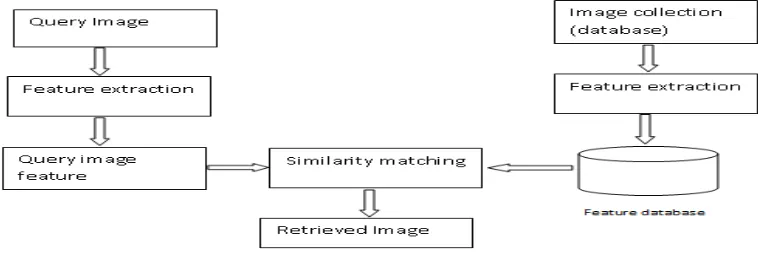
Content-based image retrieval (CBIR), also acknowledged as query by image content (QBIC) and content-based visual information retrieval (CBVIR) is the relevance of computer vision techniques to the image recovery problem, that is, the problem of searching for digital images in outsized databases. "Content-based" means that analyzes the contents of the image rather than the metadata such as tags, keyword and description associated with the image. The term "content" in this context might refer to colors, shapes, textures, or any other information that can be consequent from the image itself. CBIR is enviable because most web-based image explore engines rely purely on metadata and this produces a lot of trivia in the results. Also having humans physically enter keywords for images in outsized database can be ineffectual, exclusive and may not capture every keyword that describes the image. Thus a system that can filter images based on their content would endow with better indexing and it gives the perfect result.
Fig. 1 Query by Image Content
Artificial Neural Network:
Fig. 2 Mathematical Representation of Neuron
K-Nearest Neighbor Method:
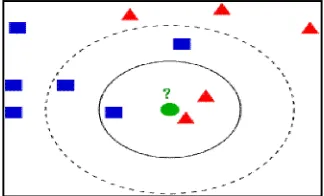
K Nearest Neighbor (KNN) is algorithms that are very simple to recognize but works extremely well in practice. Also it is amazingly versatile and its applications range from vision to DNA sequencing to computational geometry to Data mining and many more. In pattern detection, the k-nearest neighbor’s algorithm (k-NN) is a non-parametric method for categorization and deterioration that predict objects' "values" or class memberships based on the k closest training examples in the feature space. K Nearest Neighbor Method is a category of instance-based learning or lazy learning where the function is only approximated locally and all calculation is deferred until categorization. The k-nearest neighbor algorithm is used for all machines: an object is categorized by a majority vote of its neighbors with the object has been assigned to the class most common amongst its k nearest neighbors (k is a small positive integer). For example, consider the green circle is test sample should be classified to either first class such as blue squares or second class such as red triangles. If k = 2(solid line circle) it is assigned to the second class because there are 2 triangles and only 1 square. If k =4 (dashed line circle) it is assigned to the first class because there are 3 square and 2 triangles.
Fig.3 K-Nearest Neighbor Classification Wavelet Transform:
images, When a wavelet transform is applied it produces as many coefficients as there are pixels in the image. These coefficients can then be compressed more easily because the information is statistically concentrated in just a few coefficients. This principle is called transform coding. The Daubechies wavelets, based on the work of Ingrid Daubechies, are a family of discrete wavelet transform and characterized by a maximal number of evaporation moments for some given support. Each step of the wavelet transform applies the scaling function to the data input. If the original data set is N values then the scaling function will be applied to the wavelet transform step to calculate N/2 round values. In the prearranged wavelet transform, the smoothed values are stored in the lower half of the N element input vector. With each wavelet type of this class, there is a scaling function (called the father wavelet) which generates an orthogonal multi-resolution analysis.
III.PROPOSED METHOD
Our goal is classification of large number of images based on the color and shape information. So that we use wavelet, first order color moment and neural networks. There are different methods of neural network, but we use the back propagation neural network (BPNN). BPNN is very useful in classification of images. At first step, we define the number of neural network inputs. Extensive point is the size of neural networks, because the large size increases the time of learning and its not optimum. So that we try to decrease the number of input units for network. The size of all images that we have used is 500*700 pixels. We decomposed the image to its three-based color (Red, Green and Blue) and got three images in three basic bands. Later we down sampled these images into 256*256 pixels. Now we divided each colorful bands to six equal parts with 128*128 pixels and getting inputs of network in two stage :
a) Calculate the first order color moment (mean) of each six parts, for three basic bands and got 18 inputs for network that contains color's information.
b) We apply the db4 wavelet transform with sixth level decomposition to six parts of three basic bands of original image to get the horizontal, vertical and diagonal detail with size 2*2 (cH6, cV6,cD6). We used this information as inputs of neural network. To avoid large number of inputs for network we use the horizontal information of six parts of red band (cH6-R), the vertical information of six parts of green band (cV6-G) and the diagonal information of six parts of blue band (cD6-B). Totally 72 inputs of network were obtained from wavelet transform that contain the shape and texture information.
c) The next three input of NN are obtained from wavelet decomposition energy Eh, Ev and Ed, which contain the percentages of energy corresponding to the horizontal, vertical, and diagonal details, respectively. We apply the first level of db4 wavelet transform to three RGB band of original image and find the Eh, Ev and Ed of each band. Therefore, other nine input of NN are obtained. Finally after these three steps, the network has 99 input units.
IV.CONCLUSION AND FUTURE WORK
Conclusion:
In this project, we introduced a new approach for image classification using neural network and wavelet transform. The system was trained to detect an image in the presence of one of six different categories. R, G and B plains of the color image were employed for indexing Wavelet transform describe texture and shape features of images and color moments extract the color information. We use the three RGB bands of a color image in RGB model to extract the describing features. All the images in image database are divided into 6 parts. Then apply the first order color moment and Daubechies 4 wavelet transform to extract the input vector of neural network. We use the back propagation neural network for image classification and use optimum method to train it. Actually we test the performance of our proposed system with data base of different kind of objects.
Future work:
From this work in future anyone can proceed for some new approaches for image classification and comparative study of KNN and ANN for enhancing the performance of image classification. Some of the suggestions are as follows: 1) We can use some more wavelet transform like symlets wavelet, Coiflets wavelet, Biorsplines and compare result. 2) We can take more database image for batter training and perform same experiment.
3) Beside Levenberg-Marquardt (LM) training method, we can use some other neural network training method like Bayesian Regularization, Resilient Back propagation, Gradient Descent with Momentum. All this method also train neural network.
5) We can increase number of neurons and epoch.
REFERENCES
1. M. J. Swain, D. H. Ballard, “Color Indexing”, International paper of Computer Vision, Vol. 7, No. 1 , pp. 11-32, 1999.
2. J. Pakkanen and J. Iivarinen, "A Novel Image Retrieval System Based on BP Neural Network", Proc. Int. Conf. on Neural Networks, China, pp. 2561-2564, 2005.
3. J. Pakkanen and J. Iivarinen, "A Novel Self Organizing Neural Network for Defect Image Classification", Proc. Int. Conf. on Neural Networks, Hungary, pp. 2553-2556, 2007
4. Laurene Fausett, Fundamentals of Neural Networks. Prentice Hall International, Inc., Chap. 6, 1994.
5. S. Zhang and E. Salari, “Image de-noising using a neural network based on non-linear filter in wavelet domain”, Proc. Int. Conf. on Acoustics, Speech, and Signal Processing, Geneva, pp. 989-992, 2006
6. Soo Beom Park, Jae Won Lee, Sang Kyoon Kim, “Content-based image classification using a neural network” , Department of Computer Science, Inje University, 607 Obang-dong, Kimhae Kyungnam 621-749, South Korea pp 287 -300.
7. W. Niblack, R. Barber, M. Flickner, “The QBIC Project: Querying Images By Content Using Colour, Texture and Shape,” SPIE Vol. 1908 (1993)/173.
8. Laurene Fausett, “Fundamentals of Neural Networks”. Prentic Hall Intenational, Inc., Chap. 6, 1994.
9. M Khan, Qin-Ding and W Perrizo, “K-Nearest Neighbors Classification of Spatial Data Streams using P-trees”, Proceedings of the PAKDD, 2002, pp. 517-528.
BIOGRAPHY
Rupali P. Mahalleis a student of Master of Engineering in the Electronics & Telecommunication Department, P.R.
Patil College of Engineering and Technology, S.G.B.A University, Amravati, MS, India. Her research interests in Digital Image Processing Techniques.
Prof S. K. Nanda is the HOD of Electronics and Telecommunication Department, P.R. Patil College of Engineering