Efficient Location Tracker Using Keyword
Search
Prasad Prabhakar Joshi, Anand Bone
M. E Student, Smt. Kashibai Navale Sinhgad Institute of Technology and Science Kusgaon (Budruk), Lonavala, Pune,
Maharashtra, India
Assistant Professor, Department of Computer Engineering, Smt. Kashibai Navale Sinhgad Institute of Technology and
Science Kusgaon (Budruk), Lonavala, Pune, Maharashtra, India
ABSTRACT: Special objects specifically locations always associated with one or more keywords related with it.
User can reach upto these objects many times with only keywords or at most by using actual co-ordinates of location. While searching multiple locations specifically more places like hotel, theatre, hospital etc. your always gets problem to get all location in one go. If user searches hotel then user will get some hotels near to current location but the decision of which is the best hotel always depends on user. To overcome these problemsby giving suggestion to user on specific parameters and allow user to search more than one places in one go for better user satisfaction.
KEYWORDS: Latitude; Longitude; location rating; distance, location based service
I. INTRODUCTION
Now days each individual require location based services like finding shopping mall, hotel, theatre etc. When user wants to search any location or any place then number of systems are available to give result to user as per query word. As per traditional systemsuser enter single keyword at a time and will get available choices as per location searched. All locations are stored in special database with related keywords for each location. For example Movie Theatre will be related with Movie, theatre, cinema, etc. When user gets a list of places related with keyword then important thing for user will always make a choice form this list of places. User choice depends on some of following reasons like Distance form my location, Quality of place (normally we consider it with rating of place which is nothing but the review of different peoples who already visited the place), available other options like if hotel is near to that place so can continue with dinner, expense one can afford, available time etc.
Many times system can do some more calculation and can give better result in terms of choices to user. If system is already feed with some more parameters related to place then it is possible. Like if all places are with their users experiences (in terms of rating) or approximate cost for single person etc.(exception: Temple will not have any rating or cost etc). While moving through problem some more calculation system can do for best possible solution and ultimately better user experience.
II. RELATED WORK
In [1] an author first takes the keywords as input form user and then finds the locations for each keyword. Each objection location has property like latitude, longitude, rating, description etc. Based on these properties they find the best one pair of location (1 location for each word) and give this pair to user as best locations for entered keyword. The given location pair based on the rating of locations, distance from the user’s current location and distance between location for each keyword called as inner object distance.
To calculate the accurate distance between two co-ordinates two methods are available namely, Great-Circle distance method and other is haversine formula distance.
These two methods are mostly used to calculate distance between two location by specifying the latitude and longitude of both location.
possible hence great-circle distance. Great circle distance accepts latitude and longitude of two locations and calculate distance in kilometer. There are different methods to calculate great-circle distance. Following is Haversine formula:
Δ σ = arccos( sinϕ1⋅sinϕ2 + cosϕ1⋅cosϕ2⋅cos( Δ λ ) )
d = r Δ σ
Where,
d is distance in Kilometer,
ϕ1λ1 ϕ2λ2 be the geographical latitude and longitude of two points 1 and 2,
Δϕ and Δλtheir absolute differences, Δ σthe central angle between them, r is radius of sphere
Fig: Great-Circle calculation
III.PROPOSED ALGORITHM
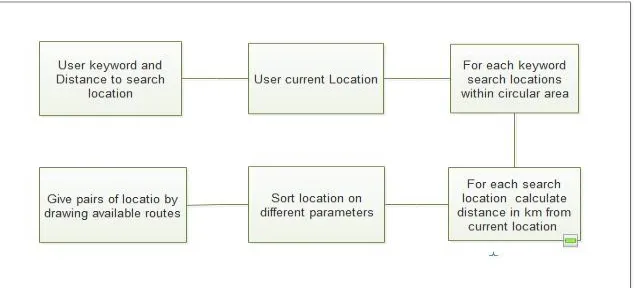
In proposed system first step is accepting the user input in terms of keyword as well as the max distance user is ready to travel. By taking each keyword finding of available location is done. While searching available location important step if to limit the location search area by drawing circle by taking user current location as centre point and user input-distance parameter as radius of circle. Due to this the accuracy of results increases as well as reduce in processing time with reduces in garbage of unnecessary locations. Here we get available location for each keyword then next step is to calculate distance between current location of user and each location we have. This distance is calculated using Haversign formula for finding great-circle distance between two locations.
After calculating distance we sort all location on basis of rating, shortest distance and inner object shortest distance. While sorting locations we get best 1 location for each word- each sorting criteria and which we gives to user. Location (single for each word) with highest rating for each keyword, with shortest distance, etc. Hence user gets number of choice pairs having one location for each keyword.
IV.PSEUDO CODE
Step 1: Take keywords and distance (in meter) for limit search as user input. Step 2: Take users current position in terms of latitude and longitude Step 3: Filter keywords for removing false result.
Step 4: Find all locations for each keyword within limited circular area.
Step 4: For each searched location calculate distance in km form current location. Step 5: Sort locations on different sorting options:
5.1: Sort as per shortest distance 5.2: Sort on rating
Step 6: For each search option take pair of location (one for each word) Step 7: Draw route between selected location for each pair and show to user Step 8: End.
V. RESULTS
After implementation above process flow we get the desire result which was the aim behind this study. When user enters keywords existing system was giving bulk of places which was too away from user too. By taking radius form user we improve upto the result as well as reduce garbage bulk places and also save the bandwidth usage system require serving user.
Implementation details with screen shot displays how actual system works. As show in following screen shot, user entered two keywords as hotel, theatre and enter radius (max area should cover in result) as 500 (which is in meters) so system gives total 3 locations for hotel, theatre and gives path to travel.
Fig : Available choices to user
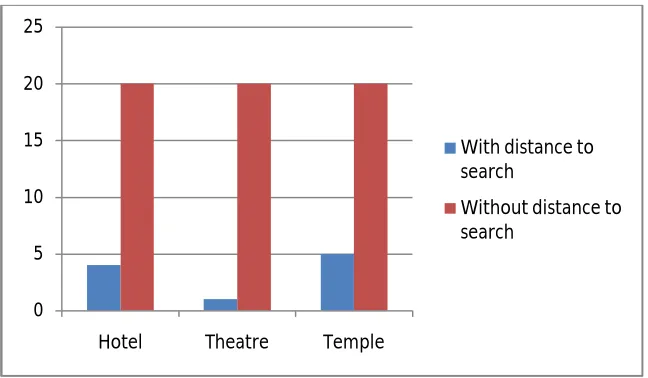
While perform search with adding distance as extra parameter the available places reduces to a great extend hence minimize wastage for all useless location system gives as a result to user.
Fig : With adding parameter as distance to consider for giving user result
VI.CONCLUSION AND FUTURE WORK
The results showed that the proposed algorithm performs better with accurate result and more than one choice for user than single result to user with no choice. Also the proposed algorithm provides more accurate locations only than the existing system as added one parameter of distance (radius to consider) for location search.Also proposed system gives the existing all routs user can consider to visit places.
In future system can improve by giving only shortest route to user as well as by stating the way user should visit location in which order. If all location are with available time and minimum budget for single user then these two parameters can give more accurate result with better user satisfaction.
0 0.5 1 1.5 2 2.5
Hotel, TheatreHotel, GardenHotel, Temple
Improved System
Existing System
0 5 10 15 20 25
Hotel Theatre Temple
With distance to search
[4] Ian De Felipe, Vagelis Hristidis, Naphtali Rishe, Keyword Search on Spatial Databases, in Proc. IEEE 24th Int. Conf. Data Eng., 2008, pp.656665
[5] Z. Li, K. C. Lee, B. Zheng, W.-C. Lee, D. Lee, and X.Wang,IRTree: An efficient index for geographic document search, IEEE Trans. Knowl. Data Eng., vol. 99, no. 4, pp. 585599, Apr. 2010.
[6] G. Cong, C. Jensen, and D. Wu,Efficient retrieval of the top-k most relevant spatial web objects, Proc. VLDB Endowment, vol. 2, no. 1, pp. 337348, Aug. 2009.
[7] D.Amutha Priya, Dr. T.Manigandan, Fast Accurate Mining on Spatial Database Using Keywords, International Journal for Research in Applied Science and Engineering Technology(IJRASET), Volume 3, Special Issue-1, May 2015.
[8] X .cao, G Cong, C Jensen COLLECTIVE SPATIAL KEYWORD QUERYING IN Proc.ACM SIGMOD Int. Conf manage. Data , 2011 ,pp. 373-384.
[9] J .fan , G Li , L . Zhou, S Chen , and J. Hu Seal : SPATIOTEXTUAL SIMILARITY SEARCH . PVLDB, 5(9): 824-835, 2012.
[10] Ruchir Puri, Student Member, IEEE, and Jun Gu, Senior Member, IEEE An Efficient Algorithm to Search for Minimal Closed Covers in Sequential Machines . IEEE TRANSACTIONS ON COMPUTER-AIDED DESIGN OF INTEGRATED CIRCUITS AND SYSTEMS. VOL. 12. NO. 6. JUNE 1993.
[11] Dingming Wu , Man Lung Yiu , Christian S. Jensen , Gao Cong Efficient Continuously Moving Top-K Spatial Keyword Query Processing . [12] https://developers.google.com
BIOGRAPHY
Prasad Prabhakar Joshi is a last year student of ME in Computer Engineering Department, SKN Sinhgad Institute of
Technology and Science, Kusgaon, Pune, Maharashtra. He isperusing Master of Computer Engineering degree from Savitribai Phule Pune University.
Anand Bone are an Assistant Prof. in Department of Computer Engineering, Smt. Kashibai Navale Sinhgad Institute