ISSN(Online): 2320-9801
ISSN (Print): 2320-9798
I
nternational
J
ournal of
I
nnovative
R
esearch in
C
omputer
and
C
ommunication
E
ngineering
(An ISO 3297: 2007 Certified Organization)
Vol. 4, Issue 8, August 2016
WiFi Based GSM Based Efficient Data
Collection from Sensor Network
Rashmi Y Kolkar, Dr G S Sharvani
PG Scholar, Dept. of CSE, RV College of Engineering, Bangalore, India
Associate Professor, Dept. of CSE, RV College of Engineering, Bangalore, India
ABSTRACT: Wireless Sensor Network is a very important technology in which sensors are placed in a distributed
manner to monitor the physical and environment changes such as temperature, humidity etc. An ecological monitoring system consists of a sensors which are linked together to form an integrated system of electronic temperature and event logger. Data transmission through this network may be done through wireless communication modes (e.g. Wi-Fi). Which enables data access from anywhere, the alert feature has also been implemented to notify users via message for monitoring data when they exceed values and events of interest. The integration of Wireless Sensor Network and wireless data transmission using esp8266 wifi module, This proposed system combines the advantages of wireless sensor networks and GSM technology which is a low power technology. Context information brings new opportunities for efficient and effective system resource management of mobile devices. In this work we focus on the use of context information to achieve energy-efficient, ubiquitous wireless connectivity. Our field-collected data show that the energy cost of network interfaces poses a great challenge to ubiquitous connectivity, despite decent availability of cellular networks. We propose to leverage the complementary strengths of Wi-Fi and cellular interfaces by automatically selecting the most efficient one based on context information. We formulate the selection of wireless interfaces as a statistical decision problem. The challenge is to accurately estimate Wi-Fi network conditions without powering up the network interface
KEYWORDS: GSM, Network Architecture and Design, Local and Wide-Area Networks, esp8266, Wi-Fi networks
I.INTRODUCTION
Smart sensing nodes with embedded CPUs, low power radios and sensors which are used to monitor environmental conditions such as temperature, pressure, humidity, vibration and energy consumption. The system consists of hardware, networks, services, storage, and interfaces to provide the better computing service. It is also possible to upload the data obtained from the wireless sensor nodes to the Web services by using protocols like Simple Object Access Protocol and Representational State Transfer, using messaging mechanisms such as emails and SMS or social networks and blogs. Using IoT web service application, wireless communication has developed in the field like e-health care services, smart homes, or even vehicular area networks (VAN). By connecting, evaluating and linking the sensor, data conclusions can be made in real time, trends can be predicted and hazardous situations can be avoided.
By using wireless sensor network (WSN) and GSM technology, we can design a security monitoring and alerting system that can detect and control various sensor values by using wireless communication along with sensor setup. Wireless sensor technology has an ability to monitor the sensor data remotely. GSM technology is generally used for long and wide range communication system. The remote monitoring system presented in this paper combines the advantages of WSN and GSM technology. Primarily, wherever theft happens at home or at the agriculture field alert message or call will be sent to concern person. GSM technology has high reliability because concerned person gets the information about the intrusion very quickly. Secondly, the wireless sensor system can be ease to setup, uses less cable and utilizes low power.
ISSN(Online): 2320-9801
ISSN (Print): 2320-9798
I
nternational
J
ournal of
I
nnovative
R
esearch in
C
omputer
and
C
ommunication
E
ngineering
(An ISO 3297: 2007 Certified Organization)
Vol. 4, Issue 8, August 2016
which displays the present status of the temperature and humidity. But most of time such an alerting message could easily go unnoticed. So, it is better to log the data in a remote computer so that he can keep a track of the data. Another work in makes use of the alarming system for attending a patient, This temperature and humidity measurement sensor can fail if the user in charge is away for the situation where the emergency is taking place. A temperature and humidity sensors rise an alarm following it would be unnoticed. So, a robust device combining an alerting and data logging system is needed to avoid this kind of situation. The paper deals with sending the values of temperature to the environment where sensor is exposed to, by SMS for the user or the person in charge. Also, by creating microcontroller database, the design described in this paper can be used as a modification for alerting the user by giving an “ALERT SMS” when the temperature have a deviation from a critical value preset by the user. The system of server guard maintenance mechanism presented in the current paper is totally different as it doesn’t take into consider any software which has to be run in any of personal computer. The final product doesn’t take into consideration any high power consumption devices like laptop or personal computer. The response of our design when the temperature or humidity is out of range as defined by the user or the critical value preset by the user is better and more advanced as we have the provision for data logging as well as to alert the user in case of an alarming event.
II.LITERATURESURVEY
Arun K. Kumar et al [1] this method proposes for an In a Wireless Sensor Network (WSN), battery power is a limited resource on the sensor nodes. Hence, the amount of power consumption by the nodes determines the node and network lifetime. This in turn has an impact on the connectivity and coverage of the network. One way to reduce power consumed is to use a special Mobile Data Collector (MDC) for data gathering, instead of multi-hop data transmission to the sink. The MDC collects the data from the nodes and transfers it to the sink. Various kinds of MDC approaches have been explored for different assumptions and constraints. But in all the models proposed, the data latency is usually high, due to the slow speed of the mobile nodes. In this paper, we propose a new model of mobile data collection that reduces the data latency significantly. Using a combination of a new touring strategy based on clustering and a data collection mechanism based on wireless communication, we show that the delay can be reduced significantly without compromising on the advantages of MDC based approach. Using extensive simulation studies, we analyze the performance of the proposed approach and show that the packet delay reduces by more than half when compared to other existing approaches.
M.G.Annapoorani et al [2] described in wireless sensor network (WSN) the data collection is more challenging one, because each node in the network having limited bandwidth and energy level. With the aim of reducing energy consumption and to achieve high data accessibility with low communication cost in the presence of multiple next hop nodes, the proposed approach is designed with 3 phases (i) initialization phase (ii) packet-splitting phase (iii) forwarding phase. Before the collection of data from sensor node, the sink node broadcast the message to all sensor nodes in the network to form the route path from the sensor to sink. To form the route path the proposed system incorporate the method of Self Cantered Friendship (SCF) that means each node will consider itself as root node and appends the nodes that are connected to them by one hop. After the basic formation of SCF Tree the system moves forward with help of CRT for splitting the packets. The Chinese Remainder Theorem (CRT) is characterized by a simple modular division between the integers. Finally the system simply forwards the sub packets towards the sink which broadcast the message for data. Once all sub packets (called CRT components) are received correctly the sink node will recombine them using mask. When, compared to the existing data collection techniques data collection using SCF Tree with CRT based packet forwarding is found to produce the best result in terms of energy consumption, data accessibility and low communication cost.
ISSN(Online): 2320-9801
ISSN (Print): 2320-9798
I
nternational
J
ournal of
I
nnovative
R
esearch in
C
omputer
and
C
ommunication
E
ngineering
(An ISO 3297: 2007 Certified Organization)
Vol. 4, Issue 8, August 2016
the treatment module in order to decide which data mule can reach the target. Several factors such as battery status, coverage issues, and communication situations have been taken into consideration.
III.PROPOSEDSYSTEM
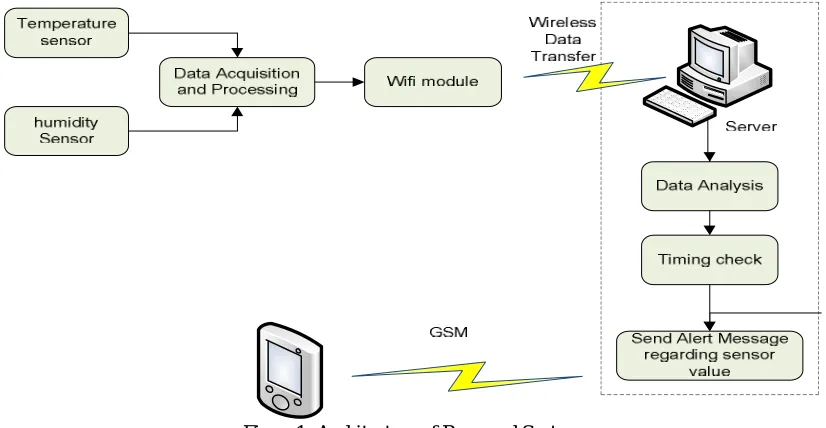
The architecture of proposed system is shown in figure 1. The system uses sensor network which is capable of sensing environmental parameter like temperature and humidity. For the data acquisition Intel Arduino UNO/Microcontroller board will be connected. The signal data is processed and transferred to server system using Wi-Fi module esp8266. Esp8266 is integrated chip which offers a complete and self-contained Wi-Wi-Fi networking solution. The data which is received by the server is analyzed and data is converted to presentable form using mat lab. For every certain time interval data is sent to the mobile user through wireless GSM technology and immediately message passing framework will be invoked.
Figure1: Architecture of Proposed System
a. Temperature Sensor
LM35 is a precision IC temperature sensor with its output Proportional to the temperature (in o C). The sensor circuitry is sealed and therefore it is not subjected to oxidation and other processes. With this sensor, temperature can be measured more accurately than with a thermostat. It also possess low self heating and does not interest to go more than 0.1 o C temperature rise in still air.
ISSN(Online): 2320-9801
ISSN (Print): 2320-9798
I
nternational
J
ournal of
I
nnovative
R
esearch in
C
omputer
and
C
ommunication
E
ngineering
(An ISO 3297: 2007 Certified Organization)
Vol. 4, Issue 8, August 2016
The operating temperature range is from -55°C to 150°C. The output voltage varies by 10mV in response to every o C rise/fall in ambient temperature. In the system a temperature sensor in LPC 2148 is used in measuring temperature of the locality. The sensor circuitry is sealed and therefore it is not subjected to oxidation and other processes. With LM35, temperature can be measured more accurately than with a thermostat. It also possess low self heating and does not cause more than 0.1 oC temperature rise in still air. The operating temperature range is from -55°C to 150°C. The output voltage varies by 10mV in response to every oC rise/fall in ambient temperature, i.e., its scale factor is 0.01V/ oC. Along with this a variable resistor output can also be set for voltage output.
b. Humidity Sensor
Humidity measurement in industries is critical because it may affect the business cost of the product and the health and safety of the personnel. Hence, humidity sensing is very important, especially in the control systems for industrial processes and human comfort. Controlling or monitoring humidity is of paramount importance in many industrial & domestic applications. The response time and power consumption of the developed sensor module were observed to be 15sec and 1.0mW, respectively. The humidity range of the developed sensor module is set from 0% to 100%.
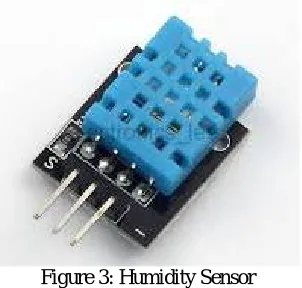
Figure 3: Humidity Sensor
Due to the effect of humidity and temperature on calibrating of gas sensors MQ-2 and MQ-135 as shown in figure 2.a and 2.b, we added temperature and humidity sensor the DHT21. DHT21 and DHT22 are relative cheap sensors for measuring temperature and humidity. In reference and there is a description of library for reading both values from these sensors. We contacted the manufacturer to get the details of the differences between the two DHT sensors to build a lib that supports both. The DHT21/22 is quite similar to the DHT11 however it has a greater accuracy (one decimal) and range (negative temperatures). The hardware pins and handshake are identical but it uses a different data format.
ISSN(Online): 2320-9801
ISSN (Print): 2320-9798
I
nternational
J
ournal of
I
nnovative
R
esearch in
C
omputer
and
C
ommunication
E
ngineering
(An ISO 3297: 2007 Certified Organization)
Vol. 4, Issue 8, August 2016
GSM is one of the most widely used mobile telephone system. As communication with a mobile phone occurs over a radio link it is susceptible to attacks that passively monitor the airways (radio paths). The security and authentication mechanisms incorporated in the GSM make it the most secure mobile communication standard currently available, particularly in comparison to the analog systems. GSM security and encryption algorithm are used to provide authentication and radio link privacy to users on GSM network. Security in GSM consists of the following aspects: subscriber identity authentication, subscriber identity confidentiality, signalling data confidentiality, and user data confidentiality. Several security functions were built into GSM to safeguard subscriber privacy. The GSM specification addresses three key security requirements: authentication, confidentiality and anonymity. There are three proprietary algorithms used to achieve authentication and confidentiality.
d. WIFI Module
Wifi modules also called Serial wifi modules, Function is the serial port or TTL level to comply with wifi wireless network communication standard embedded modules, built-in wireless networking protocols 802.11b / g / n protocol stack and TCP / IP protocol stack. Traditional embedded wifi wireless wifi module can directly access the Internet, is an important part of the intelligent home, M2M and other networking applications.
Figure 4: Global System of Module Network
Figure 5: Overall Block Diagram for Arduino UNO Connections
In this diagram consists Temperature sensor, Humidity sensor, Wi-Fi module and those are connected in to Arduino.
IV.EXPERIMENTALRESULTS
ISSN(Online): 2320-9801
ISSN (Print): 2320-9798
I
nternational
J
ournal of
I
nnovative
R
esearch in
C
omputer
and
C
ommunication
E
ngineering
(An ISO 3297: 2007 Certified Organization)
Vol. 4, Issue 8, August 2016
(a)
(b)
ISSN(Online): 2320-9801
ISSN (Print): 2320-9798
I
nternational
J
ournal of
I
nnovative
R
esearch in
C
omputer
and
C
ommunication
E
ngineering
(An ISO 3297: 2007 Certified Organization)
Vol. 4, Issue 8, August 2016
(d)
(e)
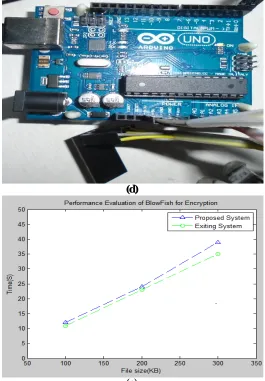
Figure 6: (a) AT Commands; (b) Ardino With GSM; (C)GSM Module; (d)Ardino; (e) Performance Evaluation of Blowfish for Encryption
V.CONCLUSION
ISSN(Online): 2320-9801
ISSN (Print): 2320-9798
I
nternational
J
ournal of
I
nnovative
R
esearch in
C
omputer
and
C
ommunication
E
ngineering
(An ISO 3297: 2007 Certified Organization)
Vol. 4, Issue 8, August 2016
REFERENCES
[1] Arun K. Kumar and Krishna M, Sivalingam, “Energy-Efficient Mobile Data Collection in Wireless Sensor Networks with Delay Reduction
using Wireless Communication”.
[2] M.G.Annapoorani1, M.S.Kokila,“Energy Efficient Data Collection for Mobile Users in Wireless Sensor Networks Using SCFT Protocol”.
International Journal of Advanced Research in Computer and Communication Engineering Vol. 3, Issue 8, 2014.
[3] HajarMansouri,FouadMoutaouakil, HichamMedromi, “An autonomous intelligent gateway for wireless sensor network based on mobile
node”, (IJACSA) International Journal of Advanced Computer Science and Applications, Vol. 5, 2014.
[4] N. Sakthipriya, “An Effective Method for Crop Monitoring Using Wireless Sensor Network”.
[5] Ismail Salhi, Mohamed Cherif, and Sidi Mohammed Senouci, “Data Collection in Vehicular Networks”.
[6] JiaHao, SeonHo Kim, SakireArslan Ay, Roger Zimmermann, “Energy-Efficient Mobile Video Management using Smartphones”.
[7] Ahmad Rahmati, Student Member, and Lin Zhong, Member, IEEE, “Context-Based Network Estimation for Energy-Efficient Ubiquitous
Wireless Connectivity”.
[8] Mohammad M. Alwakeel “Sensors and Sensor Network Applications”, vol 82.2015.
[9] MohanrajGovindaraj&SarithaKarthik, “Threshold Based Energy Efficient Data Transmission in Wireless Sensor
[10] Network”, International Journal On Engineering Technology and Sciences, Vol III, Issue I, 2016.