Scholarship at UWindsor
Scholarship at UWindsor
Electronic Theses and Dissertations Theses, Dissertations, and Major Papers
2012
ISSUES AND SOLUTIONS OF APPLYING IDENTITY-BASED
ISSUES AND SOLUTIONS OF APPLYING IDENTITY-BASED
CRYPTOGRAPHY TO MOBILE AD-HOC NETWORKS
CRYPTOGRAPHY TO MOBILE AD-HOC NETWORKS
Shushan Zhao University of Windsor
Follow this and additional works at: https://scholar.uwindsor.ca/etd
Recommended Citation Recommended Citation
Zhao, Shushan, "ISSUES AND SOLUTIONS OF APPLYING IDENTITY-BASED CRYPTOGRAPHY TO MOBILE AD-HOC NETWORKS" (2012). Electronic Theses and Dissertations. 5414.
https://scholar.uwindsor.ca/etd/5414
This online database contains the full-text of PhD dissertations and Masters’ theses of University of Windsor students from 1954 forward. These documents are made available for personal study and research purposes only, in accordance with the Canadian Copyright Act and the Creative Commons license—CC BY-NC-ND (Attribution, Non-Commercial, No Derivative Works). Under this license, works must always be attributed to the copyright holder (original author), cannot be used for any commercial purposes, and may not be altered. Any other use would require the permission of the copyright holder. Students may inquire about withdrawing their dissertation and/or thesis from this database. For additional inquiries, please contact the repository administrator via email
IDENTITY-BASED CRYPTOGRAPHY TO
MOBILE AD-HOC NETWORKS
by
Shushan Zhao
A Dissertation
Submitted to the Faculty of Graduate Studies through the School of Computer Science
in Partial Fulfillment of the Requirements for
the Degree of Doctor of Philosophy at the
University of Windsor
Windsor, Ontario, Canada
2011
c
by
Shushan Zhao
APROVED BY:
____________________________________________
Dr. I. Stojmenovic, External Examiner
University of Ottawa
____________________________________________
Dr. H. Wu
Department of Electrical & Computer Eng.
____________________________________________
Dr. A. Jaekel
School of Computer Science
____________________________________________
Dr. Z. Kobti
School of Computer Science
____________________________________________
Dr. A. Aggarwal, Advisor
School of Computer Science
____________________________________________
Dr. R. Kent, Co-Advisor
School of Computer Science
____________________________________________
Dr. M. Hlynka, Chair of Defense
Department of Mathematics & Statistics
I. Co-Authorship Declaration
I hereby declare that this thesis incorporates material that is the result of joint research
undertaken by me under the supervision of Dr R. D. Kent and Dr. A. K. Aggarwal. The
collaboration is covered in Chapter 2, 3, 4, 5, 6, 7 of the thesis. In all cases, the key
ideas, primary contributions, experimental designs, data analysis and interpretation, were
performed by the author, and the contribution of coauthors was primarily through the
pro-vision of valuable suggestions and helping in comprehensive analysis of the experimental results submitted for publication.
I am aware of the University of Windsor Senate Policy on Authorship and I certify that
I have properly acknowledged the contribution of other researchers to my dissertation,
and have obtained written permission from each of the co-author(s) to include the above
material(s) in my thesis.
I certify that, with the above qualification, this dissertation, and the research to which it
refers, is the product of my own work.
II. Declaration of Previous Publication
This thesis includes eight original papers that have been previously published/submitted
for publication in peer reviewed journals/conferences, as in following table.
I certify that I have obtained written permissions from the copyright owners to include the
above published materials in my dissertation. I certify that the above materials describe
work completed during my registration as graduate student at the University of Windsor.
I declare that, to the best of my knowledge, my thesis does not infringe upon anyone’s copyright nor violate any proprietary rights and that any ideas, techniques, quotations,
or any other material from the work of other people included in my thesis, published or
Chapter 2
Shushan Zhao, Akshai Aggarwal and Robert D. Kent “A Framework for Revocation of Proxy Certificates in a Grid”, In Proc. 8th International Conference on Soft-ware Engineering, Artificial Intelligence, Networking, and Parallel/Distributed Computing (2007), IEEE, pp. 532–537 Published. c 2007 IEEE. Chapter 2
Shushan Zhao, Akshai Aggarwal and Robert D. Kent “PKI-Based Authentication Mechanisms in Grid Sys-tems”, In Proc. International Conterence on Network-ing, Architecture, and Storage (2007), IEEE, pp. 83–90
Published. c
2007 IEEE.
Chapter 3
Shushan Zhao, Akshai Aggarwal, Richard Frost and Xi-aole Bai “A Survey of Applications of Identity-Based Cryptography in Mobile Ad-Hoc Networks”, J. Com-munications Surveys & Tutorials, Volume PP Issue 99, March 2011, IEEE, pp. 1–21
Published. c
2011 IEEE.
Chapters 4,5
Shushan Zhao and Akshai Aggarwal “PAPA-UIC: A Design Approach and a Framework for Secure Mo-bile Ad-hoc Metworks”, J. Security and Communica-tion Networks, Special Issue: Security in Ad Hoc Net-works and Pervasive Computing, Volume 3 Issue 5, September-October 2010, John Wiley and Sons, pp. 371–383
Published. c
2010 John Wiley & Sons.
Chapters 4,5
Shushan Zhao, Akshai Aggarwal, Shuping Liu and Huapeng Wu “A Secure Routing Protocol in Proactive Security Approach for Mobile Ad-hoc Networks”, In Proc. Wireless Communications & Networking Con-ference (2008), IEEE, pp. 2627–2632
Published. c
2008 IEEE.
Chapters 5
Shushan Zhao and Akshai Aggarwal “Against mobile attacks in Mobile Ad-hoc Networks”, In Proc. Infor-mation Theory and InforInfor-mation Security (2010), IEEE, pp. 499–502 Published. c 2010 IEEE. Chapters 5
Shushan Zhao, Daniel Jaskiewicz and Jouni Karvo “A Deployment Tool for Public Safety Ad-hoc Networks”, In Proc. 1st Communication System Software and Mid-dleware (2006), IEEE, pp. 1–6
Published. c
2006 IEEE.
Chapters 7
Shushan Zhao and Akshai Aggarwal “General-purpose Identity Hiding Schemes for Ad-hoc Networks”, In Proc. International Symposium on Intelligent Ubiqui-tous Computing (2009), IEEE, pp. 349–352
Published. c
2009 IEEE.
bounds of fair dealing within the meaning of the Canada Copyright Act, I certify that I
have obtained a written permission from the copyright owner(s) to include such
mate-rial(s) in my thesis.
I declare that this is a true copy of my thesis, including any final revisions, as approved
by my thesis committee and the Graduate Studies office, and that this thesis has not been
submitted for a higher degree to any other University or Institution.
Concept of Mobile Ad-hoc Networks (MANETs) was brought up a few decades ago with
assumed prosperous future. Unfortunately, we do not see many practical applications
of them in real life. Security of MANETs is a big concern considered by investors and
industries, and hinders them from putting MANETs into application. Requirements of
security, and difficulties to meet these requirements have been stated clearly already; yet
solutions to these difficulties are not quite clear. Cryptographic technologies seem to
be capable of satisfying most of the requirements, which has been proved in Internet or
wired networks. However, most of the technologies, including symmetric and traditional asymmetric cryptography (such as Public Key Infrastructure (PKI)), are inapplicable or
inconvenient to use in MANETs context. Identity-based Cryptography (IBC), as a special
form of asymmetric cryptography, carries many features interesting for MANETs. IBC
has been studied a lot recently by researchers of MANET security, and many applications
have been proposed and claimed to address this difficult problem. However, it is still the
case that most of the solutions are not sound enough to be used in a practical MANET.
This thesis starts with an intensive survey on the proposals of applications of IBC in
MANETs, and points out the issues, limitations and weaknesses in these proposals and
also in IBC itself. The thesis proposes a novel framework with key management and
secure routing scheme integrated aiming to address these issues. This scheme brings
these contributions: compared to symmetric key solutions, it has more functionality de-rived from asymmetric keys, and is more secure due to using 1-to-m broadcasting key
instead of only 1 group broadcasting key, and has less keys to store per node due to using
asymmetric keys instead of pairwise symmetric keys; compared to traditional
asymmet-ric cryptography solutions, the storage and communication requirements are lower due to
IBC properties; compared to previous IBC solutions, it has no key management and
se-cure routing interdependency cycle problem. Security of the proposed scheme is proved
proposes enhancements to counter various attacks and options to abate or eliminate
lim-itations and weaknesses of IBC. The proposed scheme has a wide range of applicability
for various MANETs with little or no administrative overhead depending on situations
where it is considered.
I would like to express my deepest gratitude to my supervisors, Dr. R. D. Kent and Dr.
A. K. Aggarwal, for providing some original ideas, inspiring discussions and valuable
comments.
I would also thank Dr. Richard Frost for instructions on conducting the survey in the
thesis work, and thank my thesis committee members, Dr. Jaekel, Dr. Kobti, Dr. Wu, and
external reader, Dr. Stojmenovic, for providing me constructive suggestions and
com-ments.
I was partly sponsored by GA/TA-ship of University of Windsor, and OGSST scholarship
of the Ministry of Colleges and Universities, Ontario, during my studies and research. I
appreciate this indispensable support.
I would also express my gratitude, from bottom of my heart, to my parents and family for
their understanding, love and support during my PhD studies.
Finally, my sincere thanks go to all people who have supported, helped, and inspired me.
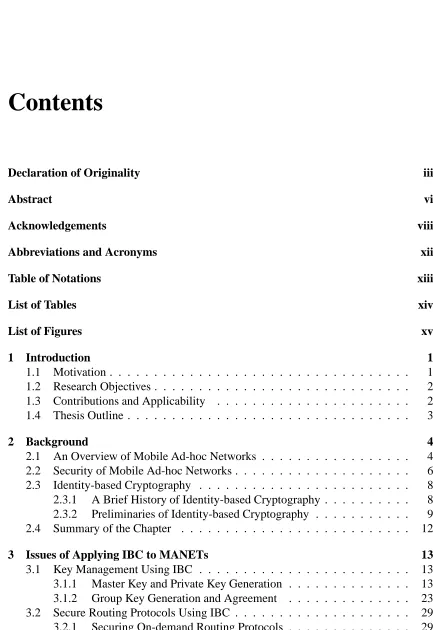
Declaration of Originality iii
Abstract vi
Acknowledgements viii
Abbreviations and Acronyms xii
Table of Notations xiii
List of Tables xiv
List of Figures xv
1 Introduction 1
1.1 Motivation . . . 1
1.2 Research Objectives . . . 2
1.3 Contributions and Applicability . . . 2
1.4 Thesis Outline . . . 3
2 Background 4 2.1 An Overview of Mobile Ad-hoc Networks . . . 4
2.2 Security of Mobile Ad-hoc Networks . . . 6
2.3 Identity-based Cryptography . . . 8
2.3.1 A Brief History of Identity-based Cryptography . . . 8
2.3.2 Preliminaries of Identity-based Cryptography . . . 9
2.4 Summary of the Chapter . . . 12
3 Issues of Applying IBC to MANETs 13 3.1 Key Management Using IBC . . . 13
3.1.1 Master Key and Private Key Generation . . . 13
3.1.2 Group Key Generation and Agreement . . . 23
3.2 Secure Routing Protocols Using IBC . . . 29
3.2.1 Securing On-demand Routing Protocols . . . 29
3.2.3 Aggregated Signature for Intermediate Node List in On-demand
Routing Protocols . . . 31
3.2.4 A Security Architecture to Secure OLSR . . . 31
3.3 Issues of Key Management and Secure Routing . . . 32
3.4 Limitations and Weaknesses from IBC . . . 36
3.4.1 Identity Disclosure . . . 36
3.4.2 Key Revocation Difficulty . . . 38
3.4.3 Key Escrow . . . 39
3.5 Summary of the Chapter . . . 40
4 A Novel KM-SR Integrated Framework 41 4.1 Basic Idea and Overview of the Framework . . . 41
4.2 Secure Key Generation and Secure Routing Setup . . . 46
4.3 Summary of the Chapter . . . 51
5 Security Analysis and Enhancements 52 5.1 Security features and proof . . . 52
5.2 Supporting Threshold Cryptography without Mobile Attacks . . . 58
5.2.1 Enhancement against Mobile Attack . . . 59
5.2.2 Support for Dynamic Membership . . . 62
5.2.3 A Working Example of the Scheme . . . 63
5.3 Enhancement against Blackhole Attacks . . . 64
5.3.1 Without Compromised Nodes . . . 64
5.3.2 With Compromised Nodes . . . 64
5.4 Against Wormhole Attacks . . . 65
5.5 Against Other Routing Attacks . . . 68
5.6 Summary of the Chapter . . . 70
6 Simulation Results and Performance Analysis 71 6.1 Computational Complexity and Efficiency Analysis . . . 71
6.2 Transmission Overhead Analysis . . . 73
6.2.1 IBC Encryption/Signature Overhead in OLSR Packets . . . 73
6.2.2 IBC Encryption/Signature and Neighbor’s Attestation Overhead in OLSR Packets . . . 74
6.2.3 An Optimization to Transmission Overhead . . . 76
6.3 Simulation Setup . . . 77
6.4 Simulation Results and Analysis . . . 78
6.5 Scalability Analysis . . . 82
6.6 Summary of the Chapter . . . 83
7 Addressing Limitations and Weaknesses of IBC 84 7.1 Addressing Identity Disclosure . . . 84
7.1.3 ElGamal-based Scheme . . . 92
7.1.4 Comparison of the Schemes . . . 95
7.2 Addressing Key Revocation Difficulty . . . 97
7.3 Addressing Key Escrow . . . 98
7.4 Summary of the Chapter . . . 99
8 Conclusions and Future Work 100 8.1 Conclusions . . . 100
8.2 Limitations and Future Work . . . 101
Bibliography 102
Appendix A: List of Publications 113 Appendix B: Permissions of Reused Publications 115
Vita Auctoris 117
AODV Ad hoc On-Demand Distance Vector
CBC Certificate-based Cryptography
DSR Dynamic Source Routing
ETSI European Telecommunications Standards Institute
GloMo Global Mobileinformation Systems
GPS Global Positioning System
IBC Identity-based Cryptography
IETF Internet Engineering Task Force
JTRS Joint Tactical Radio System
KM Key Management
MANET Mobile Ad-hoc Network
NTDR Near-Term Digital Radio
OLSR Optimized Link State Routing protocol
PBC Pairing-based Cryptography
PKG Private Key Generator
PKI Public Key Infrastructure
PRNET Packet Radio Network
RSRE Royal Signal and Radar Establishment
SR Secure Routing
SURAN Survivable Radio Networks
TA Trusted Authority
TI Tactical Internet
TIA Telecommunications Industry Association
TTP Trusted Third Party
WIDENS Wireless Deployable Network System
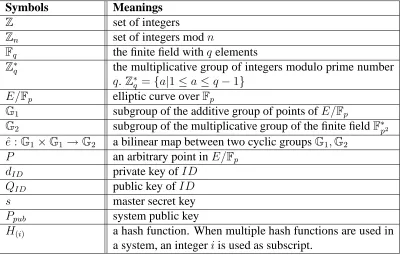
Symbols Meanings
Z set of integers
Zn set of integers modn
Fq the finite field withqelements
Z∗
q the multiplicative group of integers modulo prime number q. Z∗q ={a|1≤a ≤q−1}
E/Fp elliptic curve overFp
G1 subgroup of the additive group of points ofE/Fp
G2 subgroup of the multiplicative group of the finite fieldF∗
p2 ˆ
e:G1×G1 →G2 a bilinear map between two cyclic groupsG1,G2
P an arbitrary point inE/Fp
dID private key ofID
QID public key ofID
s master secret key
Ppub system public key
H(i) a hash function. When multiple hash functions are used in
a system, an integeriis used as subscript.
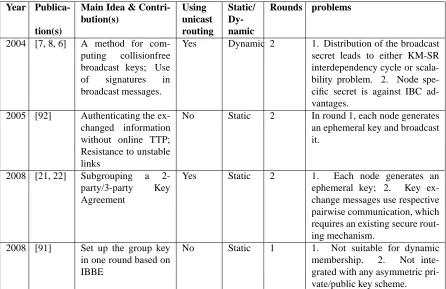
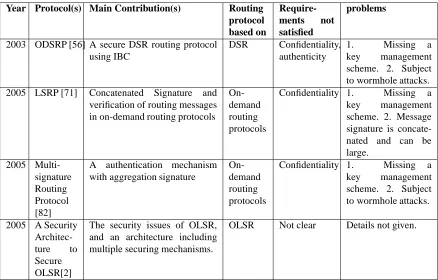
3.1 Summary of Master Key and Private Key Generation and Distribution
Schemes . . . 33
3.2 Summary of Group Key Agreement Schemes . . . 34
3.3 Summary of Secure Routing Schemes . . . 35
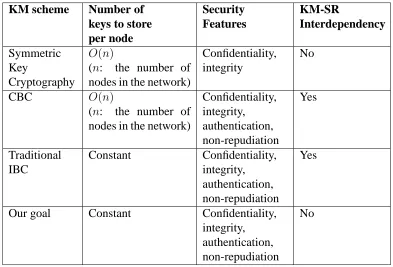
4.1 Features and Drawbacks of Symmetric Cryptography, CBC and Tradi-tional IBC . . . 44
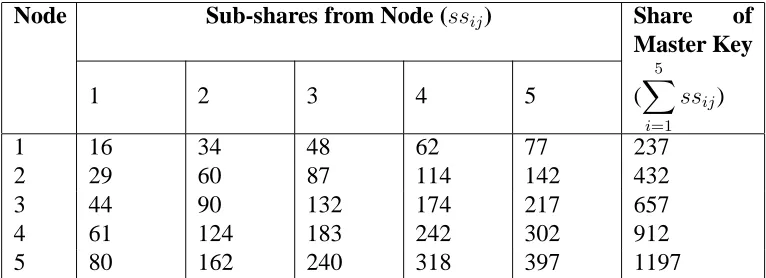
5.1 Contributions of Dynamic Part of a New Master Key . . . 63
5.2 Sub-shares and Shares of Dynamic Part of a New Master Key . . . 63
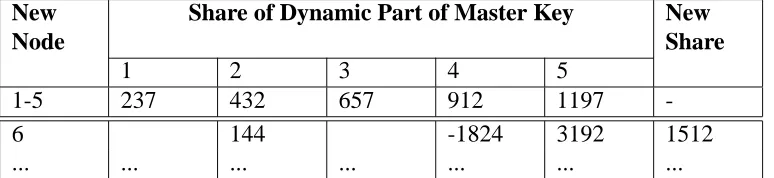
5.3 New Node (6) Gets Its Share of Dynamic Part of Master Key . . . 64
6.1 Comparison of Our Encryption/Decryption Scheme with Others . . . 72
6.2 Comparison of Our Singature/Verification Scheme with Others . . . 72
6.3 Comparison of Performance of Elliptic Curve Cryptographic Operations, DSA and RSA (in milliseconds) [86] . . . 81
2.1 Shamir’s Identity-based Cryptosystem and Signature Scheme ([81, p. 52]) 10
4.1 Comparison between Previous and Proposed KM-SR Integrated Framework 43
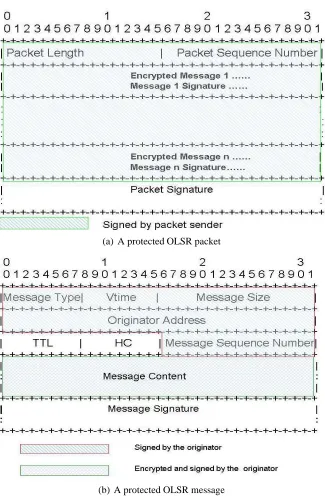
4.2 Protected OLSR Packet and Message . . . 50
5.1 Structure of OLSR HELLO and TC Message with Neigbor’s Attestations . 66 5.2 OLSR Deployment Information Message . . . 68
6.1 Transmission Overhead of a OLSR Packet with a HELLO or TC Message 74 6.2 Transmission Overhead of a OLSR Packet with a HELLO or TC Message with Neigbor’s Attestation . . . 75
6.3 Transmission Overhead of a OLSR Packet with a HELLO or TC Message with Neigbor’s Attestation and Compressed IBC Signatures . . . 77
6.4 Transmission Overhead of a OLSR Packet with a HELLO or TC Message with Neigbor’s Attestation and Compressed IBC Signatures . . . 78
6.5 Comparison of End-to-end Delays of Routing Messages . . . 80
6.6 Delays Added by IBC Operations . . . 81
6.7 Traffic Model of the KM-SR Integrated Framework . . . 82
7.1 Identity Hiding in IPv4 and IPv6 Packets . . . 86
7.2 Scrambled IP Addresses . . . 96
Introduction
1.1
Motivation
Mobile Ad-hoc Networks (MANETs) (the term Wireless Ad-hoc Networks is used in
the literature interchangeably) have been an active research topic for several decades.
The first stage of research was concentrated on efficient formation of an ad-hoc network,
i.e. routing setup. Then many researchers realized that without assurance of security,
formation of a network is meaningless—the network can be easily broken or taken over
by an adversary. During the last two decades, security of MANETs has gained more and more attention.
Cryptography is a solution that can meet most of the security requirements. More
specifically, cryptographic solutions can be classified into two categories—Symmetric
Key Cryptography and Asymmetric Key Cryptography. The former has limited
func-tionality and cannot provide a complete solution by itself. Among the latter, Public
Key Infrastructure (PKI) is a most poplar solution in wired networks. Unfortunately,
in MANETs, there are many difficulties or barriers that impede application of PKI to
MANETs. About 10 years ago, Identity-based Cryptography (IBC) emerged as a new cryptographic technology. As a special and simplified form of asymmetric cryptography,
it has many advantages to MANETs, and has aroused much research interest. Most of
re-cent development on MANET security is related to IBC. There have been a large number
of proposals using IBC for MANET security.
However, after an intensive study and survey, we noticed and identified some issues on
applying IBC to MANETs. The main issues pertain to Key Management (KM) and Secure
Routing (SR). Both of these components are essential to a security scheme. Unfortunately,
previous studies in the literature seem to treat these two components separately.
Indeed, they are interdependent on each other. You cannot generate either of the
com-ponents following these schemes if you do not have the other one already, and if you
have two of them from different schemes, you cannot couple them together in a system.
Additionally, these schemes are subject to many attacks due to loose coherency between
these two components. The issues we found motivated us to launch this research to find a
solution.
1.2
Research Objectives
The main objective of this research is to find a solution that addresses the identified issues
and is better than previous ones. Specifically, we aim to propose a novel key management
and secure routing framework that can be applied to the design of a practical MANET
without the issues we have identified. On the one hand, this framework should have ad-vantages of IBC which has already been accepted as a prospective solution for MANET
security. On the other hand, this solution should address the issues we have identified
above and known issues of IBC schemes published in the literature. The efficiency and
performance of the framework in other aspects should not degrade compared to previous
ones. The framework should be scalable to practical size of MANETs. The framework
should be feasible and applicable to practical MANETs. The framework should be
exten-sible to accommodate specific requirements of various customers and in various scenarios.
1.3
Contributions and Applicability
This thesis studies MANET security requirements and solutions. Concentrated on IBC
solutions, the thesis points out issues of applying this latest and most promising
technol-ogy to MANET security. In light of the discovered issues, a novel framework for MANET
security is proposed in this thesis. The proposed scheme addresses key management and
secure routing interdependency cycle problem of previous IBC schemes. This scheme
brings these contributions: compared to symmetric key solutions, it has more
functional-ity derived from asymmetric keys, and is more secure due to using 1-to-m broadcasting
key instead of only 1 group broadcasting key, and has less keys to store per node due
are lower due to IBC properties; compared to previous IBC solutions, it has no KM-SR
interdependency cycle problem, and is immune to insider attacks and mobile attacks and
many other routing attacks.
The result of this work presents a feasible security solution to a wide range of MANETs
where there is an administrator that generates and distributes initial system parameters to
all nodes, and the administrator can authenticate the identity of a node and assign the
ini-tial private key to it. Basically this includes all MANETs where IBC is applicable, with an extra requirement—a controlled deployment phase. Examples of this type of MANETs
include, but are not limited to: sensor networks, wearable computer systems in military,
public safety networks, and emergency and disaster rescue teams. This scheme seems to
be the best security solution to these networks so far.
1.4
Thesis Outline
The rest of the thesis is organized as follows: Chapter 2 presents a background study
related to the research work presented in this thesis. Chapter 3 presents issues we have
identified when applying IBC to MANET security, and limitations and weaknesses of IBC
itself. Chapter 4 proposes a novel key management and secure routing integrated
frame-work to address issues of applying IBC to MANETs. Chapter 5 analyzes security features
of the framework with mathematical proof, and presents enhancements to counter various
attacks. Chapter 6 presents information about the simulation environment, simulation
re-sults, and related discussions. Chapter 7 presents solutions to limitations and weaknesses
of IBC itself applicable to the framework and other IBC schemes. Conclusion and future
Background
This chapter presents a background study related to the research work presented in this
thesis. Section 2.1 presents an overview of Mobile Ad-hoc Networks. Section 2.2 sum-marizes security challenges and requirements, and cryptographic solutions on high level.
Section 2.3 introduces Identity-based cryptography.
2.1
An Overview of Mobile Ad-hoc Networks
There has been a surge of interest in ad hoc networks in recent decades. An ad-hoc (or
“spontaneous”) network is a local area network or other small network, especially one
with wireless or temporary plug-in connections, in which some of the network devices
are part of the network only for the duration of a communications session or, in the case of mobile or portable devices, while in some close proximity to the rest of the network. A
Mobile Ad-hoc Network (MANET) is defined as an autonomous system of mobile routers
(and associated hosts) connected by wireless links, the union of which form an arbitrary
graph [25]. A MANET comprises a collection of two or more devices equipped with
wireless communication and networking capability. Such devices can communicate with
another node that is immediately within their radio range or one that is outside their radio
range, intermediate nodes forwarding or relaying packets in the latter scenario [84, 37].
This kind of network is very similar to cellular networks, but support from base stations is
not necessarily required. Actually, a MANET can be an extension or a redundant backup of cellular networks. The allure of providing anytime, anywhere services without
infras-tructure makes such networks very attractive.
The development and exploitation of ad hoc wireless communication has been started
since 1970’s. Earlier projects on ad hoc wireless communication include Packet Radio
Network (PRNET) program, Survivable Radio Networks (SURAN), and Royal Signal
and Radar Establishment (RSRE)
The origin and early development of MANETs were attributed to the needs of
battle-field communication. In 1994 Defense Advanced Research Projects Agency (DARPA)
initiated Global Mobile (GloMo) [57] Information Program which recently concluded.
The flat (peer-to-peer) and hierarchical network architectures were studied. The hierar-chical architecture uses modular system of link and network layer algorithms to support
distributed, real time multimedia applications in MANETs. It has three components:
clus-tering techniques, location management and virtual circuit setup and repair.
The generation of adaptive, multi-band multi-mode radios—the Joint Tactical
Ra-dio System (JTRS) offers improved flexibility over half-duplex, single-channel raRa-dios
at higher layers of the system because of the ability to transmit and receive on different
bands and using different waveforms [42]. The Near-Term Digital Radio (NTDR) [77]
program of DARPA benefited from the results of the GloMo program and implemented many of the technologies developed during the SURAN program.
At present, one particularly active application of MANETs is interconnection of
sen-sors in industrial, commercial, or military settings. Sensen-sors are typically small
wire-less devices measuring environmental inputs and transmitting them to control centres [3].
There are many live projects going on in this area. For example, the Berkeley Wireless AC
Meter/Switch (ACme) Project. The goal of this project is to enable wireless energy/power
measurement and control of AC devices. This device fills the gap between inexpensive
LCD watt-meters (e.g. Kill-A-Watt) and expensive networked enterprise energy monitors.
ACme uses the ADE7753 energy monitor chip for energy and power measurements, the
SHARP solid-state relay for power switching, and the Berkeley EPIC wireless module for communication [50].
Another application is that of emergency response and rescue. MANETs are well
suited for such applications because of their ability to create connectivity rapidly when
the existing communication infrastructure has been destroyed. One example of this
appli-cation is the European Project entitled WIreless DEployable Network System (WIDENS)
launched in 2005 which aims to offer a common communication channel through a
wire-less ad hoc network to all actors in an emergency situation in the field of operation at the
time of intervention, for each organization and across organizations [98].
Other prospective applications of MANETs include Vehicular Ad-Hoc Networks
Net-works where end users are connected to each other via broadband channels based on
multiple connections.
In the academic community, the MANET chartered Working Group was established
in 1997 within Internet Engineering Task Force (IETF). The MANET activities are
fo-cused on studying routing specification with the goal of supporting network scaling up to
hundreds of routers [19].
2.2
Security of Mobile Ad-hoc Networks
Research on security of MANETs remains active, despite years of exploration, in both academia and industry. This is partially due to the fact that no mature solution is widely
accepted and also to the growing availability of small, personalized mobile devices with
peer to peer communication capability through wireless channels.
General security requirements for MANETs include [1]:
• Data Confidentiality that keeps data secret to outsiders,
• Data Integrity that prevents data from being altered,
• Data Freshness that keeps data in the correct order and up-to-date,
• Data Availability that ensures data to be available on request,
• Data & Identity Authentication that verifies that the data or request came from a specific, valid sender,
• Non-repudiation that ensures a node cannot deny sending a message.
Security mechanisms that are widely used and proven to be effective in wired
net-works are not always applicable to MANETs. Attacks that can be effectively detected and prevented in wired networks have been big security challenges in MANETs. Examples
include, but are not limited to, identity/address spoofing, message tampering and forgery,
message replay, etc. Compared to wired networks, the combination of the following
char-acteristics of MANETs makes it especially difficult to achieve security requirements:
• Lack of a network infrastructure and online administration.
• Network topology and node membership dynamics.
• Computing and communication capacity constrained resources.
• Wireless link vulnerabilities.
Security proposals in early research are typically attack-oriented. They often first
identify several security threats and then enhance the existing protocol or propose a new
protocol to thwart them. Such solutions are designed explicitly against limited attack models. They work well in the presence of designated attacks but may collapse under
combined or unanticipated attacks [89].
Cryptography is then used to support a general design framework. Cryptographic
so-lutions can satisfy the above requirements except Data Availability which requires
assis-tance of other technologies. Cryptography techniques used in MANETs can be classified
into two categories, namely, symmetric key based and asymmetric key based. In
sym-metric key based schemes, if an attacker compromises the symsym-metric key of a group of
users, then all encrypted messages for that group will be exposed. Asymmetric key based
schemes can provide more functionalities than symmetric ones. For example, key
distri-bution is much easier, authentication and non-repudiation are available, and compromise of a private key of a user does not reveal messages encrypted for other users in the group.
However, asymmetric key based schemes are generally more expensive computationally.
Traditional asymmetric cryptography is used widely and effectively in the Internet; it
relies on a Public Key Infrastructure (PKI), and can be called Certificate-based
Cryptog-raphy (CBC), in contrast to identity-based cryptogCryptog-raphy. The success of PKI depends on
the availability and security of a Certificate Authority (CA), a central control point that
ev-eryone trusts. With PKI, an entity has a pair of private key and public key. The private key
is bound to its public key that is signed by the CA with CA’s public key. The public key and corresponding signature of the CA are presented in a public key certificate (PKC). In
communication, the recipient needs to know the PKC of the sender and the public key of
the CA, in order to authenticate the sender and verify the message. PKCs can be stored in
the recipient in advance, or retrieved on-the-fly from CA or centralized certificate
reposi-tory. However, in general MANETs, applying PKIs by maintaining a central control point
for CA or certificate repository is clearly not always feasible. Another obstacle that
im-pedes PKI’s employment in MANETs is the heavy overhead of transmission and storage
2.3
Identity-based Cryptography
Identity-based cryptography (IBC) is a special form of public key cryptography. It is an approach that seeks to eliminate the requirement of a CA and PKCs. Since 2001, IBC has
attracted increasing attention from security researchers. Some properties of IBC make it
especially suitable for MANETs. Fang et al [35, 95] summarize the advantages of IBC to
MANETs:
• Easier to deploy without any infrastructure requirement. This saves certificate dis-tribution, while bringing gratuitous pairwise keys without any interaction between
nodes.
• Its resource requirements, regarding process power, storage space, and communi-cation bandwidth, are much lower.
• The public key of IBC is self-proving and can carry much useful information.
We believe that IBC, with its rapid development in recent years, is a promising solution for MANET security problem.
2.3.1
A Brief History of Identity-based Cryptography
IBC is in the category of asymmetric key based cryptography. It specifies a cryptosystem in which both public and private keys are based on the identities of the users. The idea
of IBC was first proposed by Shamir [81] in 1984. Such a scheme has the property that a
user’s public key is an easily calculated function of his identity, while a user’s private key
can be calculated for him by a trusted authority, called a Private Key Generator (PKG).
The identity-based public key cryptosystem can be an alternative for certificate-based
PKI, especially when efficient key management and moderate security are required.
Com-pared to traditional PKI, it saves storage and transmission of public keys and certificates,
which is especially attractive for devices forming MANETs. Thus, application of IBC to
MANETs is an important research topic in areas of both cryptography and MANETs.
For a long time after Shamir published his idea, the development of IBC was very slow. Joux [51], in 2000, showed that Weil pairing can be used for “good” by using it in a
protocol to construct three-party one-round Diffie-Hellman key agreement. This was one
of the breakthroughs in key agreement protocols. After this, Boneh and Franklin [10]
pre-sented at Crypto 2001 an identity-based encryption scheme based on properties of bilinear
identity-based encryption scheme. In Asiacrypt 2001, Boneh, Lynn and Shacham
pro-posed a basic signature scheme using pairing, the BLS scheme [13], that has the shortest
length among signature schemes in classical cryptography.
Subsequently, a number of cryptographic schemes based on the work of Boneh et al
[10] and [13] were proposed. This type of identity-based cryptography is also named
Pairing-based Cryptography (PBC). There are also a few IBC schemes using other
ap-proaches, for instance, Cocks’ scheme is based on the quadratic residuosity problem [24]. Most proposals for MANET security in the literature use PBC.
2.3.2
Preliminaries of Identity-based Cryptography
In [81], Shamir introduces a novel type of cryptographic scheme, the so-called
identity-based cryptosystem, which enables any pair of users to communicate securely and to
verify each other’s signatures without exchanging private or public keys, without keeping key directories, and without using the services of a third party.
Shamir states that “The scheme is based on a public key cryptosystem with an extra
twist: instead of generating a random pair of public/secret keys and publishing one of
these keys, the user chooses his name and network address as his public key. Any
combi-nation of name, social security number, street address, office number or telephone number
can be used provided that it uniquely identifies the user in a way he cannot later deny, and
that it is readily available to the other party. The corresponding secret key is computed
by a PKG and issued to the user when he first joins the network.” Figure 2.1 illustrates
his idea: In an identity-based cryptosystem, the recipient’s identityi is used to generate
the encryption key, and the decryption key is derived fromiand a random seedk. In an identity-based signature scheme, the signature key is generated from sender identityiand
a random seedk, and the verification key is derived from sender’s identityi.
In his paper, Shamir specifies the requirements of an implementation of such a scheme
and lists the implementation principles:
• The choice of keys is based on a truly random seed k. When the seed k is known, secret keys can be easily computed for a non-negligible fraction of the possible
public keys.
• The problem of computing the seedk from specific public/secret key pairs gener-ated with thiskis intractable.
Figure 2.1: Shamir’s Identity-based Cryptosystem and Signature Scheme ([81, p. 52])
his scheme.
He states that at that stage they have concrete implementation proposals only for
identity-based signature schemes, but conjectures that such cryptosystems exist and
en-courage the readers to look for such systems.
Currently, most IBC schemes, and all PBC schemes, are based on assumptions of hard
Diffie-Hellman (DH) problems 1 in elliptic curves. The most frequently used
assump-tions are summarized below: [34, p. 7] (Refer to Table of Notaassump-tions for notaassump-tions and
explanations. Unless otherwise stated, we use the same notations throughout the thesis.)
• Computational Diffie-Hellman (CDH) problem inG1: there is no efficient
algo-rithm to computeeˆ(P, P)abfromP, aP, bP ∈G
1wherea, b∈Z∗q. 2
• Weak Diffie-Hellman (WDH) problem and Static Diffie-Hellman (SDH) prob-lem in G1: there is no efficient algorithm to compute sQ from P, Q, sP, where
1A general Diffie-Hellman (DH) problem is to calculategxyfromgxandgyin a group.
2The general form of a bilinear map is denotedˆe:G
1×G2 →G3, whereG1andG3are cyclic, and
G2is not necessarily cyclic.A Symmetric Bilinear Map is denotedˆe:G1×G1→G2between two cyclic groupsG1,G2of orderqfor some large primeq, whereG1is the group of points of an elliptic curve over
P, Q∈G1ands∈Z∗q.
• Bilinear Diffie-Hellman (BDH) problem in (G1,G2,eˆ): there is no efficient
algo-rithm to computeeˆ(P, P)abc∈G
2fromP, aP, bP, cP ∈G1 wherea, b, c∈Z∗q.
• Decisional Bilinear Diffie-Hellman (DBDH) problem in (G1,G2,eˆ): there is no
efficient algorithm to decide ifr = ˆe(P, P)abcgivenr ∈G
2 anda, b, c∈Z∗q
Boneh and Franklin’s scheme, published in [10], is the first fully functional IBC
scheme. The paper refers to Shamir’s idea of the Identity-based Encryption (IBE) scheme
[81], and several proposals for IBE schemes such as [30, 83, 85, 64]. They consider none
of them to be fully satisfactory due to unrealistic requirements, such as users not
collud-ing, the long time required for private key generation, and tamper-resistant hardware.
Security of their system is based on the BDH problem, an analogue of the
computa-tional Diffie-Hellman assumption on elliptic curves. They build the IBE system from a
symmetric bilinear map and use the Weil pairing on elliptic curves as an example of such a map.
A cryptographic bilinear map satisfies the following properties [34, p. 6]:
1. Bilinear: ˆe(aP, bQ) = ˆe(P, Q)ab for allP, Q∈ G
1 and alla, b ∈ Z∗q. This can be restated in the following way. ForP, Q, R ∈ G1,eˆ(P +Q, R) = ˆe(P, R)ˆe(Q, R)
andeˆ(P, Q+R) = ˆe(P, Q)ˆe(P, R).
2. Non-degenerate: eˆ(P, P)∈F∗
p2 is an element of orderq, and in fact a generator of
G2. In other words,ˆe(P, P)6= 1
3. Computable: GivenP, Q∈G1 there is an efficient algorithm to computeˆe(P, Q).
Their scheme is specified by four randomized algorithms [10, p. 215]:
• Setup: The algorithm maps arbitrary string identities to points on an elliptic curve. Set the system public keyPpubassP wheresis a random number inZ∗q, andP is an arbitrary point inE/Fpof orderq. Choose a cryptographic hash functionH :Fp2 →
{0,1}nfor somen. Choose a cryptographic hash functionG : {0,1}∗ → Fp. The
system parameters areparams=hp, n, P, Ppub, G, Hi. The master-key iss ∈Zq.
• Extract: For a given string ID ∈ {0,1}∗, the algorithm builds public key forID:
• Encrypt: Choose a random r ∈ Zq, and set the ciphertext to be C = hrP, M ⊕
H(gr
ID)iwheregID = ˆe(QID, Ppub)∈Fp2
• Decrypt: Let C = hU, Vi be a ciphertext encrypted using the public key of ID, decryptC using the private keydID: V ⊕H(ˆe(dID, U)) =M
Further, they analyze the security of their scheme, and state that the scheme has chosen ciphertext security in the random oracle model assuming Weak Diffie-Hellman.
The scheme proposed in their paper is subsequently improved by many other
re-searchers, and widely adopted in many identity-based security schemes.
Following Boneh and Franklin’s scheme [10], many PBC schemes have been
pro-posed. Modified Weil Pairing and Tate Pairing are examples of cryptographic bilinear
maps. Currently, active research is being carried out to obtain efficient algorithms to
compute pairings.
2.4
Summary of the Chapter
This chapter presented background of the research topic area of MANETs, research
chal-lenges in security of MANETs and some solutions, and finally an introduction to
Identity-based Cryptography. The next chapter will present issues of applying IBC to MANET
Issues of Applying IBC to MANETs
In this chapter, we present and discuss issues we found when applying IBC to MANET
security. Simply put, there are two issues: key management (KM) and secure routing (SR). Section 3.1 reviews key management schemes in the literature, mainly those for
master key, private key and group key generation. Section 3.2 reviews secure routing
schemes in the literature. Section 3.3 discusses the issues we found in key management
and secure routing which motivated us for this research. Section 3.4 reviews limitations
and weaknesses of IBC itself and existing solutions.
3.1
Key Management Using IBC
Cryptographic techniques are often at the center of solving security problems in MANETs and hence need key management. Key management in IBC requires key generation and
distribution methods, and ideally key protection and revocation. This section reviews and
discusses proposals for IBC key management in MANETs.
3.1.1
Master Key and Private Key Generation
Most of the master key and private key generation schemes are derived from and are
variants of Boneh and Franklin’s scheme [10]. The criteria to judge this type of scheme
is use of their four primitive algorithms. In this section, we first review some examples
based on traditional threshold cryptography of Zhou et al [99] and discuss the limitations of these schemes, and then discuss some proposals that attempt to improve traditional
threshold cryptography. We also study some key generation schemes tweaked for specific
purposes: e.g. high privacy, compromise-tolerance, or light-weight.
Threshold Cryptography
Many IBC schemes use threshold cryptography which originated from Shamir [80], for
their key management. Shamir gives a solution to the problem of sharing a secret among
a number of users in [80]. In his paper, he identifies the problem of how to divide data Dinton pieces in such a way thatD is easily reconstructed from anytpieces, but even complete knowledge oft−1pieces reveals absolutely no information aboutD.
Shamir proposes a(t, n)threshold scheme to solve this problem based on polynomial interpolation: given t points in the dimensional plane (x1, y1). . .(xt, yt), with distinct xi’s, there is one and only one polynomialq(x) of degreet−1such thatq(xi) = yi for all i. To divide the secret D into n pieces, he suggests picking a random t−1 degree polynomial q(x) = a0 +a1x +· · · +atxt−1 in which a0 = D, and each piece is the
value of the polynomial at thenpoints:D1 =q(1), . . . , Di =q(i), . . . , Dn=q(n). Thus
any subset of tof the pieces can determine the coefficients of the polynomial (using e.g.
Lagrange interpolation) and thus the secret data at a certain point. He suggests the use of
modular arithmetic instead of real arithmetic. The set of integers modulo a prime number pforms a field in which interpolation is possible.
This scheme was later employed by many researchers to construct a distributed PKG in IBC and to solve security problem in MANETs.
Zhou et al [99] suggest the use of Shamir’s threshold scheme to secure ad hoc
net-works. The authors identify the problem to establish a key management service using a
single CA in ad hoc networks. They suggest distributing this service to an aggregation of
nodes.
Zhou et al refer to the work of Desmedt et al [32, 31] and indicate that they use
the theory of threshold cryptography as a basis for their work. The authors propose a
distributed CA architecture and PKI used in ad hoc networks. The CA service, as a whole, has a public/private key pairK/k. The public keyK is known to all nodes in the
network, whereas the private keykis divided intonsharess1, s2, ..., snwith one share for
each server. To provide the certificate signing service, threshold cryptography algorithm
is used—for a message m, serveri can generate a partial signature P S(m, si) using its
share si and forward the signature to a combiner. If t out of n partial signatures are
collected by the combiner, they can jointly perform the operation correctly.
The idea of distributed CA has been subsequently adopted for distributed PKG in
Key Generation Using Traditional Threshold Cryptography
PKG plays a fundamental role in an identity-based cryptosystem, but it is not trivial to
have a robust PKG in a MANET environment. As Zhou et al have suggested [99], a CA
service of PKI can be distributed to multiple nodes in a MANET environment. This idea
is also applicable to IBC.
Khalili et al [52] propose to use IBC to secure ad hoc networks. The authors refer to
the work of Zhou et al [99] and Bobba et al [5] and identify the problem that all proposed key management solutions assume either pre-existing shared secrets among nodes or the
presence of a common PKI. They propose to combine efficient techniques from
identity-based and threshold cryptography to provide a mechanism that enables flexible and
ef-ficient key distribution while respecting the constraints of ad-hoc networks. At the time
of network formation, the participating nodes form a threshold PKG, and generate—in a
distributed fashion—a master public key. The master secret key is shared in at-out-of-n
threshold manner by this initial set of n nodes. All nodes in the network can use their
identities as their public keys. The secret key, corresponding to the public key, is
com-puted by having the node obtaintshares of their key fromt-out-of-nof the original nodes.
All subsequent communications are encrypted and decrypted using the master public key and the ID of the recipient. The authors based their proposal on Boneh’s identity-based
cryptosystem algorithms [10].
As a detailed implementation of Khalili’s idea, Deng et al [29, 28] propose an
identity-based key management and authentication system for MANET, using identity-identity-based and
threshold cryptography. The proposed approach consists of two components: distributed
key generation and identity-based authentication. This paper describes algorithms for
master key generation, distributed private key generation, new master key share creation.
The system was built on the assumption that each mobile node has a mechanism to dis-cover its one-hop neighborhood and to get the identities of other nodes in the network. The
key generation component provides the network master key pair and the public/private
key pair to each node in a distributed way. The system public key/master key pair is
com-puted collaboratively by the initial network nodes without constructing the master key at
any single node, as Shamir and Zhou suggested [80, 99] 1. The public key of nodeID
1Each nodeCirandomly chooses a secretxiand a polynomialfi(z)overZ
qof degreet−1, such that fi(0) =xi. NodeCi computes his sub-share for nodeCjasssij =fi(j)forj = 1,2...nand sendsssij securely toCj. After receivingn−1sub-shares, nodeCj can compute its share of master private key as Sj =Pni=1ssij =
Pn
can be computed asQID=H(ID||ExpireT ime).
Another implementation of Deng’s scheme is described in Zhange et al’s work [93].
The authors implemented a scheme with distributed master key generation, private key
generation, secret share update, and secret share generation for a new joining node. One
thing they did not mention is how secret shares are distributed to other nodes from one
node.
Xia’s scheme [87] is also very similar to Deng’s scheme: A set of Distributed PKG (DPKG) nodes collaboratively generate system public key and master key in a fully
dis-tributed manner; Shares can be updated among PKGs; New nodes can get their shares
from PKGs and become new PKG nodes.
Differences from Deng’s scheme are:
1. This scheme does not use temporary PKI for secret share distribution as in Deng’s scheme. Instead, it employs a self-generated public/private key pair in the
follow-ing way: each DPKG node computes a temporary public key and sends it to other
DPKG nodes. Secret shares are encrypted and decrypted using this temporary
pub-lic key.
2. The author applies IBC to OLSR routing protocol, particularly use HELLO
mes-sages and TC mesmes-sages in OLSR to select and mark DPKG nodes, while Deng et
al apply IBC to DSR routing protocol.
These differences lead to the following problems:
1. Each DPKG node has to store in memory the temporary public keys of other DPKG
nodes.
2. System public key and master key collection process is not secure, because only
public channels are available at this stage.
3. The keys generated are not guaranteed secure, because it does not provide any se-curity protection for OLSR routing protocol it relies on.
All of these schemes use threshold cryptography to distribute the functionality of PKG
to multiple nodes. Due to threshold cryptography, these schemes have the following
is-sues:
1. Interdependency cycle between secure routing and security services: These schemes
rely on some existing routing or online administration mechanisms (e.g.
PKG nodes. On the other hand, as we will show later, most secure routing protocols
rely on secure keys. We identify this as interdependency cycle between key
manage-ment (KM) and secure routing (SR) in IBC, and as a specialization of noted
prob-lem of interdependency cycle between security services and secure routing [65, 88]
. These schemes cannot be used in secure routing protocols.
2. Proximity-caused insecurity: In some circumstances where a node can move in
order to access to more nodes, one way to avoid the KM-SR interdependency cycle
problem is to have a threshold number of authorized users that are physically close
to each other (i.e., within one-hop communication distance so that routing is eased).
This incurs another related problem—the proximity-caused insecurity: it is possible
that an adversary compromises these nodes within a short period of time (e.g., by
capturing the nodes and/or compromising them one by one ) [88]. Furthermore,
the proximity-based solution is not applicable to fully distributed key generation
schemes where all nodes participate in and contribute to the key generation and
thus routing connecting all nodes (not only among a threshold number of nodes) is still required.
3. Mobile Attacks: Threshold cryptography is subject to mobile attacks, in which a
mobile adversary could move to compromise multiple nodes and reveal the secret
shares of them in order to recover the secret. To counter mobile attacks, the above
proposals use secret refreshing mechanism in which secret shares are updated in
intervals and new shares cannot be combined with old ones to recover the secret.
They assume there is only one mobile adversary in the network and a mobile
adver-sary cannot compromise enough authentic nodes within the share refreshing period. Many researchers, e.g Merwe et al in [65], do not think this assumption is practical.
We will recall and discuss this problem further in Section 3.2 shortly.
Multicast Group for Threshold PKG
Li et al [58] point out that share refreshing in [99] needs a secure channel for delivering subshares, of which Zhou et al did not provide the implementation. They propose a
sign-cryption scheme that exactly provides a way for secure transmission, by using periodic
private keys, multicast group of PKGs, and key proxy. Their work is based on work of
Li et al introduce a key proxy for key generation. A key proxy is selected from a group
of server nodes: all server nodes form and maintain a few multicast groups according to
location. A node floods its Routing REQuest (RREQ) to find a route to the server nodes
group. When it receives Routing REPlies (RREPs) from server nodes, it selects a server
node, sayu, which has the shortest path to itself as its key proxy. The routing information
to the node uis stored. When it wants to update its private key later, it sends its Private
key update REQuest (PREQ) to uand u multicasts the PREQ to all server nodes. The private key of a node is updated periodically. Server node computes a partial private key
of the client (dA,i) using its master key share, then signcrypts and sends it in a Private key
update REPly (PREP) message toA.
In order to check malicious server nodes, at the initial time of the network, PKG
publishes a piece of verification information consisting ofsi·P for each server nodei. To check the validity of partial key it receives from i, nodeA needs only to check whether
the equationeˆ(QA, si·P) = ˆe(dA,i, P)holds.
Li et al use “proactive threshold” similar to Zhou et al’s [99], with two modifications: replacing secure channel with multicast, and replacing a secret share with a vector. The
share vector is encrypted and multicast to the server nodes group. Every server node can
only decrypt its own share.
This scheme distributes partial private keys of PKG server nodes to the network before
starting for future secure communication, in a way like certificates in PKI. This is against
IBC advantages. The multicast group of PKGs is fundamental in the scheme, but a critical
question remaining open in this work is how the multicast group is formed. Secure
multi-cast routing cannot be established without secure keys. Thus the KM-SR interdependency
cycle problem is not addressed.
Offline Threshold PKG
Zhang et al [96] propose a distributed PKG (D-PKG) scheme to distribute PKG of IBC
to multiple nodes, based on work of Shamir [81], Zhou et al [99] and Boneh et al [10].
The master key of the IBC system is distributed to D-PKGs in an offline manner, and then a threshold number of D-PKG’s can function as PKG. In each D-PKG, the Trusted
Authority (TA) supplements the network bootstrapping process with the following
opera-tions [96, p. 3517]:
1. Determine a(t−1)-degree (1≤t ≤N) polynomial,h(x) =s+a1x+a2x2 +· ·
2. Selectn(t ≤n ≤N)nodes as D-PKGs (denoted bySH). Each node inSH gets a share ofsassk =h(k).
3. Calculate a set of share commitments asSC ={Pk =sk·P ∈G1|1≤k≤n}.
SH andSC are appended to the public system parameters and sent to all nodes. Similar to schemes using traditional threshold cryptography presented above, any combination of tD-PKGs can collectively reconstruct the system master-keys.
These D-PKG’s collaboratively provide the PKG service: NodeBsends them a
private-key sub-request containing its public private-keyIDB. Upon receiving the request, each chosen
D-PKG sends back a sub-reply containing a partial private key:dB,i =siH1(IDB||other_ Inf o). other_Inf o may contain version number or expire time etc. B can verify its authenticity using Pi: eˆ(dB,i, P) = ˆe(H1(IDB||otherInf o), Pi) 2. After obtaining t authentic private-key pieces, B can calculate the complete private key in the same way
computing the master-key.
This scheme is similar to schemes using traditional threshold cryptography, but differs
in the following ways: this scheme distributes secret shares offline, and thus does not re-quire on-line secure channels for secret share distribution; the secret shares of this scheme
are not refreshed or updated, thus it is more subject to mobile attacks. Although the
mas-ter key generation does not require secure channels, the private key generation still needs
them; thus, KM-SR interdependency cycle is not addressed. Also, the share commitments
of each D-PKG are used like certificates which are distributed to the network nodes before
network starts. This is against IBC advantages.
Public Channels for Threshold PKG
Ren et al [75] propose another D-PKG scheme. The scheme eliminates the secure channel
requirement by using mutual authentication in public channels.
The key generation and issuing works as follows: A userUIDchooses a passwordpwd
and computes H1(ID), H1(pwd), H2(pwd). Then it publishes the tuple hID, H1(ID),
H1(pwd), H2(pwd)i. The D-PKGs store them in their database. User selects a random
numberrand computes a request and sends the request to D-PKGs. D-PKGs checks the
validity of the request and computes blinded partial private key and sends it to the user.
The user upon receiving blinded partial private keys verifies them and unblinds the private
key using the proprietary knowledge ofr.
The authors claim that the protocol does not require any secure channel to issue the
private key and is secure. However, D-PKGs have to store a password for each user,
in the same way as the distributed CA works in PKC mechanisms. This violates the
advantages of identity-based cryptosystems, and requires online service from D-PKGs.
Also, the paper did not mention how requests and secret shares are transmitted in public
channel. We assume they use broadcast in the discussion below. In that case, the KM-SR
interdependency cycle problem is addressed, but two problems remain: first, security of the private keys is not guaranteed because they only use hashing to protect the private
keys; second, it is not efficient because of communication and computational overhead of
broadcast.
A Threshold Key Generation Scheme with Compromise-tolerant Key-update Pa-rameters
Fang et al [95] propose a key generation scheme that provides compromise-tolerant
fea-ture for private keys. This is achieved by dividing public/private keys into node-specific
and phase-specific components, and predistributed key-update parameters.
The cryptographic materials distributed to each node before network deployment
in-clude: pairing parameters:hp, q,e, Hˆ 1, P, s1P, s2Pi, public and private keys: hQID,0, dID,0i,
phase salt: salt1, key-update parameters: h{vi(x), li(ID)}i=1,...,mi, wheremis the maxi-mum possible phase index,H1 is a hash function that maps a string to a non-zero element
inG1,s1ands2 are two distinct master keys. PKG distributess2to D-PKGs using
thresh-old secret sharing, each D-PKG V ∈ Ω holds a secret share s2V and a set of values
{P2V =s2V ·P|V ∈Ω}whereΩis the D-PKG set, and|Ω|=n.
Each public/private key pair is both node-specific and phase-specific. At phase-i, node A’s public key isQA,i =hH1(IDA), H1(salti)i, private key isdA,i =hs1·H1(IDA), s2·
H1(salti)i. The first element of each key is node-specific, and the second element is phase-specific. Initially, the PKG issues QA,1 and dA,1 to node A. Acan acquire
phase-specific element Qi+1 = H1(salti+1) and di+1 = (s2 · H1(salti)), where salti+1 =
salti+ 1, from the D-PKG set through key update. In the key update, a D-PKG nodeZ contactst−1D-PKG, and collects tshares ofdi+1 and generatesdi+1 using at
-out-of-n threshold cryptography. Z then broadcasts di+1 to unrevoked nodes securely using a
variant of the self-healing group key distribution scheme by Liu et al [61].
The key update parameters also facilitate key revocation feature, which we will discuss
This scheme employs threshold cryptography for generation of phase-specific
com-ponenets of private keys online. It is not clearly stated how D-PKGs communicate with
each other to exchange secret shares. This process either relies on secure routing which
leads to KM-SR interdependency cycle problem, or relies on broadcasting which incurs
insecurity and extra traffic overhead. In addition, the scheme does not have good
scala-bility because the size of key-update parameters to be distributed to nodes before network
deployment is proportional to number of phases and number of D-PKGs, both of which can become very large.
A Non-threshold Key Issuing Scheme for High Key Privacy
Threshold PKG key generation allows redundant PKGs for high availability of master key. The opposite way is to use a chain of key privacy authorities (KPAs) to protect
master key for high privacy. Lee et al [54] propose a secure key issuing protocol in which
a private key is issued by a key generation center (KGC) and then its privacy is protected
by multiple key privacy authorities (KPAs). For all i = 1,· · ·, n, KP Ai chooses his master keysi and computes his public keyPi =siP. Then KPAs cooperate sequentially
to compute the system public keyY =s0s1...snP.
A userIDgets its private key in three stages [54, p. 73]:
1. In key issuing stage, a node sends its identityIDand blinding factor X = xP to
the KGC and requests him to issue a partial private key. The KGC issues a partial
private key to the user in a blinded manner: Q′
0 =H3(ˆe(s0X, P0))s0QID, together with a signature:Sig0(Q′0) =s0Q0′. HereH3(ˆe(s0X, P0))is a blinding factor. User
can unblind it using his knowledge ofx3.
2. In key securing stage, the user requests multiple KPAs in a sequential manner to
provide key privacy service by sending ID, X, Q′
i−1 and Sigi−1(Q′i−1). Then
KPAs return the private key shares: Q′
i = H3(ˆe(siX, P i))siQ′i−1 and signature
Sigi(Q′i) =siQ′i in a blinded manner.
3. Finally, in key retrieving stage, the user unblinds it to retrieve the real private key:
dID = Q
′
n
H3(ˆe(P0,P0)x)···H3(ˆe(Pn,Pn)x) =s0s1· · ·snQID. The user can verify the correct-ness of his private key byeˆ(dID, P) = ˆe(QID, Y).
The authors have analyzed the security of this scheme and state that since the private
key of a user is computed cooperatively by the KGC and n KPAs, the privacy of user’s
3H
private key is kept if at least one authority remains honest. Only the legitimate user who
knows the blinding parameter can unblind the message to retrieve the private key.
This scheme was not originally designed for MANETs. In a MANET environment,
it has the following weaknesses: first, all KPAs are required to be online and available,
which is not feasible in MANETs; second, secure routing is required to get partial key
and signature, which is in KM-SR interdependency cycle.
A Non-PBC Lightweight IBC Key Generation Scheme
Saxena [79] proposes a scheme of public key cryptography for MANET analogous to
identity-based cryptography with some claimed advantages. This scheme can be
consid-ered as a lightweight IBC. This work is based on work of Zhao et al [99], Shamir [80] and Feldman [36] on threshold cryptography, and on the work of Boneh et al [10] on IBC.
The author suggests the use of Feldman’s Verifiable Secret Sharing (VSS) [36] to
gen-erate private keys and public keys. In order to setup the system, a dealer (or a set of
co-founding members) first chooses appropriate parameters (p, q, g) for the group, and
selects a polynomial f(z) = a0+a1z+· · ·+atzt inZq, wherea0 is the group secret.
The dealer keeps the polynomial secret and publishes commitments to the coefficients of
the polynomial, aswi =gai(mod p), fori= 0,· · ·, t. To join the group, a userMisends its unique identifier idi to the dealer who issues it its secret share xi = f(idi)(mod q) as the private key for Mi. The public key yi = gxi(mod p) of Mi can be computed
by Mj as yi =
Qt
j=0(wj)id j
i(mod p). AlsoMi can compute Mj’s public key as: yj =
Qt
i=0(wi)id i
j(mod p), and pairwise shared key as: k
ij =yxji =gxjxi =kji(mod p). With these keys, they define the sign/verify and encrypt/decrypt methods as counterparts to
Boneh’s (see [79, p. 382] for detail).
The author points out that the proposed scheme can be viewed as an IBC based on
threshold assumption. Knowing the identifier of a particular user and also the public
key of the trusted center, one can send encrypted messages and verify signatures. This is
equivalent to identity-based encryption and signature. The author further states that unlike
other IBC schemes, the proposal is based on standard (discrete logarithm) assumptions, and thus is much more efficient than these prior IDC schemes.
According to Xu et al [88], Saxena’s scheme is arguably subject to Sybil attacks.
Besides, the scheme publishes per-node parameterwi to all nodes to compute public key
![Figure 2.1: Shamir’s Identity-based Cryptosystem and Signature Scheme ([81, p. 52])](https://thumb-us.123doks.com/thumbv2/123dok_us/1441080.1176525/26.612.170.502.134.333/figure-shamir-s-identity-based-cryptosystem-signature-scheme.webp)