Video Summary Based on Moving Object
Detection
Prerak Patel1, Darshana Mistry2, Khushbu Patel3
M.Tech Student, Department of Electronics and Communications Engineering, Ganpat University, Mehsana, India1
Technical Associate, eiTRA, Ahmedabad, India 2
Engineer, eInfochips, Ahmedabad, India3
ABSTRACT: Visual surveillance has been a very active research topic in the last few years. Object detection is used
for identifying the trajectory of moving objects in video frame sequences while video summary is used for taking the summary of whole video based on motion. We are implementing object detection algorithm which is based on background subtraction and Moore neighbourhood tracing and due to the fact that it is not a computationally expensive algorithm and also presents high performance in terms of accuracy. As well as we are saving our time by doing video summary which store frames which only have motion.
KEYWORDS: Background subtraction, Gaussian blur, Otsu thresholding, Shadow removal, Morphological operation,
Moore neighborhood tracing, and video summary.
I.INTRODUCTION
The security and safety are major concern in present era. The organization put a lot of resources and wealth on security and surveillance. Due to that there is a need for the surveillance system which are cost and application efficient. Traditional method used manpower for surveillance, but with the need of 24 hours security and surveillance, the camera surveillance system comes in market. Motion detection in video is nothing but the detecting of moving object per frame.In video surveillance system, moving object detection is the capability of the system to detect motion between two frames. For this a fixed base camera has been placed and is set as an observer at the outdoor for surveillance. Threshold value defined for moving object and any small movement beyond that threshold will be consider as the motion.
To perform this task first of all we extract the frames from the video and apply Gaussian function on it to smooth that frame and remove high frequency noise. Then we are applying background subtraction for detection of moving object. Then we apply shadow removal algorithm to remove the shadow comes due to lightning conditions.The thresholding to remove the shadow is selected by using Otsu automatic thresholding method. Then we are applying morphological filtering to remove unwanted holes and make that image smoother. After that we are applying contour tracing on that for tracing the edges of detected object. Then we do the video summary of whole video to remove unwanted steady part of video.
II.RELATED WORK
To get detailed knowledge about object detection, different algorithm have studied. All algorithms have their advantages and disadvantages in different conditions. According to our requirements we pick up some algorithm and make one flow to achieve the goal to make system faster with assurance of accuracy as per our requirements.
1) Detecting moving object
(1) Temporal difference (2) Optical flow
(3) Background subtraction.
1) Temporal Difference:- The Frame difference is simplest form of background subtraction. The current frame is subtracted from the previous frame, and if the difference is grater then the Threshold (Th), the pixel is considered part of the foreground.It has strong adaptability for different environment, but it is generally difficult to obtain a complete outline of moving object.
2)Optical Flow:- Optical flow method calculate the image optical flow field, and do processing according to the optical flow distribution characteristics of image [2]. By using this method we can get the complete information about movement and detect the moving object from the background,but because of large quantity of calculation, poor anti-noise performance, and high sensitivity to anti-noise, it not suitable for real-time demanding occasions.
3) Background Subtraction:- In background subtraction method we take difference between current image and background image to detect moving objects. Identifying moving objects from a video sequence is a basic and critical task in many surveillance applications. A best approach is to perform background subtraction, which differentiate moving objects from the portion frame that differs from the background model.
2) Smoothing
All smoothing techniques are effective at removing noise but it adversely affect edges. Ways for removing holes and smoothing of image:
(1) Median filter
(2) Morphological method
1) Median filter:- After applying median filtering operations, accurate edge regions may be obtained. Median filtering is a smoothing technique. All smoothing techniques are effective at removing noise in smooth patches, but it will affect edges. Edges are of critical part of images due to that some time it is important to preserve the edges. For finding median value we need to sort all the values in the neighborhood into numerical order that leads process becomes relatively slower.
2) Morphological method:- Morphological operation tends to fuse narrow break and also remove small holes. By applying morphological closing operation some accurate edge can be obtained. Processing time required to detect the object using this technique is low but accuracy is not much good.
3) Contour Tracing
Contour tracing is a technique which is applied to digital images in order to extract their boundary. Once the contour of a given pattern is extracted, it is different characteristics will be examined and used as features which will later on be used in pattern classification. Because of that correct extraction of the contour will produce more accurate features due to that increase in the chances of correctly classifying a given pattern.
Ways for Contour tracing:
(1) Square tracing Algorithm
(2) Moore-Neighbor tracing Algorithm (3) Radial sweep Algorithm
1)Square tracing Algorithm:- square tracing algorithm is very simple, this could be attributed to the fact of the algorithm was in the first attempts it will extract the contour of binary pattern. In order to extract the contour of the pattern, you have to do the following steps:
Every time you find yourself standing on a black pixel, please turn left. Whenever you find yourself standing on a white pixel, please turn right.
2)Moore-Neighbor tracing Algorithm:- In order to extract the contour of the pattern using Moore-Neighbor tracing algorithm , you have to do the following method:
Every time you hit a black pixel, P, go back to the white pixel you were previously standing on, then, go around pixel P in a clockwise direction, visiting each pixel in its neighbor, until you hit a black pixel.
The algorithm ends when the start pixel is visited for a second time.Black pixels you walked will be the contour of the pattern.
3)Radial sweep Algorithm:-The Radial Sweep algorithm is a contour tracing algorithm that has been explained in some of the literature. Idea behind it is very simple. The Radial Sweep algorithm does the exact same thing as Moore-Neighbor tracing. It provides an interesting method for finding the next black pixel in the neighbor of a given boundary pixel. The idea behind this method is following:
Every time you locate a new boundary pixel, make it your current pixel, P, and draw an imaginary line segment joining P to the previous boundary pixel. Then, rotate the segment about P in a clockwise direction until it hits a black pixel in P's Moore neighborhood. Rotating the segment is identical to checking each pixel in the Moore neighborhood of P.
III.PROPOSED METHODOLOGY
We studied algorithms as per the literature survey and pick up some algorithms which suits our requirements. . It describes the flow chart of the proposed algorithm.
Fig.1 Flow chart of Proposed Algorithm
1) Gaussian Blur
Blurring is a distortion of a pixels due to that value of pixel changes and also amount of reduction in information contained by image. The blurring effect is modelled as convolution of blurring kernel with original image.
Fig.2 Kernel Multiplication
Gaussian distribution is function of probability theory. The function formula is shown below. This formula is referenced as bell function due to his shape.
( ) = 1
√2
( )
2) Background Subtraction
Background subtraction is widely used technique in video surveillance system. For developing this algorithm there is so many challenges. First one is illumination effect does not effect on our algorithm. Second is it does not detect non stationary object as well as the shadow of object. The background frame updating model also works efficiently. For example in first background image there is no chair present suddenly one chair comes and stys till next so many consecutive frames so, algorithm should be that much effective to conclude that chair as background in next frame updating.
Input frame (current frame) compared with the reference frame (background frame) which we are going to be updated on particular bases. We take the absolute value of the difference and compared it with the threshold value. We have to define proper threshold value for better result. Values between the thresholds are considered as 1 and others will considered as 0. So as the output of background subtraction we get binary foreground image with pixel values 1 and 0.
After background image “Back (A, B)” is obtained, now subtract the background frame “Back (A, B)” from the current frame “Fore (A, B)”. If the difference is greater than the threshold “Thre”, then we conclude that pixel is moving object pixel or it is background pixels. The moving object can be detected after threshold operation.
Sudo code for algorithm:
If (|Fore (A, B) – Back (A, B)| > Thre) {
Diff (A, B) = 1 }
Else {
Diff (A, B) = 0 }
Background subtraction method is very sensitive to environmental changes. As such, there are some errors when this conditions arises. This type of errors should be removed using some filters or thresholding. Where “Diff (A, B)” is a binary image of differential results.
3) Otsu Thresholding
Otsu’s thresholding method is used for the automatic thresholding.in this method it goes through the all possible threshold value and calculate the major of pixel spread among that threshold. The main aim of this automatic thresholding method is, it is find threshold value where foreground and background sum spread at its maximum.
function. That will assumes the bimodal distribution of values which is grey level.
4) Shadow Removal
We use normalized RGB method to remove shadow in which based on little change in pixel value when shadow appears, a hybrid colour space to suppress the shadow. It suppresses the shadow in different colour spaces when pixel X has different luminance:
If (I >= Itd) {
X= (r, g, I) }
Else {
X=(R, G, I) }
Where r and g is the normalized component R and G in RGB colour space, and I represents the luminance:
=
( + + )
=
( + + )
=( + + )
3
Above shows that it suppresses the shadow in ( r , g , I ) space when luminance of the scenario is higher than threshold and in space ( R , G , I ) when the luminance is lower. Since in the low light condition, the values of r and g of the background pixels have no regular variance before and after being covered by shadow. It may cause false detection. Therefore, it is necessary to combine the two colour spaces to suppress the shadow.
5) Morphological filtering
Morphological operation is reliable as well as it require less processing time compared to similar algorithms. Proposed algorithm will be based on background subtraction. Output of background subtraction is binary image. Foreground image contains motion with noise which can remains after the thresholding. For better output we need to remove that noise. In this method we use special mask which is 3x3 matrix. That will filter out noise. All coefficient of that matrix are 1. Correlation of filter matrix “w(x, y)” with image matrix “(x, y)” denotes as the w(x, y) * f(x, y).
If ( ( ) =∑ ( + , + ) > 4)
{
W(x, y)*f(x, y) = 1 }
Else {
W(x, y)*f(x, y) = 0 }
While applying above sudo code it counts no. of non-zero elements in matrix. If count is more than 5 then all values replaced by 1other wise all values are replaced by zero. This algorithm works on the binary images so it requires less calculation time as well as it will eliminate small holes.
Moore Neighbourhood of a pixel, P, is the set of 8 pixels which share a vertex or an edge with that pixel. The basic idea is: - When the current pixel p is black, the Moore neighbourhood of p is start traversing in clockwise direction starting with the pixel from which p was entered and increasing pixel by pixel until a new black pixel in P is found. The algorithm terminates when the start pixel is visited for second time. The black pixel walked over will be the contour of the pattern.
The main problem of Moore Neighbour tracing occurs in the choice of stopping criteria. If the algorithm depends on this criterion all the time it fails to trace contour of large family of patterns.
Mostly Moore neighbourhood uses Jacob’s stopping criterion.
Stop after visiting the start pixel two times.
Figure 3 demonstrates the working of Moore Neighbour contour tracing algorithm for an input pattern. In figure, line number indicates the iteration number of traversal. For the input pattern, start pixel is encountered three times when the algorithm ends.
Fig.3 Moore Neighborhood Tracing
7) Marking Detected Object
For drawing rectangle on detected object we use connected graph algorithm in that for traversal we use DFS algorithm in undirected graph in which two vertices or two places are connected with each other by line or path.
The traversal problem can be easily solved by using the DFS algorithm. By applying DFS algorithm on each component of the graph. Each DFS function calls a component or sub graph visited. The calling of DFS function numbers will returns the number of connected components.
8) Video Summary
For video summary we are using sum of absolute difference algorithm. In which we are taking absolute difference of previous frame with current frame. Then after we are calculating sum of that differences. Then after we are taking one threshold value and as per that threshold value we determine that the current frame will be the part of video or not. In real time scenario there are different resolutions camera available for surveillance system. For lower resolution the threshold may be different as compared to higher resolution. For that problem we proposed one formula for calculating sum shown as below
1) Height * Width < 900000 sum = sum / ((height/4) * (width/4))
2) 200000 < Height * Width < 900000 sum = sum / ((height/2) * (width/2))
3) Height * Width < 200000 sum = sum / (height) * (width))
IV.RESULTS AND ANALYSIS
The Object Detection algorithm is applied on a database videos. As the algorithm works on YUV data, all videos are converted in to YUV first and then used as input.
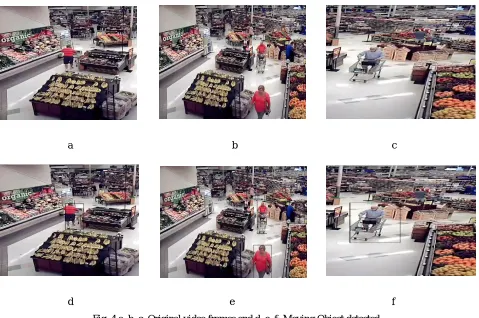
Here, different results are shown. From the results, it can be observed that proposed algorithm give better output. All testing done on the surveillance based video. Algorithms give better output in high resolution videos. We compare our results with OpenCV output by which we can know that our algorithm is better as we concern speed as our comparison parameter.
a b c
d e f
Fig. 4 a, b, c: Original video frames and d, e, f: Moving Object detected
Time comparison between proposed algorithm and OpenCV implementation of same algorithm is shown in table 1. We can see that the proposed algorithm is better compared to OpenCV implementation. The results shown are better for proposed algorithms when we take execution time per frame as comparison metric.
Table.1 Comparison between OpenCV and Proposed Algorithm
File name Height*Width OpenCV Implementation Proposed Algorithm
Implementation
Table 2. Describes the video summary output frames comparison. In which as output we only store that part that contain the motion other part should be rejected.
Table.2Frame comparison table for video summary
File name Height*Width Total Frames Frames after video
summary
Video_1.mp4 480x360 60 40
Video_2.mp4 720x1280 300 100
Video_3.mp4 640x480 1740 652
Video_4.mp4 200x604 393 292
Video_5.mp4 480x720 711 565
V.CONCLUSION
From this paper, it can be concluded that Object detection play major role in surveillance system. We designed a system in such a manner that it will works in most of condition so as the application changes the library remains the same. Algorithm is working with all present resolutions. Algorithm will working with raw data (YUV). We are using YUV 420 planner so the amount of data to be processed will be reduced and processing becomes faster. Video summary is the heart of the system. It will store only part which has motion as we can save the lots of space.
VI.FUTURE WORK
The algorithm can be modified further on the basis of different application. We can also do moving object recognization as per the application. Researches are going on for implementing efficient human recognization. We can also build the android application for some testing purpose.
REFERENCES
[1] Chowdary, M. Kalpana, S. Suresh Babu, and Haidar Khan. "FPGA implementation of moving object detection in frames by using background subtraction algorithm." Communications and Signal Processing (ICCSP), 2013 International Conference on. IEEE, 2013.
[2] Kinoshita, Koji, et al. "Tracking of a moving object using one-dimensional optical flow with a rotating observer." Control, Automation, Robotics and Vision, 2006. ICARCV'06. 9th International Conference on. IEEE, 2006.
[3] Barron, John L., David J. Fleet, and Steven S. Beauchemin. "Performance of optical flow techniques." International journal of computer vision 12.1 (1994): 43-77.
[4] Zhang, Lijing, and Yingli Liang. "Motion human detection based on background subtraction." Education Technology and Computer Science (ETCS), 2010 Second International Workshop on. Vol. 1. IEEE, 2010.
[5] Piccardi, Massimo. "Background subtraction techniques: a review." Systems, man and cybernetics, 2004 IEEE international conference on. Vol. 4. IEEE, 2004.
[6] Gonzalez, Rafael C., and Richard E. Woods. "Digital image processing, Pearson Education." Inc, India (2002).
[7] Dawoud, Nadir Nourain, BrahimBelhaouari Samir, and Josefina Janier. "Fast template matching method based optimized sum of absolute difference algorithm for face localization." Int. J.Comput. Appl 18 (2011): 30-34.
[8] Swain, Michael J., and Dana H. Ballard. "Color indexing." International journal of computer vision 7.1 (1991): 11-32.
[9] Pradhan, Ratika, et al. "Contour line tracing algorithm for digital topographic maps." International Journal of Image Processing (IJIP) 4.2 (2010): 156-163.
BIOGRAPHY
Mr. Prerak Patel, received B.E degree in Electronics and Telecommunication from NMU, Maharastra, India in 2013.
Currently, he is pursuing M.Tech in VLSI and Embedded Systems from Ganpat University, Gujarat, India and doing internship from eInfochips Pvt. Ltd., Ahmedabad, India.
Mrs. Darshana Mistry, received B.E. degree from Sardar Patel University, Gujarat, India in 2002 and M.Tech degree
pursuing Ph.D from Gujarat Technological University in “Multi view Occluded Image Registration” under Dr. Asim Banerjee (DAIICT).