
University of Windsor University of Windsor
Scholarship at UWindsor
Scholarship at UWindsor
Electronic Theses and Dissertations Theses, Dissertations, and Major Papers
2013
Highly secure cryptographic computations against side-channel
Highly secure cryptographic computations against side-channel
attacks
attacks
Yiruo He
University of Windsor
Follow this and additional works at: https://scholar.uwindsor.ca/etd
Recommended Citation Recommended Citation
He, Yiruo, "Highly secure cryptographic computations against side-channel attacks" (2013). Electronic Theses and Dissertations. 4717.
https://scholar.uwindsor.ca/etd/4717
This online database contains the full-text of PhD dissertations and Masters’ theses of University of Windsor students from 1954 forward. These documents are made available for personal study and research purposes only, in accordance with the Canadian Copyright Act and the Creative Commons license—CC BY-NC-ND (Attribution, Non-Commercial, No Derivative Works). Under this license, works must always be attributed to the copyright holder (original author), cannot be used for any commercial purposes, and may not be altered. Any other use would require the permission of the copyright holder. Students may inquire about withdrawing their dissertation and/or thesis from this database. For additional inquiries, please contact the repository administrator via email
HIGHLY SECURE CRYPTOGRAPHIC COMPUTATIONS AGAINST SIDE-CHANNEL ATTACKS
by
Yiruo He
A Thesis
Submitted to the Faculty of Graduate Studies Through Electrical and Computer Engineering in Partial Fulfillment of the Requirements for the Degree of Master of Applied Science at the
University of Windsor
Windsor, Ontario, Canada
2012
HIGHLY SECURE CRYPTOGRAPHIC COMPUTATIONS AGAINST
SIDE-CHANNEL ATTACKS
by
Yiruo He
APPROVED BY:
______________________________________________ Dr. Huiming Zhang
Department of Biological Sciences
______________________________________________ Dr.Mitra Mirhassani
Department of Electrical and Computer Engineering
______________________________________________ Dr. Huapeng Wu, Advisor
Department of Electrical and Computer Engineering
______________________________________________ Dr. Roberto Muscedere, Chair of Defense
Department of Electrical and Computer Engineering
DECLARATION OF CO-AUTHORSHIP/PREVIOUS PUBLICATION
I.
Co-Authorship Declaration
I hereby declare that this thesis incorporates material that is result of joint research. In all cases, the key ideas, primary contributions, experimental designs, data analysis and interpretation, were performed by the author and Dr. H. Wu as advisor.
I am aware of the University of Windsor Senate Policy on Authorship and I certify that I have properly acknowledged the contribution of other researchers to my thesis, and have obtained written permission from each of the co-author(s) to include the above material(s) in my thesis.
I certify that, with the above qualification, this thesis, and the research to which it refers, is the product of my own work.
II. Declaration of Previous Publication
This thesis includes 1 original paper that has been previously published/submitted for publication in peer reviewed journals, as follows:
Thesis Chapter
Publication title/full citation Publication status
Chapter 4 Efficient Architectures for Modular Exponentiation Using Montgomery Powering Ladder, IEEE Canadian Conference on Electrical and Computer Engineering 2011 (CCECE 2011), May 8-11, 2011 Niagara Falls, Canada
Published
I certify that I have obtained a written permission from the copyright owner(s) to include the above published material(s) in my thesis. I certify that the above material describes work completed during my registration as graduate student at the University of Windsor.
ABSTRACT
Side channel attacks (SCAs) have been considered as great threats to modern
cryptosystems, including RSA and elliptic curve public key cryptosystems. This is
because the main computations involved in these systems, as the Modular Exponentiation
(ME) in RSA and scalar multiplication (SM) in elliptic curve system, are potentially
vulnerable to SCAs. Montgomery Powering Ladder (MPL) has been shown to be a good
choice for ME and SM with counter-measures against certain side-channel attacks.
However, recent research shows that MPL is still vulnerable to some advanced attacks
[21, 30 and 34]. In this thesis, an improved sequence masking technique is proposed to
enhance the MPL’s resistance towards Differential Power Analysis (DPA). Based on the
new technique, a modified MPL with countermeasure in both data and computation
sequence is developed and presented. Two efficient hardware architectures for original
MPL algorithm are also presented by using binary and radix-4 representations,
ACKNOWLEDGEMENTS
I would like to thank my supervisor Dr. Huapeng Wu for introducing me to
Montgomery Powering Ladder and giving me all that advice, help and support
throughout this research work. I also want to thank Dr. Mitra Mirhassani for the
invaluable feedbacks she given me on this thesis, and Dr. Huiming Zhang for extensive
point of view.
I would also grateful to my colleagues and friends, Wangcheng Dai, Xiaojing Yu,
TABLE OF CONTENTS
DECLARATION OF CO-AUTHORSHIP/PREVIOUS PUBLICATION ... iii
ABSTRACT ...v
ACKNOWLEDGEMENTS ... vi
LIST OF TABLES ...x
LIST OF FIGURES ... xi
LIST OF ALGORITHMS ... xii
LIST OF ACRONYMS ... xiii
CHAPTER I. INTRODUCTION ...1
II. PUBLIC KEY CRYPTOGRAPHY AND SIDE CHANNEL ATTACK 2.1 Asymmetric Cryptography ...4
2.2 RSA and Elliptic Curve Cryptosystem ...5
2.3 Modular Exponentiation and Montgomery Powering Ladder ...8
2.4 Side Channel Attacks ...11
2.4.1 Power Analysis Attack ...12
2.4.2 Timing Attack ...14
2.4.3 Fault Attack ...14
2.4.4 EM Attack ...14
III.EXISTINNG WORK REVIEW AND PROBLEM STATEMENT
3.1 DPA against MPL ...18
3.2 Coron's three countermeasures in ECC and RSA ...21
3.2.1 First countermeasure: Randomization of the Private Exponent ...22
3.2.2 Second countermeasure: Blind the Point P ...22
3.2.3 Third countermeasure: Randomization of Projective Coordinates ...22
3.2.4 First countermeasure in RSA: Randomization of the Private Exponent ...23
3.2.5 Second countermeasure in RSA: Randomization of the Message ...24
3.2.6 Comparative Power Anlaysis agaisnt Coron's Work ...25
3.3 Follow up Countermeasures on Exponet and Message ...27
3.3.1 Exponent Splitting ...27
3.3.2 High Orders Attack against Expoent Splitting ...28
3.3.3 Blinded Fault Resistant Exponentiation ...30
3.3.4 Template Attack against Masked MPL ...32
3.4 Sequence Masking ...33
IV. PROPOSED PARALLEL COMPUTATION MONTGOMERY POWERING LADDER ARCHITECTURE 4.1 Proposed Architecture for Montgomery Power Ladder ...35
4.2 Proposed Modified Montgomery Power ladder ...38
4.3 Proposed Architecture for the Radix-4 MPL ...39
V. PROPOSED NOVEL SEQUENCE MASKING TECHNIQUE 5.1 Applying on MPL ...42
VI. PROPOSED COUNTERMEASURES FOR MONTGOMERY
POWER LADDER
6.1 Algorithm Explaination ...45
6.2 Efficiency Analysis ...48
6.3 Security Analysis ...48
6.3.1 Against Simple Side Channel Attacks ...48
6.3.2 Against Relative Doubling Attack and Comparative Power Analysis ...49
6.3.3 Against Template Attack ...51
6.3.4 Against High Order Attack and Complex Attacks ...52
6.4 Summary ...54
VII. HARDWARE IMPLEMENTATION FOR PORPOSED COUNTERMEASURE 7.1 SASEBO-GII ...57
7.2 HDL Simulation ...59
7.3 Synthesis Results ...59
7.4 Summary ...60
VIII. CONCLUSION 8.1 A Summary of Contributions ...65
8.2 Conclusion ...65
8.3 Possible Future Work ...66
REFERENCES ...67
APPENDICES ...72
LIST OF TABLES
2.1 Side Channels and Corresponding Side Channel Attacks ...11
2.2 Comparison between MPL and Square-and-Multiply Method on simple SCA resistance. ...16
3.1 Probability transition for fifferent exponent bits ...28
3.2 Imbalance probability for Exponent Splitting ...29
6.1 Efficiency analysis for proposed Algorithm 6.1 ...48
6.2 Countermeasures versus SCAs ...55
7.1 Hardware usage of FPGA implementation of proposed modified MPL (Algorithm 6.1) ...59
7.2 Hardware usage of different algorithms implemented on SASEBO-GII ...61
LIST OF FIGURES
2.1 Message delivery in Public Key Cryptography. ...4
2.2 SPA reveals secret exponent in binary method ...13
2.3 Comparison of Square-and-Multiply and MPL in power traces ...16
3.1 Example of Relative Doubling Attack...20
3.2 A. Shamir's patten for Exponent Masking [22] ...23
3.3 Comparative Power Analysis example[21] ...26
4.1 Architecture for Montgomery Powering Ladder ...36
4.2 An Implementation of the 2-by-2 Cross-point Switch in Figure 7 ...37
4.3 Proposed Architecture for the Modified MPL (Algorithm 4.1) ...39
4.4 Two Shift Register Holding Exponent Bits. ...40
6.1 Algorithm 6.1 against Relative Doubling Attack ...50
7.1 Top-level block diagram of SASEBO-GII ...58
7.2 Architecture of proposed modified MPL with countermeasures...62
7.3 Block diagram of Cryptographic FPGA for realizing proposed work ...63
LIST OF ALGORITHMS
2.1 Left to right version of Square-and-Multiply Method ...8
2.2 Montgomery Powering Ladder. ...10
3.1 Masked Montgomery Powering Ladder. ...30
3.2 Square-and-Multiply Always method ...33
4.1 Proposed Modified Montgomery Powering Ladder ...38
5.1 Proposed sequence masking applying on MPL ...42
LIST OF ACRONYMS
AIST National Institute of Advanced Industrial Science and
Technology of Japan
BUFG Global Buffer
DPA Differential Power Analysis
DSP Digital Signal Processing
ECC Elliptic Curve Cryptosystem
ECDLP Elliptic Curve Discrete Logarithm Problem
EM Electromagnetic
FPGA Field-programmable Gate Array
FTDI Future Technology Devices International
HDL Hardware Description Language
IP cores Intellectual Property cores
LUT Look Up Table
ME Modular Exponentiation
MPL Montgomery Powering Ladder
MVN Multivariate Normal Distribution
RNS Residue Number System
RSA Rivest, Shamir, Adleman
SASEBO Side-channel Attack Standard Evaluation Board
SCA Side Channel Attack
CHAPTER I
INTRODUCTION
The Internet has grown rapidly and it becomes a ubiquitous part of our modern
society. One of the cornerstones for its success is users’ trust on secure data transaction
over the Internet. Cryptography provides many core services for the network security to
ensure such trust. For instance, public key cryptography is famous for its strong security
strength and is frequently used as initial key exchange between two parties over insecure
communication channel. However, in many practical scenarios, attackers are able to
access the cryptographic device and gain information about internal data by monitoring
the physical information released from the device. Such attacking methodology is
introduced in [24], [25] and named Side Channel Attacks (SCA).
Modular exponentiation (ME), the most demanded computation in RSA public
key cryptosystem, is extensively targeted by SCAs. Unprotected ME algorithm offers
various possibilities for SCAs because the “leakage” physical information released by
cryptographic device is greatly associated with ME algorithm. Carefully designed ME
algorithms with proper countermeasures could result in more regular side channel signals
which may not be taken advantage of by the attackers easily. For instance, Montgomery
Powering Ladder (MPL) can provide resistance to one of the most popular SCAs, Simple
Power Analysis (SPA). Because MPL always maintains regular operations throughout its
process and has no redundant computations, the corresponding power consumption
signals release little information making SPA no longer applicable.
It has been shown that MPL is not immune to all types of SCAs. For example,
that extracts the leakage of information related to power consumption. Differential Power
Analysis (DPA) is first described by Kocher et al. in [10]. Many follow ups can be found
in [17, 20, 21, 25, and 30] and among which, [21, 30] are specially designed attacks for
breaking MPL.
Coron pointed out [9] that DPA may be prevented by randomizing the group, the
exponent or the base element. The following research work was focusing on masking
techniques targeting the exponent and the base element which can be shown as examples
in [22, 26, and 28]. However, they have all been proven ineffective toward later proposed
attacks [21, 27, 29] respectively. Other than protecting the exponent and the base element,
another algorithmic countermeasure is proposed by changing the procedure of ME
algorithm and is referred to as Sequence Masking technique in [21]. One example is
Square-and-multiply-always method which is effective in hiding computation sequences
but vulnerable to safe-error attack.
In this thesis an improved sequence masking technique is proposed. Based on the
proposed technique, a modified MPL algorithm with countermeasures of randomization
on exponent and the base element is developed. It has been shown that the new modified
MPL algorithm could provide protection to more SCAs than any other existing MPL-like
algorithms.
The thesis is organized as the following chapters. Chapter II gives an overview of
asymmetric cryptography system where MPL is put into application and introduces SCA
and explains why it is a serious threat. MPL as well as its natural resistance toward SCAs
SCAs, thus new countermeasures are in need.
Chapters IV to VII depict proposed works. In Chapter IV, two efficient
architectures for modular exponentiation are proposed respectively using MPL algorithm
and radix-4 MPL algorithm. It follows a novel sequence masking technique, which is
described in Chapter V. In Chapter VI, a new modified MPL algorithm with
countermeasures is proposed and analyzed. Its hardware implementation is described in
the following chapter VII. Chapter VIII concludes the contributions of this thesis and
CHAPTER II
PUBLICK KEY CRYPTOGRAPHY AND SIDE CHANNEL ATTACKS
2.1 Asymmetric Cryptography
In key generation point of view, there are two types of cryptographic techniques,
namely, symmetric cryptography and asymmetric cryptography. Symmetric cryptography
uses the same key for both encryption and decryption, while asymmetric cryptography
differentiates decryption key from encryption key. Asymmetric cryptography is also
popularly known as public key cryptography.
Assume that Alice and Bob are parties engaging a secure communication using
cryptographic technique. In asymmetric cryptography, each of them has her/his own pair
of public key and private key. The public key is placed in a public register accessible to
the public while the private key is kept private and known to its owner only.
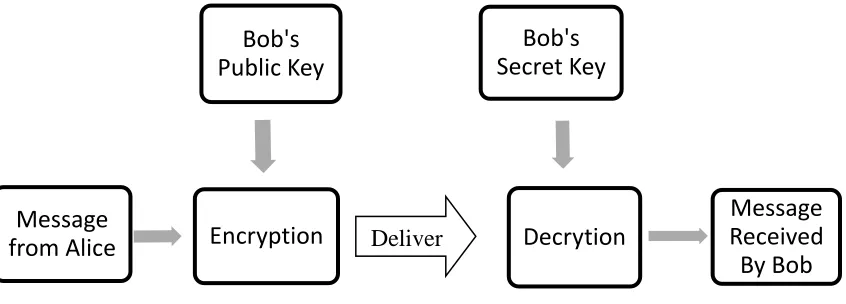
Figure 2.1 Message deliveries in Public Key Cryptography
Message
from Alice Encryption Bob's Public Key
Bob's Secret Key
Decrytion
Message Received By Bob
Deliver
receiving the encrypted message from Alice, Bob interprets this message only by using
his private key. In this example, two different keys are evolved in encryption and
decryption process. The encryption key is Bob’s public key which is revealed to public.
The decryption key is a private key that is only known by Bob. Thus, as the scheme
illustrated in Figure 2.1, the scheme is able to allow Alice sending messages to Bob
privately. Since Bob holds the only key that can be used to decrypt the encrypted
message.
It is well known that the feature of making a distinction between encryption and
decryption key for public key cryptography can facilitate many unique
cryptographic/secure services such like digital signature and key exchange. However,
public key cryptography systems usually require significant higher computation cost than
symmetric key systems as a trade off. Specifically, longer computation time and more
memory room requirement are usually expected in public key cryptography systems.
Therefore, it is very important to develop efficient algorithms for public key
cryptosystems. For the popular public key cryptosystems such like RSA, the main
computation cost is spent in performing modular exponentiation. This is why the research
on efficient modular exponentiation algorithms has becomes a focus in this area.
In real world practice of network security, symmetric and asymmetric
cryptography are co-operated. Asymmetric cryptography realizes the initial key exchange
with strong security strength, while encryption/decryption process is achieved by the low
cost symmetric cryptography process. In conclusion, both cryptography systems play
critical role. Their cooperation balances security strength and efficiency in network
2.2 RSA and Elliptic Curve Cryptosystem
Two popular cryptosystems, RSA and ECC are explained in this section. RSA is a
wildly used asymmetric cryptosystem and digital signature scheme. The invention of this
scheme was in later 1970s at MIT, by Ron Rivest, Adi Shamir and Len Adleman in [1].
And such cryptosystem is named after the first digit of their last name. The strength of
RSA is its mathematic difficulty in factorize ( ) ( ) ( )( ). The
description of such system is given as follows.
The cryptosystem holds the public key defined as (n,e) and the private key
defined as (n,d). Where, the integer n is obtained by multiply two prime number p and q.
e and d are exponents and they satisfy such requirements.
( ) ( ) ( )( )
The encryption and decryption process of RSA can be described as follows. Alice
wants to send encrypted message to Bob. Thus, she use Bob’s public key (n,e) to
compute where c is the encrypted message. The legitimate receiver, Bob
for this case, is able to decrypted c through his own private key (n,d) by computing
. The underlying equation can prove such encryption and decryption is
valid and original message are assured to be successfully delivered.
( ) ( ) ( )
RSA system can also be used as digital signature scheme. Bob wants to identify
Alice. Therefore, Alice use her own private key (n,d) to “sign” a message to tell Bob “I
am Alice”. Such purpose is fulfilled by computing c . Since the private key
Alice’s signature can be easily verified by decrypting using Alice’s public key (n,e) by
computing . The verification of such scheme is simple and straightforward.
( ) ( ) ( )
According to [2], “the most notable features about RSA are its apparent simplicity
and considerable elegance”. This sentence perfectly concludes RSA. Because of its
simplicity and elegance, RSA is abundantly applied in the world of cryptography.
Different than RSA, Elliptic Curve Cryptosystem (ECC) has not been patented.
The suggestion of using elliptic curve in cryptography is first published in [33] in 1985.
This system uses the elliptic curve discrete logarithm problem (ECDLP) which can be
defined as follows:
Let ( ) to be an elliptic curve over and let P be a point in such curve. For
any point ( ) find the integer k, where (#P is the order of P) such
that is an ECDLP. The basic operation in ECC is scalar multiplication
{ } there are k number of times additions.
A quick example will illustrate as follows. Alice tries to send a signed message to
Bob. They both share a point P on the same elliptic curve E. Bob has a private key and
private key satisfy . Because of the difficulty on solving ECDLP, making
known to public of and point P will not reveal private key .
Alice randomly generates an integer r and compute . And then she encrypts the
message m by computing .where is the public key of Bob. At last, Alice
Bob decrypt the message from Alice by multiplying his secret key with value
of . And then he subtracts the product from c. Since = , thus .
Then the message is successfully decrypted as follows:
It is obviously shown that modular exponentiation is exhaustively used and
appears nearly in nearly every derivation equations in RSA. On other hand, ECC has
huge amount of scalar multiplication which shares many commons with modular
exponentiation. The significance of modular exponentiation is self-evident. In summary,
the research work on modular exponentiation has its meaning reflected in widely usage in
popular public key cryptography like RSA and ECC etc.
2.3 Modular Exponentiations and Montgomery Powering Ladder
Algorithm 2.1.Left to right version of Square-and-Multiply method
Input: M, e=(en-1 … e1e0)2
Output: C = Me
Step 1: Set R← M;
Step 2: For i = n-1 to 0 Step -1
Step 2a: R←R2;
Step 2b: if (ei=1)
Then R←R×M;
Step 3: Return (C = R)
binary expression of the exponent to do faster computation rather than direct multiply the
base by some number of times.
Binary Method, also known as Square-and-multiply is a very classical method and
it is over 2000 years old. The left to right version starts at the exponent’s most significant
non-zero bit and work downward to least significant bit. Pseudo code illustration is
shown as follows. It shows in Algorithm 2.1 that at the beginning of each loop, the value
in register R is squared. And whenever exponent bit , R is multiply by . An
equation is able to prove this algorithm’s correctness.
e=e
n-12
n-1+e
n-22
n-2
…. +e
12
1
+e
02
0= (… (e
n-12+e
n-2)
2+…..+e
0)
Module exponentiation is the most critical part because it is the most demanded
computation in public key cryptography and have greatly influence to the computation
overhead. Unfortunately it’s also the weakest and most vulnerable point in front of SCAs.
In most case, since the secret information is part of the exponentiations parameters and
the surrender of modular exponentiation will direct result in the compromise of secret
information. Having resistance to Side Channel Attacks in Modular Exponentiation is
very important. With such background, the application of Montgomery Powering Ladder
[3] in cryptography causes great excitement for its nature resistance to Simple Power
Analysis (SPA). A comparison between Binary Method and MPL is disclosed in section
2.5 of this chapter to show MPL’s advantages towards SPA. And in this section, we still
focus on what is MPL.
MPL was originally invented as an improvement of left to right binary algorithm
towards SPA. And it is based on the following observation. [16]
It is easy to get:
{
That shows the relationship between and previous cycle value and also the
relationship between and previous cycle value . Moreover, we also found that to
obtain , there are always exist iteration where:
When , {
And when , {
Notice that and have very similar expression structure. And doubles itself
when and doubles itself when Moreover, the summation of
is assigned to in case of and to in case of
Algorithm 2.2.Montgomery Powering Ladder
Input: M, e=(en-1 … e1e0)2
Output: C = Me
Step 1: Set R0 ← 1, R1← M;
Step 2: For i = n-1 to 0 Step -1
Step 2a: if (ei=0)
Then {Set R1←R0×R1, R0←R02 ;}
Step 2b: if (ei=1)
Then {Set R0←R0×R1, R1←R12 ;}
As shown in Step2a and 2b of Algorithm 2.2, register R0 and R1 have
corresponding iteration process as and in the exponent. The summation of and
in exponent is carried out by a multiplication between R0 and R1. And the doubles
in and is realized by a squaring operation on R1 and R0 respectively. These
operations are valid since the base value is always M throughout the exponentiation.
Consider the computation overhead, MPL takes multiplications on
average. This may not as good as the performance in Square-and-multiply which takes
around 3/2 on average. Nevertheless, the capability for parallel computing makes
this method more efficient than basic binary algorithms. In [16], Marc Joye and
Sung-Ming Yen exhibit that as:
and
, where could be either and is the negation of
It is obviously that calculations relate to and the ones relate to are
independent. So, on a bi-processor, multiplication and squaring can compute at the same
time. That results parallel version of the MPL nearly attains the optimal 200% speed-up
factor over the standard one [16]. According to MPL’s capability of parallel computing,
two efficient architectures are proposed in Chapter IV in this thesis.
2.4 Side Channel Attacks
Side channel attacks exploit the information leaked by the physical characteristics
of the cryptographic modules during execution of the algorithm. The term “side channel”
is used to describe the leakage of system information. Depends on what kind of leakage
of system information SCA relies on, we can categorized it into several types as shown in
Table 2.1 Side Channels and Corresponding Side Channel Attacks
Side Channels Side-channel Attacks
Power Consumptions Simple Power Analysis, Differential Power
Analysis, Comparative Power Analysis etc
Timing information Timing Attacks
Faults response Safe-Error Attacks
Electromagnetic Radiation EM Attacks
-2.4.1 Power analysis attack
Different operation in cryptographic algorithms consumes different powers. And
these power variations can leak useful information about secret parameters. In worse case,
the secret parameters can be fully recovered by careful statically analysis on these
leakage information. Power analysis attacks proved to be very effective in attacking
smart cards and other embedded systems. And it can be categorized into Simple and
Differential Power Analysis (SPA and DPA respectively). In SPA, measured power
traces are used for analyzing which particular instruction is being carried out at specific
time. And this knowledge can lead to expose of secret parameters. DPA exploits more
statistical method in analysis process. And it is considered as one of the most powerful
SCAs for it requires relatively little resources [25]. Some of the DPAs will be detailed
explained in chapter III section 3.4 in this thesis. Currently, we focus on describe the
In order to illustrate the idea of SPA, consider an RSA encryption involves the
computation of , where is modulus and is the message need to be
encrypted. Adversary’s goal is to know the secret key .
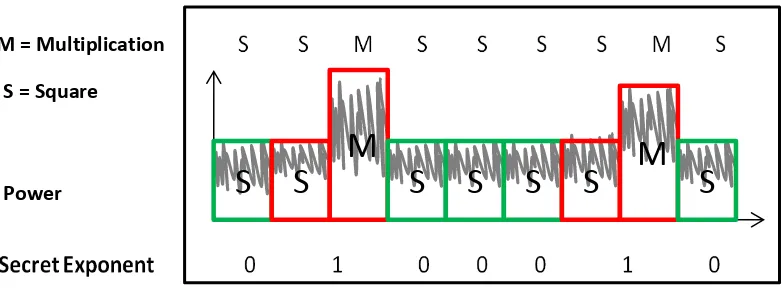
Figure 2.2 SPA reveals secret exponent in binary method
In Square-and-Multiply algorithm (Algorithm 2.1), different instructions are
carried out according to the value of secret exponent. In Step2b, the multiplication is
conditional and only occurs at the case of . In the other case of , only
squaring operation is performed. In another word, if adversary knows how to identify this
conditional multiplication, he knows the value of secret exponent. Unfortunately, the
multiplication is distinguishable in power consumption signals. As illustrate in Figure 2.2,
each wave pulse represents the power consumption of running an operation. Operations
could only be squaring or multiplication. Compare to multiplication, squaring operation
usually consumes less power and therefore has lower amplitude in power traces. As a
result, power traces can fully disclose which operation the cryptosystem was running by
identifying the amplitude difference. Operation types are record at the top of
corresponding wave pulses in Figure 2.2 where S represent squaring and M represents Power
Trace
M
S
S
S
S
S
M
S = Square M = Multiplication
multiplication. In the case of an S is followed by an M, which is highlighted as red wave
pulses in Figure 2.2, the corresponding secret exponent must be 1 since the conditional
multiplication is carried out and the triggering condition must be satisfied. Otherwise, as
shown in green, only squaring is performed which indicates the secret exponent is 0.
-2.4.2 Timing attack
Cryptographic algorithms in majority of implementation execute the computations
in a non-constant time. And these time variations sometimes related to secret exponent.
Moreover, careful statically analysis on this leakage information may fully recover the
secret exponent. First timing attack is proposed by Kocher et al. on 1996 [24]. He shows
it is possible to use such timing attack to against RSA. More works can be found in [6,
10].
-2.4.3 Fault Attack
Fault Attacks try to introduce errors into cryptographic computation, and to
identify the key by analyzing the mathematical and statistical properties of the
erroneously computed results. [22]
As illustration of the attack scheme, one of fault based attack mentioned by
Sung-Ming Yen and Marc Joye is explained as follows. In [12, 13], they descript the attack like
this: By timely inducing a fault during the execution of an instruction, an attacker may
deduce whether the targeted instruction is redundant: if the final result is correct then the
instruction is indeed redundant (or dummy operation [13]); if not, the instruction is
effective. This knowledge may then be used to obtain one or more bits of exponent. Such
effectiveness of each operation, it is dangerous to have dummy operations in
cryptographic algorithms. More fault attacks can be found in [11, 34].
-2.4.4 EM Attack
Electromagnetic (EM) radiation is considered as an extension of the power
consumption leakage and the attacks/countermeasures are applied without change [17].
Instead of measuring power consumptions, Electromagnetic radiation can be an
alternative leakage source used by adversary. More EM works can be found in [35].
2.5 Giving Protections in Algorithm Level
One of the practical approaches to stop SCAs is to provide protections in ME
algorithm level as refers to countermeasures. In this section, comparison between Square
and Multiply Algorithm and MPL are given to show how improvements in algorithm
level enhance its SCA resistances.
Square-and-Multiply is vulnerable to SPA because it has a conditional statement
that makes system operating differently and thus results in different power consumption.
This has already been discussed in section 2.4.1 as a demonstration of SPA.
MPL has shown more reliable resistance to SPA. First of all, as shown in
Algorithm 2.2, it always performs a multiplication followed with a squaring.
Consequently, there is no difference in power consumption regarding to computation on
different exponents. Secondly, there is no dummy operation in the algorithm. The faults
induced by safe-error attack always results in an incorrect exponentiation result. Thus,
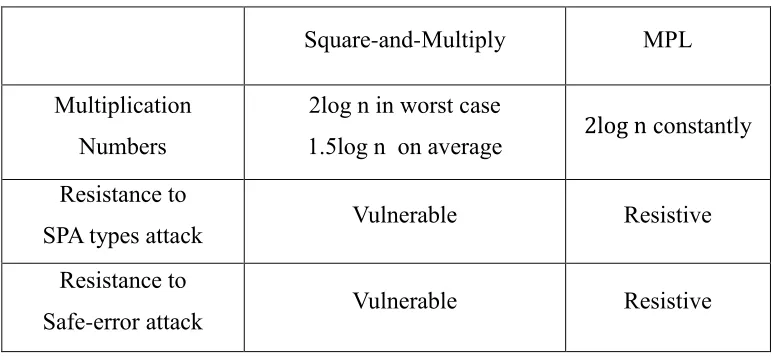
Table 2.2 Comparisons between MPL and Square-and-Multiply on simple SCA
resistance
Square-and-Multiply MPL
Multiplication Numbers
2log n in worst case
1.5log n on average constantly
Resistance to
SPA types attack Vulnerable Resistive
Resistance to
Safe-error attack Vulnerable Resistive
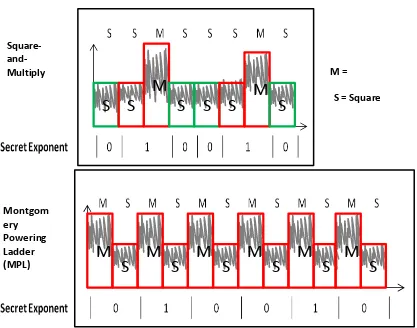
As illustrate in Figure 2.3, a comparison is performed in ME algorithms regarding
to power traces. Since Multiplication and Squaring is distinguishable by the amplitude,
the operation types are disclosed by the power traces and record as M and S in the figure.
Moreover, the secret exponents are listed below the exact wave pulse which is generated
by computing such exponent. It is obvious that Square-and-Multiply and MPL have
different power traces with inputting same secret exponents. Square-and-Multiply has
recognizable power traces for conditional multiplications. On the other hand, MPL
consistently performs multiplication with a squaring. In [14], “Highly Regular” is used
to evaluate an exponentiation algorithm. First, the algorithm is regular; which means will
always repeat the same instructions in the same order for any inputs; second, it has no
dummy operation which refers to the non-function operation padded within algorithm.
Dummy operation doesn’t effective but in some cases it has to be executed. MPL is a
requirements. Meanwhile, Square-and-Multiply fails on the first requirement of “Highly
Regular”.
Figure 2.3 Comparison of Square-and-Multiply and MPL in power traces
In conclusion, when taking into account simple Side channel attacks resistance,
MPL has better performance than Square-and-multiply algorithm. The essential of such
improvement is more regular instructions in iteration process. And the comparison also
demonstrates that improvements in algorithm level can regulate the power consumptions
and further enhance the SCA resistance.
Square- and-Multiply
M
S
S
S
S
S
M
S
Montgom ery Powering Ladder
(MPL)
M
S
M
S
M
S
M
S
M
S
S = Square M =
Multiplication
CHAPTER III
EXISTING WORK REVIEWS
According to recent research, MPL is able to resist SPA but still vulnerable to
Differential Power Analysis (DPA). Therefore, many research works are proposing on
MPL’s DPA countermeasures. Several existing works are mentioned in this chapter for
their great inspiration and influence. Respect has to be given to those pioneers in this
research field. In addition, their weaknesses are also concluded to show the potential of
further improvements.
3.1 DPA against MPL
In order to illustrate MPL’s vulnerability to DPA, Relative Doubling Attack is
explained as an example in this section. Relative Doubling Attack is proposed in [30].
Because the original doubling attack [20] does not apply to MPL, S.M Yan and etc
noticed another doubling-like attack is applicable. It is based on the following
observation:
Recall the invention of MPL algorithm, Low and High Registers were defined as:
When , {
, and when , { .
It’s easy to notice two facts.
Fact1. Given , then we have .
Assume two exponentiations are computing using MPL. They have specific
inputs M and . Therefore, the whole process is computing mod N and ( ) mod
N, where k is exponent and should be keep secret all the time. And N is modular number.
It‘s easy to obtain that if then, two squaring are performed as
follows:
{ ( )
(( ) ) ( )
These two squaring are computing the same values because of . Due to
this observation of “Collisions” on computation, a new doubling-like attack can be
mounted to derive the knowledge of . Once two computations are found not
coincidently identical, the triggering condition would be known if such computations are
spotted. Such computations are called “Collisions”.
For the same reason, it‘s also clear that if then,
{ ( )
(( ) ) ( )
These two squaring are also performing same computation because .
And such leads to the knowledge of . And for all the other case of
, there are not any collisions in the computation process.
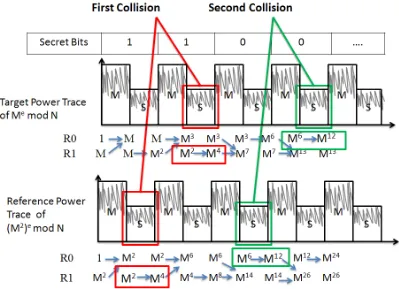
Figure 3.1 demonstrates an example of spotting collisions in power traces may
harm the cryptosystem. Assume two separate messages are input to the system. These
two inputs are carefully chosen as M and M2. The corresponding power traces for
exponentiation of and ( ) are indicated in Figure 3.1. Meanwhile, the
corresponding values in registers R0 and R1 are recorded under the exact power pulses.
internal data is in real time. They are no shown to the public. Only the power traces can
be obtained from public.
For case or case , or in another word, two adjacent
zeros or ones in secret keys, a pair of squaring in adjacent iterations is processing the
same data. As seen in highlighted blocks. Two collision was generated since there is two
“1” in a row and two “0” in a row in exponent bits. The first collision results in two
identical operations in target and reference power traces. The second collision
can be spotted in two computations.
Figure 3.1 Example of Relative Doubling Attack
collisions are not distinguishable, the detection of collision will not reveal the value of
the operand directly. However, the attacker is still able to conclude that once collision is
detected, two adjacent key bits are the same. Otherwise, they are different. As a result, for
given any bit in exponent, it is not difficult to figure out the rest. In addition, the most
significant bit of exponent is often to be chosen as one. With such awareness, the private
exponent is no longer secret.
Relative Doubling Attack is very effective to against MPL. It proves that MPL is
considerable unsecure in front of DPAs. More other attacks can be found in [21, 34].
3.2 Coron’s Three DPA Countermeasures in ECC and RSA
As illustrated in previous section, MPL cannot resist DPAs. As a result, many
researchers are working on MPL’s DPA countermeasures. In [19], J.S. Coron inclusively
concludes three types of DPA countermeasures in Elliptic Curve System. These
countermeasures are based on randomizing different parameters of scalar
multiplication . And inducing randomization in scalar multiplication and modular
exponentiation are well accepted method to against DPAs. Coron’s idea can be further
extended into RSA cryptosystem. The third countermeasure of Coron refers to randomize
the Group in RSA. This idea is not included in thesis. Thus, just first two
countermeasures are detailed mentioned in this section. In the last, the weakness of
Coron’s work is explained in a specific example: Comparative Power Analysis [21].
-3.2.1 First countermeasure: Randomization of the Private Exponent
Let be the total number of points in Elliptic Curve. The scalar multiplication
1. Compute where k is a random number and its size is suggested
to be 20 bits in practice.
2. Compute the point .
Exponent d can be replaced by in realization, because . And
( )
This countermeasure transfer scalar multiplication to a new
computation . Since exponent d and are related, the computation result Q will
still be same.
-3.2.2 Second countermeasure: Blind the point P
The point P is masked by adding a random point R which also belongs to the
same curve. And also is known. Then scalar multiplication can be computed
by ( ). To recover is just subtract ( ) with S. The mathematical proof
is as follows.
( )
This countermeasure transfer scalar multiplication to a new
computation ( ) . According to the above equation, the computation result
is correct.
-3.2.3 Third countermeasure: Randomization of Projective Coordinates
The projective coordinates of a point are not unique thus the projective
coordinates of P=(X, Y, Z) can be randomized by inducing a random number . P is
represented in a new projective coordinates of ( ) where in the finite field.
-3.2.4 First countermeasure in RSA: Randomization of the Private Exponent
This countermeasure is also known as Exponent Masking. As the name indicates,
it masks the exponent in order to protect the cryptosystem. The exponent masking
technique for RSA is firstly disclosed in [22] invented by Adi Shamir.
For computing ( ), instead of set the exponent as e, we choose
alternative exponent e’, where ( )and ( ) is the totient of modular n, and
is is a random number. Since:
( ) ( ) ( ) ( ( ( )) ) ( )
And because ( ) ( ) we could easily verify that
( ( ( )) ) ( ) ( ( ) ) ( ) ( )
In Shamir’s Patten, the computation of ( ) has the same result as the
expected ( ). However, it actually computes different operands. The
physical performance of alternative exponentiation is totally different, including power
1
1
i
Black Box Public t = phi(n)Key Scheme
Replace x^d(mod n) By x^d(d+i*t)(mod n)
consumptions and EM radiation features. Therefore, the private exponent is protected
even if the whole computation is compromised. The adversary only knows is
computed but still have no idea about original exponent . Moreover, if the ( ) is a
relative small number, this technique can be very efficient. For instance, if n and d are
1024 bit numbers, and r is a 32 bit random number as it recommended, d + r*t is a 1056
bit number consequently and it only need to take extra 32 multiplications or squaring. As
a result, this technique only cost 32/1024 extra computation.
-3.2.5 Second countermeasure in RSA: Randomization of the Message
This countermeasure is also known as Message Masking. Also as the name
indicates, it masks the message to be encrypted to prevent the potential attacks. For
computing ( ) , in order to confuse the adversary, message m is
transformed into other format. Following Coron’s idea, message m is randomized by
multiplying with a random number R. Thus, the computation is transformed into
( ) . We say it is masked by random number r. It’s obviously that doesn’t
match the ordinary C. In order to recover the ordinary C, C’ need to be unmasked by
multiply an anti-mask ( ) .
( ) ( ) ( ) ( ) ( ) ( )
In order to evaluate a message masking technique, the complexity of “Mask
Updating” is always the most important criterion. For Coron’s second countermeasure,
the mask r will be updated as the following equation specify.
If the mask won’t change as stays always as r, its update pattern is considered as a
relatively weak masking technique. But Coron’s second countermeasure update the mask
in a stable pattern and it is stronger than fixed masks.
-3.2.6 Comparative Power Analysis against Coron’s Work
Unfortunately, Coron’s two masking countermeasures are vulnerable to the
proposed attack as suggested in [21]. Comparative power analysis attack is proposed by
N. Homma et.cl in [21]. It can be applied to many standard implementations of the
exponentiation, for instance, the binary Method, M-ary Methods and MPL. Similar to
Relative Doubling Attack [30] mentioned in section 3.1, the basic idea of this attack is to
input a pair of chosen messages to generate collisions. The two chosen inputs Y and Z
have to be able to find the solution of so that it can generate collisions.
Computing Y as exponent gives a power trace including the target operation. The other
input Z gives another power trace used as reference for it has a particular operation which
is identical with target operation. In contrary to Relative Doubling Attack [30], the
Collision was generated at two arbitrary time frames. And it’s claimed in [21] that, the
two inputs have more flexible relationship.
With the intention to find to satisfy the attacker can choose an
arbitrary value r and can compute and , where can
be user customized.
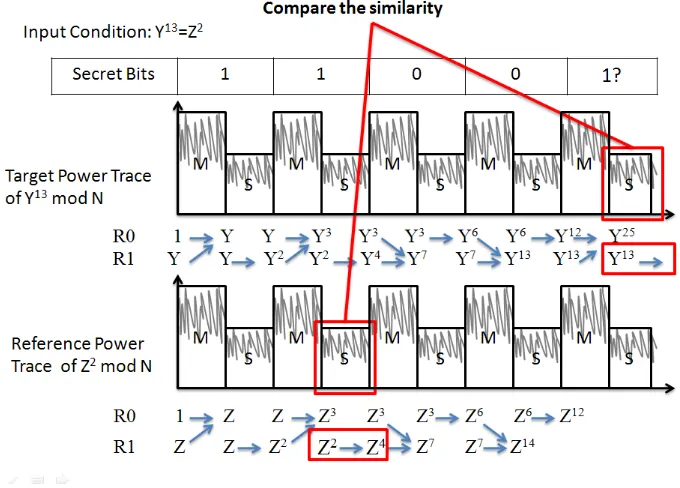
Let’s have an example for better understanding. In figure 5.2, the input condition
was chosen as . The attacker was assuming to know
the first four bits are . If the fifth bit is one, the attacker can detect that collision
bit is considered as zero. It’s simple to notice that the binary representation of decimal 13
is , and first four bits are which is treated as attacker’s knowledge in the
first place. Thus if the fifth key bits is one, the squaring at that time frame is
computing .
Figure 3.2 Comparative Power Analysis Examples
In the beginning, the attacker would choose the input condition
according to his knowledge of revealed key bits. And then he can figure out the other
input Z to create reference operation . If fifth bit is one and because ; we are
expecting similarity for target and reference operation. Otherwise, fifth bit more likely to
be zero. And after repeated attacks, the secret key bits will be exposed one by one.
And according to the analysis in [21], the Comparative Power Analysis is capable
a random number. Meanwhile, exponent E is randomized with a multiple of ( ). The
attacker will simple choose input X = -1. Thus, the exponentiation of will turns
into ( ) . At the same time, the updating process for mask is essentially . Notice that
they are taking the same exponent. And with simple comparison in power traces, the
randomized exponent ( ) will be uncovered. Although the real exponent does not
yield, ( ) is equally useful. If the attacker repeats such attack, he would get
another randomized exponent ( ) with same E but different i. the subtraction
for ( )and ( ) will gives a multiple of ( ), which is sufficient to
factorize N.
3.3 Follow up Countermeasures on Exponent and Message Masking
Two follow up countermeasures on exponent and message masking are brought
up in this section, Exponent Splitting [26] and Blinded Fault Resistant Exponentiation
[28]. These countermeasures are very effective and inspiring. Reviewing such
countermeasures helps understanding the recent research results for masking technique.
Their weaknesses are also included to show how they fail towards later proposed attacks.
More specifically, High Order attack [27] is able to break Exponent Splitting Technique.
And Masked MPL is vulnerable to Template Attack [29]. It also helps understanding the
proposed algorithm presented later in this thesis.
-3.3.1 Exponent Splitting
The idea of data splitting was first abstracted in [26]. And in [23], the idea was
used specific on exponent. Based on the simple observation of:
C. Clavier and M. Joye states in [23] that values of both r and (e -r) are required to
recover the value of e. In other word, only one of the two exponentiations requires
protection. Even though this statement was proved to be wrong in [27], it still gives an
idea on we could split the exponent to thwart side channel attacks.
The main idea of the splitting technique is to pick a random r (smaller than e) and
to compute the value r’ = e− r. After that the recovery process is completed fairly easy by
computing
( )
Exponent splitting technique has very high security strength but the cost is
severe. Naturally it doubles the computation load. Thus it is considered less efficient than
other alternative algorithms. Unfortunately, such technique is compromised to attack
proposed in [27] which is explained the following section. Further enchantment for such
technique is necessary.
-3.3.2 High Orders Attack against Exponent Splitting
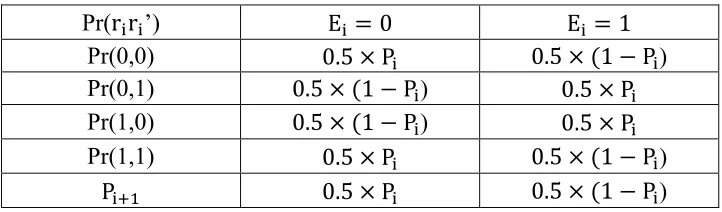
Table 3.1Probability transition for different exponent bits
Pr( ’)
Pr(0,0) ( )
Pr(0,1) ( )
Pr(1,0) ( )
Pr(1,1) ( )
( )
High Orders Attack is proposed in [27] by Frederic Muller and Frederic Valette.
Table 3.2 Imbalance probability for Exponent Splitting [27]
5 7 8 9 …….. 9
( ’) 0 1 0 1 0 1 0 0 0 0 …….. 1 1 1 1 1 Pr(0,0) 0 25 38 31 35 33 34 16 8 4 …….. 47 23 11 5 2 Pr(0,1) 50 25 12 19 15 17 16 34 41 46 …….. 3 27 39 45 48 Pr(1,0) 0 25 13 18 15 17 16 33 42 46 …….. 4 28 40 46 49 Pr(1,1) 50 25 37 32 35 33 34 17 9 4 …….. 46 22 10 4 1
The following equation is always satisfied:
, where is the carry bit in i-th iteration and refer to the two random
numbers that construct the real exponent E
If we define as the probability for the case of , and Pr( ’) as the
probability for bracket case, we could have the probability transaction as summarized in
Table 3.1. The probability for bracket cases belongs to a Markov chain, where next step’s
probability can be derived from two previous probability transaction expressions. An
example will further explain.
Two random numbers are generated to construct real exponent E for
.The Table 3.2 records the probabilities of all pair of ri and ri’ associated with the real
exponent.
For is 0, then r0 and r0’can either be 00 or 11, each has 50 % chance. If is 1,
then r0 and r0’ will be either 10 or 01, each has 50% chance. We notice that after a long
run of 0s in exponent bits, the isapproaching to zero indicating no carry bits generated.
And after a long run of 1s, (1- ) is very close to zero showing a carry bit is propagating
of actual exponent. If adversary launch any attack methods suggested in [27], exponent
splitting is not long safe.
-3.3.3 Blinded Fault Resistant Exponentiation
Algorithm 3.1. Masked Montgomery Powering Ladder
Input: M, e=(en-1 … e1e0)2 ;
is the check sum of e
Output: C = Me
Pick Random Number r
Step 1: Set R0 ← r, R1←rM, R2← r-1
Step 2: For i = n-1 to 0 Step -1
Step 2a: if (ei=0)
Then {Set R1←R0×R1, R0←R02 , R2←R22, update (CKS,ej)}
Step 2b: if (ei=1)
Then {Set R0←R0×R1, R1←R12, R2←R22 ,update (CKS,ej)}
Step 3:
Step 4: Return (C = R0×R2)
Blinded Fault Resistant Exponentiation is also known as Masked Montgomery
Powering Ladder (AKA Masked MPL). It is first proposed in [28] by G. Fumaroli and D.
Vigilant in 2009. It is a message masking technique based on Montgomery Powering
Ladder algorithm. At the very beginning, two register R0 and R1 is multiplicatively
The register R2 is initialized with the anti-mask , and such anti-mask is
also updating during each iteration process. As a result, after n number of times
iterations, the register R2 would hold . And multiply R0 and R2 give the
precise exponentiation results. In addition, in order to thwart potential fault attack and
exponent or loop counter disturbance, an on-the-fly checksum function was used to fulfill
such purpose.
The updating pattern for the mask is . Compare to Coron’s second
Countermeasure’s mask updating as , Masked Montgomery Powering Ladder has
better randomness in mathematic point of view. It’s obvious that taking n as parameter,
has high order. And we are expecting more variation on the change for higher
orders.
Since Masked MPL keeps the same structure as the regular MPL, it inherits
Montgomery Powering Ladder’s feature of Highly Regular, it’s intrinsically resistive to
simple side-channel attacks as well as Safe-Error Attack.
Other than resistance to simple side channel attack, Masked MPL contains
improved resistance towards Differential Power Analysis and Fault Attacks. By means of
masking all the computation intermediate value, the input is believed to be “statistically
independent” [28] from output. Unless the random number r is revealed, or it is a weak
mask, differential side-channel attacks can not apply in practice. And thanks to the
Checksum function’s participation, most fault attack cannot pass the very last sum
-3.3.4 Template attack against Masked MPL
Masked MPL is considered as a very strong countermeasure. Nevertheless, a
template attack [29] is claimed to be a great threat to Masked MPL.
C. Herbst and M. Medwed proposed a crypto-analysis in [29] that building a
template to guess the operand of given operation by maximum-likelihood decision rule. It
has been proved that it is effective to attack Masked Montgomery Ladder via guessing
the value of random mask. Such template represents statistical properties of the power
consumption for a given operation. It states in [29] that the power consumption of a
device follows a multivariate normal distribution (MVN). Similarly like MVN, the power
consumptions can be described by template consisted by a mean vector and a
covariance matrix . And it also assumes that the adversary can model every possible
occurring operation. Therefore, the adversary is able to fully characterize all possible
operations and know the corresponding hamming weights.
Since the adversary also knows the moments of time when the mask is operating,
he can extract those points and apply the previously built templates to them. Therefore,
adversary has the knowledge of the Hamming height of the mask as well as those of the
partial products of the multiplication.
So far, the adversary successfully extracts the Hamming weights of the processes
data out of a given trace. In this case, the attack focuses on the masking operation .
Here starts the stage of so called Sieving Step [29] which can determine the mask . The
first part of sieving is to narrow down the mask candidate by knowing the exact
The effectiveness for such attack is the same in 8bits and 16 bits system.
However, for 32-bit platforms the sieving step becomes computationally infeasible.
Although such attack is limited in low bit platforms so far, the solid standing for masked
MPL has been challenged. Further enhancement is under demands.
3.4 Sequence Masking
Algorithm 3.2 Square-and-Multiply Always method
Input: M, e=(en-1 … e1e0)2
Output: C = Me
Step 1: Set R← M;
Step 2: For i = n-1 to 0 Step -1
Step 2a: R←R2;
Step 2b: if (ei=1)
Then R←R×M;
Step 2C: if (ei=0)
Dummy Operation R×M;
Step 3: Return (C = R)
There is another method to against DPA other than Coron’s countermeasures.
Sequence masking technique usually changes the procedure of exponentiation methods.
One unsuccessful example is Square-and-Multiply-always method [19]. This method
adds a dummy multiplication to standard Square-and-Multiply method to make it more
balanced. As illustrated in Algorithm 3.2. When the exponent bit is equal to zero, the
operation. However, such dummy operation is vulnerable to safe-error attack and didn’t
improve the strength of original algorithm. It becomes very easy to locate when it
computes the multiplication R = R×M after the squaring. And when exponent bit is equal
to zero at this iteration, R = R×M’s result won’t affect the final result. This can be abused
conversely. If some computational fault is induced to system when it computes R = R×M,
it’s easy to know the exponent bit at that time frame by verifying whether the final result
is correct or not.
Sequence masking receives less attention and there is very few existing work.
First, for given ME algorithm, it is difficult to changing the computation sequence. Non
careful adjusting may ruins the computation correctness. Second, adding redundant
operation is dangerous; it can be seen in example of Square-and-Multiply Always
method. Nevertheless, sequence masking is a possible solution for DPA protection. And
if it’s well adopted, such kind of technique is additive to exponent masking and message
CHAPTER IV
PROPOSED ARCHITECTURES FOR MPL AND RADIX-4 MPL
In this chapter, two new architectures for exponentiation are proposed. The first
one is an efficient implementation of Montgomery power ladder algorithm (Algorithm
3.2) by using its parallel computing feature. The second proposed architecture is based on
a modified Montgomery powering ladder method (Algorithm 4). We firstly extend
Montgomery ladder algorithm by applying loop unrolling technique to it. The resultant
algorithm takes only half number of the loops to complete the exponentiation. A new
architecture for this modified Montgomery ladder algorithm is then proposed. The
hardware complexity and time delay of the proposed architectures are analyzed and
compared.
4.1 Proposed Architecture for Montgomery Power Ladder
An efficient architecture for realization of MPL (Algorithm 2.2) is shown in
Figure 4.1. Two registers R0 and R1 store the variables R0 and R1 in Algorithm 2.2, and
they are initialized as 1 and M respectively. Registers R0 and R1 should be larger enough
to hold the power Mk. The exponent k is stored in the binary shift register k which shifts
to the left by one bit every clock cycle. (In Figure 4.1, it is shown as a circular shift
register.) Other hardware components include one modular multiplier, one modular
squaring unit, one multiplexer, and one 2-by-2 cross-point switch.
Assume that the modulus is M and has m bits. Then each of registers R0 and R1
should be large enough to hold an m-bit number. Modular multiplier and modular
multiplexer takes two inputs of m-bit number and selects one of them as the output
depending on the select bit ki.
Figure 4.2 shows one design of the 2-by-2 cross-point switch shown at the bottom
of Figure 4.1. The implementation of the switch utilizes two multiplexers and it realizes
the following function:
If E=0, then C=A, D=B;
If E=1, then D=A, C=B.
The architecture works as follows. Registers R0 and R1 are initially loaded as 1
and M, respectively. At cycle j,j=0, 1, …, n-1, exponent bit kn-1-jis the leftmost bit in
squaring operation is performed. Otherwise if kn-1-j =1, the output of register R1 is
selected (R1) by the multiplexer and squaring operation is performed to generate R12.
Figure 4.2 Implementation of the 2-by-2 cross-point switch in Figure 4.1
The 2-by-2 cross-point switch works as follows. At cycle j, if kn-1-j =0, or the
control input to the switch E=1, the switch is configured as two cross paths where the
output of the multiplier is connected to the input to R1 and the output of the squarer is
connected to the input to R0. If kn-1-j =1, or E=0, the 2-by-2 switch is configured into two
parallel paths. The output of the multiplier is then written into R0 while the output of the
squaring unit is written into R1.
During clock cycle j the architecture completes the computation in loop i=j in
Algorithm 2.2. After n clock cycles, Register R0 contains the final result .
The complexity of the architecture includes one multiplier, one squarer, two
multiplexers, and two registers. The critical path delay T is given by
{ }
{ }
It can be seen from Figure 4.2 that the time delay of the 2-by-2 cross-point switch
large operand, then the critical path delay is . The time delay
taken to complete one exponentiation is ( )
4.2 Proposed Modified Montgomery Power Ladder
We apply the loop unrolling technique to the existing Montgomery power ladder
algorithm by unrolling two loops into one. The resultant algorithm is shown in Algorithm
4.1 as follows.
Algorithm 4.1. Modified Montgomery Powering Ladder
Input: M, e=(en-1 … e1e0)2 ;
Output: C = Me
Step 1: Set m ← (n-2)/2 if n is even;
otherwise set m ← (n-1)/2 and kn← 0.
Step 2: Set R0 ← 1, R1← M;
Step 3: For i = n-1 to 0 Step -1
Step 3a: if
Then {Set R1←R0×R1, R0←R02 ,
R1←R0×R1, R0←R02 ;}
Step 3b: if
Then { Set R1←R0×R1, R0←R02 ,
R0←R0×R1, R1←R12;}
Step 3c: if
Then {Set R0←R0×R1, R1←R12,
R1←R0×R1, R0←R02 ;}
Step 3b: if
Then {Then { Set R0←R0×R1, R1←R12,
R0←R0×R1, R1←R12;}
4.3 Proposed Architecture for the Modified Montgomery Power Ladder Algorithm
The proposed architecture to implement Algorithm3 is shown in Figure 4.3. Two
register R0 and R1, initialized as1 and M stores the variables R0 and R1 in Algorithm
4.1, respectively.
Figure4.3 Proposed Architecture for the modified MPL (Algorithm 4.1)
The two register should be large enough to hold the power . The binary
exponent k is split into two parts and they are stored in two shift registers, as shown in
Figure 4.4 Two shift register holding exponent bits
As shown in Figure 4.4, Register K0 stores all the odd bits of the exponent k, …,
k2i+1, …, k3, k1, whose output bit is used to control the top multiplexer and the top 2-by-2
cross-point switch (Figure 4.2).Register K1 stores all the even bits of k, k2i, …, k2, k0,
and its output bit controls the bottom multiplexer and the bottom 2-by-2 switch as shown
in Figure 4.3.Other units include two multipliers, two squaring units, two multiplexers,
and two 2-by-2 cross-point switches. The architecture can be roughly divided into two
parts: the upper part works similar to that in Figure 4.1, except that the outputs of the
2-by-2 switch become the inputs to the multiplier and squaring unit at the lower part, rather
than are written back into R0 and R1 in Figure 4.1. The lower part of the architecture
works also similar to that in Figure 4.1 except that the input to the multiplier and squaring
units are the 2-by-2 switch in the upper part, rather than from the registers as in Figure
4.1.
The complexity of the architecture includes two multipliers, two squaring units,
two multiplexers, two 2-by-2 switches, and two registers. The critical path delay is
given by
{ }
Note that the delay of the 2-by-2 cross-point switch is equivalent to that of one
multiplexer. The number of clock cycles required to complete one exponentiation is
CHAPTER V
PROPOSED NOVEL SEQUENCE MASKING TECHNIQUE
In this chapter, a novel sequence masking technique is proposed. This technique
is explained through the case of MPL. Then security analysis of propose technique is
followed. Even the proposed technique can only resist the
5.1 Applying on MPL
Algorithm 5.1 Proposed sequence masking applying on MPL
Input X, N, ( ); ( )
Output:
Generating 2n bits random number Seq;
Step 1: Set
Step 2: For i=2n-1 down to 0 do
Step 2.1: if
Step 2.1a: if
}
Step 2.1b: if
{
Step 2.1c: shift to left;
Step 2.2: if
Step 2.2a: if
{
Step 2.2b: if
{ }
Step 2.2c: shift to left;
Step 3: End for

![Figure 3.1 A. Shamir's Patten for Exponent Masking [22]](https://thumb-us.123doks.com/thumbv2/123dok_us/1419715.1174514/37.612.119.531.185.405/figure-shamir-s-patten-exponent-masking.webp)
![Table 3.2 Imbalance probability for Exponent Splitting [27]](https://thumb-us.123doks.com/thumbv2/123dok_us/1419715.1174514/43.612.118.542.125.212/table-imbalance-probability-exponent-splitting.webp)
