University of Windsor University of Windsor
Scholarship at UWindsor
Scholarship at UWindsor
Electronic Theses and Dissertations Theses, Dissertations, and Major Papers
2013
Social Network Opinion and Posts Mining for Community
Social Network Opinion and Posts Mining for Community
Preference Discovery
Preference Discovery
Tamanna Mumu University of Windsor
Follow this and additional works at: https://scholar.uwindsor.ca/etd
Recommended Citation Recommended Citation
Mumu, Tamanna, "Social Network Opinion and Posts Mining for Community Preference Discovery" (2013). Electronic Theses and Dissertations. 4865.
https://scholar.uwindsor.ca/etd/4865
This online database contains the full-text of PhD dissertations and Masters’ theses of University of Windsor students from 1954 forward. These documents are made available for personal study and research purposes only, in accordance with the Canadian Copyright Act and the Creative Commons license—CC BY-NC-ND (Attribution, Non-Commercial, No Derivative Works). Under this license, works must always be attributed to the copyright holder (original author), cannot be used for any commercial purposes, and may not be altered. Any other use would require the permission of the copyright holder. Students may inquire about withdrawing their dissertation and/or thesis from this database. For additional inquiries, please contact the repository administrator via email
Social Network Opinion and Posts Mining
for Community Preference Discovery
By
Tamanna Mumu
A Thesis
Submitted to the Faculty of Graduate Studies through the School of
Computer Science in Partial Fulfillment of the Requirements for the Degree
of Master of Science at the
University of Windsor
Windsor, Ontario, Canada
2013
Social Network Opinion and Posts Mining
for Community Preference Discovery
By
Tamanna Mumu
APPROVED BY:
Eugene H. Kim Department of Physics
Subir Bandyopadhyay School of Computer Science
Christie I. Ezeife, Advisor School of Computer Science
III
AUTHOR’S DECLARATION
OF ORIGINALITY
I hereby certify that I am the sole author of this thesis and that no part of this thesis has been published or submitted for publication.
I certify that, to the best of my knowledge, my thesis does not infringe upon anyone’s
copyright nor violate any proprietary rights and that any ideas, techniques, quotations, or any other material from the work of other people included in my thesis, published or otherwise, are fully acknowledged in accordance with the standard referencing practices. Furthermore, to the extent that I have included copyrighted material that surpasses the bounds of fair dealing within the meaning of the Canada Copyright Act, I certify that I have obtained a written permission from the copyright owner(s) to include such material(s) in my thesis and have included copies of such copyright clearances to my appendix.
IV
ABSTRACT
The popularity of posts, topics, and opinions on social media websites and the influence ability of users can be discovered by analyzing the responses of users (e.g., likes/dislikes, comments, ratings). Existing web opinion mining systems such as OpinionMiner is based on opinion text similarity scoring of users’ review texts and product ratings to generate database table of features, functions and opinions mined through classification to identify arriving opinions as positive or negative on user-service networks or interest networks (e.g., Amazon.com). These systems are not directly applicable to user-user networks or friendship networks (e.g., Facebook.com) since they do not consider multiple posts on multiple products, users’ relationships (such as influence), and diverse posts and comments.
In this thesis, we propose a new influence network (IN) generation algorithm (Opinion Based IN:OBIN) through opinion mining of friendship networks (like Facebook.com). OBIN mines opinions using extended OpinionMiner that considers multiple posts and relationships (influences) between users. Approach used includes frequent pattern mining algorithm for determining community (positive or negative) preferences for a given product as input to standard influence maximization algorithms like CELF for target marketing. Experiments and evaluations show the effectiveness of OBIN over CELF in large-scale friendship networks.
KEYWORDS
V
DEDICATION
To my parents Md. Rafique Uddin and Rumana Akhter, my sister
VI
ACKNOWLEDGEMENT
My sincere appreciation goes to my parents, husband and younger sister. Your perseverance and words of encouragement gave me the extra energy to see this work through.
I will be an ingrate without recognising the invaluable tutoring and supervision from Dr. Christie Ezeife. Your constructive criticism and advice at all times gave me the needed drive to successfully complete this work. I like to thank Dr. C. I. Ezeife for continuous research assistantship positions from NSERC and FedDev/OBI grants.
Special thanks go to my external reader, Dr. Eugene H. Kim, my internal reader, Dr. Subir Bandyopadhyay for accepting to be my thesis committee. Your decision, despite your tight schedules, to help in reading the thesis and providing valuable input is highly appreciated.
VII
TABLE OF CONTENTS
AUTHOR’S DECLARATION OF ORIGINALITY ... III
Abstract ... IV
DEDICATION ... V
ACKNOWLEDGEMENT ... VI
List of Figures ... X
List of Tables ... X
List of Algorithms ... XI
Introduction ... 1
1.1 Social Network Data... 2
1.2 Business Applications of Mining Social interest ... 6
1.3 Data Mining ... 8
1.3.1 Data Mining Approaches ... 9
1.3.2 Web Mining ... 15
1.4 Mining popularity and community preference ... 16
1.5 Challenges of mining social networks ... 17
1.6 Thesis Problem and Contributions ... 18
1.6.1 Problem Addressed ... 18
1.6.2 Thesis Contribution ... 20
1.7 Thesis Outline ... 21
Related Works ... 22
2.1 Product Review Domains ... 23
2.1.1 Feature-based Approach ... 23
2.1.2 Opinion Summarization ... 25
2.1.3 Feature-Entity Based Approach... 28
2.1.4 Lexicalized HMM Approach ... 29
2.1.5. Holistic Lexicon-based Approach ... 31
2.2 Opinion Mining in Weblog Domains ... 32
2.2.1 Contribution of Comment Contents ... 32
2.2.2 Statistical Analysis ... 33
2.3 User-generated tags in Bookmark Domains ... 35
2.3.1 Vector Space Model (VSM) in ISID ... 35
VIII
2.4 Opinion Mining in Co-authorship Domains ... 36
2.4.1 Graphical Probabilistic Model ... 36
2.5 Opinion Mining in Newsgroup Domains ... 38
2.5.1 Graph Theoretic Approach ... 38
2.6 Semantic Orientation and Polarity Analysis ... 39
2.6.1 Classification by Semantic Orientation of Phrases ... 39
2.6.2 Classification by Polar Language ... 41
2.7 Influence Maximization (IM) ... 42
2.7.1 ‘Lazy Forward’ Optimization ... 42
2.7.2 Trust – Influential Node Miner (T-IM) Model ... 43
Proposed Opinion and Posts Mining for discovering Community Preferences from Social Networks... 45
3.1 Features to be analyzed ... 46
3.2 Proposed OBIN Model ... 50
3.3 Data Warehouse Generation ... 54
3.4 Topic-Post Distribution (TPD) Model ... 56
3.4.1 Identification... 56
3.4.1.1 Running Example ... 59
3.4.2 Preprocessing ... 61
3.4.2.1 Running Example ... 63
3.4.3 Extraction ... 64
3.4.3.1 Running Example ... 65
3.5 Post-Comment Polarity Miner (PCP-Miner) ... 66
3.5.1 Extraction ... 68
3.5.1.1 Tokenization ... 69
3.5.1.2 Cleaning ... 70
3.5.2 Identification of Opinion Words... 71
3.5.2.1 Part of Speech Tagging (POS-tagging) ... 71
3.5.2.2 Topic/Feature Identification ... 73
3.5.2.3 Opinion Words Extraction ... 74
3.5.3 Semantic Orientation Identification... 77
3.5.3.1 Opinion Words with Frequent Features ... 78
IX
3.5.4 Polarity Measure ... 79
3.5.5 Running Example ... 80
3.6 Social Influence Graph and Community Preference ... 83
3.6.1 Running Example ... 85
3.7 Complexity Analysis ... 87
Experiments and Analysis ... 89
4.1 Experimental Setup ... 89
4.1.1 Dataset ... 89
4.1.2 Evaluation Measure ... 90
4.2 Performance Analysis ... 91
Conclusion and Future Works ... 95
REFERENCES ... 97
X
LIST OF FIGURES
Figure 1 Social network graph generated from Table 1 & 2 ... 3
Figure 2 Extracted Social Information of a sample user (id: 544249401) ... 4
Figure 3 Clustering Example ... 11
Figure 4 Bipolar adjective structure ... 26
Figure 5 Example of word propagation ... 29
Figure 6 Bootstrapping process by Jin et al. (2009) ... 30
Figure 7 Example of graph generation... 34
Figure 8 Graphical representation of TFG Model (Tang et al. 2009) ... 37
Figure 9 Social Network Graph with influence probability... 42
Figure 10 A heterogeneous network model for Topic-post ... 46
Figure 11 An example of Facebook Topic-Post ... 48
Figure 12 Example of Raising Discussion ... 49
Figure 13 System Diagram of OBIN ... 53
Figure 14 Social Network Influence graph ࡳࢠ modelled from IMAT ... 87
Figure 15 Comparison of influence spread by different number of influential nodes ... 93
Figure 16 Running time of different algorithms ... 94
LIST OF TABLES
Table 1 User information table ... 3Table 2 User relationship table ... 3
Table 3 Example Training Data for classification ... 10
Table 4 Example of Frequent patterns from Transaction table... 13
Table 5 Example of Transaction database ... 14
Table 6 Differences between issues handling by existing systems and proposed system 19 Table 7 n-grams features from extracted reviews ... 24
Table 8 Definitions of Entity Types... 28
Table 9 Basic tag set and corresponding entity ... 28
Table 10 Pattern tag set and corresponding pattern ... 28
Table 11 Example of ࢚ࢌǡ ࢚ࢌ ൈ ࢊࢌ keywords, and tags ... 35
Table 12 Patterns of Tags ... 39
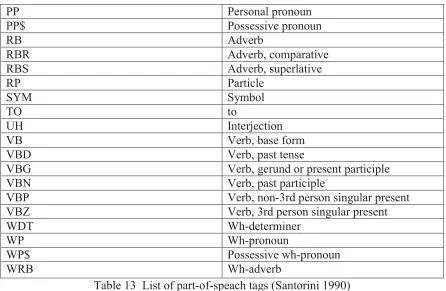
Table 13 List of part-of-speach tags (Santorini 1990) ... 40
Table 14 Category Table, tblCategory ... 55
Table 15 Topic Table, tblTopic ... 55
Table 16 User Table, tblUser ... 55
Table 17 Posts Table, tblPost ... 55
Table 18 Likes Table, tblLikes ... 55
XI
Table 20 Fact Table, tblFact ... 56
Table 21 Example of topic categories ... 60
Table 22 Example of relevant nodes and data for z = iphone ... 60
Table 23 Example of Post Data ... 64
Table 24 User Table tblUser ... 64
Table 25 Posts Table tblPosts ... 65
Table 26 Comments Table tblComments ... 65
Table 27 Classes of Tokens ... 70
Table 28 List of POS tags (Santorini 1990) with example ... 72
Table 29 Example of Frequent features ... 73
Table 30 Popularity Matrix ... 79
Table 31 Example of sample dataset for user comments ... 80
Table 32 Example data in tblComment table ... 82
Table 33 Example data in tblPost table ... 82
Table 34 Influence Matrix ... 83
Table 35 Example data for post - user relationship ... 86
Table 36 Example data for user - user relationship ... 86
Table 37 Example data for Influence Matrix (IMAT) ... 86
Table 38 User-User relationships dataset ... 89
Table 39 Opinion information dataset ... 90
Table 40 Comparison of discovering influential nodes by CELF, T-IM and OBIN ... 92
Table 41 Comparison of 95% CI for different number of discovered influential nodes .. 92
LIST OF ALGORITHMS
Algorithm 1 OBIN to generate influential network from friendship network ... 51Algorithm 2 Topic-Post Distribution (TPD) ... 58
Algorithm 3 Identification of relevant nodes ... 59
Algorithm 4 Preprocessing to generate Topic-post Matrix... 61
Algorithm 5 Post-Comment Polarity Miner (PCP-Miner) ... 68
Algorithm 6 Tokenization ... 69
Algorithm 7 Opinion Word Extraction ... 76
Algorithm 8 Semantic Orientation ... 77
1
CHAPTER 1
INTRODUCTION
The analysis of complex networks is a new emerging research area in which networks are studied in several domains using data from a wide variety of sources. Examples of such networks are social networks, technological networks such as the Internet, biological networks such as neural networks, email networks, call detail records in telecommunications networks, transactional data in a financial institution, to learn who accessed what accounts and when (Bonchi et al., 2011). Research on social networks is being carried out using data collected from online interactions. Examples of social networks include acquaintance networks (e.g., Facebook, LinkedIn, Flickr, Instant Messenger) and collaboration networks (e.g., InnoCentive.com where companies post scientific problems, Linux open-source software community).
2
example, these networks may be weblogs, newsgroups, bookmarks, question/answers, movie/product review domains, as opposed to friendship networks.
In this thesis a friendship network is considered, where users/groups can share their posts as an object (object may be a discussion topic or a product/service), the friends/fans of that user/group can submit their opinions in the form of likes/dislikes, thumbs-up/thumbs-down, or comments. Those comments can be the responses to the post or responses to another comment submitted by the users. In this way, the opinions can be categorized into three classes, positive or negative or neutral. We have considered the positive and negative opinions. Given a specific topic, by extracting the users who have posted such objects, and by extracting the opinions for each user we present an opinion mining based approach, named Opinion Based Influence Network (OBIN), to compute the popularity of topic and discover the community preference from the friendship network generated from the opinion mining and generate an influence network to maximize the influence spread. In this thesis, we have combined data mining techniques with information retrieval to extract relevant data, and natural language processing to analyze users’ opinions. Furthermore we show that, influence spread under the new OBIN model cannot be solved with good approximation guarantee using existing methods, such as ‘Lazy
Forward’ of Leskovec et al. (2007). This is mainly because existing works assume that the probability of a user performing an action is given and the influence spread increases if more of its neighbours perform the same action. However in our approach, this is not that case as the influence spread decreases if it performs actions for other products or against the targeted product. We conduct experiments using real-world datasets collected from Facebook.com to evaluate our approach. In the remaining of Chapter 1 we provide a brief description of social network properties, applications of social interest mining, data mining background, mining popularity and community preference, challenges over mining social networks, problem addressed and contribution for the thesis.
1.1 SOCIAL NETWORK DATA
3
and ܧ is the set of edges between nodes ݒ and ݒ representing a specific type of interactions between the nodes. The interactions between the users ݒ and ݒ can be:
1) Explicit: Users declare explicitly their friends or connections such as they “join” a group, “like” a page, “follow” a user or topic, accept a “friendship” request etc.
These links may be incomplete and not describe all of the relationships in the network.
2) Implicit: Links can be identified from user’s activities by analyzing broad and repeated interactions between users such as voting, sharing, bookmarking, tagging, or commenting items from a specific user or a set of users. These kinds of links also can be identified from user’s similarity by using a predictive model for advertising to analyze user’s visits to social network pages.
Let us consider the following social network data tables. Table 1 consists of list of users in a social network and Table 2 shows friendship relationship among these users.
Table 1 User information table
User id Name Age Sex Location
519 Diana 23 F Montreal
223 Chris 22 M Windsor
103 Peter 45 M Toronto
456 John 28 M London
Table 2 User relationship table
User id Friend id Date Created
519 456 12-Mar-2007
456 103 22-Apr-2009
519 223 05-Jun-2011
223 456 02-Dec-2010
Based on the data of table 1 and table 2, a social network graph can be generated as shown in figure 1.
Diana Chris
John Peter
4
Figure 1 represents a graph G(V,E), V is the set of users (or vertices) in the social network , i.e. V={Diana, Chris, Peter, John}. And E is the set of all friendship links (or edges), i.e. E={(Diana, Chris),(Diana,John),(Chris,John),(John,Peter)}.
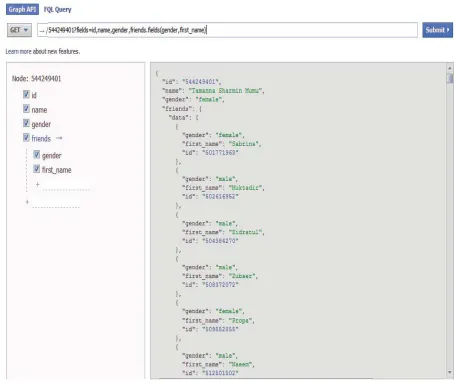
Let us consider the following social network data extracted from social graph Facebook.com.
Figure 2 Extracted Social Information of a sample user (id: 544249401) Here in figure 2,
For a sample node, we have 4 fields: ݅݀ǡ ݊ܽ݉݁ǡ ݃݁݊݀݁ݎǡ ݂ݎ݅݁݊݀ݏ
5
For example,݊݀݁ሾ݅݀ሿ ൌ ͷͶͶʹͶͻͶͲͳǡ ݊݀݁ሾ݊ܽ݉݁ሿ ൌ ̶݄ܶܽ݉ܽ݊݊ܽܵܽݎ݉݅݊ܯݑ݉ݑ̶ǡ
݊݀݁ሾ݃݁݊݀݁ݎሿ ൌ ̶̶݂݈݁݉ܽ݁
݊݀݁ሾ݂ݎ݅݁݊݀ݏሿ ൌ ݀ܽݐܽሾܽݎݎܽݕሿ
݀ܽݐܽሾͲሿሾ݅݀ሿ ൌ ͷͲͳͳͻ͵ǡ ݀ܽݐܽሾͲሿሾ݂݅ݎݏ̴݊ܽ݉݁ሿ ൌ Dzܾܵܽݎ݅݊ܽdzǡ
݀ܽݐܽሾͲሿሾ݃݁݊݀݁ݎሿ ൌ Dz݂݈݁݉ܽ݁dz
݀ܽݐܽሾͳሿሾ݅݀ሿ ൌ ͷͲʹͳͻͷʹǡ ݀ܽݐܽሾͳሿሾ݂݅ݎݏݐ̴݊ܽ݉݁ሿ ൌ Dzܯݑ݇ݐܽ݀݅ݎdzǡ
݀ܽݐܽሾͳሿሾ݃݁݊݀݁ݎሿ ൌ Dz݈݉ܽ݁dz
A typical social network follows certain properties:
1) Power-law degree distributions or exponential form (Faloutsos et al., 1999). The degree of a vertex is the number of other vertices to which it is connected. For example, the highest degree nodes are called “hubs”, and the major hubs are
closely followed by smaller ones, and these ones are followed by other nodes with a much smaller degree, and so on.
2) Have small diameter. The diameter is defined as maximum distance between any two nodes. And the distance is measured as the minimum number of edges that must be traversed on the path from one node to another.
3) Small world effect (Watts and Strogatz, 1998) i.e., the average distance between vertices in a network is short. For example, how quickly one can get from one “end” of the graph to another.
4) Clustering or network transitivity i.e., a prediction that two vertices that are both neighbours of the same third vertex, have a keen probability of also being neighbours of one another(Girvan and Newman, 2002). For example, two of one’s friends will have a greater probability of knowing one another than two people chosen at random from the network.
5) Have community structure (Girvan and Newman, 2002) i.e., a group of nodes
6
connect with each other to form metacommunities, and those metacommunities are themselves connected together, and so on.
Some main types of large-scale social networks that researchers have used for research in mining social network are listed below:
1) Friendship Network:
Friendship network records who is friend to whom relationship among nodes. Examples of friendship networks include Facebook (www.facebook.com), MySapce (www.myspace.com), Twitter (www.twitter.com) etc. Interest mining, for example, can be applied in this area.
2) Collaboration Network:
Collaboration Network records who works with whom in a specific topic. Co-authorships among scientists, is an example of collaboration network. DBLP is an example of collaboration network. Expert finding method, for example, can be applied in this area (Craswell et al., 2001).
3) Trust Network
Trust network is a social network where both positive (e.g. likes) and negative (e.g. dislikes) types of links or edges are available. It is represented by directed graphs. Wikipedia is a good example of trust network. Trust computation or influence measurement approaches, for example, can be applied in this area (Ziegler and Lausen, 2005).
4) Communication Network
Communication network models the “who-talks-to-whom”, “who-emails-whom”, or
“who-sell-whom” structure of social network. Such networks can be constructed from the logs of e-mail or from phone call records. ENRON dataset are an example of communication network data (Bird et al., 2006).
1.2 BUSINESS APPLICATIONS OF MINING SOCIAL INTEREST
7
organization can treat these communities as groups of customers. While traditional customer segmentation methods to partition a customer base are still applicable and widely used, considering communities extracted from social graphs and monitoring the aggregate trends and opinions discovered by these communities has shown its potential for a number of business applications such as marketing intelligence and competitive intelligence. This task includes identifying influential posts, influential persons and
services, users’ opinions analysis, and hence community detection based on shared
interests. The extracted communities are interpreted as organizational units in social networks. Social network also share data with third parties for advertising purposes, and furthermore social networks also provide open APIs that allow third parties to create applications that access user profile and/or their friend’s profile. Companies themselves can use social network mining to detect customers likely to purchase services that they do not intend to pay.
Some main business applications of post as well as user’s interest mining are:
1) Online marketplace combines explicit community feedback that can be used
effectively to compute reputation scores. For example, it has been observed that customers pay a remarkable premium for buying items from high-reputation sellers, increasing these sellers’ revenue, visibility and motivation to keep high reputation scores by effectively delivering what they promise.
2) Identifying groups of customers with similar interests that supports to set up
efficient recommendation systems that better guide customers through the list of items of the retailers and improve the business opportunities.
3) Delivery of products and services can be effectively done by collaborating with customers, forecasting, and creation and management of production schedules. These targets can be achieved by using insights obtained from mining customer social network data.
8
circle” feature to the search results which may have a positive impact on
knowledge intensive industries.
5) In telecommunication and other industries that have rewards program for
customer loyalty, community structure provides a significant role in identifying target groups and allocating policies for such rewards.
6) Security consulting companies or governments fighting criminal or terrorist
organizations identify communities and network structure from social networks based on the posts and opinions published by the members of those communities.
7) The field of journalism and intelligence can have extreme help from community
structure of social networks. For example, Krebs (2002) described how to mine known relationships between Al-Qaeda operative and discovering communities in that network. Identifying communities and monitoring network evolution can also be used to detect fraud.
8) Discovering positive and negative user opinions can help to assess product and
service demand, tackle crisis management, foster reputation online, etc.
Finally, discovering and mining popularity and community preferences is crucial not just for offering advertising and new services, but also for growing the networks through friend suggestions and link prediction to the user to generate link recommendations for service recommendations. Link prediction is also useful to predict customer behaviour in propagating information and adopting new services.
1.3 DATA MINING
9
Nowadays data mining is a very important and popular task in business applications. In business applications data mining techniques have been successfully employed for direct marketing i.e., the decision of whether or not to market to a particular person is based on their characteristics (Richardson and Domingos, 2002). Data mining allows an organization to ask of its data complex questions such as “what has been going on in the
organization?” or “what is going to be happened next and how to profit?” the answers to first question can be provided by the data warehouse and multidimensional database systems (OLAP) that allow to browse and visualize the data easily from various perspectives (Han and Kamber, 2006). The answer to the second question can be provided by data mining tools built on classification, clustering and association rule mining. Algorithms from different research areas such as statistics, machine learning, pattern recognitions, data visualization, information retrieval, image and signal processing, and spatial data analysis can also be embedded with data mining algorithms to improve the performance of mining process.
1.3.1 Data Mining Approaches
Data mining tasks include:
10
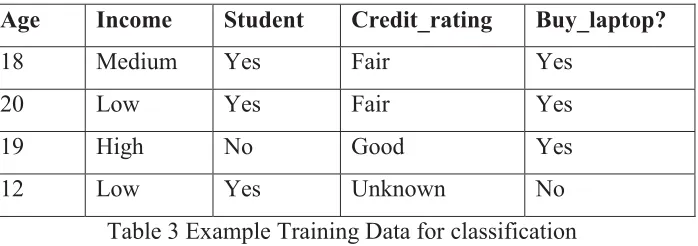
two decisions {yes, no}.The goal of any classification algorithm is to take training data set as input and produce a classification model (rules based on independent attributes) that place each data record in one of the two label classes of “yes” or “no” for the dependent attribute Buy_laptop. The model which is defined during
training is then used to classify a new record of which the class or value for dependent attribute is unknown.
Age Income Student Credit_rating Buy_laptop?
18 Medium Yes Fair Yes
20 Low Yes Fair Yes
19 High No Good Yes
12 Low Yes Unknown No
Table 3 Example Training Data for classification
From table 3, data set is ܣ݃݁ ͳͺ ר ݏݐݑ݀݁݊ݐ ר ܥݎ݁݀݅ݐ̴ݎܽݐ݅݊݃ ൌ ܨܽ݅ݎ ֜
ܤݑݕ̴݈ܽݐ ൌ ܻ݁ݏǡ ܣ݃݁ ൏ ͳͺ ר ܥݎ݁݀݅ݐ̴ݎܽݐ݅݊݃ ൌ ܨܽ݅ݎ ֜ ܤݑݕ̴݈ܽݐ ൌ ܰ. 2) Clustering – this process is also known as unsupervised and unlabeled
classification. The process is a measure of similarity between objects under consideration and combine similar objects into the same cluster while keeping dissimilar objects in different clusters according to a clustering algorithm. The process decomposes a large scale system into smaller components. Some clustering techniques include:
a. Partitioning methods such as K-means algorithms (MacQueen et al.,
1967). The algorithm consists of simply starting with k groups each of which consists of a single random point, and thereafter adding each new point to the group whose mean the new point is nearest. After a point is added to a group, the mean of that group is adjusted in order to take account of the new point. Thus at each stage the k-means are the means of the groups they represent (hence the term k-means).
11
approach where all objects are placed in one cluster and then subdivides the cluster into smaller pieces until each object forms a cluster on its own (Hastie et al., 2001)
c. Density-based methods, finds non-linear shapes structure based on the
density. The method aims at identifying clusters as areas of high-point density that are separated by areas of low-point density and thus can be arbitrarily shaped in the data space (Kriegel et al., 2011)
d. Grid-based methods, cluster data elements of a data stream. Initially, the multidimensional data space of a data stream is partitioned into a set of mutually exclusive equal-size initial cells. When the support of a cell becomes high enough, the cell is dynamically divided into two mutually exclusive intermediate cells based on its distribution statistics (Park and Lee, 2004)
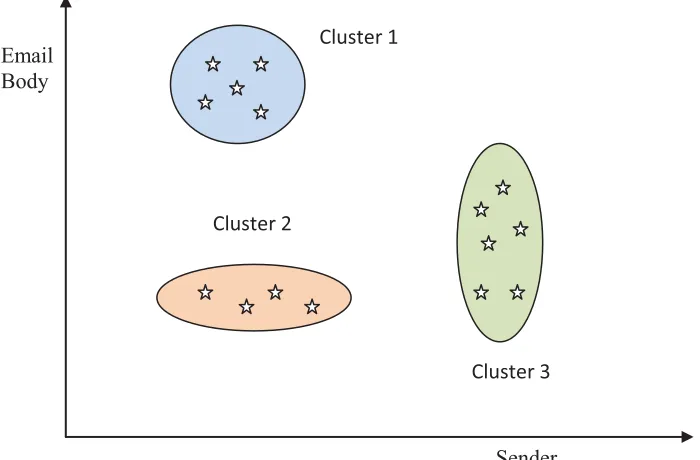
For example, using clustering technique in web mining Figure 3 shows “automatic storage of emails falling within a certain cluster based on email contents and senders”.
Cluster 1
Cluster 2
Cluster 3 Email
Body
Sender
12
3) Association rule mining– a process of finding rules from a given set of records to compute the simultaneous occurrences of various data records. Association rule mining is generally applied to databases of transactions where each transaction (record) consists of a set of items (attributes). The task is to discover all associations and correlations among data items (attributes) where the presence of one set of items in a transaction implies the presence of other items satisfying some minimum support and minimum confidence constraints (Agrawal and Srikant, 1994).
Let I = {i1, i2, …, im} be a set of items. D = a set of transactions where each transaction T
is a set of items such that T ك I. We can say that a transaction T contains X (a set of some items in I) if X ك T. Then X => Y is an association rule where X كI, Y كI, and X∩Y=Φ, and X is called antecedent and Y is called consequent.
Confidence – the probability that if the antecedent is true, then consequent will be true.
Confidence = ȁோ௨ȁ
ȁ௧ௗ௧ȁ
Support– the number of records in the database that the rule applies to. Support = ȁோ௨ȁ ȁ்௧ȁ
The task of association rule mining is done in two phases. In the first phase, frequent patterns (FP) (set of attributes) that have occurred frequently not less than Minimum Support times are computed. Then, in the second phase, association rules that have confidence not less than Minimum Confidence are computed from generated frequent patterns.
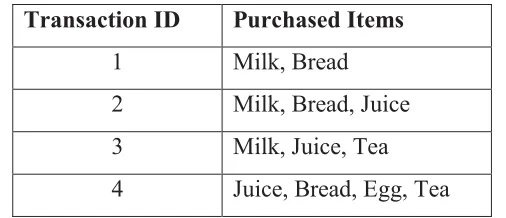
For example, Table 4 describes a transaction set indicating the purchase history of
customers. By analysing the transaction table rules are generated from all frequent
13
Transaction ID Purchased Items
1 Milk, Bread
2 Milk, Bread, Juice
3 Milk, Juice, Tea
4 Juice, Bread, Egg, Tea
Table 4 Example of Frequent patterns from Transaction table
In the above example, frequently occurred items milk, juice, and bread may lead to find association rules Milk => Bread, which means that the customers who purchase milk and may usually purchase bread. Here {Milk, Bread}, {Milk, Bread, Juice}, {Milk, Juice, Tea}, {Juice, Bread, Egg, Tea} etc., are called itemsets.
Suppose, Milk = 30 = number of transactions with Milk, Bread = 40 = number of transactions with bread, and Both = 20 = number of transaction with both milk and bread, Total = 100 = number of transactions in database
So, confidence = 20/30 = 66.67% and support = 20/100 = 20%
Rules that satisfy user-specified minimum support are called frequent items, and if the confidence is greater than a user-specified minimum confidence then we say the rule is accurate. An example of frequent pattern mining algorithm is Apriori Algorithm (Agrawal and Srikant, 1994), as described below:
14
Transaction ID Items
1 MILK, BREAD, JUICE
2 BREAD, TEA
3 BREAD, EGG
4 MILK, BREAD, TEA
Table 5 Example of Transaction database
For instance, a given minimum support is 50%, i.e., all itemsets that appear in two or more than two transactions need to be found as frequent or large itemsets. The Apriori
algorithm will first find frequent 1-itemset. MILK, BREAD, EGG, TEA, JUICE are
candidate 1-itemset. From scanning the database as shown in Table 5, MILK appears in transactions 1 and 4. Its support count is 2. BREAD appears in all 4 transactions, so support count is 4. TEA appears in transaction 2 and 4, so support count is 2. EGGand JUICEonly appear in one transaction. Therefore, the large itemsets are MILK, BREAD, TEA. Next, candidate 2-itemsets need to be generated by applying an apriori-gen join. The apriori-gen join of large itemset Li with Li joins every itemset k of first Li with every
itemset n of second Li where n > k and first (I-1) members of itemsets k and n are the
same. In this example, MILKwill join BREAD and TEA, BREAD will join TEA, but MILK will not join MILK, and BREAD will not join BREAD. Candidate 2-itemsets are MILK-BREAD, MILK-TEA and BREAD-TEA. Support count of these three candidate 2-itemsets
need to be checked by scanning the transaction database. MILK-BREAD and
BREAD-TEA are large 2-itemsets, since their support counts are 2. Candidate 3-itemsets will be
generated by large 2-itemsets that is MILK-BREAD-TEA. The Support count of
MILK-BREAD-TEA is 1 which is less than minimum support. Therefore, there is no large 3-itemsets. The algorithm will terminate, since the large itemset is an empty set.
5) Sequential pattern mining – A sequence database stores a number of records where all records are sequences of ordered events with or without time-stamp. Sequential pattern mining finds frequent subsequences as patterns in the sequence database (Ezeife and Mabroukeh, 2010).
15
represented as records [Tid, <ordered sequence events>], where each sequence event is a item set such as bread, milk, juice, sugar.
[T1, <(bread, milk), (bread, milk, sugar), (milk), (tea, sugar)>] is a four weeks transaction of one customer.
[T2, <(bread), (sugar, tea)>] is a two weeks transaction of another customer.
So records in the database may vary in length and each event can have one or more items in the set. A sequential pattern mining algorithm mines the sequence database looking for frequent patterns that can be used later to find association rules.
1.3.2 Web Mining
Web is a source of highly dynamic and rich collection of information that poses great challenges for knowledge discovery. Web mining tasks are classified into three categories (Cooley et al., 1997):
1) Web content mining – web contents involve text, images, audio, video, structured records etc. Web content mining is a process of extracting useful information from web pages. Web content mining applications include identify a specific topic represented by a web document, categorize web documents, find similar web pages located in different web servers, etc. WEBOMINER is an example of web content mining tools (Ezeife and Mutsuddy, 2012).
2) Web structure mining – is the process of discovering web structure information from the web document such as links between references and referents on the Web. Mining task can be applied either at the document level or at the hyperlink level to find links directed into and out of contents on the web. This inward and outward links represents the richness or importance to which the content is to a particular topic. Web structure mining application include classify web pages, ranking on web pages, create similarity measures between documents, the authority of a page on a topic, identifying web communities, etc. (Kadri and Ezeife, 2011).
16
user profiles, meta data such as page attributes or content attributes, etc., where ordered sequences of events in the sequence database are composed of single items and not sets of items, with the assumption that a web user can physically access only one web page at a time at any given point in time (Ezeife et al. 2005, Ezeife and Mabroukeh 2010). Applications of web usage mining include web crawler detection and filtering, web transaction identification, path and usage pattern discovery, web content personalization, prefetching and caching, e-commerce, and business intelligence (Facca and Lanzi, 2005).
1.4 MINING POPULARITY AND COMMUNITY PREFERENCE
17
domain specific and product-feature oriented. For example, these networks may be weblogs, newsgroups, bookmarks, question/answers, movie/product review domains, etc. Due to the emerging popularity of friendship networks, discovering common interests shared by users is a fundamental problem in such friendship networks since it is the bread-and-butter function of building user communities of the same interests, finding the topic experts in different subjects, identifying hot social topics, and recommending personalized relevant contents. An efficient and scalable solution is crucial to the growth of social communities.
1.5 CHALLENGES OF MINING SOCIAL NETWORKS
A good algorithm in social network analysis should address two key problems: which
groups of vertices are associated with each other (linked data) and when does the
community structure change and how to quantify the change (network dynamics). Some
major challenges of mining social networks are listed below:
1) Defining interactions among users where users have profiles holding
heterogeneous information and complex ways of interactions between users and between user and system.
2) Scalability while dealing with real social networks with millions of users since real social networks are getting bigger. The challenge here is to develop efficient and scalable mining techniques that can process large amount of real data in shortest possible amount of time and also produce models with high accuracy.
3) Multi-aspect i.e., social influences are associated with different topics. For
example, ݑݏ݁ݎͳ may have high influence to ݑݏ݁ݎʹonݐ݅ܿͳ, but ݑݏ݁ݎʹ can have a higher influence toݑݏ݁ݎͳ on ݐ݅ܿʹ. So the challenge is to be able to differentiate those influences from multiple aspects.
4) In general, popularity of a topic/product somehow depends on how fast the posted content spreads quickly in a community (a group of users with similar interest).
The spreading processes also rely on the nature of the ݏݎ݁ܽ݀݁ݎ and the
18
5) The crucial characteristic of popularity measure is the overall opinion towards the subject matter, for example, whether a product review is positive or negative. Sentiment analysis tool should efficiently extract opinions from unstructured human-authored documents.
A good algorithm should also consider some additional problems that social network data may suffer including duplicate nodes e.g., a user has two email addresses, inactive nodes e.g., the user who does not remove his profile but does not use it any more, artificial nodes e.g., automated agents. To overcome these additional problems, efficient data cleaning is also needed for social network analysis.
1.6 THESIS PROBLEM AND CONTRIBUTIONS
1.6.1 Problem Addressed
The effectiveness of an influential communication often depends on the nature (positive, negative, neutral) of responses from recipients. In a social network, people can share their interests by posting objects on their social profile/fan pages, where other people may give their opinions by showing agreements or disagreements.
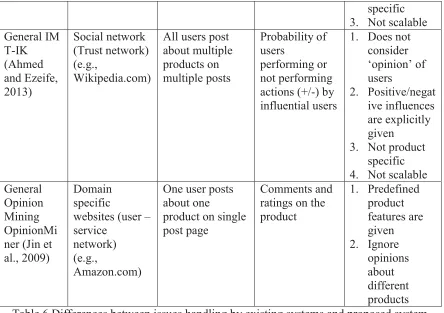
All the previous works done in the area of opinion mining are through interest networks (e.g., Amazon.com) that are product specific. Our proposed opinion mining approach is the extension of OpinionMiner system (Jin et al., 2009) which will be applicable for friendship networks. In standard influence maximization (IM) systems such as CELF (Leskovec et al., 2007), takes whole social network as input to find influential users as seed set for a specific product (e.g., iPhone) for target marketing (Ahmed and Ezeife, 2013). Table 6 shows the major differences between existing systems and our proposed system. Existing Systems Type of network Size of products/opinio ns
Measurements Limitations
General IM CELF (Leskovec et al., 2007)
Social network (user – user network) (e.g.,
Facebook.com)
All users post about multiple products on multiple posts Probability of users performing actions after an influential user
1. Does not
19
specific 3. Not scalable General IM T-IK (Ahmed and Ezeife, 2013) Social network (Trust network) (e.g., Wikipedia.com)
All users post about multiple products on multiple posts Probability of users performing or not performing actions (+/-) by influential users
1. Does not
consider ‘opinion’ of users 2. Positive/negat ive influences are explicitly given
3. Not product specific 4. Not scalable General
Opinion Mining OpinionMi ner (Jin et al., 2009)
Domain specific
websites (user – service
network) (e.g.,
Amazon.com)
One user posts about one
product on single post page
Comments and ratings on the product 1. Predefined product features are given 2. Ignore opinions about different products Table 6 Differences between issues handling by existing systems and proposed system OpinionMiner takes product features as input parameters. Features are domain-dependant, a set of features must be prepared. For example, if the system wants to extract opinion about Digital Cameras, prepare features as cover color, pixel ratio, zoom, memory, etc., and tag the reviews accordingly. The system mines opinions for reviews that have predefined product features. Moreover, the system does not consider opinions expressed on irrelevant product entities. For example, Samsung Galaxy page containing any review about iPhone will not be considered as the opinion for Galaxy.
20
The main limitation with general IM systems like CELF is that they are not effectively product-specific because of the need to first search large social networks data for multiple product opinions. For example, the existing systems may find a very influential user to his friends over network for various products and topics, but for a specific product such as iPhone, he may not be influential at all. So considering those users as influential for a product reduces the accuracy and efficiency of such general IM algorithms.
Motivated by the issues described above, the problem we tackle is as follows:
Problem Definition – Build an influential network (IN) generation model for influence maximization based on mining users’ posts and opinions (positive or negative) on a
specific product and relationships from a friendship network graph ܩሺܸǡ ܧሻwhere every edge ݁߳ܧ connects nodes ݒ and ݒ ( ݒǡ ݒܸ߳ܽ݊݀݅ǡ ݆ ൌ ͳǡʹǡ ǥ ǡ ܰ) and indicates ݒ
and ݒ have relationships on a specific product. Also, measure influence acceptance score of each node ݒ in ܸ for a product and remove nodes that are below certain threshold before applying IM algorithm on that pruned friendship network to more effectively and efficiently compute a product-specific IM.
To solve the above problem, thesis contributions are:
1.6.2 Thesis Contribution
1. First, to consider opinions on friendship network for specific product
a. A new influence network (IN) generation model is proposed, called OBIN, Opinion Based Influence Network.
i. OBIN considers multiple posts by multiple users on a specific
product
ii. OBIN aggregates all kinds of users’ explicit/implicit opinions (e.g., likes/dislikes, re-shares, positive/negative comments)
iii. OBIN discovers users-users relationships
21
3. We propose PCP-Miner (Post-Comment Polarity Miner) algorithm, to compute
the popularity scores of users by extending OpinionMiner (Jin et al., 2009) with Apriori frequent pattern mining, and to compute the influence scores of users to discover user-user relationships.
4. Experimental analysis shows that, OBIN gives relevant influential users for a
product more efficiently, and the influence spread over the network is occurred more effectively than standard IM algorithms.
1.7 THESIS OUTLINE
22
CHAPTER 2
RELATED WORKS
Social network analysis often focuses on macro-level research such as degree distribution, diameter, clustering coefficient, community detections, small-world effects, preferential attachments, etc. (Tang et al., 2009). Recently, many researchers have analyzed social network data to find patterns of popularity or influence in various domains. Such domains include blogging (e.g., Slashdot.org) and micro-blogging (e.g., Twitter.com) domains, bookmarking domains (e.g., Digg.com), co-authorship domains (e.g., Academia.edu), movie review domains (e.g., IMDb.com), and product review domains (e.g., Amazon.com). Weblog domains define a relationship between the writer of the blog and the readers by publishing short news posts and allowing readers to comment on them. In co-authorship domains, each author is related to some specific topic, there is no random author-topic relation. Movie review domains provide ratings and brief quotes from several reviews and generate an aggregate opinion. Product review domains are dedicated to specific types of products. All the domains are well-structured for a specific topic whereas friendship network is more complex and heterogeneous. Moreover, the great majority of research study only features related to the network itself or simple popularity matrices of the posts (e.g., number of likes/thumbs-up, number of comments), without analyzing the correlation of these aspects with the content of the posts.
23
2.1 PRODUCT REVIEW DOMAINS
2.1.1 Feature-based Approach
Dave et al. (2003) proposed an opinion extraction and mining method based on features and scoring matrices. This approach takes structured reviews and identifies appropriate features and scoring formula to determine whether reviews are positive or negative. The results perform machine learning method called Transductive learning to classify review sentences from the web. This approach can be summarized using the following steps:
Training a classifier– starting with a portion of web document the following are applied to refine the classifier to classify the sentences mined from broad web searches. Based on the scores, the classifier can determine whether a review sentence is positive or negative.
1. Collect users’ text reviews, title, thumbs-up or thumbs-down rating from the large web sites
2. Separate the document into sentences, then split sentences into single-word token.
3. Substitute numerical tokens with ܷܰܯܤܧܴ , product’s name token with
̴ݎ݀ݑܿݐ݊ܽ݉݁
4. Pass the document sentence by sentence through Lin’s MINIPAR linguistic parser to yield part of speech of each word and the relationships between parts of the sentence.
5. Pass the resulted words through WordNet, a database for finding synonyms. 6. Identify negative phrases and mark all words following the phrases as negated. 7. Combine sets of ݊ adjacent tokens into ݊ െ ݃ݎܽ݉ݏ.
8. Count frequencies of the extracted features i.e., the number of times each term occurs, the number of documents each term occurs in, and the number of categories a term occurs in. then set upper and lower limits for each of these measures, constraining the number of features looking for to determine a threshold for the classifier.
24
ݏܿݎ݁ሺ݂ሻ ൌ ሺ݂ȁܥሻ െ ሺ݂ȁܥԢሻ ሺ݂ȁܥሻ ሺ݂ȁܥԢሻ
ሺ݂ȁܥሻ ൌ
ൌ
Classifying– if document ݀ ൌ ݂ଵǥ݂then
݈ܿܽݏݏሺ݀ሻ ൌ ൜ܥ݂݅݁ݒ݈ܽሺ݀ሻ Ͳ ܥᇱ݂݅݁ݒ݈ܽሺ݀ሻ ൏ Ͳ
Where݁ݒ݈ܽሺ݀ሻ ൌ σ ݏܿݎ݁ሺ݂ ሻ
The classification result shows reviews under positive opinion reviews or negative opinion reviews.
Example:
At first this approach strip out HTML tags from the document containing reviews. Suppose example reviews are “This bulky lens of Kodak is not useful for me”, “The zoom view of Kodak is awesome”, “I love the pink Kodak color”.
The substitution step converts the sentence to “This bulky lens of X is not useful for me”, “The zoom view of X is awesome” and “I love the pink X color”.
After parsing, these sentences become:
ݑ݈݇ݕሺܣ݆݀ሻǣ ݈݁݊ݏሺܰሻǣ ݏݑܾ݆ǣ ݑݏ݂݁ݑ݈ሺܣ݆݀ሻǡ ݖ݉ሺܰሻǣ ݏݑܾ݆ǣ ܽݓ݁ݏ݉݁ሺܣ݆݀ሻ ,
ܫሺܲݎሻǣ ݈ݒ݁ሺܸሻǣ ݅݊݇ሺܰሻǣ ݏݑܾ݆ǣ ݈ܿݎሺܰሻ.
After turning into negation, the negation phrase “not useful” become NOTuseful.
Unigram Bigram Trigram
Positive features
Awesome I love The zoom view, the pink
color Negative features
Bulky Not useful
25
Table 7 shows n-adjacent token into n-grams. Now we can calculate the score for features
Dz݈݁݊ݏdz appears one time in negative feature Dzܾݑ݈݇ݕǯ, Dzݖ݉ݒ݅݁ݓdz appears one time in positive feature, Dz݈݅݊݇ܿݎdz appears one time in positive feature.
ܵܿݎ݁ሺ݈݁݊ݏሻ ൌ ൗ ିଷ ଶସ ൗ
ସ
ൗ ାଷ ଶൗ ൌ ିଵǤହ
ଵǤହ ൌ െͳ ,
ܵܿݎ݁ሺݖ݉ݒ݅݁ݓሻ = ଵଵൗ ି ଶସ ൗ ସ
ൗ ା ଶൗ ൌ ͳ and similarly ܵܿݎ݁ሺ݈݅݊݇ܿݎሻ ൌ ͳ
Hence, ݁ݒ݈ܽሺܭ݀ܽ݇ሻ = σ ݏܿݎ݁ሺ݂ଷ ଷሻ ൌ െͳ ͳ ͳ ൌ ͳ
So, ݈ܿܽݏݏሺܭ݀ܽ݇ሻ ൌ ݏ݅ݐ݅ݒ݁ǡ ݏ݅݊ܿ݁݁ݒ݈ܽሺܭ݀ܽ݇ሻ Ͳ
2.1.2 Opinion Summarization
Hu and Liu (2004) proposed a feature-based summarization FBS method that mine product features from customers’ reviews, identifies sentiment opinion, and summarize
the results. The inputs to FBS are a product name and an entry web page for all the reviews of the product. FBS method has the following task:
1) Part-of-Speech Tagging (POS) – NLProcessor linguistic parser (http://www.infogistics.com/textanalysis.html) is used to parse each review to split text into sentences and to produce the POS tag for each word. Output of the NLProcessor is XML. For example <W C=’NN’> means a noun and <NG>
means a noun group or noun phrase. Each tagged sentence is saved in the review database.
Example – suppose a sentence “I am absolutely in awe of this camera”. Output of POS steps is
<S><NG><W C = ‘PRP’ L = ‘SS’ T = ‘w’ S = ‘Y’>I</W></NG>
<VG><W C = ‘VBP’>am</W><W C = ‘RB’>absolutely</W></VG>
<W C = ‘IN’>in</W><NG><W C = ‘NN’>awe</W></NG>
<W C = ‘IN’>of</W><NG><W C = ‘DT’>this</W><W C =
26
2) Opinion Words Extraction– If a sentence has one or more than one product features and one or more opinion words, then it is called opinion sentence. The opinion words are identified by the following method:
Example – “The auto-flash is disgusting and makes the face blur”, here
disgusting is the effective opinion of auto-flash.
“The picture quality is awesome” and “The application that is used in it is
awesome” share the same opinion word awesome, and suppose there are
no sentences to talk about picture quality or application. That means these two features are infrequent. In this case, the nearest noun phrases around the opinion word awesome are picture quality and application.
3) Opinion Words Orientation–Words that encode a desirable state (e.g., beautiful, amazing) have a positive orientation, while undesirable state (e.g., ridiculous) have negative orientation. This task has following steps:
a. Select adjective list from WordNet store them to seed list. For example, great, cool, nice, fantastic are positive adjectives; and bad, dull, dumb are negative adjectives.
b. In WordNet, adjectives are organized into bipolar cluster. For example the Figure 4 shows bipolar adjective structure for the word ‘tiny’
Figure 4 Bipolar adjective structure, = synonym and = antonym
tiny large
bitsy
insignificant
miniature
petite
big
enormous
gigantic
27
4) Opinion Sentence Orientation –identification method of positive or negative
sentences has following steps: x
ൌͲ
ൌሺǡሻ
ሺͲሻ
ሺ൏Ͳሻ
ሼ
ൌሺǯ ǡሻ
ሺͲሻ
ሺ൏Ͳሻ
ǯൌǦͳǯሽ
x ሺǡ ሻ
ൌ
ሺ ሻ
ൌሺሻ
Example–for the feature “picture” let us take example sentences
x “overall this is a good camera with a really good picture clearly”. This sentence is determined as si positive by fulfilling first statement.
x “the auto and manual along with movie modes are very easy to use, but the software is not intuitive”. The orientation of this sentence is
determined by the last statement and average orientation of
28
2.1.3 Feature-Entity Based Approach
Jin et al. (2009) also worked similar as Hu and Liu (2004). Jin et al. (2009) have defined four entity types, eight tag sets and four pattern tag sets to the feature-based approach called OpinionMiner.
Components Physical objects of a product. e.g., LCD, viewfinder or battery of a Camera
Functions Capabilities provided by the product. e.g., automatic flash or auto focus of a Camera.
Features Properties of components or functions. e.g., color, size or weight.
Opinions Thoughts expressed by reviewers on a product features, components or functions. Table 8 Definitions of Entity Types
Tag Set Corresponding Entities
<PROD_FEAT> Features
<PROD_PARTS> Components
<PROD_FUNCTION> Function
<OPINION_POS_EXP> Explicit positive opinion
<OPINION_NEG_EXP> Explicit negative opinion
<OPINION_POS_IMP> Implicit positive opinion
<OPINION_NEG_IMP> Implicit negative opinion
<BG> Background words
Table 9 Basic tag set and corresponding entity
Pattern Tag Corresponding Pattern
<> Independent entity
<-BOE> The beginning component of an entity
<-MOE> The middle component of an entity
<-EOE> The end of an entity
Table 10 Pattern tag set and corresponding pattern
Each word in the review is represented by hybrid tag combining basic tag set and pattern tag set.
29
Hybrid
tags:<BG>I</BG><OPINION_POS_EXP>love</OPINION_POS_EXP><BG> the</BG><PROD_FEAT-BOE>ease
</PRODUCT_FEAT-BOE><PRODUCT_FEAT-MOE>of
</PROD_FEAT-MOE><PRODUCT_FEAT-MOE>transferring
</PROD_FEAT-MOE><PRODUCT_FEAT-MOE>the
</PRODUCT_FEAT-MOE><PRODUCT_FEAT-EOE>picture
</PRODUCT_FEAT-EOE><BG>to</BG><BG>my</BG><BG>computer</BG>
Similar to the bipolar adjective structure represented by Hu and Liu (2004), Jin et al. (2009) also present propagation structure for all entity.
Example: Let us suppose a review sentence is “good picture quality”. The propagation structure by Ji et al. (2009) is shown in Figure 5. Using Figure 5, some possible bi-gram can be “decent picture quality”, “good image quality” etc.
2.1.4 Lexicalized HMM Approach
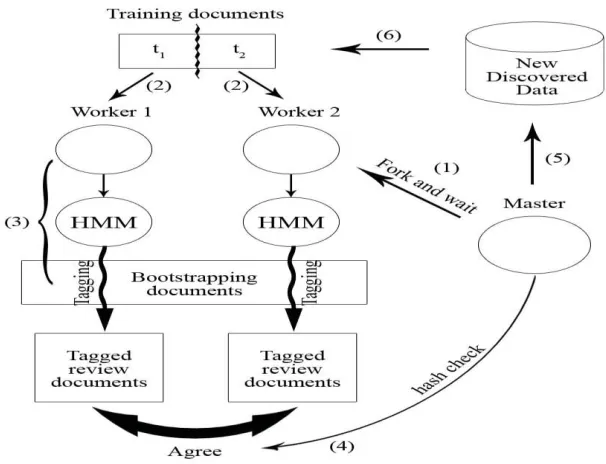
Jin et al. (2009) proposed a bootstrapping approach for HMM as shown in Figure 6. The steps are as follows:
Figure 5 Example of word propagation
Good picture quality
Decent Nice
High-quality
Image
movie feature
Poor Bad
<OPINION_POS_EXP>
<OPINION_NEG_EXP>
<PROD_FEAT-BOE> <PROD_FEAT-BOE>
Synonyms & Antonyms
Similar & Related words
30
1. Creates two child processes. Master is responsible for co-ordinating the
bootstrapping process, extracting and distributing high confidence data to each worker.
Figure 6 Bootstrapping process by Jin et al. (2009)
2. Training document is divided into two set and each is used as seeds for each
worker’s HMM.
3. Each worker trains its own HMM classifier based on its own training set, then
each worker’s trained HMM is used to tag the documents which produces a new
set of tagged review documents.
4. After each tagging step, master inspects each sentence tagged by each HMM and
only extracts opinion sentences.
5. A hash value is calculated for each extracted opinion sentence and compared with database. If it is a new sentence, store it to the database.
6. Master then randomly splits the newly discovered data from database into two
data sets again for training.
31
2.1.5. Holistic Lexicon-based Approach
Ding et al. (2008) have proposed a holistic lexicon-based approach called Opinion Observer including an orientation score function and handling the context dependent opinion words. Ding et al. (2008) have used NLProcessor (http://www.infogistics.com/textanalysis.html) to generate part-of-speech (POS) tags and then Opinion Observer is applied to find orientations of opinions expressed on product features. The opinion orientation is identified using the following steps:
1. A positive word is assigned the semantic orientation score of +1 and a negative word is -1. A review sentence may contain opinions on multiple features. For each feature f in the sentence the total score function is computed as:
ݏܿݎ݁ሺ݂ሻ ൌ σ ௪Ǥௌை ௗ௦ሺ௪ǡሻ ௪௪א௦ת௪א ,
Where ݓ ൌ ܽ݊݅݊݅݊ݓݎ݀
ܸ ൌ ݏ݁ݐ݂݈݈ܽ݅݊݅݊ݓݎ݀ݏ ݏ ൌ ݏ݁݊ݐ݁݊ܿ݁ܿ݊ݐ݂ܽ݅݊݅݊݃
݀݅ݏሺݓǡ ݂ሻ ൌ ݀݅ݏݐܾܽ݊ܿ݁݁ݐݓ݂݁݁݊ܽ݊݀ݓ ܱܵ ൌ ݏ݁݉ܽ݊ݐ݅ܿݎ݅݁݊ݐܽݐ݂݅݊ݓݎ݀ݓ
2. Holistic approach to handle context dependent opinions –
if the previous sentence exists and has an opinion then
if there is not a “However” or “But” word to change the direction of the current
sentence then
orientation = the orientation of the last clause of previous sentence
else orientation = opposite orientation of the last clause of previous sentence
else if the next sentence exists and has an opinion then
if there is a not “However” or “But” word to change the direction of the next
sentence then
orientation = the orientation of the first clause of next sentence
else orientation = opposite orientation of the last clause of next sentence
else orientation = 0
32
Example–
x Intra-sentence conjunction rule – let us suppose a sentence “the battery life is very long” which does not clearly show positive or negative for the
word “long”. Suppose another sentence “This camera takes great pictures
and has a long battery life” where we can discover “long” is a positive for
“battery life” since it is conjoined with “great”.
x Pseudo intra-sentence conjunction rule – suppose another sentence “The camera has a long battery life, which is great”. Here “long” indicates
positive semantic orientation for “battery life” though no explicit “and” is
used.
x Inter-sentence conjunction rule – if the above two rules could not decide the opinion orientation then extend the intra-sentence conjunction rule to neighbouring sentences.
x Synonym and Antonym rule Ȃif a word is found to be positive then its synonyms are also positive and antonyms are negative. e.g., “long” is
positive here for ‘battery life”, so “short” is negative here.
2.2 OPINION MINING IN WEBLOG DOMAINS
2.2.1 Contribution of Comment Contents
Mishne and Glance (2006) have analyzed the relation between the weblog popularity and commenting patterns in it.
1) Comment extraction – Identify the “comment region” which has a sequential
pattern within the HTML page.
2) Popularity – To measure weblog popularity, Mishne and Glance (2006) use the
number of incoming links and the number of page view. e.g., incoming links can be the Blogpulse index, and page views can be visit counters such as Sitemeter.
3) Some exceptions – Too few comments in high-ranked weblogs due to strict
33
blogger’s friends. Highly commented posts due to highly controversial topics
(e.g., politics).
4) Disputative comments – the features used for classification are:
1. Frequency counts – counts of words and word bigrams, counts of a mutually constructed small list of longer phrases, e.g., “I don’t think that”,
“you are wrong” etc.
2. Level of subjectivity – compare the language used in the encyclopaedia entries to the language used in the discussions about these entries, by building two language models for encyclopaedia and discussions. Compare them using a standard corpus divergence metric called log-likelihood proposed by Kilgarriff (2001).
3. Length features – add features for the average sentence length, the average comment length in the thread, and the number of comments in the thread.
4. Punctuation – frequency counts of punctuation symbols and usage of excessive punctuations.
5. Polarity– sentiment analysis is used.
6. Referral – references to previous content by quote, or authors by name. e.g., a direct quote as the first sentence of the comment can be a referral.
Gomez et al. (2008) have shown that to improve the quality and representativity of the generated social influence graph, filter some of the comments according to the three following criteria:
1. Anonymous comments are discarded.
2. Very low quality comments with score െͳ are discarded.
3. Filter out self-replies, i.e., the replies often motivated by a forgotten aspect or error fix of the original comment.
2.2.2 Statistical Analysis
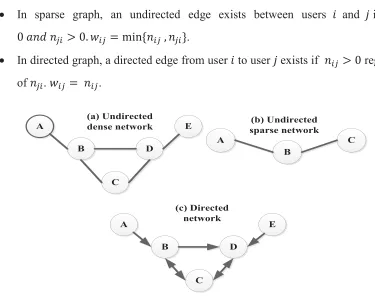
According to Gomez et al. (2008), a social network graph ܩ ൌ ሺܸǡ ܧሻ where ሺ݅ǡ ݆ሻ א ܧ
34
Example: Let ݊ ൌnumber of times user݅ comments to user݆
x In dense graph, an undirected edge exists between users ݅and݆ if either ݊ Ͳ
or ݊ ͲǤ the weight of that edge ݓ ൌ ݊ ݊.
x In sparse graph, an undirected edge exists between users ݅and݆if ݊
Ͳܽ݊݀݊ ͲǤ ݓ ൌ ሼ݊ǡ ݊ሽ.
x In directed graph, a directed edge from user݅ to user ݆exists if ݊ Ͳ regardless of ݊. ݓ ൌ ݊.
A
B D
E
C
A
B D
E
C A
B
C (a) Undirected
dense network
(c) Directed network
(b) Undirected sparse network
Figure 7 Example of graph generation
The structural properties of the obtained graph based on comments are as follows:
1. Degree distribution – the level of interactions between the users.
2. Small world effect – the average path length between all users in the graph. The maximal distance between two users should be very small.
3. Degree correlation/assortative mixing – detect whether highly connected users are preferentially linked to other highly connected ones or not.
4. Community structure – let ߣ denote the number of comments, so that users ሺ݅ǡ ݆ሻ
who interchange a number of comments ݓ ߣ are included in the network,
35
2.3 USER-GENERATED TAGS IN BOOKMARK DOMAINS
People use tags as a descriptive label to annotate the content that they are interested in and to share with others. The repetitive occurrence of common tags from a set of users represent their common interests. Li et al. (2008) have used vector space model (VSM), association rule mining, and Naive Baise clustering algorithm to develop an architecture for social tag-based interest discovery called ܫܵܫܦ.
2.3.1 Vector Space Model (VSM) in ISID
Each URL is represented by two vectors such as all tags and all document key-words. A dataset with ݐ terms and ݀ documents is represented by a term-document matrix ܣ ൌ ൫ܽ൯Each column vector ܽሺͳ ݆ ݀ሻ corresponds to a document ݆Ǥ Weight ܽ
represents the importance of term݅ in document݆. Let ݂ is the frequency of term ݅ in document ݆.
The ݐ݂– based weight of term ݅ in document ݆ is ܽ௧ ൌ ೕ
ටσೖసభೖೕమ
The ݐ݂ ൈ ݂݅݀ െbased weight of term ݅ in document݆ is ܽ௧ൈௗ ൌ ೕ
ටσೖసభೖೕమ
where
ܾ ൌ ݂Ǥ ሺ ௗ
ሻ , ܦ = number of documents that contain term i, ሺ ௗ
ሻ ൌ ݂݅݀ .
Example: Table 11 shows resolv.conf file in Linux OS is bookmarked by some users.
URL http://ka1fsb.home.att.net/resolve.html
Top ࢚ࢌ keywords domain, name, file, resolver, server, conf, network, nameserver, ip, org, ampr
Top ࢚ࢌ ൈ ࢊࢌkeywords ampr, domain, jnos, nameserver, conf, ka1fsb, resolver, ip, file, name, server
All tags Linux, howto, network, sysadmin, dns Table 11 Example of ࢚ࢌǡ ࢚ࢌ ൈ ࢊࢌ keywords, and tags
2.3.2 Clustering in ISID
36
one for URLs, where each cluster contains all the URLs that have been saved with all the tags in the topic of the cluster, and the other for users, where each cluster contains all the users who have been used all the tags in the topic of the cluster.
Example: ISID can provide queries such as:
x For a given topic, list all URLs that contain this topic, i.e., have been tagged with all tags of the topic.
x For a given topic, list all users that are interested in this topic, i.e., have used all tags of the topic.
x For a given tags, list all topics containing the tags. x For a given URL, list all topics the URL belongs to.
x For a given URL and a topic, list all users that are interested in the topic and have saved the URL.
2.4 OPINION MINING IN CO-AUTHORSHIP DOMAINS
2.4.1 Graphical Probabilistic Model
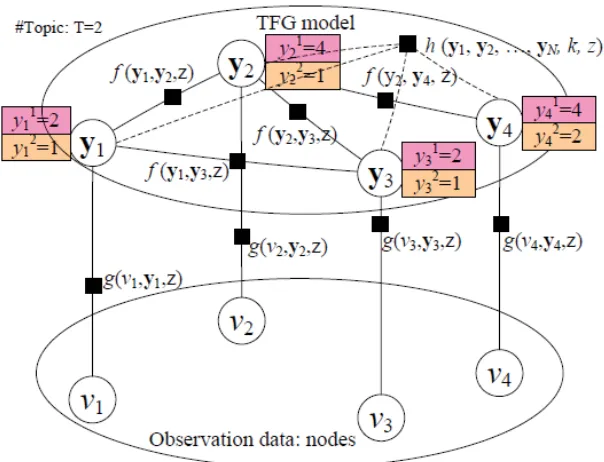
Tang et al. (2009) have proposed a Topical Factor Graph (TFG) model incorporate all the information into a unified probabilistic model and a method called Topical Affinity Propagation (TAP) for model learning.
TFG Model – Example: Figure 8 shows graphical representation of TFG model.
ሼݒଵǡ Ǥ Ǥ ǡ ݒସሽ are nodes in the social network; ሼݕଵǡ ǥ ǡ ݕସሽ are hidden vectors defined on all nodes with each element representing which node has the highest probability to influence
the corresponding node; ݃ሺǤ ሻ represents a feature function defined on a node;