Scholarship at UWindsor
Scholarship at UWindsor
Electronic Theses and Dissertations Theses, Dissertations, and Major Papers
2-1-1981
"The Magic 5 Workshop": Developing an instructional television
"The Magic 5 Workshop": Developing an instructional television
production format and testing its ability to induce learning in
production format and testing its ability to induce learning in
grade 1-3 students.
grade 1-3 students.
Richard M. Dunn
University of Windsor
Follow this and additional works at: https://scholar.uwindsor.ca/etd
Recommended Citation Recommended Citation
Dunn, Richard M., ""The Magic 5 Workshop": Developing an instructional television production format and testing its ability to induce learning in grade 1-3 students." (1981). Electronic Theses and Dissertations. 6768.
https://scholar.uwindsor.ca/etd/6768
This online database contains the full-text of PhD dissertations and Masters’ theses of University of Windsor students from 1954 forward. These documents are made available for personal study and research purposes only, in accordance with the Canadian Copyright Act and the Creative Commons license—CC BY-NC-ND (Attribution, Non-Commercial, No Derivative Works). Under this license, works must always be attributed to the copyright holder (original author), cannot be used for any commercial purposes, and may not be altered. Any other use would require the permission of the copyright holder. Students may inquire about withdrawing their dissertation and/or thesis from this database. For additional inquiries, please contact the repository administrator via email
NOTE TO USERS
This reproduction is the best copy available.
__ ____ (ft
UM1
"THE MAGIC 5 WORKSHOP":
DEVELOPING AN INSTRUCTIONAL TELEVISION PRODUCTION FORMAT
AND TESTING ITS ABILITY TO-INDUCE LEARNING
IN GRADE 1-3 STUDENTS.
RICHARD M. DUNN
A Thesis/Media Production
Submitted to the Faculty of Graduate Studies through the Department of Communication Studies
in Partial Fulfillment of the Requirements for the Degree of Master of Arts at
The University of Windsor
Windsor, Ontario, Canada
1982
INFO RM ATIO N TO USERS
The quality of this reproduction is dependent upon the quality of the copy
submitted. Broken or indistinct print, colored or poor quality illustrations
and photographs, print bleed-through, substandard margins, and improper
alignment can adversely affect reproduction.
In the unlikely event that the author did not send a complete manuscript
and there are missing pages, these will be noted. Also, if unauthorized
copyright material had to be removed, a note will indicate the deletion.
UMI Microform E C 5 4 7 5 2 Copyright 2010 by ProQuest LLC
All rights reserved. This microform edition is protected against unauthorized copying under Title 17, United States Code.
ProQuest LLC
789 East Eisenhower Parkway P.O. Box 1346
Ann Arbor, Ml 48106-1346
( c ) R IC H A R D M . DUNN
A L L R IG H TS RESERVED •1982
779434
TO MY F A M IL Y '
C A R O LY N , MY W IF E
J O Y , MY C H IL D
TOGETHER
MY L I F E
ABSTRACT
"THE MAGIC 5 WORKSHOP"!
DEVELOPING AN INSTRUCTIONAL TELEVISION PRODUCTION FORMAT
AND TESTING ITS ABILITY TO INDUCE LEARNING
IN GRADE 1-3 STUDENTS.
fey
RICHARD M. DUNN
Producers and researchers have often been on opposite
sides qf a gap which tends to lessen the effectiveness of
instructional television. The producers do the television
work and the researchers observe. Production research can
unify these two bodies under one common banner: program im
provement. Production research is seen as a necessary step in
program development and not a time was.ting impediment.
This Thesis/Media Production traces the genesis of a chil
dren's instructional television program, "The Magic 5 Workshop",
from the idea stage through to its eventual testing on a target
audience. A four step production research approach is followed
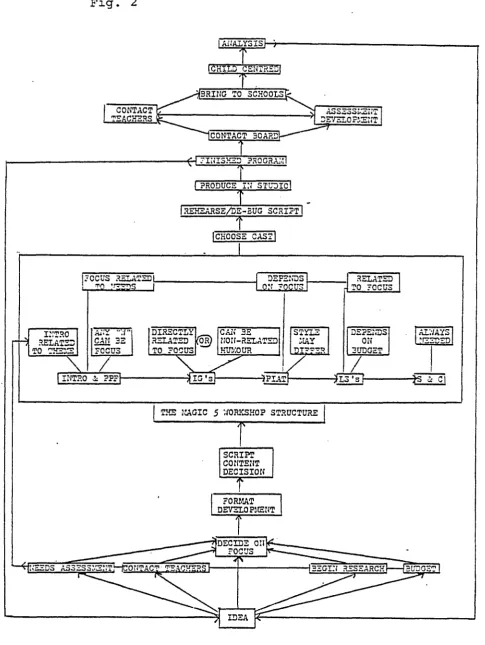
throughout the course of this study. An Annotated Script was
generated and produced in the studios of the Media Centre of the
Universi’ty^of “Windsor; ..
This work is termed as "formative research" where a tele
vision production develops at a more or less constant pace to
the point where it is ready for -testing. This means that the
television program is developed with .the idea that it is not
ready for large scale marketing and that many more changes will
most likely occur before it is ready. The only way to discover
what these changes are to be is to subject the program to testing
with a target audience. The results .obtained aid the producer
in modifying his/her program to the point where it can be as
effective as possible.
-vi
The next step after this would be "summative research”
where the program would continue to be tested on a target
audience. These are the long term, after-the-fact studies
where the program is used by a much larger target audience
and the results are then compared to those of the formative
testing. Changes to the program may still be made at this point
but basically this type of research serves to offer further
empirical support for the effectiveness-and audience appeal of the
program.
The test procedure was three-tiered in nature where the
Thesis Production was compared to two other test stimuli: a
nine minute prototype program of "The Magic 5 Workshop" produced
in ]980 as part of a COST40-505 project and a non-video presenta
tion of the content of the thesis program.
It was found that the Thesis Production had been improved
from the prototype version. The students who viewed this program
enjoyed a greater increase in comprehension- from the Pre-Test
to the Post-Test than did the students in the other two test
situations. The students and teachers who viewed the Thesis
Production of "The Magic 5 Workshop" found it to be an enjoyable
and beneficial teaching aid.
Theories regarding both identification and recognition were
not supported: identification was found to be an important
appeal variable and recognition was not found to be present in
either video test situation. This was the direct opposite of
what this researcher had predicted would take place.
vii
cognitive development with regards to children's comprehension
of instructional programming. The test scores were inconclusive
I
in support of the belief that older, more cognitively developed
children will always exhibit greater comprehension of televised
instructional material. The Post-Test results indicated that
sometimes age/development was a significant factor and at other
times, it was not.
The results also appear to indicate that there may be a
type of "natural decay" in attention behaviour that is exhibited
by children of this age range (six to nine years) as they view
ITV in their classroom. At both video test sites, the viewing
attention levels dropped considerably toward the end of the
program, even though the endings in each case .differed-.greatly
in terms of length and visual and aural complexity.
As well, data seemed to point to grade two as the proper
target audience for this program. The attention level results,
as well as the opinions of both the teachers and the students,
tend to support this assumption.
Finally, the possibility that the variable, socio-economic
status, is highly significant in a study of this nature is raised.
The results of both the Pre-and Post-Tests reveal that the stu
dents at one school scored consistently higher on many of the
test questions than did the students at the other two schools.
This school (Site #3, Non-Video presentation), was located in
an area that was described as affluent. The other two schools
’ viii
were located in a middle-class area (Site #1, COST40-505
prototype program) and an inner-city area (Site #2, Thesis
Production), respectively.
ix
First, and foremost I must thank my Heavenly Father for »
getting me this far. He has answered my nthesis prayer" every
day for a year.
T gratefully acknowledge my committee's contribution to this
■thesis. Many thanks to Hugh Edmunds for the advice given some
time a g o r "Just get the thing done". 1 have kept that idea in
the forefront of my thinking and now the "thing" i£ done. 1
also wish to thank Dr, Sue Martin for all of the encouragement
and advice she gave me back in the summer of 19 75 when "The Magic
5 Workshop" was first tried as a developmental theatre project
in some Windsor parks.
I would particularly like to acknowledge Professor James
Linton's immense contribution to this project. He encouraged
and convinced me time and again over these long months that
what X was doing was valid and useful research. He allowed me
the freedom I needed to work and offered the guidance to keep
me on track.
I would also like to express my gratitude to Dr. Tom
Carney and Dr. Walter Romanow for teaching me what communication
is really all about. Thanks as well to Janis, Fern, Chris
and Mark (wh?.pavjete:*youaare."J 1 who listened, sometimes even
patiently, to all my griping about this place. Thanks ;to Sheila
and Ann for smiles and candy.
Most of all, X must thank with all my heart my little family.
To Joy, who only cried sometimes when I neglected her, •
x
I give you my time. And to Carolyn, who has shown me with all
her heart and love what the true meaning of helpmate is, I- give
you my heart, ”l thank God for the gift you are to me and pray
that each day draws me closer to be worthy of your love.
-.xi ..
TABLE OF CONTENTS
DEDICATION . . ... iv
» A B S T R A C T ... Vi ACKNOWLEDGEMENTS ... x
LIST OF T A B L E S ... xvi
P R E F A C E ... , xix
CHAPTER 1 I N T R O D U C T I O N ... ... 1
The Production Research Continuum . . . 1
Definition of Production Research ... 1
Definition of Terms . . . 2
The Need for Production Research: A Rationale for the Thesis/Media'Approach. 3 The Four Stages of Production Research . . 10
Conclusion . . . 15
‘ 2 A REVIEW OF THE RESULTS OF- THE ORIGINAL "THE MAGIC 5 WORKSHOP"..PRODUCTION: THE. FIRST STEP IN THIS THESIS/MEDIA PRODUCTION.,.. . .. .' 19
Results of the Five Program Objectives-';', . 23 Main Points of Program Evaluation by Grade Level . . . 27
Abstract of Teacher Responses ... . 31
C o n c l u s i o n ... 32
3 HISTORICAL EVALUATION RESEARCH ... 37
Putting "The Magic 5 Workshop" in Historical Perspective ... 37
C o n c l u s i o n ... 4-9 4 AUDIENCE RESEARCH . . . ... 51
A Review of the Child/Television Relationship and Its Implications for the Present S t u d y ... Understanding the Social and Psychological Parameters of Children's Television V i e w i n g ... 53 ' Television and the Cognitive Development
P r o c e s s ... 5 8
• •
X l l
Children’s Perceptions of Television
R e a l i t y ... . 63
Learning From Television . . . 67
The Importance of Imitation to Learning ■from T e l e v i s i o n ... . 70
Identification, Para-Social Interaction and Recognition: How They Effect The Child Viewer . ... . »•'»•«--■• . « . . . «~ « 73
Children's Comprehension of Television C o n t e n t ... 73
C o n c l u s i o n ...86
5 PART I MEDIATION RESEARCH ... 91
The Structure of "The Magic 5 Workshop" . . 91
Objectives of "The Magic 5 Workshop" . . . 91
The Five Component Parts of "The Magic 5 W o r k s h o p " ... 93
The Theoretical Framework of "The Magic 5 Workshop": What Makes It a Useful Teaching A i d ... 95
Reasons for Character Choices . . . 101
Reasons for Wardrobe Choices ... . 103
Reasons for the Background and Set Choices . ... 104
Reasons for the Prop C h o i c e s ... 108
PART II .ANNOTATED SCRIPT...110
C o n c l u s i o n ... 138
6 EVALUATION RESEARCH PART I . . . ... l4l Developing the Testing Methodology . . . . l4l The Pre- and Post-Test Questionnaires . . . 145
Attention Behaviour Testin g . . . . 153
Post Viewing I n t e r v i e w s ... 155
Program Rating Sheets ... 155
Teacher's Post Viewing Questionnaire . . . 156
The Study Design, Preliminary Groundwork - for T e s t i n g ... 156
Selection of Schools ... 157
Training of Assistants ... 158
Testing Procedures ... 158
EVALUATION RESEARCH PART I I ... 164
Hypotheses Used in the Comparative T e s t i n g ... 164
xiii
Demographics... 176
Results of the Pre-Test... 177
Interpretation of Results... 178
Rfesults of the Hypotheses... 180
Other Results Not Formerly Hypothesized... .192
Children’s TV Viewing Behaviour ... 193
Teacher's Program Rating Results... 193
Overview of Teachers' Assessment Questionnaire by School...194
Aggregate of Responses to Agree/Disagree Questions About ITV From Teachers’ Assessment ... ; Questionnaire... 196
8... CONCLUSIONS... ... 198
Part I Interpretation and Discussion of the Results of the Comparative Testing Hypotheses... 198
Discussion of Results Not Formerly Hypothesized... 203
Part II Formative Analysis. ... 203
Part III General Conclusions. ... 213
9 RECOMMENDATIONS FOR FUTURE RESEARCH... 217
REFERENCES... ... ... 222
APPENDICES... ... 233
la.' Examples of Picture Responses For C0ST40-505 Production... 234
lb. Examples of Letter Responses For C0ST40-505 . Production ...237
2. Examples of Teachers' Assessment Questions For C0ST40-505 Production... 240
3. Pre-Test For Thesis Research... 243
4a. Post-Test For Site # 1 ... ... 247
4b. Differences In Questions On Post-Test For Site # 2 ... 258
4c. Post-Test For Site # 3 * * * * ... 264
5a. Attention Behaviour Observation Sheet For Site # 1 ... 274
5b. Attention Behaviour Observation Sheet For Site • • ‘*279 6 . Post-Viewing Interview Question Sheets For Sites #1 and # 2 ... • ••• •• • • ...285
7. Program Rating Sheets For Sites #1 and # 2 ... 288
8a. Teachers' Post Viewing Assessment Questions For Sites #1 and # 2 . . . . ... 293
xiv
8b. Teachers' Assessment Questions F o r Site
#3. < • . . ; ... 298 9. Tables...303
VITA AUCTORIS... 3^2
xv
Analysis of Variance, MCA, and Contingency Tables
Table " Page
1 Pre-Test Question One: How many of the "W" words do they know before the show? By sex, age,
grade and site . 30^
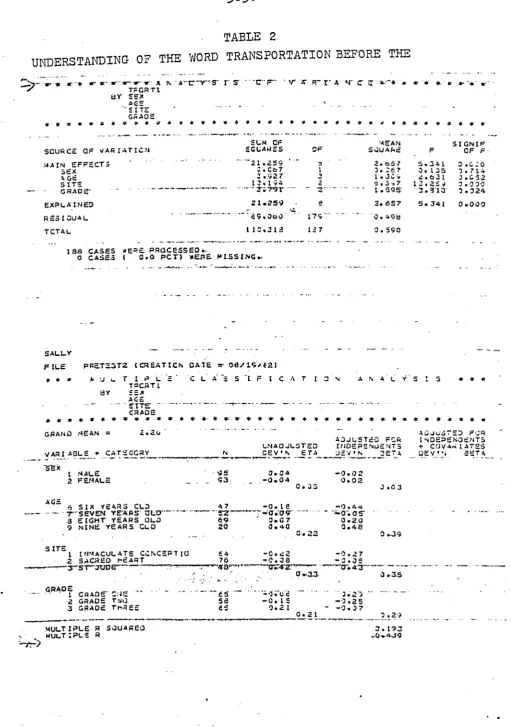
2 Pre-Test Question Two: Understanding of the word transportation before the show. By sex, age,
grade and s i t e ... 305
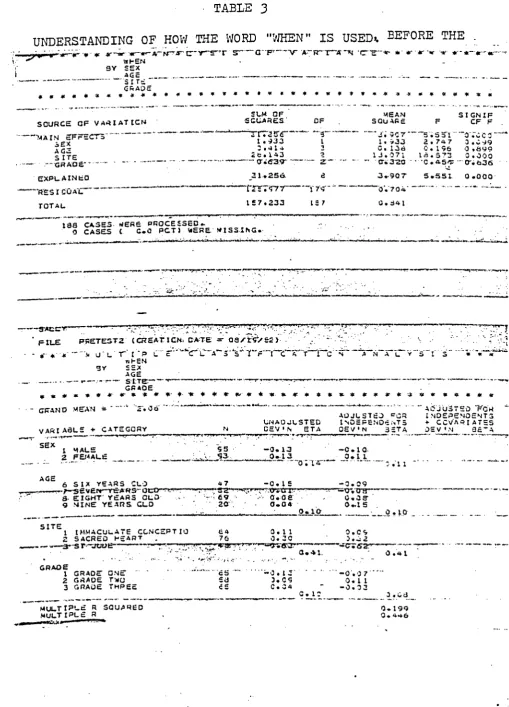
3 Pre-Test Question Three: Understanding of how the word "when" is used before the show.
By sex, age, site and grade...'...j)o6
4= Post-Test Question (P.T.Q.)t Which box has ■; the Magic 5 words in it? By sex, age,
and s i t e ... 307
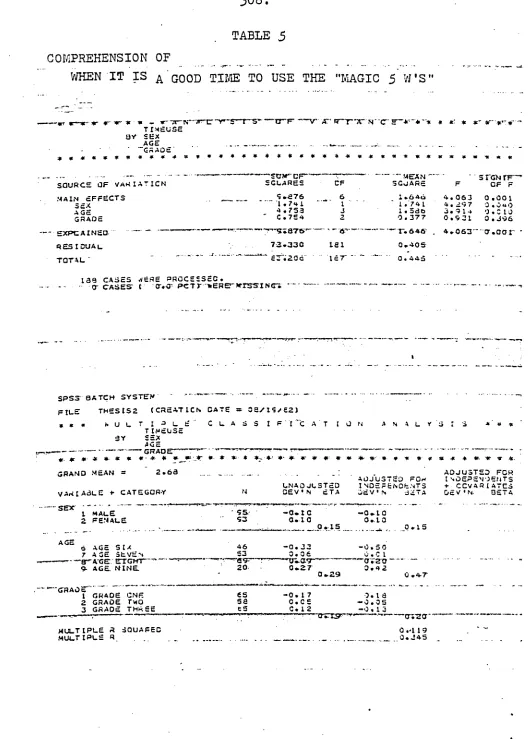
5 P^TvQ.: When is it a good time to use the
Magic 5 "W*s"? By sex, age, and grade . . . 308
6 P.T.Q.: Comprehension of who uses transpor
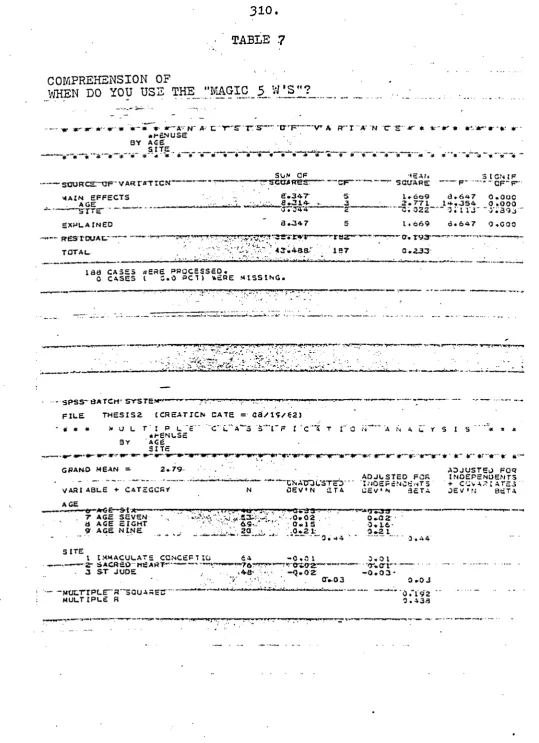
tation. By sex, age, and site... .. 309
7 P.T.Q.: When do you use the Magic 5 "W’s"? . . .
By age and s i t e ...310
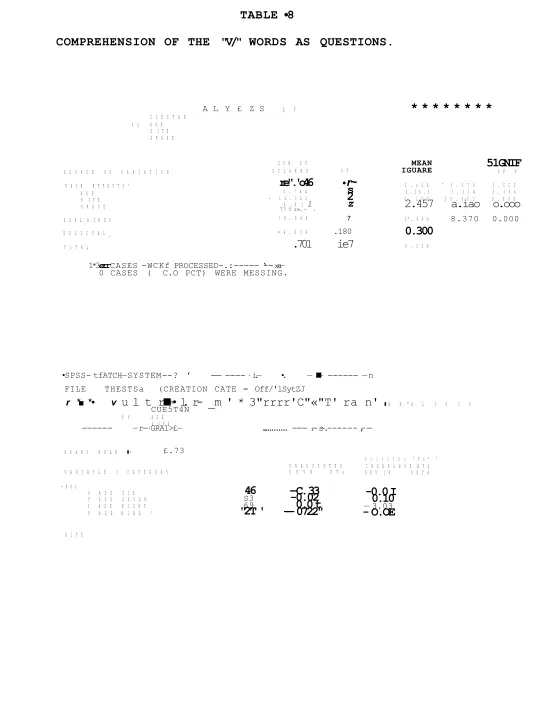
8 P .T .Q .:CComprehension of . the "W" words as
questions. By age, site, and grade... 311
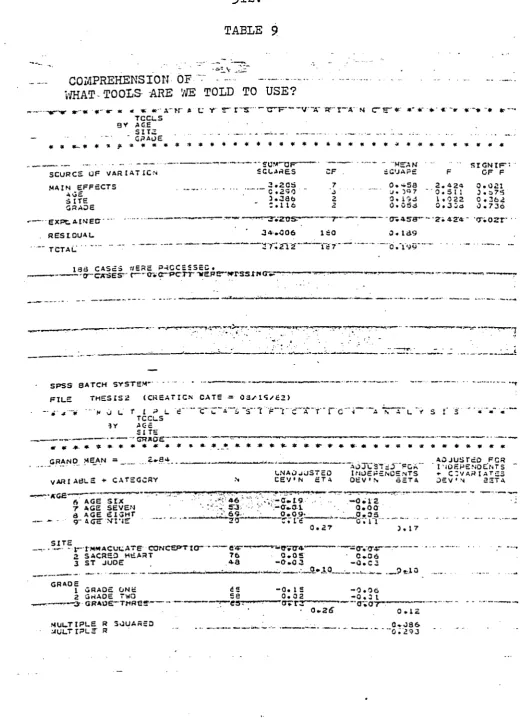
9 P.T.Q.: Comprehension of what tools we are
told to use. By age, site and grade . . . . 312
10 P.T.Q.: Comprehension of the mecuiing of the
word "who". By age and g r a d e ... 313
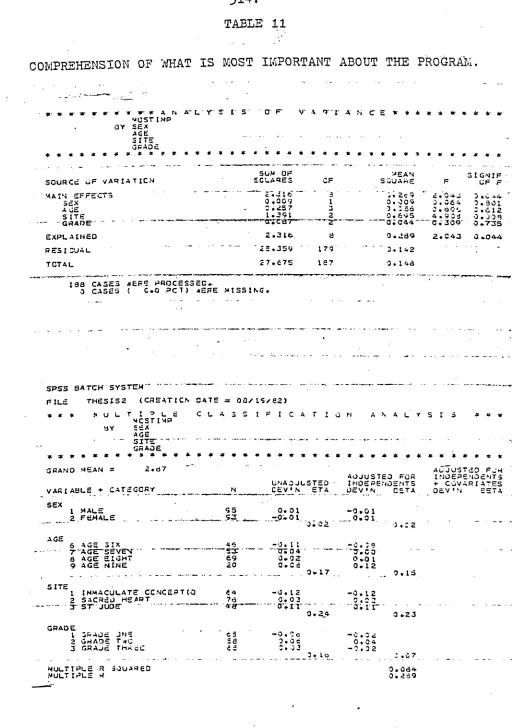
11 P.T.Q.: Comprehension of what is most important about the program. By sex, age, site and g r a d e ... 314
12 P.T.Q.: Recall Question;. Did they pull a
rope or...? By a g e ... 215
13 P.T.Q.: Recall Question: Thesis Production
only, Was it a ball or...?- By.age. . . . 316
14 P.T.Q.: Recall Question: Pretend to be the
people? By age, site and g r a d e ... 317
xvi
Table Page
15 P.T.Q.: Recall Question: Thesis Production only, Talk or Histroy Book? By age, site,
and grade... 318
16 P.T.Q.: .Recall Question: What city the action
took place in. By age... 319
17 P.T.Q.: Recall Question: Did they pretend
to pull a rope or...? By grade. ... 320
18 P.T.Q.: Recall Question: What city the action
took place in. By grade. . . . . .321
19 P.T.Q.: Recall Question: Did they talk or
look in a history "book? By grade. . . . .322
20. P.T.Q.: Recall Question, Thesis ojily: Was it
a hall or...? By grade. ... 323
21 P.T.Q.: Comprehension, Which box has the
Magic 5 words in it? By site... J2k
21a Pre-Test Question One: How many of the "W" words do they know before the show? By site... 325
22 P.T.Q.: Comprehension, Meaning of the word
"Where”. By site. . . . ... 326
23 P.T.Q.: Comprehension, About transportation
in Windsor. By site... 327
23a Pre-Test Question Two: .Understanding of the word transportation before the show. By site. . ..328
2k P.T.Q.: Identification, Favourite Character Female, Thesis Program, "Where" T-shirt.
By age, sex, grade... 329
25 P.T.Q.: Identification, Favourite Character, Male, Thesis Program, "When" T-shirt.
By age and grade... 330
26 P.T.Q.: Identification, Favourite Character, Female, Thesis Program, "Why" T-shirt.
By age and grade... 331
27 P.T.Q.: Identification, Favourite Character,
Female, C0ST40-505 Program. By age and !
grade... 332
xyii.
28 P.T.Q.: Appeal, Segment where actors are cheering, C0ST40-505 Program. By sex
ana grade... 333
29 P.T.Q.: Appeal, Would you tell a friend to
watch? By sex and grade... 334
30 P.T.Q.: Appeal, Segment where actors are
talking. By age, site and grade... 335
31 P.T.Q.s Appeal, Segment about planes. By age,
site and grade... ..336
32 P.T.Q.s Appeal, Segment about Highway 18. By
age, site and grade... .337
33 P.T.Q.s Opinion, My teacher brings TV to class so that I can play and not read so much.
By age and site... 338
34 P.T.Q.s Opinion, You can learn more from TV.
By age and s i t e . ... .'... 339
35 P.T.Q.s Opinion, I like TV in class because I don't have to work so hard. By age, site
and grade... 3^-0
36 P.T.Q.s Amount of At-Home TV viewing. By sex
and site... 341
PREFACE
As the naive student approaches the television studio of a
university, he/she is at once surrounded by what seems a techno
logical cornucopia. Suddenly visions of manipulating the medium
that' has so long been admired from a distance becomes a reality.
The possibility of giving life to a television program of his/
her own design is a very real one. Whether or not the program
is a success is a relative judgement based in part on the opin
ions of an instructor and the subjective viewpoint of the stu
dent. However, whether or not the program is effective in rea
ching its stated goals can often hinge upon the quality of the
production research that has gone into the design of the pro
gram.
This researcher was once a "naive student" deeply impress
ed by the cameras, switcher and audio board of the studio.
From this position he graduated to the role of media researcher,
with an interest in what makes an effective television program
work, particularly in the area of children's instructional tele
vision. This led to a deep involvement in the field of produc
tion research and from there to this thesis.
The form of this present work is termed a Thesis/Media
Production, where the creation of media materials for eventual
testing comprises the bulk of the research. However, these
media materials are not created solely for testing. In using
the Thesis/Media approach, the ongoing research is integrated
into the production process. Each production choice is based
xix
in nature. The program is presented to a target audience whose
opinions and reactions are measured by means of formal testing
procedures. After this formative research process is completed,
the producer knows what changes (if any) will improve the pro
gram and is thus prepared to progress to the next test stage
which is summative research.
The.present research traces the path of a children's
instructional television program, "The Magic 5 Workshop" from
its inception in prototype form in the spring of 1980 to its
eventual testing in an improved stage in May of 1982, The
production research process was rigidly adhered to throughout.
The problem was to improve upon the prototype of the program by
basing the thesis production as much as possible on existing
literature in the area of the child/television relationship.
The researcher's own intuition certainly came into play, but
it is hoped in a way that enhanced rather than detracted from
the production.
Chapter One offers a rationale for the Thesis/Media Pro
duction approach through a thorough discussion of the produc
tion research process. As well, a "new" four stage production
research approach is outlined. These four stages formed the
framework that has been followed in this research.
Chapter Two presents the results of the testing of the
prototype of "The Magic 5 Workshop". Although' not considered
as such at the time of its creation, this program became the
first stage in this Thesis/Media research. Many of the ideas
that have been incorporated into the thesis production were
conceived and tested in the protptype*
xx ^
Chapter Three surveys the present usage of instructional
television in the classroom. This chapter outlines the possi
ble roadblocks that the researcher could encounter in the tran
sition stage from production to classroom utilization. The
researcher was aware that no matter how effective a program is,
it is as if it does not exist if it remains on the shelf. By
understanding some of the environmental and school system con
straints that are inherent in classroom TV use, the researcher
was able to build controls into the program design which might
serve to counteract those problems.
Chapter Four surveys the research literature from the field
of children and television. This is an extremely broad area
and it has been limited to those researches that are particu
larly relevant to this Thesis/Media Production.
Chapter Five presents the objectives and component parts of
"The Magic 5 Workshop" along with a discussion of what makes
this program a useful teaching aid. Finally, everything is
brought together in the form of an Annotated Script. This
script is what was produced in the studio and includes a com
plete description of why each production choice was made.
Chapter Six outlines the methodology that was utilized in
this research. This was a somewhat complicated process because
of the testing structure that was chosen. The thesis production
was subjected to both formative and comparative testing. This
necessitated the development of a complex methodology which
proved both innovative and successful. This chapter includes
a discussion of the study design and the various test instruments
xxi
in the comparative study are outlined and discussed in this
chapter.
Chapter Seven surveys the results of the comparative
analysis where the effectiveness of the Thesis Production in
relation to two other stimuli was tested.
Chapter Eight offers conclusions and is presented in three
parts. First, the results of the hypotheses used to compare
the Thesis Production to the prototype 'program and the non
video presentation are interpreted and discussed in detail.
In the second part, the concentration is on the formative re
search on "The Magic 5 Workshop". In section three, general
conclusions are drawn concerning the success of the entire
project with the expressed intent of stating exactly what has
"been discovered as a result of this thorough production re
search process.
Chapter Nine presents important recommendations for fu
ture researchers who choose to involve themselves in Thesis/
Media production projects. Although the researcher enjoyed a
great deal of success-with this project, there were nonetheless
several severe limitations that were encountered that perhaps
can "be avoided in future projects.
xxii
CHAPTER 1
INTRODUCTION
The Production Research Continuum
Production research can be seen to occur on a continuum
with extremes at either end. On the one hand, one can picture
a program that is developed, produced and presented to the pub
lic, with only simple ratings as a measure of its success. At
the other extreme, one can look at the rigorous pilot program
ming and testing that has been conducted by the Children's
Television Workshop in the development of "Sesame Street"
(Ball and Bogatz, 1970, 1973; Lesser, 1972). The production for
this CTW program lasted approximately one year with a budget of
five million dollars.
The research proposed for this current project can be placed
somewhere close to the middle point on this production research
continuum. To be sure, ratings were important for this produc
tion as it was presented to a target audience and their reactions
and opinions were an important gauge of the program's success.
Equally important however, was the careful testing to which this
program was subjected. . This testing process provided concrete
data which simple observation of the audience' s behaviour could
not supply.
Definition of Production Research
This researcher sees production research as a unique process
whereby a television program is developed systematically. From
-1
the idea stage to its final testing, the production follows
step by step procedures which can prove more effective than
the intuitive program design. The program is based upon re
search literature directly related to the program content.
This thesis reports on the systematic development of the child
ren's instructional television program, "The Magic 5 Workshop".
Definition of Terms
For the purposes of this thesis, the following definitions
will be operationalized:
PRIMARY ELEMENTARY SCHOOL AGE CHILDREN:
Since most of the existing research in the field of children
and television terms "children" as any child from three to twelve
years of age, a more exact term was needed for the current research.
For the purpose of this project, the term "children" shall refer main
ly to children of primary elementary school, in grades one to three
and between the ages of six and nine.
MASS COMMUNICATION/MASS MEDIA;
These terms often include television, radio, newspapers, maga
zines, etc., under their broad scope, but for the purpose of this
study they shall most often be used in reference to television. .
CHILDREN'S TELEVISION PROGRAMMING:
This will refer to cartoons, puppet-shows, adventure shows,
and programs such as "after—school and Saturday afternoon specials".
EDUCATIONAL TELEVISION OR E T V :
No suitable definition comes to the surface from the research
literature because the term has been used rather loosely to mean
both programs that can be viewed at home or at school. For example,
"Sesame Street", "The Electric Company" and "Mister Rogers" are all
considered educational, when they are viewed at home but when they
3
.
are viewed in the classroom, they could also be termed as
"instructional television". Also, ETV can refer to more
adult-centred programs such as "Cosmos" and "The Body Human". in this
research this term shall be used to refer to "children’s education
al television" which consists of those programs that children view
at home, that are not considered to be of a "purely" entertainment
nature. These are the type of programs that will most often be
seen on such non-commercial broadcast systems as PBS in the United
States and TV Ontario in Canada. "Sesame Street" is a good exam
ple of this type of programming.
C L A S S R O O M /IN S T R U C T IO N A L T E L E V IS IO N OR I T V :
Although many individuals term television that is used in the
classroom as ETV, it is important to be more specific here. There
fore, classroom or instructional television (ITV) will refer"to
those types of TV programs that are produced especially for class
room use. They are usually of a "how to" or information nature
with very little entertainment content. They can be used either to
teach or aid in the teaching of a specific lesson. ITV can be
packaged in many forms; Closed—circuit television (CCTV), Community
Antenna Television (CATV, or cable television), Videocassette
cartridge, Videodisc and in some cases, via satelite.
The Need For Production Research; A Rationale For The Thesis/Media Approach
The practical relevance of production research cannot be
minimized. it is the one sure way "to bridge the gulf that we
all recognize exists between media researchers and media prac
titioners." (.Linton, 1981:1) What practical measures must be
taken to bridge this gulf? Consider first how the rift begins:
....with a few notable exceptions, the theoretical researcher and his applied counterpart have had little "to say either in the development of programs or in the assessment of their effects upon different classes of people.
As a result, production has depended very often on artistic, intuitive approaches, while summative research on outcomes has been largely aimed at main effects only. The opportunity provided by television for the study in a non-coercive manner of human per ceptual and cognitive processing of information and skill aquisition, and of affective variables has been relatively ignored. (O'Bryan, 1976:1)
This quote points to the fact that there are many areas that
researchers could and should have explored with regard to tele
vision production, but they have not chosen to do so. The gulf,
therefore, is more the responsibility of the media researchers
than the practitioners. The producer is after all just doing
his/her job and if the researcher wants to help;he/she has to
learn something about the production process and how to best
assist the producer with research data or providing ideas for
evaluation.
Instead the media researchers seem to have accepted a lesser
state in trying to explain, almost always after the fact, what
comprises the motivating "whys" and "whats" of television view
ing behaviour, especially in relation to child audiences. The
"hows" of TV production, which are fundamentally important, are
left almost entirely up to the media practitioner. These "hows"
are more or less a collection of accepted, standardized techniques,
which, although sometimes complicated, are by no means impossible
to learn or understand. Yet, the media researchers often seem to
accept (perhaps blindly) that technical/artistic choices such as
5.
camera angle, acting style, lighting key, costuming and set
design, must always be made by the producer/director. The com
pletely illogical takes place when the researchers act as if they
have no intuition nor feel for a medium they have been studying for
a great many years. Instead they choose to remain at a distance
with the computers and questionnaires. What this usually means is
that the researchers never fully realise the fact that the precise
methodologies they employ can often result in very concrete and
objective viewpoints. This also means that the producer will miss
out on valuable data that would serve to improve his/her program.
What this appears to point to then is the fundamental basis
for this gulf the media researcher researches post hoc and the
media practitioner simply does. The problem increases when the
researcher who, although able to talk about television as a medium,
knows and understands nothing about the mechanics of TV production
and then tries to make comments based merely on observation and
inference. If they have never been in a working studio they
probably have no concept of how a show comes together. Conversely,
if the practitioners never leave the studio catacombs but still
reject the researcher's work, can they ever know if their programs
have achieved their goals? Since the media consumer is ravenous
and will most often take what is offered, ratings simply are not
a valid response measure of effectiveness. Moreover, if the pro
ducer's objectives are information or education—oriented, a
methodical assessment of results is even more important.
This continuing separation between "art” and "science"
allows for much of what this researcher refers to as "remedial
sociology" which manifests itself in the effects studies on the
audiences, the effect of TV on political socialization and the
effect of TV commercials on children's basic language skills).
Such sociological studies are termed "remedial" because it seems
that the point to them is to look to solve a problem after it has
happened rather than to try to predict potential difficulties and
build in controls that might help to prevent them. Perhaps there
would be less need for these "remedial" studies if there could be
a regular marriage between those who do television and those who
study it.
Linton refers to the work of William Belson (former member
of the Audience Research Department of the B.B.C.) in further
clarifying the reasons for this gulf between researchers and
practitioners and what may be done about it:
Belson (1967) points out that the underutilization of television re search by the television industry is largely the result of the atti tudes of both the researchers and the production personnel, and the constraints (mainly lack of time) built into the television produc tion process. While there is lit tle we can do about changing the latter, we can certainly have con siderably more control over the at-titudinal aspects,...(Linton, 1981:2)
This passage is extremely important to this current research
for it not only highlights the fact that there is a need for pro
duction research to be done in general, but it also lends support
for the argument that it could take place at the university level.
The reason for this belief is that most universities have the
necessary physical plant (studio, equipment, technicians) and be
cause they work for the same employer, the media researchers and
producers tend to relate to each other in some measure of
harmony. Also, at the university level, time is not normally as
much of a constraint, as the programs usually do not have to be
produced to satisfy immediate consumer demands. Attitude, how
ever, may still be a problem for both sides. First, one has the
producers who, by and large, are more concerned with intuition
than with in-depth research. Perhaps if the academic research is
not too tedious and clearly broken down as to how inclusion of the
research results could enhance the program (i.e. guarantee greater
audience satisfaction), the attitudes of the producers could change
Secondly, one finds that the production process may appear too
mechanical and chaotic for the academics more accustomed to control
ling their research from behind their desk. Here again, perhaps
if the researcher is assured that hia theoretical positions will
be considered in the program construction and the research method
ologies will be adhered to, without undue interference from the
practitioners, then clearly any residual aspects of such attitudes
can be circumvented.1
In the broader view (beyond the university environment) how
will this union come about? Linton (1981), again referring to
Belson, states that clearly researchers must become involved in and
learn about the production process. This will instill in the re
searchers a sensitivity to the creative process. It should there
by make the academic research approach more pertinent so that what
ever research is done can be utilized by the producers. No better
examples exist of good production^research relationships than those
which occur at the Children*s Television Workshop CCTWl in New York
and at TV Ontario (TVO) in Toronto. Given the talent and
in-ventiveness utilized by these organizations, programs such as
"Sesame Street" and "The Electric Company" produced by CTW and
"Readalong" and "Parlez-Moi" produced lay TVO may have been
successful as mere entertainment vehicles alone. But the massive
amount of formative and summative research that was part of the
creation of these programs led to their unparalleled success as
children's ETV shows.
In scrutinizing the research done at CTW and TVO, one finds
another important aspect of production research clearly underlined.
The producer is not bound to adhere rigidly to the dictates of the
research. The research should aid the creative process, not hinder
it. This concept is constantly reinforced in the research of the
two organizations previously mentioned; not only is there a marriage
between production and research, but it is also a partnership with
each par-tner— having specific duties. This is how TVO states its
case;
Central to the evaluation model is TVO's belief that the utility of research depends on the relationship between the producer and the researcher. The reseacher in this relationship assumes a dual position; the re
searcher is familiar enough with the process to under- ^ stand the priorities and practicalities of television
production, but detached enough to assess the project objectively. It is the role of the researcher to facili tate decision making by contributing relevant information acquired through formal evaluation techniques; and it is the role of production staff to use the information pro vided by research. (Gillis and Nickerson, 1981;3Q
With this Thesis/Media Production, the researcher found
himself in a unique position. As both producer and primary
researcher the opportunity existed for the utilization of re
search data from the beginning of the program design. Such an
9.
experience is not always available in the "real world" and
certainly not in commercial television. The opportunity proved
to be both positive and negative, in the extreme. This
"one-man-team" structure that this project called for is a radical
departure from the massive group efforts launched by most edu
cational television production houses. This proved positive in
that all research and creative decisions could be made by one
source. It was negative, however, because there was never any
one other person sufficiently close to the.work-in-progress who
could provide input for those decisions. Still, it must be
stated that the positive aspects of this solitary approach to
production research outweighed the negative experiences. Never
theless, the work could have been dispatched more quickly and
more efficiently with a group effort.
The production research approach proposed in this thesis
is involved with, among other things, the creation of media
materials for eventual testing. A study about production does
not involve creating media materials, but instead leads one to
study some aspect of the production process. However, it must
be pointed out that the resulting media creation is still based
on current theory and research about production. In the case of
this present project, the researcher has had to wade through
both the many diverse propositions about and approaches to
children's instructional television and the considerable literature
in the field of how children relate to and learn from television.
The thesis program then is a "picture puzzle" of sorts constructed
as it is on the basis of many bitSand pieces of literature from
the whole sphere of the child/TV relationship. It has meant
including a number of theoretical premises in the conceptual
framework of the show that on face value appear incapable of
working. Also, this project called for the development of
an original methodology for testing those premises...
All this aside, the result had to be a program that the
child audience would find interesting, enjoyable and easy to
comprehend. in the "real world" of group efforts this is where
the partnership between the media researcher and media practitioner
would certainly feel the strain.3 Too much research could lead
to a dry program, and something that is too artistic leaves very
little to test because there might be precious little in the show
for which to test. Getting the proper mix is difficult but possi
ble, as one has tried to sho^r in the creation and study of this
program.
The Four Stages of Production Research
The preceding work has been an attempt at providing a rationale
for the Thesis/Media Production using the production research
process. It is now necessary to outline the four stages of p r o
duction-oriented research that were carried out in this thesis.3
(.1) Audience Research:
This category includes Ca) the classic demographic or social characteristic research concerning target audiences, plus Cb) viewing behaviour research which investigates the way in which audiences perceive and interpret media materials. (.Linton, 1981:6)
This category was seen as most important because this re
searcher believes that understanding the target audience is the
first step in designing a television production. Television
11.
should be seen simply for what it is* an extremely efficient
communications medium, a means to an end. But the audience is
not simple. It is composed of diverse individuals each bring
ing something to, and doing something with, that medium. They
have expectations and pre-dispositions that must be considered
from the outset. This would seem especially important for the
adult producer to remember if they wish to produce for the child
audience. If the adult does not learn to appreciate and understand
the unique world of the child's television experience, that
person cannot begin to think of what to present to that child. A
strong concentration in this area has helped this researcher attempt
to bridge the gap between his intellectual and artistic biases and
to answer the simple question of what form of televised materials
a child likes and from which he/she will learn.
(2) Mediation Research;
Using a term borrowed from Baggeley, Ferguson a n d 1 Brooks C1980), this type of research examines the effects of various technical or stylistic media variables Ce.g. camera angle, lighting key, etc.).
Xt obviously involves the examination and under standing of the viewing process covered in viewing behaviour research. (Linton, 19 81:6)
The area described by this definition appears to have been
given the least amount of consideration by production researchers
in recent children's TV analysis. Again, the problem appears to
be that researchers are willing to rely on the producer's personal
visualization and intuition with regard to program choices, and a
valuable area goes unstudied. If mediation research is done it is
usually done after the fact.4 Certainly, once an experienced
producer/director gets to the studio he/she usually has a strong
sense of what will "work" and what will not. Yet, there is still
much to be learned from mediation research. If the producer has
considered the audience and mediation research carefully, he/she
will be one step closer to achieving a wider acceptance of his/her
program by an extremely diverse audience. Once this research is
conducted, it would then follow that production choices would be
much simpler; only certain things (e.g. lighting, colour, costumes,
etc.) will work for that show and for that audience.
The mediation research appears in the Annotated Script which
occupies part two of Chapter Five. The script clearly shows the
way in which the audience and mediation research have come to—
gether in a unified way to create a strong theoretical base for
this project.
(3) Evaluation or Assessment Research;
The definition of this category as supplied by Linton is
clear but somewhat incomplete for the purposes of this thesis.
For this reason a second part or (b) portion has been added to
the definition.
(a) This category entails the examination of techniques used to make judgements about the effectiveness of media materials on either (a) a summative basis (i.e.
long term, after-the-fact studies) or (b) a forma tive basis (i.e. immediate studies, even ones done during production with the idea of modifying the pro duction in process on the basis of the results ob tained) . (Linton, 1981:6) (letter (a) added)
Cb) This type of research is perhaps more aptly termed Historical Evaluation Research where the use of the media in society is studied. Also considered is
(are) the reason (s) why this medium has or has not been successful. (Definition (b) mine)
The evaluation described in the (a) part of this definition
can be considered both summative and formative in nature with
regard to this thesis. Chapter Two reports on the results of
13,
the prototype program which wa§ produced in Professor James
Linton’s Production Research and Design class (Communication
Studies 40-505), This first project laid the groundwork for
the thesis production. Therefore, the thesis evaluation can be
considered a summative study. On the other hand that first
program pointed out a great many flaws in the program design and
the present production is by no means perfect, so this study is
also formative in structure.5
One of the most challenging aspects of this stage of pro
duction research was the search for a standardized methodology
for evaluation of this project. The structure of the test design
required test materials that would ask the same basic questions
at three test sites, with three different stimuli, in the end,
no existing methodology could be found that would satisfy the
evaluative criteria of the project so that the researcher had to
utilize parts of research methodologies from several different
studies. As well, the researcher had to design a test instrument
that was unique to this Thesis/Media Production. The complete
methodology is discussed in Chapter Six.
Under the (b) part of this definition the historical usage
of the medium is discussed within the context that a given project
is to be tested. For example, in this, thesis a brief history of
the use of instructional television in the classroom is presented
with the expressed purpose of trying to ascertain what may or may
not happen in that environment that might effect the acceptance
of the thesis production of "The Magic 5 Workshop". This research
is necessary because the program- was not tested in a vacuum and
that special world called the elementary school classroom was a
totally new experience for this researcher. An added value
of this type of research was that one got a better notion of
what the teachers' impressions of ITV use might be and this
aided in the development of test materials for eliciting re
sponses from the educators involved in the study.^
This historical-research is presented in Chapter Three and
although it is not the most important aspect of this production research
model, it must, for purposes of logical thought appear before
the audience and mediation research.
(4) Content or Subject Matter Research;
This involves locating sources concerning a subject on which a production is based, compiling information on that topic and organizing such information.
CLinton, 19 81:5)
This category was not given primary importance and indeed
must seem greatly out of sequence here. This apparent oversight
has been done purposely for this particular project and might
not be handled this way in the development of other shows. With
the design of this show one asked a chicken-and-egg type of
question: what must come first, the design (the structure of the
program) or the content? In this instance it was decided that
the design was most important because the researcher was aiming
for a program that had an original style that would appeal to the
largest audience. The content of the show had to be sufficiently
interesting to engage the attention of the child audience and it
was believed that this choice could be made well after the pro
gram design was completed. Also, discussions with educators and
children, plus a thorough literature review, indicated that a
young child's viewing preferences are highly eclectic so that the v .
15.
subject matter could be chosen from an extremely broad spectrum
of educational materials. On the other hand, more work was
needed on the design because the researcher wanted it to be such
that any topic in the social sciences and humanities could be
used with it. It was believed that this was the only way that
"The Magic 5 Workshop" could show its maximum potential.7
Still, it was important to search for some help regarding
the subject matter that would best demonstrate how this program
could be used as a teaching aid. Guidance on program content
was sought from the educational community, in particular, the
Windsor Separate School Board.8 The materials they supplied
were excellent and guaranteed the usefulness of the subject
matter for the classroom, especially since no TV program existed
in the suggested topic area. The use of the content is fully
outlined in the Annotated Script in Chapter Five,
Conclusion
Having delineated the approach to be taken in this research,
it is hoped that the reader has a fuller appreciation of the
nature of a Thesis/Media Production. Working in this manner is
still comparatively new in relation to the more traditional social
science perspectives such as effects research. Also, the research
for the construction and evaluation of the program had to be
"child-centred" , which is not always easy for adult researchers to accept.
What is meant here, of course, is that an attempt was made to al
ways keep the audience in mind both during the production and after
wards during the testing.^ The main underlying premise was that
the child must be able to comprehend, not just enjoy a program
if learning is to take place. What the child truly believed
about the program, ITV in the classroom, or the medium of tele
vision itself, had to be accepted and not reinterpreted if it
did not conform to the researcher's expectations. No excuses
have been made for the results obtained in testing. They have
been explained in reference to what the children experienced
and not what this researcher felt they should have experienced.
The chapters to follow outline the step-by-step process
that helped to bring "The Magic 5 Workshop" to the stage of its
present development.
Notes to Chapter 1
The ideas for this preceding argument are based on this researcher's experiences at the University of Windsor. He has worked extensively with the producers in the Media Centre, as well as with several of the professors in the Department of Cummunica-tion Studies. Observations and discussions in these two environ ments have led the researcher to believe the attitudes mentioned could be changed in the way discussed here. However, as this researcher has never worked in any other university setting, he cannot say with any surety that this case would hold for all situa tions involving academic researchers and producers.
2Noble (1975:96) points out that in an interview with a consultant for "Sesame Street" that the consultant did run into a conflict regarding research and artistic choice. It seems the researcher in question made it quite clear that much of the
original content proposed for the show was above the heads of pre schoolers. His advice was ignored in favour of proven attention gaining techniques.
•^Professor Linton (1981) offers four categories (stages) of production research. They are not listed here in the same sequence as he has suggested, but rather the order in which they appear is an indication of the relative importance of each category to- this work, as decided by this researcher.
4The list of research projects done in this "after the fact" fashion is quite lengthy and perhaps with good reason. Obviously, the researchers had little or no production experience and did not know what to study until they saw the program itself or it was pointed out to them. This research is nonetheless quite valuable, but one is advocating the stronger use of it in the beginning design stages and not only on the summative level.
^This researcher does not wish to lead the reader to believe that Chapter Two takes pre-eminence over the audience and mediation research. Clearly, this chapter must appear in the order it does for the purposes of logical progression.
6In point of fact, several of the statements from the Positive/ Negative chart outlined in Chapter Three were tested directly in the Post Viewing Questionnaire that the teachers completed (see Appendix
#8 a).
^This thesis program has been designed with future shows in mind and not on a "one shot" basis. The research conducted in this project should lay the groundwork for a series to be produced which could then be subjected to summative testing.
®This group was chosen because the researcher had had previous contact with the Board and found the experience to be extremely re warding. The present project was no exception.
q
The test results indicate that while this latter point was adhered to quite well, the researcher sometimes overlooked the former in the show itself (see Conclusions Chapter Eight).