Gravitational Search Algorithm Optimization
Based Design for Improving Starting Torque
of Induction Motor
P.S.Prakash
Assistant Professor, Dept. of Electrical & Electronics Engg, GCE, Thanjavur, Tamilnadu, India
ABSTRACT: Thispaper presents a Gravitational Search Algorithm (GSA) Optimization based design methodology for maximizing the starting torque of Induction Motor (IM). The GSA based design methodology is tailored to optimize the chosen primary variables with a view to obtain the global best design. The developed methodology is applied in solving two IM design problems and the results are presented with a view of exhibiting the superiority of the developed algorithm. The optimal design obtained by the proposed methodology fortwo IMs are presented with a view of illustrating the superiority.
KEYWORDS: Induction Motor,Gravitational Search Algorithm
NOMENCLATURE
EDi equivalent decimal value of ithsub-string
h(x) Objective function to be maximized
LI fitness function of ithstar
g(x) a set of inequality constraints
I ph phase current, A
IM induction motor
Ir equivalent rotor current, A
Isc short circuit current per phase, A
"min"& "max" minimum and maximum limits of the respective variables
nd number of decision variables
ODIM optimal design of IM
PM proposed method
SFL slip at full load, per unit
Tst starting torque, per unit
Vph phase voltage, V
w weight constant of the penalty terms
xiith decision variable
Z impedance per phase
I. INTRODUCTION
Although squirrel-cage induction machines are widely used in the industry for their easy manufacturing and robustness, their applications in electrical transport systems such as subways and trains are limited due to inferior starting torque than those of permanent-magnet motors. In the light of the fact that the resistance of a squirrel-cage motor is fixed and small as compared to its reactance that is very large especially at the start, the frequency of the rotor currents equals the supply frequency, the starting current of the rotor is very large in magnitude and lags by a very large angle, resulting a poor starting torque per ampere. It is roughly 1.5 times the full-load torque, although the starting current is 5 to 7 times the full load current. Hence, such motors are not useful where the motor has to start against heavy loads. Therefore it becomes imperative that the best architecture and the corresponding dimensioning have to be determined in order to maximize the starting torque with respect to several constraints in applications requiring high starting torque such as in traction systems. The resulting mathematical optimization problem is usually difficult since the design variables contain continuous variables related to the real dimensioning parameters and combinatorial variables associated with architecture characteristics and discrete dimensioning parameters; and their relationship with motor specifications are in general nonlinear (Kentli 2009).The optimal design of IM (ODIM) is so complicated that it is still a combination of art and science. There are many geometrical parameters and their relationships connected with motor specifications, which are in general nonlinear, MehmetCunkas 2010.
Over the years, in addition to statistical methods (Han and Shapiro 1967 and the Monte Carlo technique Anderson 1967, several mathematical programming techniques, which provides a means for finding the minimum or maximum of a function of several variables under a prescribed set of constraints, have been applied in solving the IM design problems. These techniques such as nonlinear programming, Ramarathnam et al 1971, Lagrangian relaxation method Gyeorye Lee et al 2013 direct and indirect search methods Nagrial et al 1979, Hooks and Jeeves method Faiz et al 2001, Rosenbrock’s method -Bharadwaj et al 1979-a, Powell’s method Ramarathnam et al 1973, finite element method T. S. Parkin et al 1993 and sequential unconstrained minimization technique Bharadwaj et al 1979-b are most cumbersome and time consuming. Besides a few of them requires derivatives and exhibits poor convergence properties due to approximations in the derivative calculations.
differences between these procedures lie in the techniques they utilize to encode candidates, the type of alterations they use to create new solutions, and the mechanism they employ for selecting the new parents. These algorithms have yielded satisfactory results across a great variety of engineering optimization problems.
The focus of this paper is to develop a design methodology using GSA for maximizing the starting torque of IMs with a view of effectively exploring the solution space and obtaining the global best solution. The developed design methodology has been applied in designing two IMs and the performances have been studied.
The paper is divided into five sections. Section I provides the introduction, section II overviews GSA, section III formulates the IM design problem and elucidates the proposed method (PM), section IV discusses the results and section V concludes
II. GRAVITATIONAL SEARCH ALGORITHM
2.1 INTRODUCTION
Rashedi et al. proposed one of the newest heuristic algorithms, namely Gravitational Search Algorithm (GSA) in 2009. GSA is based on the physical law of gravity and the law of motion. The gravitational force between two particles is directly proportional to the product of their masses and inversely proportional to the square of the distance between them. GSA a set of agents called masses has been proposed to find the optimum solution by simulation of Newtonian laws of gravity and motion. In the GSA, consider a system with m masses in which position of the th mass is
defined as follows:
Where position of the ith ismass in the dth dimension and n is dimension of the search space. At the specific time‘t’ a gravitational force from mass ‘j’ acts on mass ‘i’, and is defined as follows:
Where Miis the mass of the object i, Mj is the mass of the object j, G(t) is the gravitational constant at time t, Rij(t) is the
Euclidian distance between the two objects i and j, and is a small constant.
The total force acting on agent i in the dimension d is calculated as follows:
Where randj is a random number in the interval [0,1].
According to the law of motion, the acceleration of the agent i, at time t, in the dth dimension, aid(t) is given as
follows:
Where randiis a uniform random variable in the interval [0,1].
The gravitational constant, G, is initialized at the beginning and will be decreased with time to control the search accuracy. In other words, G is a function of the initial value (Go) and time (t):
The masses of the agents are calculated using fitness evaluation. A heavier mass means a more efficient agent. This means that better agents have higher attractions and moves more slowly. Supposing the equality of the gravitational and inertia ma, the values of masses is calculated using the map of fitness. The gravitational and the inertial masses are updating by the following equations:
Where fiti(t) represents the fitness value of the agent i at time t, and the best(t) and the worst(t) in the population
respectively indicate the strongest and the weakest agent according to their fitness route.
For a minimization problem:
For a maximization problem:
(12)
2.2 ALGORITHM:
The proposed Gravitational Search Algorithm approach for the evaluation of Available Transfer Capability can be summarized as follows:
Step 1: Search space identification.
Step 2: Generate initial population between minimum and maximum values.
Step 3: Fitness evaluation of agents.
Step 5: Calculation of the total force in different directions.
Step 6: Calculation of acceleration and velocity.
Step 7: Updating agent’s position.
Step 8: Repeat step 3 to step 7 until the stop criteria is reached.
Step 9: Stop.
The setup for the proposed algorithm is executed with the following parameters;
m=50(masses)
G is set using in equation (5.7) where GO is set to100
is set to 20
T =100(total number of iterations)
III. PROPOSED METHOD
The proposed GSA based solution method for ODIM involves formulation of the problem, representation of agents through the chosen design variables and agents are accelerated to move towards acceleration and velocity as best solutions.
3.1 Problem Formulation
The ODIM problem involves large number of design variables. Many of these variables fortunately have a little influence either on the objective function or on the specified constraints. However, to ease the curse of high dimensionality, the following seven variables are identified as primary design variables.
T x x x X core the in density Flux density current Rotor density current Stator gap air of Length conductor Ampere density flux gap air of value Average pitch pole length to Core ] , , ,
[ 1 2 7 (14)
The ODIM problem is formulated by defining an objective function and a set of constraints as
Maximize
SFL
I
I
T
x
h
r stst
2)
Subject to 0.5 current load no unit per 70 rise perature stator tem 1.5 ratio torque load full to starting 05 . 0 load full at slip 2.0 h rotor teet of density flux maximum 2 th stator tee of density flux maximum 0 ) (x g (16) max min i i i x x
x i1,2,nd (17)
Where
ph
r
I
I
0
.
85
(18)Z
I
Isc
ph (19)3.2 Representation of Design Variables
The agent
a
,is represented to denote the chosen primary design variables, defined by Eq. (14), in vector form as:
a
1,
a
2,
a
7
x
1,
x
2,
,
x
7
a
i
i i
i
(20)3.3 Fitness Function
The algorithm searches for optimal solution by maximizing a fitness of agentLI, which is formulated from the objective function of Eq. (15) and the penalty terms representing the limit violation of the explicit constraints of Eq. (21). The LI function is written as
Maximize
i i x g w x h LI 2 ) ( 1 )( (21)
IV. NUMERICAL RESULTS
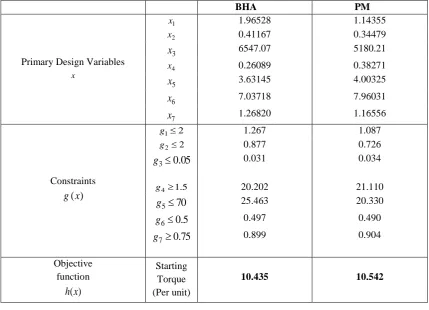
Table 1 Comparison of Results for Motor-1
BHA PM
Primary Design Variables x
1
x 1.96528 1.14355
2
x 0.41167 0.34479
3
x
6547.07 5180.214
x 0.26089 0.38271
5
x
3.63145 4.003256
x
7.03718 7.960317
x
1.26820 1.16556Constraints
)
(x
g
2 1g 1.267 1.087
2
2
g 0.877 0.726
05
.
0
3
g
0.031 0.0345 . 1
4
g 20.202 21.110
70
5
g
25.463 20.3305
.
0
6
g
0.497 0.49075
.
0
7
g
0.899 0.904Objective function
)
(x
h
Starting Torque (Per unit)10.435 10.542
Table 2 Comparison of Results for Motor-2
BHA PM
Primary Design Variables
x
1
x 1.78348 1.62509
2
x 0.56613 0.57020
3
x
5578.95 5691.084
x 0.31653 0.27394
5
x
2.87318 2.877796
x
7.26332 7.756057
x
1.14394 1.24505Constraints
)
(
x
g
2 1g 1.638 1.698
2
2
g 1.124 1.183
05
.
0
3
g
0.020 0.0195 . 1
4
70
5
g
26.552 29.4145
.
0
6
g
0.500 0.49875
.
0
7
g
0.886 0.888Objective function
)
(x
h
Starting Torque (Per unit)
16.218 16.448
It is seen from these tables that the PM offers a starting torque of 10.542and 16.448per units, which are higher than that of BHA based approach, for motor-1 and -2 respectively. These tables also include the values of the constraints of Eq. (16) along with their limits. It can also be observed from these tables that both the methods bring the constraints such as maximum flux density, slip at full load, starting to full load torque ratio, etc., of to lie within the respective limit, as the constraints are added as penalty terms in the fitness function of Eq. (21).
IV. CONCLUSION
Indeed the GSA is a powerful population based method for solving complex optimization problems. A new methodology involving GSA for solving ODIM problem has been developed and applied on two IM design problems. It determines the optimal values for primary design variables. The ability of the PM to produce the global best design parameters that maximizes the starting torque of the motor has been projected. It has been chartered that the new approach fosters the continued use of GSA and will go a long way in serving as a useful tool in design problems.
ACKNOWLEDGEMENT
The authors gratefully acknowledge the authorities of Government College of Engineering, Thanjavur for the facilities offered to carry out this work.
REFERENCES
[1]Bell J and McMullen P. (2004). Ant colony optimisation techniques for the vehicle routing problem. Adv Eng Inform 2004;18:41–8.
[2]Bharadwaj. D.G., Venkatesan.K and Saxena.R.B. (1978). Computer aided design of polyphase cage induction motors, Proc. Int. Conf. On Electrical Machines, Brussels, Belgium, 1(SP2/1): 1-10
[3]Bharadwaj. D.G., Venkatesan.K and Saxena.R.B. (1979-a). Induction motor design optimization using constrained Rosenbrock method (Hill Algorithm), Comput. Elec. Engg. 6(1): 41-46.
[4]Bharadwaj. D.G, Venkatesan.K.and Saxena.R.B. (1979-b). Nonlinear programming approach for optimum cost induction motors--SUMT algorithm, Comput. and Elect. Engg., 6(3): 199-204.
[5]Bhuvaneswari.R and Subramanian.S. (2005). Optimization of three phase induction motor design using simulated annealing algorithm, Electric Power Components and Systems, 33: 947-956.
[6]Dorigo. M, Maniezzo.V and Colorni. A. (1996). Ant system: optimisation by a colony of cooperating agents, IEEE Trans. On Systems, Man and Cybernetics, Part B, 26(1): 29-41.
[7]Dorigo and M, Gambardella LM. (1997-a). Ant colonies for the traveling saleman problem. Biosystems, 43:73–81.
[8]Dorigo and M, Gambardella LM.(1997-b). Ant colony system: a cooperative learning approach to the travelling salesman problem. IEEE Trans Evolut Comput., 1(1):53–66.
[9]Faiz. J and Sharifian. M.B.B. (2001). Optimal design of three phase induction motors and their comparison with a typical industrial motor, Comp. and Elect. Eng. 27: 133-144.
[10]Gambardella LM, Taillard E and Dorigo M. (1999). Ant colonies for the quadratic assignment problem. J Oper Res Soc, 50:167–76.
[11]Gyeorye Lee, Seungjae Min, and Jung-Pyo Hong. (2013). Optimal shape design of rotor slot in squirrel-cage induction motor considering torque characteristics, IEEE Transactions on Magnetics, 49(5): 2197-2200.
[13] Kim MK, Lee CG, Jung HK. (1998). Multiobjective optimal design of three-phase induction motor using improved evolution strategy, IEEE Trans. on Magnetics, 34(5): 2980-2983.
[14] Kentli. K. (2009). A survey on design optimization studies of induction motors during the last decade, Journal of Electrical and Electronics Engineering, 9(2): 969-975.
[15]Menzies. R.W and Neal. G.W. (1975). Optimization program for large induction motor design, Proc.I.E.E., 11(6), 643-646.
[16]Millie Pant and Radha Thangaraj. (2008). Efficiency optimization of electric motors: a comparative study of stochastic algorithms, UKWorld Journal of Modelling and Simulation, 4(2): 140-148.
[17]Parkin T. S and Preston T.W, "Induction Motor Analysis Using Finite Element", Proc.IEE, The Eighth International Conference on Electrical Machines and Drives, 1993, pp. 20-24.
[18]Ramarathnam, R., Desai.B.G., and Subba Rao. V. (1973). A comparative study of minimization techniques for optimization of induction motor design. IEEE Transactions on Power Apparatus and Systems PAS-92 (5): 1448–1454.
[19]Sakthivel. V.P, Bhuvaneswari. R and Subramanian. S. (2010-a). Economic design of three-phase induction motor by particle swarm optimization, J. Electromagnetic Analysis and Applications, 2: 301-310.
[20]Sakthivel. V.P, Bhuvaneswari. R and Subramanian. S. (2010-b). Design optimization of three-phase energy efficient induction motor using adaptive bacterial foraging algorithm, The International Journal for Computation and Mathematics in Electrical and ElectronicEngineering, 29 (3): 699-726.
[21]Esmat Rashedi, Hosseion Nezamabadi-pour, Saeid Saryazdi.(2009). GSA-Gravitational Search Algorithm, Information Sciences179(2009) 2232-2248,
[22]Thanga Raj.C, Radha Thangaraj, Millie Pant, Pascal Bouvry, and Ajith Abraham. (2012). Design optimizationof induction motors with differential evolution algorithms with an application in textile spinning, Applied Artificial Intelligence, 26: 809–83.
[23]E. Rashedi, H. Nezamabadi-pour, S. Saryazdi, GSA: A gravitational search algorithm, Information Sciences, vol. 179, 2009, pp. 2232-2248. [24] E. Rashedi, H. Nezamabadi-pour, S. Saryazdi, Filter modeling using gravitational search algorithm (Accepted for publication),Engineering Applications of Artificial Intelligence, to be published, 2010