DOI: 10.1534/genetics.107.081331
Functional Interactions Between Sae2 and the Mre11 Complex
Hee-Sook Kim,* Sangeetha Vijayakumar,* Mike Reger,
†Jacob C. Harrison,
‡James E. Haber,
‡Clifford Weil
†and John H. J. Petrini*
,§,1*Laboratory of Chromosome Biology, Memorial Sloan-Kettering Cancer Center, New York, New York 10021,‡Rosenstiel Center and Department of Biology, Brandeis University, Waltham, Massachusetts 02454,†Department of Agronomy,
Whistler Center for Carbohydrate Research, Purdue University, West Lafayette, Indiana 47907 and §Weill Medical College, Cornell University Graduate School of Medical Sciences, New York, New York 10021
Manuscript received August 30, 2007 Accepted for publication December 18, 2007
ABSTRACT
The Mre11 complex functions in double-strand break (DSB) repair, meiotic recombination, and DNA damage checkpoint pathways. Sae2 deficiency has opposing effects on the Mre11 complex. On one hand, it appears to impair Mre11 nuclease function in DNA repair and meiotic DSB processing, and on the other, Sae2 deficiency activates Mre11-complex-dependent DNA-damage-signaling via the Tel1–Mre11 complex (TM) pathway. We demonstrate thatSAE2overexpression blocks the TM pathway, suggesting that Sae2 antagonizes Mre11-complex checkpoint functions. To understand how Sae2 regulates the Mre11 complex, we screened forsae2alleles that behaved as the null with respect to Mre11-complex checkpoint functions, but left nuclease function intact. Phenotypic characterization of thesesae2alleles suggests that Sae2 functions as a multimer and influences the substrate specificity of the Mre11 nuclease. We show that Sae2 oligomerizes independently of DNA damage and that oligomerization is required for its regulatory influence on the Mre11 nuclease and checkpoint functions.
T
HE DNA damage response is a highly conservedprocess that prevents genome instability. In bud-ding yeast, checkpoint signaling is initiated by the yeast ataxia-telangiectasia mutated/ataxia-telangiectasia and Rad3-related (ATM/ATR) homologs, Mec1/Tel1, and is propagated via the effector kinases Chk1 and Rad53 (the Chk2 homolog). DNA damage sites are recognized by two different types of sensors, specific for single-strand DNA (ssDNA) or double-single-strand breaks (DSBs). RPA (a eukaryotic ssDNA-binding protein) recognizes ssDNA damage sites in cooperation with replication factor C (RFC)-like and PCNA-like (the 9-1-1) com-plexes. The Mre11 complex consists of three highly
conserved members—MRE11,RAD50, andXRS2(NBS1
in mammals)—and appears to be primarily required for signaling the presence of DSBs (reviewed in Zhou
and Elledge 2000; D’Amours and Jackson 2002;
Petriniand Stracker 2003; Stracker et al. 2004).
Spo11 catalyzes the formation of DSBs to initiate mei-otic recombination. Inrad50Smutants, Spo11 remains covalently attached at the DSB ends that it forms (Keeney et al. 1997). Sae2Dcells exhibit the same
re-tention of Spo11 at meiotic DSBs, consistent with the view that, in both mutants, Mre11 nuclease function is impaired (Keeney and Kleckner 1995; McKee and
Kleckner 1997; Prinz et al. 1997). This view is
sup-ported by the fact that Spo11 retention is also seen in nuclease-deficient alleles of MRE11(Nairzand Klein
1997; Moreauet al. 1999).
In vitro, Mre11 has both endo- and exonuclease activ-ity (D’Amoursand Jackson2002). Mutations of conserved
histidine residues (e.g., H125N) in the phsophoesterase domain eliminate both activities; however,in vivo Mre11-H125N has apparently normal exonuclease activity in degrading an HO-endonuclease-generated DSB (Moreau
et al. 2001; Leeet al. 2002). These data, and the fact that
it is a 39-59exonuclease, support the interpretation that the Mre11 complex is not directly involved in the 59-39 resection of DSB ends. Spo11 removal from meiotic DSBs and DNA hairpin cleavage in mitotic cells, both presumably requiring endonuclease activity, are abro-gated by Mre11 nuclease deficiency (Lobachev et al.
2002; Yuet al. 2004).
rad50S and sae2D also affect Mre11 nuclease func-tions in mitotic cells (Rattrayet al. 2001). Both
muta-tions impair the processing of hairpin DNA structures (Lobachevet al. 2002; Yuet al. 2004) and camptothecin
(CPT)-induced Top1 cleavage complexes (Vanceand
Wilson2002; Denget al. 2005). These phenotypes are
also exhibited by nuclease-deficient mre11mutants. In addition, rad50S and sae2D mutants exhibit synthetic lethality with rad27D (FEN1 in human), another flap endonuclease that is required for Okazaki fragment maturation (Debrauwereet al. 2001; Moreauet al. 2001).
It has recently been shown that Sae2 itself possesses endonuclease activity, suggesting the possibility that 1Corresponding author:Laboratory of Chromosome Biology, MSKCC,
1275 York Ave., RRL 901C, New York, NY 10021. E-mail: [email protected]
Sae2 may play dual roles: as a regulator of Mre11 nu-clease function and/or as a nunu-clease (Lengsfeldet al.
2007).
Previously, we demonstrated that both rad50S and sae2Dsuppress the checkpoint phenotype of Mec1 de-ficiency via a conserved pathway dependent on the Mre11 complex and Tel1 (referred to as the TM path-way) (Usuiet al. 2001, 2006; Moraleset al. 2005).sae2D
also prevents the normal turning off of the DNA damage checkpoint once a DSB is repaired (Clericiet al. 2006).
In contrast, overexpression ofSAE2suppresses bothMEC1 andTEL1kinase activity modifying Rad53 and also pre-vents the damage-induced phosphorylation of Mre11. These observations suggest that Sae2 may be an inhibi-tory factor for the Mre11-complex checkpoint function. Supporting this possibility, we report here thatSAE2 overexpression enhances the methyl methanesulfonate (MMS) sensitivity ofmec1Drad50Scells, suggesting in-hibition of the TM pathway. We have isolatedsae2alleles that fail to enhance this MMS sensitivity and recovered among themsae2alleles that alter the Mre11 effect on specific types of substrates. For example, the N terminus of Sae2 appears to be required specifically for the Mre11 nuclease to open hairpin DNA structures, but not for Spo11 cleavage. Further, Sae2 appears to function as an oligomer, and self-interaction is correlated with Sae2 influence on the Mre11 complex’s nuclease and check-point functions.
MATERIALS AND METHODS
Yeast strains:The following strains are of W303 background (MATa,-aora/atrp1-1 ura3-1 his3-11,15 leu2-3,112 ade2-1 can1-100 RAD51, originally from R. Rothstein): JPY2252 (MATa
sae2D), JPY2253 (MATa FLAG-SAE2), JPY2254 (MATa FLAG-sae2-12), JPY2255 (MATaFLAG-sae2-58), JPY2256 (MATa FLAG-sae2-1), JPY2258 (MATasae2D), JPY2259 (MATaFLAG-SAE2), JPY2261 (MATaFLAG-sae2-1), JPY2262 (MATaFLAG-sae2-12), JPY2264 (MATaFLAG-sae2-58), JPY2290 (MATaFLAG-sae2-51), JPY2308 (MATa/asae2D/sae2D), JPY2309 (MATa/aFLAG-SAE2/ FLAG-SAE2), JPY2310 (MATa/aFLAG-sae2-1/FLAG-sae2-1), JPY2311 (MATa/aFLAG-sae2-12/FLAG-sae2-12), JPY2312 (MATa/a FLAG-sae2-58/FLAG-sae2-58), JPY2318 (MATa/asae2D/FLAG-sae2-51), JPY2335 (MATa/a rad27D/RAD27 sae2D/SAE2), JPY2338 (MATa/a rad27D/RAD27 FLAG-SAE2TLEU2/SAE2), JPY2339
(MATa/arad27D/RAD27 FLAG-sae2-1TLEU2/SAE2), JPY2340
(MATa/arad27D/RAD27 FLAG-sae2-12TLEU2/SAE2), JPY2344
(MATa/arad27D/RAD27 FLAG-sae2-51TLEU2/SAE2), JPY2345
(MATa/arad27D/RAD27 FLAG-sae2-58TLEU2/SAE2), JPY2518
(MATaFLAG-SAE2TLEU2 mec1Dsml1D), JPY2540 (MATa
FLAG-sae2-1TLEU2 mec1D sml1D), JPY2557 (MATa FLAG-sae2-12T
LEU2 mec1Dsml1D), JPY2589 (MATaFLAG-sae2-51TLEU2 mec1D
sml1D), JPY2606 (MATa FLAG-sae2-58TLEU2 mec1D sml1D),
JPY2666 (MATa sae2D mec1D sml1D), JPY2247 (MATa SAE2-HATURA3, YLL1103 from Longhese; Baroni et al. 2004),
JPY2248 (MATaSAE2-HATURA3 mec1Dsml1D, DMP380from
Longhese; Baroni et al. 2004). The following strains are of
A364a background: JPY319 (MATaWT), JPY321 (MATamec1-1 sml1), JPY326 (MATarad50S mec1-1 rad53 sml1), JPY352 (MATa
rad50S mec1-1 sml1), JPY847 (MATarad50S mec1-1 tel1Dsml1), JPY848 (MATarad50S sae2Dmec1-1 sml1), JPY851 (MATasae2D
mec1-1 sml1), JPY3009 (MATamec1-1 sml1 FLAG-SAE2), JPY3010 (MATamec1-1 sml1 FLAG-sae2-1), and JPY3011 (MATamec1-1 sml1 FLAG-sae2-12). The following strains are of SK1 back-ground: JPY839 (MATarad50S sae2DTRP1) and JPY840 (MATa
sae2). The following strains were used for chromatin immuno-precipitation: JPY1475 (MATa WT hoD hmlDTADE1 hmrDT
ADE1 ade1 leu2-3,112 lys5 trp1ThisG ura3-52 ade3TGALTHO
bar1TADE3Tbar1, H1072 from Lichten; Shroffet al. 2004)
and JPY2319 (MATasae2D).
Construction of yeast strains:Yeast strains carrying theSAE2
orRAD27deletion were obtained by PCR disruptions using pFA vectors containingKAN(G418 resistant),HYG (hygrom-ycin resistant), orTRP1markers. For the integration ofsae2
mutants, theSAE2open reading frame (ORF) was swapped with either aKANor aHYGmarker andFLAG-SAE2or FLAG-sae2 mutants were integrated at this locus. Deletions and integrations of these genes were verified by PCR. All primers and plasmids used for the mutant constructions and genotyp-ing are available upon request.
sae2 mutant screen: JPY352 (rad50S mec1) strains were cotransformed with PCR random-mutagenizedFLAG-sae2 frag-ments and pRS425 vector digested withSacII andKpnI. Trans-formants were replica plated on media containing 0.007% MMS.rad50S mec1transformed with empty vector and FLAG-SAE2/2m were used as controls. The sae2 mutants were screened for the inability to increase MMS sensitivity ofrad50S mec1cells. Approximately 20,000 colonies were screened for this phenotype. To eliminate the mutants that do not express Flag-sae2 proteins, trichloroacetic acid (TCA)-extracted whole proteins were prepared and expression ofsae2mutants was analyzed by Western blot using a monoclonal Flag-antibody.
FLAG-sae2 mutant plasmids were then rescued from these cells. The MMS sensitivity and protein expression of these clones were reverified. A total of 15sae2mutants were isolated and sequenced. To compensate for the bias in screening, due to the N-terminal tagging of Sae2, Sae2 was tagged at the C terminus with HA. Three N-terminal truncation alleles, sae2-82,sae2-139, andsae2-146, were isolated by the C-terminal HA tagging. These were N-terminal 120-amino-acid truncation mu-tants (referred to as asae2-DN120). In addition, two N-terminal truncations,sae2-DN170and-DN225, were also generated.
Analysis of MMS, UV, and CPT sensitivity: Fresh growing cells were serially diluted and spotted onto solid media containing different concentrations of indicated drugs or irradiated with indicated UV doses. Plates were photographed after 3 days of incubation at 30. For the transient treatment, exponentially growing cells were untreated or treated with the indicated concentrations of drugs and the same number of cells was spotted onto a YPD plate. The percentage of viability was determined by counting colonies after 3 days of incubation.
Immunoprecipitation and Western blot analysis:About 53 108cells were lysed in lysis buffer½25 mmTris–HCl (pH 7.5),
1 mmEDTA, 0.5% NP-40, 10% glycerol, 1 mm
phenylmethyl-sulfonyl fluoride, 1 mmdithiothreitol, 13complete and 150 mm
NaClusing FASTprep (Q-BIOgene). Extracts were immuno-precipitated with HA or Flag antibody. Coimmuno-precipitated pro-teins were analyzed by Western blot.
Chromatin immunoprecipitation and real-time PCR: Cell extracts were prepared as described (Shroffet al. 2004) and
association with a HO break, 0.05 and 66 kb from the break, was obtained by normalizing the chromatin-immunoprecipitated DNA to input DNA. The sequences of primers used for the real-time PCR are available upon request.
Checkpoint, adaptation, and recovery assays: For G2/M
checkpoint assays, cells were arrested in G1 with a-factor
and released into 0.02% or 0.03% MMS. Cells were collected at the indicated time points and stained with DAPI. The percentage of nuclear division was assessed as described (Usui
et al. 2001).
YMV80 sae2D cells transformed with the sae2 plasmids (CEN) were assayed for repair and recovery after a single HO–DSB induction. To assay G2/M arrest and recovery, cells
were grown overnight either in YEP–lactate media or in synthetic media plus raffinose at 30. Galactose was added to the liquid culture to a final concentration of 2% and the culture was incubated at 30for a further 6 hr. Cells were then spread onto YEP–galactose plates and incubated at 30 over-night. At 24 hr the plates were examined for the percentage of cells that were still arrested as G2/M dumbbells, as an
indication of failed repair or delayed recovery. In parallel, samples were plated directly from preinduction media onto YEPD and YEP–galactose plates to determine the percentage of viability.
Telomere Southern blot: XhoI-digested genomic DNA was analyzed for telomere length by Southern blot hybridizing32
P-labeled telomere oligo probes.
Analysis of meiotic DSB processing:Following 4.5 and 9 hr in sporulation media, EcoRI-digested genomic DNA was assayed for meiotic DSB processing at the THR4 locus by Southern blot.
RESULTS
Sae2 blocks the TM pathway:We showed previously that Sae2 deficiency suppresses the MMS sensitivity of mec1mutants (Usuiet al. 2001) through the TM
path-way, which suggests that Sae2 may antagonize Mre11-complex checkpoint or DNA repair functions. This view predicts that SAE2overexpression would increase the sensitivity of mec1 and rad50S mec1 cells to genotoxic stress. To test this idea, Flag-epitope-taggedSAE2 in a high-copy (2m) or in a low-copy (CEN) plasmid was introduced intosae2Dstrains that were otherwise wild type, rad50S, mec1, orrad50S mec1. High-copy plasmid produced at least five times more Flag-Sae2 proteins compared toSAE2/CEN (Figure 1B).SAE2 overexpres-sion increased sensitivity to UV-induced damage (Figure 1A) in mec1 and rad50S mec1cells, whereas it did not affect wild type orrad50S. Serially diluted cells carrying SAE2plasmids were transferred onto solid media
con-taining MMS, andSAE2 overexpression again showed
increased MMS sensitivity only in the absence ofmec1 (Figure 1C)
The effect ofSAE2overexpression onmec1andrad50S mec1cells reflected an effect on the TM pathway.SAE2 overexpression was carried out in rad50S mec1 rad53D and rad50S mec1 tel1D mutants; both Rad53 and Tel1 deficiency block the TM pathway (Usui et al. 2001).
SAE2overexpression did not further increase the MMS sensitivity ofrad50S mec1cells lacking eitherRAD53or
TEL1 (Figure 1, C and D). The effect of SAE2 over-expression on the G2/M checkpoint was assessed by releasing G1-arrested cells into 0.02% MMS and scoring nuclear division by counting binucleated cells (Figure 1E). Wild-type cells were arrested in G2/M, whereas binucleated cells accumulated in mec1 cells. The mec1 arrest defect was suppressed by rad50S as shown pre-viously; however, in rad50S mec1 cells overexpressing SAE2, binucleated cells were again increased, similar to the mec1 mutant. These data argue thatSAE2 overex-pression impairs the TM pathway, supporting the inter-pretation that Sae2 and the Mre11 complex functionally interact.
Both the Mre11 complex and Tel1 influence telomere maintenance (Ritchieand Petes2000; D’Amoursand
Jackson2002; Lundblad2002; Pandita2002;d’Adda di Fagagna et al. 2003). sae2Dcells exhibited slightly
elongated telomeres and caused further telomere elon-gation in combination with amec1mutation, similar to observations ofrad50Scells (Kironmaiand Muniyappa
1997; data not shown). This telomere lengthening was dependent onTEL1, again suggesting a dependence on the TM pathway (data not shown). Thus, we examined whetherSAE2overexpression inhibited telomere length-ening, but found thatSAE2overexpression did not af-fect telomere length, regardless of the genotypes (Figure 1F). UV sensitivity ofmec1 rad50Scells was not affected by extremely shortened or elongated telomeres caused bytlc1D, a RNA component of the telomerase complex, or byrif1D, a negative regulator of telomerase (data not shown). These data suggest that controlling telomere length is not a primary target of Sae2 in regulation of the TM pathway.
Sae2 influences DNA repair events that require the Mre11 nuclease:To gain mechanistic insight regarding the functional interaction between Sae2 and the Mre11 complex, we mutagenizedSAE2and screened for alleles that failed to sensitizerad50S mec1cells to MMS. Approx-imately 20,000 colonies of rad50S mec1 strains trans-formed with randomly mutagenizedFLAG-sae2fragments were tested on solid media containing 0.007% MMS. Fifteen alleles were isolated (Figure 2C). sae2-13, -19, and-20appeared to encode unstable sae2 proteins and behaved similarly to the empty vector control. These mutations are clustered between amino acids (aa) 195– 198 (Figure 2C), indicating that this region is important for protein stability. Unexpectedly, overexpression of sae2-33orsae2-105further sensitizedrad50S mec1to MMS compared to wild-typeSAE2overexpression.
sae2Dphenocopies Mre11 nuclease deficiency in the repair of CPT-induced DNA damage, the metabolism of DNA hairpins, the processing of meiotic DSBs, and synergism with rad27D (Cao et al. 1990; Keeney and
Kleckner 1995; Nairz and Klein 1997; Prinz et al.
1997; Debrauwere et al. 2001; Moreau et al. 2001;
Lobachevet al. 2002; Vanceand Wilson2002; Yuet al.
likely to require the metabolism of distinct DNA lesions, we asked whether any of thesae2alleles obtained were separation-of-function mutants that affected some Mre11-dependent processes while leaving others intact.
sae2 alleles were integrated at the SAE2 locus and analyzed as described below. The data obtained are summarized in Table 1. sae2-12 and sae2-58 strains exhibited MMS and CPT sensitivity comparable to Figure1.—Sae2 blocks the TM pathway. (A)SAE2overexpression increases the UV sensitivity ofmec1andrad50S mec1. Yeast
strains carryingFLAG-SAE2/CEN (low copy) orFLAG-SAE2/2m(high copy) were 1/10 serially diluted, spotted onto plates, and left untreated (left) or irradiated with UV (right). (B) Whole-cell extracts were prepared from the strains listed in A by TCA preici-pitation and were Western blotted with anti-Flag antibody. Extracts from high-copy transformants were diluted to 1/5. (C and D)
SAE2overexpression influencesTEL1- andRAD53- dependent pathways. MMS sensitivity ofrad50S mec1 tel1orrad50S mec1 rad53
cells carrying empty vector orFLAG-SAE2/2mwas determined by spotting experiments (1/5 serial dilution). (E)SAE2 overexpres-sion blocks G2/M checkpoint. G1-arrested cells were released into 0.02% MMS and the percentage of binucleated cells was
de-termined. Solid symbols with straight lines indicate MMS-treated samples; wild type with 2mvector (¤),mec1with 2m(n),rad50S
sae2D, whereassae2-1andsae2-51were indistinguishable from wild type in this regard (Figure 3A). Accordingly, sae2-12 and -58 behaved as sae2D and suppressed the MMS sensitivity ofmec1D(Figure 3B). Although sae2-1 did not exhibit MMS or CPT sensitivity (Figure 3A), as withsae2-12 and sae2-58, this allele behaved as a hypo-morphic mutation with respect to the suppression of mec1DMMS sensitivity. As expected,sae2-51behaved as wild type and did not affect the MMS sensitivity ofmec1D. sae2D did not suppress the mec1 growth defect in response to CPT, in contrast to MMS treatment (Figure 3B). However, asae2-1 mec1Ddouble mutant grew about five times better thanmec1Dorsae2Dmec1Dstrains on a CPT-containing plate. These data indicate that Mec1
influences the regulation of Mre11-complex nuclease function by Sae2.
To examine whether thesae2mutants were proficient in Spo11 removal from meiotic DSBs, diploid W303 cells homozygous for each of thesae2alleles were examined for DSB processing (Figure 3C). Genomic DNA pre-pared from thesae2 mutant cells at 4.5 and 9 hr after meiosis induction was examined for accumulation of
unprocessed DSBs at the THR4 meiotic hotspot by
Southern blot. Unprocessed DSBs in sae2D cells were detected as a discrete 5.7-kb fragment band (Figure 3C). The unprocessed DSBs in sae2D, sae2-12, and sae2-58 homozygotes were two to three times more abundant than in wild type at 4.5 and 9 hr, whilesae2-1was similar Figure2.—Isolation ofsae2alleles that fail to
sensitize rad50S mec1 to MMS. (A)rad50S mec1
( JPY352) cells carrying sae2 mutants isolated from the screen were reverified for the MMS sen-sitivity by spotting experiments (1/5 serial dilu-tion, 0.006% MMS). (B) Protein expression level ofsae2mutants. The TCA-extracted whole proteins were prepared from sae2D mec1
to wild type. Since unprocessed DSBs block spore formation, we also tested sporulation efficiency in the sae2mutants. The trend observed in DSB accumulation was recapitulated in spore viability.sae2-1cells (70.9%) sporulated and 93.8% of the spores were viable, com-parable to wild type. In contrast, only 12.3 and 0.3% of cells formed tetrads in sae2-58 and sae2-12 diploids (Figure 3D and Table 1).
The Mre11 nuclease and Sae2 are required to open DNA hairpin structures (Lobachevet al. 2002; Yuet al.
2004). To examine the ability of thesae2mutants to pro-cess hairpin structures, we took advantage of a trans-position assay system in budding yeast. In this assay strain (Weiland Kunze2000), a maizeDstransposon is
inserted in the middle of theADE2ORF. Expression of the maizeAc transposase excises the Ds element and leaves a hairpin at the ends of the adjacent chromo-somal DNA. These hairpins have to open to be repaired by DSB repair pathways. Repair efficiency can be esti-mated by the frequency of Ade1
revertants.sae2Dstrains carryingsae2mutant plasmids (2m) were examined for the frequency of Ade1
revertants (Table 1 and supplemen-tal Table S1 at http://www.genetics.org/supplemensupplemen-tal/). SAE2gave 37.0 revertants/107cells whereas sae2-12,
sae2-58, or empty vector transformants gave 2.0, 8.3, or 0 revertants, respectively.sae2-1(41.5/107) was similar to
wild type. Althoughsae2-51 behaved as wild type with respect to checkpoint regulation and to MMS and CPT sensitivity as well as meiotic progression (Table 1; supplemental Table S1 and Figure S2 at http://www. genetics.org/supplemental/), this allele exhibited a severe hairpin repair defect (1.7/107).sae2-51contains
a E24V mutation, indicating that the N-terminal end of Sae2 may be specifically required for the Mre11 nu-clease to open hairpin DNA. We note that another N-terminal mutant,sae2-58, also cannot process hairpin ends.
Mutations that impair Mre11 nuclease functionin vivo, such assae2Dandmre11-H125N, are synthetically lethal with Rad27 deficiency (Debrauwereet al. 2001; Moreau
et al. 2001). Synthetic lethality betweenrad27Dandsae2 mutants was analyzed by tetrad dissection. sae2-12 and sae2-58were each lethal withrad27D, butsae2-1 rad27D andsae2-51 rad27Ddouble mutants were viable (Table 1). Role of Sae2 in checkpoint activation and inactiva-tion:Upon MMS treatment, wild-type cells arrest in G2/ M, whereas checkpoint-deficient mec1 mutants fail to arrest and undergo nuclear division accompanied by loss of viability. We showed that sae2D suppresses the checkpoint defects associated with Mec1 deficiency (Usuiet al. 2001). Integratedsae2-1,sae2-12, andsae2-58
were assayed for the rescue of the G2/M checkpoint defect ofmec1cells. G1-arrested cells were released into MMS and binucleated cells were counted every 30 min. As shown in Figure 4A, wild-type cells were arrested in G2/M while binucleated cells accumulated over time in mec1mutants. Approximately 25–29% ofmec1cells un-derwent mitosis at 150 min after MMS treatment. This mec1defect was rescued insae2-12(Figure 4A, a) or sae2-58(Figure 4A, b), indicating that these two alleles behaved assae2D and thus were able to rescue themec1 check-point defect. On the other hand,16% ofsae2-1 mec1 cells were similar tomec1and went through mitosis 120 and 150 min after MMS treatment (Figure 4A, a). Hence, TABLE 1
Summary of mutantsae2phenotypes
Lesion:
Complex substrate
Top1
Spo11
sae2
allele
Growth on MMS
Growth on CPT
With
rad27D
Hairpin processing (Ade1revertants/107)a
Sporulation efficiency:
% tetrads
% viable
spores Recoveryb
SAE2 1 1 Viable 37.066.1 68.3 100 1
sae2-1 1 1 Viable 41.5610.6 70.9 93.8 1
sae2-51 1 1 Viable 1.761.5 49.0c 93.0d ND
sae2-58 Lethal 8.369.1 12.3 22.5
sae2-12 Lethal 2.061.7 0.3 ND
sae2D Lethal 0 0 ND
Integratedsae2mutations were examined (1, wild-type phenotype;, null phenotype). Synthetic lethality withrad27Dwas de-termined by tetrad dissection of diploids heterozygous forsae2andrad27D. Sporulation efficiency ofsae2diploids was examined. The percentage of tetrads was determined by counting tetrads 48 hr after induction of meiosis.
a
sae2Dcells carryingsae2mutant plasmids were analyzed for the ability to repair hairpin DNA structure, and experiments was per-formed as described (Weiland Kunze2000). Repair efficiency is measured by the frequency of Ade1revertants.
bRecovery phenotype was assessed in YMV80 background as described (Vaze
et al. 2002). YMV80sae2Dcells were transformed with
sae2mutant plasmid (pRS314/CEN) and the percentage of viability was determined in response to a HO break. ND, not determined.
cIn a separate experiment, 49% of
sae2-51/sae2Dcells sporulated after 21 hr of sporulation induction, comparable to wild type (52% sporulation).
as in other determinations, this allele’s behavior is sim-ilar to wild type with respect to TM pathway regulation. When DNA damage is repaired, cells must inactivate checkpoint pathways to resume the cell cycle; this is defined as recovery from checkpoint arrest (Lee et al.
1998; Pellicioliet al. 2001; Vazeet al. 2002; Leroyet al.
2003). It has recently been shown thatsae2Dcells are defective for recovery from arrest induced by a long-lived HO-endonuclease-mediated DNA break (Clerici
et al. 2006). Accordingly, we examined the panel ofsae2 mutants for their ability to recover from checkpoint arrest. In strain YMV80, DSBs induced by HO endo-nuclease are repaired by single-strand annealing (SSA) 6 hr after HO induction (Vazeet al. 2002). The DNA
damage checkpoint is fully activated in 2 hr after the HO-DSB formation but is turned off for cells to resume cell cycle progression when SSA is completed. YMV80 sae2D cells were transformed with the sae2 plasmids (CEN) and then assayed for recovery after HO induc-tion by determining the percentage of cells with dumb-bell shape, indicative of cells that are permanently arrested in G2.sae2Dcells carrying aSAE2plasmid main-tained 88% viability (Figure 4B) and only 8.3% cells were still arrested in G2 at 24 hr after HO induction (Figure 4C). In contrast, thesae2Dcells showed 18.7% viability and 43.8% cells arrested in G2, consistent with
previous findings (Clericiet al. 2006).sae2-1was
pro-ficient in recovery similar to wild type (55.8% viability, 15.1% arrest), andsae2-12andsae2-58behaved as null mutants.
In contrast to results reported by Clericiet al. (2006),
the recovery defect of sae2Dwas rescued by tel1D. Re-covery was also rescued by C-terminal mutation of Xrs2 that fails to associate the Mre11 complex with Tel1, xrs2-664 (Shimaet al. 2005). Finally, the recovery defect of
sae2Dwas suppressed byPTC2overexpression (a regu-lator subunit of phosphatase) andmec1D, both of which prevent maintenance of Rad53 phosphorylation (Fig-ure 4C). However, the viability was not significantly
sup-pressed by these mutations or PTC2 overexpression
(Figure 4B). These data indicate that compromising the checkpoint or the untimely turning off of it can rescue DNA damage arrest without fully complementing the viability.
Influence of Sae2 on Mre11–DSB association: Phys-ical association of the Mre11 complex with DSBs is vital for its function in checkpoint activation as well as in meiosis (Usuiet al. 2001; Petriniand Stracker2003;
Bordeet al. 2004; Lisbyet al. 2004; Shroffet al. 2004).
Therefore, we hypothesized that the inhibition of the TM pathway bySAE2overexpression limits Mre11 asso-ciation with DSBs. Indirect evidence for this possibility Figure3.—Sae2 influences DNA repair events that require the Mre11 nuclease activity. Integratedsae2alleles were examined
for their phenotypes. (A) MMS and CPT sensitivity ofsae2single mutants (1/5 serial dilution). (B) MMS and CPT sensitivity ofsae2
mutants in the absence ofMEC1(1/5 serial dilution). (C) The ability to remove Spo11-DNA intermediates. Accumulation of unprocessed DSBs insae2mutant diploids was determined by Southern blot. Cells were collected at 4.5 and 9 hr after meiosis induction.EcoRI-digested genomic DNA prepared from these cells was examined for accumulation of unprocessed DSB at the
comes from the apparent requirement for Sae2 in the formation of Mre11 ‘‘repair’’ foci (Lisby et al. 2004;
Clericiet al. 2006). To test this hypothesis, we carried
out chromatin immunoprecipitation (ChIP) experi-ments to assess Mre11-complex association at an HO break in ahmrDhmlDstrain to prevent repair by gene conversion (Shroffet al. 2004). Wild-type andsae2Dcell
extracts were immunoprecipitated with anti-Mre11 serum, and Mre11 association at 0.05 kb from the HO break was determined by quantitative PCR. As previ-ously reported (Lisby et al. 2004; Clerici et al. 2006),
Mre11 associated with a HO break two to three times more efficiently insae2Dcells, compared to wild type, although Sae2 deficiency did not change the association and dissociation kinetics (Figure 5). Overexpression did not affect Mre11 association (supplemental Figure S5 at http://www.genetics.org/supplemental/). These data suggest that regulation of Mre11–DSB association is not the basis of Sae2’s influence on Mre11-complex-mediated checkpoint functions.
Sae2 self-interaction via two domains is critical for its cellular functions:Sae2–Sae2 interaction was observed in a global analysis of two-hybrid interactions (Itoet al.
2001). To determine whether the phenotypes of our sae2 mutant panel could be associated with compro-mised self-association, we constructed diploid strains
carrying integrated FLAG-SAE2 and SAE2-HA and
ex-amined their interaction by co-immunoprecipitation
(co-IP) experiments. Cells were either untreated or treated with 0.03% MMS for 2 hr and extracts were im-munoprecipitated with anti-HA or anti-Flag antibody. As shown in Figure 6A, Flag-Sae2 coprecipitated with Sae2-HA, and Sae2-HA also coprecipitated with Flag-Sae2 (lanes 5 and 6) regardless of MMS treatment, indicating that Sae2 interacts with Sae2 independently of DNA damage.
Figure 4.—Role of Sae2
in checkpoint activation and inactivation. (A) The rescue of the G2/M checkpoint
de-fect ofmec1. G1-arrrested cells
were released into 0.02% (a) or 0.03% (b) MMS and the percentage of nuclear di-vision was analyzed by count-ing binucleated cells. Open symbols with dashed lines in-dicate MMS-untreated sam-ples. Closed symbols with straight lines indicate MMS-treated samples. Wild type (¤), mec1 (:), sae2Dmec1
(n),sae2-1 mec1(x),sae2-12 mec1(d), andsae2-58 mec1 ( ). (B and C) Recovery and viability in response to an HO break. The percent-age of viability (B) and of G2-arrested cells (C) were
determined in YMV80sae2D cells carrying SAE2or sae2
mutant plasmids (CEN) and in sae2D tel1, sae2D xrs2-664, sae2D GAL-PTC2, andsae2Dmec1mutant cells.
Figure5.—Influence of Sae2 on Mre11–DSB association.
To determine whether this interaction remains intact in sae2 mutants, we performed co-IP experiments in diploid strains carrying integratedSAE2-HAand FLAG-sae2 mutants. As shown in Figure 6B, among the
full-lengthsae2mutants, only sae2-58 did not coprecipitate with Sae2-HA (lane 10).sae2-58is null for all phenotypes that we examined (Figure 3 and Table 1), indicating that Sae2–Sae2 interaction is required for its function. The Figure6.—Sae2 self-interaction via two domains is critical for its cellular functions. (A) Sae2 self-interacts regardless of DNA
damage. Interaction between Sae2-HA and Flag-Sae2 was examined in diploid strains carrying integratedSAE2-HAandFLAG-SAE2
by co-IP and Western blot. Cells were either untreated or treated with 0.03% MMS for 2 hr. (B) Sae2 self-interaction is required for its cellular functions. The interaction was examined in diploid strains carrying integratedSAE2-HAandFLAG-sae2mutants by co-IP and Western blot. (C) Residue L25 is required for the Sae2 self-interaction. The interaction was examined inSAE2-HAstrains carrying Flag-sae2 mutant plasmids (2m). Two independent clones were analyzed forsae2-E171Gandsae2-L25Pmutants. (D) Res-idue L25 is required for the inhibition of the TM pathway.rad50S mec1cells were transformed with eithersae2-L25Porsae2-E171G
sae2-12 protein, a C-terminal truncation mutant, copre-cipitated with Sae2-HA (Figure 6B, lane 9), indicating that the interaction domain is located in the N-terminal region.sae2-58contains two mutations in the N-terminal half,L25PandE171G. As shown in Figure 6C, we found that the region encompassing residue L25 is required for the interaction, since Sae2-HA IP pulled down sae2-E171G (lanes 5 and 6), but not sae2-L25P (lanes 7 and 8). Consistently, overexpression ofsae2-L25P behaved assae2-58, andsae2-E171Gas wild type in the MMS sen-sitivity ofrad50S mec1(Figure 6D).
To further test the N-terminal domain of Sae2 in the self-interaction, we generated three N-terminal trunca-tion mutants with a C-terminal HA tag (sae2-DN120,
-DN170, and -DN225). Unexpectedly, sae2-DN120, which lost L25, pulled down wild-type Sae2 and sae2-12 (lanes 5 and 6), while sae2-D170 did not (lanes 7 and 8), dem-onstrating that the additional region between residues 120 and 170 is required for the interaction (Figure 6E). sae2-DN225may be misfolded as HA antibody did not pull down this protein. We concluded that Sae2 oligomeriza-tion via two domains in the N-terminal half is required for DNA repair, meiosis, and checkpoint functions.
DISCUSSION
The genetic relationship between Sae2 and the Mre11 complex suggests that Sae2 may antagonize checkpoint regulation, while, on the other hand, enhancing Mre11 nuclease functions. In this study, we find evidence that the association of the Mre11 complex with DSB ends may be influenced by Sae2, but this does not appear to be the basis of the Sae2 effect on checkpoint signaling. Thesae2 mutant panel confirms the influence on the DNA repair functions of the Mre11 complex and con-tains separation-of-function alleles that parse the influ-ence on the Mre11 nuclease in substrate-specific manner. Finally, the data demonstrate that Sae2 self-interaction and oligomerization are critical to its function.
Specificity of Sae2 regulation of the Mre11 complex nuclease function: As summarized in Table 1, we ob-served a consistent correlation betweensae2phenotypes in CPT sensitivity and the defects in processing of Spo11-DNA intermediates. Both these contexts presum-ably require the cleavage of DNA with protein covalently attached to it, suggesting that the Mre11-complex-dependent aspects of such cleavage events are strictly dependent upon Sae2. Alleles in this class are also syn-thetically lethal with Rad27 deficiency, further suggest-ing that the impairment of Mre11 nuclease function engendered by thesesae2alleles exacerbates the effects of DNA lesions stabilized by the absence of Rad27.
Thesae2-51allele (E24V) suggests that the influence of Sae2 on Mre11-complex-dependent hairpin cleavage may be mechanistically distinct. This allele exhibited severe defects in hairpin DNA repair, whereas it was
proficient for other functions and did not exhibit MMS and CPT sensitivity, defects in Spo11 cleavage, or syn-thetic lethality withrad27D(Table 1, Figure 3, and sup-plemental Figure S2 and Table S1 at http://www.genetics. org/supplemental/). On the basis of a recent report on biochemical functions of Sae2 (Lengsfeldet al. 2007),
endonuclease activity appears to be present at the C terminus. However, it did not rule out the possibility that the N terminus of Sae2 may also have hairpin processing activity, as the N-terminal truncation lost the ability to bind DNA. Therefore, it is possible that the N terminus of Sae2 may directly be required for cleavage of hairpin DNA or may specifically regulate Mre11-complex nu-clease activity on hairpins. Further investigation of sae2-51allele, in particular with respect to the disposition of E24 in the higher-order Sae2 structure and nuclease activity, will provide important insight regarding the biochemical functions of Sae2.
Despite failing to inhibit the TM pathway when over-expressed, thesae2-1allele appeared to be wild type for most phenotypes (Figure 3 and Table 1).sae2-1was not sensitive to CPT; however, sae2-1 suppressed the CPT sensitivity of a mec1D mutant, whilesae2D and the re-maining sae2 alleles were unable to suppress (Figure 3B). These results suggest that Mec1 influences Sae2 function, consistent with previous data demonstrating that it is a Mec1/Tel1 substrate (Baroniet al. 2004).
The only region of Sae2 that exhibits any conser-vation is at the C terminus (Figure 7A). This region appears to be required for Spo11 cleavage, as the over-expression of sae2-DN120 or sae2-DN170 could support
sporulation insae2Dcells, whereas the overexpression ofsae2-12(DC170) could not (supplemental Table S1).
In addition, overexpression of sae2-58 could partially suppress MMS sensitivity ofsae2D, whereas sae2-DN170
could not (supplemental Table S1 and Figure S3). These observations indicate that sporulation and DNA repair are mechanically distinctive.
Role of Sae2 in TM pathway:The genetic interaction betweenSAE2and the Mre11 complex strongly suggests that they may physically interact. We can reproducibly co-immunoprecipitate Sae2 with components of the Mre11 complex, but this apparent interaction requires the presence of DNA (data not shown). Interestingly, upon cell fractionation, the majority of Sae2 was found associated with chromatin; hence, it remains a possibil-ity that Sae2 and the Mre11 complex physically associate on chromatin.
Mre11 associates more efficiently with DSB sites in the absence of Sae2 (Figure 5), perhaps suggesting that the role of Sae2 may be to inhibit Mre11–chromatin asso-ciation. Although GFP fusions of Sae2 were shown to form foci in response to ionizing radiation (Lisbyet al.
Mre11-complex-dependent signaling by inhibiting DNA damage recog-nition; however, our data do not strictly rule out a kinetic effect of Sae2 on Mre11 complex dynamics at DSBs.
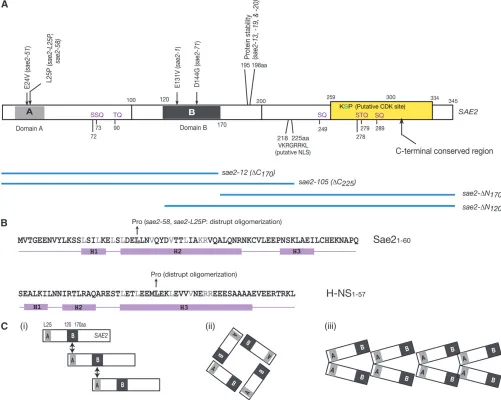
Higher-order structure of Sae2:Sae2 has two interac-tion domains in the N-terminal half, a region around L25 (domain A) and a region between 120 and 170 amino acids (domain B). Co-immunoprecipitation data (Figure 6) indicates that interaction appears to occur via domain A and B, and A and A, but not B and B, as
sae2-L25Plost the ability to associate with wild-type Sae2. This suggests several modes of interaction that could be organized to form oligomeric structures pictured in Figure 7C.
We favor the idea that Sae2 mulitmerizes as opposed to simple dimerization. The affect of overexpressing sae2mutations inrad50S mec1Dcells is influenced by the presence of a wild-typeSAE2gene on the chromosome. For example, the rescue of mec1D MMS sensitivity by rad50S was not inhibited by sae2-1 overexpression Figure7.—(A) Schematic of Sae2 and sae2 mutants. The sites of mutations insae2alleles and interaction domains (domains A
and B) are illustrated. The yellow box indicates the region conserved among 10 fungal species, includingSaccharomyces cerevisiae,
(Figure 2A); hence, even thoughsae2-1is present in at least 5- to 10-fold excess, wild-type Sae2 protein exerts a significant effect. In contrast, overexpressingsae2-1with no wild-type Sae2 present abrogated the suppressive effect ofsae2Donmec1D(supplemental Figure S1), sug-gesting that overproduced sae2-1 protein may be able to form partially functional homomultimers. Overexpres-sion of seven of thesae2mutants (sae2-51,-71,-78,-97, -102,-110, and-142) showed similar phenotypes tosae2-1 overexpression (supplemental Table S1 and Figure S1). Five of these alleles (sae2-1,-51,-71,-110, and-142) have mutations in one of the interaction domains. Sae2–Sae2 self-association, however, appears to be intact in all of thesesae2mutants. These features are similar to some of the dominant-negative p53 mutants that interact with wild-type p53, resulting in dysfunctional tetramer for-mation (Milner and Medcalf 1991; Sun et al. 1993;
Wanget al. 1994).
Alternatively, Sae2 may dimerize first and then self-assemble to form higher-order structure (Figure 7C, iii), similar to H-NS, a nucleoid-associated protein in bacteria (Dorman2004). H-NS contains an N-terminal
oligomer-ization domain (Blochet al. 2003), and structural- and
microscopy-based studies have shown that a coiled-coil interaction between helix H3 (rich in Leu and Val) of two H-NS proteins mediates the dimerization (Ueguchi
et al. 1996; Dameet al. 2000; Espositoet al. 2002; Bloch
et al. 2003). Head-to-tail assembly of the dimers then forms a filament-like, higher-order structure. The mu-tation of Leu29 to proline, a helix breaker, results in the inability of H-NS to oligomerize, presumably by prevent-ing formation of the initial dimers (Ueguchi et al.
1997). As illustrated in Figure 7B, residues 1–60 of the Sae2 N terminus are predicted to form three helices. Helix H2 consists of residues 22–45, with every 3–4 res-idues occupied by leucine or valine. Similar to the situa-tion with H-NS, a Sae2 L25P mutation abolished the oligomerization of Sae2 (Figure 6C); in additon, over-expression of the H-NS oligomerization domain exhib-ited dominant-negative effects (Williams et al. 1996;
Ueguchiet al. 1997), similar to some of oursae2mutant
alleles. Interestingly, however, anE24Vmutation did not disrupt the Sae2 self-interaction, further supporting the idea that the N terminus of Sae2 may form a hydropho-bic interaction surface, similar to H-NS.
A putative SAE2 homolog, CtIP, has recently been identified in humans, worms, and plants (Penkneret al.
2007; Sartoriet al. 2007; Uanschouet al. 2007). CtIP
has sequence homology to budding yeastSAE2at the C-terminal region, a small domain that is conserved in several fungal species. Similar tosae2D, CtIP deficiency is associated with defects in processing of meiotic DSBs, and evidence for alteration in the processing of mitotic DSBs has been presented and CtIP appears to be re-quired for recruitment of ATR in human cells (Sartori
et al. 2007). The data presented here shed light on Sae2’s mechanisms of action and illustrate that its
in-fluence on nuclease activities required for DSB metab-olism varies according to the substrate, as well as the status of the checkpoint pathway.
We thank Maria Pia Longhese for theSAE2-HAstrain and Michael Lichten for yeast strains for chromatin immunoprecipitation experi-ments; Gene Bryant and Daniel Spagna in the Mark Ptashne lab for technical help for real-time PCR; and the members of our labs for insightful discussion over the course of this work. This work was supported by grants GM56888 and GM59413 and the Joel and Joan Smilow Initiative ( J.H.J.P.), grant GM61766 ( J.E.H.) and National Science Foundation MCB-0344655, and Binational Agriculture Re-search and Development award IS-372305 (C.W.).
LITERATURE CITED
Baroni, E., V. Viscardi, H. Cartagena-Lirola, G. Lucchiniand M.
P. Longhese, 2004 The functions of budding yeast Sae2 in the
DNA damage response require Mec1- and Tel1-dependent phos-phorylation. Mol. Cell. Biol.24:4151–4165.
Bloch, V., Y. Yang, E. Margeat, A. Chavanieu, M. T. Augeet al.,
2003 The H-NS dimerization domain defines a new fold con-tributing to DNA recognition. Nat. Struct. Biol.10:212–218. Borde, V., W. Lin, E. Novikov, J. H. Petrini, M. Lichtenet al.,
2004 Association of Mre11p with double-strand break sites dur-ing yeast meiosis. Mol. Cell13:389–401.
Cao, L., E. Alaniand N. Kleckner, 1990 A pathway for generation
and processing of double-strand breaks during meiotic recombi-nation in S. cerevisiae. Cell61:1089–1101.
Clerici, M., D. Mantiero, G. Lucchini and M. P. Longhese,
2006 The Saccharomyces cerevisiae Sae2 protein negatively reg-ulates DNA damage checkpoint signalling. EMBO Rep.7:212– 218.
d’Adda diFagagna, F., P. M. Reaper, L. Clay-Farrace, H. Fiegler, P.
Carret al., 2003 A DNA damage checkpoint response in
telo-mere-initiated senescence. Nature426:194–198.
Dame, R. T., C. Wymanand N. Goosen, 2000 H-NS mediated
com-paction of DNA visualised by atomic force microscopy. Nucleic Acids Res.28:3504–3510.
D’Amours, D., and S. P. Jackson, 2002 The Mre11 complex: at the
crossroads of DNA repair and checkpoint signalling. Nat. Rev. Mol. Cell Biol.3:317–327.
Debrauwere, H., S. Loeillet, W. Lin, J. Lopesand A. Nicolas,
2001 Links between replication and recombination in Saccha-romyces cerevisiae: a hypersensitive requirement for homologous recombination in the absence of Rad27 activity. Proc. Natl. Acad. Sci. USA98:8263–8269.
Deng, C., J. A. Brown, D. Youand J. M. Brown, 2005 Multiple
en-donucleases function to repair covalent topoisomerase I com-plexes inSaccharomyces cerevisiae. Genetics170:591–600. Dorman, C. J., 2004 H-NS: a universal regulator for a dynamic
ge-nome. Nat. Rev. Microbiol.2:391–400.
Esposito, D., A. Petrovic, R. Harris, S. Ono, J. F. Ecclestonet al.,
2002 H-NS oligomerization domain structure reveals the mech-anism for high order self-association of the intact protein. J. Mol. Biol.324:841–850.
Ito, T., T. Chiba, R. Ozawa, M. Yoshida, M. Hattoriet al., 2001 A
comprehensive two-hybrid analysis to explore the yeast protein interactome. Proc. Natl. Acad. Sci. USA98:4569–4574. Keeney, S., and N. Kleckner, 1995 Covalent protein-DNA
com-plexes at the 59strand termini of meiosis- specific double-strand breaks in yeast. Proc. Natl. Acad. Sci. USA92:11274–11278. Keeney, S., C. N. Girouxand N. Kleckner, 1997 Meiosis-specific
DNA double-strand breaks are catalyzed by Spo11, a member of a widely conserved protein family. Cell88:375–384. Kironmai, K. M., and K. Muniyappa, 1997 Alteration of telomeric
sequences and senescence caused by mutations in RAD50 of Sac-charomyces cerevisiae. Genes Cells2:443–455.
Lee, S. E., J. K. Moore, A. Holmes, K. Umezu, R. D. Kolodneret al.,
1998 Saccharomyces Ku70, Mre11/Rad50, and RPA proteins regulate adaptation to G2/M arrest after DNA damage. Cell94:
Lee, S. E., D. A. Bressan, J. H. J. Petrini and J. E. Haber,
2002 Complementation between N-terminalSaccharomyces cere-visiae mre11alleles in DNA repair and telomere length mainte-nance. DNA Repair1:27–40.
Lengsfeld, B. M., A. J. Rattray, V. Bhaskara, R. Ghirlandoand T.
T. Paull, 2007 Sae2 Is an endonuclease that processes hairpin
DNA cooperatively with the Mre11/Rad50/Xrs2 complex. Mol. Cell28:638–651.
Leroy, C., S. E. Lee, M. B. Vaze, F. Ochsenbien, R. Gueroiset al.,
2003 PP2C phosphatases Ptc2 and Ptc3 are required for DNA checkpoint inactivation after a double-strand break. Mol. Cell
11:827–835.
Lisby, M., J. H. Barlow, R. C. Burgessand R. Rothstein, 2004
Cho-reography of the DNA damage response: spatiotemporal relation-ships among checkpoint and repair proteins. Cell118:699–713. Lobachev, K. S., D. A. Gordeninand M. A. Resnick, 2002 The
Mre11 complex is required for repair of hairpin-capped double-strand breaks and prevention of chromosome rearrangements. Cell108:183–193.
Lundblad, V., 2002 Telomere maintenance without telomerase.
Oncogene21:522–531.
McKee, A. H., and N. Kleckner, 1997 A general method for
iden-tifying recessive diploid-specific mutations inSaccharomyces cerevi-siae, its application to the isolation of mutants blocked at intermediate stages of meiotic prophase and characterization of a new geneSAE2. Genetics146:797–816.
Milner, J., and E. A. Medcalf, 1991 Cotranslation of activated
mu-tant p53 with wild type drives the wild-type p53 protein into the mutant conformation. Cell65:765–774.
Morales, M., J. W. Theunissen, C. F. Kim, R. Kitagawa, M. B. Kastan et al., 2005 The Rad50S allele promotes ATM-dependent DNA damage responses and suppresses ATM deficiency: implications for the Mre11 complex as a DNA damage sensor. Genes Dev.19:
3043–3054.
Moreau, S., J. R. Fergusonand L. S. Symington, 1999 The
nucle-ase activity of Mre11 is required for meiosis but not for mating type switching, end joining, or telomere maintenance. Mol. Cell. Biol.19:556–566.
Moreau, S., E. A. Morganand L. S. Symington, 2001 Overlapping
functions of theSaccharomyces cerevisiaeMre11, Exo1 and Rad27 nucleases in DNA metabolism. Genetics159:1423–1433. Nairz, K., and F. Klein, 1997 mre11S: a yeast mutation that blocks
double-strand-break processing and permits nonhomologous synapsis in meiosis. Genes Dev.11:2272–2290.
Pandita, T. K., 2002 ATM function and telomere stability.
Onco-gene21:611–618.
Pellicioli, A., S. E. Lee, C. Lucca, M. Foiani and J. E. Haber,
2001 Regulation of Saccharomyces Rad53 checkpoint kinase during adaptation from DNA damage-induced G2/M arrest. Mol. Cell7:293–300.
Penkner, A., Z. Portik-Dobos, L. Tang, R. Schnabel, M. Novatchkova et al., 2007 A conserved function for a Caenorhabditis elegans Com1/Sae2/CtIP protein homolog in meiotic recombination. EMBO J.26:5071–5082.
Petrini, J. H., and T. H. Stracker, 2003 The cellular response to
DNA double-strand breaks: defining the sensors and mediators. Trends Cell Biol.13:458–462.
Prinz, S., A. Amonand F. Klein, 1997 Isolation of COM1, a new
gene required to complete meiotic double- strand break-induced recombination inSaccharomyces cerevisiae. Genetics146:781–795. Rattray, A. J., C. B. McGill, B. K. Shaferand J. N. Strathern,
2001 Fidelity of mitotic double-strand-break repair in Saccharo-myces cerevisiae: a role for SAE2/COM1. Genetics158:109–122.
Ritchie, K. B., and T. D. Petes, 2000 The Mre11p/Rad50p/Xrs2p
complex and the Tel1p function in a single pathway for telomere maintenance in yeast. Genetics155:475–479.
Sartori, A. A., C. Lukas, J. Coates, M. Mistrik, S. Fuet al., 2007
Hu-man CtIP promotes DNA end resection. Nature450:509–514. Shima, H., M. Suzukiand M. Shinohara, 2005 Isolation and
char-acterization of novel xrs2 mutations in Saccharomyces cerevisiae. Genetics170:71–85.
Shroff, R., A. Arbel-Eden, D. Pilch, G. Ira, W. M. Bonneret al.,
2004 Distribution and dynamics of chromatin modification in-duced by a defined DNA double-strand break. Curr. Biol.14:
1703–1711.
Stracker, T. H., J. W. Theunissen, M. Moralesand J. H. Petrini,
2004 The Mre11 complex and the metabolism of chromosome breaks: the importance of communicating and holding things together. DNA Repair (Amst.)3:845–854.
Sun, Y., Z. Dong, K. Nakamuraand N. H. Colburn, 1993
Dosage-dependent dominance over wild-type p53 of a mutant p53 isolated from nasopharyngeal carcinoma. FASEB J. 7: 944– 950.
Uanschou, C., T. Siwiec, A. Pedrosa-Harand, C. Kerzendorfer,
E. Sanchez-Moran et al., 2007 A novel plant gene essential
for meiosis is related to the human CtIP and the yeast COM1/ SAE2 gene. EMBO J.26:5061–5070.
Ueguchi, C., T. Suzuki, T. Yoshida, K. Tanakaand T. Mizuno,
1996 Systematic mutational analysis revealing the functional domain organization of Escherichia coli nucleoid protein H-NS. J. Mol. Biol.263:149–162.
Ueguchi, C., C. Seto, T. Suzukiand T. Mizuno, 1997 Clarification
of the dimerization domain and its functional significance for the Escherichia coli nucleoid protein H-NS. J. Mol. Biol.274:
145–151.
Usui, T., H. Ogawaand J. H. Petrini, 2001 A DNA damage
re-sponse pathway controlled by Tel1 and the Mre11 complex. Mol. Cell7:1255–1266.
Usui, T., J. H. Petriniand M. Morales, 2006 Rad50S alleles of the
Mre11 complex: questions answered and questions raised. Exp. Cell Res.312:2694–2699.
Vance, J. R., and T. E. Wilson, 2002 Yeast Tdp1 and Rad1-Rad10
function as redundant pathways for repairing Top1 replicative damage. Proc. Natl. Acad. Sci. USA99:13669–13674.
Vaze, M. B., A. Pellicioli, S. E. Lee, G. Ira, G. Liberi et al.,
2002 Recovery from checkpoint-mediated arrest after repair of a double-strand break requires Srs2 helicase. Mol. Cell10:
373–385.
Wang, P., M. Reed, Y. Wang, G. Mayr, J. E. Stengeret al., 1994 p53
domains: structure, oligomerization, and transformation. Mol. Cell. Biol.14:5182–5191.
Weil, C. F., and R. Kunze, 2000 Transposition of maize Ac/Ds
trans-posable elements in the yeast Saccharomyces cerevisiae. Nat. Genet.26:187–190.
Williams, R. M., S. Rimskyand H. Buc, 1996 Probing the structure,
function, and interactions of the Escherichia coli H-NS and StpA proteins by using dominant negative derivatives. J. Bacteriol.178:
4335–4343.
Yu, J., K. Marshall, M. Yamaguchi, J. E. Haberand C. F. Weil,
2004 Microhomology-dependent end joining and repair of transposon-induced DNA hairpins by host factors in Saccharomy-ces cerevisiae. Mol. Cell. Biol.24:1351–1364.
Zhou, B. B., and S. J. Elledge, 2000 The DNA damage response: