SCHNEIER, JOEL IRA. Of Co-Presence and Keyboards: Investigating Synchronous Mobile Communication Practices through Keystroke-Logging Analysis (Under the direction of Dr. Jason Swarts).
This study examines how text-based mobile communication practices are performatively
constructed as individuals compose messages key-by-key on virtual keyboards, and how these
synchronous performances (Farman, 2012) reflect the iterative process of constructing and maintaining what I term virtual co-presence, with friends and family via mobile telephony. In doing so, this study reports on a methodology that incorporates ethnographic methods as well as
keystroke logging analysis (see Leijten & Van Waes, 2013) in order to observe how participants
(N = 10) composed text as part of everyday mobile communication for the period of one week. Participants used LogKey, a virtual keyboard application made exclusively for this study to run
on the Android mobile operating system. Analysis of interview, observational, and keystroke
log-file data yielded key findings that suggest that timing processes of composing text may differ
as participants messaged with different categories of interlocutors, composed on different
communication applications, and composed paralinguistic cues—such as Lol and Haha (Thurlow & Brown, 2003; Tagg, 2012)—at different discursive positions. Through the lens of a
performative framework (Barad, 2003; Copeland, 2017), these findings provide evidence that
text-based mobile communication practices involve complex synchronous performances
(Farman, 2012) that are entangled with how individuals manage interpersonal relationships in
real-time (Laursen, 2005; Spilioti, 2011; Baym, 2010) through symbolic linguistic capital that
has been re-contextualized in mobile telephony (Thurlow & Brown, 2003); Androutsopolous,
© Copyright 2019 by Joel Ira Schneier
by
Joel Ira Schneier
A dissertation submitted to the Graduate Faculty of North Carolina State University
in partial fulfillment of the requirements for the degree of
Doctor of Philosophy
Communication, Rhetoric, and Digital Media
Raleigh, North Carolina 2019
APPROVED BY:
_______________________________ _______________________________ Dr. Jason Swarts Dr. Robin Dodsworth
Committee Chair
DEDICATION
This dissertation is dedicated to two women—
First, to my loving wife, Dr. Michelle Taub. Michelle, you are brilliant, caring, relentless,
and so inspiring to me. I love you and am forever thankful that I get to share my life with you.
Second, to my late grandmother, Regina Schneier, who was the strongest human being I
BIOGRAPHY
The fact that this dissertation exists is nothing short of surprising to me. While I was
always an interested student, constantly wanting to make sense of the world around me by
absorbing new knowledge and perspectives, following my undergraduate studies in writing I had
different ambitions. For several years I jumped between jobs at language-learning software
company, in community non-profit work in Portland, Oregon, and even publishing. I knew none
of these places were exactly right for me, but I knew that I was excited by the prospect of
studying more about the relationships between language, writing, and technology in order to
improve people’s lives.
I arrived as a Master’s student at North Carolina State University with the goal to walk
away with practical real-world tools and knowledge to put back into community-based education
programs. But that isn’t what happened. What I learned about the fields of composition, rhetoric,
and sociolinguistics—and subsequently about myself—led me to a nexus point in my life. I like
to think of the important moments in one’s life—whether they are fixed on events, experiences,
or people—as nexus points to parallel universes. These are moments that are so clearly defined
that you can see yourself as having diverged into an parallel reality where the other version of
yourself that experienced those moments differently is an entirely different being. The people
that I met in the Master’s in English program, and subsequently the Communication, Rhetoric, &
Digital Media program, whether faculty or fellow students, who accompanied and guided me on
my early studies and inquiries were that nexus point that led to me ask myself, Do I want this?, and Can I do this?
Through my time in graduate school at NC State, I was able to develop and pursue my
studied alongside other brilliant and driven students, all with their own backgrounds and
interests, and was mentored under faculty from a similarly diverse array of academic research
interests and expertise. In this social environment I continued to develop research skills and
questions that would be foundational to this project. Whether it was designing the first study to
use keystroke logging for studying mobile communication conducting a micro-ethology of
mobile Minecraft play amongst children, or designing and conducting a usability study about a
digital archive with a networked-browsing interface.
I like to think that all of this challenging research and studies I engaged in has led me—
and continues to lead me—to the project detailed in this dissertation. I hope this study to be the
start of an elaborate, long-term endeavor that attempts to understand what occurs and is created
when humans interact with mobile touchscreen interfaces in order to meaningfully communicate
ACKNOWLEDGEMENTS
This dissertation would not have been remotely possible without the guidance, assistance,
encouragement, or existence of numerous individuals. In this space I would like to single-out and
thank these individuals, in no particular order.
First, I would like to thank the members of my Ph.D. committee at North Carolina State
University: Dr. Jason Swarts, Dr. Robin Dodsworth, Dr. Nicholas Taylor, and Dr. Elizabeth
Craig. The honor of getting to study under and learn from these individuals has taught me so
much about my own potential and the furthest reaches of intellectual curiosity. Collectively I
have learned from these four a model of mentorship and scholarship that demands rigor,
innovation, creativity, reflexivity, and—most important—kindness. I specifically would like to
thank my advisor and dissertation chair, Dr. Jason Swarts, for his patience, flexibility,
thoroughness, and enthusiasm in working with me since I strolled into his office on a Spring day
in 2016 to tell him about my outlandish idea for how to study mobile communication.
I would also like to thank a few other faculty members at NCSU who were instrumental
in this project and my endeavors. First, I would like to thank Dr. Walt Wolfram, who generously
helped me secure funding that contributed to this project’s implementation, as well as for his
mentorship since 2011. In fact, if it wasn’t for Dr. Wolfram and Dr. Dodsworth’s tag-team of
encouragement and persistence, I never would have applied to the CRDM program in the first
place. I would also like to thank Dr. Melissa Johnson, who served as faculty sponsor and adviser
for the research project reported in Schneier & Kudenov (2018) that eventually led to this
project. Lastly, I would like to thank Dr. William Enck for his advice regarding data security as
I would like to thank fellow students from my time as a graduate student for sharing
reading notes, thoughtful discussions in and outside of class, and providing a space to vent to
about the mental and emotional struggles that come with grad school. This includes fellow
members of my Ph.D. cohort, as well as those from my Master’s cohort who completed their
doctoral journeys close by. I don’t think I would have stayed sane without the friendship and
kindness of these individuals.
I would like to thank Peter Kudenov, a fellow member of my CRDM cohort and onetime
co-author on Schneier & Kudenov (2018). Peter’s partnership on that project not only planted the
seed of the idea for this dissertation project, but he also advised me early on in the
conceptualization of a virtual keyboard application. Additionally, I would like to thank Nick
Miano, who consulted on LogKey’s design and—more importantly—built the darn thing! Nick
was genuinely curious about my project, and kind enough to accept far less money than his time
is worth. Nick’s contributions to this project and its success cannot be overstated—without him
and his technical know-how, LogKey would not have come to fruition.
I would like to thank my ever-growing family, particularly my parents and siblings for
realizing at some point that I actually knew what I was doing—even if they didn’t. They have
been continually supportive and proud, and I know they are nothing short of delighted for me to
be the first doctor in the family. Furthermore, I would like to thank my new family members,
including in-laws and nieces and nephews, who have not only been encouraging of my studies
but have also been kind enough to feign interest in what I do.
Lastly—and most importantly—I would like to thank my loving wife, Dr. Michelle Taub.
Our meeting at NCSU is in fact the single greatest result from pursuing my doctoral studies.
support and partnership I have learned to challenge and believe in myself. Any achievement of
TABLE OF CONTENTS
List of Tables ... x
List of Figures ...xii
Chapter 1 Introduction: What is a Virtual Keystroke? ... 1
1.1 Defining this Project ... 8
1.2 The Contribution of My Study... 10
1.2.1 What’s in a Pause? ... 11
1.2.2 Synchronous Performances ... 14
1.2.3 Performing Style ... 16
1.3 Research Questions ... 21
1.4 Overview of Chapters ... 22
Chapter 2 Review of Literature ... 26
2.1 Co-Presence, or What it Means to Connect Through Technology ... 27
2.1.1 Cybernetics, or How Co-Presence is Virtual ... 29
2.1.2 Building and Maintaining Virtual Co-Presence ... 34
2.1.3 Communicating Affect through Media ... 39
2.2 Performativity ... 43
2.2.1 Linguistic Performativity, or How Language Performs the Social ... 46
2.2.2 Mediated Performances and Mediatization... 52
2.3 Toward the synchronous study of mediated linguistic performances in mobile media ... 59
2.3.1 Performing and Locating Mobile Communicative Practices ... 61
2.3.1 Keystroke-Logging Analysis ... 67
2.4 Coda ... 71
Chapter 3 Methodology and Study Design ... 75
3.1 Study Design ... 80
3.1.1 Target Population ... 82
3.2 Data Collection ... 83
3.2.1 Designing LogKey ... 83
3.2.2 Text Logs: SMS to Text... 89
3.2.3 Observations and Interviews ... 91
3.3 Data Analysis ... 94
3.3.1 Asynchronous Data Analysis ... 95
3.3.2 Synchronous Data Analysis ... 98
3.4 On the Ethics of Studying Mobile Communication ... 100
3.5 Research Questions Revisited and Exploratory Hypotheses ... 104
4.1 Profile of Participants ... 106
4.1.1 Undergraduate Participants ... 107
4.1.2 Graduate and Working Professionals ... 110
4.2 General Timing-Processes of Writing on a Mobile Device ... 111
4.3 Answering Research Questions ... 119
4.3.1 Timing Processes of Linguistic Features in Text-Messaging ... 120
4.3.2 Participant Social Networks ... 134
4.3.3 Mobile Applications Used ... 142
Chapter 5 Analysis and Key Findings ... 160
5.1 Paralinguistic Features as Stable and Symbolic Capital ... 163
5.2 Discursive Performances as Psychomotor Processes ... 168
5.3 Performing Interpersonal relationships through text... 174
5.4 Mobile Applications and the Emergence(?) of Mobile Registers ... 184
5.4.1 Shifting Registers Across Mobile Applications ... 185
5.4.2 What are the Kids these Days Doing on Snapchat? ... 189
5.5 Coda ... 194
Chapter 6 Discussion: Toward the Synchronous Study of Digital Articulation ... 196
6.1 Implications ... 197
6.1.1 Synchronous Performances in Mobile Communication ... 197
6.1.2 Cognition and (Mobile!) Writing ... 202
6.2 Limitations ... 204
6.2.1 Interview Structures ... 205
6.2.2 LogKey Keyboard Design ... 207
6.3 Future Directions... 210
6.4 Coda ... 213
LIST OF TABLES
Table 3-1: Example of log file data in comma-separated value form... 88
Table 3-2: A sample of exported messages from SMS to Text (identifying information redacted) ... 91
Table 4-1: General Summary of Keystrokes for All Participants ... 112
Table 4-2: General Summary of Keybursts for All Participants ... 116
Table 4-3: General Summary of Keystroke and Keybursts from Text Messaging ... 121
Table 4-4: Summary of Occurrence of Paralinguistic Variables in Sent Text-Messages ... 123
Table 4-5: Summary of Positioning of Linguistic Variables that Occurred in Sent Text-Messages (relative frequency from total word units of text-messaging transcripts in parentheses) ... 123
Table 4-6: Text Messages and Interlocutors ... 124
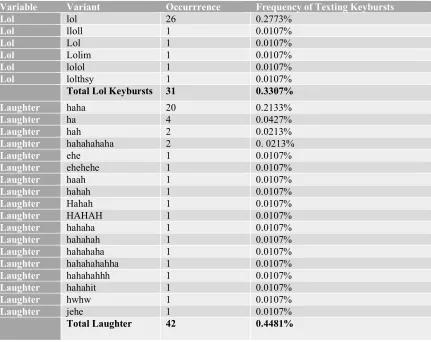
Table 4-7: Frequency and occurrence of all Haha or Lol Keybursts from Text-Messaging Data ... 125
Table 4-8: Linear Mixed Effects Model (with participant as random intercept) examining inter-KB, occurrence of the keyburst, and total characters in the keyburst ... 127
Table 4-9: Linear mixed effects model (participant as random intercept) examining relationship between Average Intra-KB IKI and discursive position of all three aggregate variables (Laughter, Lol, and Emphasis) ... 129
Table 4-10: Linear mixed effects model (participant as random intercept) examining three paralinguistic variables with inter-KB below 500ms ... 133
Table 4-11: Linear mixed effects model (with participant as random intercept) examining inter-KB and interlocutor category ... 140
Table 4-12: Linear model examining relation between interlocutor type and inter-KB value of Participant C (excluding inter-KB >500ms) ... 141
Table 4-13: Distribution of Keybursts by Mobile Application ... 143
Table 4-14: Linear Mixed Effects Models (with participant as random intercept) examining inter-KB and average intra-KB of keybursts across application type ... 147
Table 4-15: Linear Regressions for Inter-KB and Application Type for each participant ... 148
Table 4-16: Linear Mixed Effects Model for inter-KB and Haha or Lol keybursts (participant as random intercept) ... 153
Table 4-17: Linear Mixed Effects models (participant as random intercept) showing Inter-KB (keybursts below 2000ms) and Snapchat vs. Texting ... 154
Table 5-1: Text Message Exchange between Participant A and their Partner using Lol... 166
Table 5-2: Text Message Exchange between Participant A and their Partner using Haha ... 166
Table 5-3: Text Message Exchange between Participant H and Friend11 ... 167
Table 5-4: Text Message Exchange between Participant I and Friend01 ... 168
Table 5-5: Text Message Exchange between C and their Partner ... 169
Table 5-6: Linear mixed effects model (participant as random intercept) showing raw occurrence of keybursts and mobile application ... 187
LIST OF FIGURES
Figure 3-1: The LogKey keyboard, with autosuggest options ... 86
Figure 3-2: The standard Android emoji package on the LogKey keyboard ... 87
Figure 3-3: screenshot of the SMS to Text menu ... 90
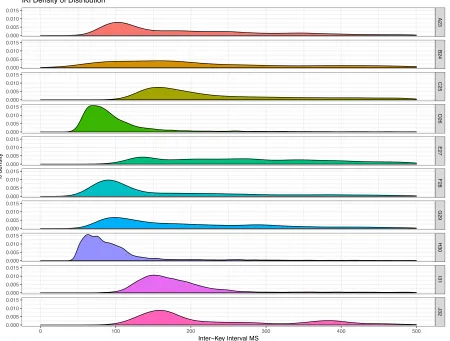
Figure 4-1: Density Plot of IKI for Each Participant ... 113
Figure 4-2: Density of IKI for All Participants ... 113
Figure 4-3: Comparing Inter- and Intra-KB IKI for Each Participant ... 117
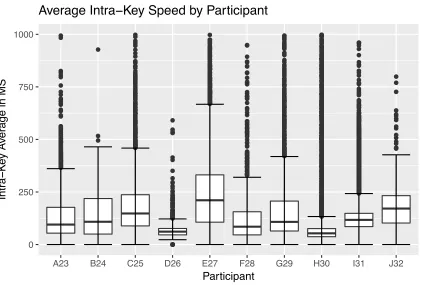
Figure 4-4: Average Intra-KB IKI for Each Participant ... 118
Figure 4-5: Jitter plot showing range of speed of linguistic features by position ... 129
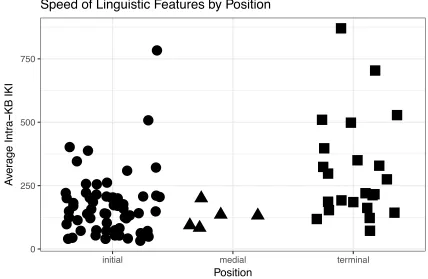
Figure 4-6: Speed of Linguistic Variables by Position ... 130
Figure 4-7: Density plot of inter-KB IKI for all keybursts in texting data (only showing <2000ms) ... 132
Figure 4-8: Comparing inter-KB by position above or below 2000ms, using a log10 scale ... 134
Figure 4-9: Bar graph showing distribution of who participants send messages ... 136
Figure 4-10: Density graph showing overall Average Intra-KB IKI for different categories of interlocutors ... 136
Figure 4-11: Boxplot showing speed of keyburst composition by interlocutor category by participant ... 138
Figure 4-12: Boxplot showing time between keybursts for different categories of interlocutor 139 Figure 4-13: Density plot showing Participant C's inter-KB range when texting different interlocutors ... 141
Figure 4-14: Keyburst count for Application Type for each participant ... 143
Figure 4-15: Boxplot graphs for each participant showing Average Intra-KB of composing keybursts across application type ... 145
Figure 4-16: Boxplot graphs for each participant showing the inter-KB value for each application type... 146
Figure 4-17: Occurrence of Haha or Lol feature by application type for each participant ... 152
Figure 4-19: Boxplot comparing Inter-KB values of Linguistic Keybursts in Snapchat and Texting ... 154
Figure 4-20: Boxplots showing Inter-KB values for keybursts in Snapchat and Texting ... 156
Figure 4-21: Jitter plot comparing Average Intra-KB IKI of Linguistic Features by position ... 158
Figure 5-1: Bar graph showing IKI of each key in composing the message "Haha oh lordy" ... 170
Figure 5-3: Inter-KB values of keybursts in text message between C and Friend01 ... 177
Figure 5-4: Inter-KB values of keybursts in text message between C and Friend01 ... 177
Figure 5-5: Inter-KB values of keybursts in text message between C and Partner ... 179
Figure 5-6: Keybursts in text message between C and Partner ... 179
Figure 5-7: Bar graph showing total messages sent to and received by C during participation . 181 Figure 5-8: Bar graph showing percentages of Thurlow & Brown’s (2003) communication orientations in messages C sent to Partner and Friend01... 183
Figure 5-9: Density plot (x-axis scaled Log10) showing frequency of keybursts and mobile application ... 187
Figure 5-10: Inter-KB of keybursts from Participant A likely sent through Snapchat messaging ... 191
CHAPTER 1
INTRODUCTION: WHAT IS A KEYSTROKE?
A woman enters an elevator, presses the button for the fifth floor, and then steps to the
rear right corner of the cab. Two other individuals enter and press the buttons for other floors.
The woman takes out her smartphone and, seeing she has received a new message, keeps her
head down as begins composing a response on her phone’s virtual QWERTY keyboard. As she
composes a message in response to the one she received, the doors to the elevator close and the
cab rises to the second, then third floor. The doors open, an occupant steps out, the doors close
again, the elevator rises to the fourth floor, then the fifth. The doors open, another person steps
in, and the doors close. The woman who initially pressed the button for the fifth floor remains
fixated on her phone’s screen as her thumb and index finger continue to hold and inscribe upon
the screen. It is only after the doors close that she glances up to realize what has happened. With
other occupants in the cab she laughs a self-effacing laugh, steps forward to press the fifth button
again, retreats back to the corner, and resumes writing her message on the phone.
This experience may be familiar in any number of other permutations, where operating
physically and socially in the so-called ‘real world’ is complicated when simultaneously
operating in a mediated and networked space through one’s mobile device. Such a readily
observable, and often comical, bodily coordination/discoordination involved in mobile
communication reflects questions about the balancing act between the mobile and compositional
aspects of mobile communication that are juggled by individuals in real time. Nonetheless,
the process of writing on her phone absorbed her cognitive attention and social awareness that
she embarrassed herself in front of total strangers?
From the moment an individual receives a notification from their phone, they engage in a
complex process of interacting with the phone’s interface that involves reading and interpreting
the received message, thinking of a response, writing out a response through text and other
symbolic material, and even editing the text. While the messages themselves become static
re-readable units on a mobile phone’s screen, the actions and thought-processes that lead up to
pressing “send” are anything but static. Indeed, the static product of text-messages are merely
artifacts of the dynamic processes of text-messaging.
This distinction between product and process—the former being a finished text, the latter
being a text that is still taking shape—is analogous to a distinction between asynchronous and
synchronous media, or forms of communicating. Historically, communicating through text has been considered asynchronous media because these texts are completed products that themselves are communicated outside of time (Innis, 1986; Ong, 1982). In other words, because a message has been written down, the same message may be sent and received without alteration across
time, meaning that the “Declaration of Independence” may be read the same in 2017 as it was in
1776. Synchronous media, on the other hand, have traditionally been defined as ways of communicating that require time as a means of transmission, such as speech or talking over the
phone.
Within these traditional considerations of asynchronous and synchronous media, text messaging as well as most message-based services for communicating through mobile devices
much is dependent upon factors specific to the moments in time in which the messages are being
composed. The way the sun may create glare on the screen, a sidewalk may be crowded with
foot-traffic, a friend may call the writer’s name, the movement of a thumb pressing the keys,
notifications from other applications, unintentional use of autocorrect, and much more all may
contribute to unique processes involved in articulating every text message. Jason Farman argues
that this is characteristic of the performance of producing textual content in mobile media, which, because of the mobile nature afforded by smartphone devices, makes composing
messages possible across varied spaces, places, and movements (Farman, 2012). In this way, the
text messages themselves may be asynchronous messages that reflect a completed task; however, the processes and practices of using text messaging to communicate with friends and family in
one’s everyday life is a social and linguistic performance that is very much synchronously
experienced by the writers of such messages as they strive to maintain co-presence with their
social circles.
Farman argues that a shift to the synchronous performances involved in text messaging draws attention to the how mobile communication is largely concerned with making distant
bodies seem close. In other words, according to Farman, when longtime friends who live in separate cities text one another, they are largely concerned with feeling near to one another, or
being co-present, through their use of mobile communication. Co-presence is primarily
concerned with how media collapses the time it takes to communicate with distant bodies, which
John Urry argues is central to a highly mobile society (Urry, 2007). The very act of continually
sending and receiving text-messages with close ties, regardless of textual content, is therefore a
Understanding mobile communication, such as text messaging, in terms of synchronous
processes indeed provides vivid details of what it is to send and receive text messages
performatively. The time that elapses between sent and received messages may indicate numerous social cues to the senders and receivers. If a response is not sent immediately, the
sender may interpret this as a sign that the receiver under-values their relationship, while a quick
response may be interpreted as a sign that the receiver highly values their relationship (Laursen,
2005; Ling & Yttri, 2001). This analysis nevertheless relies on the asynchronous data, i.e., the
particular time at which the message was received as well as the static text itself. In other words,
it leaves out when individuals actually begin composing responses, how long they spend
composing a message, and how much content they actually revise prior to pressing “send.”
Therefore, in order to fully understand how such timing processes may be experienced as part of
affective perceptions by receivers of messages, it is necessary to understand how the senders
temporally composed such messages. Placing a microscope on synchronous performances
involved in texting may shift the focus not just upon the textual products but upon the process of
performing co-presence through message composition itself.
The prospect of understanding the various synchronous performances that occur in the
stream of mobile communication is nonetheless daunting for researchers. While individuals
doing the texting have some manner of first-person perspective of what they may do in-the-moment (i.e., where their eyes fixate, how their fingers press the keys, the dual-task of crossing the street), researchers will be hard-pressed to make the same observations short of strapping a
video camera to their heads (Schneier & Kudenov, 2018). While text-based messaging on
computers, such as Instant Messaging (IM), has afforded stable vantage points to observe
messaging means that synchronous observations require a laborious level of agility and
time-commitment, in addition to potentially impeding participants’ mobile activity.
Indeed, this is a frequent challenge for all manner of researchers concerned with
observing how people use and interact meaningfully with different forms of technology. The
presence of a research-observer, or the requirement of individuals to be observed in a
pre-determined space, may be convenient for researchers; however, designs of such controlled
conditions may disrupt how individuals perform mediated co-presence because of the
researcher’s presence. Seth Giddings suggests that a means of overcoming such limitations
requires incorporating perspectives from the technologies themselves in order to understand how
humans and machines interact with one another—what he calls a cybernetic circuit (Giddings, 2014). Qualitative researchers who focus specifically on mobile communication have suggested
that the log-file data, or the digital records of input and output actions taken by digital devices
resulting from the cybernetic circuit, may provide one such perspective. In a typical personal computer, input is an action via the human operator, such as pressing the [K] key on the keyboard, and output is an action the machine takes, such as displaying the letter K on screen. However, as Lucy Suchman (1987) cautions, machines are characterized “by the severe
constrains on their access to the evidential resources on which human communication of intent
routinely relies” (p. 169). Log-files, as records of machinic ‘interpretations’ or ‘translations’ may
therefore not necessarily be indicative of the intentionality of the human user. Nevertheless, they may nonetheless provide a granular and detailed chronological record of that human-machine
interaction. Researchers such as Boase (2013) and Ørmen & Thorhauge (2015) argue that since
log-files represent a chronological record of these input/output exchanges with the machine, i.e.,
data in conjunction with traditional ethnographic means of observation may yield richly detailed
observations of mobile communication processes. Therefore, while the log-file from pressing a
[K] may not be indicative of a human’s intent to press that key, examining keystroke log-files as
a series of situated actions in addition to other means of observation makes it possible to
understand, holistically, how keystroke activity functions as part of meaning-making.
Since numerous types of mobile communication requires the use of a keyboard that may
appear and disappear on a touchscreen device, called a virtual keyboard, log-file data that focuses on keystrokes will provide evidence of the process of writing and sending messages. Indeed, in the decades since personal computers have become widespread, writing researchers
have made great strides using keystroke log-file data to better understand the processes through
which texts are composed. Broadly speaking, keystroke analysis involves examination of writing processes via the time elapsed between pressing individual keys, called pause analysis, as well as the timing and contexts in which individuals delete and revise textual content that they had
previously inputted, called revision analysis (Leijten & Van Waes, 2013). Writing scholars argue that understanding a writer’s pause and revision patterns as part of multi-channel observation
provides insights into how they manage the various demands of writing, including the social
needs that the text will fulfill, their familiarity or comfort with the type of text, how well they can
recall key information and translate their thoughts into words, their skill with the particular
writing technologies, and even how the physical and social environment may manage their
attention. In other words, just as keystroke log-file data provides rich synchronous observations
about how individuals write with personal computers, keystroke log-file data from mobile
devices provides similar insights into how individuals engage in mobile communication such as
Since co-presence may be managed through text-messaging and other kinds of mobile
communication, and texters are compelled to respond quickly in order to iteratively perform
co-presence (as demonstrated by quick response times or the woman diverting attention to
composing a message so that she misses her floor), keystroke log files offer a highly granular
chronological observation of how individuals use their phones to meaningfully maintain
co-presence. This study therefore posits that analyzing keystroke log-files—i.e., a chronological
record of each individual press of a key on a keyboard—from the virtual keyboards of mobile
devices will yield synchronous observations of individuals engaged in mobile communication.
This study draws upon keystroke analysis from writing process research, as well as more
traditional means of observing individuals as they engage in mobile communication with friends,
family, and persons from their social networks. In doing so, this study intends to nudge
researchers of various persuasions to reconsider the very matter of mobile communication. While the message content that is sent and received between friends is nonetheless valuable to
contextualizing relationships that text messaging might maintain (it is what texters are
performatively producing, after all), these asynchronous products do not explain why friends are
compelled to send and receive specific content so quickly, how they come to place value in
synchronicity, and how these processes may be reflected in the performance of highly valued and
symbolic textual features. Through this study, I intend to demonstrate not only how
keystroke-logging analysis of mobile communication reveals how highly valued linguistic features are
articulated key-by-key, but, more importantly, how the articulation of such features is made
valuable by collapsing spacetime to maintain co-presence. In other words, I argue that observing
1.1 DEFINING THIS PROJECT
The project described in this dissertation is interdisciplinary in that its subject matter, the
synchronous process of engaging in mobile communication, concerns various fields that are
continuously engaged in studying how language and communication is mediated through
technology. As such, this dissertation will draw upon numerous perspectives and traditions—
some of which are in tension with one another—that each seek different, albeit complementary,
answers to questions that concern how individuals use mobile technology to communicate with
one another. While this project will most immediately be concerned with questions from research
in mobile communication, technical communication, sociolinguistics, and posthuman studies, it
will incorporate methods from the likes of writing studies, game studies, and human-computer
interaction, as well as draw on the histories and theories of scholars in sociology, media history,
philosophy of science, and feminist criticism.
Nevertheless, as the title of this dissertation suggests, this project is most squarely
grounded in keystroke analysis, which is where this project was initially conceived. In the Spring
of 2015, a colleague and I set out to conduct a small study with two rather straightforward
questions: First, was it feasible to collect keystroke log-file data from a mobile device with a
touchscreen interface?; and, second, what would that data tell us about how individuals managed
composing messages on a mobile device while simultaneously walking about to accomplish
familiar everyday tasks? This study, reported on in Schneier & Kudenov (2018), involved
developing a custom chat application on an HTC Incredible One smartphone that would send
text-based messages between the phone and a laptop and log the time of the first press of each
key on the phone’s virtual keyboard. This brief pilot study asked participants to use the phone to
recording keystrokes of how participants composed messages on the phone while they donned a
GoPro video-camera on their heads. Through the coordination of keystroke and video data, it
was observed that that texting was an all-out embodied dance coordinated from our participants’
fingers to their feet. One participant missed her floor while riding the elevator because she was
texting. Another stopped walking in the middle of an open social space when she received a
message, and only resumed walking once she pressed the send button. Yet another participant stood between book stacks when texting in order to avoid being seen or obstructing other library
patrons, and, when the fire alarm unexpectedly went off in the building, she continued to text and
check for responses while she was evacuating the library! Further, the keystroke data provided
temporal evidence that participants indeed took more time, wrote more, and revised more when
texting about personal questions, but wrote quickly and curtly when responding to the logistical
orientation of tasks within the library space.
Schneier & Kudenov (2018) nevertheless encountered a number of methodological and
design difficulties. For one, the use of a designated phone, one which was an unfamiliar size and
ran unfamiliar software for some participants, presented a barrier to understanding keystroke
patterns in such a short experiment. For example, the virtual keyboard, autotext choices, and
even size of the phone presented elements that took participants at least a few minutes to become
accustomed to. Additionally, since most participants completed the study tasks inside of 20
minutes, we lacked the same sheer quantity of keystroke data that many computer-based studies
gathered. Furthermore, each participant exhibited individual differences that are difficult to
generalize from so few participants engaged in such a short study. Lastly, the use of autotext—
whether suggestive or corrective—appeared to be much more involved in every message than
interaction. We therefore had to do a great deal of comparison between the final message that
was received and the individual keystrokes in order to accurately surmise when autotext was used but also what text was selected by participants.
This project is therefore intended to further explore the efficacy of keystroke logging as a
method for studying mobile communication practices as established in Schneier & Kudenov
(2018); however, this study’s goals are more broadly concerned with understanding theoretically
and operationally what it means to observe everyday mobile communication practices that are
socially meaningful in-the-moment, and will do so by engaging participants for longer durations of time, collecting keystroke data from their own devices, and concentrating on text-messaging
that they engage in with members of their own social network rather than a researcher. This
study is an extended qualitative observation, a form of microethology (Giddings, 2014), that will
qualitatively and quantitatively analyze keystroke data as well as more traditional ethnographic
interviews and observations with participants in order to better understand how individuals
meaningfully write with their phones for social purposes.
1.2 THE CONTRIBUTION OF MY STUDY
As discussed above, this study is an outgrowth of Schneier & Kudenov (2018), which
was firstly concerned with applying keystroke-logging methodologies to mobile devices. This
study therefore continues along the same path, albeit with a more concerted effort to address
significant gaps in understanding within these fields. These gaps in understanding go beyond the
relative newness of ubiquitous mobile devices and extend to deeper theoretical and
1.2.1 What’s in a Pause?
This study will prod not only at the challenges and distinctions of understanding the
input/output process of writing with a mobile touchscreen interface, but also at the operational
definition of a pause during the writing process. While seemingly trivial, the notion of pause in writing studies—or the time during which an individual is said to be composing but not
inputting/inscribing text—is a conceptual unit that cuts through understandings of cognitive,
psychomotor, and social contexts in which a human may write. In the context of this study, it is
through examining pauses between keystrokes that it is possible to observe how co-presence may
be materialized in real-time.
Writing process research has historically centered around the different technologies
individuals use for inscribing text, whether pen and paper, typewriter, computer, or mobile
device. Each of these writing technologies requires a unique set of knowledges, materials, and
psychomotor functions in order to successfully operate to compose text. As various digital
writing tools emerged at the same time as new methods for observation in the 1980s, writing
process researchers shifted to use of multiple data channels and increasing use of
computer-based writing. As a result, a greater emphasis was placed on understanding revision processes in
writing, which often involve writers re-reading what they have already written (reviewing),
considering what to do next (planning), as well as altering already written text (text revision)
(Hayes, 1996). Crucially, all of these processes may occur in-between entering text. In other words, a significant aspect of understanding how people write requires attention to when they are not writing! In writing process research, this is at the core of the conceptual unit known as a
A pause is the time in between the input or production of text, whether writing is done by pen or by keyboard, and it may be linked to the cognitive aspects of composing, reviewing,
revising, and—perhaps most importantly—planning text. Kristyan Spelman Miller argues that
this conceptualization of the pause borrows heavily from speech production, in which a pause may evidence physiological, cognitive, or even communicative functions between speakers and
listeners (Miller, 2006, p. 13). For an idealized professional or scholastic writer at a computer
terminal, measuring the duration, distribution, and characteristics of “time spent not producing or
reviewing text” during writing provides indirect and inferential evidence of “attentional
resources in the writer during composition” (Miller, 2006, p. 19). Importantly, a distinction is
commonly made between shorter pauses (between 200 - 2000 milliseconds) that likely reflect the
momentary psychomotor processes, or the link between brain and physiological functions, and
longer pauses that may reflect extended affective or social processes, such as fatigue or being
interrupted by a coworker (Leijten & Van Waes, 2013; Leijten, Waes, Schriver, & Hayes, 2014).
A pause to think of the next word, edit a typo, or re-read a composed sentence may therefore
present in milliseconds, while a pause to plan global changes while getting more coffee or
playing a quick game of Minesweeper may present in seconds or minutes. How these pause
patterns present may also reflect social strategies to maintain co-presence, for example, as
demonstrated by the pause processes involved in composing emails.
As keystroke-logging methods became more widely available through programs such as
Inputlog (Leijten & Van Waes, 2013), which uses Microsoft Word to collect and analyze
keystrokes, the conception of a pause has become increasingly defined within the socio-technical
context of a writer on a computer that can run a word processor application. Since these
individual key is depressed and the time that key is released. Pauses are therefore measured by
the inter-key interval, or the time that expires between the release of one key and the depression of the following key. This is requires a digital computer keyboard that is descended from rather
simple digital keys, buttons, or switches that have a binary on or off position—in this case,
pressed or not pressed.
Furthermore, the use of digital keyboards for writing on a computer has an important
consequence for writing—writers do not have to look at their hands while they write! As
demonstrated by Leijten & Van Waes (2013), many writers who are computer literate and
trained typists rarely look at their hands while they write. This means that writers can read and
re-read what they write while they are writing, which may allow for recursive revision and
editing processes while writing. This hand-eye separation is descended from the pioneering
Underwood Number 5 typewriter that allowed typists to see each character being impressed onto paper as they depressed the corresponding key, a feature that has been attributed to both the
speed of writing with a keyboard as well as the ability to revise and edit while writing (Kittler,
1999).
Importantly, this technological and tactile affordance of computer keyboards is not
present on a mobile device. Even though the virtual keyboard on a touchscreen mobile device is
still typically a QWERTY keyboard layout, and writers who have touch-typing skills will likely
know where different keys are, touch-typing is not necessarily possible. After all, since there are no physical buttons on a virtual keyboard, only a virtual button that appears and disappears on
the touchscreen, the eyes need to gaze at the hands in order to coordinate each finger press to the
appropriate key, which has potential consequences for the cognitive and physiological process of
depression of a button, how can one determine the inter-key interval? Is it the contact and release
of contact of a finger to the touchscreen? What if another finger has already made contact with
the screen to press anotherkey before the first finger has ceased contact with the first key? Beyond these technological differences between writing interfaces and how they may
affect writing at the psychomotor level, it is important to consider the social contexts in which
writing on mobile devices may occur. First, mobile communication is mobile, meaning that a pause in writing may occur because a traffic light turned green, the sun came out from behind the
clouds, a push notification from another app pops up, etc. Second, what and why individuals
write on a mobile device may also reflect distinctive genres, registers, and social contexts that
require distinct planning and strategies from writing on a desktop computer at the workplace. In
other words, the idealized model of a professional or scholastic writer that is largely the focus of
writing process research may look quite different through the lens of a mobile device. Studying
keystroke logging on a mobile device may therefore be productive for understanding emerging
writing contexts and processes, as well as preparing for the study of writing as touchscreen
interfaces become more prevalent.
1.2.2 Synchronous Performances
This study also seeks to contribute to broader understandings of mobile communication
practices, particularly how using a mobile device involves synchronous performances of
asynchronous media as part of managing co-presence. Mobile communication scholars have
challenged this categorization, partially on the grounds that it discounts the material
configurations and contexts in which the media is produced and transmitted (Carey, 2009;
Eisenstein, 1983; Innis, 1986; Kittler, 1999). For example, Harold Innis (1986) argued that the
transmitted as well as how long it may physically last. Digital texts, which may be electronically
transmitted instantaneously, stored via networked servers, and accessed through mobile devices
kept in an individual’s pocket is thus materially a very different type of asynchronous text from a single manuscript that was inscribed by hand on vellum. After all, what if a text message is
composed and sent, but never received? Is a record of the message stored elsewhere besides the
phones of the sender and receiver? If sender and receiver have phones with different hardware,
software, and cellular networks, is the message still considered the same on the sender’s phone
and the receiver’s phone?
Further, numerous scholars have argued that, regardless of a media being categorized as
asynchronous, that it is performatively and locatively synchronous. In other words, if the messages that are received through a buzz on one’s phone are static and complete, those
messages were still composed by an individual over a period of time in a specific social context.
Jason Farman (2012; 2014) has argued that understanding mobile communication as
performative acknowledges the complex collaborations between senders and receivers of messages, the devices they use to communicate, and the spaces they compose in. The
collaboration between the individual and the mobile device, particularly the ways in which the
time it takes to respond to a message may serve as a contextualization cue (Laursen, 2005), text
their neighbors rather than knock on their doors (Humphreys, 2012), or use location-based games
for spontaneous play (de Souza e Silva, 2017), reflects the cybernetic relationship between a
mobile device and a user. Farman (2012; 2014) calls this the sensory-inscribed body, a socio-technical practice whereby individuals perform social-ness in-the-moment.
Observing the synchronous performances of mobile communication practices, however,
After all, there is no controlled research space, and spontaneous mobile practices could lead
individuals to unexpected places and times. A traditionally trained ethnographic researcher
would have to be exceptionally agile and nearby participants in order to effectively and reliably
observe many aspects of these performances. While numerous researchers have certainly
engaged in innovative practices to examine the all-out embodied performances that occur in the
moment of engaging in mobile communication practices (Becerra, 2015), these observations are
often unable to capture how that all-out embodied performance presents in the composition of
asynchronous messages. As observed in Schneier & Kudenov (2018), embodied performances
and synchronous writing processes appeared to be tightly coordinated with one another.
Engaging in more prolonged and extensive observation of how mobile communicative practices are performed synchronously, as evidenced bymobile keystroke data, will therefore provide new understandings and suggestions for how individuals maintain co-presence through mobile
technologies.
1.2.3 Performing Style
In addition to providing further understanding for mobile communicative practices in
terms of synchronous performances, this study will also examine how individuals strategically
and purposefully use these practices for stylistic performances. As demonstrated by linguistic
studies of text-messaging, features strongly associated with texting styles may be strategically
used to manage co-presence (see Thurlow & Brown, 2003); Spilioti, 2011; Tagg, 2012). Style, as defined in the field of sociolinguistics, may refer to how individuals use linguistic phenomena to
define themselves in relation to others. In terms of spoken language, particular styles may be
performed through the use of linguistic forms that have been made socially meaningful and
are typically marked as qualitatively distinctive, meaning they are noticeable and have already
been established as having a particular social meaning (Irvine, 2001). Individuals may shift
between particular stylistic performances for a variety of reasons, perhaps in response to certain
audiences (Bell, 2001; Bell, 1984), to signal personal or group identification (Coupland, 2001),
to align with particular social roles (Podesva, 2011), and so on. Importantly, Penny Eckert argues
that stylistic performances are intended for particular social purposes and practices, and may be
particularly noticeable in highly symbolic and socially valuable areas of interaction (Eckert,
2000).
Eckert (2000) also discusses how spoken linguistic forms, such as use of a particular
dialect feature, are only one of many possible meaningful resources in an indexical field. For
example, Eckert has demonstrated how a particular skull and crossbones design or even style of
pants could be a highly valued social symbol for signaling affiliation with particular group of
teenagers. If such symbols could be exchanged through language and clothing, then by logical
extension it could certainly be exchanged through mobile communication practices as well. After
all, scholars such as Rich Ling, Nancy Baym, Ditte Laursen, and Alexandra Georgakopoulou
have demonstrated how valuable mobile communication is for maintaining the social cohesion of
a peer group, as well as how valuable it is for youth to exchange in symbolic material through
mobile communication (Baym, 2010; Georgakopoulou, 2014; Laursen, 2005; Ling, 2008).
Written language composed and transmitted through mobile devices, and particularly the timing
processes through which it is inscribed into existence, may therefore serve as such symbolic
material.
Written language has indeed been the subject of investigations of sociolinguistic style.
variation between academic writing and speech (Biber, 1988). Arguing that such variation
between constitutes differences in register rather than style, Biber’s work has demonstrated large-scale linguistic variation may depend on different functionally recognized goals (Biber &
Conrad, 2009; Finegan & Biber, 2001). Further, since written language may be composed more
slowly and visually seen by individuals as they write, Biber & Conrad (2009) have argued that
variations across written registers may also reflect deliberate use of socially symbolic forms.
Sociolinguists who have looked to Twitter, Facebook, instant messaging, text messaging, and
other forms of communicative text-based media have indeed spent a great deal of time and
energy documenting unique features that may occur in these media (Tagg, 2012), how style may
be performed in them (Thurlow & Brown, 2003), how features may be associated with social
meaning such as regionality or ethnicity (Pavalanathan & Eisenstein, 2015a; Pavalanathan &
Eisenstein, 2015b), and even how these forms may be transmitted and made salient over time
(Grieve, Nini, & Guo, 2017).
Since much of this research takes a corpus-based approach, however, the linguistic
features themselves are frequently separated from the individuals who composed and initially
transmitted these features. In other words, accounts from the individuals are frequently obscured
or missing, lost in the ether. While corpus-based research is a powerful tool for examining
macro-level sociolinguistic patterns, particularly for examining the dissemination, salience, and
potential social meanings of these forms, these are indirect methods for observing the strategic use of language. For example, if using corpus-based methods to investigate how traditional
sociolinguistic categories, such as ethnicity and race, may present on Twitter, the starting point is
through the stream of linguistic forms that have already been tweeted. If narrowing in on the use
accompany the use of these features, at least as afforded by Twitter, are user-volunteered data
such as gender, city of residence, and geolocation of the tweet. Regardless of the
‘trustworthiness’ of such volunteered data, surmising other social variables such as ethnicity,
race, class, etc. is problematic. For example, Taylor Jones’s (2015) study of African American
Vernacular English attempted to do just this, and while Jones certainly found
regionally-patterned distribution of different AAVE forms on Twitter, determining if an individual was an
“authentic” AAVE speaker or not based on their profile and previous tweets is circumstantial
evidence. In other words, such methods will never be able to appropriately respond to the
question, how do you know that tweeters aren’t just performing an ethnolinguistic feature that does not reflect their own real ethnic identity?
Granted, questions about the authenticity of individuals who compose mediated texts
have been around for ages—even before questions about the true authorship of Shakespeare’s
plays. Interpersonal communication scholars have long studied how individuals have developed
strategies when communicating through asynchronous and non-face-to-face media. Joseph
Walthers, for example, has argued that because of the so-called deficits in text-based mediums such as email, that do not include facial or other non-verbal cues, that individuals frequently
engage in disclosure of hyper-personal information in order to reassure interlocutors that a real human is on the other side (Walthers, 1996). Stylistic performances in text-based media is
therefore inherent to communicating through said media in order to accommodate material
interpersonal conditions, certainly for signaling interpersonal communicative orientations, as
well as for performing identities (see Spilioti, 2011; Thurlow & Brown, 2003); Thurlow, Lengel,
Drawing upon social theorist Erving Goffman, Nikolas Coupland has argued that
examining language and style through the lens of performativity shifts the conversation away
from questions of authenticity to questions of how individuals use social practices and
knowledges to “stage” and present their identities to the world, which thereby contributes to new
social practices and knowledges that others may draw upon to present their identities, and so on
and so forth (Coupland, 2007). Coupland suggests that individuals may therefore use various
social resources, including speech, to “self-authenticate” their identities through performing style
(Coupland, 2007, p. 25). Janis Androutsopoulos has demonstrated such identities may be
performed and managed through linguistic decisions on social media, particularly Facebook, that
may signal content for certain members of a social network over another (Androutsopoulos,
2014a; Androutsopoulos, 2014c; Pavalanathan & Eisenstein, 2015a). Alexandra Georgakopoulou
has similarly demonstrated that youth sharing media, such as YouTube videos, as part of mobile
communication may similarly signal social identity affiliation—even if the content is
extra-linguistic. Indeed, Androutsopoulos argues that communication media is a particularly rich space
for individuals to exchange in a marketplace of socially meaningful linguistic information, and
that this space is similarly ripe for such information to be made meaningful in new ways through
re-contextualization (Androutsopoulos, 2010; Androutsopoulos, 2014b).
As with the examination of performativity in mobile communication, temporal
dimensions are sorely missing from linguistic analysis of stylistic performances in media.
Researchers predominantly rely upon textual analysis, even though Ditte Laursen demonstrated
the importance of reply time norms over a decade ago (Laursen, 2005). In other words, if the
compose said linguistic content, as measured by pause analysis, through mobile devices may
similarly shed new light on stylistic performances through mobile communication. As briefly
mentioned above, temporal analysis of spoken language is a long-standing measure of fluency;
however, as demonstrated by Tyler Kendall, it may similarly reflect social meaning and stylistic
performances in constellation with cognitive dimensions (Kendall, 2013). For example, Kendall
(2013) demonstrates that speech rate, or the speed an individual speaks at, has been perceptually
linked to various dialects; while pauses, hesitations, and restarts have been linked to attention
that individuals dedicate to their own speech production. Individuals may therefore manipulate
such temporal dimensions in speech production to perform different social meanings, and the
timing of such speech production may also reflect the degree to which individuals are
consciously manipulating stylistic performances. It therefore stands to reason that if the
pause-based analysis of textual production in writing is analogous to fluency and cognitive aspects of
writing, that the same would go for the performance of style in mobile communication. In
examining the timing processes of composing text-messages, this study will contribute to an
understanding of how particular stylistic performances may be articulated in real-time through
mobile communication practices.
1.3 RESEARCH QUESTIONS
In the previous section I outlined the disciplinary gaps in research that this study intends
to address. These gaps primarily revolved around the lack of temporal analyses for examining
how individuals communicate via mobile devices, as reflected within the fields of writing
studies, mobile communication, and sociolinguistics. The primary goal of this study, therefore, is
to contribute to a performative understanding of how time matters in mobile communication, and
performances in the production of linguistic content in text messaging. In order to guide this
investigation into how individuals maintain co-presence through synchronous performances,
therefore, this study will seek to answer the following research questions:
1. How are stylistic choices synchronously articulated by individuals through text messaging?
2. How do these timing processes reflect the configurations of these individuals’ social networks?
3. How do these timing processes reflect the configurations of/with mobile technologies?
Each of these questions reflect the gaps in research discussed in section 1.2, and will
investigated through the use of keystroke-logging methodology and analysis. This will involve,
as I will further detail in Chapter 3, the development and use of a mobile application called
LogKey, a virtual keyboard for Android devices, to log keystrokes, as well as engaging
participants in ethnographic interviews and observations. By coordinating keystroke analysis
alongside the ethnographic methods, this study will examine the timing processes of how
individuals communicate with friends and family through text messaging, key by key. This study
will therefore provide a unique empirical investigation that is simultaneously a continuation of
one conceived of in Schneier & Kudenov (2018) as well as the start of broader and more detailed
inquiry into how mobile communication practices are performed made meaningful in
individuals’ everyday lives.
1.4 OVERVIEW OF CHAPTERS
This dissertation is divided into two sections, the first consisting of chapters 1-3, and the
terms of its contributions broader theoretical, disciplinary, and methodological issues at stake.
This will involve developing a theoretical and conceptual framework, as well as detailing the
methodology and study design. In the second section, I will discuss the study’s results, analysis,
and conclusions, in an attempt to make sense of the study’s observations and findings as they
pertain to the research questions discussed in section 1.3.
Chapter 2 will provide a detailed background on theory and research relevant to this
study’s goals. In doing so I will address why timing-processes matter when examining and
understanding mobile communication, primarily through the concepts of co-presence and
performativity. This chapter will also attempt to weave together the various interdisciplinary resources that address these concepts and will work toward theorizing time as a material
component in mobile communication. This will provide a broad exploration of how co-presence
is defined amongst the social sciences, and how communication technologies alter how
co-presence may be experienced. I will additionally discuss how performativity is conceptualized,
and how performative approaches to understanding mediated communication address how
language is understood and theorized to be a performative process. Lastly, I will argue for how
synchronous observations may reveal how virtual co-presence is performed. This will position
keystroke-logging analysis as a method for observing the timing-process of how someone uses a
mobile phone’s virtual keyboard to send and receive messages, and how the process of writing
out such messages reveals how they materialize and re-construct their social relations.
Chapter 3 will discuss this study’s methodology and study design. This will involve a
detailed discussion of how keystroke logging is operationalized, particularly how LogKey was
designed to capture keystrokes from mobile devices, as well as how this requires coordination
particular linguistic variables. Further, I will discuss how the study was designed, employed
ethnographic interviews and microethological observation how data collection was coordinated
with participants, and how this design was intended to address the research questions. Lastly,
considering the nature of the means of data collection from individuals’ mobile devices, this
chapter will also discuss the ethical concerns at stake, and how this study directly addresses those
concerns.
Chapters 4 and 5 will provide an overview of the results and analyses of the study,
respectively. Chapter 4 will provide detailed information regarding the participant pool in the
study as well as a general overview of each participant’s social network with whom they
interacted via text messaging during the course of their participation in the study. In addition to
providing descriptive pause- and revision-based analysis of each participant, as well as general
patterns of participants’ timing processes. Chapter 5 will overview the in-depth qualitative and
quantitative analysis of keystroke data, with attention to the timing patterns of linguistic and
paralinguistic variables, as well as how these variables patterned across participants and
participants’ social networks.
Chapter 6 will conclude this study by drawing together critical findings and analyses
from Chapters 4 and 5 in order to address how these findings present answers to the research
questions discuss in section 1.3. This chapter will further discuss this study’s theoretical,
disciplinary, and methodological contributions, as well as future directions of research.
In total I intend for this study to serve as another jumping-off point for research that
observes mobile communication from synchronous perspectives. This study is therefore
ambitious in its further application of methods that are still yet to demonstrate empirical worth.
communication practices that are materialized as synchronous performances as part of
constructing and maintaining co-presence in their everyday lives. Furthermore,
methodologically, this study seeks to continue to demonstrate that keystroke logging through
mobile devices can contribute to understanding how people use mobile communication as a
CHAPTER 2
REVIEW OF LITERATURE
This study’s broader goal is to better understand how individuals construct and maintain
co-presence with members of their social network through synchronous performances in mobile communication practices. To even conceive of such practices as maintaining co-presence
through synchronous performances requires an exploration of theoretical and empirical research
of how and why humans use media technology for communicative purposes. Scholars of various
disciplinary backgrounds, including media theorists, sociolinguists, cyberneticians, and so forth,
have contributed to understanding mobile communication in such terms, and this reaches as far
back as the history of writing. Perhaps most important for this study is therefore an
understanding of how the composition of texts occurs over time rather than outside of time. The way texts preserve and distribute messages transforms how individuals experience
time. Indeed, the relationship between text and time has long been a discussion point of various
scholars concerned with the history of media and technology, from the development of written
alphabets (see Ong, 1982) and materials for inscribing writing (see Innis, 1986), the transition
from script to print (Eisenstein, 1983), the electrification of message transmission through the
telegraph (see Carey, 2009), and even the digitization of writing via typewriters (Kittler, 1999.
According to John Urry (2007), texts, as a type of communication technology, specifically alter
how people perceive presence and absence of other persons in their social circles. In other words, as Carey (2009) theorized, because messages can be written, sent, received, and
responded to across vast distances over a matter of seconds, space and time are collapsed since
present with another person despite their proximal absence, or co-presence, is therefore
performed through text-based communication technologies.
While it is outside the scope of this study to provide a thorough historical review of
writing technologies, it is within the scope of this study to discuss and frame how mobile
communication, such as text messaging, allows people to maintain co-presence through the
social and linguistic performance of using that technology. I will first discuss how previous
scholarship has described just how people use various types of communication technologies to
keep in contact and maintain relationships with their close friends and family, professional
relationships, neighbors, etc. Throughout I will pay close attention to how relations amongst
people (the social) and relations among various machine resources (the technical) are temporally
synced together in what is called the socio-technical. As I hope to demonstrate, co-presence is dependent on these socio-technical entanglements, and I will argue that affect is the glue that keeps these entanglements synced together. Second, I will discuss how previous scholarship has
described how individuals using communication technology to build and maintain these social
relationships are performing these social relationships through the technology. I will additionally demonstrate how language and other symbolic resources, what will be called linguistic capital, are used to perform these interactions. In doing so I hope to show how every unique
performance—including the communication technologies themselves—changes the possible
meanings of future performances.
2.1 CO-PRESENCE, OR WHAT IT MEANS TO CONNECT THROUGH
TECHNOLOGY
Central to the needs and desires of people using communication technology is that these