Spectrum Sensing Technique with FPGA
Implementation Using System Generator
Sharad B. Gholap1, Dr. R. V. Kshirsagar2,Mr. Amrut Manohar Nadgouda3
Research Scholar, PCE, Nagpur, RTMU, Nagpur, India1
Principal, PIGCE, Nagpur, RTMU, Nagpur, India2
PG Student, Sinhgad Institute of Technology, Lonavala, SPPU Pune, India3
ABSTRACT: This work exhibits a range detecting procedure taking into account the entropy of recurrence area autocorrelation of accepting sign at various cyclic frequencies. The execution of the proposed detecting procedure is contrasted and other detecting systems, for example, vitality recognition utilizing Bayesian and Neyman–Pearson criteria, entropy estimation under recurrence space, cyclostationary highlight identification. The execution of detecting calculations is additionally broke down for single hub and multi-hub/agreeable environment under most plausible channel impacts, for example, blurring, shadowing, collector’s vulnerability and frees space way misfortune utilizing Monte-Carlo strategies. Recreation results uncover that the proposed detecting system can recognize flags of sign to-commotion proportion up to 24 dB with five hubs in collaboration while keeping up a false caution likelihood of 0.1 and recognition likelihood of 0.9.
KEYWORDS: Cyclic frequency; Cyclostationary detection; Spectrum Sensing; System Generator; Monte-Carlo.
I. INTRODUCTION
taking into account entropy estimation utilizing cyclostationary components of the got signals. This methodology is stretched out to brought together Multinode range detecting utilizing delicate choice combination rationale to enhance the execution of the framework.
At long last, the execution of the proposed entropy location utilizing cyclic components is contrasted and vitality recognition utilizing Neyman–Pearson (NP) foundation, vitality discovery utilizing Bayesian rule, cyclostationary highlight (SCF) identification and entropy location in Frequency area. Computerized Video Broadcasting-Terrestrial (DVB-T) signal (as appeared in Fig. 1) is considered as a PU signal under Additive White Gaussian Noise (AWGN), Rayleigh blurring and shadowing environment. For actualizing the sign preparing calculations into equipment, Field Programmable Gate Arrays (FPGAs) are normally utilized. The points of interest are rate of operation because of parallelism, low power utilization and reconfigurable components. Since range detecting will be completed in every CR unit, equipment execution of this is fundamental and just as imperative. In the later past, FPGAs are as a rule famously utilized as a part of sign preparing applications. In this way, the proposed range detecting calculation in view of entropy estimation is actualized in Xilinx Virtex-4 (XC4VSX35-FFG668-10) FPGA.
II. RELATED WORK
SR.
NO. TITLE AUTHOR
NAME OF JOURNAL/SOURCE
CONTRIBUTION OF AUTHOR
FUTURE SCOPE/ RELEVANCE
1 System Generator: The State-of-art FPGA Design tool for
DSP Applications
(Department of Electronics and Computer IIT, Rourkee)
Applications of FPGAs for DSP
The values of the
percentage of area used and the placement speed are shown and compared
Methodology of
designing the model
for a useful
communication technique using
Xilinx System
Generator (XSG
System Generator: The State-of-art
FPGA Design tool for DSP
Applications (Department of Electronics and Computer IIT, Rourkee)
2. Simulink based spectrum Sensing (Avila.J,Thenmozhi. K)
Simulink Model Of Cyclostationary Detection Method
Simulink Models Simulink Model
Study
Simulink based spectrum Sensing (Avila.J,Thenmozhi. K)
3. Cyclostationary Signatures in Practical Cognitive Radio Applications (Paul D. Sutton, Member, IEEE, Keith E. Nolan, Member, IEEE, and Linda E. Doyle, Member, IEEE)
Cyclostationary Signal Analysis
The implementation of a
full OFDM-based
transceiver
Mathematical
Analysis of
Cyclostationary Detection Method
Cyclostationary Signatures in
Practical Cognitive Radio
Applications (Paul D. Sutton, Member, IEEE, Keith E. Nolan, Member, IEEE, and Linda E. Doyle, Member, IEEE)
4. Comparison of HighLevel
FPGA Design Tools for A
BPSK Signal Detection
Application- Software Defined Radio Technical Conference and Product Exposition (SDR), November 2003.
Comparison of XSG tool and C language and compiler
Evaluation of System Generator
Signal processing algorithm
Comparison of HighLevel FPGA Design Tools for A BPSK Signal Detection Application- Software Defined Radio Technical Conference and Product Exposition (SDR), November 2003.
5. Meyer-Base, U. Vera, A. Meyer-Base, A. Pattichis, M.
Perry, R. ,
"Discrete wavelet transform
FPGA design using
MatLab/Simulink" In Proceedings of SPIE The International Society For Optical Engineering, 2006, vol. 6247, pages 624703.
Comparison of the design flows from
Altera‟s DSP
Builder Version 5.0 and Xilinx‟s System Generator Version 7.1
Strengths and weaknesses of two approaches.
Library blocks, Quality of Results
Base, U. Vera, A. Meyer-Base, A. Pattichis, M. Perry, R. , "Discrete wavelet transform FPGA design using MatLab/Simulink" In
Proceedings of SPIE The
III.MOTIVATIONS
The obstruction temperature (IT) model offers a novel approach to perform range portion and administration. Late research has proposed plans that exploit the model; notwithstanding, there are as yet waiting inquiries regarding what precisely IT means, and how it ought to be measured. The temperature portrayal might bode well for warm clamor, yet obstruction carries on in an unexpected way. In 2003, the Federal Communications Commission (FCC) presented the idea of impedance temperature (IT) for "measuring and overseeing obstruction". The thought is to direct gotten control as opposed to transmitted force. Utilizing this model, subjective radios (CRs) working in authorized recurrence groups would be equipped for measuring the present obstruction environment, and modifying their transmission attributes in a manner that their transmissions abstain from raising the impedance temperature over an administrative point of confinement. In the course of recent years, the obstruction temperature model has frequently been perceived as a conceivable answer for the dynamic range allotment issue, yet there have been no genuine plans for really utilizing it.Without a solid strategy, it's hard to say regardless of whether it will be a pragmatic arrangement. Specifically, there are nonlinear interrelations between transfer speed, force, limit, and impedance temperature that make it hard to register ideal transmission parameters. The idea of impedance temperature is indistinguishable to that of commotion temperature. It is a measure of the force and transmission capacity involved by obstruction.
Interference temperature TI is specified in Kevin and is defined as TI (fc, B) = PI (fc, B)/ kB
Where:
PI (fc, B) is the average interference power in Watts centered at fc, covering bandwidth B measured in Hertz. Boltzmann’s constant k is 1.38 · 10−23 Joules per Kelvin degree.
The idea is that by taking a single measurement, a cognitive radio can completely characterize both interference and noise with a single number. Of course, it has been argued that interference and noise behave differently. Interference is typically more deterministic and independent of bandwidth, whereas noise is not. For a given geographic area, the FCC would establish an interference temperature limit, TL. This value would be a maximum amount of tolerable interference for a given frequency band in a particular location.
IV.SPECTRUM HOLE CONCEPT
Fig.1. Spectrum Hole
The electromagnetic range is the scope of every single conceivable frequency of electromagnetic radiation. The "electromagnetic range" of an article has an alternate importance, and is rather the trademark dispersion of electromagnetic radiation discharged or consumed by that specific item. The electromagnetic range stretches out from beneath the low frequencies utilized for present day radio correspondence to gamma radiation at the short-wavelength (high-recurrence) end, in this manner covering wavelengths from a large number of kilometers down to a small amount of the extent of a particle.
a part of science for spectroscopic and other testing associations, as approaches to consider and describe matter. Moreover, radiation from different parts of the range has discovered numerous different uses for correspondences and assembling. For the majority of history, unmistakable light was the main known part of the electromagnetic range. The antiquated Greeks perceived that light went in straight lines and concentrated some of its properties, including reflection and refraction. The investigation of light proceeded, and amid the sixteenth and seventeenth hundreds of years clashing hypotheses viewed light as either a wave or a molecule. The primary revelation of electromagnetic radiation other than obvious light came in 1800, when William Herschel found infrared radiation. He was moving so as to concentrate on the temperature of various hues a thermometer through light split by a crystal. He saw that the most astounding temperature was past red. He estimated that this temperature change was because of "calorific beams" that were a kind of light beam that couldn't be seen. The primary revelation of electromagnetic radiation other than obvious light came in 1800, when William Herschel found infrared radiation. He was moving so as to examine the temperature of various hues a thermometer through light split by a crystal. He saw that the most elevated temperature was past red. He guessed that this temperature change was because of "calorific beams" that were a kind of light beam that couldn't be seen. Maxwell's comparisons anticipated an endless number of frequencies of electromagnetic waves, all going at the rate of light. This was the principal sign of the presence of the whole electromagnetic range. Maxwell's anticipated waves included waves at low frequencies contrasted with infrared, which in principle may be made by swaying charges in a conventional electrical circuit of a specific sort. Endeavoring to demonstrate Maxwell's mathematical statements and identify such low recurrence electromagnetic radiation, in 1886 the physicist Heinrich Hertz manufactured a mechanical assembly to produce and recognize what is currently called radio waves. Hertz found the waves and could gather (by measuring their wavelength and duplicating it by their recurrence) that they went at the pace of light. Hertz additionally showed that the new radiation could be both reflected and refracted by different dielectric media, in the same way as light. For instance, Hertz could center the waves utilizing a lens made of tree sap. In a later trial, Hertz also created and measured the properties of microwaves. These new sorts of waves prepared for innovations, for example, the remote broadcast and the radio. The last parcel of the electromagnetic range was filled in with the disclosure of gamma beams. In 1900 Paul Villard was concentrating on the radioactive emanations of radium when he recognized another kind of radiation that he first considered comprised particles like known alpha and beta particles, however with the force of being significantly more entering than either. Nonetheless, in 1910, British physicist William Henry Bragg exhibited that gamma beams are electromagnetic radiation, not particles, and in 1914, Ernest Rutherford (who had named them gamma beams in 1903 when he understood that they were in a general sense unique in relation to charged alpha and beta particles) and Edward Andrade measured their wavelengths, and found that gamma beams were like X-beams, however with shorter wavelengths and higher frequencies. Electromagnetic waves are ordinarily depicted by any of the accompanying three physical properties: the recurrence f, wavelength λ, or photon vitality Frequencies saw in stargazing range from 2.4×10²³ Hz (1 GeV gamma beams) down to the neighborhood plasma recurrence of the ionized interstellar medium (~1 kHz).
V. PROPOSED MECHANISM
Fig. 2. Cyclostationary Spectrum Sensing
Fig.2 shows a block diagram of the proposed spectrum sensing method. The received signal x(t) is filtered by a Band-Pass Filter (BPF) to select the channel to be scanned. The Auto-Correlation Function (ACF) is computed in the detector from the discrete time samples (x[n]) of input signal using the Analog to Digital (A/D) converter. The Cyclic Auto-Correlation Function (CACF) is then computed using different values of a followed by the computation of N point FFT. Subsequently, entropy of these values is computed and compared with the threshold value in the threshold device. The received signal x[n] follows second-order cyclostationary if its autocorrelation is periodic in time with a period T.
VI. SPECTRUM SENSING ALGORITHM
A. Single Node Sensing:
The objective of spectrum sensing is to detect the presence of a signal in the sensing band. Hence, the spectrum sensing problem can be modeled into a binary hypothesis test as follows:
H0: x [n] = w[n];
H1: x [n] = h s[n]+ w[n] ; n = 0; 1 ; 2; . . . ; N - 1 Where;
H0 is the hypothesis when the primary user signal s[n] is absent, H1 is the hypothesis when the PU signal is present in the sensing band, x[n] is the received signal sequence by the cognitive user,
N is the number of samples in a particular duration, w[n] is the AWGN and ‘h’ is the channel gain.
B. Multinode sensing algorithm:
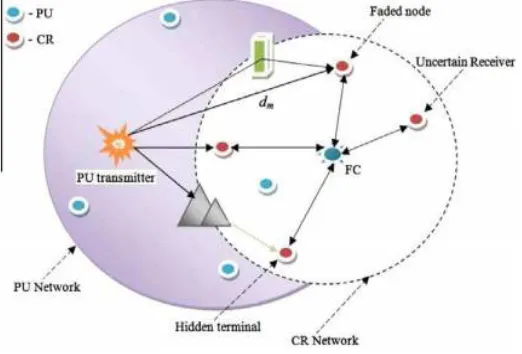
Fig. 3 Multimode spectrum sensing model
Fig.3 shows a PU network and a CR network. In a PU network, the PU user is in communication mode. Each CR user in the CR network receives the PU transmitted signal with different strengths due to free space path loss and/or shadowing effects. The Fusion Center (FC) selects a frequency band of interest for sensing and informs all cooperating CRs to individually perform local sensing. In this figure, four CR users are present in the CR network and are in the cooperating mode for sensing the spectrum. Each of them sense the designated band locally and transmit their sensing measurement through the control channel. Finally, the FC makes the global decision by aggregating the received local sensing information and relays the global decision back to cooperating CR users. The hypothesis tests for multimode sensing by assuming M nodes in the cooperation is,
H0 : xm [n] =w[m],n ; m= 0; 1 ; . . . M – 1
H1 : xm [n] = hm:sm [n] + wm [n], n = 0; 1 ; ... N – 1 Where hm is the channel gain
It is assumed that the channel is slowly varying such that the channel frequency response or channel gain remains constant during the sensing duration. Multinode sensing is classified into soft and hard decision mode based on the type of data being received in the FC to make the global decision. One more issue in the multinode sensing is free space path loss.
Due to free space path loss, the SNR of the received signal varies and depends on the distance that the CR user is located from the primary user transmitter. The free space path loss in dB can be approximated as
Where, dm is the distance of mth node from PU transmitter and ‘m’ is the velocity of radio waves in free space. The current work concentrates on the soft decision fusion technique.
In general, each CR receives different strengths of the signal because of noise in the medium or location of CR. Hence, some nodes that participate in cooperation have a better SNR with respect to other nodes.
To attain reliable detection in this condition, FC will give different weights to different nodes based on received signal strength and aggregate the measurements.
Where, m and wm are the entropy measurement and weight of mth node, respectively. In case of EGC rule, wm = 1, m.
In the case of SCF and energy detection methods the cooperative detection probability can be expressed as,
Where: Гm is the estimated SCF of mth node.
VII. SIMULATION RESULTS
Fig. 4. SNR vs Pd for SCF method, entropy detection using cyclic features, energy detection, entropy detection in frequency domain methods at different Pfa = 0.05 and 0.1.
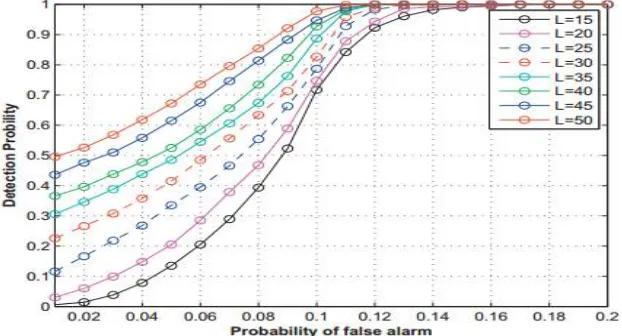
Fig.5. ROC curves for entropy detection using cyclic features with different bin width (L).
Signal identification in view of entropy estimation utilizing cyclic elements has been presented. The execution of the proposed recognition strategy is contrasted and other identification strategies, for example, cyclostationary discovery, vitality location utilizing Bayesian and NP criteria, and entropy discovery under recurrence space. The reenactment results demonstrate that the proposed detecting location strategy outflanks the other indicated recognition techniques. It can recognize the got signs of SNR up to - 19 dB utilizing single hub, - 24 dB utilizing five hubs as a part of participation at craved execution (Pfa 6 0.1 and Pd P 0.9) with no. of canisters (L) = 15.
REFERENCES
[1] FPGA implementation and performance study of spectrum sensing based on entropy estimation using cyclic features (Computers and Electrical Engineering 38 (2012) 1658–1669. Published in 2012)
[2] Practical Implementation of a Cognitive Radio for Dynamic Spectrum Access (A Thesis by Alice Crohans) [3] Cyclostationary Signatures in Practical Cognitive Radio Applications (IEEE Journal Jan 2008).
[4] Yucek T, Arslan H. A survey of spectrum sensing algorithms for cognitive radio applications. IEEE Commun Surv Tutorials 2009;11(1):116– 30.
[5] Liang Y-C, Zeng Y, Peh E, Hoang AT. Sensing-throughput tradeoff for cognitive radio networks. IEEE Trans Wirel Commun 2008;7(4):1326–37.
[6] Francois-Xavier Socheleau PC, Houcke Sbastien, Assa-El-Bey A. Cognitive OFDM system detection using pilot tones second and third-order cyclostationarity. Signal Process 2010;91(2):252–68.
[7] Lee W, Akyildiz I. Optimal spectrum sensing framework for cognitive radio networks. IEEE Trans Wirel Commun 2008;7(10):3845–57. [8] Nagaraj SV. Entropy-based spectrum sensing in cognitive radio. Signal Process 2009;89(2):174–80.
[9] Zhang YL, Zhang QY, Melodia T. A frequency-domain entropy-based detector for robust spectrum sensing in cognitive radio networks. IEEE Commun Lett 2010; 14(6):533–5.
[10] Yue W, Zheng B. Spectrum sensing algorithms for primary detection based on reliability in cognitive radio systems. Comput Electr Eng 2010; 36(3):469–79.
[11] Akyildiz IF, Lo BF, Balakrishnan R. Cooperative spectrum sensing in cognitive radio networks: a survey. Phys Commun 2011; 4(1):40–62. [12] Duan D, Yang L, Jose C. Cooperative diversity of spectrum sensing for cognitive radio systems. IEEE Trans Signal Process 2010; 58(6):3218–