ABSTRACT
LECORCHICK III, DOUGLAS GROVER. Problem Formulation Within Engineering Design: A Grounded Theory. (Under the direction of Dr. Matthew Lammi and Dr. Aaron Clark).
Problem solving is an essential ability and skill for life and engineering is no
exception. Although there has been research on problem solving, there is little known about
problem formulation, particularly within engineering design and educational settings. The
aim of this study is to understand how high school students experience and engage in the
process of formulating an open-ended engineering design problem. Thirty-two high school
students grouped together in self-selected teams of two (dyads) were given an engineering
design problem and asked to solve the problem using sketch paper, a whiteboard, and access
to a computer. Each dyads’ entire attempt was video and audio recorded. The recorded data
were analyzed from a classic grounded theory methodological approach including
substantive and theoretical coding, field note annotations, and memo annotations. This
analysis resulted in a substantive grounded theory of high school students’ experience of and
navigation through problem formulation within engineering design. The findings of this
study show that problem formulation is present in varying degrees throughout the problem
solving process. The participants within each dyad employed different approaches to the
problem formulation process, however the navigation of problem formulation within
engineering design followed a natural progression that were labeled through classic grounded
theory coding protocol. This study concludes with implications of the findings and
© Copyright 2017 Douglas Grover Lecorchick III
Problem Formulation Within Engineering Design: A Grounded Theory
by
Douglas Grover Lecorchick III
A dissertation submitted to the Graduate Faculty of North Carolina State University
in partial fulfillment of the requirements for the degree of
Doctor of Education
Technology Education
Raleigh, North Carolina
2017
APPROVED BY:
_______________________________ _______________________________
Matthew Lammi Aaron Clark
Committee Co-Chair Committee Co-Chair
_______________________________ _______________________________
DEDICATION
To my boys:
Alexander Douglas Lecorchick
&
Austin Douglas Lecorchick
May your journey through this life be filled with God’s grace. Look for people to help and do
so quietly. Find people to love and love them deeply. Celebrate the seasons of life with eager
hope for the future.
BIOGRAPHY
Douglas was born and grew up in Uniontown, Pennsylvania. He attended Fayette
County Vocational and Technical Institute toward earning a certification in Computer Aided
Drafting & Design while in high school. His studies then took him to Pittsburgh Technical
Institute where he earned an Associate of Science degree with a concentration in Computer
Aided Drafting. Douglas then went on to earn a Bachelor of Science in Professional Studies
with a concentration in Technology Management from Point Park University. Douglas then
continued his education with earning a Masters of Business Administration degree with a
concentration in Management from Point Park University as well. In the summer of 2010
Douglas was accepted into the doctoral program at North Carolina State University to pursue
a Doctorate of Education degree in Technology Education with a minor in Curriculum and
Instruction.
Douglas has been fortunate enough to travel the world while calling many places
home. The highlights of traveling have been living in Heredia, Costa Rica; Shenyang, China;
and Jining, China. Douglas is not sure where the next journey is but remains eager to
embrace wherever that destination will be.
The highlights of Douglas’s life are summarized by three dates. March 12th, 2000
was a Sunday morning around 11:00am when God called to his heart and Douglas answered.
July 13, 2007 Alexander Douglas Lecorchick came into the world, which in a moment, made
Douglas the world's proudest father. September 25, 2009 Austin Douglas Lecorchick was
born and demonstrated that there is no limit to the amount of love a father can have inside.
TABLE OF CONTENTS
LIST OF TABLES ... vii
LIST OF FIGURES ... viii
CHAPTER 1 – INTRODUCTION ... 1
Problem Statement ... 1
Need for the Study ... 1
Purpose Statement ... 3
Research Question ... 3
Research Study Overview ... 3
Methodology Overview ... 4
Rational for Classic Grounded Theory ... 6
Significance of Study ... 7
Delimitations ... 9
Definition of Terms ... 9
Chapter Summary ... 10
CHAPTER 2 – LITERATURE REVIEW ... 11
Engineering Design ... 11
Engineering Design Education ... 12
Problem Solving ... 16
Problem Formulation ... 19
Describing Problem Formulation ... 19
Problem Formulation Structure ... 21
Cognitive Load in Problem Formulation ... 23
Education of Problem Formulation ... 23
Understanding Problem Formulation ... 25
Qualitative Research ... 26
History of Grounded Theory ... 29
Grounded Theory Approaches ... 30
Classic Grounded Theory ... 31
Straussian Grounded Theory ... 32
Constructivist Grounded Theory ... 34
Addressing the Literature in Classic Grounded Theory ... 35
Chapter Summary ... 36
CHAPTER 3 – METHODOLOGY ... 37
Classic Grounded Theory Overview ... 37
Theoretical Sensitivity ... 40
Existing Literature ... 41
Theoretical Sampling ... 41
Analysis... 42
Participants ... 45
Coding ... 46
Phase One ... 49
Purposeful Sample of Participants ... 50
Observations ... 51
Design Challenge Problem ... 53
Open Coding ... 55
Field Note Annotations ... 58
Memo Annotations ... 59
Constant Comparative Method of Analysis ... 59
Core Categories ... 60
Theoretical Saturation ... 60
Phase Two ... 61
Selective Coding ... 61
Phase Three ... 61
Theoretical Coding ... 62
Phase Four ... 62
Theoretical Sorting ... 62
Situating the Researcher ... 63
Background ... 64
Vocation ... 65
Life Experience ... 65
Beliefs ... 66
Chapter Summary ... 66
CHAPTER 4 – FINDINGS ... 68
Research Questions ... 69
1. Substantive Coding ... 69
1a. Open Coding ... 70
1b. Selective Coding ... 71
2. Theoretical Coding ... 75
Memo - Annotations ... 79
Student Action ... 79
Problem Area Knowledge ... 80
Problem Formulation Development ... 81
Overcoming the Unmet Need ... 82
Sub problems ... 82
Systematic Tracking Method ... 83
Problem Formulation Environment ... 84
Field Note - Annotations ... 84
Dyad 01 ... 85
Dyad 02 ... 85
Dyad 03 ... 86
Dyad 04 ... 86
Dyad 05 ... 87
Dyad 07 ... 88
Dyad 08 ... 88
Dyad 09 ... 88
Chapter Summary ... 88
CHAPTER 5 - DISCUSSION ... 90
The Substantive Grounded Theory ... 91
Discussion of Research Questions ... 93
Research Question 1 ... 93
Discussion – Problem Formulation Characteristics ... 93
Research Question 2 ... 97
Discussion – Problem Formulation Experience ... 97
Comparative Literature Review ... 98
Memo - Annotations ... 101
Field Notes ... 109
Implications for Teaching ... 110
Recommendations for Future Research ... 112
Development of Problem Formulation Definition ... 116
Evaluating the Grounded Theory Study ... 116
Chapter Summary ... 118
REFERENCES ... 120
APPENDICES ... 134
Appendix A: Memo Annotations ... 135
Appendix B: Open Code List ... 137
Appendix C: Gender Distribution of Dyads ... 139
Appendix D: Dyad Coding Schedule ... 140
Appendix E: Dyad 01 Transcript ... 141
Appendix F: Dyad 02 Transcript ... 150
Appendix G: Dyad 03 Transcript ... 167
Appendix H: Dyad 04 Transcript ... 180
Appendix I: Dyad 05 Transcript ... 190
Appendix J: Dyad 06 Transcript ... 198
Appendix K: Dyad 07 Transcript ... 203
Appendix L: Dyad 08 Transcript ... 210
Appendix M: Dyad 09 Transcript ... 216
Appendix N: Dyad 10 Transcript ... 221
Appendix O: Dyad 11 Transcript ... 227
Appendix P: Dyad 12 Transcript ... 239
Appendix Q: Dyad 13 Transcript ... 254
Appendix R: Dyad 14 Transcript ... 265
Appendix S: Dyad 15 Transcript ... 279
LIST OF TABLES
Table 1. Design problem taxonomy ... 18
Table 2. Contrasting characteristics of five qualitative approaches ... 28
Table 3. Chronology of analysis ... 49
Table 4. Synthesized list of open codes ... 70
Table 5. Core concept of Solution Introduction ... 71
Table 6. Core concept of Explore ... 72
Table 7. Supporting concepts Constraints and Justification ... 72
Table 8. Core concept of Implement ... 73
Table 9. Supporting concept of Implement ... 73
Table 10. Core concept of Modify ... 74
Table 11. By the numbers ... 74
Table 12. Theoretical code of Implicit Formulation ... 76
Table 13. Theoretical code of Tacit Formulation ... 77
Table 14. Theoretical code of Problem Formulation Framing ... 78
Table 15. Theoretical code of Applied and Evaluative Discourse ... 78
Table 16. Memo annotation of Student Action ... 80
Table 17. Memo annotation of Problem Area Knowledge ... 81
Table 18. Memo annotation of Problem Formulation Development ... 81
Table 19. Memo annotation of Overcoming the Unmet Need ... 82
Table 20. Memo annotation of Sub problems ... 83
Table 21. Memo annotation of Systematic Tracking Method ... 84
Table 22. Memo annotation of Problem Formulation Environment ... 84
Table 23. Comparative Literature Summary ... 101
Table 24. Effective Communication and Ineffective Communication ... 102
Table 25. Problem formulation approach type ... 103
Table 26. General knowledge conversation ... 104
Table 27. Overcoming the unmet need conversation ... 106
LIST OF FIGURES
Figure 1. Research study overview. ... 5
Figure 2. Four-phase approach. ... 5
Figure 3. Overview of literature review search. ... 11
Figure 4. Similarities and differences in grounded theory (Kenny & Fourie, 2015). ... 31
Figure 5. Coding procedure of classic grounded theory (Kenny & Fourie, 2015). ... 32
Figure 6. Coding procedure of Straussian grounded theory (Kenny & Fourie, 2015). ... 34
Figure 7. Coding procedure of constructivist grounded theory (Kenny & Fourie, 2015). ... 35
Figure 8. Principles of classic grounded theory ... 40
Figure 9. Researcher workspace. ... 42
Figure 10. Original handwritten field note. ... 43
Figure 11. Soft and hard copy of coding documents. ... 44
Figure 12. Memo sorting process. ... 45
Figure 13. The coding scheme progression. ... 47
Figure 14. Overall study approach. ... 48
Figure 15. Design challenge sheet. ... 54
Figure 16. Vantage points captured by recording. ... 55
Figure 17. Coding process. ... 56
Figure 18. Classic grounded theory coding. ... 57
Figure 19. Example of open coding (Holton & Walsh, 2016, p. 82). ... 58
Figure 20. Example of a field note annotation (Holton & Walsh, 2016, p. 71). ... 59
Figure 21. Constant comparative method of analysis (Kenny & Fourie, 2015). ... 60
Figure 22. Sorting conducted on a tabletop (Holton & Walsh, 2016, p. 122). ... 63
Figure 23. Problem formulation navigation. ... 75
Figure 24. Memo areas of interest. ... 79
Figure 25. Influence of discussion. ... 91
Figure 26. A graphical representation of the Substantive Grounded Theory: Typical navigation through problem formulation. ... 92
Figure 27. Tacit formulation. ... 94
Figure 28. Formulation framing. ... 95
Figure 29. Implicit formulation. ... 96
Figure 30. Activity for approach type "A-Holistic" and type "B-Detailed". ... 98
Figure 31. Problem formulation environment. ... 108
Figure 32. Problem formulation archetype. ... 112
CHAPTER 1 – INTRODUCTION
Problem solving is an essential ability and skill for life. In STEM (science,
technology, engineering, and math) settings - engineering is no exception - the ability to
understand and solve open-ended technical problems is paramount. Problem solving in
engineering design includes more than devising a solution, and typically involves
formulating, defining, and scoping problems; handling ambiguity; understanding and
communicating constraints, variables, and specifications; and implementing a solution (Dym,
1992; Jonassen, Strobel, & Lee, 2006).
Although research has been done on problem solving, little is known about problem
formulation, particularly within engineering design and educational settings. This is
problematic because problem formulation is crucial to the problem solving process (Eierman
& Philip, 2003).
Problem Statement
The aim of this study is to understand how high school students experience and
engage in the process of formulating an open-ended engineering design problem. The current
body of literature does not sufficiently address problem formulation within engineering
design at the K12 education level and the complexity of engineering design requires more
detailed qualitative research toward unpacking the actual experience of engineering design
problem solving (Watkins, Spencer, & Hammer, 2014).
Need for the Study
In formal education settings the incentive, or value, for solving problems is usually in
unknown is much more incentivized. For example, engineers are not only hired based on
their workplace problem solving ability, they are rewarded and recognized throughout their
career because of it (Jonassen et al., 2006).
It is generally accepted that problem solving skills are highly valued and that skillset
continues throughout most people’s careers regardless of what formal training they have had
or what career path they have chosen (Sweller, 1988). However, a problem typically needs to
be formulated for successful problem solving (Baer, Dirks, & Nickerson, 2013).
Problem formulation greatly influences the decision making process while attempting
a solution. Therefore, a problem that is better formulated should allow for better quality
decisions to be made from the problem solver and less time should be spent on solving the
wrong problem (Baer et al., 2013; Bardwell, 1991). Thus, if a student can enhance their
problem formulation ability, there should be an increase in their overall problem solving
aptitude.
Knowing how people perceive information is important to understanding how they
solve problems (Bardwell, 1991; Eierman & Philip, 2003). By exploring how people
experience and engage in problem formulation, we can further understand how they approach
the problem solving process. This exploration of problem formulation starts with a working
theory of how students experience and engage in problem formulation. With a better
understanding of how individuals problem formulate researchers can then suggest best
Purpose Statement
The purpose of this study is to generate a theory of high school students’ problem
formulation experience within engineering design. For this study, problem formulation will
be initially defined as the process of exploring, identifying, and discovering a problem within
a given context driven and bounded by constraints and personal beliefs.
Research Question
A research question should be both relevant and of interest to the researcher (Chism,
Douglas, & Hilson, 2008). This grounded theory study begins with a single focus that is
relevant regarding the researcher and the general problem solving community (Chism et al.,
2008; Creswell, 2007). The primary research question of this study is: How do high school
students experience and engage in problem formulation during an engineering design
challenge?
The nature of a grounded theory research question and any sub-questions is that they
can change as more information is discovered during the study (Creswell, 2007). The
researcher is open to modifying, changing, or creating new research questions and
sub-questions as the data emerges.
Research Study Overview
Thirty-two high school students were given an engineering design challenge that
asked them to solve an open-ended problem working in teams of two (dyads). The students
were given access to a computer with the Internet, sketch paper, and a whiteboard. All
students were high school juniors enrolled in one of three rural mid-Atlantic school districts
stayed after school to complete the challenge. Each dyad was video and audio recorded
during its entire design session. The audio of each dyad was later transcribed in a word
processing software, and those transcriptions were used for coding per classic grounded
theory methodology.
Methodology Overview
The researcher compiled a literature review of grounded theory methodology toward
conducting a thorough and trustworthy study (McCallin, 2006). This literature review
explored the development and history of grounded theory, the divergence and variations of
the methodology, and a rationale for selecting classic grounded theory as the best fitting
approach for this study.
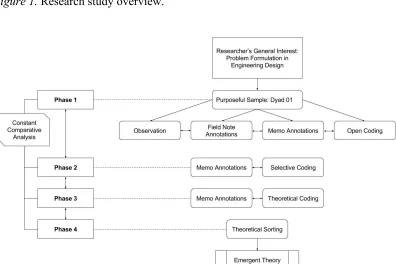
The data analysis was a four-phase systematic approach toward generating a theory
grounded in the data. The analysis began with the researcher watching the recorded videos
(observation) while annotating memos and field notes per classic grounded theory
methodological practice. The transcripts were then coded in three levels: open coding,
selective coding, and theoretical coding. During open coding the researcher looked for
relatedness among the raw data and assigned an open code to each segment of text. Then,
through selective coding the researcher began looking for relationships among the open
codes and compared them with the main concern of problem formulation within engineering
design toward the emergence of core concepts. Finally, the researcher began to reconstruct
the fragmented data by detecting relatedness among the previously identified core concepts
toward outlining the emerging theory (Glaser, 2014; Glaser & Strauss, 1967; Holton, 2008;
Through theoretical sorting, the researcher organized the annotated memos and field
notes toward forming conceptual patterns of behavior. Along with behaviors and the analysis
of the coded transcriptions, the researcher identified an emergent theory that is grounded
within the data (Holton, 2008). Figure 1 is an overview of this research study along with a
detailed visual of the four-phase approach to data analysis in Figure 2.
Figure 1. Research study overview.
Rational for Classic Grounded Theory
The researcher intended to investigate the actual problem formulation experience of
high school students during an engineering design challenge. Classic grounded theory offered
the platform to generate a theory from data analysis.
Glaser and Strauss offered a novel methodology that could be applied to generate theory based upon the data that were collected. In other words, this methodology was able to present a theory, which has its hypotheses and conceptualization derived from data that were gathered and are generated as the data are collected, coded, and
analyzed (simultaneously) for the duration of the research process. This style of theory development, based on empirical investigation, would certify that the theory-product would be relevant to the phenomenon being studied (Howard-Payne, 2016, p. 52).
Grounded theory is the generation or discovery of a theory from systematically
collecting and analyzing the data (Glaser & Strauss, 1967). The researcher of this study
aimed to generate a theory of how high school student’s problem formulate during an
engineering design challenge. Thus, grounded theory is the most influential qualitative
method of use when the researcher aims to generate theory from the data (Chism et al., 2008;
Strauss & Corbin, 1997).
Furthermore, grounded theory data analysis focuses more on identifying patterns than
describing the data (Griffiths, 2013). Through meaning, action, and interaction the researcher
begins to see the fit and relevance within the context of the study (Giske & Artinian, 2007;
Glaser, 2014). This allows the researcher to see things as they currently are and not how one
could preconceive them to be (Glaser, 2014).
One freedom of grounded theory is that the researcher can select substantive or
study (Glaser & Strauss, 1967). Most grounded theories are substantive, meaning specific to
a population within a certain setting, due to the specific nature of the study (Charmaz, 2006).
This allows a more narrow focus and the ability to generate a theory suited to the intended
context of the study (Glaser & Strauss, 1967).
The methods used in grounded theory are viewed as a set of principles, not strict
directions for data analysis (Charmaz, 2006). This gives the researcher flexibility and
freedom to go where the data leads. Within this flexibility and freedom, researchers should
also be open to the emerging evidence the data might show and tolerate confusion during the
grounded theory process (Fernández, 2003).
The study of methodological literature is helpful for a researcher to conduct a proper
and trustworthy grounded theory study (McCallin, 2006). For this study, the researcher used
the literature supporting classic grounded theory as the primary guide in data analysis. The
authoritative texts used throughout this research study were Glaser and Strauss’s (1967) text
titled The Discovery of Grounded Theory and Holton and Walsh’s (2016) text titled Classic Grounded Theory: Applications with Qualitative and Quantitative Data.
Significance of Study
People draw from their experience with previously encountered problems within
similar contexts to recall lessons learned from the situation and are rewarded for their ability
to solve those problems (Jonassen, 2000; Jonassen et al., 2006). If we know how people
experience and engage in problem formulation within problem solving, then we can create
more authentic educational exercises. Transferring problem solving skills from the classroom
2006). However, most engineering programs focus on problems specifically classified as
engineering only; although actual life and professional workplace problems are more general
and include many non-engineering constraints (Jonassen et al., 2006). Also, it is doubtful that
practicing to solve a large number of conventional problems would increase one’s problem
solving skills (Sweller, 1988).
Engineering design problems are complex and ill-structured and call for much more
than the ability to transfer general problem solving skills used to solve well-structured
problems (Jonassen, 2000). Well-structured problems rely on domain and context specific
problem solving applications, whereas ill-structured problems are more varied in the problem
solving process and do not rely on a general schematic method (Jonassen, 2000). Domain
specific knowledge in the form of schemas, or chunks of information easily retrieved, is a
major asset when problem solving (Sweller, 1988). However, ill-structured problems require
the solver to go beyond basic problem solving skills acquired from formal education and
previous personal experience.
By discovering how students experience and engage in problem formulation, one can
provide insight in creating academic problems that more closely resemble and simulate real
life and professional workplace problems. New discoveries in this area could help facilitate
better transferability between academic problem solving and both real life and professional
workplace problem solving. This research will also add to the minimal existing body of
problem formulation literature and suggest multiple areas of interest for further studies,
especially within engineering design and engineering research activities in the formal
Delimitations
The researcher studied grounded theory literature in order to generate the most
informed and credible substantive theory from the data collected. Throughout the study the
researcher referenced the literature on grounded theory as a guide to accurately conduct the
study. The delimitations of this study are listed to clarify the boundaries of the study and to
illustrate how the scope of the study was narrowed and controlled (Roberts, 2004). They are:
1. Time of the study: fall of the participants’ junior year of high school
2. Location of the study: three rural mid-Atlantic high schools
3. Sample used in the study: thirty-two high school students (sixteen dyads) make the
entire sampling field
4. Phenomenon to be studied: problem formulation within engineering design
5. Method of data collection: unstructured observations of the dyads (participants)
verbalizations, team interactions, video, and student generated sketches
Definition of Terms
1) Problem – An emergent undesirable situation to be corrected (Eierman & Philip, 2003).
2) Problem Solving – The evaluation and selection process of identifying possible solutions
to an unknown by the problem solver (Baer et al., 2013).
3) Problem Formulation – The process of exploring, identifying, and discovering a problem
within a given context driven and bounded by constraints and personal beliefs.
4) Engineering Design – The systematic, intelligent generation and evaluation of
specification for artifacts whose form and function achieve stated objectives and satisfy
5) Grounded Theory – The generation or discovery of a substantive theory grounded in
systematically analyzed data (Glaser & Strauss, 1967).
6) Constant Comparative Method of Analysis – The iterative analysis of data where
statements are coded, categorized, and grouped to assist in theory generation by
comparison as they are analyzed (Chism et al., 2008).
7) Saturation (theoretical saturation) – The collection of data until no new information can
be obtained from new participants in both conceptual and theoretical coding (Chism et
al., 2008).
8) Context (study) – The environment or situation of the grounded theory data (Glaser,
2014).
Chapter Summary
This study is presented and organized in five chapters including this chapter. Chapter
two is a literature review of engineering design, engineering design in education, problem
solving, problem formulation, and an overview of grounded theory within qualitative
research. Chapter three describes the classic grounded theory methodology used to conduct
this. Chapter four presents the findings from the data analysis. Chapter five presents and
discusses the substantive grounded theory, finders of research question one and research
CHAPTER 2 – LITERATURE REVIEW
This section presents a targeted overview of the existing literature on Engineering Design, Engineering Design Education, Problem Solving, and Problem Formulation. This sections also presents literature on grounded theory history, development, and methodology.
Although engineering design can be viewed as a subset of problem solving (Jonassen, 2000),
the literature review within this body of work is focused on problem formulation within each
of these areas. Therefore, this literature presentation moves from general engineering design
to a specific discussion of problem formulation, see Figure 3. The researcher was intentional
to not include computational and mathematical problem solving literature as these areas are
outside the scope of this study.
Figure 3. Overview of literature review search.
Engineering Design
Dym states (1992, p. 99), “Engineering design is the systematic, intelligent generation
and evaluation of specification for artifacts whose form and function achieve stated
objectives and satisfy specified constraints.” Additionally, Hall and Rapanotti (2009) and Yu,
Gu, Ostwald, and Gero (2014) state that engineering design is creative and iterative with both
Extending that perspective Howard et al. (2008) suggests that creativity is an essential part of
engineering design and that the nature of design includes decision making, constraint
awareness, is purposeful, and is in itself a learning activity (Gero, 2006).
Engineering design inherently interacts with many surrounding systems (Dym &
Little, 2004). These systems cannot be viewed as single components but need to be viewed
holistically including other systems and variables within the surrounding environment
simultaneously (Hmelo-Silver, Cindy, & Azevedo, 2006). Engineering design usually
requires the designer to understand the end users’ requirements (Dym & Little, 2004). This
understanding includes knowledge of non-engineering constraints and requirements that
demand flexibility from the designer. These constraints and requirements include technical
variables such as temperature and load and also non-technical variables such as safety and
nature (Jonassen, 2011; Wulf & Fisher, 2002).
As most engineers are required to design under constraints, the human factor is
critical within engineering design to evaluate and interact with many systems simultaneously
(Brophy, Klein, Portsmore, & Rogers, 2008; Wulf & Fisher, 2002). The end result of
engineering design is typically a device, system, or process (ABET, 2014). Mathematical
analysis has been a common way to teach engineering design however, design in general, has
been very misunderstood in engineering education (Dym, 1992; Mentzer, Becker, & Sutton,
2015).
Engineering Design Education
Engineering design education is critical in pre-college engineering curriculum
education level and engineering design is paramount within engineering education (Watkins
et al., 2014). Engineering design problems provide a platform for students to experience
critical thinking, problem solving, and creativity (Katehi, Pearson, & Feder, 2009). These
skillsets are valued and are recognized during one’s entire career.
Most students usually prefer open-ended engineering design activities (Prince &
Felder, 2006). These activities allow students to take responsibility for the problem solving
process and provide greater student engagement during the problem solving process (Hynes,
Milto, Rogers, & Hammer, 2011). In addition, design problems that are personal to students
allow them to see both relevance and meaning in their solution suggestions (McKenna &
Hirsch, 2005). Design problems require the solver to not only understand the aspects of a
problem but to accurately interpret and interact with the problem as well (Watkins et al.,
2014). These design problems are commonly used in order to introduce the engineering
design process to students (Mentzer et al., 2015; Sadler, 2000).
Engineering design educational activities should be realistic and authentic (Dinsmore,
Alexander, & Loughlin, 2008). Thus, those responsible for creating engineering design
curriculum should aim for engineering design activities that closely resemble real-world
engineering situations (Brophy et al., 2008). This real-world resemblance can increase
student engagement that is necessary for students to succeed in solving engineering design
problems (Sadler, 2000).
An appropriate conceptual base for K12 engineering students is not fully understood.
This lack of knowledge is exceptionally problematic in creating engineering design education
However, the instructor can identify the conceptual base for each student individually. The
novelty of engineering design activities allows the instructor to help students get to desired
levels of design capability by identifying where the student is currently and where the student
needs to be, commonly known as scaffolding.
Engineering design activities usually have multiple acceptable solutions and various
processes to achieve them (Brophy et al., 2008; Foster, Kay, & Roe, 2001). These activities
are not linear and usually have many different design decisions that guide the solution
finding process (Ottino, 2004). Therefore, instructors should be tolerant of multiple solutions
and pathways within an engineering design activity (D. Crismond, 2001). Instructors also
need to be patient while becoming familiar with the engineering design culture, specifically
the ability to handle ambiguity (Crismond & Adams, 2012; Hmelo, Holton, & Kolodner,
2000).
Decisions are inherently part of engineering design and a designer should be well
equipped to make those decisions (Jonassen, 2011; Marston & Mistree, 1997). Designers
could use a variety of decision making aides similar to matrices and decisions trees (Eide,
Jenison, Mashaw, & Northrup, 2002; Jonassen, 2011; Jonassen et al., 2006). Designers
should also have the ability to determine when a problem is sufficiently solved (Bucciarelli,
1994). Justification of these solutions and solution process are evidence of learning within
engineering design activities and allow students to reflect on their learning (Hmelo-Silver,
Cindy, & Azevedo, 2006; Jonassen, 2011).
Engineering designers should learn to formulate problems in teams, as engineering
et al., 2014). By creating problems that develop problem solving skills such as
communication, a student learns to depend less on the instructor and more on himself or
herself (Deluca, 1991).
Engineering design education is also experienced outside the K12 classroom.
Museums, summer camps, and student lead organized competitions are a few examples
where students engage in engineering design outside the classroom and are afforded
experience with hands-on activities (Schnittka, Brandt, Jones, & Evans, 2012). These
activities provide opportunities for students to engage in both procedural knowledge and
experiential learning (Halverson & Sheridan, 2014; Kolb, 1983). One such critical ability
within engineering design is technical drawings (Bucciarelli, 1994). These drawings allow
the designer to visualize and display expressions of thought toward the communication of
those ideas to others (MacDonald, Gustafson, & Gentilini, 2007; Mehalik & Schunn, 2006).
Visualization within engineering design is critical and the ability to sketch what is
being visualized is an essential skill of product design (Harris & Meyers, 2007). However,
many students feel they simply cannot draw well enough to effectively communicate their
ideas to someone else (Huaiwen, Daiwei, Kaiyin, & Ding, 2013). As the teaching of
engineering design graphics needed to and have evolved with technological advancements
there remains a need to teach free hand sketching (Harris & Meyers, 2007; Huaiwen et al.,
2013). Pencil drawing activities in the classroom with the focus on descriptive geometry and
orthographic drawings can enhance the drawing ability of students (Huaiwen et al., 2013;
Designers should continuously ask themselves questions during each stage of the
engineering design process. This ability to pose questions usually suggests learning and
reflection by the designer as well as enhanced reasoning ability (Katehi et al., 2009; Prince &
Felder, 2006). Within engineering design activities, questions should occur often and
sporadically (Dym & Little, 2004). A difference exists in the value of a final product and the
process in achieving that final product within a problem solving activity (Deluca, 1991).
Engineering design activities should provide students the opportunity to reflect on
their design process and solution suggestion (Asunda & Hill, 2007). This practice of
reflection is critical to the application aspect of engineering design and allows the students to
connect classroom learning to real world experience (Atman, Kilgore, & McKenna, 2008;
Schon, 1984). These design activities should embrace various iterations to promote student
understanding of the engineering design process and the actual detection of the problem
(Crismond, 2001).
“Teaching students how to solve problems is an important goal of education and
technology education has had a long history of providing an environment for developing
these skills” (Deluca, 1991, p. 1). Qualitative research is needed to develop K12 design
education. A rich description of the actual experience of engineering design by students will
further the ability of curriculum designers toward more authentic content material (Watkins
et al., 2014).
Problem Solving
A problem is the awareness of where something is, where something needs to be, and
problem solving process: a content knowledge base, communication skills, and an organized
approach to solve the problem (Huitt, 1992). Bardwell (1991) suggests that problem solving
effort can be compartmentalized by first defining the problem, identifying the goal, and then
searching for and deciding on a solution to evaluate.
Woods (1987) stated that problem solving requires intuition and should be woven into
content areas and not taught separately and specifically. He further stated that problem
solving process knowledge and content knowledge are needed to solve problems one has not
experienced before. A problem must have an unknown, a value for solving that unknown,
and a process to reach the desired state (Deluca, 1991; Jonassen, 2000).
A problem can be categorized as logical, algorithmic, story, rule-using, decision
making, trouble shooting, diagnosis-solution, strategic performance, case analysis, design
problem and dilemmas (Jonassen, 2000). Newman, Webb, and Cochrane (1995) reiterate and
reference Garrison’s model “Five Stages of Problem Solving” where problem evaluation and
a solution introduction occur after a problem identification, problem definition, and
exploration of the problem.
Design problems are important to solve because they are often encountered in life
outside of the classroom. These design problems are also one of the most complex and
ill-structured problems experienced, second to dilemma problems (Jonassen, 2000). A
Table 1. Design problem taxonomy
Furthermore, problem solving is a process where the solver must modify the problem
goals and means available to them as they navigate through the process even though most
design problems are misunderstood, especially early in the design problem solving process
(Logan & Smithers, 1993). This design process also incorporates brainstorming, solution
suggestions, prototyping and deciding on a final design (Deluca, 1991).
Some aspects of conventional problem solving are focused on goal identification but
do not actually enforce learning. Additionally, some forms of learning, like the means end
analysis approach, can interfere with the learning process (Sweller, 1988). However Quist,
Rammelt, Overschie, and De Werk (2006) suggest that an approach termed “backcasting”
problem solving, where the end goal is established and a work backwards approach is
conducted, facilitates effective problem solving within energy systems. This “backcasting”
approach can be used as a template to teach problem solving in other areas outside energy
Problem solvers identify the type of problem and select the appropriate process
toward solving that problem (Deluca, 1991). Some problem solving strategies are act out or
use of objects, make a picture or diagram, use or make a table, make an organized list, guess
and check, use or look for a pattern, work backwards, use logical reasoning, make it simpler,
and brainstorm (Florida Department of Education, 1998). The correct selection of a problem
solving strategy directly influences the solvers ability to navigate the problem solving
process.
Problem solving skills divide complex problems into manageable tasks that provide a
path to a solution. Problem solving in education should be centered on teaching students how
to think (Deluca, 1992). “The essence of problem solving is the application of knowledge and
process that leads to a solution” (Deluca, 1991, p. 1). Before a solver can navigate the
problem solving process the problem needs to be correctly formulated.
Problem Formulation
Problem formulation takes on many definitions and is interchangeable with as many
labels. The following section presents findings from the current body of literature in
describing problem formulation, problem formulation structure, cognitive load in problem
formulation, education of problem formulation, and the understanding of problem
formulation.
Describing Problem Formulation
The primary purpose of problem formulation is to identify the undesirable system and
to eliminate the system or the components that are causing the undesirability within the
suggestion that the goals of problem exploration, or framing, are: understanding the problem,
aspect discovery of the problem, and identifying the properties of the problem.
Problem formulation development does not end, but it continues at some level
throughout the problem solving process. With more understanding of the problem setting, the
solver redefines the problem and the solution idea. When the solver suggests solutions and
explores them, the result is added structure to the problem formulation process. This provides
a more accurate perspective of the problem, which generates better fitting solution ideas
(Logan & Smithers, 1993).
Design problem solving is a process of problem development and solution idea
generation occurring in parallel (Yu et al., 2014). This design problem solving process
mirrors and restructures new information to resemble past experiences where problem
formulation is actually a memory of a problem setting (Sweller, 1988; Swezller & Sweller,
1994). When subjects understand the problem setting, they can formulate goals and solution
easier and will have knowledge of what solution ideas can be acceptable (Charney, Reder, &
Kusbit, 1990).
Problem formulation includes the generation, evaluation, and selection of alternate
solution ideas and that better problem formulation leads to better decision making by the
solver (Baer et al., 2013). Furthermore, before a strategic solution can be suggested, the
problem solver should understand the problem and that by not formulating the problem
correctly leads to solving the wrong problem, which is the biggest problem solving
distraction most solvers experience. Charney, Reder, and Kusbit’s (1990) suggest that
Problem Formulation Structure
Problem solvers present solutions derived from either previous experience or an
existing product modification (Daly, Yilmaz, Christian, Seifert, & Gonzalez, 2012). Then,
within the problem space, change occurs by acquiring new information from memory,
constraints, or the problem setting (Simon, 1973). This leads to a solver’s perception of
purpose, understanding of constraints, and knowledge of the related context to develop as
new information is received and processed (Gero, 2006). In addition, Basu, Roy, and
McMahon (2012) suggests learners embrace problem formulation by making a mental model
of the complex problem, then collect and integrate the known information into that mental
model producing an evaluative platform for the introduction of solution ideas.
Incomplete problem descriptions, common with design problems, is the reason
solvers search and discuss ideas to become more familiar with the problem, rather than
focusing on the solution (Maher, Poon, & Boulanger, 1996). This discussion leads to a better
understanding of the problem and results in a change in the problem definition. This change
in problem definition results further as a change in the overall goal (Maher et al., 1996).
During problem solving activities, solvers navigate through a structured process
beginning with a framing phase where designers explore the problem space for irregularities
and then move into a formulation phase where solvers identify the cause of those
irregularities, specifically not addressing any solution ideas during these phases (Baer et al.,
2013). This problem solving process occurs in progression through four phases: problem
This form of problem solving deals with problems that are not clearly defined or lack
in structure, and this is why solvers return to the design space and continue modifying it until
a solution is accepted, thus solidifying the process by adding structure resulting with the
process ending (Yu et al., 2014). During this process, the solver asks critical questions and
explores answers through analysis, synthesis, and evaluation toward developing a
relationship between the problem space and solution space. Logan and Smithers (1993)
support this by stating that even though design problems are initially poorly defined, they
acquire structure once solutions are introduced and explored. This assentation adds to the
possibility of all problems being ill-structured at some level. Simon (1973) states even some
well-structured problems are really ill-structured problems because of the level of complexity
within and the possibility no well-structured problems exist, only ill-structured problems that
the solver has recreated and formalized to have structure.
Most real world problems are ill-structured, and those ill-structured problems have
three characteristics: inconsistency where the problem cannot be solved as presented,
incompleteness where there is a lack of information necessary to solve the problem, and
imprecision where there are too many possible solution ideas (Corne, Smithers, & Ross,
1994). The solving of ill-structured problems require structuring, restructuring, and revision.
Better problem construction is an important aspect of enhancing one's problem solving
ability because problem space manipulation is needed before problem solving can occur
(Jonassen, 2000). These design problems are challenging but an important type of problem
because of the professional demands for design problem solvers (Corne et al., 1994;
Cognitive Load in Problem Formulation
Most cognitive activity in the form of utterances occurs during problem exploration,
and most discussions within groups are centered around assumptions and constraints of the
problem setting (Basu, Roy, & McMahon, 2012; Huitt, 1992). Swezller and Sweller (1994)
suggest that schema acquisition and automation facilitate learning. Furthermore, through
repetition, any cognitive activity can become more automatic decreasing cognitive load. This
decrease in cognitive load in turn increases the cognitive ability to perform in other areas.
However, Paas, Renkl, and Sweller (2004) suggest that having structure within the problem
space is more important than trying to reduce the cognitive load of a solver during the
problem solving process.
Education of Problem Formulation
Woods, Felder, Rugarcia, and Stice (2000) and Dzbor and Zdrahal (2002) suggest
different problem solving terminology is confusing for students, and a common definition is
needed. Furthermore, engineering education should equip students with problem solving,
teamwork, and communication skills. Maher et al. (1996) supports this suggestion and adds
that the engagement of problem solvers in problem and solution exploration in design was
not adequately addressed in the current body of literature.
A deep understanding of problem formulation is needed to solve difficult problems,
and problem formulation is different across disciplines. Ill-structured problems are
experienced in life contrary to the well-structured problems experienced in the classroom,
and communication and evaluation skill sets are needed to facilitate problem solving, both of
and Ferris (2007) suggest that most engineers and technologists have varying philosophical
perspectives toward identifying how and why something works, and a systematic approach is
needed to teach problem formulation similar to systems engineering.
Workplace problems usually differ from classroom engineering problems, and this is
problematic regarding the teaching of problem solving because professionals are rewarded
for their problem solving ability throughout their careers (Jonassen et al., 2006). These
differences appear in ways of constraints and structure, where the education problems
already have the problem space outlined with more details than are typically detected in
workplace problems (Jonassen, 2000).
To solve a problem one must understand and construct the problem well. This is
sometimes problematic within engineering design problems. Design problems are usually
unclear, having vague goals, with many initially undiscovered constraints and usually will
have varying solutions with multiple ways to reach those solutions (Jonassen et al., 2006).
Experts can manipulate and present the problem space differently toward increasing
the communication, interpretation, and understanding within a team. However, experience
and knowledge are only useful if one can communicate his ideas well. This warrants the need
for students to develop conceptual frameworks in class and learn to apply them to solve
ill-structured problems. Even well-ill-structured problems become ill-ill-structured when constraints
are continually identified and unanticipated problems occur (Jonassen et al., 2006; Jonassen,
2000).
Teaching problem formulation requires the instructor to be flexible because students
formulation strategies is as important as teaching the actual strategies (Schoenfeld, 1980).
However, the teaching of strategies or techniques used to help students formulate problems
often have inconclusive results because the strategies are too complex. Kirschner, Sweller,
and Clark (2006) suggest a theory based on how people learn is needed rather than more
types of currently used theories of ideology and that strong instruction produces better results
than minimal involvement (exploratory learning).
Understanding Problem Formulation
Thinking is the goal towards solving a problem and consists of decision-making,
problem exploration, judgment of alternatives, and problem solving. The term “team
thinking” allows a group of individual problem solvers to become more valuable when
working together than individually. This “team thinking” is useful because as engineering
design problems increase in complexity the documentation that is available decreases, which
places more value on the solver or solver’s prior experience (Lamb & Rhodes, 2008).
Jonassen et al. (2006) suggests that within the area of problem formulation, team
members make different contributions and represent problems in different ways to better
facilitate a more accurate interpretation of their ideas. These team members can also enhance
communication within a team setting by representing data differently, and an individual’s
approach to problems differ contingent upon individual cognitive styles and cognitive ability
(Huitt, 1992).
Knowledge of the problem setting influences one's problem formulation behavior.
This is problematic when comparing problem formulation across disciplines. However, by
personal problem formulation aptitude. This enhanced problem formulation aptitude is
valuable because problem formulation can be costly when not done correctly (Eierman &
Philip, 2003). Daly et al. (2012) suggests that solvers reformulate problems to focus on what
they evaluate and consider the actual problem.
Bardwell (1991) states that understanding one's response to information can help in
understanding his problem solving process. Furthermore, solvers approach problems using
familiar systems driven by their personal problem framing ability, and people attempt to
solve problems too quickly. Time is also wasted on solving the wrong problem, stating the
problem incorrectly, solving for a solution idea, not being specific enough about the problem,
or agreeing on a solution before identifying the actual problem. To this point, Huitt (1992)
also suggests that a scientific decision making process of problem formulation is needed and
can enhance the development of problem formulation.
Real world designers solve multiple problems, which they label as “cross problems,”
within one design problem. Each “cross problem” affects the entire problem solving process,
and the actual design process that occurs is more erratic than most models suggests (Hall &
Rapanotti, 2009). Identifying a problem is actually more like searching for an unknown,
unmet need. Once discovered, a better formulated problem allows for the solver to identify a
solution more easily, especially when the problem formulation within the problem state has
not been recalled from memory (Nickerson, Silverman, & Zenger, 2007).
Qualitative Research
Grounded theory is commonly viewed as a qualitative methodology (Creswell, 2007).
methodology that can facilitate a quantitative, qualitative, or mixed methods approach to
research (Holton & Walsh, 2016). An overview of grounded theory situated within the
qualitative research approach is presented here in an attempt to avoid derailing this body of
work by engaging in a debate as to where grounded theory belongs methodologically.
“Qualitative research begins with assumptions, a worldview, the possible use of a
theoretical lens, and the study of research problems inquiring into the meaning individuals or
groups ascribed to a social or human problem” (Creswell, 2007, p. 37). Thus, the primary
goal of qualitative research is to enhance the understanding of a phenomena within the
context of the situation (Chism et al., 2008). Although at times looked at with misgivings,
qualitative research is ideal for engineering education because of its ability to explore the
participants reasoning and decision-making skills (Chism et al., 2008). The initial ideas may
be fuzzy, but the approach is focused and data driven (Ng & Hase, 2008).
Creswell (2007) also suggests using qualitative research when an issue needs to be
explored, when a detailed explanation of the issue is desired, or when quantitative measures
will not fit the study. It’s also very useful when the researcher does not know which variables
of the phenomena are important (Creswell, 2014). This is particularly valuable when the
researcher takes an exploratory approach toward the generation of a theory where the overall
focus should be the conceptual description of data that applies to the specific context being
studied (Chism et al., 2008).
No formal agreed upon structure of qualitative studies exists (Creswell, 2007).
However, the researcher is an acknowledged participant, viewed as an asset in qualitative
(Chism et al., 2008; Creswell, 2007). This is significant in grounded theory studies because
the overall design of study and the conceptual framework is tentative and will change as
directed by the findings, which ultimately require the researcher to be flexible and open
(Chism et al., 2008).
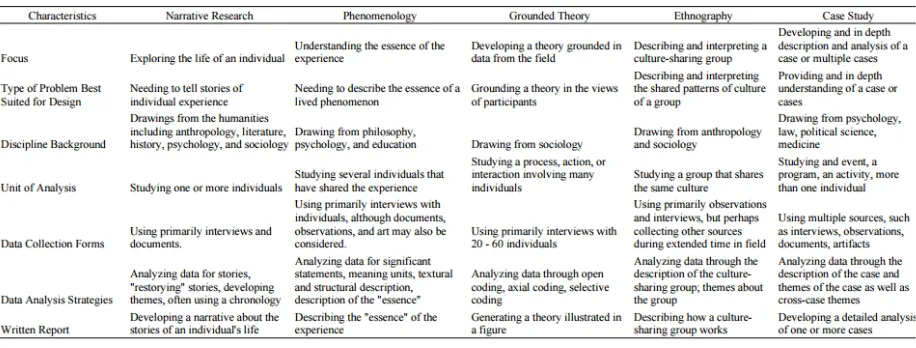
As Creswell (2007, p. 81,82) illustrates below in Table 2, the focus of a grounded
theory study is to develop a theory that is grounded in the data. The best problems suited for
grounded theory are when the researcher aims to discover phenomena from the participant’s
perspective. Additionally, grounded theory has a sociology background and is primarily the
study of a number of individuals’ actions and processes. Typical grounded theory studies
involve between twenty to forty participants, and their experiences are analyzed by a
systematic coding scheme producing a theory that can be presented as a figure toward
clarifying the discovered grounded theory.
Table 2. Contrasting characteristics of five qualitative approaches
History of Grounded Theory
Barney Glaser and Anselm Strauss developed grounded theory in 1967 while both
were working together on a study among medical staff and terminally ill patients. The title of
the study is Awareness of Dying (1965). The study argued that researchers needed a method that would allow theories to emerge from data without pre-existing theories guiding the
study. Grounded theory methodology was designed to allow for data-to-contextualized
theories to emerge by the systematic collection and analysis of data toward the generation of
a theory (Cooney, 2013; Glaser & Strauss, 1967; Holton & Walsh, 2016; Howard-Payne,
2016; Kenny & Fourie, 2014, 2015; Willig, 2013).
As the years went on and grounded theory became more popular within the research
community, Glaser stayed more focused on methods than methodology, which left many
questions to be answered by other grounded theorists (Birks & Mills, 2011). Strauss
eventually teamed with Juliet Corbin in 1990 and released a book titled Basics of Qualitative Research: Grounded Theory Procedures and Techniques. This book became known as the authoritative text regarding the Straussian approach to grounded theory and outlined some
differences to Glaser and Strauss’s original approach. However, further clarification was still
needed on the methodology. This need was met by a graduate student of Glaser and Strauss,
Kathy Charmaz, with her clarification in the book titled Constructing Grounded Theory
(2006), which is now known as the constructivist grounded theory approach (Birks & Mills,
2011).
The need to discuss the different variations of grounded theory became relevant as it
philosophical perspective, the use of literature, and the approach to data collection and
analysis, the primary focus of each method of grounded theory still remains to generate a
theory that is grounded in the data and to learn more about the world in which we are living
(Charmaz, 2006; Chism et al., 2008; Cooney, 2013; Kenny & Fourie, 2015). However, one
does need to decide which approach to take during a research study, especially for novice
researchers where a combination of approaches decrease the study’s overall validity
(Cooney, 2013).
Grounded Theory Approaches
The similarities among the three approaches encompass the main idea of grounded
theory; that is the intent to generate theory that is grounded in the data. This is done by the
systematic collection and analysis of data using the methods of memo annotation, constant
comparison, theoretical sampling, and choosing between substantive or formal theory
generation (Glaser & Strauss, 1967; Holton & Walsh, 2016; Kenny & Fourie, 2015)
The major differences among these approaches are centered around three ideas: the
philosophical perspective, the existing literature, and the coding procedures (Cooney, 2013;
Howard-Payne, 2016; Kenny & Fourie, 2015; Willig, 2013). A comparison highlighting both
Figure 4. Similarities and differences in grounded theory (Kenny & Fourie, 2015).
A description of the similarities and differences between the approaches are presented
below. The outline of the description begins with the approach of grounded theory, the
philosophical positioning, the use of literature, and finally a presentation of the coding
scheme.
Classic Grounded Theory
Classic grounded theory begins with the researcher having a sense of general
wonderment about a phenomenon and thus begins to ask questions that start to frame the
study. The ultimate goal is the development of a theory grounded in the data that is
discovered by the researcher. This is a specific philosophical difference among the
approaches in which classic grounded theory embodies a soft-positivist philosophical
It is important to note that in classic grounded theory the researcher is a passive
observer and should practice a high level of restraint regarding prior knowledge of content
during the study (Jones & Alony, 2011; Kenny & Fourie, 2014). Thus, the literature within a
classic grounded theory study should be read, if at all, after the concepts, category, and theory have emerged (Holton & Walsh, 2016). This facilitates classic grounded theory’s
desire to “remove the researcher from the research” (Kenny & Fourie, 2015, para. 42). When
a literature review is conducted in a classic grounded theory study, the aim is to achieve
emergent concept saturation toward discovering no further insight about the categories or
theory (Christiansen, 2011).
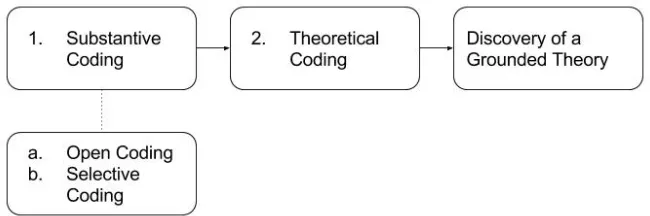
Two levels of coding, substantive and theoretical, fracture the data into chunks and
then piece the chunks together forming core concepts and categories through the constant
comparative method of analysis. A visual representation of the coding process is shown
below in Figure 5.
Figure 5. Coding procedure of classic grounded theory (Kenny & Fourie, 2015).
Straussian Grounded Theory
In the 1990’s Anselm Strauss and Juliet Corbin created the first major evolution of
researcher having a general idea of what to study and how to collect the information. The
questions and observations are more structured than in the classic approach where the
researcher is an active participant who is charged with interpreting both the phenomena and
data emerging from the coding levels. Straussian grounded theory embodies a
post-positivism philosophical perspective (Jones & Alony, 2011; Kenny & Fourie, 2014, 2015).
Strauss suggests that performing a literature review before the study will not hinder
the researcher’s ability because the intent of the researcher is to take a more active role in
detecting theory (Kenny & Fourie, 2014). This approach also highlights the necessity to
conduct an appropriate use of literature at every stage, but not so the empirical body of
literature hinders the researcher’s ability to remain focused on the study (Kenny & Fourie,
2015).
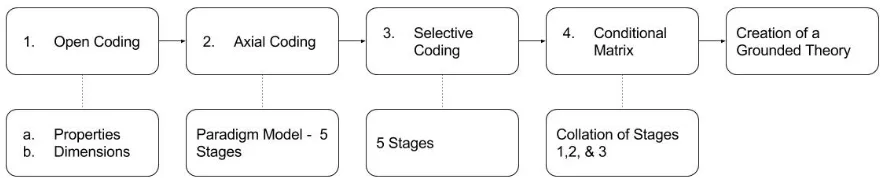
Three highly structured coding levels; open, axial, and selective are utilized. Each
phase is more progressive in nature and fragments the data into descriptive accounts of what
is happening during the phenomena (Jones & Alony, 2011). Strauss’s prescriptive coding
process shifts the inductive nature of coding in classic grounded theory to a more deductive
and rigid process (Willig, 2013). A visual representation of the coding process is shown
Figure 6. Coding procedure of Straussian grounded theory (Kenny & Fourie, 2015).
Constructivist Grounded Theory
Kathy Charmaz, a student of both Glaser and Strauss, developed the constructivist
grounded theory approach focusing on grounded theory being more flexible in application
and acting as a guide, not a set of rules (Babchuk, 2011). She disagrees with both the classic
and Straussian approach premises that the researcher actually discovers or creates a theory.
Charmaz argues that in constructivist grounded theory the researcher is an important part of
the theory generation process where the researcher constructs the theory while being
influenced by his or her personal history (Willig, 2013). This approach takes the original
methods of grounded theory and situates them into a contemporary (circa 2006) research
paradigm that has evolved since the conception of grounded theory almost forty years prior
and aligns with a constructivist philosophical perspective (Kenny & Fourie, 2014, 2015).
Similar to the perspective of Strauss, constructivist grounded theory suggests
researchers use literature at appropriate levels throughout the study but also conduct a
comprehensive literature review after the data has been analyzed toward situating the theory
within the current academic field (Kenny & Fourie, 2015).
Viewing both the classic and Straussian coding process as too prescribed and limiting
process allowing the researcher to be guided by the data, not formal processes (Kenny &
Fourie, 2014). A visual representation of the coding process is shown below in Figure 7.
Figure 7. Coding procedure of constructivist grounded theory (Kenny & Fourie, 2015).
Addressing the Literature in Classic Grounded Theory
Literature in grounded theory research studies has been an issue of uncertainty and
confusing for many doctoral students embarking on their dissertation journey because the
role of the literature review is different than traditional qualitative and quantitative
methodologies (Andrew, 2003). A comprehensive study of literature on the development and
evolution of grounded theory has provided adequate information regarding grounded theory
data collection and analysis methods. Reading methodological literature is highly
recommended throughout the study (Christiansen, 2011). This study of literature serves as an
active guide while writing the study and analyzing the data.
However, an extensive research of problem solving, problem formulation, and
engineering design literature would be counterproductive and hinder the results of generating
a theory that is grounded in the data if conducted before an emergent theory has been
established. The researcher aims to generate a theory grounded in the data and to do so there
is a need to avoid preconceived ideas (Ng & Hase, 2008). In classic grounded theory studies
there should be no literature review on the topic being studied before the analysis of data as
Therefore, the literature review is delayed to avoid the researcher looking at extant or
preconceived ideas (Charmaz, 2006). It’s important for the researcher to evaluate the fit
between the participant and the emerging data, not the existing literature (Charmaz, 2006).
Chapter Summary
The findings of this literature review show that engineering design is a systematic
approach to solving complex problems. By approaching a problem systematically the solver
is required to interact with many different systems simultaneously. Thus, engineering design
education is critical to engineering literacy and the engineering workforce. The education of
engineering design should consist of authentic problems that increase student engagement
and to teach problem solving skills and design thinking (Deluca, 1991).
Problem solving involves identifying an area of need, a process to satisfy that need,
and justifying a reason why the need requires being satisfied. A problem that is formulated
properly allows the solver to more efficiently navigate the problem solving process. Moving
forward, problem formulation includes the generation, evaluation, and selection of alternate
solution ideas (Baer et al., 2013). During problem formulation the solver explores constraints
and requirements of the problem setting that provide a holistic understanding of the entire
problem. This understanding allows for an adequate solution to be introduced and ultimately