MODELLING FLOW INSIDE THE FUEL ASSEMBLY OF THE
ADVANCED GAS-COOLED REACTORS
Juan Uribe1, Charles Moulinec2, Bing Xu3 and Jim Gotts3
1
EDF Energy R&D UK Centre. Modelling and Simulation Centre. Manchester M913 9PL.
2
STFC Daresbury Laboratory. Scientific Computing Department. Warrington WA4 4AD, UK
3
EDF Energy Generation, AGR Fault Studies Group. Nuclear Technology Branch. Barnett Way, Barnwood. Gloucester, GL4 3RS
ABSTRACT
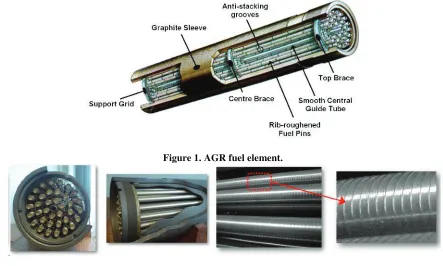
In the Advanced Gas-cooled Reactors (AGRs) a fuel element contains 36 fuel pins that hold the fuel pellets. The 36 fuel pins are contained within a cylindrical graphite sleeve. The fuel pins have helical ribs in order to increase the rate of heat transfer from the pins and to improve gas mixing in the fuel cluster. A fuel assembly is made out of 8 such fuel elements, stacked vertically end to end. As the graphite bricks making up the core of the reactor age, there is a possibility that mechanical interaction between the graphite sleeves and the bricks could cause small axial gaps to open between the fuel element sleeves. The gap could allow ingress of gas at a different temperature to occur. Currently it is assumed that all gas mixes before reaching the top of the assembly, due to the swirling motion imposed by the helical ribs. Recent studies using Computational Fluid Dynamics (CFD) have shown that the effect of the ribs might be limited to a region close to pins and therefore it is possible that the two streams of cold and hot gas do not mix completely before exiting the assembly.
No flow periodicity can be set due to the varying boundary conditions for the temperature along the fuel assembly. Therefore there is the need for a very large scale computation. This has been carried out using the High Performance Computing facilities at STFC. The total number of cells is close to one billion to be able to model the mixing of the two streams.
INTRODUCTION
Extending the current nuclear power plant lifetime is crucial to cover the ever-growing energy demand, before renewable energy gets more widespread and affordable. Checks and measurements carried out during plant operation provide necessary data to ensure safe operation, but in order to understand the changes after many years of service a more detailed knowledge of the working conditions inside the reactor is needed. New measurements are not possible without costly intrusive and disruptive work on site. Meanwhile, the constant improvement of CFD and HPC has made them suitable to tackle complex issues occurring in industrial situations.
be limited to a region close to pins and therefore it is possible that the two streams of cold and hot gas do not mix completely before exiting the assembly.
The temperature at the end of the assembly is measured by a single thermocouple and therefore it is impossible to know from plant data how uniform the thermal field is. In order to see what the effect of ingress of gas at a given point is, a CFD calculation is carried out. Due to the temperature distribution on the sleeve and the fuel pins, the thermal field evolves as the gas goes upwards. This means that a periodic calculation can only predict the pressure drop but not the thermal field. A CFD calculation involving the whole assembly has never been tried before due to the large number of cells required for this domain.
Recent advances in computational resources (software and hardware) have brought the field of CFD to a stage advanced enough where this type of calculation is now possible. This paper presents the first production run known to the authors with a mesh larger than 109 cells.
Figure 1. AGR fuel element.
Figure 2. Close up of the ribbed pins. GEOMETRY
The fuel assembly has 8 elements, each comprised by 36 pins. There is a guide tube in the middle that goes through all the assembly and whose surface is smooth (i.e. no ribs). Between each element there is a gap to allow the pins to expand while heated. The pins are helically ribbed with 12 starts. The element contains a mixture of right-handed and left-handed helices to promote gas mixing. This means that the symmetry is only achieved by a 120 degrees sector. Unlike the real element, the model does not contain any braces or support grids.
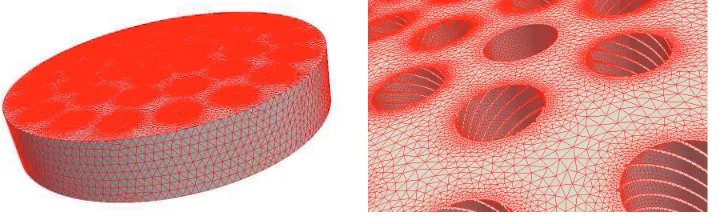
The model consists of two main parts, the fuel pins and the gaps between the each element. In order to create the mesh for the pins, a repeatable base section of a length equivalent to the rib pitch is created (see
Figure 3
). This section contains about 5.4 million tetrahedral cells. The capability of Code_Saturne for pasting meshes is used to translate and join this section 30 times. This creates one fuel element. Another mesh of about 2.1 million cells is created for the gap between elements and it is glued at the top of the element using the CFD software. This process is repeated to create the domain comprising 6.5 elements. All the interfaces are carefully constructed as conformal, even though the code can handle non-conformal joining. This avoids creating extra faces and therefore less CPU time is used during the computation. The mesh for the gap is built by extracting the boundary face of the base unit mesh, filling the holes for the pins surfaces and extruding it in the vertical direction with refinement near the pins. A prism layer mesh is added to all the solid surfaces to ensure the correct use of wall functions. The total number of cells for the 6.5 element mesh is 1,068,926,189.NUMERICAL APPROACH
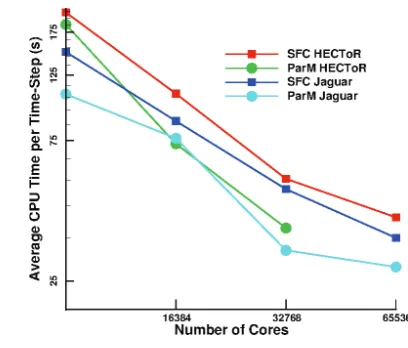
The CFD software Code_Saturne (Archambeau et. al. 2004) is used to compute the flow inside the fuel assembly. The recent developments of the code to join meshes in parallel are exploited to obtain the full domain mesh directly on the machine where the calculation takes place. The simulations were run on Blue Joule1 and on ARCHER2. Blue Joule is the Hartree Centre IBM Blue Gene/Q. It has 6 racks of 1,024 nodes, each node (16GB RAM) being made of 16 physical cores. ARCHER Phase 2 is the UK National Facility. It is a Cray XC30 with 4,920 nodes, each node (64 GB RAM at least) being made of 24 physical cores. The code has been optimised in recent year for use in HPC (Fournier et al. 2011) and a representative curve for its scalability in different machines using up to 65,536 cores is shown in
Figure
4
.The turbulence model used is the SST model of Menter (1994) with wall functions. The working fluid is CO2 and its properties have been made function of the temperature. The boundary conditions have been
taken from a representative set for normal operation of an AGR. These include the inlet velocities and temperature at the middle of the second fuel element and the heat flux profiles of the graphite sleeve and heat from the nuclear fuel (both function of the height).
Figure 3. Base repeated mesh.
1
http://community.hartree.stfc.ac.uk/wiki/site/admin/resources.html 2
Figure 4. Example of the scalability of Code_Saturne.
RESULTS
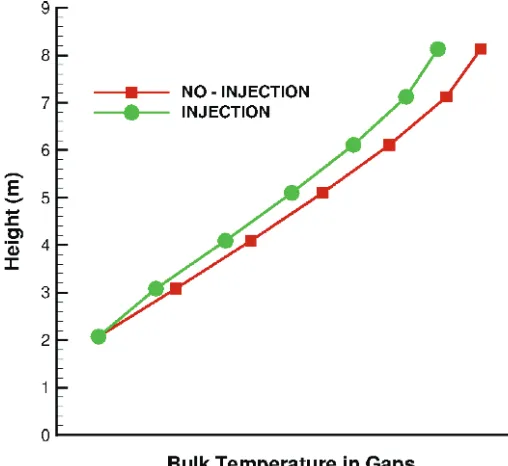
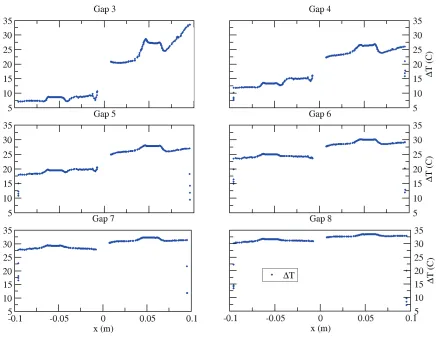
Two calculations are presented in this paper. The first one computes the flow inside the fuel assembly in normal operating conditions and is used as basis for comparison. The second case has the same domain, mesh and boundary conditions but it has an injection of colder gas at the top of the second element. This represents what might occur when the graphite sleeves move creating a gap in the locking system. The injection is done by selecting faces of the sleeve located in a given circle and imposing the injection velocity and temperature. It is noted that in real plant conditions the shape of the injection might not be circular but for the purpose of this study this is not expected to have a large influence. The mass flow of the jet is about 9% of the flow rate in the assembly and the bulk velocity of the jet is about 1.8 times larger than the averaged inlet velocity at the bottom of the domain.
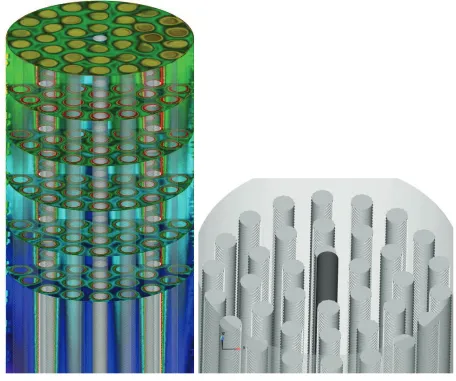
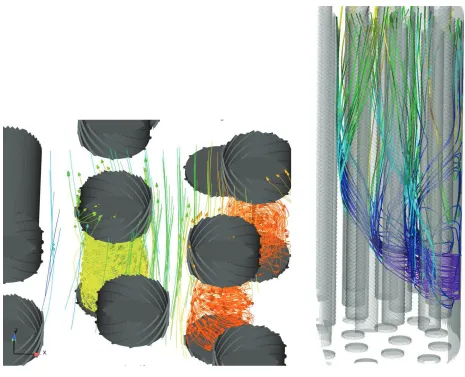
The base case presents some level of mixing of the gas as it travels upwards. The helical ribs induce a swirl that enhance the heat transfer at the pins but also helps mixing between the different channels between the ribs. This can be seen in
Figure 5
where the temperature at various cross sections is shown. The swirl generated by the ribs is easily seen in Figure 6 (left) which shows the top of element 2.plug, top reflector and flow control gag and these items could give additional mixing. This needs to be studied further.
CONCLUSIONS
The flow inside the AGR fuel assembly has been computed. The large size of the domain and the need to resolve the detail of the ribs makes it necessary to use a code that has excellent HPC performance and portability. Code_Saturne has been selected for these reasons and the recent improvements on its HPC capabilities have been tested in a real industrial case. The performance of the code has been satisfactory and the issues encountered by processing a large amount of data have been solved using the tools available inside the code.
The flow in the assembly has been compared with a case where there is ingress of gas through the graphite sleeve. For this particular case, the computation shows that the effect of a colder temperature gets almost completely mixed by the last fuel assembly. It is important to note that for other possible cases where the sleeve leakage is at a higher position or with a different mass flow, there could be still a cold plume by the time the gas reaches the end of the 8th element and therefore further investigation is required.
ACKNOWLEDGEMENTS
Figure 5. Temperature contours in element 2 (left) and schematics of the right and left handed pins.
REFERENCES
F. Archambeau, N. Mechitoua, and M. Sakiz. (2004) “A finite volume method for the
computation of turbulent incompressible flows - industrial applications”.
International
Journal on Finite Volumes
, 1 (1):1–62.
Y. Fournier, J. Bonelle, C. Moulinec, Z. Shang, A.G. Sunderland, and J.C. Uribe. (2011)
“Optimizing Code_Saturne computations on petascale systems”.
Computers & Fluids
,
45(1):103–108.
F. Menter. (1994) "Two-Equation Eddy-Viscosity Turbulence Models for Engineering
Applications,"
AIAA Journal
, 32:1598-1605.
8-7 6-5 4-3 2 8-7 6-5 4-3 2
Figure 7. Temperature contours at the midplane. Base case (left) and injection case (right) Fuel Element numbers given on axis.