©
DOI: 10.1534/genetics.104.040386
Bayesian Model Selection for Genome-Wide Epistatic Quantitative
Trait Loci Analysis
Nengjun Yi,*
,†,1Brian S. Yandell,
‡Gary A. Churchill,
§David B. Allison,*
,†Eugene J. Eisen** and Daniel Pomp
††*Department of Biostatistics, Section on Statistical Genetics,†Clinical Nutrition Research Center, University of Alabama, Birmingham, Alabama 35294,‡Departments of Statistics and Horticulture, University of Wisconsin, Madison, Wisconsin 53706,
§The Jackson Laboratory, Bar Harbor, Maine 04609,**Department of Animal Science, North Carolina State University, Raleigh, North Carolina 27695 and††Department of Animal Science,
University of Nebraska, Lincoln, Nebraska 68583 Manuscript received December 29, 2004
Accepted for publication April 4, 2005
ABSTRACT
The problem of identifying complex epistatic quantitative trait loci (QTL) across the entire genome continues to be a formidable challenge for geneticists. The complexity of genome-wide epistatic analysis results mainly from the number of QTL being unknown and the number of possible epistatic effects being huge. In this article, we use a composite model space approach to develop a Bayesian model selection framework for identifying epistatic QTL for complex traits in experimental crosses from two inbred lines. By placing a liberal constraint on the upper bound of the number of detectable QTL we restrict attention to models of fixed dimension, greatly simplifying calculations. Indicators specify which main and epistatic effects of putative QTL are included. We detail how to use prior knowledge to bound the number of detectable QTL and to specify prior distributions for indicators of genetic effects. We develop a computa-tionally efficient Markov chain Monte Carlo (MCMC) algorithm using the Gibbs sampler and Metropolis-Hastings algorithm to explore the posterior distribution. We illustrate the proposed method by detecting new epistatic QTL for obesity in a backcross of CAST/Ei mice onto M16i.
M
ANY complex human diseases and traits of bio- tive corrections for multiple testing. Non-Bayesian modellogical and/or economic importance are deter- selection methods combine simultaneous search with a
mined by multiple genetic and environmental influ- sequential procedure such as forward or stepwise
selec-ences (Lynch and Walsh 1998). Mounting evidence tion and apply criteria such asP-values or modified
Baye-suggests that interactions among genes (epistasis) play sian information criterion (BIC) to identify well-fitting
an important role in the genetic control and evolu- multiple-QTL models (Kaoet al.1999;Carlborget al.
tion of complex traits (Cheverud2000;Carlborgand 2000;Reifsnyderet al.2000;Bogdanet al.2004). These
Haley2004). Mapping quantitative trait loci (QTL) is methods, although appealing in their simplicity and
pop-a process of inferring the number of QTL, their geno- ularity, have several drawbacks, including: (1) the
uncer-mic positions, and genetic effects given observed pheno- tainty about the model itself is ignored in the final
in-type and marker genoin-type data. From a statistical per- ference, (2) they involve a complex sequential testing
spective, two key problems in QTL mapping are model strategy that includes a dynamically changing null
hy-search and selection (e.g., Broman and Speed 2002; pothesis, and (3) the selection procedure is heavily
in-Sillanpa¨a¨andCorander2002;Yi 2004). Traditional fluenced by the quantity of data (Rafteryet al. 1997;
QTL mapping methods utilize a statistical model, which George 2000;Gelmanet al.2004;KadaneandLazar
estimates the effects of only one QTL whose putative 2004).
position is scanned across the genome (e.g.,Landerand Bayesian model selection methods provide a
power-Botstein 1989; Jansen and Stam 1994; Zeng1994). ful and conceptually simple approach to mapping
multi-Extensions of this approach can allow for main and epi- ple QTL (Satagopanet al.1996;Hoeschele2001;Sen
static effects at two or perhaps a few QTL at a time and and Churchill 2001). The Bayesian approach
pro-employ a multidimensional scan to detect QTL. How- ceeds by setting up a likelihood function for the
pheno-ever, such an approach neglects potential confound- type and assigning prior distributions to all unknowns
ing effects from additional QTL and requires prohibi- in the problem. These induce a posterior distribution
on the unknown quantities that contains all of the avail-able information for inference of the genetic
architec-1Corresponding author:Department of Biostatistics, University of
Ala-ture of the trait. Bayesian mapping methods can treat
bama, Ryals Public Health Bldg., 1665 University Blvd., Birmingham,
AL 35294-0022. E-mail: [email protected] the unknown number of QTL as a random variable,
A BAYESIAN MODEL SELECTION FRAMEWORK
which has several advantages but results in the
complica-FOR QTL MAPPING
tion of varying the dimension of the model space. The
reversible jump Markov chain Monte Carlo (MCMC) We consider experimental crosses derived from two
algorithm, introduced byGreen(1995), offers a power- inbred lines. In QTL studies, the observed data consist
ful and general approach to exploring posterior distri- of phenotypic trait values,y, and marker genotypes,m,
butions in this setting. However, the ability to “move” for individuals in a mapping population. We assume that
between models of different dimension requires a care- markers are organized into a linkage map and restrict
ful construction of proposal distributions. Despite the attention to models with, at most, pairwise interactions.
challenges of implementation of reversible jump algo- We partition the entire genome into H loci, ⫽ {1,
rithms, effective approaches for mapping multiple non- . . . , H}, and assume that the possible QTL occur at
interacting QTL have been developed (Satagopanand these fixed positions. This introduces only a minor bias
Yandell1996;Heath1997;Thomaset al.1997;Uimari in estimating the position of QTL whenHis large. When
andHoeschele1997;Sillanpa¨a¨andArjas1998;Ste- the markers are densely and regularly spaced, we set
phensandFisch1998;YiandXu2000;Gaffney2001). to the marker positions; otherwise,includes not only
Bayesian model selection methods employing the re- the marker positions but also points between markers.
versible jump MCMC algorithm have been proposed to In general, the genotypes,g, at lociare unobservable
map epistatic QTL in inbred line crosses and outbred pop- except at completely informative markers, but their
ulations (YiandXu2002;Yiet al.2003, 2004a,b;Narita probability distribution, p(g|,m), can be inferred from
andSasaki2004). However, the complexity of the reversi- the observed marker data using the multipoint method
ble jump steps increases computational demand and may (JiangandZeng1997). This probability distribution is
prohibit improvements of the algorithms. used as the prior distribution of QTL genotypes in our
Recently, Yi (2004) proposed a unified Bayesian Bayesian framework.
model selection framework to identify multiple nonepi- The problem of inferring the number and locations
static QTL for complex traits in experimental designs, of multiple QTL is equivalent to the problem of
select-based upon a composite space representation of the ing a subset ofthat fully explains the phenotypic
varia-problem. The composite space approach, which is a tion. Although a complex trait may be influenced by
modification of the product space concept developed multitudes of loci, our emphasis is on a set of at most
by Carlin and Chib (1995), provides an interesting LQTL with detectable effects. TypicallyLwill be much
viewpoint on a wide variety of model selection prob- smaller thanH. Let ⫽ {1, . . . ,L} (僆{1, . . . ,H})
lems (Godsill2001). The key feature of the composite be the current positions ofLputative QTL. Each locus
model space is that the dimension remains fixed, may affect the trait through its marginal (main) effects
allowing for MCMC simulation to be performed on a and/or interactions with other loci (epistasis). The
phe-space of fixed dimension, thus avoiding the complexi- notype distribution is assumed to follow a linear model,
ties of reversible jump. InYi(2004), the varying
dimen-y⫽⫹X⫹ e, (1)
sional space is augmented to a fixed dimensional space
(the composite model space) by placing an upper bound where is the overall mean,  denotes the vector of
on the number of detectable QTL. In the composite all possible main effects and pairwise interactions ofL
model space, latent binary variables indicate whether potential QTL ,Xis the design matrix, andeis the
vec-each putative QTL has a nonzero effect. The result- tor of independent normal errors with mean zero and
ing hierarchical model can vastly simplify the MCMC variance2. The number of genetic effects depends on
search strategy. the experimental design, and the design matrix X is
In this work we extend the composite model space determined from those genotypesgat the current loci
approach to include epistatic effects. We develop a frame- by using a particular genetic model (seeappendix a
work of Bayesian model selection for mapping epistatic for details of the Cockerham genetic model used here).
QTL in experimental crosses from two inbred lines. We There is prior uncertainty about which genetic effects
show how to incorporate prior knowledge to select an should be included in the model. As in Bayesian
vari-upper bound on the number of detectable QTL and able selection for linear regression (e.g., George and
prior distributions for indicator variables of genetic ef- McCulloch 1997;Kuo andMallick 1998; Chipman
fects and other parameters. A computationally efficient et al. 2001), we introduce a binary variable␥ for each
MCMC algorithm using a Gibbs sampler or Metropolis- effect, indicating that the corresponding effect is
in-Hastings (M-H) algorithm is developed to explore the cluded (␥ ⫽ 1) or excluded (␥ ⫽ 0) from a model.
posterior distribution on the parameters. The proposed Letting⌫⫽diag(␥), the model becomes
algorithm is easy to implement and allows more
com-y⫽⫹X⌫⫹e. (2)
plete and rapid exploration of the model space. We first
describe the implementation of this algorithm and then This linear model defines the likelihood,p(y|␥,X,),
illustrate the method by analyzing a mouse backcross with⫽(,,2), and the full posterior can be
p(␥,,g,|y,m)⬀p(y|␥,X,)p(␥,,g,|m). wmandwe, it may be better to first determine the prior
expected numbers of main-effect QTL,lm, and all QTL,
(3)
l0 ⱖlm(i.e., main-effect and epistatic QTL), and then
Specifications of priorsp(␥,,g,|m) and posterior
solve forwmandwefrom the expressions of the prior
ex-calculation are given in subsequent sections.
pected numbers. It is reasonable to require thatwmⱖwe,
The vector ␥ determines the number of QTL (see
which requires some adjustment below whenlm⫽0.
appendix b). Hereafter, we denote the included
po-As shown inappendix b, the prior expected number
sitions of QTL by ␥. The vector (␥,␥) comprises a of main-effect QTL can be expressed as
model index that identifies the genetic architecture of
lm⫽ L[1⫺ (1⫺wm)K], (5)
the trait. A natural model selection strategy is to choose
the most probable model (␥, ␥) on the basis of its
and the prior expected number of all QTL as
marginal posterior,p(␥,␥|y,m) (GeorgeandFoster
2000). For genome-wide epistatic analysis, however, no l0⫽ L[1⫺ (1⫺wm)K(1 ⫺we)K
2(L⫺1)
], (6)
single model may stand out, and thus we average over
whereKis the number of possible main effects for each
possible models when assessing characteristics of
ge-QTL andK2is the number of possible epistatic effects
netic architecture, with the various models weighted by
for any two QTL.
their posterior probability (Raftery et al.1997; Ball
The prior expected number of main-effect QTL ,lm,
2001;Sillanpa¨a¨andCorander2002).
could be set to the number of QTL detected by
tra-ditional nonepistatic mapping methods, e.g., interval
mapping or composite interval mapping (Landerand
PRIOR DISTRIBUTIONS
Botstein1989;Zeng1994). The prior expected
num-The above Bayesian model selection framework
pro-ber of all QTL ,l0, should be chosen to be at leastlm.
vides a conceptually simple and general method to
iden-The number of QTL detected by traditional epistatic tify complex epistatic QTL across the entire genome.
mapping methods,e.g., two-dimensional genome scan,
However, its practical implementation entails two
chal-could provide a rough guide for choosing l0. From
lenges: prior specification and posterior calculation. In
Equations 5 and 6, we obtain this section, we first propose a method to choose an
upper bound for the number of QTL and then describe
wm⫽ 1⫺
冤
1⫺ lmL
冥
1/K(7) the prior specifications for the model index and other
unknowns.
and Choice of the upper boundL:We suggest first
speci-fying the prior expected number of QTL , l0, on the
we⫽ 1⫺
冤
1⫺(l0/L)
(1⫺ wm)K
冥
1/K2(L⫺1)
. (8)
basis of initial investigations with traditional methods, and then determining a reasonably large upper bound,
We note above that if no main-effect QTL is detected
L. We assign the prior probability distribution for the
by traditional nonepistatic mapping methods andlm⫽
number of QTL, l, to be a Poisson distribution with
0, then wm ⫽ 0. In this case, we suggest making all
mean l0. The value of L can be selected to be large
weights equal,wm⫽we⫽
䉭
w, and using (6) to obtain
enough that the probability Pr(l ⬎L) is very small. On
the basis of a normal approximation to the Poisson
distribution, we could takeLasl0⫹3√l0. w⫽ 1⫺
冢
1⫺l0 L
冣
1/(K⫹K2(L⫺1))
. (9)
Prior on ␥: For the indicator vector ␥, we use an
independence prior of the form Prior on:When there is no prior information
con-cerning QTL locations, these could be assumed to be
p(␥)⫽
兿
w␥jj(1⫺ wj)1⫺␥j, (4)
independent and uniformly distributed over theH
pos-sible loci. Thus, givenl0the prior probability that any
wherewj⫽ p(␥j⫽1) is the prior inclusion probability
locus is included becomesl0/H. In practice, it may be
for thejth effect. We assume thatwjequals the
predeter-reasonable to assume that any intervals of a given length
mined hyperparameterwmorwe, depending on thejth
(e.g., 10 cM) contain at most one QTL . Although this
as-effect being main as-effect or epistatic as-effect, respectively.
sumption is not necessary, it can substantially reduce the Under this prior, the importance of any effect is
inde-model space and thus accelerate the search procedure. pendent of the importance of any other effect and the
Prior on : We propose the following hierarchical prior inclusion probability of main effect is different
mixture prior for each genetic effect, from that of epistatic effect.
The hyperparameterswmandwecontrol the expected 
j|(␥j,2,x•j)ⵑN(0,␥jc2(xT•jx•j)⫺1), (10) numbers of main and epistatic effects included in the
model, respectively; smallwmandwewould concentrate wherex•j⫽(x1j, . . . ,xn j)Tis the vector of the coefficients
ofj, andcis a positive scale factor. Many suggestions
the priors on parsimonious models with few main
selec-tion problems of linear regression (e.g.,Chipmanet al. p(␥,g␥,␥|␥,y)⬀p(y|␥,X␥,␥)p(␥,g␥,␥|␥),
2001;Fernandezet al. 2001). In this study, we takec⫽
(14)
n, which is a popular choice and yields the BIC if the
prior inclusion probability for each effect equals 0.5 p(⫺␥,g⫺␥,⫺␥|␥,y)⬀p(⫺␥,g⫺␥,⫺␥|␥), (15)
(e.g.,George andFoster2000;Chipmanet al.2001).
and In this prior setup, a point mass prior at 0 is used for
the genetic effectjwhen␥j⫽ 0, effectively removing p(␥|,g,,y)⬀p(y|␥,X
␥,␥)p(␥)p(␥,g␥,␥|␥)
jfrom the model. If␥j⫽1, the prior variances reflect
⫻ p(⫺␥,g⫺␥,⫺␥|␥). (16)
the precision of each j and are invariant to scales
changes in the phenotype and the coefficients. The
It can be seen that the unused parameters do not affect
value (xT
•jx•j)⫺1 varies for different types of genetic
ef-the conditional posterior of (␥, g␥, ␥) and thus do
fects. For a large backcross population with no
segrega-not need to be updated conditional on ␥. Since the
tion distortion, for example, (xT
•jx•j)⫺1/n⬇ 1⁄4for
mar-unused parameters do not contribute to the likelihood,
ginal effects and [1⫺(1⫺2r)2]/16 for epistatic effects,
the posterior of (⫺␥,g⫺␥,⫺␥) is identical to its prior.
with r the recombination fraction between two QTL ,
From (16), the conditional posterior of ␥depends on
under Cockerham’s model (Zenget al.2000).
(⫺␥,g⫺␥,⫺␥) and thus the update of␥requires
genera-Priors onand2:The prior for the overall mean
tion of the corresponding unused parameters in the
isN(0,20). We could empirically set
current model. These properties lead us to develop MCMC algorithms as described below. We first briefly
0⫽y⫽
1
n
兺
n
i⫽1
yi and 20⫽ s2y ⫽ 1
n⫺1
兺
ni⫽1
(yi⫺y)2.
describe the algorithms for updating␥,g␥, and ␥and
then develop a novel Gibbs sampler and Metropolis-We take the noninformative prior for the residual
vari-Hastings algorithm to update the indicator variables for
ance,p(2)⬀1/2(Gelmanet al.2004). Although this
main and epistatic effects, respectively. prior is improper, it yields a proper posterior
distri-Conditional on␥,X␥, and ␥, the parameters,2,
bution for the unknowns and so can be used formally
and ␥ can be sampled directly from their posterior
(Chipmanet al.2001).
distributions, which have standard form (Gelmanet al.
2004). Conditional on␥,␥, and␥, the posterior
distri-bution of each element ofg␥ is multinomial and thus
MARKOV CHAIN MONTE CARLO ALGORITHM
can be sampled directly as well (YiandXu 2002). We
To develop our MCMC algorithm, we first partition
adapt the algorithm ofYiet al.(2003) to our model to
the vector of unknowns (,g,) into (␥,g␥,␥) and update locations
␥: (1) is restricted to the discrete
(⫺␥, g⫺␥, ⫺␥), representing the unknowns included space ⫽ {
1, . . . , H}, and (2) any intervals of some
or excluded from the model, respectively, where␥and length␦include at most one QTL . To update
q,
there-g␥ (⫺␥ andg⫺␥) are the positions and the genotypes fore, we propose a new location *
q for the qth QTL
of QTL included (excluded), respectively,␥(⫺␥) rep- uniformly from 2d most flanking loci of
q, whered is
resent the genetic effects included (excluded),⫽(,
a predetermined integer (e.g.,d⫽2), and then generate
,2),
␥⫽(␥,,2), and⫺␥⫽⫺␥. Similarly,X␥ genotypes at the new location for all individuals. The
(X⫺␥) represent the model coefficients included (ex- proposals for the new location and the genotypes are
cluded), which are determined bygand␥.
then jointly accepted or rejected using the Metropolis-We suppress the dependence on the observed marker
Hastings algorithm.
data below. For a particular ␥the likelihood function
At each iteration of the MCMC simulation, we update
depends only upon the parameters (X␥,␥) used by that
all elements of␥ in some fixed or random order. For
model,i.e.,
the indicator variable of a main effect, we need to
con-p(y|␥,X,)⫽p(y|␥,X␥,␥). (11) sider two different cases: a QTL is currently (1) in or
(2) out of the model. For (1), the QTL position and
The prior distribution of (,␥,g,) can be partitioned as
genotypes were generated at the preceding iteration. For (2), we sample a new QTL position from its prior
p(␥,,g,)⫽p(␥)p(␥,g␥,␥|␥)p(⫺␥,g⫺␥,⫺␥|␥).
distribution and generate its genotypes for all individu-(12)
als. An epistatic effect involves two QTL , hence three
The full posterior distribution for (␥,,g,) can now
different cases: (1) both QTL are in, (2) only one QTL be expressed as
is in, and (3) both QTL are out of the model. Again, the new QTL position(s) and genotypes are sampled as
p(␥,,g,|y)⬀p(y|␥,X␥,␥)p(␥)p(␥,g␥,␥|␥)
needed.
⫻p(⫺␥,g⫺␥,⫺␥|␥). (13) We update ␥
j, the indicator variable for an effect,
using its conditional posterior distribution of␥j, which
From (13), we can derive the conditional posterior
p(␥j⫽1|␥⫺␥j,X,⫺j,y)⫽1⫺p(␥j⫽0|␥⫺␥j,X,⫺j,y) p(
h|y)⫽ 1
N
兺
N
t⫽1
兺
L
q⫽1
1((t)
q ⫽ h,(qt)⫽1), h⫽0, 1, . . . ,H, (19)
⫽ wR
(1⫺w)⫹wR, (17)
whereqis the binary indicator that QTLqis included
where or excluded from the model. Thus, we can obtain the
cumulative distribution function per chromosome,
de-R⫽
p(y|␥j⫽1,␥⫺␥j,X,⫺j)
p(y|␥j⫽0,␥⫺␥j,X,⫺j) ⫽
冢
⫺2
j ⫹ ⫺2
兺
ni⫽1x2ij
⫺2
j
冣
⫺0.5fined asFc(x|y)⫽兺 x
h⫽0p(h|y) for any positionxon
chro-mosomec. It is worth noting that the cumulative
distribu-tion funcdistribu-tion defined here can be⬎1 if the corresponding
⫻exp
冢
1 2(
兺
ni⫽1xij(yi⫺ ⫺xi· ⫹xijj)⫺2)2
⫺2
j ⫹ ⫺2
兺
ni⫽1x2ij
冣
,chromosome contains more than one QTL. Bothp(h|y)
andFc(x|y) can be graphically displayed and show
evi-xi•is the vector of the coefficients offor theith individ- dence of QTL activity across the whole genome.
Com-ual,w⫽pr(␥j⫽1) is the prior probability thatjappears monly used summaries include the posterior
probabil-in the model,2jis the prior variance ofj(see Equation ity that a chromosomal region contains QTL , the most
likely position of QTL (the mode of QTL positions),
10),␥⫺␥jmeans all the elements of␥except for␥j, and
and the region of highest posterior density (HPD) (e.g.,
⫺jrepresents all the elements ofexcept forj. We
Gelmanet al. 2004). To take the prior specifications,
can sample␥jdirectly from (17) or update␥jwith
proba-bility min(1,r), wherer⫽((w/1⫺w)R)1⫺2␥j. p(
h), into consideration, we can use the Bayes factor
to show evidence for inclusion ofh against exclusion
The effectjwas integrated from (17). We can generate
jas follows. If␥jis sampled to be zero,j⫽0. Otherwise, ofh(KassandRaftery1995),
jis generated from its conditional posterior
BF(h)⫽
p(h|y) 1⫺p(h|y)
·1⫺p(h)
p(h)
. (20)
p(j|␥j⫽ 1,␥⫺␥j,X,⫺j,y)⫽ N(˜j,˜
2
j), (18)
where In a similar fashion, we can compute the Bayes factor
comparing a chromosomal region containing QTL to
˜j ⫽(2⫺2j ⫹
兺
ni⫽1
x2
ij)⫺1
兺
ni⫽1
xij(yi⫺ ⫺xi•⫹xijj) that excluding QTL .
We can estimate the main effects at any locus or
chro-mosomal intervals⌬,
and
˜⫺2j ⫽ ⫺2j ⫹
⫺2
兺
ni⫽1
x2
ij. k(⌬)⫽
1 N
兺
N
t⫽1
兺
L
q⫽1 1((t)
q 僆⌬,(qt)⫽1)(qkt), k⫽1, 2, . . . ,K. (21)
The heritabilities explained by the main effects can also
POSTERIOR ANALYSIS be estimated. In epistatic analysis, we need to estimate
two types of additional parameters, the posterior inclu-The MCMC algorithm described above starts from
ini-sion probability and the size of epistatic effects, both tial values and updates each group of unknowns in turn.
involving pairs of loci. These two types of unknowns can Initial iterations are discarded as “burn-in.” To reduce
be estimated with natural extensions of (19) and (21), serial correlation, we thin the subsequent samples by
respectively.
keeping everykth simulation draw and discarding the
rest, where k is an integer. The MCMC sampler
se-quence {(␥(t) ,(t)
␥ ,g(␥t),␥(t));t⫽1, . . . ,N} is a random EXAMPLE
draw from the joint posterior distributionp(␥,␥,g␥,
␥|y), and thus the embedded subsequence {(␥(t),(␥t)); We illustrate the application of our Bayesian model
selection approach by an analysis of a mouse cross
pro-t ⫽ 1, . . . , N} is a random sample from its marginal
posterior distributionp(␥,␥|y), which is used to infer duced from two highly divergent strains: M16i,
consist-ing of large and moderately obese mice, and CAST/Ei, the genetic architecture of the complex trait. For
ge-nome-wide epistatic analysis, no single model may stand a wild strain of small mice with lean bodies (Leamyet al.
2002). CAST/Ei males were mated to M16i females, and out, and we may average over all possible models to
as-sess genetic architecture. Bayesian model averaging pro- F1males were backcrossed to M16i females, resulting in
54 litters and 421 mice (213 males, 208 females) reach-vides more robust inferences about quantities of interest
than any single model since it incorporates model un- ing 12 weeks of age. All mice were genotyped for 92
microsatellite markers located on 19 autosomal
chromo-certainty (Rafteryet al. 1997; Ball 2001; Sillanpa¨a¨
andCorander2002). somes. The marker linkage map covered 1214 cM with
average spacing of 13 cM. In this study, we analyze FAT, The most important characteristic may be the
poste-rior inclusion probability of each possible locush, esti- the sum of right gonadal and hindlimb subcutaneous
Figure1.—Profiles of LOD scores from maxi-mum-likelihood interval mapping. On thex-axis, large tick marks represent chromosomes and small tick marks represent markers.
linearly adjusted by sex and dam and standardized to ated. For all analyses, the MCMC started with no QTL
and ran for 4⫻105cycles after discarding the first 2000
mean 0 and variance 1, although this transformation
may result in the possibility of destroying true biological burn-ins. The chain was thinned by one in k ⫽ 20,
yielding 2⫻104samples for posterior Bayesian analysis.
interaction (Jansen 2003). We used the Cockerham
genetic model (appendix a), in which the coefficients An initial interval map scan revealed three significant
QTL (LOD⬎3.2) on chromosomes 2, 13, and 15
(Fig-of main effects are defined as 0.5 and⫺0.5 for the two
genotypes, CM and MM, where C and M represent the ure 1), explaining 20.7, 4.9, and 5.1% of the phenotypic
variance, respectively. CAST/Ei and M16i alleles, respectively.
We partitioned each chromosome with a 1-cM grid, Under the nonepistatic analysis, epistatic effects are
always excluded from the model and thus putative QTL resulting in 1214 possible loci across the genome. A
nonepistatic and an epistatic QTL model were evalu- are chosen only on the basis of their main effects. As
Figure 3.—Bayesian nonepistatic analysis: profiles of Bayes factor. Black line,lm⫽1; red line,lm ⫽3; blue line,lm ⫽6. On the x- axis, large tick marks represent chromosomes and small tick marks represent markers.
described earlier, we took the number of significant Therefore, the prior probabilities of inclusion for each
main effect werewm⫽1⫺[1⫺(lm/L)]1/K⫽1⁄3,1⁄4, and
QTL detected in the interval mapping as the prior
num-ber of main-effect QTL (lm). To check prior sensitivity, 3⁄7, respectively. Figure 2, top, displays the posterior
prob-ability of inclusion for each locus across the genome.
we reran the algorithm forlm⫽1, 6. The upper bound
of the number of QTL was calculated asL⬇lm⫹3√lm, Note the similarity to Figure 1, with clear evidence of
QTL and flat profiles on other chromosomes. The peaks
orL ⫽9, 4, and 14 for lm⫽ 3, 1, and 6, respectively.
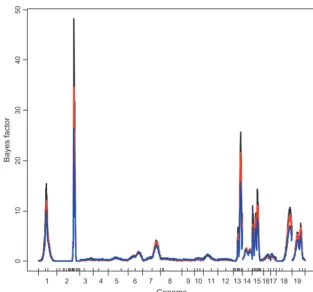
Figure5.—Bayesian epistatic analysis: pro-files of Bayes factor. Black line,l0⫽4; red line, l0⫽6; blue line,l0⫽8. On thex- axis, large tick marks represent chromosomes and small tick marks represent markers.
on chromosomes 2, 13, and 15 overlap those identified tended to provide smaller posteriors, especially for
inquently arising loci. However, the identification of fre-by interval mapping. The graphs of the cumulative
dis-tribution function, displayed in Figure 2, bottom, show quent arising loci remained the same. The profiles of
the Bayes factor are depicted in Figure 5. The three that the posterior inclusion probability of each
chromo-some is close to 1 for chromochromo-somes 2, 13, and 15. The choices oflmprovided similar profiles of the Bayes
fac-tor, especially for infrequently arising loci. results show that, at least in this data set, detection of
large-effect QTL is not sensitive to the choice of lm. As shown in Figures 4 and 5, the epistatic analyses
detected the same regions on chromosomes 2, 13, and
However, larger lm tend to pick up more small-effect
QTL as expected. The profiles of the Bayes factor are 15 as the nonepistatic analyses. In addition to those on
chromosomes 2, 13, and 15, our epistatic analyses found
depicted in Figure 3. For the three choices oflm, the
regions on chromosomes 2, 13, and 15 show strong strong evidence of QTL on chromosomes 1, 18, and
19 with high cumulative probabilities (close to 1) and evidence for being selected, and other regions show a
very low Bayes factor. suggestive evidence of QTL on chromosomes 7 and 14.
In the nonepistatic analyses, these chromosomes were
The epistatic analysis took lm ⫽ 3, the number of
QTL detected in the nonepistatic analyses, as the prior found to have weak main effects and hence were
de-tected in the epistatic model mainly due to epistatic expected number of main-effect QTL . Three values,
l0 ⫽ 4, 6, and 8, were chosen as the prior expected interactions.
The profiles of the location-wise main effects and the number of all QTL under the epistatic model. The
up-per bound of the number of QTL ,L, was thusL⫽10, variances explained by the main effects are depicted in
Figure 6. For the three prior specifications, the posterior 14, and 17, respectively. From Equations 7 and 8, the
prior inclusion probabilities were 0.30, 0.21, and 0.18 inferences were essentially identical. Therefore, we
re-ported only the summary statistics forl0⫽6 (see Tables
for main effects and 0.017, 0.025, and 0.027 for epistatic
effects, for the three values of (l0,L), respectively. The 1 and 2). For the HPD regions on chromosomes 2, 13,
and 15, the posterior inclusion probabilities are close profiles of the posterior inclusion probability for each
locus across the genome and the cumulative posterior to 1, and the corresponding Bayes factors are high. The
estimated main effects were⫺0.856, 0.371, and⫺0.342
probability for each chromosome are depicted in Figure
4, top and bottom, respectively. It can be seen that the and explained 18.4, 3.5, and 3.1% of the phenotypic
variance, respectively. For the HPD regions on
chromo-three different prior specifications of (l0,L) provided
fairly similar profiles of the posteriors, indicating that somes 1, 18, and 19, the posterior inclusion probabilities
were ⵑ82, 88, and 70%, and the corresponding Bayes the posterior inference may be not very sensitive toward
the small or mediate change of l0. As expected, the factors wereⵑ28, 47, and 12, respectively. In these HPD
Figure6.—Bayesian epistatic analysis: profiles of main effect and heritability explained by main effect. Black line,l0⫽ 4; red line, l0 ⫽ 6; blue line, l0 ⫽ 8. On thex- axis, large tick marks represent chromosomes and small tick marks rep-resent markers.
plained low proportions of the phenotypic variance. from relatively short runs. The Bayesian framework
pro-vides a robust inference of genetic architecture that However, our epistatic analyses detected strong epistatic
interactions associated with the HPD regions on chro- incorporates model uncertainty by averaging over all
possible models (Rafteryet al. 1997;Ball2001;
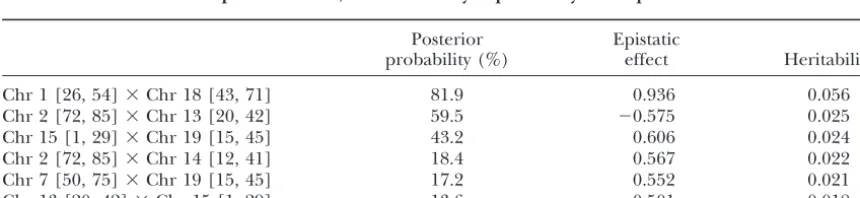
Sil-mosomes 1, 18, and 19. As shown in Table 2, the
strong-est epistasis is the interaction between chromosomes 1 lanpa¨a¨andCorander2002).
and 18. This epistatic effect was estimated to be 0.936 One of the most challenging statistical problems
pre-and explained 5.6% of the phenotypic variance. The pos- sented by QTL mapping is that the number of QTL is
un-terior inclusion probability of this epistasis was 81.9%. known. Most previous Bayesian mapping methods treat
The region of chromosome 19 was found to interact QTL models as models of varying dimension and
em-with chromosomes 15 and 7. The interaction between ploy the reversible jump MCMC algorithm to explore
the regions of chromosomes 19 and 15 was 0.604 and the posterior. Although such a framework is very general
explained 2.5% of the phenotypic variance. The epi- and powerful (Green1995), it is difficult to implement
static analyses also revealed interactions among chromo- efficient search strategies. The key idea of the proposed
somes 2, 13, and 15. For example, the interaction be- Bayesian approach is to turn varying dimensional space
tween the HPD regions on chromosomes 2 and 13 was of multiple-QTL models into fixed dimensional model
included in the model with probability of ⵑ60% and space by using a fixed but large set of known loci,,
explainedⵑ2.5% of the phenotypic variance. and putting a constraint on the upper bound of the
number of detectable QTL . In this setting, posterior simulation then can be achieved with a relatively simple
DISCUSSION
Gibbs sampler or M-H algorithm (Godsill 2001; Yi
2004). The algorithm proposed herein is easier to imple-The Bayesian model selection approach provides a
ment than the reversible jump method and it reduces comprehensive solution to mapping multiple epistatic
the computational time of model search, an essential QTL across the entire genome using the posterior
distri-feature for the practical analysis of complex genetic bution as a selection criterion. MCMC algorithms based
architectures. on the composite model space representation mix
rap-A prerequisite of the proposed method is a reasonable idly, thus ensuring that high-probability models are
TABLE 1
Summary statistics for epistatic analysis: high posterior density (HPD) regions of QTL locations, posterior inclusion probabilities of main effects, Bayes factors, estimated main effects,
and heritabilities explained by main effects in the HPD regions
Chromosome
2 13 15 1 18 19 7 14
HPD region (cM) [72, 85] [20, 42] [1, 29] [26, 54] [43, 71] [15, 45] [50, 75] [12, 41]
Posterior probability (%) 98.3 97.2 93.5 81.9 88.4 70.6 36.7 30.1
Bayes factor 821.4 291.3 92.2 28.1 47.3 12.2 4.1 2.7
Main effect ⫺0.856 0.371 ⫺0.342 ⫺0.037 0.103 ⫺0.167 ⫺0.137 ⫺0.147
Heritability 0.184 0.035 0.031 0.002 0.015 0.020 0.019 0.009
QTL . A minimal requirement is that the predetermined to reasonably reduce the model space, such as our
pro-posed composite model space approach, can improve upper bound is greater than the true number of QTL
with high probability. As an extreme case, we could take the performance of the MCMC algorithms and enhance
our ability to detect complex epistatic QTL . We
parti-the total number of loci (H) as the upper bound. Since
the number of detectable QTL is usually much less than tion the entire genome into intervals by a number of
points and restrict putative QTL to these fixed points,
H, such a choice is unlikely to be optimal. The
sugges-tion made here utilizes the expected number of QTL reducing loci to a discrete space. Additional speedup is
achieved by computing the conditional probability of and the prior probability distribution of the number
of QTL to determine the upper bound. The expected the genotypes given the marker data on this fixed (but
dense) grid of possible locations before the MCMC pro-number of QTL could be roughly estimated using
stan-dard genome scans. In practice, one could experiment cedure starts.
Several other strategies of reducing the model space with several values of the expected number of QTL and
investigate their impact on the posterior inference. In could be incorporated into the proposed approach to
improve the procedure. We could adopt a two-stage high-dimensional problems, specifying the prior
distri-butions on both the model space and parameters is search method, first searching for main-effect QTL and
second searching for epistatic effects of these and addi-perhaps the most difficult aspect of Bayesian model
selection. We propose a novel method for elicitation of tional epistatic QTL given the already detected
main-effect QTL . The positions and main main-effects of the QTL prior distribution on the indicator variables. Instead of
directly specifying the prior inclusion probabilitieswm detected in the first stage should be updated in the
second stage since inclusion of epistatic effects may yield
andwe, the expected numbers of main-effect QTL and
all QTL can first be given incorporating previous results more accurate estimation of the positions and the
ef-fects. Alternatively, we could selectively ignore some
ge-and then are used to determine wm and we. Here we
have fixedwmandwebut we could relax this by treating netic effects. Even with a moderate number of
detect-able QTL, the epistatic models must accommodate many
wmandweas unknown model parameters and assigning
priors (Kohnet al.2001). potential genetic effects. In a backcross population, for
example, there are a total ofL(L⫹1)/2 (⫽210, ifL⫽
A major difficulty of genome-wide epistatic analysis
is created by the huge size of the model space. Strategies 20, say) possible effects, but many may be negligible.
TABLE 2
Summary statistics for epistatic analysis: posterior inclusion probabilities of epistatic effects, estimated epistatic effects, and heritability explained by each epistatic effect
Posterior Epistatic
probability (%) effect Heritability
Chr 1 [26, 54]⫻Chr 18 [43, 71] 81.9 0.936 0.056
Chr 2 [72, 85]⫻Chr 13 [20, 42] 59.5 ⫺0.575 0.025
Chr 15 [1, 29]⫻Chr 19 [15, 45] 43.2 0.606 0.024
Chr 2 [72, 85]⫻Chr 14 [12, 41] 18.4 0.567 0.022
Chr 7 [50, 75]⫻Chr 19 [15, 45] 17.2 0.552 0.021
Chr 13 [20, 42]⫻Chr 15 [1, 29] 13.6 ⫺0.501 0.018
M.Wade, B.Brodieand J.Wolf. Oxford University Press, New
To see this, categorize putative QTL into three types:
York.
(1) QTL with main effects (main-effect QTL), (2) QTL Chipman, H., E. I. EdwardsandR. E. McCulloch, 2001 The
practi-cal implementation of Bayesian model selection, pp. 65–116 in
with weak main effects but epistatic effects with other
Model Selection, edited by P. Lahiri. Institute of Mathematical
main-effect QTL , and (3) QTL with weak main effects
Statistics, Beachwood, OH.
but epistatic effects among themselves. Letting the num- Fernandez, C., E. LeyandM. F. J. Steel, 2001 Benchmark priors
for Bayesian model averaging. J. Econom.100:381–427.
bers of these three types of QTL beL1,L2, andL3(L⫽
Gaffney, P. J., 2001 An efficient reversible jump Markov chain
L1 ⫹ L2 ⫹ L3), respectively, and ignoring the main
Monte Carlo approach to detect multiple loci and their effects
effects of (2) and (3) QTL , the number of possible ef- in inbred crosses. Ph.D. Dissertation, Department of Statistics,
University of Wisconsin, Madison, WI.
fects reduces toL1(L1⫹ 1)/2⫹ L1L2⫹L3(L3⫺1)/2
Gelman, A., J. Carlin, H. SternandD. Rubin, 2004 Bayesian Data
(⫽ 115, ifL1⫽ 10, L2 ⫽ 5, andL3 ⫽5). These three
Analysis. Chapman & Hall, London.
types of QTL can be detected either simultaneously or George, E. I., 2000 The variable selection problem. J. Am. Stat.
Assoc.95:1304–1308.
conditionally with a three-stage approach.
George, E. I., andD. P. Foster, 2000 Calibration and empirical
A number of extensions of the basic model are
possi-Bayes variable selection. Biometrika87:731–747.
ble within this framework. The simplicity of the MCMC George, E. I., andR. E. McCulloch, 1997 Approaches for Bayesian
variable selection. Stat. Sin.7:339–373.
search enhances the overall flexibility of this approach
Godsill, S. J., 2001 On the relationship between MCMC model
and enables one to consider analysis in more complex uncertainty methods. J. Comput. Graph. Stat.10:230–248.
settings. Extensions to binary or ordinal traits, inclusion Green, P. J., 1995 Reversible jump Markov chain Monte Carlo
com-putation and Bayesian model determination. Biometrika 82:
of fixed- or random-effect covariates, and
gene-by-envi-711–732.
ronment interactions are feasible. In principle, the com- Heath, S. C., 1997 Markov chain Monte Carlo segregation and
posite space method can be directly applied to identify linkage analysis for oligogenic models. Am. J. Hum. Genet.61:
748–760.
higher-order interactions. However, the dramatic
in-Hoeschele, I., 2001 Mapping quantitative trait loci in outbred
pedi-crease in the size of model space is likely to limit the grees, pp. 599–644 inHandbook of Statistical Genetics, edited by
performance of the MCMC algorithm. We regard the D. J.Balding, M.Bishopand C.Cannings. Wiley, New York.
Jansen, R. C., 2003 Studying complex biological systems using
multi-methods proposed here as a step toward achieving more
factorial perturbation. Nat. Rev. Genet.4:145–151.
efficient and comprehensive analysis of complex genetic Jansen, R. C., andP. Stam, 1994 High resolution of quantitative traits
architectures. There are many opportunities to extend into multiple loci via interval mapping. Genetics136:1447–1455.
Jiang, C., andZ-B. Zeng, 1997 Mapping quantitative trait loci with
and improve upon this general approach.
dominant and missing markers in various crosses from two inbred N.Y. and D.B.A. were supported by National Institutes of Health (NIH) lines. Genetica101:47–58.
Kadane, J. B., andN. A. Lazar, 2004 Methods and criteria for model grants NIH RO1GM069430, NIH RO1ES09912, NIH RO1 DK056366,
selection. J. Am. Stat. Assoc.99:279–290. NIH P30DK056336, and an obesity-related pilot/feasibility studies
Kao, C. H., andZ-B. Zeng, 2002 Modeling epistasis of quantitative grant at the University of Alabama (Birmingham) (528176). G.A.C.
trait loci using Cockerham’s model. Genetics160:1243–1261. was supported by NIH GM070683. B.S.Y. was supported by NIH/
Kao, C. H., Z-B. ZengandR. D. Teasdale, 1999 Multiple interval National Institute of Diabetes and Digestive and Kidney Diseases mapping for quantitative trait loci. Genetics152:1203–1216. (NIDDK) 5803701, NIH/NIDDK 66369-01, American Diabetes Associ- Kass, R. E., andA. E. Raftery, 1995 Bayes factors. J. Am. Stat. Assoc. ation 7-03-IG-01, and U.S. Department of Agriculture Cooperative 90:773–795.
State Research, Education and Extension Service grants to the Univer- Kohn, R., M. SmithandD. Chen, 2001 Nonparametric regression using linear combinations of basis functions. Stat. Comput.11:
sity of Wisconsin (Madison) (C.J. and B.S.Y.). This research is a
con-313–322. tribution of the University of Nebraska Agricultural Research Division
Kuo, L., andB. Mallick, 1998 Variable selection for regression (Lincoln, NE; journal series no. 14858) and the North Carolina
Ag-models. Sankhya Ser. B60:65–81. ricultural Research Service and was supported in part by funds
pro-Lander, E. S., andD. Botstein, 1989 Mapping Mendelian factors vided through the Hatch Act.
underlying quantitative traits using RFLP linkage maps. Genetics
121:185–199.
Leamy, L. J., D. Pomp, E. J. EisenandJ. M. Cheverud, 2002 Pleiot-ropy of quantitative trait loci for organ weights and limb bone lengths in mice. Physiol. Genomics10:21–29.
LITERATURE CITED
Lynch, M., andB. Walsh, 1998 Genetics and Analysis of Quantitative
Ball, R. D., 2001 Bayesian methods for quantitative trait loci map- Traits. Sinauer Associates, Sunderland, MA.
ping based on model selection: approximate analysis using the Narita, A., andY. Sasaki, 2004 Detection of multiple QTL with Bayesian information criterion. Genetics159:1351–1364. epistatic effects under a mixed inheritance model in an outbred
Bogdan, M., J. K. GhoshandR. W. Doerge, 2004 Modifying the population. Genet. Sel. Evol.36:415–433.
Schwarz Bayesian information criterion to locate multiple inter- Raftery, A. E., D. Madiganand J. A. Hoeting, 1997 Bayesian acting quantitative trait loci. Genetics167:989–999. model averaging for linear regression models. J. Am. Stat. Assoc.
Broman, K. W., andT. P. Speed, 2002 A model selection approach 92:179–191.
for identification of quantitative trait loci in experimental crosses. Reifsnyder, P. R., G. ChurchillandE. H. Leiter, 2000 Maternal J. R. Stat. Soc. B64:641–656. environment and genotype interact to establish diabesity in mice.
Carlborg, O., andC. Haley, 2004 Epistasis: Too often neglected Genome Res.10:1568–1578.
in complex trait studies? Nat. Rev. Genet.5:618–625. Satagopan, J. M., andB. S. Yandell, 1996 Estimating the number of
Carlborg, O., L. AnderssonandB. Kinghorn, 2000 The use of quantitative trait loci via Bayesian model determination. Special a genetic algorithm for simultaneous mapping of multiple inter- Contributed Paper Session on Genetic Analysis of Quantitative acting quantitative trait loci. Genetics155:2003–2010. Traits and Complex Disease. Biometric Section, Joint Statistical
Carlin, B. P., andS. Chib, 1995 Bayesian model choice via Markov Meeting, Chicago.
chain Monte Carlo. J. Am. Stat. Assoc.88:881–889. Satagopan, J. M., B. S. Yandell, M. A. NewtonandT. C. Osborn,
Cheverud, J. M., 2000 Detecting epistasis among quantitative trait 1996 A Bayesian approach to detect quantitative trait loci using Markov chain Monte Carlo. Genetics144:805–816.
Sen, S., andG. Churchill, 2001 A statistical framework for quantita- x
iq1⫽ziq⫺ 1, tive trait mapping. Genetics159:371–387.
Sillanpa¨a¨, M. J., andE. Arjas, 1998 Bayesian mapping of multiple x
iq2⫽(1⫹ xiq1)(1⫺xiq1)⫺0.5, quantitative trait loci from incomplete inbred line cross data.
Genetics148:1373–1388.
Sillanpa¨a¨, M. J., andJ. Corander, 2002 Model choice in gene mapping: what and why. Trends Genet.18:301–307.
xiqq⬘k⫽
⎧ ⎪ ⎨ ⎪ ⎩
xiq1xiq⬘1, k⫽ 1
xiq1xiq⬘2, k⫽ 2
xiq2xiq⬘1, k⫽ 3
xiq2xiq⬘2, k⫽ 4 .
Stephens, D. A., andR. D. Fisch, 1998 Bayesian analysis of quantita-tive trait locus data using reversible jump Markov chain Monte Carlo. Biometrics54:1334–1347.
Thomas, D. C., S. Richardson, J. GaudermanandJ. Pitkaniemi,
1997 A Bayesian approach to multipoint mapping in nuclear For the Cockerham model, q1and q2 correspond to families. Genet. Epidemiol.14:903–908.
additive and dominance effects of QTLq, respectively;
Uimari, P., andI. Hoeschele, 1997 Mapping linked quantitative
andqq⬘1,qq⬘2,qq⬘3, andqq⬘4are the epistatic effects be-trait loci using Bayesian method analysis and Markov chain Monte
Carlo algorithms. Genetics146:735–743. tween lociqandq⬘, called by-additive,
additive-Yi, N., 2004 A unified Markov chain Monte Carlo framework for
by-dominance, by-additive, and
dominance-mapping multiple quantitative trait loci. Genetics167:967–975.
by-dominance effects, respectively. The Cockerham model
Yi, N., andS. Xu, 2000 Bayesian mapping of quantitative trait loci
for complex binary traits. Genetics155:1391–1403. keeps the same interpretation of main effects with or
Yi, N., andS. Xu, 2002 Mapping quantitative trait loci with epistatic
without epistatic effects. However, main effects should
effects. Genet. Res.79:185–198.
always be interpreted with caution in the presence of
Yi, N., D. B. AllisonandS. Xu, 2003 Bayesian model choice and
search strategies for mapping multiple epistatic quantitative trait epistatic interactions. loci. Genetics165:867–883.
Yi, N., A. Diament, S. Chiu, J. FislerandC. Warden, 2004a Charact-erization of epistasis influencing complex spontaneous obesity
in the BSB model. Genetics167:399–409. APPENDIX B: THE PRIOR EXPECTED NUMBER OF
Yi, N., A. Diament, S. Chiu, J. FislerandC. Warden, 2004b Epistatic QTL INCLUDED IN THE MODEL interaction between chromosomes 7 and 3 influences hepatic
lipase activity in BSB mice. J. Lipid Res.45:2063–2070. We define
qas the binary variable to indicate
inclu-Zeng, Z-B., 1994 Precision mapping of quantitative trait loci.
Genet-sion (q⫽1) or exclusion (q⫽0) of QTLq. QTLqis
ics136:1457–1468.
included into the model when and only when at least
Zeng, Z-B., C. KaoandC. J. Basten, 2000 Estimating the genetic
architecture of quantitative traits. Genet. Res.74:279–289. one of the genetic effects associated with QTL qis
in-cluded. Therefore, we have
Communicating editor: J. B.Walsh
q⫽1⫺
兿
Kk⫽1
(1 ⫺ ␥qk)
兿
K2
k⫽1
冤
兿
Lq⬘⬎q
(1⫺ ␥qq⬘k)
兿
Lq⬘⬍q
(1 ⫺ ␥q⬘qk)
冥
,APPENDIX A: THE MODIFIED COCKERHAM EPISTATIC MODEL FOR BACKCROSS AND
whereKis the number of possible main effects for each
INTERCROSS POPULATIONS
locus,K2is the number of possible epistatic effects for
For a mapping population withK⫹1 genotypes per
any two loci, and␥qkand␥qq⬘kare the indicators of main
locus, there are Kmarginal effect degrees of freedom
and epistatic effects, respectively. The actual number of
(d.f.) for each locus and K2 interaction-effect d.f. for
QTL then equals 兺L
q⫽1q. The prior expected number
any two loci. The design matrixXfor model (1) hasKL
of all QTL is the expectation of the actual number of
main-effect coefficients,xiqk, andK2L(L⫺1)/2 epistatic
QTL and thus can be derived as
effect coefficients,xiqq⬘k, obtained from the genotypes at
the corresponding loci by using a particular epistatic l
0⫽
兺
L
q⫽1
pr(q⫽1) model. The main and epistatic effects are denoted by
qkandqq⬘k, respectively.
⫽L⫺
兺
L
q⫽1
冦
兿
K k⫽1pr(␥qk⫽0)
兿
K2k⫽1
冤
兿
Lq⬘⬎q
pr(␥qq⬘k⫽0)
兿
Lq⬘⬍q
pr(␥q⬘qk⫽0)
冥冧
For a backcross population, there are two segregatinggenotypes denoted bybqbq,Bqbqat locusq. For the
com-⫽L[1⫺(1⫺wm)K(1⫺we)K
2(L⫺1)
] .
monly used Cockerham epistatic model (KaoandZeng
2002), the coefficients are defined as If we consider only main effects, then QTLqis included
into the model when at least one of the main effects of
xiq1⫽ziq⫺ 0.5 and xiqq⬘1⫽xiq1xiq⬘1,
QTLqis included. The binary indicator variable of QTL
where ziq denotes the number of allelesBq. For an
in-qthen becomesq⫽ 1⫺ ⌸
K
k⫽1(1⫺ ␥qk). Therefore, the
tercross derived from two inbred lines, there are three
prior expected number of main-effect QTL is
segregating genotypes denoted bybqbq,Bqbq, andBqBqat
locus q. For the commonly used Cockerham epistatic l
m⫽L⫺
兺
L
q⫽1
冤
兿
K k⫽1pr(␥qk⫽0)