Perspectives
Anecdotal, Historical and Critical Commentaries on Genetics
Edited by James F. Crow and William F. Dove
Ira Herskowitz: 1946–2003
David Botstein
1Lewis-Sigler Institute, Princeton University, Princeton, New Jersey 08544
A
S a rule, we geneticists do not pay very much attention posed while the twins were still students. He also wrote his own songs, which contained perceptive and witty to intellectual history. Occasionally somethinghap-pens that causes us to think, if only briefly, about the vignettes of life in the major leagues of academic science in the late twentieth century. Ira occasionally performed intellectual roots of our science. One such event was
the premature death of Ira Herskowitz in April of 2003 these songs at meetings, especially in later years. Every-at the age of 56. Through his scientific discoveries, and the body looked forward to them, even though we knew all uniquely elegant and effective way in which he conveyed the words already. So it was with lectures; Ira’s skill in them in person and in print, Ira had a profound and delivery made even the most basic or elementary ideas formative effect on the way in which all biologists today (the central dogma, regulation, or thelacoperon) fresh think about and describe genetic regulatory circuits and and interesting for old pro and novice alike.
mechanisms. Ira was a dedicated and effective teacher all his life Ira had a great ear for colloquial language, especially (Figure 2). Some of his extraordinary teaching style was the language of sports. So it is appropriate to sum up derived from his egalitarian instinct and temperament his career by saying that from its very beginning to its and some, no doubt, from his tradition. He made per-premature end, Ira was a franchise player in the major sonal connections and talked as easily with the dish-leagues of genetics. Not everybody will remember that, washer or janitor as he did with the graduate student while still a graduate student, Ira contributed one of or professor. Ira’s tradition was academic genetics: his the major pieces to our understanding of the logic of father Irwin was a Drosophila geneticist (a former stu-regulation in the bacteriophage . Ira’s phage work dent of H. J. Muller, who in turn had studied with T. H. established him as a pioneer in molecular genetics. Morgan), well known for his teaching and a successful (Figure 1) was the first organism whose regulatory strate- college-level genetics textbook. Ira excelled in talking gies became well understood; the themes and lessons to nonscientists and students, but he also had a special ofgenetics resonate in all of modern genetics. Much knack for finding new ways of making the value of genet-better known are Ira’s many subsequent contributions
to basic understanding of the molecular genetics of
Saccharomyces cerevisiae, which in time, partly as a conse-quence of Ira’s work, became the premier experimental organism for eukaryotic regulatory studies.
Any description of the basis for Ira’s influence must take into account his extraordinary personality and com-munication skills. Ira was legendary for the clarity and humor with which he could convey often complicated ideas and experimental results. But this observation does not begin to convey his charisma. Ira loved music and loved to perform, especially his twin brother Joel’s composition “The Double-Talking Helix Blues,”
com-1Address for correspondence:Lewis-Sigler Institute, 140 Carl Icahn Labor-atory, Washington Rd., Princeton, NJ 08544.
E-mail: [email protected] Figure1.—Phage.
ics clear to biochemists. More than one of his colleagues in the Department of Biochemistry and Biophysics at the University of California at San Francisco (UCSF) has remarked that Ira made geneticists of them all. His papers, especially his reviews (discussed later), were, like his songs, works of art. The scientific content, sometimes confusing even for geneticists, was always enhanced by Ira’s gift for creative and effective ways of describing complexity simply and elegantly.
BACTERIOPHAGE : THE LATE OPERON AND POSITIVE CONTROL
Ira Herskowitz defended his Ph.D. thesis at the Massa-chusetts Institute of Technology (MIT) in 1971. It con-tained the substance of several papers that have had enduring impact. Ira entered graduate school in 1967, after completing his undergraduate work at Caltech, an experience which, he often said, left him ambivalent. On the one hand, Caltech was something of a struggle for Ira, as it was for many students during the 1960s,
especially those who were not strongly mathematics ori- Figure2.—Ira Herskowitz, 1980. ented. On the other hand, it was at Caltech that Ira first
encountered phage (in Bob Edgar’s laboratory) and
came under the influence of the Delbru¨ ck school (or time, a regulatory site in the prophage where the prod-uct of theQgene of the superinfecting phage must act “church,” as it was sometimes called), and it was there
that he was introduced (by Jean Weigle) to, his first to induce the late genes. Ira found that the site was adjacent to the Q gene, but that deletion of the pro-love in science. In the best tradition of undergraduate
education, Ira found his calling at Caltech. phage Q gene (along with the entire left side of the prophage, including the promoters regulated by the At MIT in the 1960s, doing genetics meant one
worked with phage and bacteria. The Department of phage repressor) made no difference in functional res-cue, establishing unambiguously that theQgene of the Biology had recently been rebuilt around a group of
senior intellectual leaders in the new science of molecu- superinfecting phage must be producing a diffusible activator. This result also meant that transcription of lar biology (notably Salvador Luria, Cyrus Levinthal,
Boris Magasanik, Maurice Fox, and Alexander Rich), the late genes must originate from this region at or near the site of Q product action, all other known promoters who recruited in turn a number of younger scientists
with similar interests (including David Baltimore, Har- having been deleted. Further, because the induction of the late genes appeared to be all or none, Ira concluded vey Lodish, Paul Schimmel, Ethan Signer, and me). Ira,
wanting to build on his Caltech experience, chose to that the entire complement of late genes composes a single operon controlled by the site. Such an operon work with Ethan, who had studied with Levinthal and
Sydney Brenner and whose entire laboratory was devoted must span the ends of the linear mature genomic DNA, allowing Ira to provide a very convincing argu-to. At that time, regulation of gene expression was the
major preoccupation. Negative regulation of operons by ment that, after infection, late gene expression must require circularization (or end-to-end joining) of the repressors had already been well established through
the work of F. Jacob, E. Wollman, and J. Monod. In injectedDNA.
This was a plentiful harvest of strong conclusions from contrast, positive regulation by activators was still a
con-troversial idea, although evidence for such a system had what really was a modest series of very well-conceived experiments. Later, Ira extended these results, showing been presented by Ellis Englesberg.
Ira wrote a short memoir (Herskowitz1998) recall- that a substitution in theQSRregion offrom another lambdoid phage resulted in a new regulatory specificity ing how, early in his graduate career, he had become
fascinated with the “functional rescue” of late gene with similar properties: theQgene products fromand the p4 variant can each act on their adjacent sites but not function from a repressed prophage by superinfecting
heteroimmune phages (i.e.,-like phages with a differ- on each other’s sites, in perfect analogy with immunity repressors (HerskowitzandSigner1974). Except, of ent repressor specificity) defective in late genes (
Dam-bly et al. 1968) and how Ethan had suggested testing course, this was positive control, and the specificity was one of apparently proteinaceous activators as opposed a nested series of deletion prophages for their ability
to elicit this expression. The subsequent investigation to repressors for sites on the DNA.
of the six substantive chapters of Ira’s thesis. Succeeding mutants showed that, for some of thegro⫺ bacterial strains, the phage mutations fell into a single gene. Ira chapters described the activities of additional positive
regulators in: the products of theN,cII, andcIII genes. pursued one class of these bacterial mutants, groP⫺, which were named for the property that themutants The latter occupied Ira and his group for many years,
and I will return to them later. () that grow on this strain fall into thePgene, and Costa (now already at Stanford) also pursuedgroN⫺and
groE⫺mutants, analogously defined. In short order, Ira
GENE INTERACTIONS:gro⫺MUTANTS
and Costa each had shown, by genetic means, that the failure to grow in thegroP⫺orgroN⫺host was the failure The sixth chapter of Ira’s thesis describes an entirely
different line of investigation, one that was to have com- ofPorNfunction, respectively, during infection. Even more importantly, a short time later, each had identified parable influence on molecular genetics in the future.
This was a collaboration with Costa Georgopoulos, who the host gene involved: one of thegroP⫺genes turned out to be the essential host DNA replication genednaB, had recently obtained his Ph.D. at MIT for thesis work
done on the glycosylation of phage T4 DNA with S. E. and thegroN⫺gene turned out to encode the-subunit ofE. coliRNA polymerase.
Luria. Costa had applied to work as a postdoctoral fellow
with Dale Kaiser at Stanford, then a major center for These studies (Georgopoulos and Herskowitz
1971;Georgopoulos1971a,b) are essentially the first
research, but there was no bench space in Kaiser’s
laboratory for about a year. Costa asked Luria if he examples in which functional interactions between genes (or proteins) could be straightforwardly and un-might remain in Luria’s MIT laboratory and begin to
learn more about. It says a lot about science in those ambiguously inferred from purely genetic arguments. The work was simplified, both experimentally and with days that Luria agreed to this as a matter of course. It
went without saying that the source oflearning at MIT respect to interpretation, by the fact that the host and phage have separate genomes. The genes in question was Ethan Signer’s laboratory (which was on the same
floor as Luria’s) and, more specifically, Ira Herskowitz. ( genes Pand N and the host genes dnaBand rpoB) are essential to growth, and some notion of function Ira and Costa came up with an experimental rationale
and design that had far-reaching consequences, as an for each of them existed already on the basis of mutant phenotypes. The lasting effect of these articles was a intellectual approach and as a fertile source of
interpret-able genetic interactions, through the discovery of genes strong affirmation that the genetic interaction game (finding mutants that do not do something and recov-that encode proteins of a kind (molecular chaperones)
that had previously not even been suspected. The idea ering second-site mutants that recover this function) could be broadly applicable, interpretable, and fertile, was simple: it seemed obvious that host genes and
pro-teins participate in intracellular processes that are essen- even under less simple circumstances, and could be managed even for genes essential to survival. Further, tial for phage propagation, such as transcription and
DNA replication. Ira and Costa set out to find mutations many of the host genes (notably groE⫺ and a trio of additionalgroP⫺genes (now known asdnaJ,dnaK, and in such host genes that had lost their ability to
partici-pate in the phage process. They adapted a variant of grp E) turned out to define a new class of protein, the molecular chaperones, whose function is to facilitate a then already standard technique referred to as the
“nibbled colony” method in which single colonies of protein folding and/or to control the formation and dissociation of protein complexes. This field has grown phage-sensitive bacteria are “nibbled” as they grow up
by phages that previously had been spread on the plates. massively, and its importance has risen steadily since it began as a collaboration between a graduate student To circumvent the straightforward reasons for host
resis-tance (loss of surface receptors and immunity), they and a postdoc (seeFrydman2001 andSlavotinekand
Biesecker2001 for recent reviews). used a mixture of phage types, and they applied
num-bers of phages too small to kill cells when they first were Thus Ira, in his Ph.D. thesis, made seminal contribu-tions to two major intellectual ideas that have animated plated, but large enough to strongly inhibit the growth
of colonies thereafter. The large colonies that emerged molecular genetics since: inference, by well-designed genetic studies, of regulatory mechanism, on the one from this screening procedure were calledgro⫺mutants.
It was at this point that the real inspiration came. Ira hand, and inference of gene and/or protein interac-tions on the other. Readers interested in the latter point and Costa platedon each of these mutant hosts and
were rewarded, in a number of cases, with mutants may find the discussion of mechanisms in Georgo-poulosandHerskowitz(1971) surprisingly prescient. that again had the ability to grow. It was also here that
“chance favored the prepared mind” (or that Delbru¨ ck’s “principle of limited sloppiness” came into play): they
COMMUNICATING REGULATORY RELATIONSHIPS:
had done the screen in an Escherichia coli strain that
THE T-BAR AND THE ARROW
carried the nonsense suppressorsupE, and many of the
mutants that they recovered turned out to be amber Ira came early to the business of writing about genet-ics for a broad audience. Already in high school, he mutants. This simplified greatly the subsequent
Figure3.—Summary diagram from a slide used by Ira in his lectures,ca.1980.
and, by all accounts, had improved it in other nontrivial It was about this time that Ira began to develop his unique style of blackboard and slide presentations. At ways. He spent the summer of 1968 at Cold Spring
Harbor, becoming accepted as a peer by the famous first these were just elaborate arrows and drawings that could be characterized as elegant doodles; but in time and highly competitive group of more senior
“lambdolo-gists” who gathered there in the summer. He later was they became not only a feature of Ira’s style, but also an increasingly effective communication technique. Ira’s invited to spend a few months at the Institut Pasteur,
another hotbed ofresearch presided over at that time 1973 review contained the first of these “Ira-grams” to be published (seeHerskowitz1973, Figure 7). A later by Harvey Eisen and, of course, Franc¸ois Jacob. Ira
at-tended the extraordinary meeting in September of 1970 version of this diagram is shown in Figure 3. Here Ira displays his mature diagramming style and has incorpo-that resulted in the famous and ultimately authoritative
monograph “The Bacteriophage Lambda,” edited by Al rated his signature innovation, the use of arrows to indi-cate stimulatory action (or positive control) and the Hershey, in which thegroP⫺andgro N⫺articles (
Geor-gopoulos and Herskowitz 1971; Georgopoulos T-bar to indicate inhibitory action (or negative control).
In the 1973 version, both kinds of regulation were shown 1971a) were published. The groP story was published
nowhere else: Ira treasured Hershey’s handwritten re- with arrows. The T-bar makes the diagram very much easier to understand. It is no wonder that it has come view of this article: “Written with clarity and care” and
signed simply “Al.” It was no surprise that Hershey chose into universal favor and is now to be found wherever genetic regulation or signal transduction relationships Ira to index and proofread (and, of course, suggest
improvements to) the book. Ira also produced its excel- are described.
The diagram offers an opportunity to summarize Ira’s lent glossary. One of Ira’s improvements was the
inclu-sion of a list of “Lambda Genetic Elements” (Szybalski contributions to the understanding of the regulatory circuitry of (see Herskowitz and Hagen 1980 for andHerskowitz 1971) that helped everyone reading
the book connect discussions in the articles to the ge- detail and references). At the extreme right of Figure 3, the arrow shows positive control of late gene transcrip-netic and physical maps.
This experience, and the urging of the readers of his tion, Ira’s first important contribution. Ira also contrib-uted, in his own laboratory in Oregon and later in San thesis, resulted in the first of Ira’s two influential reviews
of genetics (Herskowitz 1973; Herskowitz and Francisco, to the full understanding of the positive regu-latory actions ofcII andcIII and to understanding the
Hagen1980). These won him one of his proudest
hon-ors, the 1985 National Academy of Sciences Award for central role of the positive regulator N on both rightward and leftward transcription. And, not least, Excellence in Scientific Reviewing. These reviews
re-main the most comprehensible expositions of the essen- Ira had a considerable role in elucidating the several regulatory roles ofcro(all negative) andcI (some nega-tial elements ofregulation. They, along with the
afore-mentioned monograph, are the permanent record of tive and some positive) on themselves and each other. What is remarkable is how easily the T-bars and the what we ultimately understood, in the pre-DNA
se-quence era, about regulation from genetic studies of arrows in Figure 3 allow the reader to follow the com-plexity of these circuits.
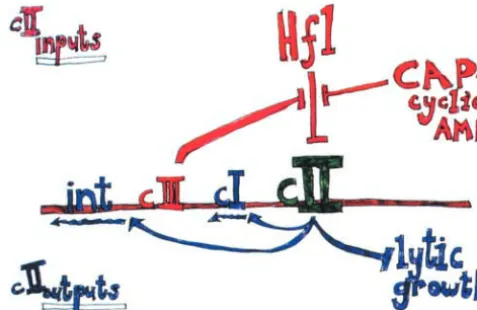
Ira’s lasting interest inconcerned the way in which these already complicated circuits respond to signals from the bacterial host. Ira’s diagram of this (Figure 4) emphasizes the central role of cIIin this regard. The host Hfl function responds to the level of cyclic AMP, which is a measure of nutritional status of the cell. Hfl is a negative regulator ofcII, which in turn has an overall inhibitory effect on lytic growth and a stimulatory role on lysogenization functions [repressor (cI) expression andint]. cIII has a negative effect onhf l (which Ira’s group eventually traced to proteolysis), and the circuit is complete.
Figure4.—Host influence on the lysis-lysogeny decision. BRINGING -STYLE GENETIC ANALYSIS TO THE
STUDY OF GENE REGULATION IN YEAST
While still a graduate student, Ira was offered, and
functions that must be different for each type, and he accepted, a position as assistant professor in the
Molecu-began to talk about studying the regulation that must lar Biology Institute at the University of Oregon. Nobody
underlie these cell-type differences. Just as he had dis-was surprised that this nest of major figures in phage
covered at Caltech, Ira decided at this time that he biology (including Frank Stahl, George Streisinger, and
would focus his yeast research interests on the cell-type Aaron Novick) would make such an appointment, given
differentiation problem, which he already saw as a prob-Ira’s accomplishments, even though they were still
lem analogous in many ways to the lysis-lysogeny prob-largely unpublished. However, feeling a little
unpre-lem in temperate phages. This became the underlying pared, Ira asked for a year’s delay, which he spent in
theme of all his subsequent work. my laboratory at MIT. Ira and I decided to spend that
By all accounts, Ira’s arrival in Oregon the next year year learning something new together. We took the
was memorable. So attractive was the intellect, style, and Yeast Course at Cold Spring Harbor, which had been
enthusiasm of this beginning assistant professor that a inaugurated by Gerry Fink and Fred Sherman the
previ-number of students soon abandoned their perfectly ous year (seeSherwood 2001). Elsewhere (Botstein
good projects in other laboratories and began to work 1993) I have described some of our ideas and motivation
with Ira. Within a year he had several students working for choosing yeast. I also describe (Botstein1993) how
on both phage and yeast. Notable among these were impressed I became with Ira as a teacher when he
man-Jim Hicks and Jeff Strathern, soon to be joined by Jasper aged to teach me, a nearly total nonathlete, enough
Rine. With this able group of students, Ira set out to table tennis to be regarded as dangerous at Gordon
understand the regulatory circuits associated with mat-Conferences. The secret, he said, was to “do the same
ing and cell type in Saccharomyces. in Ping-Pong as in genetics. Focus on the fundamentals
and you’ll do all right.” After we returned to Cambridge, we started to work with yeast and did a little phage
MATING-TYPE INTERCONVERSION
work on the side (eventually published as Botstein
andHerskowitz1974). Ira had an appointment as an The first success of this group was the elucidation of the mechanism by which the mating types switch in instructor, and together we taught a Project Laboratory
course in which Ira once again distinguished himself as homothallic strains. Once again, a classic diagram of Ira’s (Figure 5) makes the outline of this idea clear at an extraordinarily effective and memorable teacher, this
time in the laboratory. a glance. The critical feature of this mechanism ( Hers-kowitzandOshima1981;Rineet al.1981) is the idea Almost from the first, Ira became fascinated with the
mating system in Saccharomyces. He was especially in- that when there is switching, the information at the
MATlocus is discarded, and a copy of one of the silent trigued by an article by Takano and Oshima (1970)
that showed apparently mutational conversion of mat- loci (HMR in Figure 5) is substituted. This feature was the basis for the critical experimental distinction be-ing types in yeast. We spent many hours discussbe-ing the
differences in frequency and consequences of forced tween this and a true “switching” mechanism, involving an alternation of the same information. That critical matings between twoaor two␣strains. Ira’s fascination
soon turned to insight. One day Ira wrote a table on experiment Ira called the “healing experiment,” wherein a mutation at theMATlocus rendering the cell the blackboard in my office in which, for the first time
in my memory, he distinguisheda(or a/a), ␣ (or␣/ sterile is “healed” by a sequence of two mating-type switches. Once again, the Ira-gram says it all succinctly
␣), anda/␣ diploid cells as three different cell types.
Figure5.—Ira’s diagram of the cassette model of mating-type interconversion.
more critical) tour de force was the “wounding experi-ment,” in which a mutant cassette in one of the silent
Figure7.—Ira’s diagram of analogies to development in
loci in a fertile strain caused a cell to be rendered sterile
higher eukaryotes.
after two switches of mating type (Kushneret al.1979). The technology that Ira and his group employed to achieve these results was both simple and elegant. They
to come. One of the major results, however, was the used simple microscopy and micromanipulation
to-establishment of the fundamental asymmetry of cell divi-gether with a clever assay based on pheromone
sensitiv-sion in yeast (Strathern and Herskowitz 1979), ity for assessing the mating phenotype of single cells.
which led Ira to propose a generalization that has had The results of these experiments were to guide study
considerable influence in the larger world of cell biol-of both cell-type determination and switching for years
ogy. This is summarized in Figure 7.
Finally, of course, Ira’s Oregon period was capped by the derivation and ultimate success of thea1-␣2 hypoth-esis (Figure 8), which was the result of a long study of regulatory mutants isolated by Ira’s group at theMAT
locus. The hypothesis describes strikingly-like regula- a mechanism that is largely conserved in mammalian cells as well.
tory circuitry that allows yeast to produce the three cell
types under the control of the genes defined by these In his last years, like many others of us, Ira became impressed with how slow the evolution of proteins and mutants (Strathernet al.1981). This system is
proba-bly still the best-understood regulatory system in eukary- signal transduction systems has been, and how closely related, in their basic cell biology, all eukaryotes remain. otic biology and today is taught in every textbook of
genetics and cell biology, alongside the lysis-lysogeny This led him to pursue the possibility that yeast, now well established as a model system for genetic regulation decision of and the lac operon of E. coli. Here Ira
achieved his goal: he brought-style molecular genetics and cell biology, could be used to screen for and to understand the activities of chemical agents. He sought to yeast, used it to understand a complex eukaryotic
regulatory system, and explained it all to the world. to bring the “awesome power of yeast genetics,” a power he did more than anybody else to establish, more di-rectly into the practice of medicine through
pharmacol-THE AWESOME POWER OF YEAST ogy. He did not live long enough to accomplish this last GENETICS AT UCSF
of his big goals, but his track record in choosing such goals should give pharmacogenetics advocates consider-After 10 productive years at Oregon, Ira moved to
the Department of Biochemistry and Biophysics at the able comfort.
I hope that readers who did not know Ira Herskowitz, University of California, San Francisco. Basic science at
UCSF then was dominated by intellectually powerful or who know him only from his later works, will see how Ira’s career was a coherent whole, animated by a life-figures in biochemistry and cell biology, microbiology,
and virology. Ira brought to UCSF a similar power in long set of intellectual interests and goals that had their origins in his earliest work on regulation in. He had, genetics. He once told me that he moved to UCSF after
a sabbatical there convinced him that he would be able more than any of his peers, the gift for pushing back the frontier of science with simple experiments ably to think more broadly about more diverse science at
UCSF. He also thought he could have an impact by conceived, which somehow always got to the heart of the issues with a minimum of fuss and with no unnecessary bringing the power of genetics to that diverse science,
and possibly even to medicine. As usual, Ira had the technology. He clarified every problem he addressed and made the solution as well as the problem clear to right instinct, for, as I have already indicated, he “made
geneticists of them all.” At UCSF he contributed repeat- everyone. In April 2003, the science of genetics lost one of its very best.
edly to the science of others, faculty and students alike,
by encouraging them to think genetically. An interesting I am grateful to many of Ira’s colleagues for their help with this publication that came out of such discussions is Ira’s essay, especially Costa Georgopoulos, Jasper Rine, and Gerry Fink, who read the manuscript, corrected some of my errors, and made
influential note (Herskowitz 1987) pointing out the
many useful comments. Jasper found the slides from which the
illustra-potential value of overexpressing dominant-negative
tions were made among Ira’s papers. Jeff Strathern and Pinky Kushner
mutant proteins in systems, such as mammalian cell
helped me try to find (somewhat inconclusively) Ira’s first use of the
culture, in which standard genetic approaches are not T-bar and the arrow. Douglass Forbes was kind enough to provide, practical. This suggestion has, of course, more than in a very short time, a copy of Ira’s Ph.D. thesis.
stood the test of time; it, too, has become a standard method and appears in all the textbooks. Note that, in
contrast to many, Ira’s San Francisco colleague Marc LITERATURE CITED
Kirschner got the dominant-negative approach right by Amaya, E., T. J. MusciandM. W. Kirschner, 1991 Expression
of a dominant negative mutant of the FGF receptor disrupts
distinguishing between the “antimorph” and the
“neo-mesoderm formation in Xenopus embryos. Cell26:257–270.
morph” through titration by wild type (Amayaet al.1991).
Botstein, D., 1993 A phage geneticist turns to yeast, pp. 361–373
It is tempting to continue to chronicle Ira’s contribu- inThe Early Days of Yeast Genetics, edited by M. N. Hall and
P.Linder. Cold Spring Harbor Laboratory Press, Cold Spring
tions. However, as we come closer to the present, Ira’s
Harbor, NY.
contributions are actually much better known, and only
Botstein, D., andI. Herskowitz, 1974 Properties of hybrids
be-a mention seems necessbe-ary. Among the highlights be-are tweenSalmonellaphage P22 and coliphage lambda. Nature251:
584–589.
his classic studies on cell polarity, originally motivated,
Chant, J., andI. Herskowitz, 1991 Genetic control of bud site
once again, by Ira’s interest in the differences among
selection in yeast by a set of gene products that constitute a
the yeast cell types and how they are controlled. Among morphogenetic pathway. Cell65:1203–1212.
Chant, J., K. Corrado, J. R. PringleandI. Herskowitz, 1991 Yeast
these differences are the budding pattern (new buds in
BUD5, encoding a putative GDP-GTP exchange factor, is
neces-aand␣cell types emerge adjacent to the previous bud,
sary for bud site selection and interacts with bud formation gene
whereas a/␣ buds emerge at the opposite pole). By BEM1.Cell65:1213–1224.
Dambly, C., M. CouturierandR. Thomas, 1968 Control of
devel-isolating and analyzing mutations that alter the budding
opment in temperate bacteriophages. II. Control of lysozyme
pattern, Ira’s group discovered how eukaryotic cells
es-synthesis. J. Mol. Biol.32:67–81.
tablish and maintain asymmetry (Chant et al. 1991; Frydman, J., 2001 Folding of newly translated proteins in vivo: the
role of molecular chaperones. Annu. Rev. Biochem.70:603–647.
Georgopoulos, C. P., 1971a A bacterial mutation affectingNfunc- Herskowitz, I., andE. R. Signer, 1974 Substitution mutation in tion, pp. 639–645 inThe Bacteriophage Lambda, edited by A. D. bacteriophage lambda with new specificity for late gene
expres-Hershey. Cold Spring Harbor Laboratory Press, Cold Spring sion. Virology61:112–119.
Harbor, NY. Kushner, P. J., L. C. BlairandI. Herskowitz, 1979 Control of
Georgopoulos, C. P., 1971b Bacterial mutants in which the gene yeast cell types by mobile genes: a test. Proc. Natl. Acad. Sci. USA N function of bacteriophage lambda is blocked have an altered 76:5264–5268.
RNA polymerase. Proc. Natl. Acad. Sci. USA68:2977–2981. Rine, J., R. Jensen, D. Hagen, L. BlairandI. Herskowitz, 1981
Georgopoulos, C. P., andI. Herskowitz, 1971 Escherichia colimu- Pattern of switching and fate of the replaced cassette in yeast tants blocked in lambda DNA synthesis, pp. 553–564 inThe Bacte- mating-type interconversion. Cold Spring Harbor Symp. Quant. riophage Lambda, edited by A. D.Hershey. Cold Spring Harbor Biol.45:951–960.
Laboratory Press, Cold Spring Harbor, NY. Sherwood, P. W., 2001 The yeast genetics course at Cold Spring
Herskowitz, I., 1973 Control of gene expression in bacteriophage Harbor Laboratory: thirty years and counting. Genetics 157: lambda. Annu. Rev. Genet.7:289–324. 1399–1402.
Herskowitz, I., 1987 Functional inactivation of genes by dominant Slavotinek, A. M., andL. G. Biesecker, 2001 Unfolding the role negative mutations. Nature329:219–222. of chaperones and chaperonins in human disease. Trends Genet.
Herskowitz, I., 1998 Coming early to the late genes. Curr. Biol.8:
17:528–535. R827–R828.
Strathern, J. N., andI. Herskowitz, 1979 Asymmetry and
direc-Herskowitz, I., andD. Hagen, 1980 The lysis-lysogeny decision of
tionality in production of new cell types during clonal growth: phage lambda: explicit programming and responsiveness. Annu.
the switching pattern of homothallic yeast. Cell17:371–381. Rev. Genet.14:399–445.
Strathern, J., J. HicksandI. Herskowitz, 1981 Control of cell
Herskowitz, I., andY. Oshima, 1981 Control of cell type in
Saccharo-type in yeast by the mating Saccharo-type locus. The alpha 1-alpha 2
hypoth-myces cerevisiae: mating type and mating-type interconversion, pp.
esis. J. Mol. Biol.147:357–372. 181–209 inThe Molecular Biology of the Yeast Saccharomyces: Life
Szybalski, W., andI. Herskowitz, 1971 Lambda genetic elements,
Cycle and Inheritance, edited by J. N.Strathern, E. W.Jonesand
pp. 778–779 inThe Bacteriophage Lambda, edited by A. D.Hershey. J. R.Broach. Cold Spring Harbor Laboratory Press, Cold Spring
Cold Spring Harbor Laboratory Press, Cold Spring Harbor, NY. Harbor, NY.
Takano, I., andY. Oshima, 1970 Mutational nature of an
allele-Herskowitz, I., andE. R. Signer, 1970 A site essential for
expres-specific conversion of the mating type by the homothallic gene sion of all late genes in bacteriophage lambda. J. Mol. Biol.47: