ISSN(Online): 2319-8753 ISSN (Print): 2347-6710
I
nternational
J
ournal of
I
nnovative
R
esearch in
S
cience,
E
ngineering and
T
echnology
(An ISO 3297: 2007 Certified Organization)
Website: www.ijirset.com
Vol. 6, Issue 6, June 2017
Data Security in Clouds Using Proxy Server
Provided Keys
Gali Sai Kiran1, Polepaka Sanjeeva2
M. Tech, Dept. of CSE, Mallareddy Engineering College (Autonomous) Hyderabad, Telangana, India1
Associate Professor Dept. of CSE, Mallareddy Engineering College (Autonomous) Hyderabad, Telangana, India2
ABSTRACT: An ever increasing number of customers would relish storing their information to open cloud servers (PCSs) alongside the quick improvement of distributed computing. Nascent security pickles must be comprehended to benefit more customers handle their information in broad daylight cloud. At the point when the customer is limited to get to PCS, he will designate its intermediary to prepare his information and transfer them. Then again, remote information honesty checking is withal a principal security bind in broad daylight distributed storage. It makes the customers check whether their outsourced information is kept in place without downloading the entire information. From the security situations, we propose a novel intermediary arranged information transferring and remote information uprightness checking model in personality predicated open key cryptography: character predicated intermediary arranged information transfer inland remote information honesty checking out in the open cloud (ID-PUIC).We give the formal definition, framework model, and security demonstrate. At that point, a solid ID-PUIC convention is planned using the bilinear pairings. The proposed ID-PUIC convention is provably secure predicated on the hardness of computational Differ–Hellman scrape. Our ID-PUIC convention is withal productive and adaptable. Predicated on the flawless customer's authorize, the proposed ID-PUIC convention can understand private remote information trustworthiness checking, assigned remote information honesty checking, and open remote information uprightness checking.
KEYWORDS: ID-PUIC, remote information uprightness checking, open key cryptography, validation, open distributed storage.
I. INTRODUCTION
ISSN(Online): 2319-8753 ISSN (Print): 2347-6710
I
nternational
J
ournal of
I
nnovative
R
esearch in
S
cience,
E
ngineering and
T
echnology
(An ISO 3297: 2007 Certified Organization)
Website: www.ijirset.com
Vol. 6, Issue 6, June 2017
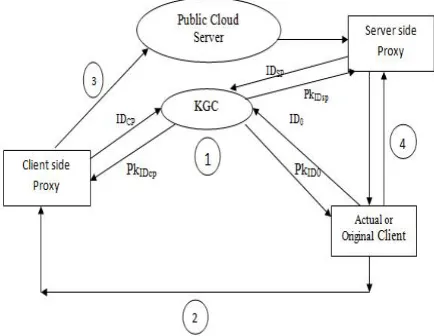
cloud brings concerning a few difficult style issues that have significant impact on the sponsorship and execution of the general framework, since this data stockpiling is outsourced to distributed storage providers and cloud customers lose their controls on the outsourced information. It's interesting to transmute cloud customers to confirm the uprightness of their outsourced data and recover the main data inside the cloud, just on the off chance that their data has been accidentally defiled or maliciously bargained by insider/pariah Byzantine assaults out in the open cloud setting, most customers exchange their data to Public Cloud Server (PCS) and check their remote information's respectability by internet.[6] Once the customer is a private supervisor, some sensible binds can come to pass. On the off chance that the supervisor is associated with being worried into the business extortion, he is isolated by the police. All through the measure of examination, the supervisor is confined to get to the system in order to rampart against intrigue. Be that as it may, the director's licit business can proceed all through the measure of examination. Once a larger than average of data is induced, who will encourage him strategy these data If these information can't be handled just in time, the administrator can confront the loss of financial intrigue. So as to stop the case coming to pass, the administrator must delegate the intermediary to technique its data, for example, his secretary. In any case, the administrator won't trust others have the puissance to play out the remote data honesty checking. Open checking can bring about some danger of unseaworthy the protection. For example, the hang on data volume is regularly identified by the pernicious verifiers. [8] Once the transferred data volume is private, non-open remote data honesty checking is central. Despite the fact that the secretary has the puissance to strategy and exchange the data for the administrator, regardless he can't check the director's remote data honesty unless he's designated by the chief. [9] While transferring records on cloud intermediary stores copy of document so that if documents on cloud are hacked or adulterated or respectability of records is not find out then those records are again recover from intermediary. We grade to choice the secretary on the grounds that the intermediary of the supervisor. In PKI (open key framework), remote data respectability checking convention can play out the testament administration. [10] Once the supervisor designates a few substances to play out the remote data trustworthiness checking, it can acquire sizeable overheads since the promoter will check the testament once it checks the remote data uprightness.
II. RELEGATED WORK
2.1Existing System
Out in the open cloud condition, most customers transfer their information to PCS and check their remote information's honesty by Internet. At the point when the customer is an individual director, some useful difficulties will come to pass. On the off chance that the supervisor is associated with being included into the business misrepresentation, he will be taken away by the police. Amid the time of examination, the administrator will be confined to get to the system keeping in mind the end goal to sentinel against plot. In any case, the supervisor's licit business will continue amid the time of examination. At the point when a cosmically huge of information is induced, who can benefit him prepare these information? On the off chance that these information can't be handled without a moment to spare, the director will confront the loss of financial intrigue. Keeping in mind the end goal to deter the case happening, the chief needs to assign the intermediary to prepare its information, for instance, his secretary. However, the supervisor won't trust others have the competency to play out the remote information respectability checking.[7] Chen et al proposed an intermediary signature conspire and an edge intermediary signature plot from the Weil blending. By amalgamating the intermediary cryptography with encryption procedure, some intermediary re-encryption plans are proposed. Liu et al. formalize and develop the property predicated intermediary signature. Gout al exhibited a non-intuitive CPA (separated plaintext assault)- secure intermediary encryption plot, which is impervious to arrangement assaults in producing re-encryption keys
2.2Proposed System
This paper is predicated on the examination aftereffects of intermediary cryptography, personality predicated open key cryptography and remote information respectability checking out in the open cloud. Out in the open cloud, this paper focuses on the personality predicated intermediary arranged information transferring and remote information respectability checking.
ISSN(Online): 2319-8753 ISSN (Print): 2347-6710
I
nternational
J
ournal of
I
nnovative
R
esearch in
S
cience,
E
ngineering and
T
echnology
(An ISO 3297: 2007 Certified Organization)
Website: www.ijirset.com
Vol. 6, Issue 6, June 2017
remote information honesty checking model out in the open cloud. We give the formal framework model and security demonstrates for ID-PUIC convention. At that point, predicated on the bilinear pairings, we composed the principal solid ID-PUIC convention. In the self-assertive prophet display, our outlined ID-PUIC convention is provably secure. Predicated on the unblemished customer's authorize, our convention can understand private checking, appointed checking and open checking. We propose an effective ID-PUIC convention for secure information transferring and capacity convenience in broad daylight mists. Bilinear pairings system makes character predicated cryptography pragmatic. Our convention is based on the bilinear pairings. We initially audit the bilinear pairings.
III. IMPLEMENTATION
The remarkable attributes of distributed computing predicated on the definitions given by the National Institute of Standards and Terminology (NIST) are illustrated beneath:
3.1 On-demand self-service:
A buyer can singularly arrangement figuring abilities, for example, server time and system stockpiling, as required consequently without requiring human cooperation with each specialist co-op's.
3.2 Broad network access:
Capacities are accessible over the system and gotten to through standard instruments that advance use by heterogeneous thin or thick customer stages (e.g., cell phones, tablets, and PDAs).
3.3 Resource pooling:
The supplier's figuring assets are pooled to oblige various purchasers using a multi-occupant demonstrate, with various physical and virtual assets progressively allocated and reassigned by buyer request.[5] There is a feeling of area autonomy in that the client for the most part has no control or intelligence over the correct area of the gave assets yet might have the capacity to assign area at a higher gauge of reflection (e.g., nation, state, or server farm). Cases of assets incorporate capacity, handling, memory, organize data transmission, and virtual machines.
3.4 Rapid elasticity:
Abilities can be quickly and flexibly provisioned, sometimes consequently, to speedily scale out and quickly surrendered to quickly scale in. To the buyer, the capacities accessible for provisioning regularly seem, by all accounts, to be illimitable and can be obtained in any amount whenever.
3.5 Measured service:
Cloud frameworks naturally control and improve asset use by utilizing a metering capacity at some level of reflection harmonious to the sort of convenience (e.g., capacity, preparing, transmission capacity, and dynamic utilizer accounts). Asset usage can be overseen, controlled, and detailed giving straightforwardness to both the supplier and customer of the used settlement.
ISSN(Online): 2319-8753 ISSN (Print): 2347-6710
I
nternational
J
ournal of
I
nnovative
R
esearch in
S
cience,
E
ngineering and
T
echnology
(An ISO 3297: 2007 Certified Organization)
Website: www.ijirset.com
Vol. 6, Issue 6, June 2017
IV. EXPERIMENTAL RESULTS
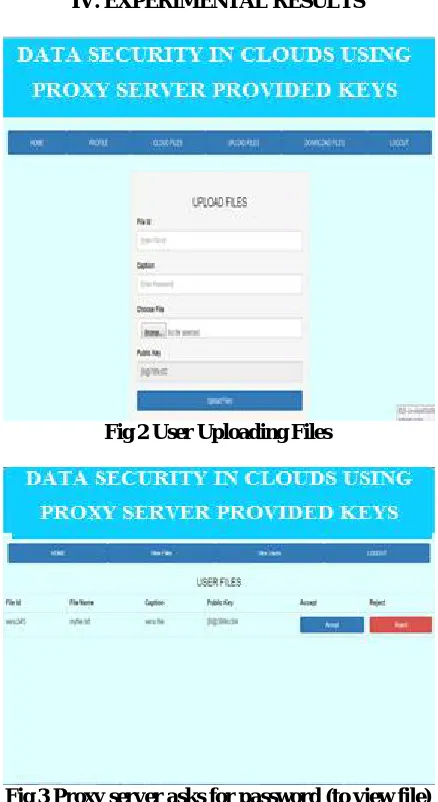
Fig 2 User Uploading Files
Fig 3 Proxy server asks for password (to view file)
ISSN(Online): 2319-8753 ISSN (Print): 2347-6710
I
nternational
J
ournal of
I
nnovative
R
esearch in
S
cience,
E
ngineering and
T
echnology
(An ISO 3297: 2007 Certified Organization)
Website: www.ijirset.com
Vol. 6, Issue 6, June 2017
Fig 5 Cloud Server Downloads Files of Users
Fig 6verifying the keys
V. CONCLUSION
Boosted by the application needs, this paper proposes the novel security idea of ID-PUIC in broad daylight cloud. The paper formalizes ID-PUIC's framework model and security show. At that point, the primary solid ID-PUIC convention is composed by using the bilinear pairings method. The solid ID-PUIC convention is provably secure and productive by using the formal security evidence and proficiency examination. Then again, the proposed ID-PUIC convention can withal acknowledge private remote information trustworthiness checking, designated remote information respectability checking and open remote information honesty checking predicated on the flawless customer's endorse.
REFERENCES
[1] Z. Fu, X. Sun, Q. Liu, L. Zhou, and J. Shu, “Achieving efficient cloud search services: Multi-keyword ranked search over encrypted cloud data supporting parallel computing,” IEICE Trans. Common., vol. E98-B, no. 1, pp. 190–200, 2015.
[2] Identity-Based Proxy-Oriented Data Uploading andRemote Data Integrity Checking in Public Cloud.IEEE Transactions on Information Forensics and Security (Volume:11 , Issue: 6 ),21 January 2016
[3] M. Mambo, K. U suda, and E. Okamoto, “Proxy signatures for delegating signing operation,” in Proc. CCS, 1996, pp. 48–57.
[4] E.-J. Yoon, Y. Choi, and C. Kim, “New ID-based proxy signature scheme with message recovery,” in Grid and Pervasive Computing (Lecture Notes in Computer Science), vol. 7861. Berlin, Germany: Springer- Verlag, 2013, pp. 945–951.
ISSN(Online): 2319-8753 ISSN (Print): 2347-6710
I
nternational
J
ournal of
I
nnovative
R
esearch in
S
cience,
E
ngineering and
T
echnology
(An ISO 3297: 2007 Certified Organization)
Website: www.ijirset.com
Vol. 6, Issue 6, June 2017
[6] X. Liu, J. Ma, J. Xiong, T. Zhang, and Q. Li, “Personal health records integrity verification using attribute based proxy signature in cloud computing,” in Internet and Distributed Computing Systems (Lecture Notes in Computer Science), vol. 8223. Berlin, Germany: Springer-Verlag, 2013, pp. 238–251.
[7] H. Guo, Z. Zhang, and J. Zhang, “Proxy re-encryption with unforgettable re-encryption keys,” in Cryptology and Network Security (Lecture Notes in Computer Science), vol. 8813. Berlin, Germany: Springer-Verlag, 2014, pp. 20–33.
[8] E. Kirshanova, “Proxy re-encryption from lattices,” in Public-Key Cryptography (Lecture Notes in Computer Science), vol. 8383. Berlin, Germany: Springer-Verlag, 2014, pp. 77–94.
[9] P. Xu, H. Chen, D. Zou, and H. Jin, “Fine-grained and heterogeneous proxy re-encryption for secure cloud storage,” Chin. Sci. Bull., vol. 59, no. 32, pp. 4201–4209, 2014.