Lifecycle Costing
Mehul Rathore1,Sadhana A. Shalu2
Student, Department of Civil , Dr. D. Y Patil College of Engineering, Akurdi Pune, Savitribai Phule Pune University
Pune India.1
Professor, Department of Civil , Dr. D. Y Patil College of Engineering, Akurdi Pune, Savitribai Phule Pune University
Pune India.2
ABSTRACT: India, being a making nation is experiencing critical improvement in its system. Concrete is the huge fragment of this infrastructural impact. This has provoked the need of benevolence of bond in broad sums. This essential can be fulfilled by the readied mix solid bunching and mixing plants. To fill the cleft between the interest and supply of concrete incalculable plants are showing up. The rule focus of this study is to learn the life cycle cost of a RMC office, which will help a money related master or any individual or a relationship to take wander decisions as to a RMC office. The study develops the wage for the RMC office pleasing in hypothesis and capital time related decisions. The business part has been outlined and the sensible costs for working and keeping up the RMC office are assembled as in like manner the cost of charging and raising the RMC plant are accumulated from the makers. Travel blenders shape a basic portion of the RMC office and their cost of owning and working edge a vital part of the life cycle cost of RMC. In perspective of the step by step demand from a few destinations in the city of Mumbai, the amount of travel blenders that would be required on the RMC plant to fulfill that demand has been reenacted using Monte Carlo propagation. The life cycle cost of the RMC office has then been found out. Further with the help of this study the life cycle cost of whatever other farthest point RMC office can be figured and in light of necessities and capital availability, the financial option can be picked.
KEYWORDS: Ready mix concrete (RMC), life cycle cost, Monte Carlo simulation
1. INTRODUCTION
II. OBJECTIVE OF STUDY
1. The concentrate mostly concentrates on the Value Engineering apparatus, Life Cycle Cost Analysis (LCCA),
its study and its application for discovering the life cycle expense of the RMC plant office.
2. The action of ascertaining the life cycle cost has been helped by device of recreation. The fundamental goal of
the recreation action is to discover the ideal number of trucks that would be required for fulfilling a specific interest of RMC which thusly is utilized as a part of the life cycle cost computation of the travel blender, a noteworthy segment of the RMC office.
3. At long last, this will empower us to locate the aggregate expense brought about and the income for a RMC
office.
III. MOTIVATION
Keeping in mind the end goal to fulfill the goal sketched out over, a careful audit of the writing has been finished first to recognize and comprehend the parameters included connected with the theme. The study uses the current methodology for discovering the life cycle expense of RMC plant office by actualizing Value Engineering device, Life Cycle Cost Analysis (LCCA). A scientific cost model is utilized to decide the life cycle cost. The cost model has diverse cost segments like starting speculation and erection cost, operation cost, upkeep cost, backhanded expense and so forth for RMC clustering plant and it likewise considers the different costs identified with travel blenders. Operation cost takes care of power expense, water cost, work cost and so on. Imperative support cost incorporates saves, ointments, fitting expense and so forth. All the cost information identified with RMC plant and travel blender is gathered by going to the RMC office. Ideal number of travel blenders for taking care of the normal demand is figured by actualizing device reproduction. The normal monetary life and the rescue or resale estimation of RMC office are expected. All these expenses connected with the RMC office will must be changed over to the present quality utilizing markdown rates and calculate accessible different determinations and codes. The information from World Bank's legitimate site is utilized for getting the rebate rates and the markdown elements have been figured. At last, the life cycle cost calculation of RMC office is finished by utilizing present quality technique. Ascertaining the life cycle expense of any office helps a man or an organization to know the amount of capital speculation is required for a venture as additionally the amount of cash will be required all through the valuable time of the office. The LCCA device can be utilized to look at changed options and discover the more monetary one. In any case, the extent of this study is constrained to the utilization of the LCCA instrument on a RMC office. No examinations are made as no options are included. The different expenses connected with a RMC office are gathered. The ideal number of travel blenders required to satisfy the required interest has been figured and the life cycle cost calculation has been done. The extent of the study is constrained to taking in the utilization of life cycle cost Analysis. This degree and the target have been accomplished by taking after the approach to be talked about at this point.
IV. LITERATURE REVIEW
The value of any item or utility or any administration is judged on the premise of the worth it gives to its client. Unless the item is justified regardless of its cost it doesn't speak to great worth. Quality can be characterized as the proportion of capacity by expense. Great worth will demonstrate that the item or administration performs the craved capacity at any rate cost. The estimation of an item can consequently, be expanded by either enhancing the capacity or diminishing the expense. The Value Engineering or esteem examination is one such instrument or system which is utilized to enhance the estimation of the item by utilizing its different devices like enhancing the capacity by distinguishing and taking out item and administration highlights that increase the value of the client or the item or by selecting the savviest option. [3]
sorted out exertion coordinated at breaking down the elements of frameworks, gear, offices, administration and supplies with the end goal of accomplishing the crucial capacities at the most reduced life cycle cost steady with the required execution, unwavering quality, quality and security. [3]
In this way, esteem building is an exceptionally intense and effective administration strategy. Esteem examination is done to expand the estimation of the item or administration. Taken a toll cutting shouldn't meddle with productivity i.e. dependability or nature of the item. Esteem Engineering does not mean just cost cutting but rather it likewise includes enhancing the capacity of the item. Just by doing this can the estimation of any item or administration increment, which is the fundamental prerequisite of quality designing. The quality designing has numerous instruments and methods, which can be utilized to build the estimation of the item or administration. [4]
These incorporate quick chart, inventive speculation and life cycle costing of the item. They are essentially utilized as a part of diminishing or killing the non-critical expenses connected with the item. It gives a technique to creating thoughts and options for conceivable arrangements. In today's aggressive world, each organization's point is to make most extreme benefit. One of the most ideal approaches to keep a beware of spending plan and to build the gainfulness of the task is to make key and huge utilization of the worth designing strategy. The worth investigation contends by decreasing the cost, enhancing the benefits, enhancing the quality, sparing time, utilizing the assets all the more reasonably and adequately and meeting the consumer loyalty. The worth designing strategy comprises of efficient methodologies, which takes after the employment arrangement. Esteem philosophy is utilized to enhance the estimation of activities through examination of capacities. Different exercises are led amid every period of the employment arrangement. This system encourages the VE group to assemble, produce and actualize different thoughts through choices amid different periods of task. [1]
V. FLOW OF THE SYSTEM
a) Information Phase
This phase consists of obtaining project data and information and key documents such as scope of work definition, drawings, specifications, reports, detailed project cost information, quality data, marketing information, process flow charts, etc. This phase brings all team members to a common, basic level of understanding of the project, including tactical, operational and specifics of the subject.
b) Functional Analysis Phase
This consists of identifying the project from functional point of view rather than how it is conceived. Determination of functions of project and its elements as per requirement is done in this phase. Generally the basic and secondary functions are determined and analysis is done accordingly. The FAST diagrams and tools are used in this phase, which helps in analyzing the project functionally.
c) Speculation Phase
In this phase different ideas are generated for same function. Hence it is also called as creative phase. The ideas are generated as much as possible, which will provide alternatives to perform the same work. This provides wide variety of possible alternative ways to perform the function that helps to improve the value of project.
d) Evaluation Phase
consideration their effect on project cost and performance parameters. Tools like life cycle cost analysis (LCCA) are used to evaluate the cost effective alternative for any particular task or whole project.
e) Development Phase
Further the shortlisted ideas are analyzed and developed in this development phase. Informative description is prepared for all the ideas, which are selected mentioning their merits over rejected ideas and any exclusive things they have.
f) Presentation Phase
The value alternatives are presented to the management team, other project related managers and to decision makers. These are presented via presentations and supporting documents, in which comparison between the study conclusions is done to the success requirements established during the information phase.
VI. SYSTEM MODEL
The RMC supply process involves six components: batching, mixing, discharging into transit mixers, travelling to placing site, placing and washout. A more detail process is explained by the following figure. Once the RMC plant receives the order, materials for manufacture of concrete are obtained. The materials are first batched and then mixed in a pan mixer. After the mixing process is over, concrete is discharged into Transit mixers. The transit mixer travels to the placing site allotted to it. In this study, four placing sites have been selected. The dispatch series is set according to the requirement of the placing site and number of transit mixers used. Once the transit mixer reaches the placing site, a concrete slump test is performed. If the concrete fails this test the transit mixer is sent back without placing the concrete. If the concrete passes the slump test it proceeds for placing. The placing equipment may be a boom placer, concrete pump etc. Once the concrete is placed the next transit mixer waiting in a queue starts placing concrete. After transit mixer finishes placing it proceeds to the washing area. This model is very complex and difficult to analyze.
Explanation-
FAST provides an organized step-by-step method for the determining the function required and exploring the complicated processes of a product. FAST is used to determine the project functions as well as the function of each part of the product. The FAST modeling process with the facilitator asking several questions designed to identify the scope of the model, its objective function, and basic function, or basic functions.
These questions are designed to identify the mission of the system while bounding the scope of the problem, or opportunity. By stating the mission of the system as a problem, or opportunity helps the team specify what the system has to accomplish. The basic structure of a FAST model looks somewhat similar to a process flow chart. However, there are some very significant differences. FAST serves as a problem solving technique to determine the essential functions to be performed and the supporting functions. Each function is evaluated to usefulness for reducing functions.
VII. MECHANISM OF READY MIX CONCRETE
Prepared blend cement is solid, which is made in a plant or grouping plant, as indicated by the necessities, and after that conveyed to a work site, by truck mounted travel blender. It was initially licensed in Germany, path in 1903. By 1950s, the utilization of prepared blended cement grabbed in a large portion of the propelled nations in Europe and America. In the blink of an eye, about 75 % of the bond utilized as a part of the USA is directed through prepared blended solid outlets. The relating normal figure in Europe was 46.7% in the year 2005. Mechanically, the creation procedure of prepared blended cement has been consistently been redesigned, prompting change in item, quality and consistency. Today's plants are exceedingly mechanized and comprise of best in class hardware having electronic controls on the whole creation process. Contrasted with the propelled nations, India was a late starter in prepared blended cement the past over 10 years, RMC-India and numerous other driving producers have extended their operations to different metropolitan and other enormous urban communities in India. Adequate experience and ability have been presently acquired in the generation and utilization of prepared blended cement. In fact speaking, RMC is unquestionably progression over the age-old site blended cement. The RMC gives favorable circumstances like expanded rate of development, enhanced quality, diminishes site work prerequisite, lessening in wastages and so on. The crude materials utilized for prepared blend concrete, specifically, bond, sand, coarse/fine total, water and admixtures are blended at a halfway found PC controlled plant that screens weigh-clumping, water-concrete proportion, dose of admixture, dampness content and so on with accuracy, to create the prepared blend concrete.
Prepared blend cement is then transported to the site in travel blenders in plastic condition, without influencing the piece and with no further treatment. Travel blenders are trucks fitted with turning drums for conveying prepared blend concrete. For the most part the limit of the travel blenders is 2 to 14 cubic meters. The procedure of RMC assembling and supply is as per the following: Generally the pressure driven measure grouping is received to convey the solid concerning the necessities/blend outline of customers with suitable water concrete proportion. Toward the begin of creation, dry materials from the upper stockpiling canisters are released into the plant's stationary focal blender. The extent of materials in the blend is hand crafted to meet the particulars for every venture. Proportioning is controlled by PC to guarantee quality control. The client regularly works with the prepared blended solid maker to decide attributes, for example, total size, droop, air substance, and quality in view of the expected use. Common creation by volume is around 10-15% bond, 60-75% totals, and 15-20%water. Entrained air pockets may likewise represent 5-8%. Utilizing less water for the most part results as a part of a higher quality cement. Subsequent to blending is finished, the blend is released into a truck-mounted, pivoting drum blender. Turning drum truck blenders ordinarily have a limit extending from 2 to 14 cubic meters and release the solid from the back. Since droop misfortune can happen amid travel, it is required that the solid be released at work site inside a hour and a half or before 300 upsets after the expansion of water to the concrete.
pumped or physically transported by wheelbarrows and set at required area. The holding up time of travel blenders at site relies on upon setting operation.
VIII. MECHANISM OF LIFE CYCLE COST ANALYSIS
Life–cycle cost analysis (LCCA) is an economic method of project evaluation in which all the cost arising from owning, operation, maintaining, and ultimately disposing of a project are considered to be potentially important to that decision. Life cycle costing is a process to determine the sum of all the costs associated with the any facility, including acquisition, installation, operation, maintenance, refurbishment and disposal cost. LCCA is a powerful tool of an economic analysis which can be applied to any capital investment decision in which higher initial costs are traded for reduced future cost obligation. The LCCA can be used to identify an economical alternative as also it can be used to prioritize the funding of the project. However, the aim of this study is just to understand the application of the LCCA tool and so comparisons are not drawn between alternatives rather, the calculation of the life cycle cost of an RMC facility is done. The LCC method, contributes the total cost of owning, operation, maintaining and disposal of the system over a study period with all the costs discounted to reflect the time value of money. In calculating the LCC of the facility present value method is used, in which all the future costs are generally discounted to their present value equivalent. This report consists of LCCA of the RMC facility with present value method.
A. Define the project objective.
B. Set the study period.
C. Establish the common assumptions.
D. Estimate costs and time of occurrence for each cost.
E. Discount future costs to present value.
F. Compute LCC by present value method.
The first step in life cycle cost analysis is to identify what has to be analyzed. It is important to understand how the analysis will be used and what type of decision is to be made in structuring the analysis and in selecting a method of economic evaluation.
In case of RMC facility, our project deals with to minimize the idle time of the plant and the transit mixers. The tool of simulation has been used to find the optimum number of transit mixers required for fulfilling a particular demand. The optimum number is so selected that the total idle time of the plant and the transit mixer is minimum. The time over which the costs and benefits related to capital investment are taken into consideration is termed as study period. The study period begins with the base date and includes the planning/construction period and the service period. The study period is so selected that the facility is in efficient use during that period.
a) The Base Date
The base date is generally taken as the date of start of the analysis and all the future costs are discounted. The base date in this Study has been considered as July, 2013.
b) The Service Date
The service date, is the date, on which project is expected to be implemented. Operating, maintenance costs including energy and water related costs are generally incurred after this date. The service date marks the start of the service period of the facility. The service date in this case is taken as 1st January 2014.
c) The Service Period
The service period is the total period in which the facility operates efficiently. Sometimes the period of the analysis during which the operations on the facility are going on, that period is considered as the service period. Here, a service period of 6 years has been considered for the LCCA study.
d) The planning/construction period
The planning and construction period (P/C) is the time, which is taken for the acquisition and the erection of the components of the facility. During the P/C period the operations of the project do not take place. Whenever there is delay between beginning of study period and the service date the intervening time is planning/construction period. All the costs occurring in planning and construction period are discounted to the base date. This study has considered a P/C period of 6 months or half a year. Hence the total study period, which comprises of the P/C and the Service period, is considered as 6.5 years in this study.
IX. EXPERIMENTAL SETUP
Fig No 02 Graph of idle time cost of plant and transit mixers
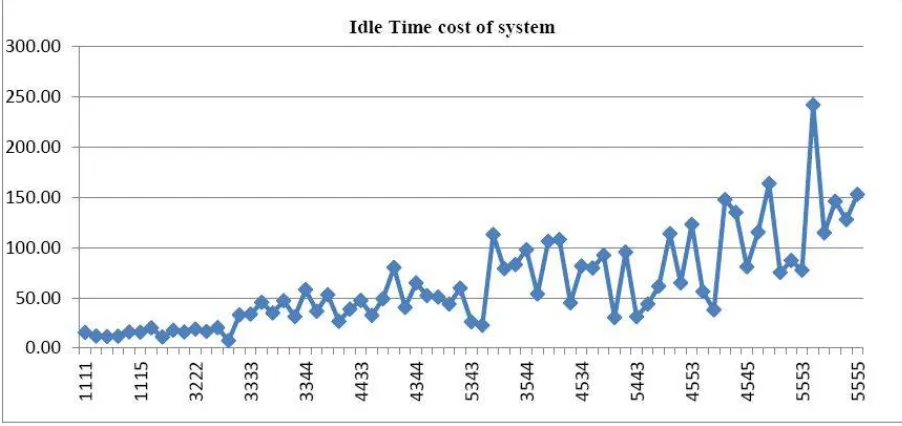
From the above graph it can be seen that as the number of transit mixers go on increasing the idle time cost of the RMC plant goes on reducing, whereas the idle time cost of the transit mixers goes on increasing. The idle time cost of transit mixers increases with number due to the increase in the size of the queue at the RMC plant and the cost of owning more transit mixers. The graph below shows the total idle time cost variation with the number of transit mixers.
X. CONCLUSION
The estimation of Life Cycle Cost of the 30cu.m./Hour limit RMC Batching and Mixing Plant has been done with the assistance of LCC Model and reenactment action. In this way, the use of the worth building apparatus, life cycle cost examination has been learnt. The movement has a few confinements as it depends on suspicions. The different operations support and repair costs connected with the RMC office is spread consistently. Rather, the study has made a suspicion that the expenses are happening at one point that is the end of the year. The underlying venture and erection cost happens all through the P/C period however the study considers it to happen on the base date. The information has been gathered from a restricted source. No monetary option has been given by this study. Model does not mull over the wash out time for the travel blenders and their situating time.
REFERENCES
[1] Concrete Technology Theory and Practice, M.S. SHETTY, S.Chand- New Delhi.
[2] IS 4926 - 2003, Standard on Ready mixed concrete – Code of Practice, BIS, New Delhi. http://xa.yimg.com/kq/groups/21948400/12595375 78/name/4926.pdf
[3] An Approach for Supplier Selection for Construction Companies Through Analytical Hierarchy Process, IJSR – INTERNATIONAL JOURNAL OF SCIENTIFIC RESEARCH, Volume : 2 | Issue : 5 | May 2013 • ISSN No 2277 – 8179
[4] Saaty, T.L. (2008) ‘Decision making with the analytic hierarchy process’, Int. J. Services Sciences,Vol.1,No.1,pp.83–98 http://ebookbrowse.com/gdoc.php?id=413809505& url=89ec1345c521d3ccec17ce81fabd454f
[5] AHP approach for supplier evaluation and selection in a steel manufacturing company, Journal of Industrial Engineering and Management, doi:10.3926/jiem.2008.v1n2.p54 76,
[6] Qualitative analysis of Internal and External Risks for Ready Mix Concrete Plants - A case Study Approach, IOSR Journal of Engineering May. 2012, Vol. 2 (5) pp: 1013-1019 – http://www.iosrjen.org/Papers/vol2_issue5/N02510 131019.pdf
[7] Analytical Hierarchy Process as a tool for Selecting and Evaluating Projects, int j simul Model8(2009)1,16–26 http://www.ijsimm.com/Full_Papers/Fulltext2009/t ext8 1_16-26.pdf
[8] Model Chart of Quality Control Process for Ready Mixed Concrete Plants, IOSR Journal of Mechanical and Civil Engineering (IOSR JMCE), ISSN: 2278-1684, PP: 50-54; http://www.iosrjournals.org/iosrjmce/papers/sicete( civil)-volume2/23.pdf
[9] Costing of the Production and Delivery of Ready-Mix-Concrete, Jordan Journal of Mechanical and Industrial Engineering, Volume 6, Number 2, April 2012, ISSN 1995-6665, Pages 163 – 173 http://jjmie.hu.edu.jo/files/v6n2/JJMIE-182-10.pdf
[10] Quality in Ready-Mixed Concrete - A Case Study on Specialised Marine Concreting in Singapore
http://www.vcemglobal.com/images/downloads/T asUnderSeaCableTunnel-final-EN.pdf
[11] Study of Material Testing and Mix design procedure of Ready Mixed Concrete http://grietinfo.in/projects/MINI/civil/Civil_Minip oject_AbhilashReddy.pdf
[12]Ready-Mixed Concrete growth prospects in India http://www.cipremier.com/e107_files/downloads/ apers/100/27/100027032.pdf
[13]Analytic hierarchy process - Wikipedia, the freeencyclopedia http://en.wikipedia.org/wiki/Analytic_hierarchy_pr ocess [14] Ready Mixed Concrete by Dr. R.V. Ranganath http://elearning.vtu.ac.in/12/enotes/Adv_Conc_Str /Unit5 RVR.pdf
[15] Chapter 7 - Ready Mixed Concrete by Mineral Industry of the State of New York, by William M.Kelly, http://www.nysm.nysed.gov/publications/record/vol 03/pdfs/vol_03-CH07.pdf