NUMBERS AND DISTRIBUTION OF CHROMOSOME KNOBS I N UNITED STATES MAIZE
WILLIAM L. BROWN Pioneer Laboratory, Johnston, Iowa
Received October 25, 1948
H E chromosomes of maize possess a number of distinguishing features
T
used by cytologists to identify members of the complement. Among the more important of these are the dark staining enlargements known as knobs, which have been shown to occur a t certain points and only a t certain points on the chromosomes. Although chromosome knobs are distinguishable in mi- totic prophases they are best studied a t the pachytene stage of meiosis a t which time they are highly pycnotic when stained with ordinary chromatin dyes. Knob number is constant for any individual plant and in United States maize may vary from 0 in some varieties to 14 in others. I t can therefore be used as one criterion in determining the relationships of various kinds of maize, a problem which is becoming increasingly important in modern maize breeding. Although this paper deals only with differences in total knob numbers there is some evidence to indicate that knob size and position might be equally useful as a tool in studying relationships in maize.LONGLEY (1938) studied knob number and position in a collection of maize from 33 Indian tribes of the United States. He found very few knobs on the chromosomes of most strains from the northern Indian tribes. A slightly higher number of knobs were found in the southeastern varieties and many knobs were observed on the chromosomes of most varieties from New Mexico and Arizona. On the basis of these findings, LONGLEY suggests that “the num- ber of knobs on the chromosomes of a strain of Indian corn may give a clue t o the geographical origin of the strain.”
MANGELSDORF and REEVES (1939) have suggested that the presence of chromosome knobs in maize is a result of admixture with Tripsacum, a related genus in which high knob number has been established for several species. They suggested further that the hybridization of Tripsacum and Zea with repeated natural backcrossing to Zea resulted in the formation of a new genus, Euchlaena. These investigators point out that so-called “Andean” or uncon- taminated maize of the South American highlands has few or no knobs while most types of maize which show morphological evidence of Tripsacum intro- gression (either directly or through teosinte) have knob numbers roughly in proportion to the amount of putative Tripsacum germ plasm present. Further evidence supporting this hypothesis was offered by REEVES (1944) who, in a study of knob numbers in maize from North, Central and South America, demonstrated a statistically significant relationship between numbers of knobs and proximity to Central America, a region in which in certain areas both Tripsacum and teosinte occur in abundance. However, GRANER and ADDISON
CHROMOSOME KNOBS IN MAIZE 525 (1944) found that Tripsacum australe, a South American species, unlike its Central and North American relatives, has no terminal knobs and few internal ones. These results suggest a t least that knob numbers cannot always be taken as a reliable measure of the amount of Tripsacum germ plasm in Zea.
Disregarding the origin of chromosome knobs in Zea and their relation to the Tripsacum hypothesis they do nevertheless represent a stable, easily meas- ured character. As will be shown later, differences in knob numbers and their association with morphological characters, seem to be significant, even in the highly selected maize of the United States corn belt.
MATERIALS AND METHODS
At the time this work was initiated the material used was limited to a series of inbred lines representative of corn belt dent corn. Later, it was felt that the true significance of the differences in knob numbers found in corn belt inbreds could not be fully appreciated without first having available some basic in- formation on the parental types of maize that were combined to produce corn belt dents. For this reason, the field was expanded to include (1) Northeastern Flints, (2) Flints and Flours of the Northern Great Plains and the Midwest, and (3) Southern Dent Corn. A total of 171 strains have been studied repre- senting a reasonably comprehensive collection of the major races of United States maize, exclusive of the southwestern United States and the coastal area of southeastern United States. The material has been studied over a period of three years, from 1945 through 1947. All varieties were grown in the field, the Southern Dents a t Gray Summit, Missouri, and the Flints, Flours and Corn Belt Dents a t Johnston, Iowa.
Knob numbers were determined from temporary smears of pollen mother cells a t the pachytene stage of meiosis. For those inbreds included, most of which were relatively homozygous, sporocytes were collected from only one or two plants of each line. Among the open-pollinated varieties of Northern Flint and Southern Dent Corn, which, of course, were much more variable than the inbred lines, sporocytes were collected from two to four plants.
DESCRIPTION O F RACES
526 WILLIAM I,. BROWN
The Southern Dents herein reported upon are quite variable and apparently have undergone a complicated history. Notwithstanding this fact, it is possible, on the basis of comparative morphology and known history, to separate them into two fairly distinct categories. These have been arbitrarily designated as (1) Old Southern Dents, and (2) Derived Southern Dents (BROWN and ANDERSON 1948). The former group is composed of varieties which are either very similar to some present-day Mexican corns or whose culture in the South dates back to Colonial times. Some of the varieties included in this category such as Mexican June and Tuxpan, for example, may actually be recent intro- ductions from Mexico. With the exception of Hickory King, the ears of each of these varieties are typified by a very strong taper from base to tip. The strains which exhibit a high degree of denting tend to have high row numbers and considerable pointing. I n practically all varieties of this category there is a strong tendency for the tip of the cob to extend well beyond the rows of kernels (fig. 2). The tassels although variable, usually have many secondary branches which are often highly condensed, particularly in the case of those varieties with high numbers of rows of kernels. Plants of Mexican June and similar varieties frequently have rather short, stiff, upright secondary tassel branches giving a pronounced “whisk broom” appearance to the tassel. The plants are tall, with as many as 24 nodes in some varieties. Ears are usually set high on the culms and internode length frequently becomes increasingly shorter above the ears.
The Derived Southern Dents differ from the former group primarily by exhibiting a more pronounced similarity to corn belt maize. The ears are usually more cylindrical; row numbers tend to be lower and there is a less pronounced tendency for exposed cob tips. Although plant types in the two groups show few consistent differences, it may be significant that the only variety encountered with highly pubescent leaf sheaths was among the Old Southern Dents. As a group the Derived Southern Dents are of somewhat shorter plant height than the Old Southern Dents. There are, however, among the derived sorts, certain varieties as tall as the tallest of the Old Southern Dents. Most varieties included in this category are apparently of more recent origin and are of more heterogeneous genetic background than the Old South- ern Dents.
Since dent corn inbreds of the corn belt are widely grown and since they, as a group, are well known by most corn breeders and corn geneticists, it seems unnecessary to describe them in detail. The majority of the present day inbreds are the products of inbreeding open pollinated dent corn varieties of the corn- belt, or of inbreeding single or double crosses of corn belt inbreds. Since corn belt dent corn is itself a heterogeneous mixture resulting from the blending of Northern Flints and Southern Dents it is not surprising to find that corn belt inbreds range in type from strains resembling Northern Flints (fig. 3), to others approaching Southern Dent types, (fig. 4).
DISTRIBUTION OF KNOBS
CHROMOSOME KNOBS I N MAIZE 527
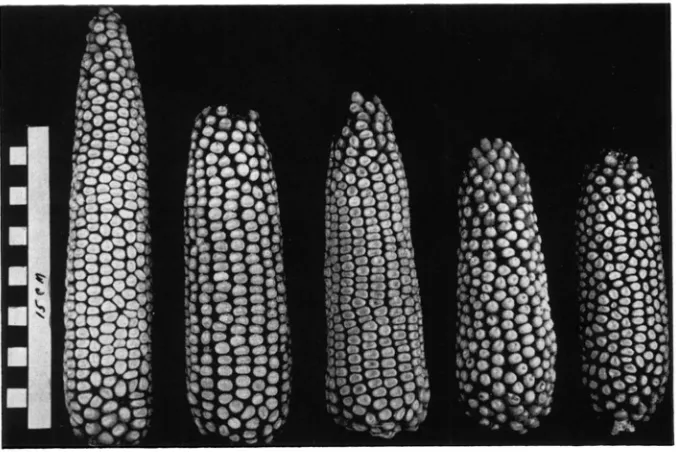
FIGURE 1.-Representative ears of flint and flour corns of the Northeast, Northern Great Plains, and the Midwest. Left to right. Stevens F l i n t 4 knobs; 8-row Flint (New Y o r k ) 4 knobs; 8-row New England Flint-1 knob; New York Flour Corn-1 knob; Gehu Flint-0-2 knobs; 12 row Dakota IXnL-3 knobs; Sax and Fox Flint-3 knobs; Bear Island Flint-2 knobs.
528 WILLIAM L. BROWN
FIGURE 3.-Ears of inbred strains possessing IOW numbers of chromosome knobs. Left to right. L317-3 knobs; Ind. 38-11-3 knobs; 113-3 knobs; GlP1-1,2 knobs; LDG-2 knDbs.
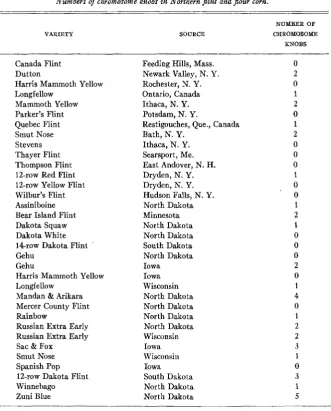
CHROMOSOME KNOBS IN MAIZE 529 logical type. The Northeastern Flints, for example, have few if any knobs. A number of these varieties have no distinct knobs and even the nucleolus or- ganizer is frequently light-staining and indistinct. The maximum number of knobs in any of these varieties is 2, while several have but one knob, frequently
TABLE 1
Numbers of chromosome knobs in Northern j i n t and jour corn.
NUhCBER OF
VARIETY SOURCE CHROMOSOm,
KNOBS
Canada Flint Dutton
Harris Mammoth Yellow Long fellow
Mammoth Yellow Parker’s Flint Quebec Flint Smut Nose Stevens Thayer Flint Thompson Flint 12-row Red Flint 12-row Yellow Flint Wilbur’s Flint Assiniboine Bear Island Flint Dakota Squaw Dakota White 14row Dakota Flint Gehu
Gehu
Harris Mammoth Yellow Longfellow
Mandan & Arikara Mercer County Flint Rainbow
Russian Extra Early Russian Extra Early Sac & Fox
Smut Nose Spanish Pop 12-row Dakota Flint Winnebago Zuni Blue
Feeding Hills, Mass. Newark Valley, N. Y. Rochester, N. Y. Ontario, Canada Ithaca, N. Y. Potsdam, N. Y.
Restigouches, Que., Canada Bath, N. Y.
Ithaca, N. Y. Searsport, Me. East Andover, N. H. Dryden, N. Y. Dryden, N. Y. Hudson Falls, N. Y. North Dakota Minnesota North Dakota North Dakota South Dakota North Dakota Iowa Iowa Wisconsin North Dakota North Dakota North Dakota North Dakota Wisconsin Iowa Wisconsin Iowa South Dakota North Dakota North Dakota 0 2 0 1 2 0 1 2 0 0 0 1 0 0 1 2 1 0 0 0 2 0 1 4 0 1 2 2 3 1 0 3 1 5
at the terminal position on the short arm of chromosome 9. A wider range of knob numbers is encountered in the flint and flour varieties of the Northern Great Plains and the Midwest. Among these corns, numbers range from 0 to 5.
530 WILLIAM L. BROWN
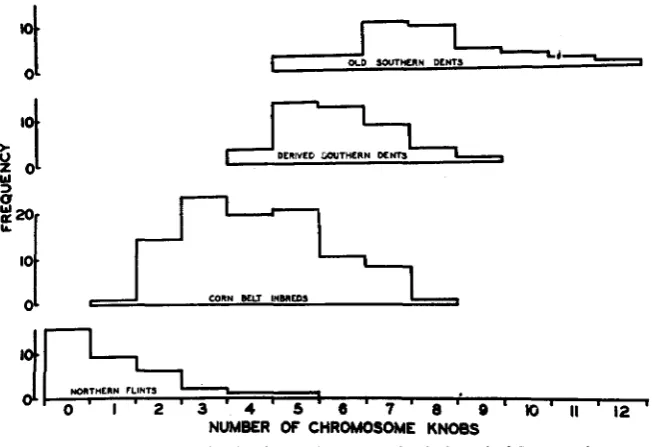
The highest number of knobs encountered in this study were among the Old Southern Dents. Numbers in these varieties range from 5 to 12, with a rather strong mode a t 7 to 8. Eleven and twelve knobs were found only in June Corn, which is of Mexican June type, and the variety Hickory King. Each of these corns are similar to some present-day Mexican varieties which are known to
TABLE 2
Numbers of chromosome knobs i n Southern dent corns.
VARIETY SOURCE
m-
BER OF CHROMO-
SOME KNOBS
VARIETY
NUM-
BER OF
SOURCE CHROMO-
SOME KNOBS Gourdseed Hickory King Hickory King Hickory King Jellicorse June Corn Mexican June Mexican June Old White Dent (1) Old White Dent (2) Red Cob Chisholm Shoepeg
Shoepeg Shoepeg Tenn. Red Cob Tuxpan Tuxpan White Dent Yellow Shoepeg Yellow Tuxpan Neal’s Paymaster Neal’s Paymaster Sherman Southern Ill. 1 Southern 111.2 Texas Virginia Georgia Tennessee Virginia Louisiana Tennessee Tennessee Arkansas Arkansas Texas Louisiana Louisiana Louisiana Tennessee Louisiana Virginia Arkansas Louisiana Louisiana Ark ansa s Mississippi Tennessee Illinois Illinois 6,778 7 6,11,12 5,778 9 1 0 , l l 738 9 5 5 10 778 6 7 7’8 7 ,8,9 8 7 7,8,9,10 8 6 6 5 5 6 7 Southern Snowlhke Southern Yel. Dent Strawberry Va. Horsetooth Whatley’s Prolific Yellow Dent 10-Row Dent Cambren Caraway’s Prolific Cherokee Clarks Yel. Dent Columbia Beauty Garretts 1 Garretts 2 Giant Yel. Dent Huffman
Jarvis Golden Prolific Jarvis Golden Prolific Johnson Co. White Latham’s Douhle Mammouth Ensilage Mosby’s Prolific Mosby’s Prolific Mosby’s Prolific Mosby’s Prolific
Virginia 5 Mississippi 4 , s
Texas 899
Virginia 4,6,7 Virginia 7,8 Louisiana 6 Arkansas 5 Kentucky 6 Louisiana 6 , 7 Georgia 5
Texas 596
Tennessee 6 Kentucky 5 , 6 Kentucky 7
Texas 5
Tennessee 5 Tennessee 5 Mississippi 4 Missouri 7 Virginia 6 Virginia 5
Mississippi 5
Virginia 7 , 8 Louisiana 7
Tennessee 6
possess rather high numbers of chromosome knobs. It seems quite probable therefore that the Mexican June and Hickory King types of corn of the southern United States have come directly from Mexico without having undergone much change in plant or chromosome morphology. It is likewise relatively easy to find in central Mexico today varieties which closely ap- proach in ear type the southern Gourdseeds and Shoepegs.
CHROMOSOME KNOBS I N MAIZE 531
TABLE 3
Numbers of chromosome knobs in dent corn inbreds.
-_
LlOITnCllH TLINTS
j
k
NO.
CHROHOSOME
KNOBS
INBRED STRAIN
1 GIPI*
2 B4AM1*, CI.61, GlPl*, Ind. 33-16, IW1*, JC3*, KG2*, K77AT1*, LDG, LE4*, SW19*, S32*, W61*, 101*.
3 A94*, BG6*, B4Y3*, CI.7, CI.61, Conn. 103, D31*, F3-2, G3K2*, I13*, JG3*, J61*, KYS, K43*, L24*, L317, Minn. 49, Ohio 28, Ohio 40b, SN2*, SU'19*, W23, 38-1 1.
4 AE1*, AG1*, B4U2*, CI.187-2, Conn. 103, Conn. 105, IDT, Ind. B2, Ind. Lx2, Ky27, K4, K77, LE7UI*, Minn. 11, S02*, SRS386*, T27GSA*, 104*, 106*.
5 A99*, CI.7, CI.187-2, F3K4*, Ill. 3414, Ind. B2, IWlCM2*, K155, K201, LF5*, MD1*, MY1*, Sol*, SS2*, SY1*, WF9, WGl*, WP1*, 103*, 105*. 6
7
IJH1*, RH2*, CI.2, CV1*, Ill. A, Ill. HY, LA, SS2*, W26, 102*.
F3B2*, H65*, Ill. R4, L21*, Os 420, SIl*, SK2*.
8 GN2BD1*.
~
~ ~-
- ~ ~~
~~ -
* Inbred Strains developed by PIONEER HI-BRED CORN COMPANY.
.t
05
f 'OI 0
532 WILLIAM L. BROWN
taken as further substantiating evidence for the hybrid origin of corn belt maize iri which the two parental types are represented by the Northern Flints and Southern Dents.
RELATIONSHIP BETWEEN NUMBERS OF KNOBS AND MORPHOLOGY
Even a cursory survey of figures 1 to 4 will suggest that numbers of chromo- some knobs in United States maize do not vary a t random but are instead associated with several morphological characters. A detailed statistical analysis of these relationships is being made and will be published a t a later date. For this reason only the following more obvious associations between knobs and morphological characters will be referred to in this report.
Number of Rows of Kernels
Since the 8-rowed Northern Flints have but few knobs and the many-rowed Southern Dents have several, one might expect to find some correlation be- tween knobs and row number in the maize of the corn belt. A positive correla- tion between these characters does exist although the value is not high. For 95 dent corn inbreds the correlation between knobs and row number is r = +.20 (significant a t .05 level). For all the material herein reported upon including Northern flints, Southern dents and corn belt inbreds the correlation between these characters is r = +.73.
Denting
For purposes of this study denting has been scored in the following manner: 0. No soft starch a t crown of kernel
1. Soft starch but no denting 2. Soft starch and a small dent
3. Soft starch and a deep dent but no wrinkling of pericarp 4. Soft starch and wrinkling pericarp
5 . Soft starch and the apex of the kernel collapsed
I n a population comprising the Northern Flints and Southern Dents there is, of course, a very close relationship between knobs and denting. As is true in the case of row number some association between these characteristics still exist in corn belt inbreds. For 95 dent inbreds the correlation coefficient be- tween knobs and denting is r = +.20, which value is significant a t the 0.5 level. Even though this correlation is low it is perhaps significant that there should be any relationship between these characteristics since corn belt corn has un- dergone a t least a century of very intensive selection for soft texture. The genetics of denting is complicated and is controlled by a number of genes which are probably distributed over several chromosomes. It is interesting, therefore, to find such a complex quantitative character associated with knobs, a factor which certainly has not been subject to intentional selection.
Husk Leaf Blades
CHROMOSOME KNOBS IN MAIZE 533 of varieties of Northern Flint and Southern Dent corn and approximately 75
dent inbreds reveal that flag leaves are closely associated with few or no knobs. Flag leaves are rarely found in Southern Dents but are extensively developed in most varieties of Northern Flints. This relationship carries over into corn belt inbreds. Those strains with longest flag leaves are found among the lowest knob groups whereas few strains with well-developed flag leaves have been found among inbreds with high numbers of knobs. It seems likely therefore that flag leaves are very closely associated with absence of knobs since more than a century of breeding and selection has failed to alter this association signifi- c a ntly
.
Seminal Roots
While it is recognized that seminal root development in corn is greatly in- fluenced by age of the seed and environmental factors, it is also apparent that there are inherent differences in numbers of seminal roots produced by differ- ent varieties of United States maize. I n the Southern Dents the mean number of seminal roots per seed was found to be 4.70. The Northern Flints averaged 2.40. The average number of seminal roots for inbred strains in the 1 to 4 knob group was 2.54 whereas inbreds in the 5 to 8 knob group averaged 3.64. Thus there appears to be a rather close association between knobs and seminal roots in the open-pollinated Northern Flints and Southern Dents and some slight association between these characters in corn belt inbreds.
Ear Shape
The overall shape of the ear of maize is difficult to measure accurately. The ear may be cylindrical, it may be tapered from base to tip or it may be tapered from center to tip and a t the same time contracted a t the base. During this study it became evident that most strains could be placed in one of two categories (pyramidal or cylindrical) so far as shape of the ear is concerned. Although it is recognized that this classification is somewhat crude and not absolutely reliable, it has been found to be usable. Early in this study it be- came apparent that the knob number of corn belt inbreds could be predicted with some accuracy by observing the shape of the ears. It was found, for example, that if a strain possessed pyramidal ears the chances were good that it would have five or more knobs. If on the other hand the ears of an inbred were cylindrical or nearly so, it was usually found to have fewer than five knobs. The reasons for this association in corn belt material were clear when the Northern Flint and Southern Dent corns were analyzed. The ears of most Southern Dents are distinctly pyramidal whereas the low knob Northern Flints are typified by cylindrical ears. This association strongly expressed in the ancestors of corn belt corn has been maintained even in the highly selected inbred parents of today’s hybrid corn.
Irregular Rows
534 WILLIAM L. BROWN
result of some breakdown in the usual arrangement. An examination of a large number of ears suggests that a t least three types of irregularity occur. That which is observed rather frequently is an irregular arrangement of rows due to the abortion of one member of a pair of paired spikelets. Another com- mon occurrence is the dropping of a row or several rows of paired spikelets. This type of phenomenon seems to occur more frequently in the Southern Dents than in corn belt inbreds. A third type of irregular rowing and one which has been observed less frequently is that resulting from multiplication (CUTLER 1946).
The Northern Flints and dent inbreds with low numbers of rows of kernels tend to have very straight rows. There are, however, a few exceptional cases among these varieties in which a tendency toward irregularity does exist. I n the majority of such cases examined the irregular rowing was found to be due to multiplication.
There is, therefore, in this material a tendency for irregular rows to occur in combination with high numbers of chromosome knobs. However, this associa- tion would be altered if the Caribbean flints of the Gulf Coast and the Indian varieties of southwestern United States were included in the survey. These two types of corns are in general typified by high numbers of knobs and straight rows, an association that is exactly the opposite of that found in the Southern Dents, Northern Flints and corn belt inbreds.
DISCUSSION
Data on knob numbers in maize are now available for a rather large number of varieties of South, Central and North America. Only for a collection of Guatemalan corn, however, has information on knob numbers been correlated with morphological data. MANGELSDORF and CAMERON (1942) have shown that for 162 varieties of Guatemalan maize there is an association of high and low numbers with several plant and ear characters. Their data demonstrate quite definite associations between high knob number and cylindrical vs. py- ramidal ears, straight rows 11s. irregular rowing, denting vs. flint and flour endosperm, glabrous leaf sheaths VS. pubescent sheaths, and several other
CHROMOSOME KNOBS IN MAIZE 535
here which exhibited marked sheath pubescence was Tuxpan, one of the Old Southern Dents with 7, 8, and 9 knobs. The most glabrous varieties of United States corn are found among the almost knobless Northeastern Flints.
It is not probable, however, that this bit of conflicting evidence has any great significance. Our present knowledge of United States corn suggests that Guatemalan varieties have played a very minor role in the origin of United States varieties. Although we cannot yet completely abandon the idea of a Guatemalan origin of Northern Flints the evidence for such a hypothesis is indeed meager. I n contrast, there is abundant evidence that a large segment of TJnited States corn (most southern varieties exclusive of Caribbean flints) has stemmed directly from Mexico, and since Mexican and Guatemalan maize are very different entities it is probably incorrect to make direct morphological and cytological comparisons between Guatemalan and United States varieties. The work of MANGELSDORF and his collaborators suggests that the presence of chromosome knobs in maize is the result of contamination with Tripsacum. If this hypothesis can be applied t o United States corn one would expect the Northern Flints, which externally exhibit more Tripsacum influence than any other group of varieties included in this survey, to possess many knobs. Actu- ally, they have fewer knobs than any other group of United States maize. This may mean one of two things. Either the assumed tripsacoid nature of the Northern Flints is a superficial one or these flints are the result of the admix- ture of a knobless maize with a low knob Tripsacum, such as T . australe. It would seem, therefore, that more data are needed before one can safely regard knobs as a reliable indicator of Tripsacum germ plasm in Zea. It does appear, however, that knobs may represent one of the better indicators of relation- ships in corn.
SUMMARY
1. Chromosome knob numbers were determined for representative collec- tions of United States maize consisting of Northern Flints, Southern Dents, and corn belt inbreds.
2. Knob numbers range from 0 to 12 with the greatest number being con- centrated in the Southern Dents, the lowest in the Northern Flints. The dis- tribution of knobs in inbreds of the corn belt is intermediate between the Northern Flints and Southern Dents.
3 . High numbers of knobs are positively correlated with the following ex- ternal features of the ear and plant: High row numbers, denting, absence of husk leaves, many seminal roots, and irregular rows of kernels.
4. The fact that similar relationships between knobs and morphological characters can be shown in the open pollinated Northern Flints and Southern Dents and in corn belt inbreds suggests th at associations present in the an- cestors of corn belt maize have not been extensively altered even after a century of breeding.
536 WILLIAM L. BROWN LITERATURE CITED
BROWN, WILLIAM L., and EDGAR ANDERSON, 1947 The northern flint corns. Ann. MO. bot. Gdn. 34: 1-28.
1948 Southern dent corn. Ann. MO. bot. Gdn. 35: 255-268.
CUTLER, HUGH C., 1946 Races of maize in South America. Bot. Mus. Leafl., Harv. 12: No. 8, GRANER, E. A., and GEORGE ADDISON, 1944 Meiose em Tripsacz4m uzlstrale Cutler e Anderson. LONGLEY, A. E., 1938 Chromosomes of maize from North American Indians. J. agric. Ties. MANGELSDORF, P. C., and J. W. CAMERON, 1942 Western Guatemala, a secondary center of MANGELSDORF, P. C., and R. G. REEVES, 1939 The origin of Indian corn and its relatives. REEVES, R. G., 1944 Chromosome knobs in relation to the origin of maize. Genetics 29: 141-147.
257-291.
An. Escola Agric. Piracicaba, Brazil: 213-224.
56: 177-195.
origin of cultivated maize varieties. Bot. Mus. Leafl., Harv. 10: 217-256.