ISSN(Online): 2319-8753 ISSN (Print): 2347-6710
I
nternational
J
ournal of
I
nnovative
R
esearch in
S
cience,
E
ngineering and
T
echnology
(An ISO 3297: 2007 Certified Organization)
Vol. 4, Issue 12, December 2015
Enhanced Deblocking of block-transform
Image Compression Artifact Removal
V.Sujini Goud1, Bandi Prathyusha2
Assistant Professor, Dept. of ECE, Malla Reddy Engineering College for Women, Hyderabad, Telangana, India1,2
ABSTRACT: Improving the quality of degraded images is a key problem in image processing, but the extent of the problem hints todomain-specific approaches for tasks such as super-resolution and compression artifact removal. Block-transform coding is susceptible toblocking artifacts, particularly at low bit-rates due toquantization errors. This paper addresses this problem bypresenting an algorithm based on shifted thresholding thatreduces blocking artifacts in block-transform compressedimages and video.
KEYWORDS: Super resolution, deblocking, block-transform coding, shifted thresholding
I. INTRODUCTION
With the quick improvement of display devices, along with ultra-high-definition (UHD) television and high-resolution (HR) smartphone, the decision of screen will increaseswiftly. However, on the way to shop the bandwidth and storage,the internet films and images are often downscaled and compressed. Hence, many net movies/images are with low-quality (LQ) and low-resolution (LR). Image excellent-decision (SR) is a typically used approach to resolve the mismatch betweenthe HR display devices and the LR sources. Unfortunately,traditional picture SR methods especially consciousness on naturalimages and those techniques are not very sturdy for web images withblocking off artifacts. A green approach for joint SR andde-blocking is therefore very useful for relative programs.Traditional SR methods for herbal photographs can be more or lessdivided into three categories, i.e., interpolation-primarily based methods,reconstruction-based strategies, and studying-based methods.Interpolation-based totally strategies [1]–[5] utilize kernel primarily based algorithms to estimate an unknown pixel with its recognized neighborpixels. This type of method may be very rapid but frequently leadsto unnatural artifacts, together with blurring, jaggy, and ringing.Reconstruction-primarily based approach is another sort of classical SRtechnique, which imposes the similarity among the reproducedT and the HR image and the unique LR input.
II. RELATED WORK
K. Zhang, X. Gao, D. Tao, and X. Li et al (2012) [7] projected“Single Image Super-Resolution With Non-Local means thatand Steering Kernel Regression”. Image super-resolution(SR) reconstruction is truly partner in nursing unwell-poseddrawback, so it is a need to vogue associate in nursingin our price range previous. For this purpose, we have a tendency tohave a tendency to propose a novel image SR technique by using learning everynon-neighborhood and local regularization priors from a given low-resolutionimage. The non-neighborhood previous takes gain ofthe redundancy of comparable patches in natural images,whereas the local preceding assumes that a target constituentare numerable by using a weighted common of its neighborssupported the upper than considerations. Thoroughexperimental consequences counsel that the projected SR approachcan reconstruct better nice consequences each quantitatively,perceptually and successfully take away the unnatural artifacts atthe same time.
ISSN(Online): 2319-8753 ISSN (Print): 2347-6710
I
nternational
J
ournal of
I
nnovative
R
esearch in
S
cience,
E
ngineering and
T
echnology
(An ISO 3297: 2007 Certified Organization)
Vol. 4, Issue 12, December 2015
from 3databases show that the projected CLBC location unitequipped to do similar accurate classification cost withcompleted local binary pattern with minimum quantity ofloss.
L. Wang, S. Xiang, G. Meng, H. Wu, and C. Pan, etal (2013) [5] delineate the “Edge-Directed Single-ImageSuper-Resolution via accommodative Gradient MagnitudeSelf-Interpolation”. In this paper, the Super-resolution fromone image plays a considerable position in many system imaginative and prescientstructures. However, it's nonetheless a difficult assignment, extensivelyin defensive native side systems. To assemble high-resolutionimages whereas protecting the sharp edges,accomplice low-cost part-directed amazing-decisionmethodology is supplied throughout this paper. Associateaccommodative self-interpolation components is first projected toestimate a pointy excessive-resolution gradient subject immediately fromthe input low-excessive-resolution image. The obtained high-excessive-resolutiongradient is then thought-approximately a gradient constraint orpartner edge- preserving constraint to reconstruct the high-resolutionimage. Exhaustive results have proven eachqualitatively and quantitatively that the projectedmethodology can prove convincing super-resolution imagescontaining superior and sharp selections.
H. Zhao, X. Li, L. Zhuo el at (2014) [11] planned “Aelegance-special learning based by and large brilliant resolution forlow-bit-rate compressed image”. An as a consequence ofboundaries on the image capturing gadgets, distance, storagefunctionality and expertise live for transmissions of more images in multimedia applications are low-bit-ratecompressed and low- resolution. Throughout this paper, we havewere given a bent to plan a class-designated gaining knowledge of based totallyexquisite resolution for this kind of excellent footage. Firstly, we havewere given a tendency to planned a category-unique filter out to urgedo away with the compressed distortions. Then a class-particulargetting to know primarily based theme is employed to exceptional remedy imageswith completely completely exceptional compression quotes.
Experimental consequences display that the planned method can improve every the goal and subjective pleasant of the imagesefficaciously with low computational complexity.T. Goto, T. Fukuoka, F. Nagashima, et al (2014) [2]noted “Super-resolution System for 4K-HDTV”. In thispaper, we've got bent to propose a very exceptional account 4KHDTVdevice that combines a high-resolution system and anoise detachable device. The outstanding-resolution gadgetincludes entire version (TV) regularizationdecomposition, a shock clear out, and a pulse development clear out,and conjointly the compression noise detachable gadgetconsists of the TV regularization decomposition and a deblocking edge filter(DEF). We've a bent to urge clever endsup in phrases of image quality which we have a tendency toimplement our system on GPGPU, which we will be predisposedto deliver domestic the bacon each noise exclude and super-resolutionfrom Full-HD to 4K-HD resolution conversion inactual time we have a bent to contemplate this method to be a bettersolution, significantly for the incredible-decision of tvbroadcasting sign for gadgets like 4K-HDTV receivers andPCs with 4K display panels.
J. Xie, R. Feris, S. Yu, et al (2015) [6] added“Joint tremendous decision and denoising from single intensity image.This paper describes a substitute rule for depth image high-resolution and denoising the usage of one depth image as input. Adurable coupled lexicon studying approach with segmentcoordinate constraints is added to reconstruct thecorresponding high resolution depth map. The localconstraints effectively deflate the prediction uncertainty andprevent the lexicon from over-becoming. We tend to stop as wellcontain accomplice in Nursing adaptively ordinary shockfilter out to at a similar time deflate the jagged noise and sharpenthe edges. What's plenty of, a joint reconstruction and swishyframework is deliberate with Associate in Nursing L0 gradientsmooth constraint, making the reconstruction more durable tonoise. Experimental effects exhibit the effectiveness ofour planned rule compared to formerly in accordance approaches.
ISSN(Online): 2319-8753 ISSN (Print): 2347-6710
I
nternational
J
ournal of
I
nnovative
R
esearch in
S
cience,
E
ngineering and
T
echnology
(An ISO 3297: 2007 Certified Organization)
Vol. 4, Issue 12, December 2015
basedregularization time period for SR improvement. Experimentalconsequences indicate that our approach is each quantitatively andqualitatively superior to completely specific application orientedSR ways in which, whereas maintaining noticeablylow time and storage complexity.
III. NEED ARTIFACT REMOVAL
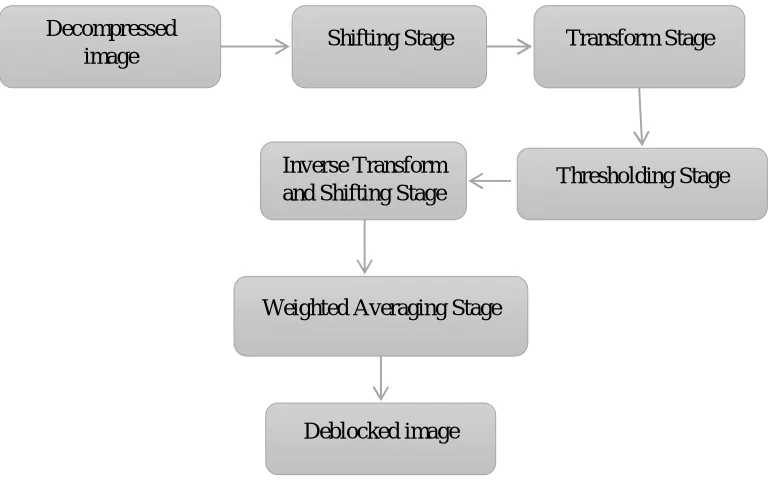
Deblocking algorithms square measure typicallyapplied within the video codec, compression andcompressed-image post-processing. For joint SR anddeblocking situation, chiefly discuss the post-processingdeblocking techniques. These ways have thought of thesensible demands in internet videos/images SR applications,and may cut back the compression artifacts throughout the SRmethod to get artifact-free and high visual quality SR results.The proposed deblocking algorithm utilizes the conceptof shifted transforms in a practical way to reducecomputational complexity while preserving visual quality.Using a 5-stage combination of integer transforms,frequency-domain thresholding, and weighted averaging,the proposed algorithm is hardware-efficient, deliversgood performance, and provides a high level of visualquality. Thus, the algorithm is suitable for efficient blockartifact reduction in real-time image and videoapplications. A general overview of the algorithm isshown in Figure 1.
Figure 1. Overview of suggested algorithm
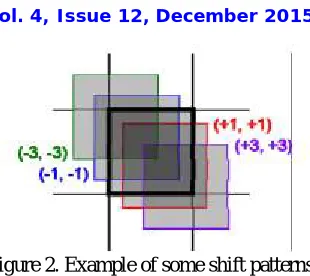
Shifting Stage :During this stage, the input image is shifted based on fourshift patterns: (Δx, Δy) = {(
-3,-3),(-1,-1),(1,1),(3,3)},where (Δx, Δy) represents the shift in the x and ydirections. These patterns are illustrated in Figure 2.This produces a total of four shifted images. Therefore,the actual deblocking process is repeated a total of fourtimes, one for each shifted image. Results during testinghave shown that this configuration provides gooddeblocking results for the proposed algorithm whileminimizing the number of computations needed. This issignificantly less than other algorithms of this type so thecomputational requirements of this stage are effectivelyreduced.
Decompressed
image Transform Stage
Thresholding Stage
Weighted Averaging Stage Inverse Transform and Shifting Stage Shifting Stage
ISSN(Online): 2319-8753 ISSN (Print): 2347-6710
I
nternational
J
ournal of
I
nnovative
R
esearch in
S
cience,
E
ngineering and
T
echnology
(An ISO 3297: 2007 Certified Organization)
Vol. 4, Issue 12, December 2015
Figure 2. Example of some shift patterns
Transform Stage: During this stage, the shifted images are transformed tothe frequency domain. The basic DCT forward transformon an input block.To reduce the number ofmultiplications needed for the transform, a number ofelements in the matrix are set to powers of 2 while othersare readjusted to compensate for this change.
Thresholding Stage: During this stage, the transformed images are subjected toa threshold in the spatial frequency domain using athreshold matrix T. All frequency coefficients below the correspondingthreshold value in the threshold matrix are set to zero.The threshold matrix used in the algorithm is a scaledinteger approximation of the quantization matrix used todecompress the image. This threshold matrix allows thedecompressed image to be adaptively filtered dependingon the image quality.
Inverse Transform and Shifting Stage: After the transformed images have been thresholdfiltered, the inverse transform of input block Y. Finally, the shifted images are inverse-shiftedbased on their corresponding shift pattern such that all theimages are aligned together.
Weighted Averaging Stage: Once the images have been inverse transformed andinverse shifted, an unweighted averaging process is usedto combine the images. While the thresholding process reduces blocking artifacts,it also introduces a slight degradation to the areas that arenot subject to blocking artifacts. To remedy theintroduction of this degradation, a number of images withdifferent shift patterns are threshold filtered, effectivelyintroducing a different degradation to each image.Averaging across the set of filtered images effectivelyreduces the degradation while preserving the imagesignal
IV. CONCLUSION
In this paper, we have introduced a new method fordeblocking compressed image and video sources based onthe concept of shifted thresholding. The algorithmreduces blocking artifacts in a computationally effectivemanner. In future apply super-resolution for this method to get better results.
REFERENCES
[1] T. M. Lehmann, C. Gonner, and K. Spitzer, “Survey: Interpolationmethods in medical image processing,” IEEE Trans. Med. Imag., vol.18, no. 11, pp. 1049-1075, Nov. 1999.
[2] X. Li and M. T. Orchard, “New edge-directed interpolation,” IEEE Trans.Image Process., vol. 10, no. 10, pp. 1521-1527, Oct. 2001.
[3] F. Zhou, W. Yang, and Q. Liao, “Interpolation-based image super resolution using multisurface fitting,” IEEE Trans. Image Process., vol.21, no. 7, pp. 3312-3318, Jul. 2012.
[4] X. Liu, D. Zhao, R. Xiong, S. Ma, W. Gao, and H. Sun, “Imageinterpolation via regularized local linear regression,” IEEE Trans. ImageProcess., vol. 20, no. 12, pp. 3455-3469, Dec. 2011.
[5] A. Giachett and N. Asuni, “Real-time artifact-free image upscaling,” IEEETrans. Image Process., vol. 20, no. 10, pp. 2760-2768, Oct. 2011. [6] R. Fattal, “Image upsampling via impose edge statistics,” ACM Trans.Graph., vol. 26, no. 3, Jul. 2007, Art. ID 95
ISSN(Online): 2319-8753 ISSN (Print): 2347-6710
I
nternational
J
ournal of
I
nnovative
R
esearch in
S
cience,
E
ngineering and
T
echnology
(An ISO 3297: 2007 Certified Organization)
Vol. 4, Issue 12, December 2015
images,” in Proc. IEEE Int. Conf. Multimedia ExpoWorkshops, 2014, pp.1-6.
[12] T. Michaeli and M. Irani, “Nonparametric blind super-resolution,” inProc. IEEE Int. Conf. Comput. Vis., Dec. 2013, pp. 945-952.
BIOGRAPHY
V.Sujini Goud, completed her M.Tech (Embedded Systems), she is having teaching experience of 7 months. Presently working as Assistant Professor, ECE Dept, Malla Reddy Engineering College for Women Hyderabad, Telangana, India.