ABSTRACT
JONES, PAUL. Self-Tracking Instrumentation Agents and Analytics to Enable Knowledge Creation and Collaborative Intelligence from Analytical Workflows. (Under the direction of Dr. Nagiza F. Samatova.)
The ‘self-tracking’ (or ‘quantified-self’) movement is enabling people to gain increased self-awareness of aspects of their daily lives, such as health and fitness, and is enabling analytics developers to create useful services based on the collected data. This is achieved through a combination of sensors, algo-rithms and visualizations. More recently, it has become apparent that the self-tracking movement also has the potential to help knowledge workers gain self-awareness of their processes for analysis of complex information - individually and/or collaboratively - and to assist them with knowledge creation, collaborative intelligence, and other tasks.
This research is motivated by a study of how students and intelligence analysts work with their computers to find and manage information, the difficulties that they encounter, and the opportuni-ties that aren’t being fully explored as a result. We observe that often these groups work in teams to analyze information, and are often forced to regularly switch between multiple tasks. In such envi-ronments, the principle difficulties we discovered are in keeping track of information artifacts and sources during knowledge creation tasks, and especially doing so collaboratively. These can prevent knowledge workers from clearly reasoning about analytic conclusions, and from backing up those conclusions with detailed provenance.
We propose a novel method for mathematically modeling analytical workflows that links hetero-geneous information sources with the tasks that they correspond to, and that combines information from collaborating users. Inspired by recent ideas in the deep learning and graph analytic commu-nities, we propose a new abstraction of the idea of embedding entities in low dimensional spaces, which allows us to co-represent users, documents and tasks in a common vector space, and hence to automatically infer links between these different types of entities. While other applications of this method are possible, we focus on the challenge of inferring associations between documents (in-cluding files and URLs) and the individual and shared tasks to which they correspond - we refer to this as ‘task-centric document curation’. Our method allows us to easily leverage a combination of content-based features and task-related features, as well as other characteristics of individual and team-based workflows, such as temporal patterns. We also show how our algorithm can operate in close to real-time (in order to facilitate timely user feedback) and can work well with few training ex-amples. To demonstrate our method in practice, we introduce a ‘recent-work dashboard’ exemplar application that displays the inferred associations, as well as gathering feedback from users.
and evaluation of ideas to further improve the classification accuracy that can be achieved from the vector space embeddings. One such method that proved successful is to incorporate coarse-grained temporal characteristics of tasks. We show how to leverage relationships between different entity types to increase classification accuracy by up to 20% over simpler baselines, and with as little as 10% labelled data from users.
To enable the development of these analytics, we first needed to capture data from longitudinal studies of analytic workflow, and to facilitate iterative prototype development. To achieve these aims, we address two further research challenges: the first of these is the challenge of creating self-tracking ‘instrumentation’ (or measurement) agents capable of capturing necessary features for task-centric document curation algorithms on a continuous basis. By learning from previous self-tracking pro-totypes that did not prove suitable for continuous use, we propose novel agents that are entirely passive (and hence non-disruptive to users), and we employ careful feature selection in order to cre-ate stcre-ate-of-the-art desktop instrumentation agents. The second challenge is the creation of active ‘journaling’ interfaces to facilitate user provision of task labels for individual and collaborative tasks. This is tackled using a hybrid ‘task-tree’ interface consisting of a mixture of elements based on a fixed taxonomy and an adaptable ‘folksonomy’, combined with carefully controlled user prompting.
Finally, we present an alternative method for better enabling knowledge creation tasks by help-ing knowledge workers keep track of finer-grained information artifacts - this time in the context of ‘claims’ they are making in written reports, and the associated ‘evidence’ they might be using to justify their claims. We use a large corpus of screenshots collected from one of our instrumentation agents during a controlled analysis study to demonstrate a novel algorithm to automatically asso-ciate these two types of information artifacts - we refer to this as ‘automatic provenance generation’.
© Copyright 2017 by Paul Jones
Self-Tracking Instrumentation Agents and Analytics to Enable Knowledge Creation and Collaborative Intelligence from Analytical Workflows
by Paul Jones
A dissertation submitted to the Graduate Faculty of North Carolina State University
in partial fulfillment of the requirements for the Degree of
Doctor of Philosophy
Computer Science
Raleigh, North Carolina 2017
APPROVED BY:
Dr. Kathleen M. Vogel Dr. Rada Y. Chirkova
Dr. Dennis R. Bahler Dr. Nagiza F. Samatova
DEDICATION
BIOGRAPHY
ACKNOWLEDGEMENTS
There are many people I would like to thank for helping with this work, and for making my time at the LAS and NCSU so productive and enjoyable. First and foremost, I would like to thank my tireless advisor, Dr Nagiza Samatova, for her expert guidance, ideas and highly motivating feedback over the years. It has been a great privilege to have been a part of her research group. Next, I would like to ex-tend my deepest thanks to my doctoral committee members - Dr Kathleen Vogel, Dr Rada Chirkova, and Dr Dennis Bahler - for their valuable time and feedback. This work is the result of several highly fruitful collaborations - firstly, between the LAS and the College of Humanities and Social Sciences (CHASS) at NCSU, which was made possible by the expert direction and boundless energy of Dr Joann Keyton and her research assistants, Grant Harned, Heewon Shin and Hannah Jaffee. The data gathered from Dr Keyton’s first ‘collaborative interactive study’ in 2014 was used as the basis for the work in Chapter 4, and is continuing to push the bounds of both computer science and social science research. Secondly, I would like to acknowledge the collaboration between LAS and the Renaissance Computing Institute, RENCI, especially Steve Cox, Michael Matthews and Sidharth Thakur, who were responsible for much of the design and implementation of the Instrumentation platform and Jour-naling prototypes described in Chapters 3 and 5. Thirdly, I extend my sincere thanks and apprecia-tion to Dr Kathleen Vogel, Chris Kampe, Gwendolynne Reid and Eli Typhina, without whom we could not have gathered the data for Study B, nor could we have gathered such detailed and insightful feed-back from participants and LAS analysts. Next, I would like to thank all the staff at the LAS who kindly ‘instrumented’ themselves in order to provide the data for Study C (with a special shout-out to Sean Streck and John Slankas for their invaluable support), as well as all the students who helped with the implementation of various aspects of the prototypes and evaluations described here, including Stew-art CStew-artmell, Shivani Sharma, Preetham Srinath, Sajal Garg, Manish Singh, Sreekanth Ramakrishnan, Rajat Shah and Arvind Lakshmanan. A special mention is also due to Jonathan Downing, whose infectious enthusiasm for the macOS platform helped enormously when creating the macOSinstru-menter. It has also been a great pleasure working with the highly talented graduate students in the data analytics research group at NCSU, especially Changsung Moon, Dakota Medd, Claude Hsu and Steve Harenberg, who provided helpful guidance for much of this work and for the associated pub-lications, as well as all the students in the group who instrumented their laptops to provide data for Study A. Finally, many thanks to Adam Amos-Binks for helpful chats throughout my time as a grad student, and to James Grzymkowski for his comprehensive proof-read of this dissertation.
TABLE OF CONTENTS
LIST OF TABLES . . . viii
LIST OF FIGURES. . . ix
Chapter 1 INTRODUCTION . . . 1
1.1 Motivation . . . 1
1.2 Terminology . . . 4
1.3 Research Questions and Approaches . . . 5
1.3.1 Task-Centric Document Curation (Chapter 2) . . . 5
1.3.2 Passive Instrumentation (Chapter 3) . . . 8
1.3.3 Analysis of Screenshots (Chapter 4) . . . 8
1.3.4 Active Journaling Interfaces (Chapter 5) . . . 9
1.4 Publications . . . 10
1.4.1 Published . . . 10
1.4.2 Accepted . . . 11
1.4.3 Under Submission . . . 11
1.5 Human Subject Participation . . . 12
Chapter 2 TASK-CENTRIC DOCUMENT CURATION . . . 13
2.1 Problem Statement . . . 13
2.1.1 Formulation . . . 14
2.2 Related Work . . . 16
2.2.1 Task Switch Detection and Task Prediction . . . 16
2.2.2 Document Content Analysis . . . 20
2.2.3 Task Sequence Prediction . . . 22
2.2.4 Heterogeneous Network Fusion . . . 23
2.2.5 Classifier Combination . . . 25
2.3 Major Research Contributions . . . 26
2.4 User Behavior Characterization . . . 27
2.4.1 Datasets . . . 27
2.4.2 Observations . . . 28
2.5 Algorithmic Approach . . . 30
2.5.1 Simplest Baseline . . . 31
2.5.2 Classification by Document Similarity . . . 32
2.5.3 Classification by Task Sequence Prediction . . . 34
2.5.4 Classification from Heterogeneous Network Fusion . . . 35
2.5.5 Enhancing the Node Embeddings . . . 39
2.5.6 Combination of Classifiers . . . 42
2.5.7 Approaches Chosen for Evaluation . . . 42
2.6 Empirical Evaluation . . . 43
2.6.1 Workflow datasets . . . 43
2.6.3 Batch-mode Evaluation Results . . . 44
2.6.4 Effect of Biasing the Random Walks . . . 47
2.6.5 Streaming-mode Evaluation Results . . . 53
2.6.6 Ensemble of Network Fusion and Sequence Prediction . . . 54
2.7 Discussion and Future Work . . . 55
Chapter 3 PASSIVE INSTRUMENTATION . . . 58
3.1 Motivation . . . 58
3.2 Related Work . . . 60
3.3 Major Contributions . . . 62
3.4 Instrumentation Agents . . . 63
3.4.1 Passive Instrumentation for macOS . . . 63
3.4.2 Passive Instrumentation for Chrome web browser . . . 64
3.4.3 Other Instrumentation Agents . . . 64
3.5 Event-based Architecture . . . 65
3.5.1 Overview . . . 65
3.5.2 Integration with Microblogging Platform . . . 66
3.5.3 Instrumentation API . . . 67
3.5.4 Data Model . . . 67
3.5.5 Query and Visualization Portal . . . 68
3.5.6 Data Collection and Aggregation Service . . . 69
3.5.7 Hardware Infrastructure . . . 69
3.6 Passive Instrumentation Use Cases . . . 70
3.6.1 Prediction of User Activity . . . 70
3.6.2 Instrumentation for Enterprise Intelligence . . . 70
3.6.3 Analysis of Online Search Behaviors . . . 71
3.7 Performance Evaluation . . . 73
3.7.1 Performance Characteristics of Instrumentation Agents . . . 73
3.7.2 Performance Characteristics of Event-based Architecture . . . 73
3.8 Discussion and Research Directions . . . 74
Chapter 4 ANALYSIS OF SCREENSHOTS . . . 78
4.1 Motivation . . . 78
4.2 Related Work . . . 79
4.3 Major Contributions . . . 80
4.4 Approach . . . 81
4.4.1 Passive Instrumentation System . . . 81
4.4.2 Screenshot analysis . . . 82
4.4.3 Algorithms for relating sensemaking artifacts . . . 83
4.5 Empirical Evaluation . . . 85
4.5.1 Data collection . . . 85
4.5.2 Data Characterization . . . 87
4.5.3 Results . . . 87
Chapter 5 ACTIVE JOURNALING INTERFACES . . . 95
5.1 Motivation . . . 95
5.2 Related Work . . . 96
5.3 Major Contributions . . . 98
5.4 Creating a Taxonomy of Tasks . . . 98
5.5 Labeling Information Artifacts . . . 99
5.5.1 Requesting labels during initial document use . . . 99
5.5.2 Requesting labels through the dashboard . . . 101
5.6 Benefits to Users and Managers . . . 102
5.7 Empirical Evaluation . . . 103
5.7.1 Approach - Iterative Evaluation Studies . . . 103
5.7.2 Computer Science Class . . . 105
5.7.3 Political Science Class . . . 107
5.7.4 Intelligence Analysts . . . 108
5.8 Discussion and Future Work . . . 109
5.9 Human Factor Considerations . . . 110
Chapter 6 CONCLUSIONS AND FUTURE DIRECTIONS. . . 114
LIST OF TABLES
Table 1.1 Common terms used in this dissertation. . . 4
Table 2.1 Comparison of main features of related task switch detection and task predic-tion research. . . 19
Table 2.2 Basic characterization of Journaling datasets . . . 28
Table 2.3 Results from classification using document vectors alone . . . 34
Table 2.4 Accuracy of next task prediction using sequence prediction alone . . . 35
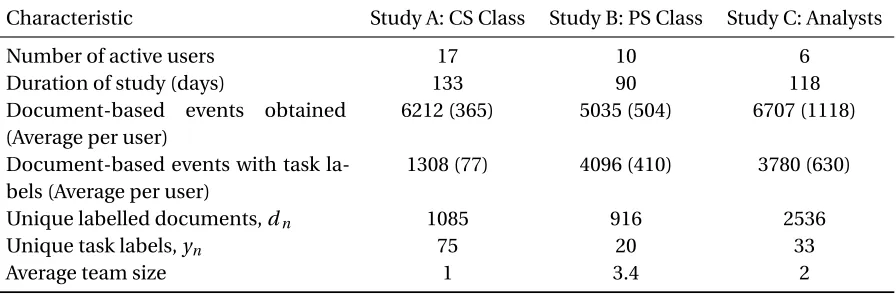
Table 2.5 Characteristics of our 3 workflow datasets for algorithm evaluation. . . 44
Table 2.6 Percentage changes in accuracy from baseline . . . 46
Table 2.7 Analysis of standard deviations in cumulative accuracy over 10 runs on each dataset with varying probability of user feedback. . . 54
Table 3.1 Core Section of Event Protocol . . . 68
Table 3.2 Events captured bymacOSInstrumenterduring a single run of the experiment, based on the activity of three people over a 90-minute period. . . 72
Table 3.3 Benchmarking Characterization of Instrumentation Platform . . . 74
Table 3.4 Aspects of Sensemaking we could attempt to measure using our platform . . . . 77
Table 4.1 Summary of key metrics from the screenshot corpus[KJ17] . . . 88
Table 4.2 Confusion matrix for active window detection . . . 88
Table 4.3 Summary of results from Stateless and Stateful algorithms . . . 89
Table 4.4 Likert scoring for quality of claim-evidence associations . . . 90
Table 4.5 Fleiss’ Kappa Statistics for Stateful Jaccard ratings . . . 91
Table 4.6 Examples of high quality claim-evidence associations extracted by our algo-rithms, which were given a score of 5 (Excellent) on our Likert scale by human raters. . . 92
Table 5.1 Comparison of Journaling tools in industry and academia . . . 97
Table 5.2 Levels Defined in Task-Tree Hierarchy . . . 99
LIST OF FIGURES
Figure 1.1 Survey Results from Knowledge Workers . . . 3
Figure 1.2 Recent-work dashboard exemplar application . . . 7
Figure 2.1 Sequence of User Document Accesses . . . 15
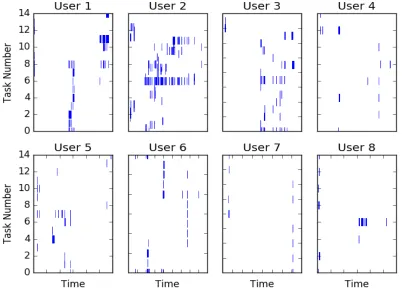
Figure 2.2 Observed task switching behavior for users in Study A . . . 29
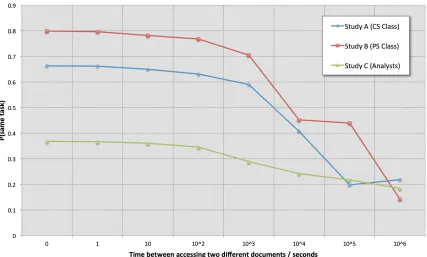
Figure 2.3 Task switching behavior observed from studies . . . 30
Figure 2.4 2D embedding of similarity between TF-IDF document vectors . . . 33
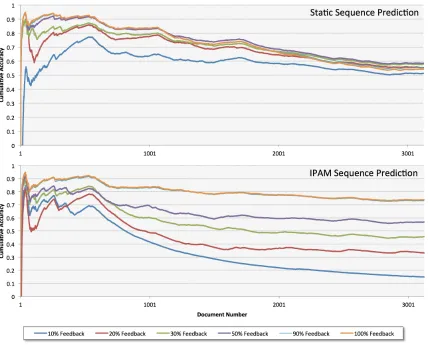
Figure 2.5 Cumulative accuracy of streaming sequence prediction algorithms with vary-ing probability of feedback . . . 36
Figure 2.6 Multi-Layer Graph relating Users, Tasks and Documents . . . 38
Figure 2.7 Automatic construction of edges in Task layer . . . 40
Figure 2.8 Micro and Macro-F1 scores for batch-mode evaluation . . . 45
Figure 2.9 t-SNE plot showing embeddings of User||Task nodes . . . 49
Figure 2.10 t-SNE plot showing embeddings of concatenated node combinations . . . 50
Figure 2.11 Top-n accuracies on the three datasets . . . 51
Figure 2.12 F1 scores for node2vec evaluation of multi-layer graph algorithm . . . 52
Figure 2.13 Cumulative accuracy in streaming mode with varying probability of feedback . 57 Figure 3.1 Our model of an Instrumentation Hierarchy . . . 59
Figure 3.2 Instrumentation Platform Overview and Architecture . . . 66
Figure 3.3 Example of a Personnel Dashboard . . . 69
Figure 3.4 Data Collection/Aggregation Service Architecture . . . 69
Figure 4.1 Example of a screenshot captured during the experiment . . . 84
Figure 4.2 Likert Scores for Evaluating Quality of Claim-Evidence Associations . . . 91
Figure 4.3 Human vs Jaccard Similarity Scores . . . 92
Figure 4.4 Examples of Some Problem Images . . . 93
Figure 5.1 Journaling User Interfaces . . . 100
Figure 5.2 Example Feedback button added to Dashboard . . . 102
Figure 5.3 Icicle Plot and Task-Tree Visualization constructed from data from Study A . . . 104
Figure 5.4 Survey Results on Journaling Interfaces . . . 107
CHAPTER
1
INTRODUCTION
1.1
Motivation
Knowledge workers - including students, intelligence analysts and others - are being exposed to more information than ever before, as well as increasingly having to work in multi-tasking[Dra05]and col-laborative[DC15a]environments. The overarching goal of the work described in this dissertation is to support these workers by generating continuous feeds of data on what they are doing (using In-strumentation Agentson their computer desktops), and by creating novel analytics to run on this data that support them when carrying out information-rich tasks, such as knowledge creation[VK00]and collaborative sensemaking[Moo12]. We observe that the recent ‘self-tracking’ movement[GD16]has so far had the greatest impact in health, fitness and life-style domains, as well as in some specialist workplaces, such as trucking[Lev15](although in this context the tracking is seldom voluntary). How-ever, self-tracking technologies are yet to become widespread in the field of knowledge work, with the notable exception of ‘productivity’ apps that are designed to simply keep track of the time spent on particular activities[Res14][Des14]. We think the potential space of applications for self-tracking of knowledge workers is much wider than this.
on their work computers, and what kinds of interfaces and algorithms they might find helpful. A summary of responses to some of the questions we asked is provided in Figure 1.1. From this, we identified that these populations tend to spend time creating organized folder hierarchies on their computers. However, on downloading new documents, many people initially store them in a default location (such as their Desktop or Downloads folder) and, although most intended to sort them later, they often did not in practice. Also, they generally tended to access previously seen doc-uments (that were related to past work) more than new ones. Next, we asked a freeform question about different ways to organize documents - suggestions included sorting by date, topic, keyword, project and task. In a subsequent question, 86% agreed that a system that could help organize by task (i.e. that could performtask-centric document curation) would be useful. We followed up the survey with some discussions with participants and discovered that the time spent organizing and keeping track of information artifacts was detracting from the time that knowledge workers wanted to be spending clearly reasoning about analytic conclusions, and on backing up those conclusions with a detailed record of where the information was derived from (i.e. recording theprovenanceof the information).
For these reasons, we decided to focus on algorithms and interfaces for organizing previously accessed documents (rather than for helping to search for new ones) and to do this in a task-centric manner. This is the focus of chapter 2. After a detailed literature review of previous algorithmic ap-proaches, we realized that an opportunity existed to model analytic workflows in a new way, building on recent developments in the deep learning and graph analytic communities. Our research resulted in a multi-layer graph model for capturing analytic workflows that allows us to bring together a lot of different ‘clues’ as to the current task that a user is working on. We then map the different types of nodes in the graph (representing users, tasks and documents) to a common vector space in order to create an effective, robust and scalable algorithm to automatically associate documents (and poten-tially other entities) with individual or collaborative tasks. The challenge of creating a suitable inter-face for displaying the curated documents is not the primary focus of this dissertation but we con-sidered an exemplar application, known as the ‘recent-work dashboard’, which is initially described in section 1.3.1.
begin on supervised machine learning algorithms for organizing documents by task, it was necessary to ask participants to label their documents with the (possibly shared) tasks and goals to which they corresponded. The research challenge of creating active ‘journaling’ interfaces suitable for continu-ous use is the subject of chapter 5, which includes empirical evaluation studies with three groups of students and intelligence analysts. As well as providing labelled data for our algorithms, these studies also show how workflow logs can provide insights into collaborative sensemaking processes.
Finally, we demonstrate an alternative method for instrumentation of user desktops, based on capturing screenshots at regular intervals, and on events that indicate user engagement, such as mouse clicks. We show how this type of data can provide an opportunity to capture information artifacts at a lower granularity than entire documents. In chapter 4, we show how it is possible to use screenshots to extract sentences corresponding to ‘claims’ being made in written reports, and to automatically associate these with ‘evidence’ derived from web browsing, thus providing a means for automatic gathering of provenance information for some types of knowledge creation tasks.
We hope that this early work in self-tracking for knowledge workers will lead to more effective rec-ommender and knowledge-creation systems in the future, and to other analytics that will help com-puters provide pro-active and timely assistance to knowledge workers. To further stimulate this, we provide a brief analysis in section 5.9 of some of the softer, ‘human factors’, involved in self-tracking technologies. This analysis suggests ideas to improve our prototypes, as well as potentially promising directions for future research work in this nascent field.
1.2
Terminology
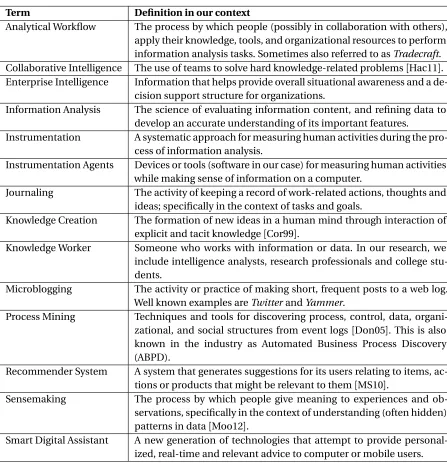
For the sake of consistency and clarity, a list of definitions of terms used throughout this dissertation is provided in Table 1.1. Some of these terms are well established in the research community; others have specific meanings in the context of the work described here.
Table 1.1Common terms used in this dissertation.
Term Definition in our context
Analytical Workflow The process by which people (possibly in collaboration with others), apply their knowledge, tools, and organizational resources to perform information analysis tasks. Sometimes also referred to asTradecraft. Collaborative Intelligence The use of teams to solve hard knowledge-related problems[Hac11]. Enterprise Intelligence Information that helps provide overall situational awareness and a
de-cision support structure for organizations.
Information Analysis The science of evaluating information content, and refining data to develop an accurate understanding of its important features.
Instrumentation A systematic approach for measuring human activities during the pro-cess of information analysis.
Instrumentation Agents Devices or tools (software in our case) for measuring human activities while making sense of information on a computer.
Journaling The activity of keeping a record of work-related actions, thoughts and ideas; specifically in the context of tasks and goals.
Knowledge Creation The formation of new ideas in a human mind through interaction of explicit and tacit knowledge[Cor99].
Knowledge Worker Someone who works with information or data. In our research, we include intelligence analysts, research professionals and college stu-dents.
Microblogging The activity or practice of making short, frequent posts to a web log. Well known examples areTwitterandYammer.
Process Mining Techniques and tools for discovering process, control, data, organi-zational, and social structures from event logs [Don05]. This is also known in the industry as Automated Business Process Discovery (ABPD).
Recommender System A system that generates suggestions for its users relating to items, ac-tions or products that might be relevant to them[MS10].
Sensemaking The process by which people give meaning to experiences and ob-servations, specifically in the context of understanding (often hidden) patterns in data[Moo12].
1.3
Research Questions and Approaches
Here we provide a summary of the key research questions addressed in each chapter of this disser-tation, along with a high-level summary of the general approaches taken. The full context for each question should become clear from reading the ‘Motivation’ and ‘Related Work’ sub-sections of each chapter to which they relate.
1.3.1 Task-Centric Document Curation (Chapter 2)
This chapter addresses the challenge of building a machine learning model and classifier to automat-ically associate documents with the tasks to which they correspond. More formally:
Can an efficient, accurate and scalable streaming algorithm be created to predict task
associ-ations for each information artifact that is accessed by knowledge workers in a collaborative and multi-tasking environment?
Tackling this research question necessitated a unique algorithmic approach. Specifically, we re-quired an algorithm capable of taking into account many different types of ‘clues’ to a document-task association, including from content analysis, collaboration patterns, document-task similarity and tem-poral patterns. Furthermore, the algorithm must be capable of providing probabilistic associations, it must handle (and learn from) multiple users, and it must be adaptable, scalable and suitable for streaming deployment. Each of these aspects is discussed in section 2.5. Our eventual approach built on much past research and led to the creation of a novel network-fusion algorithm that generates representations of users, tasks and documents in a common vector space.
In order to provide a reference application for our algorithm, we developed a novel dashboard that automatically organizes a user’s recently-accessed documents according to the tasks to which they relate. The dashboard is both enabled by document curation algorithms, and also provides a means to evaluate the algorithms with real-world users.
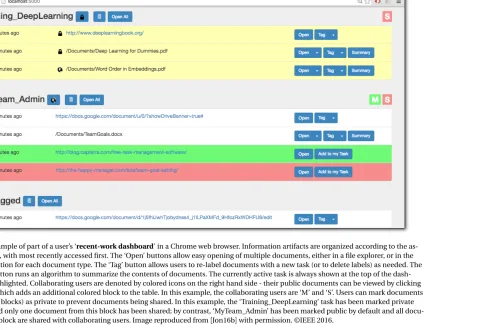
A screenshot of the ‘recent-work dashboard’ prototype is shown in Figure 1.2. Documents are listed in reverse-time order in blocks labelled by the task they are related to (note that the same doc-ument can appear in any number of task blocks). The dashboard relies on underlying ‘instrdoc-umenta- ‘instrumenta-tion’ to detect that documents have been accessed, and also on ‘journaling’ interfaces for gathering ground-truth task labels at the time of access, when these are needed.
in-corporated this observation into the dashboard by highlighting the currently suspended task, and displaying the time since the last activity. This acts as a subtle cue for the user to resume their work.
As well as assisting in information recall, the dashboard also allows documents and tasks to be re-labelled by users, thus improving the quality of future document/task associations. The dashboard also aims to promote collaboration by displaying a list of other users working on the same tasks (the ‘initial icons’ on the right hand side). In due course, we will also use the dashboard interface to provide recommendations and results from analytics running over the documents (e.g. on-demand topic classification and summaries).
Figure 1.2Example of part of a user’s ‘recent-work dashboard’ in a Chrome web browser. Information artifacts are organized according to the as-sociated tasks, with most recently accessed first. The ‘Open’ buttons allow easy opening of multiple documents, either in a file explorer, or in the native application for each document type. The ‘Tag’ button allows users to re-label documents with a new task (or to delete labels) as needed. The ‘Summary’ button runs an algorithm to summarize the contents of documents. The currently active task is always shown at the top of the dash-board and highlighted. Collaborating users are denoted by colored icons on the right hand side - their public documents can be viewed by clicking these icons, which adds an additional colored block to the table. In this example, the collaborating users are ‘M’ and ‘S’. Users can mark documents (or entire task blocks) as private to prevent documents being shared. In this example, the ‘Training_DeepLearning’ task has been marked private by default, and only one document from this block has been shared; by contrast, ‘MyTeam_Admin’ has been marked public by default and all docu-ments in this block are shared with collaborating users. Image reproduced from[Jon16b]with permission. ©IEEE 2016.
..
..
1.3.2 Passive Instrumentation (Chapter 3)
This chapter addresses the challenges of gathering continuous data streams of user activities related to their analytic workflow. In order to enable algorithms that can continually learn about user tasks, it is necessary to create instrumentation agents that run silently in the background on knowledge worker’s computers, automatically gathering all the required information without disrupting users. We address the following research questions:
Can passive instrumentation agents continuously capture all features necessary for state-of-the-art task-centric document curation in a collaborative multi-tasking environment?
What other aspects of sensemaking tasks, such as knowledge creation and collaborative intel-ligence, might it be possible to capture using passive instrumentation agents?
Whilst these questions are our core focus, we also have to address some prerequisite issues in this chapter, such as how to store and analyze all the live streams of data from our instrumentation agents. We consider some architectural and design issues for doing this and conduct a brief perfor-mance evaluation on our chosen architecture. In the course of our research on instrumentation, we also struck upon several other applications of instrumentation data related to user workflows, such as next-action prediction, and analysis of web search behavior. These and other use cases are also briefly described.
Our general approach to this was to create a single instrumentation agent for themacOS oper-ating system that was able to provide a holistic (but high-level) view of user activity, as well as a platform-independent agent for Chrome web browsers. Using this combination, alongside a state-of-the-art analysis platform, we were able to obtain sufficiently granular data to support our use-cases, and our algorithm development.
1.3.3 Analysis of Screenshots (Chapter 4)
Can some or all of the features extracted by passive instrumentation agents be extracted (or at
least approximated) from analysis of desktop screenshots?
Is it possible to accurately and reliably associate analyst ‘claims’ in written reports with
associ-ated ‘evidence’ from web pages, at least in a controlled setting?
These questions are tackled using a large corpus of screenshot data obtained from a series of controlled experiments conducted by the Laboratory for Analytic Sciences and the College of Hu-manities and Social Sciences (CHASS). Various methods are explored for identifying and extracting relevant claims and evidence, and for associating them using a variety of text similarity methods. These methods are verified through a human evaluation with expert analysts.
This work represents early inroads into this novel approach to instrumentation, but promising results are obtained and possible future directions are discussed.
1.3.4 Active Journaling Interfaces (Chapter 5)
Finally, we tackle the question of how to systematically obtain ‘ground-truth’ information on tasks that knowledge workers are engaged in, and how to do so in a way that users find acceptable (or even beneficial) on an ongoing basis.
We encapsulate this phase of the work in the following research question:
Can active journaling interfaces be created to capture task labels for individual and
collabora-tive user activities, and to provide continuous benefits to users that successfully offset any disrup-tion?
In answering this question, we consider the case where we want to capture labels at the time the activity is taking place, and also how to allow corrections (and new labels) to be supplied at a later date or time. We also tackle the question of how to define a taxonomy of tasks, and how to allow this to be easily modified so as not to become constraining.
Our eventual approach involves a simple but effective ‘task-tree’ visualization that is automati-cally triggered at appropriate times when ground-truth labels are needed. We evaluate our interfaces with groups of students and analysts using a design-based research approach. At the same time, we use these evaluation trials to capture unique labelled document corpora for development of our doc-ument curation algorithms.
1.4
Publications
This section lists publications associated with or enabled by the work described in this dissertation. In the list below, * indicates lead author papers, some of the content from which makes up parts of this dissertation. Text content and figures are reproduced with permission from the IEEE and ACM, and references to the original published works are included below.
1.4.1 Published
1. *Title:Towards Automatic Linkage of Knowledge Worker’s Claims with Associated Evidence from Screenshots[Jon17b]
Publication: The Third IEEE International Conference on Big Data Computing Service and Ap-plications (BDS) 2017.
Authors:Paul Jones, Dakota Medd, Sreekanth Ramakrishnan, Rajat Shah, Joann Keyton, Nag-iza Samatova
2. *Title:A Network-Fusion Guided Dashboard Interface for Task-Centric Document Curation[Jon17a] Publication: 22nd Annual ACM International Conference on Intelligent User Interfaces (IUI) 2017.
Authors:Paul Jones, Shivani Sharma, Changsung Moon, Nagiza Samatova.
3. *Title:Journaling Interfaces to Support Knowledge Workers in their Collaborative Tasks and Goals[Jon16b]
Publication: The 17th International Conference on Collaboration Technologies and Systems (CTS) 2016.
Authors:Paul Jones, Sidharth Thakur, Steve Cox, Michael Matthews, Sean Streck, Chris Kampe, Preetham Srinath, Nagiza Samatova.
4. *Title:A Versatile Platform for Instrumentation of Knowledge Worker’s Computers to Improve Information Analysis[Jon16a]
Publication: The Second IEEE International Conference on Big Data Computing Service and Applications (BDS) 2016.
Authors:Paul Jones, Sidharth Thakur, Steve Cox, Michael Matthews.
5. Title:A Hybrid CNN-RNN Alignment Model for Phrase-Aware Sentence Classification[Hsu17] Publication: 15th Conference of the European Chapter of the Association for Computational Linguistics (EACL) 2017.
6. Title:Online Prediction of User Actions through an Ensemble Vote from Vector Representation and Frequency Analysis Models[Moo16]
Publication: SIAM International Conference on Data Mining (SDM) 2016.
Authors: Changsung Moon, Dakota Medd,Paul Jones, Steve Harenberg, William Oxbury, Nag-iza Samatova.
7. Title:Enabling Self-Awareness for Knowledge Workers Through Visualization of Instrumenta-tion Data[Tha15]
Publication: Workshop on Personal Visualization, IEEE Visualization Conference (Vis) 2015. Authors: Sidharth Thakur,Paul Jones, Steve Cox.
8. Title:Mining Aspect-Specific Opinions from Online Reviews Using a Latent Embedding Struc-tured Topic Model
Publication: Conference on Computational Linguistics and Natural Language Processing (CI-CLing) 2017.
Authors: Mingyang Xu, Ruixin Yang,Paul Jones, and Nagiza Samatova.
1.4.2 Accepted
9. Title:Understanding Web Search Behavior for Analytical Tasks
Publication: Journal of the International Association of Law Enforcement Intelligence Analysts (IALEIA) 2017.
Authors: Joann Keyton, Grant Harned,Paul Jones, Sean Streck.
10. Title:Bringing NSA into the Classroom: Lessons Learned from Studying Student Workflows Publication: International Studies Association (ISA) 2017.
Authors: Christopher Kampe, Gwendolynne Reid,Paul Jones, Colleen Stacey, Sean Streck, Kath-leen Vogel
1.4.3 Under Submission
11. Title:Real Time Utility-Based Recommendation for Revenue Optimization via An Adaptive On-line Top-K High Utility Itemsets Mining Model
Publication: 13th International Conference on Natural Computation, Fuzzy Systems and Knowl-edge Discovery (ICNC-FSKD) 2017.
1.5
Human Subject Participation
Much of the work in this dissertation necessarily involved gathering user workflow data and con-ducting studies with human subjects. The relevant NCSU human subject protocol (e-IRB) protocol numbers that authorized or exempted this research are as follows:
• 3996: CHASS Instrumentation Experiment in 2014, as described in section 3.6.3; also includes the capture of screenshot data as described in section 4.4. An addendum to this IRB covers the public release of portions of the data corpus.1(Principal Investigator: Dr Joann Keyton).
• 5521: Task Journalling Behaviors and Goals - interviews to gather human feedback on journal-ing prototypes, as described in sections 5.7.2 and 5.7.4. (Principle Investigator: Dr Chris Anson)
• 6195: Evaluating the Effects of Journaling Software on Student Driven Analysis in the Political Science Classroom, covering the evaluation in section 5.7.3. (Principle Investigator: Dr Kath-leen Vogel)
• 9012: Big Data and Open Source Analysis: Social, Ethical, and Policy Issues, covering some of the issues described in section 1.1 and section 5.9. (Principle Investigator: Dr Kathleen Vogel)
• 9136: New CHASS Instrumentation Experiment in 2016 - a follow-up instrumentation study to the one in 2014, as described in section 3.8. (Principle Investigator: Dr Joann Keyton)
• 9222: Recent-work dashboard and Journaling evaluation studies with Computer Science stu-dents and LAS staff, covering some motivating research in section 1.1, data collection used in section 3.6.1, and the evaluations in sections 5.7.2 and 5.7.4. (Principle Investigator: Dr Nagiza Samatova)
CHAPTER
2
TASK-CENTRIC DOCUMENT CURATION
2.1
Problem Statement
From our survey in Chapter 1, we learned that future systems that incorporate ‘smart digital assistant’ technologies will need to be able to provide task-centric assistance to users. For such systems to be minimally disruptive to users, they will need to automatically learn associations between informa-tion artifacts and tasks, and to organize them accordingly (in user interfaces such as the ‘recent-work dashboard’). We refer to this combined association and organizing capability as ‘task-centric docu-ment curation’.
Also recall from Chapter 1 that a core challenge for a task-centric document curation system is for computers to quickly and accurately predict task associations for each information artifact (henceforth referred to as simply a ‘document’) that is accessed by a knowledge worker. Some of the sub-challenges involved in this are as follows:
• although some human-provided task labels will be available, they can be assumed to be sparse and infrequent. If a long period of time has passed since the most recent label (perhaps a few hours), confidence levels in new predictions may be lower since it is more likely that the user has switched tasks in the mean time.
dashboard in saving user’s time when resuming tasks will be greatly reduced. This means that the transformation step from document to features must also be done in real-time.
• there are many factors that may influence the association between a document and a task. Clearly, the document contents (such as the topic distribution) may provide a good clue but often tasks involve a heterogeneous collection of documents. The sequence of tasks that a user has been working on in the recent past also provides a clue, as does the overall distribution of time spent on each of their tasks (their underlyingworkflowpatterns). All three of these types of information could be taken into account when making task classification predictions.
• it cannot be assumed that document-task associations are unilateral or exclusive - a given document may be associated with many different tasks, and a given task may be associated with many different documents. In a similar way, certain documents are related to each other (e.g. from topic similarity), as are tasks.
• document curation must also be user-centric, as well as task-centric. Users may have very dif-ferent workflows, and associations may be subjective. Updates must be made to each user’s dashboard in real-time, which may constrain the types of analytics that are possible.
2.1.1 Formulation
LetU={u1,u2, ...}be a set of users of the dashboard interface,Y ={y1,y2, ...}be a set of task labels, andD={d1,d2, ...}be a set of documents. All of these sets are unbounded - new users, task labels or documents can appear at any time while the system is running.
During the course of their work, users will access documents and may or may not manually apply task labels. This will generate a sequence of ‘document access events’ for each user. Each event (for example, thejt h event for userui) will contain a timestampti
j, a document named i
j ∈D and, op-tionally, a task labelyji ∈Y and an associated confidencecij. For userui, let this sequence of events be denoted asAi = (ai1,a2i, ...,ain), where eachaij is a quad {tji,dij ∈D,yji ∈Y,cij}.ain is the most recently observed document access event for userui.
At any given time, the system may be assumed to have access to the previousk+1 documents (from a total ofndocuments) that have so far been accessed by a given user,ui, during the course of their work. The most recently accessed document is denoted asdi
nand the next document that they may access is denoted asdin+1. This forms the following sequence for each userui ∈U:
ui:(din−k,din−k+1,dni−k+2, . . . ,dni−1,dni,dni+1)
Note that these documents are not necessarily unique - the same document may be accessed multiple times. Each document also has an associated task label, the most recent beingyi
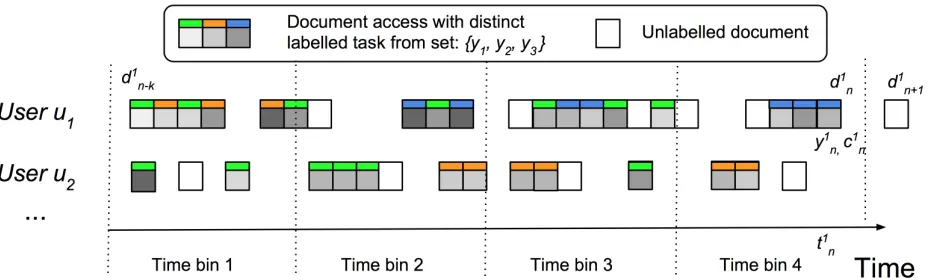
Figure 2.1Sequence of document accesses for usersu1andu2. Colored headers denote different task labels, with unlabelled documents shown in white. The most recently viewed document foru1is denotedd1n, and it has associated task labely1
n =y3(blue header), which has been assigned with confidencec1n(depicted as different levels of gray shading). The most recent document is accessed at timet1
n(in Time bin 4). For the se-quence prediction problem, we are interested in guessing the identity of the next documentd1
n+1[Moo16]. For the task-centric document curation problem, we assume we are given a new documentd1
n+1, and we want to predict its task labely1
n+1and associated confidencecn1+1. Image reproduced from[Jon17a]with per-mission. ©ACM 2017.
also a confidence value associated with the document-task pairingci
n. A given document may have different task labels and different confidences at each position in the sequence.
Furthermore, the time that the knowledge worker spends accessing (either viewing or editing) a given document, thedwell time, is also available from instrumentation and is denoted astn for the most recent document. The periods of time in between document accesses (i.e. the ‘gaps’) are also available, the most recent beinggn.
This sequence is illustrated for two users in Figure 2.1, which forms the input to our task-centric document curation system. Note that the dwell times and gaps are omitted from the diagram for clarity. Given this document sequence, two key research challenges present themselves:
• Sequence prediction problem- to what extent can the identity of the next document,din+1, be predicted in the sequenceAi for userui, either with or without the presence of task labels and confidences? The case without task labels or confidences was explored in[Moo16]and is not the focus of this dissertation. However, ideas from that work can be re-applied for predicting the next task labelyni+1, given a sequence of previous task labels, irrespective of the document itself. These ideas are outlined in section 2.2.3.
user, as well as their associated task labels and confidences. Furthermore, we can use associa-tions between usersui ∈Uand any known associations between tasksyi ∈Y to improve the predicted task-document associations.
The task-centric document curation problem is the focus of this chapter.
2.2
Related Work
This section comprises a survey of related approaches in five areas that are relevant to the task-centric document curation problem. Firstly, previous approaches to detection of task switches and task prediction are considered, and it is explained why the task-centric document curation formula-tion described here is a more tractable (and hopefully useful) angle on this problem. Secondly, state-of-the-art approaches to measuring document similarity are described, which is a core component of our formulation; thirdly, approaches to predicting user tasks by sequence analysis are considered; fourthly, an analysis of heterogeneous network fusion approaches is carried out, with a view to com-bining information on users, tasks and documents in a single graph; finally, approaches to fusing the classifiers derived from these approaches are considered.
2.2.1 Task Switch Detection and Task Prediction
First, we consider general approaches to task switch detection and prediction that have been pro-posed by other researchers. These projects tend to have somewhat different aims to that of ours but they all include elements that can be learned from, or built upon. Some attempt to learn about tasks in an unsupervised manner (i.e. without any manually provided task labels) while others take super-vised or semi-supersuper-vised approaches; some are designed for real-time operation, others only learn in a batch mode; and each project exploits a slightly different set of features.
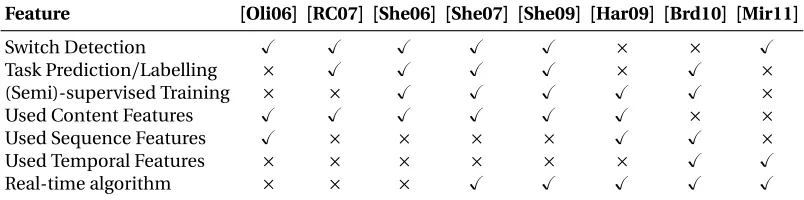
A summary of the main characteristics of each of the eight approaches considered here is shown in Table 2.1, and each of these approaches is briefly described below:
• CAAD[RC07]- again, the intention here was to create an automatic task support system that did not use explicit task labels. The authors used some of the same metadata we are provid-ing through our Instrumentation (Chapter 3), includprovid-ing use of files, URLs and applications. This metadata was used to detect structures (called task context structures) from the user’s workflows once per day. These offline computations were then used to inform a simple online model of document-task associations. Feedback gathered from user trials found several types of contradictions between the mental models participants had of their own work and the tem-porally correlated context structures captured by CAAD. Also the work was limited to a small subset of files on the user’s computer. Whilst a good step forward, this work highlighted the need for a semi-supervised approach.
• TaskPredictor[She06]- similar to SWISH, this approach also exploited a variety of window-based text content, such as window titles, file pathnames and website URLs, for task switch detection. The algorithm began by segmenting the text from these into a set of ‘words’ and then created a binary variable in the feature set for each unique word. They then applied three simple machine learning techniques: (a) classification thresholds using Bayes rule, (b) mutual information feature selection, and (c) a hybrid Naive Bayes/Support Vector Machine classifier. An advantage of this approach was that the predictions could be computed immediately and rapidly each time the user switched focus from one window to another. The disadvantage was that, with such impoverished features, the accuracy of the predictions was poor, although they did show that accuracy could be improved by using features from windows other than just the one currently in focus. Other major limitations were that document content was not taken into account, and the model didn’t make use of information from collaborators.
• Real-time detection of task switches[She07]- this approach built on the work carried out in TaskPredictor to implement a variant of change-point detection based on simple features from a Single Window Classifier. It was found that a metric based on an assumed task switch tran-sition cost and the Viterbi algorithm gave the best results. This learning method was based on analyzing the sequence of recently-visited resources. It first applied the single-window clas-sifier to each of these resource visits. Then it detected activity switches by applying a Viterbi algorithm with a fixed switch cost. This led to somewhat improved accuracy but had the side effect of introducing a potentially significant delay between the time of the switch and the time the switch was detected. This led in turn to major usability problems when implemented in the TaskTracer framework[Dra05].
draw-back of both of the previous learning methods is that they employed a batch SVM algorithm. This required the storage of all of the training examples and they all had to be reprocessed when retraining was required. SVM training time was found to be roughly quadratic in the number of examples, so the longer TaskTracer was used, the slower the training became. Fur-thermore, activity prediction is a multi-class prediction problem over a potentially large num-ber of classes. TaskPredictor2 included a richer set of contextual features and provided a better user experience but had a complex architecture. It adopted a ‘regularized passive-aggressive algorithm’[Cra06]to ensure that, when user feedback was provided, the algorithm would be adjusted enough so that the same mistake would not be repeated.
• AUGUR[Har09]- the goal of this research system was to understand the user’s current ‘con-text’ just enough to be able to provide useful recommendations for completing forms on the web. For instance, when booking a train, the system might provide suggestions for the ‘From’ field based on locations found in current calendar entries. Although the context referred to here doesn’t correspond directly to a ‘task’, it does provide clues as to what the user is looking to achieve. Hence this research is relevant to systems that aim to provide task-centric support through UIs. The system used a graph-based model of relations between context and activities and suggestions are primarily based on a simple frequency count of edges connecting each of these types of nodes. The method also makes use of the FxL[HS07]sequence prediction algo-rithm for assigning confidence to form suggestions. Whilst limited to web forms, this work did demonstrate the potential benefits of this kind of pro-active support, with 85% of participants stating that they would like to see more of this kind of context-aware support.
• Deriving user tasks from document usage patterns[Brd10](and patent[BA12]) - this approach for task recognition only used document identifiers and the temporal switch history between them as input. Unlike most other approaches, it didn’t use any text from windows or from doc-ument contents. Retrieved docdoc-uments were filtered by their dwell times (i.e. the amount of time a user spent studying them) and a document similarity matrix was estimated based on document usage frequencies and switches. A spectral clustering algorithm then grouped doc-uments into tasks using the derived similarity matrix. Their results showed that worked well in identifying a small set of high-level tasks but the precision of the isolated clusters decreased as the number of tasks (and in particular, the granularity of tasks), increased. However, they did claim better results than content-based approaches like SWISH, and show the potential of creating initial task representations in an unsupervised manner, which can then be labelled and refined by users.
Table 2.1Comparison of main features of related task switch detection and task prediction research.
Feature [Oli06] [RC07] [She06] [She07] [She09] [Har09] [Brd10] [Mir11]
Switch Detection ✓ ✓ ✓ ✓ ✓ × × ✓
Task Prediction/Labelling × ✓ ✓ ✓ ✓ × ✓ ×
(Semi)-supervised Training × × ✓ ✓ ✓ ✓ ✓ ×
Used Content Features ✓ ✓ ✓ ✓ ✓ ✓ × ×
Used Sequence Features ✓ × × × × ✓ ✓ ×
Used Temporal Features × × × × × × ✓ ✓
Real-time algorithm × × × ✓ ✓ ✓ ✓ ✓
switch was occurring. i.e. thetn andgn from Figure 2.1. The authors demonstrated that tem-poral aspects do provide some predictive power but, on their own, the prediction accuracy was relatively poor.
In summary, research in the field of task switch detection and prediction was particularly active between 2006 and 2011. Over the past 5 years, there seems to have been a slowing down in the pace of new research in this field. This does not appear to be because many of the problems have been solved - unfortunately, there are very few task recognition or context-aware recommendation systems in widespread use by knowledge workers. This lack of task-centric systems in the workplace suggests that the problems taken on above were too ambitious and solutions could not be found that were considered acceptably unintrusive and useful by users.
However, several developments in other research fields have come together to make this a poten-tially good time to re-examine this research. Before describing some of those, the main limitations of previous systems can be summarized as follows:
• most of these previous attempts did not make use ofcontent-based featuresfrom inside docu-ments when classifying docudocu-ments across tasks - the ones that did use content features mostly just processed text from window tiles or web URLs (rather than from the document content itself ). The field of document content analysis has moved on considerably in recent years, and it seems worthwhile to re-examine this approach in the light of state-of-the-art methods.
• few previous approaches took into account task or document sequence information, and those that did were using sequence prediction approaches from several years ago, that would not be considered state-of-the-art today.
• only two of the approaches considered above made use of temporal information when detect-ing task switches or predictdetect-ing task labels. The ones that did showed that there is potentially some value here, but only when combined with content and/or sequence-based features.
• previous approaches typically included complex feature selection procedures and hence could not be easily generalized to new desktop environments and new types of tasks. Furthermore, they could not easily be maintained or extended due to low-level instrumentation that was typically closely coupled to the underlying system.
As a result of these limitations, accuracy on task switch detection and prediction has typically been too low to be useful (rather than frustrating) for users, and solutions are difficult to general-ize. The following sections examine state-of-the-art research that may help to address the first three of the limitations described - content features, sequence information, and heterogeneous relation-ships.
2.2.2 Document Content Analysis
As we have seen, many existing methods are limited by their minimal analysis of document content when attempting to cluster them, or to associate them with tasks. The types of content found in doc-uments may not be relevant for some tasks but it does provide one potential approach to assigning task labels if there are one or more ‘topics’ associated with each task. This is especially likely to be the case in learning/educational tasks, where each sub-task likely corresponds to a slightly different subject to be learned.
There may be many other clues to be found in documents, such as in titles, filenames, folder locations etc but these are considered to be metadata for our purposes, not content. There follows a brief review of some of the methods used to examine document contents and to compute similarity between pairs or groups of documents:
• TF-IDF[SM83]- computing Term Frequency/Inverse Document Frequency weightings on word counts is probably one of the most well-known methods for producing a simple vector repre-sentation of a document. One simply counts words (optionally with prior stop-word removal and stemming), and computes a weighting for each word that represents its relative frequency in a wider corpus. The TF-IDF method is a simple, fast, and sometimes effective bag-of-words approach for creating document vectors. These vectors can then easily be compared using co-sine similarity.
that correspond to Dirichlet distributions. LDA has been shown to produce reasonable topic distributions but unfortunately they are often seen as unintuitive by human observers. The topic distributions can be used directly as vector representations and hence support direct document similarity measurement but the number of topics must be known in advance, which is often not realistic.
• word2vec[Mik13]- this refers to a group of related models for producing vector representations of words. They use two-layer neural nets to learn contexts for words in large corpora (such as Wikipedia). The resulting word embeddings are useful for performing ‘computations’ over words along hidden semantic dimensions (for instance, the computation“Brother” - “Man”+ “Woman”=“Sister”works because we’ve found a hidden dimension for ‘sibling’ words). Whilst these word embeddings are clearly effective, it is not clear how to combine word embeddings to represent entire documents - a simple approach is simply to average the word vectors but has been shown to work poorly in most circumstances.
• doc2vec[LM14]- this is a more recent algorithm that builds on the neural net representation approach of word2vec to create vector representations of short pieces of text. It is an unsuper-vised algorithm that learns fixed-length feature representations from variable-length pieces of texts, such as sentences, paragraphs, and documents. doc2vec has been shown to overcome weakness of some bag-of-words approaches but it is very expensive to train.
• LINE[Tan15a]- it is possible to model text as a word co-occurence network (where edges are created between words if they occur within short, say 5-word, sliding windows). The Large Scale Information Network embedding approach then computes first and second order prox-imities in this graph. First order proximity simply refers to weight on edges connecting two nodes; second order proximity refers to the similarity of their shared neighborhood. LINE is suitable for arbitrary types of information networks: undirected or directed, binary or weighted. It optimizes an objective function which aims to preserve both the local and global network structures, and is appropriate even when no labelled data is available, or when documents are short.
strongly suggest using the PTE model to jointly train the embedding with both the unlabeled and labeled data.
To summarize, for our problem, we require a semi-supervised method for learning vector repre-sentations that works on short documents as well as long ones. Often we may only get a small amount of usable text from web pages, or from documents that the user is creating themselves. Therefore it seems sensible to consider several of these algorithms for computing document similarity, including TF-IDF, word2vec (perhaps with vector averaging), doc2vec, LINE and PTE.
2.2.3 Task Sequence Prediction
As discussed in section 2.2.1, few existing research efforts have considered the sequence of tasks that multi-tasking knowledge workers are engaged in. The ones that did found that even simple heuristics can produce reasonable guesses as to the likely task that a worker is occupied with.
This approach assumes that a user is likely to continue working on tasks that they have worked on previously, and hence the sequence of past tasks holds some predictive power for guessing their current or future tasks. The advantage of this approach is that it is completely orthogonal to docu-ment similarity and does not depend on the tasks having any inherent ‘topics’ associated with them. Also, the problem of modeling a sequence of tasks, rather than a sequence of documents, may be easier due to the smaller number of possible classes to guess from - a person’s task list is typically bounded.
This section reviews some sequence analysis methods that may be applicable for this problem, ranging from very simple to state-of-the-art. Note that we may not just want to predict a single task at any give time-step; instead, we can maken predictions, and all of them can be used to organize documents in the dashboard interface (section 1.3.1).
• Static - in the simplest possible case, we could simply choose the previousn tasks for the user as the top-n predictions. This has been shown to work surprisingly well in related work [Moo16], and is certainly a valuable baseline algorithm.
• HMM - in a Hidden Markov Model, we assume that our sequence of tasks is a Markov process with hidden states. This makes the assumption that the next task depends only on the current hidden states of the model (which might correspond roughly to a user’s workflow). However, in a related investigation[Moo16]where we were interested in predicting user ‘actions’ (ap-plication of web page opening events from instrumentation), a simple HMM (based on the Baum-Welch algorithm) performed poorly.
arbitrary number of previous inputs. A common implementation is in the form of a partially recurrent neural network known as an Elman network. This network consists of three layers (input, hidden, and output), with the addition of ‘context units’, which take their input from hidden units. The number of context units and hidden units is the same. An advantage of El-man nets over other forms of RNN is that the number of context units is not determined by the output dimension but, instead, by the number of hidden units, which are easy to add and remove. In our study of user actions[Moo16], an Elman network-based RNN performed badly, although there is much room for further optimization here, such as by using Long-Short Term Memory (LSTM) units[HS97]in the network.
• FxL[HS07]- this method calculates a score for each potential action (or task in this case) by multiplying the frequency of an action (F) with the length of the context (L). FxL Builds upon an n-gram trie containing the frequencies of different input sub-sequences. The frequencies are weighted according to the lengths of the sub-sequences. This was the best performing al-gorithm among the existing prominent alal-gorithms.
• IPAM[DH98]- the Incremental Probabilistic Action Modeling method assumes that each ac-tion depends only on the previous acac-tion. It stores the probabilities of transiac-tions from an action to a next action in a table, and the probabilities are updated by the use of an update function. In our tests[Moo16], IPAM did not perform as well as FxL, although it is simple to implement and fast.
• FVEC[Moo16]- the Frequency-Vector model is based on an ensemble prediction that com-bines a frequency model with a vector representation, and beats either one in isolation. From online performance tests on user actions[Moo16], FVEC showed a higher accuracy and a lower standard deviation than the other online sequential prediction algorithms.
There appears not to be any related work in the literature on sequence prediction that also takes into account time spent on each action and the gaps between actions (i.e. combining a prediction from sequence analysis, with task switch detection from an approach such as the Switch Detector [Mir11]approach in section 2.2.1). Such an approach may provide a fruitful avenue for future re-search.
In summary, it would seem sensible to combine a sequence analysis approach (such as Static, IPAM, FxL or FVEC) with a content analysis approach in order to address the task-centric document curation problem.
2.2.4 Heterogeneous Network Fusion
and similar tasks, and also document-task associations made by collaborating users. One approach to modeling all of these associations is as a network, or graph, in which edges represent associations between entities of the same or different types.
This section reviews some of the methods in the literature for creating such heterogeneous net-works and for prediction of ‘missing’ edges in the network. These methods include the following:
• Personalized Entity Recommendation[Yu14]- although this is solving a slightly different prob-lem to ours, the recommendation probprob-lem is closely related to that of link prediction. This work describes a heterogeneous information network approach, which incorporates a variety of different types of entity relationships, and uses a Bayesian ranking process for recommend-ing entities. Latest features for users and items are calculated with matrix factorization tech-niques. This would be one possible approach for our problem, although matrix factorization is known not to scale well for large networks, and when using such techniques it isn’t possible only to consider a small part of the overall graph.
• Neural Word Embedding[LG14]- in related work to[Yu14], the authors show that skip-gram with negative-sampling[Mik13]is implicitly factorizing a word-context matrix. Skip-gram is a widely-used distributed word representation method. This insight suggests that it may not be necessary to factorize the entire matrix in order to compute similarity between nodes. Instead, we can create an embedding of each node in a shared vector space. Recall that we desire a means to build an embedding of users, tasks and their documents, so that the ‘similarity’ of any pair of these can be computed through a simple distance function. In this way, task association can be carried out by computing the distance of each task to a given new document.
• DeepWalk[Per14]- building on the insight that large-scale matrix factorization is undesirable, this work introduced skip-gram[Mik13]into the study of social networks for the first time. By applying skip-gram to random walks of a graph, DeepWalk learns vertex representations that correspond to the network structure - the idea being that nodes that frequently co-occur in short random walks should also be close to each other in the vector space. This method was shown to work well both for small and for large graphs, and may be a good approach to combine User, Task and Document networks. Also, this approach potentially lends itself well to an online algorithm since it is possible to consider only a subgraph when creating an embedding for a given node, and parameters such as the number of random walks, or skip-gram window size are configurable.
method to take into account document content features in the association graph, when these features are available.
• Heterogeneous Network Embedding via Deep Architectures[Cha15]- in this work, the authors use deep learning techniques to capture the complex interactions between heterogeneous components. For our problem scenario, we don’t need the additional complexity or compu-tational expense that is incurred by this approach, as we can simply use the same generic ‘association’ relationship between each pair of entities. This approach may also require large networks for effective training.
• Multi-layer Networks[Kiv14]- in this paper, the authors describe many different variants of multi-layer networks. They examine the history of the field and why literature on multilayer networks has rapidly become ‘extremely messy’. They present a general framework for study-ing multilayer networks and have constructed a dictionary of terminology to relate the numer-ous disparate existing notions to each other.
• Knowledge Graph Joint Embedding[Wan14]- this paper presents a novel method of jointly embedding entities and words into the same continuous vector space, which is comparable to, or perhaps slightly better than, word2vec (particularly the skip-gram variant). The embedding aims to preserve associations between entities in a knowledge graph and co-occurrences of words in the text corpus. Again, this might provide a means to model our workflow data but the richness of a knowledge graph model may not be required here.
• Review of Relational Machine Learning for Knowledge Graphs[Nic15]- to complete our brief review, this paper provides a summary of many approaches to construction and learning over Knowledge Graphs. Whilst this is a potential approach, we do not require the full expressivity of a knowledge graph model for this problem.
To summarize, a simple homogeneous network with node attributes (types) should actually suf-fice in this context, rather than a true heterogeneous network. Also DeepWalk with word2vec (skip-gram) could provide a relatively simple means to measure embed the different node types in a com-mon vector space, from which similarity between different types of nodes can easily be computed using distance metrics.
2.2.5 Classifier Combination

![Figure 2.4 Two-dimensional t-SNEweights were obtained, and Cosine Similarity calculated between all pairs of documents, giving a 270x270 [MH08a] embedding of human-readable content from 270 web pagestagged by the Political Science class during the second J](https://thumb-us.123doks.com/thumbv2/123dok_us/1696147.1214796/45.612.96.543.66.510/dimensional-sneweights-similarity-calculated-documents-embedding-pagestagged-political.webp)