Energy Saving using Token Bucket in Sensing
Network
Harpreet kaur1, Amandeep kaur2,
M.Tech Student, , Global Institutes of Management& Emerging Technologies, Batala Road, Asr,India1. Head of Department of ECE, Global Institutes of Management & Emerging Technologies, Batala Road, Asr, India2
ABSTRACT
:
Wireless network in this modern era is more popular because of its efficiency, availability and convenience.As a consequence, congestion increases day by day. In this paper, we have proposed a method for lesser energy consumption and to set equilibrium in traffic with the help of BEEM and Token bucket procedure due their major advantages in wireless environment. So the main objective is to maintain load with BEEM and to control congestion such as average rate, maintain burst size with the help of token bucket algorithm, where wireless environment is of heterogeneous and cluster type. All simulation results are obtained by using MATLAB software.
KEYWORDS: Wireless, Sensor, BEEM, Protocol, Token, Energy,HEED.
I.INTRODUCTION
cluster heads being elected. The constraint threshold of distance was used to optimize cluster scheme. Furthermore, it was also constructed the routing tree based on cluster heads' weight.
II.TOKEN BUCKET ALGORITHM
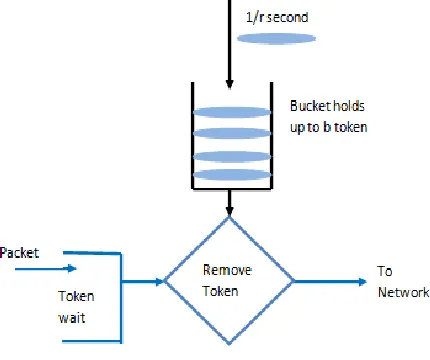
M.M. Islam [8] presented an extended Stable Election Protocol (SEP) algorithm for cluster head selection in a hierarchically clustered heterogeneous network to reorganize the network topology and energy efficiently. This was not able to work with BEEM protocol. So token bucket is integrated with BEEM [3] that allows the output rate to vary, depending on the size of the burst. Lu, Y., Zhang et. al[9] proposed a method to change the node's threshold function to prolong the network's lifetime and realize the balance of energy in network. The simulation results indicate that the new protocol can prolong network's life time and balance energy consumption of nodes. But this method is quite similar with leaky bucket method but this technique focus on coming packets size and having queue to hold token until next second.Token is a unit or fixed number of bytes or single packet of fixed Size.We assume a token = a unit byte The figure 1 represent procedure and need of this method step by step.
Figure 1: Token Bucket Algorithm
The token bucket algorithm can be conceptually understood as follows:
A token is added to the bucket every 1/r second.
The bucket can hold at the most b tokens. If a token arrives when the bucket is full, it is discarded.
When a packet (network layer PDU) of n bytes arrives, n tokens are removed from the bucket, and the packet is sent to the network.
If fewer than n tokens are available, no tokens are removed from the bucket, and the packet is considered to be non-conformant.
III.PROPOSED METHOD
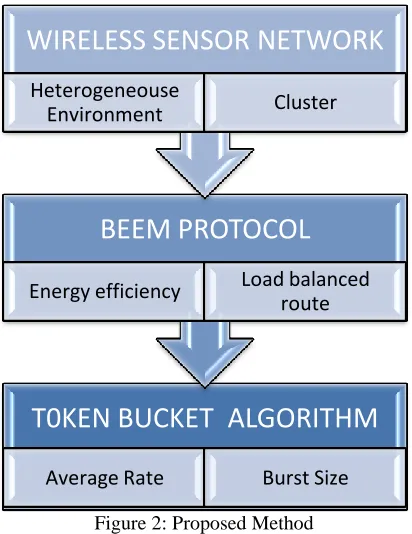
We have proposed a method for lesser energy consumption and to set equilibrium in traffic with the help of BEEM and Token bucket procedure due their major advantages in wireless environment.
Figure 2: Proposed Method
Wireless sensor network is of two types: Homogenous and heterogeneous. In our proposed method heterogeneous type is used where all nodes work independently in a cluster.
Energy efficiency and to balance load are two main goals which are controlled by using BEEM.
Token bucket is used to average rate and burst size in case of heavy traffic
IV.SIMULATION RESULTS AND DISCUSSION
In this article we have observed that BEEM protocol in wireless network stands with dynamite performance. Where BEEM is responsible for load balance and token bucket helps to control congestion in path.
T0KEN BUCKET ALGORITHM
Average Rate
Burst Size
BEEM PROTOCOL
Energy efficiency
Load balanced
route
WIRELESS SENSOR NETWORK
Heterogeneouse
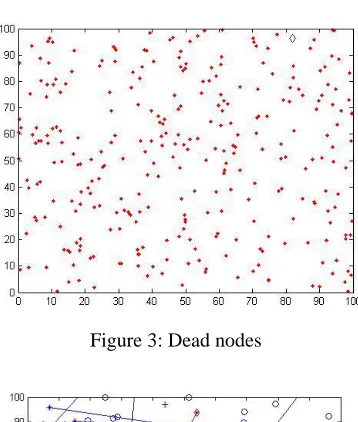
Figure 3: Dead nodes
Figure 4 : Current scenario
Figure 5 : Packets send to base station
In this figure 5, maximum 1400 packets are sent to base station during 67 rounds. It means that at every round 10 packets are increasing.
Figure 6: Packets send to cluster head
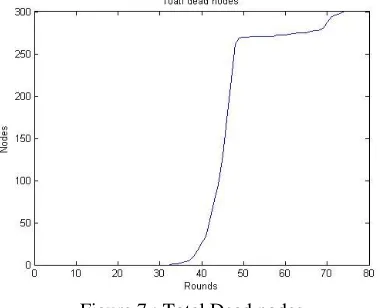
In figure 7, First dead note is happened in 32 rounds and last dead note is at 74 rounds.
V. COMPARATIVE ANALYSIS
From previous work , it is evident that BEEM cannot work efficiently without Token as shown in figure 8. Furthermore when it is integrated with token method, its performance increased. In figure 9, we can see that in more load and congestion, this method create balance in network.
Figure 8 : BEEM without Token Bucket Algorithm
Figure 9 : BEEM with Token Bucket Algorithm
VI.CONCLUSION AND FUTURE TREND
REFERENCES
[1] Khediri, Salim EL, et al. "A New Approach for Clustering in Wireless Sensors Networks Based on LEACH." Procedia Computer Science 32 1180-1185, 2014.
[2] Xu, Lina, G. M. P. O'Hare, and Rem Collier. "A Balanced Energy-Efficient Multihop clustering scheme for Wireless Sensor Networks." Wireless and Mobile Networking Conference (WMNC), 2014 7th IFIP.IEEE, 2014.
[3] Hamid R. Rabiee, “Traffic Access Control”, Advanced Information and Communication Technology Center, Springer, 2012.
[4] VivekKatiyar, Narottam Chand, Gopal Chand Gautam,Anil Kumar “Improvement in LEACH Protocol for Large-scale Wireless Sensor Networks”, (IEEE), 23-24 March; Tamil Nadu, pp.1070-1075, 2011
[5] ReetikaMunjal, Bhavneesh Malik “Approach for Improvement in LEACH Protocol for Wireless Sensor Network”, Second International Conference on Advanced Computing & Communication Technologies (IEEE) Rohtak, Haryana, pp.517-521, 2012.
[6] Shuo Shi, Xinning Liu and XuemaiGu “An Energy-Efficiency Optimized LEACH-C forWireless Sensor Networks”, 7th International ICST Conference on Communications and Networking in China (CHINACOM) (IEEE) , kun Ming, pp.487-492. 2012
[7] Thu Ngo Quynh, Kieu-Ha Phung2,3, Hoan Vu Quoc1 “Improvement of Energy Consumption and Load Balance for LEACH in Wireless Sensors Networks”, (IEEE) 15-17 Oct; Jeju, Island, pp.583-588, 2012.
[8] M M Islam, M A Mati, T K Mondol “Extended Stable Election Protocol (SEP) for Threelevel Hierarchical Clustered Heterogeneous WSN”, (IEEE) London, pp.1-4, 2012
[9] Lu, Y., Zhang D., Chen Y., Liu, X. and Zong P., “Improvement of L EACH in Wireless Sensor Network Based on Balanced Energy Strategy” IEEE Proceeding of International Conference on Information and Automation Shenyang, China, June 2012 on p 111-115 in IEEE,2013. [10] Heinzelman, W., Anantha, P. and Balakrishnan, H. “An Application-Specific Protocol Architecture for Wireless Micro sensor Networks” IEEE
Transactions on Wireless Communications, in IEEE Vol. 1,No 4, pp.661-670, 2002
[11] Babaie, S., Agaalizadeh, S. and Golsorkhtabar, M. “The Novel Threshold Based Hierarchical Clustering Method for Wireless Sensor Network”, IEEE International Conference on Electronics and Information Engineering (ICEIE), August 2010, pp. 191 – 195.
[12] Guisheng Yin, Guang Yang, Wu Yang, Bingyang Zhang, Wenjin Jin1, “An Energy-Efficient Routing Algorithm for Wireless Sensor Networks”, International Conference on Internet Computing in Science and Engineering (IEEE) (2008),28-29 Jan; Harbin, pp.181-186. [13] Sun, J., Chen, W., Zhang, B., Liu, X. and GU, X., “Energy-efficient Clustering Routing Protocol Based on Weight”, IEEE International