-"
,
SIMULATION-EXTRAPOLATION ESTIMATION
IN PARAMETRIC MEASUREMENT ERROR MODELS
by
J.
R. Cook and l. A. Stefanski
Institute of Statistics Mimeograph Series No. ZZZ4R
Revised November 1993
NORTH CAROLINA STATE UNIVERSITY
(
I
I I , Ii
,
!..
J.R.Cook& L.A. Stefanski MIMEO
SERIES SI~1ULATION-EXTRAPOLATION
#2224R ESTIMATION IN PARAMETRIC
ERROR MODELS
NAME DATE
SIMULATION-EXTRAPOLATION ESTIMATION
IN
PARAMETRIC MEASUREMENT ERROR MODELS
J. R. Cook
Merck Research Laboratories Division of Merck
&
Co., Inc. West Point, PA 19422L. A. Stefanski Department of Statistics North Carolina State University Raleigh, NC 27695
ABSTRACT
We describe a simulation-based method of inference for parametric measurement error models
in which the measurement error variance is known or at least well estimated. The method entails
adding additional measurement error in known increments to the data, computing estimates from
the contaminated data, establishing a trend between these estimates and the variance of the added
errors, and extrapolating this trend back to the case of no measurement error.
We show that the method is equivalent or asymptotically equivalent to method-of-moments
estimation in linear measurement error modelling. Simulation studies are presented showing that
the method produces estimators that are nearly asymptotically unbiased and efficient in standard
and nonstandard logistic regression models.
An
oversimplified but fairly accurate description of themethod is that it is method-of-moments estimation using Monte Carlo derived estimating equations.
Note: This paper uses data supplied by the National Heart, Lung, and Blood Institute, NIH, and
DHHS from the Framingham Heart Study. The views expressed in this paper are those of the
authors and do not necessarily reflect the views of the National Heart, Lung, and Blood Institute,
1. INTRODUCTION
Inthis paper we introduce a simulation-based method of inference for measurement error models
applicable when the measurement error variance is known or can be reasonably well estimated,
say from replicate measurements. It combines features of parametric-bootstrap and
method-of-moments inference. Estimates are obtained by adding additional measurement error to the data
in a resampling stage, establishing a trend of measurement-error-induced bias versus the variance
of the added measurement error, and extrapolating this trend back to the case of no measurement
error.
The method lends itself to graphic description of both the effects of measurement error on
parameter estimates and the nature of the ensuing "corrections for attenuation." It is also very
simple to implement. This is particularly useful in applications where the user, though very familiar
with standard statistical methods, may not be comfortable with the burdensome technical details of
model fitting and statistical theory that generally accompanies all but the simplest of measurement
error models. Since the method is completely general, it is also useful in applications when the
particular model under consideration is novel and conventional approaches to estimation with the
model have not been thoroughly developed/studied.
We developed the procedure in response to the need for fitting nonstandard generalized linear
measurement error models, specifically models in which the mean function depends on something
other than a linear function of the predictor measured with error. In principle, the general
approaches described by Stefanski (1985), Fuller (1987, Ch. 3), Whittemore and Keller (1988),
and Carroll and Stefanski (1990) could be applied to such models. However, in addition to their
complexity and the need for specialized software, these methods entail approximations, the quality
of which would be difficult to verify with complicated models.
Although the attenuating effects of measurement error have been well publicized and documented
of late, see for example Palca (1990a,b) and MacMahon et al. (1990), it often happens that
preliminary to a measurement error model analysis it is necessary to explain the need for such
an analysis. The fact that measurement error in the predictor variable induces bias in least
squares regression estimates is counter-intuitive to many, even those with training in statistics.
A by-product of our method is a self-contained and highly relevant simulation study that clearly
demonstrates the effect of measurement error and the need for bias correction(s).
When corrections for attenuation are made, they are often regarded by many with skepticism
above and beyond the normal amount that should accompany any statistical modelling. The reason
is that a correction for attenuation is often in the researcher's best interest. For example, assuming
that the presence of an effect has been convincingly demonstrated, the perceived importance of the
effect is likely to depend on its magnitude. A correction for attenuation generally increases the
magnitude of the effect, thus it is in the researcher's interests to make such corrections. For an
example in health economics, consider a situation wherein a pharmaceutical company is estimating
the cost effectiveness of a blood pressure drug. A correction for attenuation due to measurement
error in blood pressure readings produces a greater predicted decrease in risk for a given reduction
in blood pressure, see MacMahon et aZ. (1990) and Palca (1990a,b). Clearly a correction for
attenuation is in the company's best interest.
In the situations just described we believe that there is a need for corrections for attenuation
that are both statistically and scientifically defensible while also being demonstratively conservative.
By suitable adjustment of the extrapolation step, our method is capable of producing estimates
with thedesir~dproperties. The trend line referred to in the first paragraph is generally monotone convex or concave and thus it is possible to obtain best linear-tangential approximations that result
in conservative estimates.
1.1. Organization of the Paper
In this paper we describe our method in the context of parametric models with one predictor
measured with error. The assumptions we employ are set forth in Section 2 along with a description
of the basic method. A heuristic explanation of the procedure is given in this section as well.
An example illustrating the method is presented in Section 3. Section 4 describes the application
of the method to standard and nonstandard linear and logistic regression models. Simulation results
are used to demonstrate the utility of the procedure.
In Section 5 we consider application to a subset of data from the Framingham study. Here we
also consider fitting some nonstandard logistic regression models to illustrate the ease with which
new and complicated models can be handled.
2. BASIC METHOD and REFINEMENTS
2.1. Simulation Eztrapolation Estimation
The majority of applications involve regression models and we adopt a notation convenient for
such problems. LetY, V, UandX denote respectively the response variable, a covariate measured
without error, the true predictor and the measured predictor. Inthis paper we restrict attention to
cases in whichUandX are scalars. Furthermore it is assumed that the observed data
{Yi,
Vi,Xi}fare such that
where Zi is a standard normal random variable independent ofUi, Vi andYi ,and q2 is the known
measurement error variance.
We suppose the existence of an estimation procedure that maps a data set into the parameter
spacej for example, linear or logistic regression. Let 8 E 0 denote the parameter and T the
functional that maps the data set into
0.
Then we can define the following estimators:8TRUE =
T({Yi,
l'i,Udi)j8NAIVE
=
T({Yi,
l'i,Xi}i).Since 0TRUE depends on the unknown
{Udi,
it is not an estimator in the strict sense. Neverthelessit is convenient to have a notation for this random vector.
For
"X
~ 0, defineXb
.("X)
=
X·
+
"Xl/2q Zb .
~
.
~,where {Zb,ilf=l are mutually independent, and independent of
{Yi,
l'i,Ui,Xdf, and identicallydistributed standard normal random variables. Define
and
(2.1)
that is, the expectation above is with respect to the distribution of{Z",i}f=l only.
Note that 0(0)
=
0,,(0)=
0NAIVE. Exact determination of0(,\) for ,\>
0 is generally not feasible, but it can always be estimated arbitrarily well by generating a large number of independentmeasurement error vectors,
HZ",i}f=tlr=l'
computing8,,('\)
for b=
1, ... , B and approximating0('\) by the sample mean of
{o,,('\)}f.
This is the simulation component of our method. We callthe {Z",i}f=l pseudo errors.
The extrapolation step of the proposal entails modelling 0('\) as a function of ,\ for ,\ ~ 0 and
using the model to extrapolate back to ,\
=
-1. This yields the simulation-extrapolation estimatordenoted 0SIMEX.
As an illustration of the SIMEX algorithm we describe its application to the familiar
components-of-variance model. With this model only
{Xi}r
is observed and(J
=
ci/"
the variance ofU.
In thiscase
8
NAIVE=
s~, the sample variance of{Xdf,
andA 1 ~ - 2
(J,,('\)
=
n _ 1LJ(X",i('\) - X,,(,\»
i=l
=
_1_t(Xi+
,\1/2uZ",i -X -
,\1/2uZ,,)2.n-
1 01
1=
For this model it is well known that the expectation indicated in (2.1) is just
but we emphasize that it can also be estimated arbitrarily well by B-1
L:r=l
0,,('\).In
this case 0('\) is exactly linear in ,\ ~ 0and extrapolation to ,\=
-1 results in 0SIMEX=
s~
- u
2, the familiar method-of-moments estimator. Note that 0SIMEX is an unbiased andconsistent estimator offJ.
2.2. Heuristics
In
this section we give a heuristic explanation for SIMEX estimation. In later sections extensivesimulation evidence for the procedure's utility in practice is presented.
Consider the naive estimator as the sample sizen increases. It converges in probability to some
limit depending on the true value of the parameter, say (Jo, and the measurement error variance
u2 • Call the limitT(fJo,u2). Ifwe assume that the naive estimator is a consistent estimator of(Jo
Now as n increases 8(~) also converges in probability to some limit and we would expect that
this limit can be represented as T(60 ,O'2
+
~O'2), at least under sufficient regularity conditions.Evaluating the latter expression at ~
=
-1,yields T(60 ,0'2 - 0'2)=
T(60 ,O)=
60. Since 8SIMEXapproximately estimates T(60 ,O'2
+
~O'2)~=_hitwillbe approximately consistent for 60 in general.2.3. Some Refinements
There may be estimators for which the expectation indicated in (2.1) does not exist. This mayor
may not cause problems with the use of the sample mean as a location estimator in the simulation
step. However, it may be necessary to summarize the simulated estimates with a robust estimator
of location such as the median.
Our measurement error model assumes independence between measurement errors and the other
variables in the data sets. Although thelID pseudo errors are generated under these assumptions,
the simulated sets of errors have nonzero sample correlations with Y, V or X, nonzero sample
means, and sample variances
:F
1. The effects of these random departures from expected behaviorcan be eliminated by generating the pseudo errors to be uncorrelated with the observed data and
normalized to have sample mean and variance equal to
°
and 1 respectively. We call theseNON-lID pseudo errors. Using NON-lID pseudo errors improves the convergence ofB-1~~=1 6b(~)to
6(~) as B -+ 00. For example, if NON-lID pseudo errors are used in the components-of-variance
application, B-1~~=1 8b(~)
=
8(~) for all B.2../. Methods of E:ctrapolation
The Achilles' heel of our proposal is the extrapolation step. H this cannot be done in a convincing
and demonstrably useful fashion, our strategy is of limited utility. However, even when the
extrapolation step is unreliable, the plot of8(~)versus ~is still informative, especially in complex
models where the direction and approximate magnitude of the measurement-error induced bias is
not obvious. Note that in the components-of-variance model the extrapolation was exact.
In the simulation results that follow we employed three extrapolants: (i) a two-point linear
extrapolation; (ii) a three-point quadratic extrapolation; and (iii)a nonlinear extrapolation based
on fitting mean models of the form p(~)
=
a+
b(e+
~)-1 to the components in 6(~).3. An Example
We now present an example to describe the type of analysis we have in mind and to point out
some concessions for computational speed that were made in the simulations that follow.
We generatedn
=
1500 independent observations from the logistic regression measurement errormodel
x
=
u
+
(lZ,pr(Y
=11
u,
V) =F(131
+
l3uU+
I3vV+
l3uvUV), (3.1)where F is the logistic distribution function and (U, V) are bivariate normal with zero means,
unit variances and correlation
=
1/../5~ 0.447. The regression parameters were set at131
=
-2,l3u
=
1, I3v=
0.25 and l3uv=
0.25, and we set(12=
0.5.The sample size is consistent with large epidemiologic studies of the type motivating much of the
current research in measurement error models, although the parameter values were not matched
with any particular study. A full simulation study of this model is described in Section 4.5. Here
we analyze one generated data set.
Our algorithm ca.lls for generating pseudo errors {Z",i}f=I' forming pseudo predictors X",i(~)
=
Xi
+
~(IZ",i, and fitting the logistic model (3.1) to{¥i, Vi,
X",i{~)}f=1 for several values of~. Thisis repeated for b
=
1, ... ,B.In any particular application, the grid of lambda values can be extensive and
B
can be chosenso large that the Monte Carlo error is negligible, without making the computations prohibitively
time consuming. Computing time is a factor in simulation studies, however. Thus in the simulation
studies that follow we employed a relatively course grid, ~ E {O, 0.5, 1.0, 1.5, 2.0}, and B was chosen after some preliminary investigations of the Monte Carlo variability and computational time.
However, for this example we took ~ E
{O,
1/8, ... , 15/8, 16/8}, withB=
50.In a.ll our work only one set of pseudo errors was used to calculate the estimates
0"
(~j)for differentvalues of
~j
for a fixedb. That is, for a givenb,O"(~j)
was calculated from{¥i,
Vi,Xi+~~/2
(lZ",i}f=I'where Z",i did not vary withj.
Figures 1a-d display the results of the Monte Carlo step and the extrapolation step. Although
c. Coefficient of 1
b. Coefficient of U
-1 -.5 o 2 2.5
q
...
-1 -.5 0 .5 1.5 2 2.5
c. Coefficient of V
d. Coefficient of UV
-1 -.5 0 .5 1.5 2 2.5 -1 -.5 0 .5 1.5 2 2.5
(open boxes), and the naive estimate ~
=
0 (open box), were used in the extrapolation step.Linear extrapolations used ~
=
0, 1; quadratic extrapolations used ~=
0, 1, 2; and the nonlinear extrapolations used the five points plotted with open boxes to fit the model.The linear, quadratic and nonlinear fits and extrapolants are graphed with dotted, dashed and
solid curves respectively. These graphs were made from the NON-lID pseudo errors with the sample
mean as location estimator. The other combinations of location estimator and lID/NON-lID errors
produced nearly identical results for this data set.
The plots make the qualitative effect, i.e., the direction of the bias, of the measurement error
readily apparent. Although it might be argued that the plot in 1b merely confirms intuition, the
same cannot be said of the plots in 1a, c and d.
For this data set and choice of {Aj}, the estimators are well ordered with ordering NAIVE>
LINEAR> QUADRATIC> NONLINEAR, with respect to estimation error, i.e. the NAIVE
estimate is worst, the NONLINEAR extrapolant is best for all regression coefficients.
The fit of the nonlinear model is excellent and instills confidence in the extrapolation step.
Remember that only the box points were used in fitting the model. Inlater sections we prove that
the mean function a+b(c+~)-lis exactly appropriate for linear models, but we were unexpectedly
surprised by the quality of the fit in logistic models.
The plots suggest that a two-point extrapolation based on a small positive value of~ and ~
=
0 would perform well. Our experience to date suggests that this is the case. The plots of8(
~) aregenerally convex or concave and thus a tangential approximation is the best linear extrapolant
in a conservative sense. The problem is that a two-point extrapolation based on two close ~s is very sensitive to the Monte Carlo sampling error. Thus we have not studied it in our simulations.
However, it should perform well whenever Monte Carlo error can be made negligible.
Also it is likely that a quadratic extrapolant based on three ~s close to zero would work well provided the Monte Carlo error is negligible. Our experience is that the curvature in the graph of
8(~)increases as ~ decreases. In such cases it is possible to argue that a local three-point quadratic
extrapolation would be conservative in the same sense as a tangential linear extrapolant.
Estimated Response Curves
m
.
o
co
o
I '
.
o
>'(0
....
:- °
..01{)
o
.
..0 0
Ov
L •
(LO n
o
N
.
o
.-.
o
-3
-2
-1
o
u
1
2
3
4
and the NANE estimator. Graphs of (3.1) are plotted with t1
=
1 and-5/-/5 ::;
u ::;7/-/5.
Thesolid curve with the least average slope corresponds to the NANE estimate. The other solid curve
is the population response curve, i.e., the estimand. The long-dashed, short-dashed and dotted
curves correspond to the linear, quadratic and nonlinear extrapolants respectively. Note that the
conservatism of the linear and quadratic extrapolants manifests itselfin the estimated response
functions as well.
4. Application to Parametric Models
./..1.
Simple Linear RegressionWe developed the simulation/extrapolation procedure primarily for usein models for which the
exact effects of measurement error cannot be determined. However, it is instructive to investigate
how new methods perform in familiar, well-understood models and hence we study the simple
errors-in-variables model first.
An
added benefit of studying this model is that the validity of theheuristics in Section 2.1 is readily confirmed.
We consider least-squares estimation of a line. Thus the functional T returns least-squares
estimates of an intercept and slope. Let (J
=
(fJl' fJu )T. Thenand
fJ
~u(.\)
=
E{ SyX+
.\1/2u S yZ•I
{Yo
X }n}Sxx
+.\
u2Sz.z.+
2.\1/2USXZ• i, i I 'where conventional notation is used for sums of centered cross products. For the NON-lID pseudo
errors, Syz.
=
Sxz.=
Zb
=
0 and Sz.z.=
n, and thus~ ~ ~ SyX
fJI(.\) =
Y -
fJu(.\)X and fJu(.\) = S .\ 2· (4.1)xx+n u
Note that both Pl(.\) and Pu(.\) in (4.1) are functions of .\ of the form a
+
b(e+
.\)-1 andthat evaluation at .\
=
-1 yields the usual method-of-moments estimators (Fuller 1987, p. 14).Asymptotically (n -
00)
the difference between estimators based on the NON-lID and lID pseudoerrors is negligible. Thus (4.1) holds asymptotically for the lID pseudo errors as well.
Although the nonlinear extrapolant estimators derived from the NON-lID pseudo data are
location functional, and error type yield different SIMEX estimators. We conducted a simulation
study to compare these estimators with some common errors-in-variables estimators. In addition
to the SIMEX estimators we included in the study the method-of-moments estimator (MOM),
Fuller's modified moment estimators (Fuller, 1987, p. 164) with a
=
2 and S(F2 and FS), and twoestimators proposed by Cook (1989) (C1 and C2). Cook (1989) studied estimators of the form
~ 1- Bk+I ~
{3U,k
=
1 _G
(3NAIVEwhere
6
=
nq2 /S x x and determined k to minimize an approximation to the mean squared errorof the estimator. The two estimators included in our study correspond to two estimates of the
optimal k,
log
(-n
e
I-6)1016)k
~ _ 210gnI - ~
log(1/6) and
k
2=
logn~.
log(1/6)
Inour simulation we employed a structural measurement error model
i
=
1, ...,100.Four-hundred independent data sets were generated and analyzed. The SIMEX estimators were
computed with B
=
100.The results of the simulation study for the slope ({3u
=
1) are displayed as kernel densityestimates in Figure 3. A normal kernel was used and the same bandwidth was used for all of the
density estimates. The common bandwidth was set to .3 X the median of the standard deviations
ofallthe estimators in the study.
There are six well-defined groups among the estimators. Groups I, II and VI have only a single
member each,Pu,TRUE' Pu,NAIVEandPU,C1respectively. Groups III and IV have four members
each, corresponding to the 22 factorial of location estimator (mean, median)
x
error type (lID,NON-lID), for the linear and quadratic extrapolants respectively. Group V contains Pu,MOM'
Pu,F2' Pu,FS' Pu,C2' and the two SIMEX estimators obtained by the nonlinear extrapolation of
the lID pseudo data using the mean and median location functionals. It also contains the SIMEX
estimators based on the NON-lID pseudo errors, since the latter are equivalent to the
method-of-moments estimator for simple linear regression.
Simple Linear Regression
o
-i-LO
.
en""
20
On
E
. - LO-+-' •
en N
W
o
~.
-+-IN
.-enLO
c
.
0 )
-°0
.
-LO.
o
0.0
0.5
1.0
(3
C{3u -
1)
1.5
v
2.0
The simulation sample (400) is not large enough to allow detailed comparisons between
estimators within groups. However, this was not our intent. Rather we wanted to demonstrate
the conservative behavior of the linear and quadratic extrapolants and the method-of-moments-like
performance of the nonlinear extrapolants.
4.f.
Multiple Linear RegressionInstead of presenting simulation results for the multiple linear regression model, we will prove
that the nonlinear SIMEX estimators based on NON-lID pseudo errors are identical to the usual
method-of-moments estimators. We adopt a different notation in this section in order to make best
use of standard linear algebra results. Let
Ui
denote the true p-dimensional predictor with onecomponent, the first, measured with error, and let Xi denote the pX 1 observed predictor. The
vector of regression coefficients is
f3.
Then for the NON-lID pseudo data it is readily shown that
Clearly
P(
-1) is the common method-of-moments estimator (Fuller, 1987, p. 105). Now writeT
(A
BT)
X X= B e '
Then
(A
+
AU
2B
T)(~I(A»)
=
(k
l )B C
f32(A)
k2
where
(PI (A), P2(A)T)T
=
P(A)
and (kl l knT
=
XTy
independent ofA.
Solving this systemyields
showing that allof the components of
P(A)
are functions ofA
of the form a+
b(c+
A)-I.
4.9.
Multiple Linear Regression with InteractionNext we consider the measurement error model
i
=
1, ...,200,where
/31
=
0,/3u
=
/3v
=
/3uv
=
1.The benchmark estimator for this model is the method-of-moments estimator
where
/3
=
(/317
/3u, /3v, /3uV)T, D
is the 200X
4 design matrix (1,U, V, UV)
and(
0 0 0 0 )
o
1 0V-C= 0 0 0 0 j
o
V-
0(V-
2 +8~) see Fuller (1984) and Hwang (1986).(4.2)
Figures 4a.-d display the results of a simulation study of this model. The SIMEX estimators
were computed with B
=
200. Four hundred data sets were generated and analyzed. The kerneldensity estimates were calculated as in the simple linear regression simulation study.
The estimators again lie in well-defined groups. Groups I and II contain the TRUE and NAIVE
estimators respectively. Groups III and IV contain the linear and quadratic extrapolant SIMEX
estimators respectively. Group V includes the nonlinear extrapolant SIMEX estimators and the
method-of-moments estimator.
The conservative behavior of the linear and quadratic extrapolants and the
method-of-moments-like performance of the nonlinear extrapolants is readily apparent.
4.4.
Multiple Logistic RegressionThe model for the study is
Pr(Yi
=
11
Uj, Vi)
f',JF(/31
+
/3UUi
+
/3vVi),
i
=
1, ... , 1500,a. Coefficient of 1
b. Coefficient of U
-0.8 1.8
c. Coefficient of V
d. Coefficient of UV
•
v
,
..
0.4
where
f31
=
-2,f3u
=
1,f3v
=
.5.There are a number of estimators that have been proposed for this model. Only the so-called
sufficiency estimator of Stefanski and Carroll (1985, 1987) is known to be generally consistent and
asymptotically efficient in the absence of parametric distributional assumptions on Uand thus we
included only it in our Monte Carlo study. It provides a benchmark for comparison just as the
methods-of-moments estimators did for the linear models simulations. The estimating equations for
the sufficiency estimator and its optimality properties are discussed in the previously cited papers.
Figures 5a-c display the results of the simulation study of this model. The SIMEX estimators
were computed with B
=
50. Four hundred data sets were generated and analyzed. The kerneldensity estimates were calculated as in the previous simulation studies.
Groups I and II correspond to the TRUE and NAIVE estimates respectively, Groups III and IV
to the linear and quadratic extrapolant estimators, and Group V contains the nonlinear extrapolant
SIMEX estimators and the sufficiency estimator. The groupings are well defined for the intercept
and
f3u,
somewhat less so forf3v.
Again we see the conservative behavior of the linear and nonlinearextrapolants. More interesting is the near indistinguishability between the distributions of the
nonlinear extrapolants and the sufficiency estimator, the latter being asymptotically efficient among
all estimators that do not assume a parametric form for the distribution ofU.
Figures 5d-f display the results of a second simulation study of this model with the difference
that the error in X as a measurement ofU was generated as a standardized (mean 0, variance 1)
uniform random variable. The SIMEX procedure generates normal errors in the simulation step,
thus the issue of robustness naturally arises. Although we have not studied this in detail, Figures
5d-f suggest that at least for the logistic model the SIMEX estimators behave similarly for normal
and uniform measurement errors.
4.5. Multiple Logistic Regression with Intemction
We now present the results from a simulation study of the model (3.1) of Section 3. The SIMEX
estimators were computed with
B
=
50. Four hundred data sets were generated and analyzed. Thekernel density estimates were calculated as in the previous simulation studies.
,
!
~q-'"
-
~ b~..
~ 0q -2.5I'
s:l
!
r
q --2.50'. Coefficient of 1
d. Coefficient of 1
-2.0
I (I, - -2)
-1.5 -1.S ~ -q ~lftg Sq
;3.
i:l
~~
~ 0.2 ~Iq
--
gS,
.:s
~-~~
q...
CI.2b. Coefficient of U
e. Coefficient of U
•
1•• 1.8 a ci -~q D+ E!~
~ -q fiN o q -~-l'
~~
~l~
~ 0.2c. Coefficient of V
1 - - -
..
_._._.
.---"
---'1 _
0.4 0.5 0..
_e-v ""
0.5)f. Coefficient of V
1 - - -
..
_._._.
.---
"
v---0.4 0.5 0.1
_ elv - 0.5)
0.11
0.11
general approximate estimation procedures (Stefanski, 1985; Fuller, 1987, Ch. 3; Whittemore and
Keller, 1988; Carroll and Stefanski, 1990) we are not aware of any results specific to models with
interaction terms. Thus there is no benchmark estimator in this study.
The results of the simulation study are displayed in Figures 6a-d. A familiar pattern is apparent.
The linear, quadratic and nonlinear variants of the SIMEX estimators all reduce bias with the
nonlinear extrapolant yielding a nearly unbiased estimator of all the parameters.
5. EXPERIENCE with REAL DATA
The favorable simulation results are very encouraging. However, in applications to real data it
is generally the case that all assumptions are violated to 80meextent, and real data are seldom as
amenable to analysis as simulated data. Consequently impressions derived from simulation studies
are often optimistic.
The ideal test for our method would require several data sets having both X and U recorded
for all observations. Then the SIMEX estimators based on
{¥i, 'Vi,X,}f
could be compared to theestimators derived from
{¥i, 'Vi, U,}f.
This would allow direct assessment of the procedure whileblocking for the effects of model misspecification and other violations of assumptions.
Alternatively we might envision a single data set with a large number of replicate measurements,
X"I, ... ,X"m,
for each observation. The SIMEX estimators based on data including only the /hmeasurement,
{¥i, 'Vi,X"j}i=I'
could be compared with the estimator based on{¥i,
'Vi"X".}~.The latter being a reasonable substitute for the TRUE estimate.
Unfortunately, the two hypothetical experiments just described cannot be realized. However, in
the next section we approximate the second experiment by resampling from a data set containing
two replicate measurements.
The examples that follow make use of a subset of the data from the Framingham Heart Study.
The variables are:
Y,
an indicator of coronary heart disease (CHD) during an eight year periodfollowing the second exam; A, age at second exam; and PI and P2, systolic blood pressure
measurements at exams two and three (two and four years post baseline) respectively. Records
with missing information were dropped from the data set, leaving a total of 1660 observations.
a. Coefficient of 1
b. Coefficient of U
0.. 0.1 1.0 1.2 1.4 1.1
~ ~u - 1)
d. Coefficient of UV
Cl.2
-1.5 -2.0
~
<1, -
-2)c. Coefficient of V
-2.5
•
-0.2 -0.2 0.0 Cl.2 U 0.1
~ ~lN - .25)
0.1 1.0
We decided to In-transform systolic pressurea.n:d represent age in decades. Thus in what follows
Xj
=
In(Pj ), j=
1, 2, denote the measured predictors, and V=
A/l0is a covariate. The truepredictorUis thus defined as the natural logarithm of the true SBP, which is defined as a long-term
average.
A components-of-variance analysis produced the estimates
uk
=
.02171 and0';'=
.01563. Thus the simple linear measurement error model correction for attenuation would be 1.389. This issmaller than the value of 1.6 reported elsewhere (MacMahon et aZ., 1990), probably because our
blood pressure measurements are from exams two years apart whereas MacMahon et aZ. (1990) use
measurements four years apart. The value 1.389 is comparable to the correction for attenuation
found by Carroll and Stefanski (1992) using data from the same exams as MacMahon et aZ. (1990),
but employing one measurement as an instrumental variable as a means to account for possible
trends over time.
The measurement error variance is estimated to be0'2
=
.006078, which we assume has negligiblesampling variability in the analyses that follow.
5.1. Blood Pressure and Coronary Heart Disease
In our first set of analyses we ignore the covariate and consider simple logistic regression
modelling of CRD on SBP. Thus we have data
{l'i,
Xi,I, Xi,2H660• Let Xi,. denote the averageofXi,1 and Xi,2. In this study we are going to analyze resampled data sets
{l'i,
XtH660 whereX;
is randomly selected to be one ofXi,1 or Xi,2 with equal probability. With this scheme we create multiple data sets having the same responses and covariates, but with different measuredpredictors. The variance in a measured predictor is that of a single measurement, (12 = .006078.
One-hundred resampled data sets were generated.
Each resampled data set was analyzed using the nonlinear SIMEX procedure. That is, the
naive estimate, Pu, and {PU(Aj),
Aj
=
.5, 1, 1.5, 2} were computed and used to fit the nonlinearextrapolant a
+
b/(c+
A). Thus for b=
1, ... ,100 we have the extrapolant curveP~)(A)
for-1 ~ A~ 2. Evaluation at A= 0, -1 yield the naive and nonlinear SIMEX estimators respectively for the bth generated data set.
a. Coefficient of U
b. Estimated Responses
4.10 4.15 5.00 5.05 5.10 5.1S 5.20 5.25
Ln(SBP)
d. Model Comparison
o
d
o
d
2
o
c. Bootstrap Percentiles
-1 -.5..
',
.' ,
..
,
./....
, ' /
..
','
,.'...
:;,
; /....
,,/
.'
,
.'
,
...
:'"...
:...'
~,."
,
".
..,-:.d" ..
,<.:.:~::
.
o . ...:~~~:::::::: .
d ~~ ~-:~r.•• ,...,
:-::,,:
..
,4.10 4Jl5 5.00 5.05 5.10 5.15 5.20 5.25 Ln(SBP)
4.10 ...., IJlO 5.CI5 5.10 5.15 5.20 5.21
Ln(SBP)
Figure 7a-d. Framingham Data Example. a. Mean extrapolant function with 5th and 95th
%-tiles. b. Estimated Response functions for high-risk individuals. Solid, NAIVE and NONLINEAR;
dotted, LINEAR; dashed, QUADRATIC. c. Estimated NONLINEAR response function with
pointwise fifth and ninety-fifth percentile functions (dotted lines).
The two points plotted at ~
=
0, -1 are the means of the naive and nonlinear extrapolant estimators respectively, and lie on the solid curve. The point plotted at ~=
-.5is the estimate of f3u(= 3.377) obtained by fitting the logistic model to {Yt,
Xi,. } and does notlie on the curve. Thefact that it lies so close to the mean extrapolant curve(=3.383 at ~ = -.5)is a consequence of our data generation scheme and the virtual unbiasedness of the nonlinear SIMEX estimator. That is,
ifour procedure produced exactly unbiased estimates and if an infinite number of resampled data
sets had been analyzed, we would expect the curve to pass through the point plotted at ~
= -
.5. To see this, consider that a generated predictor has the representationwhere
Ti
is a Bernoulli variate with pr(Ti = 0) = .5= pr(Ti = 1). ThusX;
can be written as thesum of
U
and two uncorrelated errors having zero means and equal variances of(12/2.The second error can be regarded as the measurement error in
X;
as a measure of Xi,.. Thus we would expect the SIMEX procedure to be capable of eliminating the bias due to this error,and return an unbiased estimator of the estimate off3u obtained by fitting the logistic model to
{Yt,
Xi,.}. Since this error has variance(12/2 and not(12,the extrapolant curve should be evaluatedat ~
=
-.5. In other words, evaluation at ~=
-.5"corrects" for the bias introduced by the second error,(T
i -
.5)(X
i,1 -Xi,2).
Evaluation at ~=
-1
corrects for bias caused by the sum of the twoerrors.
This simulation study demonstrates the near unbiasedness of the procedure with real data. In
this example unbiasedness means that the the corrected estimator, (~
=
-.5),
derived from singlemeasurements should, on average, equal the estimate obtained by regressing on the average of of
the two measurements. Ifwe had played this game, starting with m measurements instead of two,
again generating data sets with one randomly selected measurement, then extrapolation back to
~= -(m - 1)/m would provide an unbiased estimate of the naive parameter estimate obtained by fitting the model to
{Yt,
Xi,.}.The simulation study also provides additional evidence of robustness to the assumption of normal
(t - .5)(Xt -
X2),
t = 0,1 and is far from normal. Yet the SIMEX procedure, which simulatesthe effects of measurement error by adding normally distributed errors, proved to be unbiased for
this particular case of nonnormal errors.
5.~. Bootstrapping the SIMEX Procedure
The simplicity of the SIMEX procedure is offset to some extent by the difficulty of developing
asymptotic distribution approximations for the estimators. However, the bootstrap is ideally suited
to the task of assessing sampling variability, apart from the obvious computational burden of nested
resampling schemes.
In this section we fit the model
preY =
11
U, V)= F(fJI+
{JuU+
(JyV), (5.1)and use the bootstrap to obtain standard errors and assess the sampling variability in estimated
response curves.
Our naive estimate wasobtained by fitting (5.1) to { }Ii,
Xi..,
Vi
}l660.
The error inXi,.
as a measurement ofUi
is now taken to be &2=
.003039(=
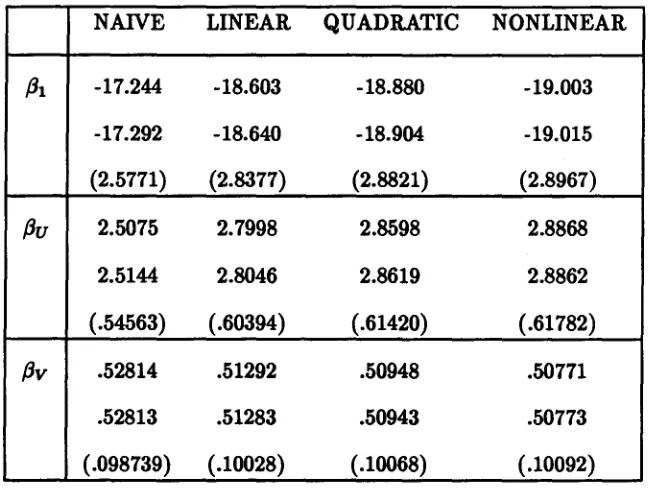
.006078/2).Table 1 displays results from the SIMEX procedure using NON-lID pseudo errors and the sample
mean as location functional. Four-hundred bootstrap data sets were analyzed. Table entries are,
from top to bottom, point estimates and the means and standard deviations of the 400 bootstrap
sample estimates. For comparison we note that the usual inverse-information standard errors of
the NAIVE estimates are 2.6594, .56436 and .10420 for
fJI,
{Ju and{Jy respectively.Figure 7b displays estimated response functions for high-risk 50-year old males. The response
functions are graphed over the range
(X.,.,
X.,.+3s)
wheres
is the standard deviation of{Xi,.H
660• The two solid curves graph the NAIVE and NONLINEAR SIMEX response curves. The LINEARand QUADRATIC SIMEX curves are graphed with dotted and dashed lines respectively. The
. similarity of the SIMEX response functions is due to the small measurement error (0'2 = .003039,
with a linear correction for attenuation = 1.19). For measurement error this small the extrapolant
curves are nearly linear and the three methods of extrapolation produce similar results.
Figure 7c displays graphs ofthe NONLINEAR SIMEX response function (solid line) and selected
bootstrap percentiles enclosing central regions of 90% (dotted), 75% (dashed) and 50% (close dots).
5.9. Exploratory Data Analysis with Mwsured Predictors
Our final example was chosen to emphasize the generaJity and fiexibility of the SIMEX procedure
in deaJing with nonstandard models. Starting with the naive fit of the model (5.1), we considered
the addition of interaction terms of the form X;,~
lti
r2for small integer powers ({ -1, 0, I}) ofrl
and r2. Taking rl = r2
=
-1 produced the greatest decrease in the deviance, 7.14, although theimprovement in the fit is only marginally significant when compared to a Chi-Squared distribution
with three degrees of freedom (p-value ~ .075). However, the reported p-value is conservative since three is only an approximate degrees of freedom; our model was fit by searching over the
two-dimensional finite set of powers,
(rl' r2),
and the one-dimensional continuous coefficient space.A model with the measured predictor appearing both on its nominal scale and as an interaction on
an inverse scale provides a nice vehicle for illustrating the fiexibility of the SIMEX procedure.
Therefore we consider fitting the model
pr(Y
=
1I
U, Y)=
F(,81
+
,8uU+
,8vY+
,8uv U1y ) ,
(5.2)and using the SIMEX procedure to correct for the effects of measurement error.
Table 2 displays coefficient estimates from the SIMEX procedure employing the NON-lID pseudo
errors and the sample mean as location estimator. The inclusion of the interaction term induces
collinearity, making it difficult to interpret individual coefficients. We present instead a graph
similar to that in Figure 7b. Figure 7d displays plots of the NAIVE and NONLINEAR response
curves for two models, with and without the inverse interaction term in (5.2). The response
functions for the models with and without the interaction term are graphed with solid lines and
dotted lines respectively. For both models the SIMEX response function dominates the NAIVE
response function over the range plotted.
6. SUMMARY
We have shown how the results of several coordinated simulation studies,
i.e.,
the{e(~): ~>
O},
can be used to obtain unbiased or nearly unbiased estimators in nonlinear measurement error modelswhen the measurement error variance is specified. Our experience suggests that employing
NON-lID pseudo errors and using the sample mean as the location estimator works as well as any other
The success of the method is due in large part to the empirically supported general applicability
ofthe nonlinear extrapolant modela+b/(c+ A). The beauty ofthe method is that the appropriate
values of the parameters a, band c, which for nonlinear models are no longer simple functions of
the data as they are for linear models, are determined by Monte Carlo methods, thereby avoiding
mathematical technicalities and/or resorting to approximations of any type.
It seems likely that the basic method can be improved through the use of more creative
resampling schemes. We are currently exploring the possibility of combining bootstrap resampling
with the Monte Carlo pseudo-error generation in a way that produces both the point estimate and
a standard error without the high computational overhead of nested resampling. Also, it may be
advantageous to use Avalues other than {.5, 1, 1.5, 2}, say by solving an optimal design problem
for the mean modela
+
b/(c+
A).Finally we note that the method is applicable to functional as well as structural measurement
error models. This is evident from the results in Sections 4.1, 4.2 and, though not as obviously,
from the resampling simulation in Section 5.1. In the latter case,
Xi,.
remained fixed, as in afunctional model. Thus the method does not depend on the nature (random or fixed) of the
so-called true values
Ui.
This is not true of other methods that explicitly model, either parametricallyor non-parametrically, the
Ui
as random variables.For example, the regression-calibration method (Prentice, 1982; Fuller, 1987, p 261; Rosneret al.,
1989,1990; Rudemo et al., 1989; GIeser, 1990; Carroll and Stefanski, 1990; and Pierce et al., 1991)
depends on (a model of)
E( U
IX,
V).
The importance of this is that an estimate ofE(U
IX,
V)
obtained from external validation/replication data may not "match" the data to be analyzed in the
sense that the regressions ofUon(X, V)in the validation and target populations need not be equal.
However, methods that depend on external validation/replication data only through estimates of
(72 are generally more robust to differences in the validation and target population distributions.
This is obviously true, for example, when measurement error is due entirely to instrument error
and the error variance is independently assessed via a designed experiment.
REFERENCES
Carroll, R.
J.
& Stefanski, L. A. (1990) Approximate quasilikelihood estimation in models with•
surrogate predictors. Journal
0/
the American Statistical Association,85, 652--663.Carroll, R. J. & Stefanski, L. A. (1992) Meta.-Analysis, Measurement Error and Correction for Attenuation. Statistics in Medicine, to appear.
Cook, J. R. (1989) Estimators for the Errors-in-Variables Problem in the Ordered Categorical Regression Model. Unpublished Ph.D. Thesis, Department of Statistics, North Carolina Stae University.
Fuller, W. A. (1984), "Measurement Error Models With Heterogeneous Error Variances," in Topics in Applied Statistics eds. Y. P. Chauby and T. D. Dwivedi, Montreal: Concordia University, pp. 257-289.
Fuller, W. A. (1987). Measurement EfTOr Models. Wiley, New York.
GIeser, L. J. (1990). Improvements of the naive approach to estimation in nonlinear errors-in-variables regression models. In Statistical Analysis
0/
Measurement EfTOr Models and Application,P.J. Brown and W. A. Fuller, editors. AmericanMathematics Society, Providence.Hwang, J. T. (1986), Multiplicative Errors-In-Variables Models with Applications to the Recent Data Released by U. S. Department of Energy. Journal
0/
the American Statistical Association,81,680--688.
MacMahon, S., Peto, R., Cutler,
J.,
Collins, R., Sorlie, P., Neaton,J.,
Abbott, R., Godwin,J.,
Dyer, A., & Stamler, J. (1990). Blood Pressure, Stroke and Coronary Heart Disease: Part 1, Prolonged Differences in Blood Pressure: Prospective Observational Studies Corrected for the Regression Dilution Bias. Lancet,335, 765-774.
Palca, J. (1990a). Getting to the Heart of the Cholesterol Debate. Science, 24,1170-71.
Palca, J. (1990b). Why Statistics May Understate the Risk of Heart Disease. Science, 24,1171.
Pierce, D. A., Stram, D.O., Vaeth, M., Schafer, D. (1991). Some insights into the errors in variables problem provided by consideration of radiation dose-response analyses for the A-bomo survivors. Preprint.
Prentice, R. L. (1982). Covariate measurement errors and parameter estimation in a failure time regression model. Biometrika, 69, 331-342.
Rosner, B., Willett, W. C. & Spiegelman, D. (1989). Correction of logistic regression relative risk estimates and confidence intervals for systematic within-person measurement error. Statistics in Medicine,8, 1051-1070.
Rosner, B., Spiegelman, D. & Willett, W. C. (1990). Correction of logistic regression relative risk estimates and confidence intervals for measurement error: the case of multiple covariates measured with error. American Journal
0/
Epidemiology, 132, 734-745.•
with applications to bioassay. Biometrics, 45, 349-362.
Stefanski, L. A. (1985). The effect of measurement error on parameter estimation. Biometrika, 12, 583-592.
Stefanski, L. A. and Carroll, R. J. (1985). Covariate Measurement Error in Logistic Regression.
The Annals of Statistics, 13, 1335-135l.
Stefanski, L.A. and Carroll, R.J. (1981). Conditional Scores and Optimal Scores for Generalized Linear Measurement-Error Models. Biometrika, 14, 103-116.
Whittemore, A. S. and Keller, J. B. (1988). Approximations for Regressions with Covariate Measurement Error. Joumal of the American Statistical Association, 83, 1051-1066.
•
•
•
TABLE 1: COMPARISON OF ESTIMATORS. This simulation is described in Section 5.2. Table entries are from top to bottom, point estimates, bootstrap means and bootstrap standard
errors. Inverse information standard errors for the NAIVE estimates are 2.6594, .56436 and .10420 for
f3t, f3u
andf3v
respectively.NAIVE LINEAR QUADRATIC NONLINEAR
f31
-17.244 -18.603 -18.880 -19.003-17.292 -18.640 -18.904 -19.015
(2.5771) (2.8377) (2.8821) (2.8967)
f3u
2.5075 2.7998 2.8598 2.88682.5144 2.8046 2.8619 2.8862
(.54563) (.60394) (.61420) (.61782)
f3v
.52814 .51292 .50948 .50771.52813 .51283 .50943 .50773
(.098739) (.10028) (.10068) (.10092)
TABLE 2: COMPARISON OF ESTIMATORS. NAIVE and SIMEX estimates for the model with inverse interaction (5.2).
NAIVE LINEAR QUADRATIC NONLINEAR