OPTIMIZATION OF PAPAIN EXTRACTION
BY AQUEOUS TWO-PHASE SYSTEM
(ATPS) USING RESPONSE SURFACE
METHODOLOGY (RSM)
Chaman Mehta.C
1, M. P. Rajesh
2V.Sridevi
*3,
Divya M. L
4and Satya Ch.V
5Assistant Professor, Department of Biotechnology & Chemical Engg, Anil Neerukonda Institute of Technology and
Sciences, Sanghivalasa, Vishakapatnam, India 1
Professor, Department of Bioprocess Engineering, SRM University, Chennai, India 2
Associate professor, Centre for Biotechnology, Department of Chemical Engineering, Andhra University,
Visakhapatnam-03, Andhra Pradesh, India *3
Assistant Professor, Department of Biotechnology & Chemical Engg, Anil Neerukonda Institute of Technology and
Sciences, Sanghivalasa, Vishakapatnam, India 4
Women Scientist, Department of Chemical Engg & Biotechnology, Andhra University, Vishakapatnam, India5
Abstract: This work attempts to study and optimize aqueous two-phase system (ATPS) made of PEG, sodium carbonate and PEG, sodium sulphate. Three factors ;PEG concentration, salt concentration and pH affecting the papain partitioning were studied. The statistical analysis showed that for both systems the phase forming salt concentration significantly affect
the “K” value for papain partitioning. However, the performance of PEG/Na2CO3 system was generally better than
PEG/Na2SO4 system. Hence, detail study was carried out on the PEG/Sodium carbonate system using CCRD (Central
Composite Rotatable Design) in Response Surface Methodology (RSM). The optimal condition gave a “K” value of partitioning of 1.51 with a yield of 76%.
Keywords: Aqueous two-phase system, Polyethylene glycol, Sodium Carbonate, Central composite design.
I. INTRODUCTION
Conventional techniques for separation and purification of biomaterials have some disadvantages such as insufficient selectivity, high energy consumption and possibility of denaturation of biomolecules when organic solvents are used in extraction processes. Most of these difficulties can be overcome by conducting the bio-separations in aqueous two-phase systems (ATPS).
Aqueous two-phase system was developed in Sweden during mid-1950s for the separation of macromolecules, cells and organelles. These systems were initially applied to the separation of plant organelles and viruses. Since, then attention has
been directed towards widening its application scenario. During the last two decades [1] lot of work has been done to
develop feasible separation processes using aqueous two-phase systems for various biological materials, proteins and
The papain present in the latex of papaya (Carica papaya) has been extensively studied and is an enzyme of industrial use
and of high research interest [2]. The latex of carica papaya is a rich source of cysteine endopeptidases, Glycyl
endopeptidases, Chymopapain, Papain and Caricain, which constitute more than 80% of the whole enzyme fraction. This
enzyme is widely used as meat tenderizer, and has also several other applications for e.g, Shrink proofing of wool,
treatment of edemas, purification of papain from papaya latex has involved the use of various chromatographic techniques
which includes Ion-exchange and Gel filtration [3].
ATPS has shown interest especially in the view of providing integrated clarification, concentration and purification of the
target product in one unit operation [4]. They also have been applied successfully for large scale enzyme separation and
purification [5] use of PEG-Phosphate system has earlier been reported for separation and purification of papain from
papaya latex [6].
The aim of this study is to investigate for performance of aqueous two-phase system and the significant factors that may
affect papain partitioning of two different systems. Response surface methodology [7]will be used to identify the significant
factors and develop model to predict the response of the ATPS and obtain the optimal conditions for papain partitioning [8].
II. MATERIALS AND METHODS
Materials
Polyethylene glycol with Molecular weights 4000 and 6000, sodium sulfate, and sodium carbonate were obtained from Hi-media. Sodium chloride was obtained from Sisco (Chennai). Crude papain was purchased from Shri Ganesh industrial enzymes (Madhya Pradesh). All other chemicals were of analytical grade.
Native PAGE
Non-denaturing electrophoresis was carried out by the method of [9] with some modification, using a gel consisting of a
resolving gel (pH 4.3, 15%, w/v, and acrylamide) and a stacking gel of 4% acrylamide (pH 6.7). The upper and lower chamber electrode buffer (pH 4.5) consisted of 100mM Glycine –0.14M acetic acid. The protein sample was diluted (1:1, v/v) with stacking buffer (pH 6.7) containing 10% sucrose and bromophenol blue (used as a tracking dye) prior to loading
onto the gel. Electrophoresis was run at a constant current of 40 mA [10].
Chromatography of Crude Papain
Aliquots of proteins dissolved in 100mM Glycine -NaOH buffer, pH 10.6, were applied to a DEAE cellulose
column (1.5 x 20 cm) equilibrated with the same buffer [13]. The material was eluted using a continuous gradient (0.4
to 1.0 M) of Glycine-NaOH buffer, pH 10.6. The peaks obtained were delimited (Fig. 2), pooled and eluted with 1M NaCl buffer. Initial no of proteins are given in the form of peaks to know and purify the protein (Papain) of interest.
pH Gradient
3
3
10
Molecular weight
Fig. 1 Coomassie brilliant blue-R250 stained 2-D gel strip. The protein sample
was first subjected to isoelectric focusing with a pH 3 to 10 strip for 16 h
.
Determination of Protein Content
The protein content in the samples during purification was determined by Bradford method [14].
Purification of Papain Extraction in Aqueous Two-Phase System
The crude papain was mixed with water and pH adjusted using 6M phosphate buffer. For extraction in aqueous two-phase
system, defined amounts of solid PEG and sodium carbonate were added to the Crude preparation (30 g)[15], and the total
mixture was made up to 50 g with water. The mixture was then gently shaken for 15 min. The two phases were separated
by centrifugation at 9000×g for 30 min at 40C [16]. Aliquots of the phases were taken for determination of protein
concentration and protease activity. For calculation of protease activity in the two phases, volumes of the respective phases
were taken into consideration [17]. The presence of papain was verified by cathodic gel electrophoresis and FPLC. The
dialyzed solution was subjected to ion-exchange chromatography for separation of the enzyme from PEG[18]. The solution
was loaded on a DEAE -cellulose column (1.5 cm×2 cm) equilibrated with 100mM Glycine-NaOH buffer, pH 10.6 and
Fraction number
Fig. 2Chromatogram of crude papain. The column (1.5 x 10 cm) after equilibrated with 100mM
Glycine-NaOH buffer, pH 10.6. 20mg of protein is added and eluted with 0.4, 0.6, 0.8 and 1.0 M with the same buffer at a flow rate of 30 mL/h.
Absorbance at 280nm
1
2
Experimental design
Two -level fractional factorial design
A factorial design is experiments which in each complete trial or replication of the experiment, all possible combinations
of the levels of the factors are investigated. For any experiments which have k factors, each at only two levels (i.e. high (+1)
and low (−1)), they are known as 2 level factorial design (2k) [21]. The number of experimental run required to complete a
replicate is given by 2×2× . . . ×2=2k where k is the number of factor, thus giving it its name. If it can be reasonably
assumed that certain high order interactions in the system is negligible, then information on the main effects and low order
interactions may be obtained by running only a fraction of the complete factorial experiment [22]. Running just a partial
number of a complete experimental design is known as fractional factorial design [23]. An important feature in a fractional
factorial design is aliasing of the factors. The degree of aliasing present in the factors is given by the design resolution.PEG/sodium carbonate and PEG/sodium sulfate systems were initially investigated with the aid of two-level fractional factorial. The five factors which were considered to affect the protein partition coefficient in the ATPS systems
were the PEG concentration of concentration of phase-forming salt, concentration of sodium chloride and Ph [24]. The
response measured was the papain partition coefficients shows the experimental conditions for each system studied. The
factors which are identified as important or significant are then investigated more thoroughly in subsequent experiment.
Response surface methodology (RSM)
The basis of RSM is form of an experimental design and the most frequently used is the central composite rotatable design (CCRD) for the prediction and verification of model equation as well as the optimization of the response as the function of
the independent parameters [23]. CCRD experimental design is preferred and widely used for fitting a second order models.
III. RESULTS AND DISCUSSION
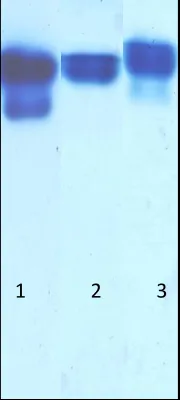
As papain is a protease of broad specificity and no specific synthetic substrate is available, casein was used as a substrate to determine the total protease activity present in the latex while the purity of papain was determined by electrophoresis and chromatography. On cathodic gel electrophoresis, the proteins in the latex separated as three bands.
Fig. 3 Non-denaturing polyacrylamide gel electrophoresis using 15% acrylamide gel and glycine buffer, pH 4.3. Staining was by Coomassie Blue R-250.
Lane 1: Crude papain (90µg)
Lane 2: Standard papain (40µg)
Lane 3: Aqueous two-phase extracted sample.
Purification of Papain by Aqueous Two-Phase Extraction
As sodium carbonate is commonly used for separation of cysteine proteases, a two-phase system composed of PEG–sodium
carbonate was evaluated for partitioning of papain. According to the phase diagram of PEG–NaCO the system comprising
electrophoresis results, all the papain in the crude was moved into PEG phase which represented ∼8% of the total
proteolytic activity in the crude papain. All the PEG-Na2CO3 systems except the system of 20% PEG–14% Na2CO3
provided pure papain in the top phase. Interference with chymopapain was thus not noticed, as was the case in PEG– carbonate system.
The remaining proteolytic activity corresponding to chymopapain, glycyl endopeptidase and caricain remained in the salt rich (bottom) phase. The optimal conditions for extraction turned out to be a two-phase system composed of 20% (w/w)
PEG–14% (w/w) Na2CO3 and crude papain containing 20–40 mg protein/ml at pH-9.Furthermore, the pure papain was
obtained in a more concentrated form since the top phase volume was about 1/4th the volume of the whole system (top phase volume=5ml; bottom phase volume = 25 ml). The optimal conditions for the papain partitioning were obtained.
Optimization of Papain Partition Coefficient
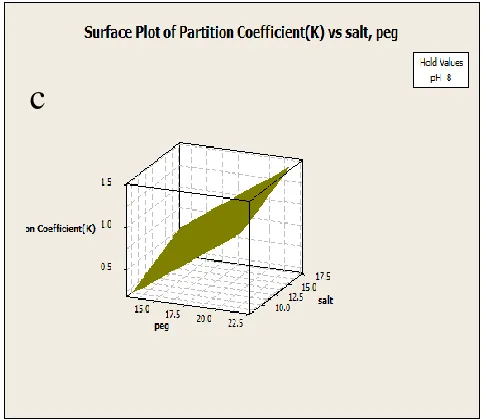
The CCRD was able to function as optimal design for the desired response of the system based on the model obtained and the input criteria. The optimization of papain extraction via ATPS was optimized based on the minimum usage of PEG 4000 and sodium carbonate and sodium chloride concentration was in the range of experimentation. The system was maintained with buffer at pH 9. The results from the software indicated that optimized condition for papain partitioning
(Fig.4,5,6) was when the PEG, sodium carbonate concentration were at 20.00% (w/w), 14% (w/w) with papain partitioning
value of 1.51(K). The experimental runs gave an average experimental value of papain partitioning, log K of 1.483 with the
papain yield of 76% and the results were shown in Tables 1&2.
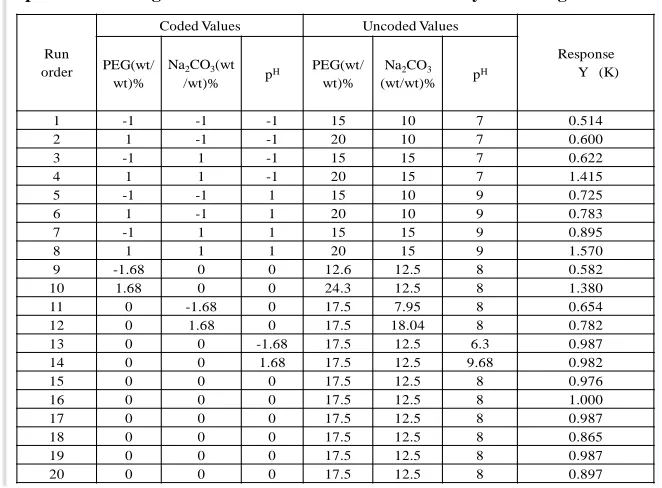
Table I Experimental Design matrix for PEG/Sodium Carbonate system using CCRD
Run order
Coded Values Uncoded Values
Response Y (K) PEG(wt/
wt)%
Na2CO3(wt
/wt)% p
H PEG(wt/
wt)%
Na2CO3
(wt/wt)% p
H
1 -1 -1 -1 15 10 7 0.514
2 1 -1 -1 20 10 7 0.600
3 -1 1 -1 15 15 7 0.622
4 1 1 -1 20 15 7 1.415
5 -1 -1 1 15 10 9 0.725
6 1 -1 1 20 10 9 0.783
7 -1 1 1 15 15 9 0.895
8 1 1 1 20 15 9 1.570
9 -1.68 0 0 12.6 12.5 8 0.582
10 1.68 0 0 24.3 12.5 8 1.380
11 0 -1.68 0 17.5 7.95 8 0.654
12 0 1.68 0 17.5 18.04 8 0.782
13 0 0 -1.68 17.5 12.5 6.3 0.987
14 0 0 1.68 17.5 12.5 9.68 0.982
15 0 0 0 17.5 12.5 8 0.976
16 0 0 0 17.5 12.5 8 1.000
17 0 0 0 17.5 12.5 8 0.987
18 0 0 0 17.5 12.5 8 0.865
19 0 0 0 17.5 12.5 8 0.987
20 0 0 0 17.5 12.5 8 0.897
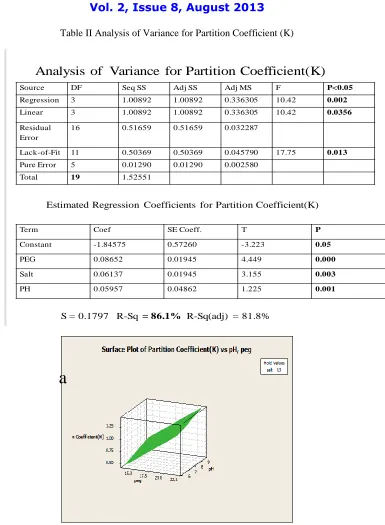
Table II Analysis of Variance for Partition Coefficient (K)
Source DF Seq SS Adj SS Adj MS F P<0.05
Regression 3 1.00892 1.00892 0.336305 10.42 0.002
Linear 3 1.00892 1.00892 0.336305 10.42 0.0356
Residual Error
16 0.51659 0.51659 0.032287
Lack-of-Fit 11 0.50369 0.50369 0.045790 17.75 0.013
Pure Error 5 0.01290 0.01290 0.002580
Total 19 1.52551
Term Coef SE Coeff. T P
Constant -1.84575 0.57260 -3.223 0.05
PEG 0.08652 0.01945 4.449 0.000
Salt 0.06137 0.01945 3.155 0.003
PH 0.05957 0.04862 1.225 0.001
Analysis of Variance for Partition Coefficient(K)
Estimated Regression Coefficients for Partition Coefficient(K)
S = 0.1797 R-Sq = 86.1% R-Sq(adj) = 81.8%
2
Fraction number
Fig. 5 Response surface curve of papain recovery as a function of pH and salt (PEG concentration was set at central point).
Fig. 6 Response surface curve of papain recovery as a function of PEG and salt (pH concentration was set at central point).
b
IV. CONCLUSION
The work shows the feasibility of using ATPS as a first step purification of papain using phases composed of PEG/sodium carbonate system. The study demonstrated the PEG concentration, phase-forming salt concentration lead to a higher papain partitioning value.. The CCRD used in this work allowed the definition of appropriate model for the factors studied which in turn lead to the definition of an optimum condition. Papain partition coefficient of 1.51 and a yield of about 76% are undoubtedly a good result for a first step purification.
ACKNOWLEDGEMENTS
We are indebted to Dr. M. P. Rajesh for guidance and also thank Dr. K. Ramasamy for his valuable suggestions. I thank my colleagues Divya and Kalaivani for helping me during my project and finally my college providing the chemicals during my project.
REFERENCES
[1] Grossman, P. D., and Gainer, J. L., “Correlation of aqueous two-phase partitioning of proteins with change in free volume”, Biotechnology Progress, vol. 4, pp. 6–11, 1988.
[2] Huang, A. S., and von Elbe, J. H., “Effect of pH on the degradation and regeneration of betanine”, Journal of Food Science, vol. 52, pp.1689–1693, 1987.
[3] Freitas, S., “Alternatives for the intermediate recovery of plasmid DNA: performance, economic viability and environmental impact”, Biotechnology, vol. 4, pp. 265–278, 2009.
[4] Lius, L.L., Nikas, Y., and Blankschtein, D., “Partitioning of proteins using two-phase aqueous surfactant systems”, AIChE Journal, vol. 41, pp. 991– 995,1995.
[5] Kula, M.R., Kroner, K. H., and Hustedt, H., “Advances in Biochemical Engineering”, Springer Verlag, vol. 24, pp. 73–118, 1982.
[6] Kuboi, R., Wang, W.H., and Komasawa, I., “Effect of contaminating proteins on the separation and purification of papain from papaya latex using aqueous two-phase extraction”, Current science, vol. 16, pp. 772–779, 1990.
[7] Asenjo, J.A., “Phase separation rates of aqueous two-phase systems: correlation with system properties”, Biotechnology and Bioengineering, vol. 79, pp. 217–223, 2002.
[8] Chang, H.N., “Production of alkaline protease by Bacillus lichiniformis in an aqueous two-phase system”, Journal of Fermentation and Bioengineering,vol. 2, pp. 89–92,1990.
[9] Reisfeld, R.A., Lewis, U.J., and Williams, D.E., “Disk electrophoresis of basic proteins and peptides on polyacrylamide gel”, Nature, vol. 195, pp. 281–283, 1962.
[10] Sarote Nitsawang, Rajni Hatti-Kaul., and Pawinee Kanasawuda, “Purification of papain from Carica papaya latex: Aqueous two-phase extraction versus two-step salt precipitation”, Enzyme and Microbial Technology, vol. 39, pp. 1103–1107, 2006.
[11] Smithies, O., and Poulik, M.,“Two-dimensional electrophoresis of serum proteins”, Nature, vol. 177, pp. 1033-1039,1956. [12] Raymond, S., and Aurell, B., “Two-dimensional gel electrophoresis”, Science, vol. 138, pp.152-153, 1962.
[13] Rubens Monti1, Carmelita, A., Basilio, Henrique, C., Trevisan., and Jonas Contiero, “Purification of Papain from Fresh Latex of Carica papaya”, Brazilian Archives of Biology and Technology, vol. 43, pp. 501-507, 2000.