New Molecular Markers for the Distal End of the t-Complex and Their
Relationships to Mutations Affecting Mouse Development
Thomas Ebersole, Fang Lai and Karen
Artzt
Department of Zoology, University of Texas, Austin, Texas 78712-1064 Manuscript received November 4, 199 1
Accepted for publication January 10, 1992
ABSTRACT
Many mutations affecting mouse development have been mapped to the t-complex of mouse chromosome 17. We have obtained 17 cosmid clones as molecular markers for this region by screening a hamster-mouse chromosome 17 and 18 cell hybrid cosmid library with mouse-specific repetitive elements and mapping positive clones via t-haplotype us. C3H restriction fragment length polymor- phism (RFLP) analysis. Twelve of the clones mapping distal to Leh66B in t-haplotypes are described here. Using standard RFLP analysis or simple sequence length polymorphism between t-haplotypes, exceptional partial t-haplotypes and nested sets of inter-t-haplotype recombinants, five cosmids have been mapped in or around Zn(l7)3 and seven in the most distal inversion Znl 7(4). More precise mapping of four of the cosmids from Zn(l7)4 shows that they will be useful in the molecular identification of some of the recessive lethals mapped to the t-complex: two cosmids map between H- 2K and Crya-I, setting a distal limit in t-haplotypes for the position of the
r5
lethal, one is inseparablefrom the
eY*'
lethal, and one maps distal to tfnear theP(f)
lethal and cld.W
HILE molecular genetic approaches to under- standing developmental processes have met with considerable success in simpler experimental or- ganisms, early mammalian development has long been a formidable challenge to molecular technology. In the mouse many of the interesting embryo-expressed genes which have been described in recent years were derived from conserved invertebrate sequences (e.g.,the hox clusters) (GRAHAM, PAPALOPULU and KRUM-
LAUF 1989; KESSEL and GRUSS 1990) or oncogenes (e.g., the int genes) (JAKOBOVITS et al. 1986; ADAMSON
1987), and tended to be expressed around mid-stage o r later in embryogenesis. While these remain valua- ble sources for mammalian genes involved in devel- opment, other strategies also hold great promise. New methods used to identify functionally interesting em- bryo-expressed genes, such as enhancer and promoter trapping, insertional mutagenesis (GOSSLER et al.
1989), and targeted mutagenesis (ZIMMER and GRUSS 1989) will no doubt provide significant contributions. Also, the cloning of the T gene, required for meso- derm formation (HERRMANN et al. 1990), and the identification of the first early embryo transcription factor, Oct-4 (SCHOLER et al. 1990), both of which map to the t-complex of mouse chromosome 17, demon- strate the effectiveness of other approaches.
A well established and promising system for identi- fying early mouse developmental genes is the mouse t-complex. T h e t-complex of the mouse is a relatively
T. E. dedicates this paper to DOROTHEA BENNETT in memory of her many achievements as an educator and investigator in mouse genetics.
Genetics 131: 175-182 (May, 1992)
well characterized region (BENNETT 1975; FRISCHAUF 1985) representing -1 % of the mouse genome. It occupies some 30-40 Mb of the proximal end of mouse chromosome 17 and has several distinguishing features. A t-bearing chromosome has several large inversions that make up the t-complex and isolates the region recombinationally from wild-type chromo- somes (SHIN et al. 1983; HERMANN et al. 1986; HAM- MER, SCHIEMENTI and SILVER 1989). Several muta- tions that map to this region affect sperm function (LYON 1984,1986; SILVER and REMIS 1987) and over
20 mutations affect early or mid-stage embryogenesis (BENNETT 1975; BABIARZ 1983; ARTZT 1984). Molec- ular identification of the genes involved has been a difficult task for several reasons, one of the primary ones being the lack of sufficient DNA markers for such a large chromosomal region.
T h e production of a detailed and balanced genetic and physical map would be a significant aid in the molecular characterization of this region. While a large number of DNA probes have been mapped to the t-complex (Committee on Mouse Chromosome 1 7
176 T. Ebersole, F. Lai and K. Artzt
o f sites f o r the rare-cutting restriction enzymes used (GARDINER et al. 1990). With the number and distri- bution of probes currently mapped to t h e t-complex, it is doubtful that a level of coverage equivalent to
human 21q could be achieved.
I n order to enhance the physical and genetic map
of this region, we sought new DNA markers specifi-
cally for the t-complex by screening a hamster-mouse
chromosome 27 and 18 cosmid library with mouse-
specific repetitive elements followed by t-haplotype vs. C3H restriction fragment length polymorphism
(RFLP) analysis of t h e positive clones. In this report we describe the results of this work. Seventeen cos- mids were obtained which map t o the t-complex. The
m a p positions of 12 of these clones within the t-
complex and their relationship to known develop-
mental mutations on chromosome 17 are discussed.
T h e remaining five cosmids, all of which m a p cen-
tromeric to the Leh66B locus in t-haplotypes are dis-
cussed in some detail in a companion study (EBERSOLE,
RHO a n d ARTZT 1992).
MATERIALS AND METHODS
Mice: Mice carrying the entire t-complex or partial re- combinants are congenic on the inbred strain C3H/DiSn (C3H) or approaching that state. The breakpoints of the partial t-haplotypes
P
and Pr8 are as described in Committee on Mouse Chromosome 17 (1991). T f 6 is described in SIL-VER and ARTZT (1 98 l), and HOWARD et al. (1 990). The PI2'
proximal partial t-haplotype was derived from C3H.t"75
(ARTZT, BABIARZ and BENNETT 1979; HOWARD et al. 1990).
t"" (LYON and BECHTOL 1977) was a gift from LEE SILVER, Princeton University. The inter-t-haplotype recombinants analyzed were generated from the parental t-haplotypes P5, t I 2 or P32, T f 6 , and P". Most of the recombinants had been typed for the presence of the relevant t-lethals. Anchor loci in the distal inversion already defined in these recombinants were TL, H-2D, H-2K, Crya-I, Pim-I,
6
and in those that were derived from P7;', cld (ARTZT 1984). Not all the recombinants were typed for each of the anchor loci.Nomenclature: Because all the loci described here are on chromosome 17, an abbreviation of the formal name will be used for easier reading. Thus D17Au126 will be called Au126, etc. For the same reason the full name for the t-
lethals will be abbreviated, that is, tcl-P5 will be called P5,
etc., whereas the t-complex bearing chromosome with the mutation will be called the P5 haplotype.
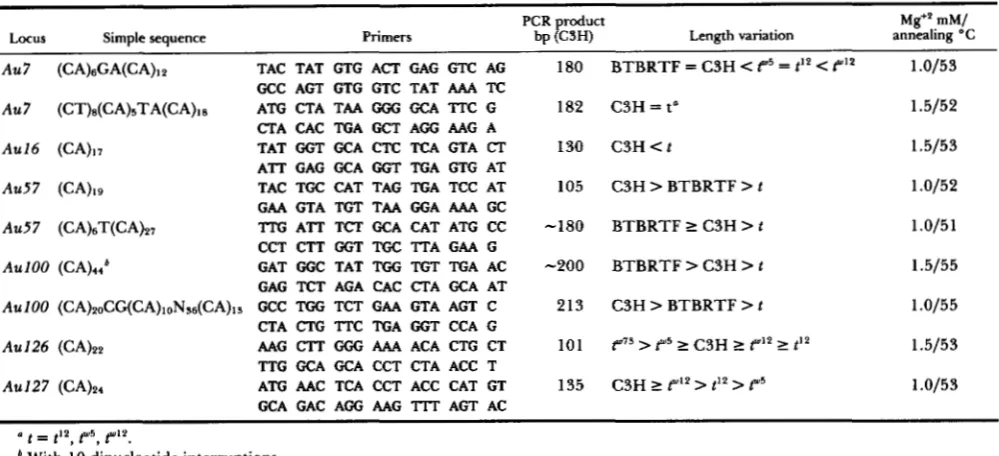
Primers and probes: Table 1 lists the primers used at each of the (CA), blocks and other relevant information. Optimized MgC12 concentrations vary depending on trace EDTA amounts. Genomic DNA (stored in 10 mM Tris-HC1,
1 mM EDTA, pH 8.0) was diluted in dHpO to 100 ng/pl before addition to the polymerase chain reaction (PCR).
PCRs were as follows: 100 ng genomic template DNA were added to a reaction mix of 70.0 p M dNTPs, 1.0 p M of each primer, 0.25 pCi ["PIdCTP (3000 Ci/mmol, 10 pCi/
pl), 0.75 unit Taq polymerase (Perkins-Elmer Cetus, U.S.
Biochemical), 1 X buffer (Perkins-Elmer Cetus, U.S. Bio- chemical, no MgC12), 1 .O-1.5 mM MgCl2, in a 25-pI volume. This was overlaid with mineral oil and cycled as follows: 3 min, 95O, initial denaturation (Taq polymerase present), then 30 cycles of (1) annealing, 60 sec, (2) extension at 72", 60 sec, (3) denaturation at 94O, 30 sec. The final extension step was done at 72" for 15 min. PCR products were
separated by polyacrylamide gel electrophoresis (6% gels). Probe P126 is a 1.4-kbp BamHI genomic fragment from cosmid 126. Probe P7 is a 1.9 EcoRI genomic fragment from cosmid 7. Probe P64 is a 1.4-kbp BamHI genomic fragment from cosmid 64.
Screening for (CA). repeats: Cosmids from each locus were digested with the blunt-end frequent cutters HaeIII, AluI, RsaI and HincII, either singly or in double digests. The digested DNA was then separated on an agarose gel, blotted and hybridized with a '2P-end-labeled (CA)Ic+C oligomer. DNA digests from enzymes or enzyme combina- tions which gave positive fragments less than 600 bp were shotgun subcloned into the SmaI site of plasmid vector pBluescript I1 KS (Stratagene) or PUC 18. Colony blots of transformants were hybridized with the labeled (CA)16+C oligomer to identify a set of subclones with small inserts for sequencing. Primers for PCR were synthesized on an AB1 model 381A.
Cell hybrid and DNA libraries: The cell hybrid R4 4.1 was originally produced by SMILEY et al. (1 978). It contains
mouse chromosome 17 and 18 (derived from C3H) in a
translocation resulting in a single metacentric murine chro- mosome on a Chinese hamster background. The genomic library was constructed by G. GUMMERE in this laboratory by ligating an MboI partial digest into the BglII site of cosmid
vector PTL5 (HOWARD et al. 1990).
Screening the genomic library: T o avoid the secondary screening of large numbers of clones, the library was plated at a low density of 2-4000 per 150 mM plate. Thirty-six plates were screened with an average of 10-15 positive colonies per plate. Of 402 clones picked in the primary screen 70% were single colony isolates. The remainder were brought through a standard secondary purification. Verifi- cation of the mouse origin of the cosmid insert of the single colony picks from the primary screen was performed by picking them onto a filter with a grid drawn on it, regrowing the colonies and reprobing duplicate blots of the grid with
Bam5R. Following secondary screening 21 2 clones re-
mained. Fifty-three duplicate clones were eliminated based on identical BglII digestion patterns and mouse liver DNA probe hybridization patterns. Fourteen Chinese hamster clones which had cross-hybridized strongly with Bam5R during the original screening were identified when they hybridized strongly with R4 4.1 genomic DNA, but weakly with mouse DNA during the mapping of the clones (see
RESULTS). Ultimately, 145 mouse-derived cosmid clones from the Bam5R screen were analyzed for map position in the t-complex. Added to this were 28 clones derived from a previous screen using the VL30 and IAP repeated elements as probes (HOWARD et al. 1990). For mapping to the t-
complex, 8-10 ug of genomic DNA from C3H, C3H.tJ2/P5, and C3H.tI2 mouse livers were separately digested with four enzymes, BamHI, EcoRI, Hind111 and Tap1 or MspI. Each whole cosmid clone from minipreps was used as a probe after precompetition of repetitive elements with an excess of cold mouse liver DNA (see below).
Blotting and hybridizations: Genomic digests were elec- trophoresed in a 0.7% agarose gel in TPE buffer for 15- 17 hr at -0.7 V/cm. Transfer of DNA was done by standard capillary blotting or by vacuum on a homemade device. Transfer buffer was either 20 X SSC (Hybond-N) or 0.4 N
NaOH (Hybond-N+) (Amersham). Colony blots on Hy-
bond-N membranes were hybridized with random primed
Bam5R DNA at 2-3 X lo6 cpm/ml according to manufac-
turer's instructions. Hybridizations of cosmids to genomic blots were done as follows: Prehybridization of the blot was
done in 50% formamide, 50 mM NaPO.,, pH = 6.5, 2.5 X
t-Complex Molecular Markers
TABLE 1
Primers used at the (CA). sites
Locus Simple sepuence
PCR roduct Mg+',mM/
Primers bP PCW Length variation annealmg "C
.
.
Au7 (CA)~GA(CA)I~ TAC GTG ACT TAT GAG GTC AG 180 BTBRTF = C3H < Y5 = t" 1"" 1.0153 GCC AGT GTG GTC TAT AAA TC
At47 (CT)S(CA)~TA(CA)IS TAA CTA ATG GGG GCA TTC G 182 C3H = t' 1.5152
CTA CAC TGA GCT AGG AAG A
Au16 (CA)I'I TCA CTC GCA GGT TAT
GTA
CT 1 . 5 1 5 3 C 3 H < t 1 3 0
ATT GAG GCA GGT TGA GTG AT
Au57 (CA)lg AT TCC TGA TAG CAT TAC TGC 105 C3H > BTBRTF > t 1.0152
GAA GTA TGT TAA GGA AAA GC
Au57 (CA),T(CA)z, CC ATG TTG CAT GCA ATT TCT -180 BTBRTF L C3H > t 1.0151
CCT CTT GGT TGC TTA GAA G
Au 100 (CA)44b GAT AC GGC TGA TGT TAT TGG -200 BTBRTF > C3H > t 1.5155
GAG TCT AGA CAC CTA GCA AT
AuJOO (CA)zoCG(CA)1oNss(CA)ls GCC TGG TCT GAA GTA AGT C 213 C3H > BTBRTF > t 1.0155
CTA CTG TTC TGA GGT CCA G
AuJ26 (CA)zz AAG CTT GGG AAA CT ACA CTG 101 Y7' > P5 h C3H 2 t"" 2 t" 1.5153
TTG GCA GCA CCT CTA ACC T
AuJ27 (CA)p, GT CAT ATG ACC CCT AAC TCA 135 C3H 2 t"" > t" > tw5 1.0153
GCA GAC AGG AAG TTT AGT AC
a t = t ' 2 , t " 5 , F .
With 10 dinucleotide interruptions.
DNA for 2 hr at 42". Hybridization of probe was done with the same solution as in the prehybridization except dextran
sulfate was added to 7%, and the hybridization was done for 12-24 hr. For cosmid probe preparation insert and vector from minipreps was sonicated to <1 kbp and 100- 200 ng random primed to at least 10' cpm/pg. Three to five million cpm/ml were added to 200 pg/ml sonicated
salmon sperm DNA and 200 pg/ml sonicated cold mouse
DNA. This mixture was denatured and incubated for 2 hr at 42" in 8-10 ml hybridization solution, and then added
to the blot.
RESULTS
Screening the cell hybrid genomic library: While several methods exist for obtaining random DNA probes for a specific mammalian subregion including microdissection (ROHME et al. 1984), PCR amplifica- tion of sequences flanking highly repeated elements in somatic cell hybrids (NELSON et al. 1989), and screening of genomic libraries derived from somatic cell hybrids with a species-specific repetitive element (KASAHARA, FIGUEROA and KLEIN 1987) only the lat- ter method allows for the quick identification of large fragments of DNA which can be then examined for simple sequence blocks or expressed sequences if de- sired. Also, the availability of -40 kbp of insert DNA per clone for use as a probe would help in the mapping of the clones, since this mapping would rely heavily on the detection of RFLPs.
We compared the ability of the highly repetitive interspersed mouse elements B1, Bam5R (FANNING
1982; BENNETT et al. 1984; HASTIE 1989) or mouse liver DNA (precompeted with excess cold Chinese hamster DNA) to distinguish between mouse and hamster DNA containing clones. Our results indicated that B1 was relatively ineffective, while Bam5R and
mouse liver DNA were both effective and virtually identical in the mouse clones detected (data not shown). A conservative estimate of -500 copies of Bam5R-related sequences should reside in the t-com- plex (5 X 1 O4 copies/haploid genome X 1 %). Hence, for simplicity, Bam5R was the probe of choice. Ninety- one percent (145/159) of the clones thus identified proved to be mouse-DNA-containing clones. The final number of clones screened for map position in the t- complex was 173. Of these, 145 were detected with Bam5R and the remaining 28 were added from a previous screen which had used VL30 and IAP as the mouse-specific probe (HOWARD et al. 1990).
Mapping to the t-complex by RFLP analysis: The goal of the RFLP analysis was to identify which of the 173 cosmid clones would detect RFLPs specific to the t-complex when probed against blots of restricted DNA from the inbred strain C3H and from mice carrying the t-complex congenic on the C3H back- ground. Since t-haplotypes and inbred laboratory mice are thought to have diverged from a common ancestor
-
1-2 million years ago (SILVER et al. 1987), the use of a small number of restriction enzymes (seeMATERIALS AND METHODS) has a reasonable probabil-
178 T. Ebersole, F. Lai and K. Artzt
c
-
""7
I- .--
-
+10.0 +10.0'9.0
a
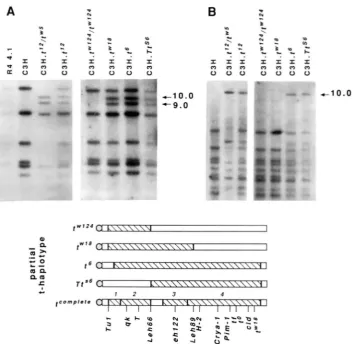
FIGURE 1 .-Partial t-haplotype mapping. (A) Mapping of At4144 to the t complex. The 9- and IO-kbp BumHl fragments are specific to the
lanes carrying the complete t-haplotypes (t" and r'). The R4 4.1 and C3H patterns are identical as expected. The 9- and IO-kbp fragments are not present in t"'2'/t"'2' which is wild type for the distal end of the t-complex. (B) Mapping of Au126. The IO-kbp Tug1 I-type band is shared by the complete t-haplotypes
t"'
and 1". Other smaller t-type bands can also be seen. The IO-kbp t-type band is present in the t" andTf" partial t-haplotypes only. Precompeted whole cosmid was used as the probe in all hybridi7ations. Below is a diagram of the four partial I-
haplotypes; the bottom-most chromosome is a complete t-haplotype shown with the four inversions shown above it and relevant markers ~~
noted below. Crosshatched portions represent t-chromatin.
. . .
average, five to seven fragments larger than 1 kbp could be seen with standard 6-bp recognition se- quence restriction enzymes. Of 145 Bam5R positive clones, 15 gave an RFLP specific to the t-haplotypes t" and twJ. (See Figure 1, A or B, for a typical exper- iment.) Of 28 VLSO/IAP positive clones, two were mapped to the t-complex giving a total of 17 t-complex DNA markers. More precise mapping of twelve cos- mids that map distal to Leh66B is described below.
Mapping within the t-complex: RFLP analysis was initially used to map 1 1 of the 12 clones described here into t-complex subregions by hybridization to blots containing DNA from partial t-haplotypes. (Only one clone, A u 6 4 , showed an RFLP between t-haplo- types; its mapping is discussed below.) Partial t-haplo- types arise from rare recombination events between complete t-haplotypes and wild-type chromosomes. In these exceptional recombinants, wild-type chromatin has replaced t-chromatin in either proximal or distal regions. ("Proximal" or "distal" will refer to the t-
complex and its relative orientation of markers unless
otherwise noted.) T h e partial t-haplotypes used were t6 and Tt6tf, which have wild-type chromatin at the proximal end, and tw18 and tw'24tf, which have wild-
type chromatin at the distal end (see Figure 1). Figure
1 A demonstrates a typical mapping experiment using whole cosmid clone 144 as the probe. T h e two t- specific bands at 9- and IO-kbp are present only in t6,
T t 6 and tWl8, but not tw'24, indicating that tW"', which retains only the proximal end of the t-complex, has lost the t-specific allele. T h e two bands are present in tw", another proximal recombinant, whose breakpoint is further distal than that of tWlz4. Hence, the locus
Au144 should map to that region of the t-complex present in PI8, but not tw124. Cosmids defining the loci
Au17, Au31, Au49 and A u 5 3 gave results identical to cosmid 144 and map to the same region. This region has a distal limit in t-haplotypes set by the breakpoint near the loci duplicated in the tw18 partial t-haplotype
(D17Leh89, D17Leh467, D17Leh525; B U ~ A N et al.
1987) and a proximal limit set by tw'24 at the Leh66B
&Complex Molecular Markers
occured within Zn(17)4, one or more of these new markers may be separated in wild-type to regions more distal, like the loci duplicated in the
t
'
"
partial'
t-haplotype.DNA sequences from a second set of cosmids mapped more distal in t-haplotypes; these cosmids define the loci Au7, Au16, Au57, Au100, Au126 and Au127. A typical mapping experiment using whole cosmid clone 126 as the probe is shown in Figure 1B. These clones retain their 1-type band in t6 and T f 6 only, indicating a map position distal to the twrR break- point in Zn(l7)4.
Specific map positions of four cosmids: T h e map positions of four cosmids located within In(l7)4 were refined. (CA), length polymorphism (WEBER and MAY
1989) at Au7, Au126 and Au127 and RFLP analysis at Au64 were used to identify their respective alleles on a set of anchored inter-t-haplotype recombinants with breakpoints in Zn(I7)4. For each locus a prelimi- nary survey of the anchored intervals indicated on which interval to focus.
Au64 and A d 2 7 set a new distal limit in t-haplo- types for the position of the
t
"
'
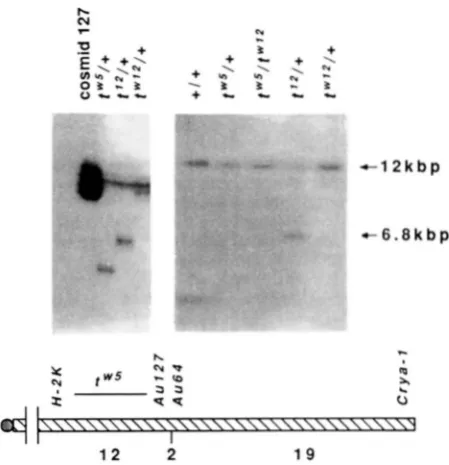
gene: T h e P64 probe detects a unique 6.8-kbp PstI band in t" not shared by the other t-haplotypes involved in the crosses or by the wild-type trans chromosome used. Au127 contains a (CA), block which showed a three-way polymor- phism between t", tw5 and T f 6 (see Figure 2). T h e initial typing showed that these two clones reside in the -3 cM H-2K to Crya-1 interval. We typed 33 recombinants with breakpoints between these two an- chor loci. Fourteen recombinants separated Au64 from H-2K, while 19 separated Au64 from Crya-I. Almost identical results were obtained with the Au127 locus. Twelve breakpoints mapped between H-2K and Au127 and 21 mapped between Au127 and Crya-1. There were, however, two recombinants with break- points in between these markers. These results al- lowed us to order these loci and estimate genetic distances (cM) in t-haplotypes as follows: cen. . .
H-2K/tw5. .
(1.1). .
Au127. .
(0.2). .
Au64. .
(1.7).
.
Crya-1.
Closer scrutiny of cosmids 127 and 64 indicated that they are very likely overlapping. First, they share several BamHI, EcoRI and Hind111 fragments as judged by inspection of complete restriction enzyme digestion patterns, and secondly, several fragments shared by the two cosmids cross-hybridize following precompetition of the labeled cosmid with cold mouse DNA. One of these cross-hybridizing fragments was isolated and hybridized to genomic blots and appears to be a two-copy sequence devoid of any moderately or highly repeated elements.
Since several of the recombinants derived from the t"' complete t-haplotype had been progeny tested for the presence of the tW5 lethal mutation, these loci set a limit toward Crya-I for the position of tW5. t"' is
+ 1 2 k b p
- 6 . 8 k b p
h -4-
3 3 Y
v-
m A
?
\\\\\\\\\\\\\\\\\\\\\\\\\\\\\\\y , W J v- u,
L
T T 0
I
1 2 2 1 9
FIGURE 2.-Map position of AuZ27 and Au64. Top left, (CA).
polymorphism at Au127. Top right, Pstl polymorphism detected by
1'64. Bottom, chromosome showing positions of markers in the region between H-2K and Crya-Z in the t-haplotype orientation. Below the chromosome are the number of recombinants detected between markers.
genetically inseparable from H-2K, and these data indicate that it can be no further than
-
1.1 cM distal to H-2K in t-haplotypes.The A d 2 6 locus maps near the cld and to genes distal to tf: Results with the whole cosmid 126 probe indicated that the tw18 partial proximal t-haplotype had
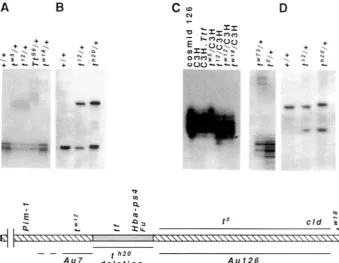
lost the t-specific fragment seen in other complete t- haplotypes (see Figure lB), indicating that Au126 must either map in Zn(l7)4 or be deleted from tw" (BUCAN et al. 1987). However, A d 2 6 should be pres- ent on the twJ8 haplotype for the following reason: Amplification across a (CA), block at the Au126 locus from a C3H.t"'8 animal yielded a length polymor- phism that could only have come from the wild-type region of the tw" haplotype (see Figure 3C). In other words, even though the tw" haplotype was made con- genic on C3H, it still retained a portion of feral chromosome between the end of the t-chromatin and the beginning of the C3H-derived chromosome. [The t"" exception occurred in a I5 haplotype still trans to a chromosome from the wild (BENNETT and DUNN 1960).] T h e feral chromosome and C3H were poly- morphic indicating that this locus is not deleted in the t"" partial t-haplotype and sets a distal limit for Au126 in t-haplotypes at the t"" deletion.
180 T. Ebersole, F. Lai and K. Artzt
A
B
+ &
A.D
v VI
-
?
k
N mrn
-
._
*
t oI
Q
\\\\\\\\\\\\1 I\\\\\\\\\\\\\\\\\\\\\\\\\\\\\\\\Y
c l d L
c
2
2:
c~
"-
t h 2 0d e l e t i o n A u 1 2 6
FIGURE 3.-Map position of Au7 and Au126. (A and C ) (CA). polymorphism at Au7 and Au126, respectively. The polymorphism from the
wild-type region of the f""8 haplotype is marked with an asterisk in (C). (B and D) Neither Au7 (probe P7) nor Au126 (probe P126).
respectively, are deleted from p2". Bottom, chromosome showing position of markers between Pim-I and t"" in the f-haplotype orientation. Stippled region identifies the deletion in pZ". The position oft" proximal to cld is inferred from separate genetic crosses and is tentative.
tJ Only two recombinants were available which in- volved the more distal interval between tfand cld. In both cases Au126 mapped with cld, distal to t$ This placement was corroborated by the
PZo
haplotype which deletes Hba-ps4, tfand Fu (LYON and BECHTOL1977; Fox, SILVER and MARTIN 1984) but not Au126 (see Figure 3D) nor cld (LYON 1985).
Au7 maps near the tWI2 gene: A (CA), length poly- morphism allowed us to initially map this locus distal
to Pim-I in t-haplotypes (see Figure 3A). Analysis of three recombinants breaking between Pim-I and PI2, and four recombinants breaking between tWl2 and tf
showed that Au7 was not separated from tWlz in these seven events. These are the same recombinants used by ARK et al. (1 991), to position Pim-I,
P"
and to. T h e distal limit of Au7 can be set proximal to tfby the thZodeletion, which deletes tf, Hba-ps4 and Fu, but not Au7 (see Figure 3B).
DISCUSSION
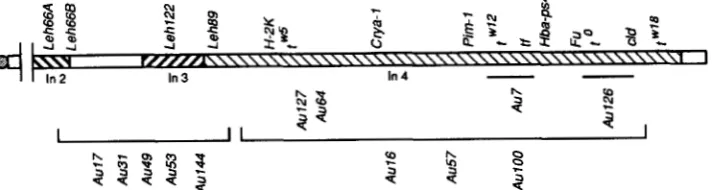
We have identified a set of 17 cosmid clones that reside in the t-complex and mapped the position of 12 of these clones. Five loci have been mapped in t-
haplotypes to the interval between Leh66B and Leh89. Three loci have been broadly mapped to In(l7)4, and the remaining four loci have been specifically mapped near developmental mutations in In(Z7)4 (see Figure
Distribution of the markers: T h e level of resolu- tion of our mapping does not allow for unequivocal
4).
interpretations of chromosomal distribution of the cosmid clones, however, on a gross scale, it appears fairly random. I t should be noted, however, that 12 of 15 Bam5R-identified cosmid clones mapped distal
to the Leh66B locus in t-haplotypes while four of four VL3O/IAP-identified clones (this number includes two from a previous screen (HOWARD et al. 1990)) mapped proximal to Leh66B. A similar screen of R4 4.1 derived cosmids using Bam5R plus a second anon- ymous repetitive element has mapped a high number of clones in or near the major histocompatablity com- plex (MHC) (KASAHARA, FICUEROA and KLEIN 1987; VINCEK et al. 1989). By contrast, only two of the Bam5R identified loci described here, Au64 and Au127, map close to the MHC. None of the three remaining clones that have been broadly mapped to In(I7)4 cross-hybridize with pH-2IIa, a probe which detects most MHC class I genes.
(CA),
length polymorphism among t-haplotypes: Three of the loci were mapped using (CA), length polymorphism and inter-t-haplotype crosses. As shown here, these simple sequence repeats are a useful source of polymorphism for genetic mapping in t-haplotypes. We actually looked at nine separate (CA), blocks in six of the cosmids mapping to In(] 7)4 (see MATERIALS AND METHODS). In this small sample size, 33% (3/9)6 % h
a
$ 3
IFIGURE 4."Summary of the map positions of 12 cosmids on a t-haplotype. The distal end of Zn(l7)2 is shown at left. Clear boxes are noninverted regions. The markers described in this paper are noted below the chromosome.
here (C3H or BTBRTF). This difference in polymor- phism is comparable to that reported between inbred laboratory mice and Mus spretus (CORNALL et al. 199 1 ;
MONTAGUTELLI, SERIKAWA a n d G U ~ N E T 199 1).
Markers mapping near developmental mutations: T h e A u l 2 7 and Au64 markers map
-
1.1 cM distal to H-2K. H-2K has not been genetically separated from the tw5 recessive lethal in over 1200 mice analyzed, and they are therefore thought to be located very close to each other (ABE et al. 1988). This notion assumes a random distribution oE breakpoints in this region. However, it has been shown that a hotspot of recombination exists within 100 kbp of H-2K toward the H-21 region (ARTZT et al. 1988), therefore the physical distance between H-2K and P5 might be quite different from that implied by the genetic data. T h e proximal limit of P5 in t-haplotypes has been shown to be at a point -65 kbp toward H-2Pb from H-2K. Until now the closest distal marker mapped with re- spect to tw5 has been the Crya-1 gene some 3.0 cM from H-2K. T h e physical size of the region between H-2K and the new distal limit, Au127, in which the P5 gene must map is unknown. However, using the stand- ard conversion in mice between genetic and physical distance shows that the physical distance may still be quite large, -2 X lo6 bp.T h e tw5 gene is an interesting target for cloning. Homozygous mutant embryos are affected in early development at 5-6 days post coitum, when embry- onic ectoderm dies (BENNETT 1975). T h e two new markers that set a distal boundary for the gene should aid in its cloning.
The Au7 locus has been mapped near the tWl2 reces- sive lethal. This mutation affects neural tube and brain development, initially causing the ventral half of both these tissues to become pycnotic and die, as does the entire embryo somewhat later (BENNETT 1975). Inter- estingly, this mutation distinguishes between the ven- tral and dorsal halves of the developing nervous sys-
tem. The mapping of Pim-1, t w z 2 , and tfby ARK et al.
(1991), suggests that Au7 may be very close to tWl2.
Distances of 0.6 cM from Pim-1 to tWl2 and of 0.5 cM from tW" to tfwere estimated from inter-t-haplotype crosses. These same recombinants have been used in this study. In addition, the
PZ0
deletion breakpointshould be proximal to
tf;
this further reduces the interval, since Au7 is not deleted inP2'.
T h e Au126 locus may map near two recessive lethal mutations, one, cld, which affects lipid metabolism in neonates (PATERNITI et al. 1983), and the second, to
(t'), a mutation which causes the early embryo to fail
in the stage when it differentiates into extra-embry- onic and embryonic ectoderm (BENNETT, BADENHAU-
SEN and DUNN 1959). T h e relative positions of Fu, to and cld are not firmly established; however, Fu is deleted in
t""
and cld is not. T h e presence or deletion of the to(t6) gene cannot be ascertained sincet""
was derived from the t6 haplotype. Since Au126 is not deleted inP2",
we tentatively place it closer to to and cld than to Fu.The authors would like to thank P. CENTILLI for help in the screening and in the manufacture of primers, L. SILVER for the gift of th2", and J. CAMPS for help with the manuscript. This work was
supported by grants CA21651 and HD10668 from the National Institutes of Health.
LITERATURE CITED
ABE, K., J.-F. WEI, F . 4 . WEI, Y.-C. Hsu, H. UEHARA, K. ARTZT and D. BENNETT, 1988 Searching for coding sequences in the mammalian genome: The H-2K region of the mouse MHC is replete with genes expressed in embryos. EMBO J. 7: 3441- 3449.
ADAMSON, E. D., 1987 Oncogenes in development. Development
9 9 449-47 1.
ARK, B., G. GUMMERE, D. BENNETTand K. ARTZT, 1991 Mapping of the Pim-I oncogene in t-haplotypes and its use to define the relative map positions of the tcl loci t'((t4, and t"" and the marker tf(tufted). Genomics 10: 385-389.
ARTZT, K., 1984 Gene mapping within the T / t complex of the mouse. 111. t-Lethal genes are arranged in three clusters on chromosome 17. Cell 3 9 565-572.
ARTZT, K., B. BABIARZ and D. BENNETT, 1979 A t-haplotype (t"")
overlapping two complementation groups. Genet. Res. 33:
ARTZT, K., K. ABE, H. UEHARA and D. BENNETT, 1988 Intra-H- 2 recombination in t-haplotypes shows a hot spot and close linkage of I"' to H-2K. Immunogenetics 2 8 30-37.
BABIARZ, B. S., 1983 Deletion mapping of the T / t complex: evi- dence for a second region of critical embryonic genes. Dev. Biol. 95: 342-35 1.
279-285.
BENNETT, D., 1975 The T-locus of the mouse. Cell 6: 441-454. BENNETT, D., S. BADENHAUSEN and L. C. DUNN, 1959 The em-
bryological effects of 4 late lethal t-alleles in the mouse which affect the neural tube and skeleton. J. Morphol. 1 0 5 105-144. BENNETT, D., and L. C. DUNN, 1960 A lethal mutation ( P 8 ) in the house mouse showing partial duplications. J. Exp. Zool.
BENNETT, K. L., R. E. HILL, D. F. PIETRAS, M. WOODWORTH-
182 T. Ebersole, F.
GUTAI,
c.
KANE-HAAS, J. M. HOUSTON, J. K. HEATH and N.D. HASTIE, 1984 Most highly repeated dispersed DNA fami- lies in the mouse genome. Mol. Cell. Biol. 4 156 1
-
157 1.B u ~ N , M., B. G. HERRMANN, A.-M. FRISCHAUF, V. L. BAUTCH, V. BODE, L. M. SILVER, G. R. MARTIN and H. LEHRACH, 1987 Deletion and duplication of DNA sequences is associ- ated with the embryonic lethal phenotype of the t9 complemen- tation group of the mouse t-complex. Genes Dev. 1: 376-385. Committee on the Mouse Chromosome 17, 1991 Maps of mouse
chromosome 17: first report. Mamm. Genome 1: 5-29. CORNALL, R. J., T. J. AITMAN, C. M. HEARNE and J. A. TODD,
1991 The generation of a library of PCR-analyzed microsa- tellite variants for genetic mapping of the mouse genome. Genomics 1 0 874-881.
EBERSOLE, T., 0. RHO and K. ARTZT, 1992 The proximal end of mouse chromosome 1 7 new molecular markers identify a deletion associated with Genetics 131: 183-190. FANNING, T. G., 1982 Characterization of a highly repetitive
family of DNA sequences in the mouse. Nucleic Acids Res. 1 0
FOX, H. S., L. M. SILVER and G. R. MARTIN, 1984 An alpha globin pseudogene is located within the mouse t complex. Immunogenetics 1 9 125-130.
FRISCHAUF, A.-M., 1985 The T / t complex of the mouse. Trends Genet. 1: 100-102.
GARDINER, K., M. HORISBERGER, J. KRAUS, U. TANTRAVAHI, J.
KORENBERG, V. RAO, S. REDDY and D. PATTERSON, 1990 Analysis of human chromosome 21: correlation of phys- ical and cytogenetic maps; gene and CpG island distributions.
GOSSLER, A., A. L. JOYNER, J. ROSANT and W. C. SKARNES, 1989 Mouse embryonic stem cells and reporter constructs to detect developmentally regulated genes. Science 2 4 4 463- 465.
GRAHAM, A., N. PAPALOPULU and R. KRUMLAUF, 1989 The mu- rine and Drosophila homeobox gene complex have common features of organization and expression. Cell 57: 367-378. HAMMER, M. F., J. SCHIMENTI and L. M. SILVER, 1989 Evolution
of mouse chromosome 17 and the origin of inversions associ- ated with t-haplotypes. Proc. Natl. Acad. Sci. USA 86: 3261- 3265.
HASTIE, N. D., 1989 Highly repeated DNA families in the genome
of Mus musculus, pp. 559-573 in Genetic Variants and Strains
of the Laboratory Mouse, Ed. 2, edited by M. F. LYON and A. G. SEARLE. Oxford University Press, Oxford.
HERRMANN, B., M. BUCAN, P. E. MAINS, A.-M. FRISCHAUF, L. M.
SILVER and H. LEHRACH, 1986 Genetic analysis of the prox- imal portion of the mouse t-complex: evidence for a second inversion within t-haplotypes. Cell 4 4 469-476.
HERRMANN, B. G., S. LABEIT, A. POUSTKA, T. R. KING and H. LEHRACH, 1990 Cloning of the T gene required in mesoderm formation in the mouse. Nature 343: 6 17-622.
HOWARD, C. A., G. R. GUMMERE, D. BENNETT and K. ARTZT, 1990 Genetic and molecular analysis of the proximal region of the mouse t-complex using new molecular probes and partial t-haplotypes. Genetics 1 2 6 1103-1 114.
JAKOBOVITS, A., G. M SHACKLEFORD, H. E. VARMUS and G. R.
MARTIN 1986 Two proto- oncogenes implicated in mammary carcinogenesis, ant-1 and int-2: are independently regulated during mouse development. Proc. Natl. Acad. Sci. USA 83:
KASAHARA, M., F. FIGUEROA and J. KLEIN, 1987 Random cloning 5003-5013.
EMBO J. 9: 25-34.
7806-7810.
Lai and K. Artzt
of genes from mouse chromosome 17. Proc. Natl. Acad. Sci. USA 84: 3325-3328.
KESSEL, M., and P. CRUS, 1990 Murine developmental control genes. Science 2 4 9 374- 379.
LYON, M. F., 1984 Transmission ratio distortion in mouse t-
haplotypes is due to multiple distorter genes acting on a re- sponder locus. Cell 37: 621-628.
LYON, M. F., 1985 Private communication. Mouse News Letter.
72: 104.
LYON, M. F., 1986 Male sterility of the mouse t-complex is due to homozygosity of the distorter genes. Cell 44: 357-363. LYON, M. F., and K. B. BECHTOL, 1977 Derivation of mutant t-
haplotypes of the mouse by presumed duplication or deletion. Genet. Res. 30: 63-76.
MONTAGUTELLI, X., T . SERIKAWA and J.-L. GU~NET, 1991 PCR- analyzed microsatellites: data concerning laboratory and wild- derived mouse inbred strains. Mamm. Genome 1: 255-259. NELSON, D., S. A. LEDBETTER, L. CORBO, M. F. VICTORIA, R.
RAMIREZ-SOLIS, T. D. WEBSTER, D. H. LEDBETTER and C. T.
CASKEY, 1989 Alu polymerase chain reaction: a method for rapid isolation of human-specific sequences from complex DNA sources. Proc. Natl. Acad. Sci. USA 8 6 6686-6690.
PATERNITI, J. R., W. V. BROWN, H. N. GINSBERG and K. ARTZT, 1983 Combined lipase deficiency (cld): A lethal mutation on chromosome 17 of the mouse. Science 221: 167-169. ROHME, D., H. Fox, B. HERRMANN, A. FRISCHAUF, J. EDSTROM, P.
MAINS, L. SILVER and H. LEHRACH, 1984 Molecular clones of the mouse t-complex derived from microdissected metaphase chromosomes. Cell
3 6
783-788.SCHOLER, H., G. R. DRESSLER, R. BALLING, H. ROHDEWOHLD and P. GRUSS, 1990 Oct-4: a germline-specific transcription factor mapping to the mouse t-complex. EMBO J. 9: 2 185-2 195. SHIN, H A . , L. FLAHERTY, K. ARTZT, D. BENNETT and J. RAVETCH,
1983 Inversion in the H-2 complex of t-haplotypes in mice. Nature 3 0 6 380-383.
SILVER, L. M., and K. ARTZT, 1981 Recombination suppression of mouse t-haplotypes due to chromatin mismatching. Nature
SILVER, L. M., and D. REMIS, 1987 Five of the nine genetically defined regions of mouse t-haplotypes are involved in trans- mission ratio distortion. Genet. Res. 4 9 51-56.
SILVER, L. M., M. HAMMER, H. Fox, J. CARRELS, M. BUCAN, B. HERRMANN, A,". FRISCHAUF, H. LEHRACH, H. WINKING, F. FIGUEROA and J. KLEIN, 1987 Molecular evidence for the rapid propagation of mouse t-haplotypes from a single, recent, ancestral chromosome. Mol. Biol. Evol. 4 473-482.
SMILEY, J. R., D. A. STEEGE, D. K. JURICEK, W. P. SUMMERS and F. H. RUDDLE, 1978 A herpes simplex virus 1 integration site in the mouse genome defined by somatic cell genetic analysis. Cell 15: 455-468.
VINCEK, V., H. KAWAGUCHI, K. MIZUNO, Z. ZALESKA-RUTCZNSKA, M. KASAHARA, J. FOREJT, F. FIGUEROA and J. KLEIN, 1989 Linkage map of chromosome 17: localization of 27 new DNA markers. Genomics 5: 773-786.
WEBER, L. M., and P. E. MAY, 1989 Abundant class of human DNA polymorphism which can be typed using the polymerase chain reaction. Am. J. Hum. Genet.
44.
388-396.ZIMMER, A., and P. GRUSS, 1989 Production of chimaeric mice containing embryonic stem (ES) cells carrying a homeobox Hox 1.1 allele mutated by homologous recombination. Nature 338: 2 9 0 68-70.
150-156.