ABSTRACT
MORGAN, JONATHAN QUENTIN. The Role of Regional Industry Clusters in Urban Economic Development: An Analysis of Process and Performance. (Under the direction James H. Svara.)
This dissertation examines the potential of industry clusters as an economic development strategy for metropolitan regions and their central cities. The ultimate research question is whether or not industry clusters matter for economic development and, if so, how and why they do.
The research focuses on two aspects of industry clusters: 1) the extent to which clusters affect economic development outcomes, and 2) how the socio-institutional and policy process of promoting clusters influences their potential use in economic development. The first conceives of clusters as critical mass within certain industries and seeks to determine whether they are associated with better economic development performance. This question was examined using quantitative methods including bivariate correlation and multiple regression analysis. The second overarching research question is concerned with the social, institutional and governance dimensions of clustering and how they might shape the strategic use of industry clusters to accomplish economic development goals. This process question is an inherently qualitative one and was explored using a comparative case study analysis of how three metropolitan regions support their respective transportation, distribution, and logistics clusters. Both the quantitative and qualitative phases of the research analyze the extent to which clusters can be utilized to achieve a broader set of economic development goals including regional equity and inner city prosperity.
found only a modest relationship between certain clusters and increased regional economic performance and equality. Conversely, some clusters had a negative effect on these
development indicators. Similar to the quantitative findings, the interview responses from the case studies confirm the proposition that all clusters are not created equal in terms of their ability to bring about economic development. Moreover, the case study regions varied in the extent to which they provided support to target clusters suggesting that not all regions are created equal in terms of facilitating the clustering process. The qualitative findings revealed that the promise of cluster-based development for increasing economic opportunity in the inner city is hampered by a number of intractable challenges. In the case of the
THE ROLE OF REGIONAL INDUSTRY CLUSTERS
IN URBAN ECONOMIC DEVELOPMENT:
AN ANALYSIS OF PROCESS AND PERFORMANCE
by
JONATHAN QUENTIN MORGAN
A dissertation submitted to the Graduate Faculty of
North Carolina State University
in partial fulfillment of the
requirements for the Degree of
Doctor of Philosophy
PUBLIC ADMINISTRATION
Raleigh
2004
APPROVED BY:
__________________ ____________________ _________________
G. David Garson Roland Stephen Michele Hoyman
_____________________
James H. Svara
DEDICATION
This dissertation is dedicated to my dear parents Champ and Shirley Morgan whose loving support throughout my entire life has meant so much to me in all my academic,
professional, and personal endeavors. I thank you so much for always being there for me and raising me in such a way that I could even dream of one day earning a Ph.D. Now that I have fulfilled that dream, I share it with you and hope that I have made you proud.
I also dedicate this achievement to the memory of other family members who have passed away, but whose lives touched and inspired me in some way. My older brother Champ Morgan, III showed me how to hang tough in the midst of adversity. My uncle William Morgan was there for me as a youngster in a way that made me feel special and increased my self-esteem early in life. My uncle John Richard Morgan set the example by being the first in my family to earn a doctorate. My cousin Richard Reaves, Sr. offered advice and
BIOGRAPHY
Jonathan Quentin Morgan is an Assistant Professor of Public Administration and
Government in the School of Government at the University of North Carolina at Chapel Hill. Prior to joining the UNC School of Government in 2003, Jonathan was Director of Economic Development Programs at the consulting firm Regional Technology Strategies, Inc. He has also served as Director of Economic Policy & Research at the North Carolina Department of Commerce and Research & Policy Director for the North Carolina Institute of Minority Economic Development. He is a member of Pi Alpha Alpha, the National Honor Society for Public Affairs and Administration.
ACKNOWLEDGEMENTS
The process of earning a Ph.D., particularly researching and writing a dissertation, is extremely challenging. It is certainly a marathon much more than it is a sprint. Anyone who has been through this process knows that one individual cannot do it alone. First and
foremost, I give thanks and praise to God for giving me the physical, mental, emotional, and spiritual fortitude to see this through to completion. I often had to draw from this higher source of strength that comes from heaven above. The process also requires the involvement and support of many people here on earth. I am especially grateful to my faculty advisor and chairman of my dissertation committee, Dr. Jim Svara, who helped me get through the entire doctoral degree process at North Carolina State University. I also appreciate the time and effort provided by my other committee members, Dr. G. David Garson, Dr. Roland Stephen, and Dr. Michele Hoyman, whose feedback and advice were extremely helpful throughout my dissertation research.
I was fortunate to have received financial support for my dissertation research from the U.S. Department of Housing and Urban Development through its Doctoral Dissertation Research Grant program. This funding made a huge difference in my ability to do the research and writing for the dissertation in a reasonable amount of time. My qualitative research would not have been possible without the participation of the individuals and
organizations in the study regions of Indianapolis, IN, Louisville, KY, and Memphis, TN. I owe a debt of gratitude to a number of former colleagues and professors for the role they have played in influencing my pursuit of this degree. I discovered the topic for my
During my time at the North Carolina Institute of Minority Economic Development, Andrea Harris and Dr. David Alston provided encouragement when I started the doctoral program back in 1997. While matriculating at Clark Atlanta University, Dr. James Jones, Dr. Henry Elonge, Dr. Gretchen Maclachlan, and Dr. Bob Holmes became my mentors and professional role models, and they have been extremely supportive over the years.
TABLE OF CONTENTS
Page
LIST OF TABLES………. xi
I. INTRODUCTION………. 1
Research Problem……….…. 1
Context: The Growth Imperative at the Local Level………. 2
The Pursuit of Growth as a Response to Fiscal Crisis………... 3
People and Places Left Behind……….. 4
The Problems of the Inner City……….… 5
The Policy Problem………6
Inner City Workers and Regional Competitiveness………... 7
An Industry Cluster-Based Approach to Urban Economic Development.….8 Research Gaps Addressed by Study……….. 10
Industrial Clustering and Regional Economic Performance……….. 11
The Process of Regional Clustering……….….. 12
Clusters and Equity……… 13
Organization of the Dissertation……… 15
II. REVIEW OF THE LITERATURE……….…...16
Defining Economic Development……….. 17
Economic Development as Process and Outcomes……….….. 19
Economic Development as Government Action……… 19
Models of Urban Economic Development……… 23
Political Factors and/or Market Forces……….. 23
Economic Theories of Urban and Regional Growth……….. 25
Economic Base Theory……….. 25
Classical Location Theory………. 28
Central Place Theory……….. 29
Product Cycle Theory……… 29
Endogenous Growth Theory……….. 30
Flexible Specialization and Agglomeration Economies……… 32
Agglomeration Economies……… 34
Industrial Districts: Old and New……….. 36
The Empirical Validity of the Industrial District Model……….….. 41
From Industrial Districts to Industry Clusters……….….. 47
Previous Research on the Relationship between Industry Clusters and……… 51
Regional Economic Performance The Economic Development Benefits of Industry Clusters……….. 52
Localization and Urbanization Economies and Competition……… 53
Industrial Structure and Industry Performance……….. 59
Industrial Structure and Regional Economic Performance……… 60
The Process of Regional Clustering……….…. 63
Institutional “Thickness”………... 64
Social Capital, Trust, and Untraded Interdependencies………. 65
Linkages and Inter-organizational Networks………. 67
Innovation Networks and Learning Regions………. 68
Collaboration on Workforce Development……… 69
Previous Research on the Clustering Process……… 72
Networking and Flexibility in Silicon Valley……… 73
Explaining Growth in “Second Tier Cities”……….. 76
Understanding Growth Clusters in Europe……… 77
Literature Review Note……….. 79
III. THEORETICAL FRAMEWORK………. 80
Clusters as Pure Agglomeration……….81
Specialization versus Diversity: A False Dichotomy?………... 84
The Quantitative Relationship between Industry Clusters and Urban Economic Performance……….. 85
Clusters as Industrial Complexes………... 88
Market-Based Interdependencies………... 89
Clusters as Social Networks………...90
Institutions, Inter-organizational Networks, and the Clustering Process…...92
The Local Embeddedness of Cluster Linkages……….. 94
Local Governance and Cluster-Based Economic Development……… 95
The Link between Regional Industry Clusters and the Inner City…………. 97
IV. RESEARCH DESIGN AND METHODOLOGY………. 100
The Quantitative Relationship between Clusters and Urban Economic Development……….. 101
The Metropolitan Region as a Unit of Analysis……… 102
Variables and Data………. 103
Dependent Variables……….. ……... 103
Metropolitan Economic Performance……… 104
Independent Variables………... 105
Regional Industry Clusters……… 105
Control Variables………... 107
Population Size and Density……….. 107
Base-Year Economic Conditions………... 108
Workforce Education and Skill Levels……….. 108
Local Tax Revenues………...109
Local Government Expenditures………... 110
Region of the U.S………... 110
Data Analysis……….…… 111
Regression Models………. 112
Testing the Assumptions for Regression………... 113
The Qualitative Process of Regional Clustering for Urban Economic Development……….. 114
Qualitative Case Study Design……….. 115
Why the Transportation and Logistics Cluster?……… 116
Choice of Metropolitan Regions………... 117
The Industrial Complex Model……….……… 118
Market-based Trading Relations……… 119
The Social Network Model……… 120
Non-Market Inter-organizational Networks……….. 120
Local Embeddedness of Cluster Linkages………. 121
Local Governance……….. 122
Cluster Linkages to the Inner City………. 123
V. QUANTITATIVE DATA ANALYSIS AND RESULTS………. 124
Descriptive Findings for Industry Clusters and Metropolitan Economic Development………. 124
Clusters in Metropolitan Regions……….. 124
Descriptive Analysis of Metropolitan Economic Development……… 128
Findings on the Relationship between Industry Clusters and Metropolitan Economic Development………. 130
Clusters and Metropolitan Economic Performance………... 131
Multiple Regression Results for Economic Performance……….. 136
Influence of other Explanatory Variables on Economic Performance…….. 138
Clusters and Intra-Metropolitan Economic Equality………. 140
Multiple Regression Results for Economic Equality……….…… 146
Influence of other Explanatory Variables on Economic Equalit…….…….. 147
VI. CASE STUDY ANALYSIS AND QUALITATIVE FINDINGS:
THREE REGIONAL CLUSTERS AND THEIR USE IN URBAN ECONOMIC
DEVELOPMENT……….. 156
The Regions and their Transport, Distribution, and Logistics (TDL) Clusters……. 157
The Clusters and their Regional Impacts………..………. 159
The Regional TDL Clusters as Industrial Complexes………... 168
Social Networks and the Process of Cluster-Based Economic Development……... 169
Non-Market Interorganizational Linkages………. 169
Local Embeddednes of Cluster Linkages……….………. 177
Local Governance…….………. 179
Cluster Linkages to Inner City………... 194
VII. CASE STUDY ANALYSIS AND QUALITATIVE FINDINGS: POTENTIAL FOR CLUSTER-BASED ECONOMIC DEVELOPMENT IN THE INNER CITY………. 204
Opportunities and Barriers in Using TDL Cluster for Inner City Economic Development……….. 204
Jobs in Cluster……….………..………. 204
The TDL Paradox……….. 206
Land and Facility Requirements……… 208
Nature of the Work in TDL Cluster……….. 209
Lack of Career Paths……….. 211
Education and Basic Skills……….214
Soft Skills………... 217
Access to Transportation and Child Care……….. 219
Criminal Activity and Substance Abuse……… 223
Racial Discrimination and Negative Perceptions……….. 224
Lack of Policy Coordination……….. 225
VIII. SYNTHESIS AND CONCLUSIONS………... 230
Synthesis of Quantitative and Qualitative Findings………... 231
Clusters and Urban Economic Development………..………... 231
The Critical Role of Human Capital……….. 232
Realizing the Benefits of Regional Clusters……….. 233
Implications for Theory and Policy………... 233
Do Clusters Matter for Economic Development?……….. 233
Targeting Clusters for Urban Economic Development……….……… 234
Usefulness of Social Network Model for Understanding Cluster-Based Development………... 236
Strengthening Linkages………. 238
Linking Economic, Workforce, and Community Development…… 238
Linking Firms within Clusters………... 239
Linking Communities to Regional Clusters………... 240
Linking Political Jurisdictions………... 241
Overcoming Barriers……….. 242
Lessons for Governance and Policy………... 243
Study Limitations and Areas for Future Research………. 244
Industrial Specialization versus Diversity Revisited………. 245
Measuring Cluster Linkages and Interdependence……… 245
Connecting the Clustering Process to Regional Outcomes………246
REFERENCES……….. 247
APPENDICES………... 265
Appendix A. List of Variables in Statistical Analysis……….. 266
Appendix B. Bivariate Correlations between Explanatory Control Variables……. 267
Appendix C. Multiple Regression Analysis Results………. 268
Appendix D. Sample Contact Letter for Case Study Interviews……….. 278
LIST OF TABLES
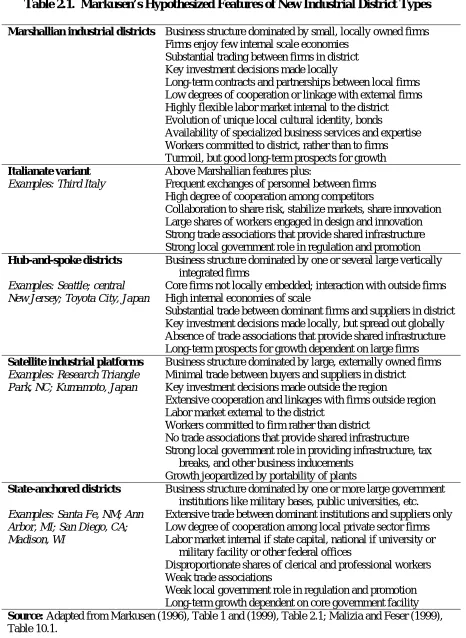
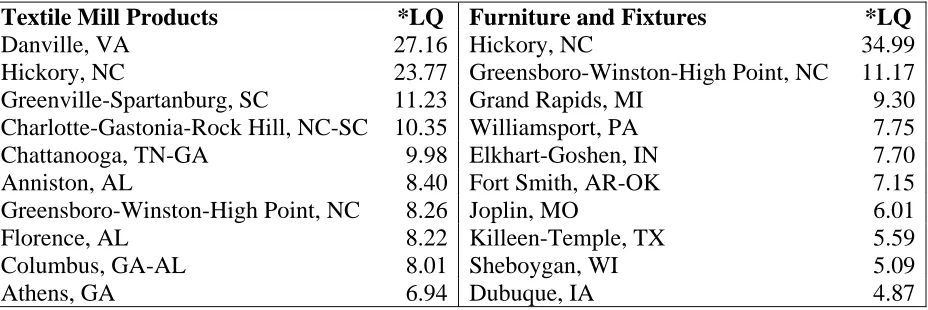
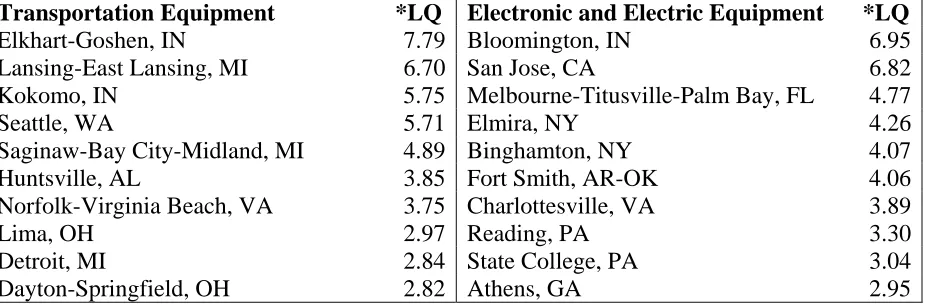
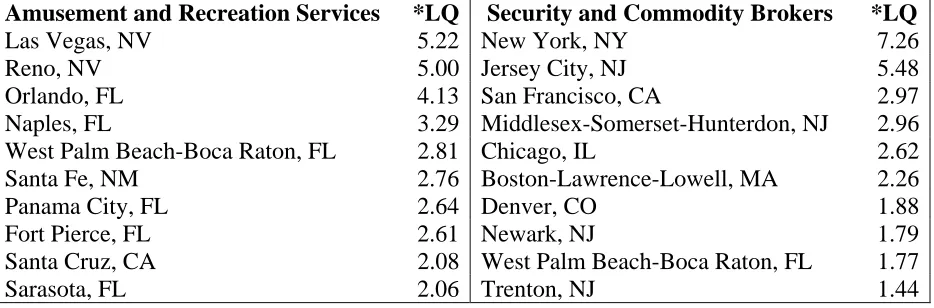
Page Table 2.1 Markusen’s Hypothesized Features of New Industrial District Types…….. 46 Table 5.1 Ten Highest Metropolitan Employment Concentrations
in Selected Traditional Manufacturing Industries……….. 126 Table 5.2 Ten Highest Metropolitan Employment Concentrations
in Selected Knowledge-Intensive Industries……….. 127 Table 5.3 Ten Highest Metropolitan Employment Concentrations
in Selected Service Industries………..……….. 128
Table 5.4 Descriptive Statistics for Economic Performance Variables………. 129 Table 5.5 Descriptive Statistics for Economic Equality Variables……… 130 Table 5.6 Bivariate Correlation Results for Industrial Specialization
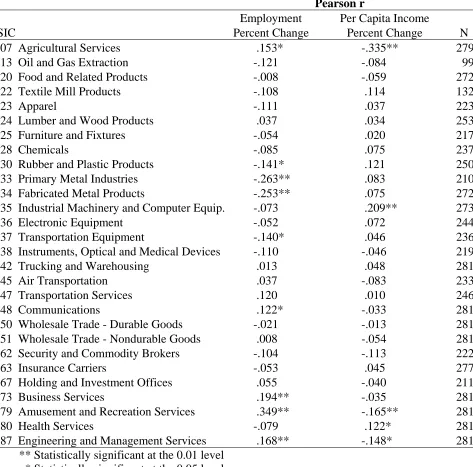
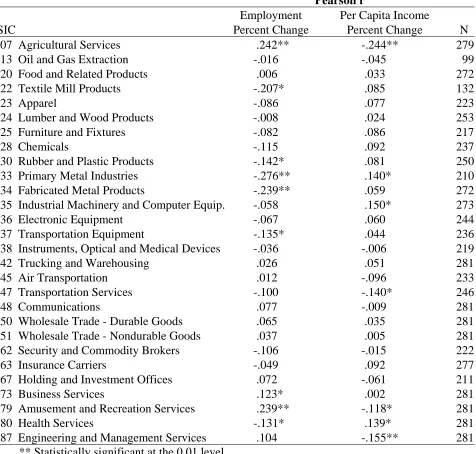
and Economic Performance Variables………... 134 Table 5.7 Bivariate Correlation Results for Industry Cluster/Critical Mass
and Economic Performance Variables………... 135 Table 5.8 Multivariate Regression Results for Metropolitan Employment Change….. 137 Table 5.9 Multivariate Regression Results for Metropolitan
Per Capita Income Change……… 138 Table 5.10 Multivariate Regression Results for Metropolitan Economic Performance –
Other Explanatory Variables……….. 140 Table 5.11 Bivariate Correlation Results for Industrial Specialization
and Economic Equality Variables……….……. 142
Table 5.12 Bivariate Correlation Results for Industry Cluster/Critical Mass
and Economic Equality Variables……….……. 145
Table 5.13 Multivariate Regression Results for Metropolitan
Per Capita Income Equality………... 146 Table 5.14 Multivariate Regression Results for Metropolitan
Table 5.15 Multivariate Regression Results for Metropolitan Economic Equality –
Other Explanatory Variables……….. 149 Table 5.16 Summary Findings for Economic Performance by Type of Industry……… 151 Table 5.17 Summary Findings for Economic Equality by Type of Industry…………... 152 Table 5.18 Industry Wage Characteristics for Statistically Significant
Industry Clusters……… 155
Table 6.1 Industrial Specialization and Metropolitan Economic Development
Variables by Region………... 160 Table 6.2 Non-Market Interorganizational Linkages Related to TDL Cluster……….. 170 Table 6.3 Role of Local Governance in TDL Cluster-Based
I. CHAPTER ONE INTRODUCTION
Research Problem
This dissertation examines the potential of industry clusters as an economic development strategy for metropolitan regions and their central cities. The cluster concept has become increasingly popular as a tool for localities and regions to use in understanding their economies and taking actions to become more competitive. The proliferation of cluster-based policies represents the latest trend in the quest to pursue economic growth at the local level. Yet, little is known about whether or not industry clusters really make a difference for the purposes of economic development or the institutional and policy process that surrounds their use.
The assumptions of industry cluster theory and the beneficial effects of clusters are mostly taken for granted. Empirical evidence demonstrating a strong link between clusters and improved economic performance has been tentative and inconclusive. Moreover, in regions where functioning industry clusters exist, there has been only limited research into the factors that facilitated their creation and growth and how they are used to achieve economic development goals. For example, we do not know much about how the support for and strategic use of clusters vary from one regional context to another in terms of the role of local institutions, policies, collaborative activity, and having an explicit focus on equity concerns.
This study advances our understanding of how industry clusters influence regional economic performance and of the process by which this happens. Clusters are
region. It is also hypothesized that the process of regional clustering and its potential impacts on economic development will vary with respect to a region’s institutional and policy milieu. That regional milieu includes (1) the level of local government
involvement; (2) the presence and support of other institutions; (3) extent of inter-organizational networking and collaboration; and (4) the strength of linkages between cluster and community. The relationship between industry clusters and regional
economic performance is examined empirically by testing a statistical model on data for U.S. metropolitan areas. The cluster process questions are addressed using a qualitative multi-case study approach. The findings from this dissertation will contribute new knowledge to the literature regarding the role of industry clusters in growing local economies and their prospects as an urban/regional economic development strategy. There are a number of dimensions to the challenges of urban growth and regional competitiveness. This introductory chapter discusses some of the reasons why
communities perceive a need to do economic development in general and why promoting industry clusters, in particular, has become the strategy of choice. It then identifies gaps in existing research on clusters and explains the theoretical and policy relevance of the current study. The chapter also frames the broad research questions that are the focus of the dissertation. Finally, it provides a brief overview of how the dissertation is organized.
Context: The Growth Imperative at the Local Level
agendas (Imbroscio 1997; Eisinger 1988). Several factors contribute to the current preoccupation with promoting growth at the local level. Communities are anxious about how they will fare in an increasingly global economy. The loss of blue-collar jobs in industries such as manufacturing and the constant threat of corporate downsizing create a sense of urgency to do something, even if only for political reasons. Urban decay, rising income inequality, racial tensions, and a growing underclass have also been an impetus for taking action to improve economic conditions.
Another factor is the “new economic federalism” characterized by reduced federal dollars to states and cities and increased policy responsibility at the state and local level (Fosler, 1988). In addition, the increased inter-jurisdictional competition for mobile capital and labor has created a so-called “economic war” between communities. Ever mindful that both employers and workers can “vote with their feet” (Tiebout, 1956), localities and regions seek to create environments that are attractive to industry, residents, and capital investment. Communities seeking to get a leg up on the next large industrial recruit keep raising the ante, so to speak, by offering more and more in the way of financial incentives to induce private investment and create jobs for their residents. The Pursuit of Growth as a Response to Local Fiscal Crisis
to meet increased demand for services. By maintaining its so-called “tax-services equilibrium” (Pagano and Bowman, 1997, p. 24), a community can curtail excessive out-migration of residents and stay competitive with other areas. In the face of strong public resistance to higher taxes, governments turn to economic development activities in order to maintain the optimal balance between taxes and services.
People and Places Left Behind
The overall strength of the U.S. economy during the last several years tends to mask the fact that many inner-city communities have not shared in the nation’s recent
prosperity. Despite the current economic slowdown, the technological advances of the 1990s resulted in a more vibrant economy characterized by rapid job and business
creation, increased productivity, higher income levels, and increased wealth. However, it is clear that the rising tide of economic growth has not benefited everyone. For example, despite the recent economic boom, one-third of central cities in the U.S. continues to struggle with high levels of poverty and one in six experiences unusually high
unemployment (U.S. HUD 1999). There are obviously several factors that help explain why so many people and places are being left behind in the new economy. These include some of the old problems of geographic and social isolation and racial discrimination. In addition, a host of newer factors related to the globalization of the economy, the
The Problems of the Inner City
The decline of the inner cities within U.S. urban areas is a long-standing challenge faced by city governments and provides another reason for finding new ways to spur economic development. Residents of the inner city continue to be disproportionately represented among the unemployed and poor (Engberg 1996). Local economic
development policies that are intended to remedy inner city economic problems must take into account the complex array of factors that contribute to those conditions. Teitz and Chapple (1998) identify the most commonly cited hypothesized causes of inner city poverty:
1) Profound structural economic shifts that have eroded the competitive position of central cities in the industrial sectors that historically provided employment for the working poor, especially minorities.
2) Inadequate human capital of the labor force, which results in lower
productivity and inability to compete for employment in emerging sectors that pay adequate wages.
3) Persistent racial and gender discrimination in employment, which prevents the population from achieving its full potential in the labor market.
4) Complex interaction of culture and behavior, which has produced a population that is isolated, self-referential, and detached from the formal economy and labor market.
5) The outcome of a long, historical process of segregating poor and minority populations in U.S. cities that resulted in a spatial mismatch between workers and jobs.
6) Migration processes that simultaneously remove the middle class and
successful members of the community, thereby reducing social capital, while bringing in new, poorer populations whose competition in the labor market drives down wages and employment chances of residents.
7) An endogenous growth deficit that results from low levels of entrepreneurship and access to capital, especially among minority populations.
8) The unanticipated consequence of public policy that was intended to alleviate social problems, but has, in fact caused them to worsen in some respects (Teitz and Chapple, 1998, pp. 36-37).
Cluster-based strategies are no exception and their effectiveness for creating economic
opportunity among inner city residents hinges on the ability to address these obstacles.
The Policy Problem
Addressing the many problems of the inner city is a challenge that has confounded public officials for years. A variety of policy initiatives have attempted to reduce urban poverty and joblessness. Yet the continued disconnect of many low-income inner-city communities and residents from the growth and development occurring within the larger metropolitan regions of which they are a part points to a need for a more effective public policy response. One might ask what constitutes an appropriate policy response to this challenge. The answer will vary depending on the specific aspect of the problem being targeted, which derives in part from one’s conception of its root causes. While
acknowledging that multiple factors working together have left the inner-city poor shut out of the economic mainstream, this study contends that the most significant single issue is the role that low-skills and poor human capital development play in hindering access to larger regional labor markets.
Thus, public policy can make a difference by supporting initiatives that attempt to integrate low-income residents of the inner city into the economic mainstream by
an approach centered on increasing the skill base and human capital potential within distressed urban communities has a good chance of succeeding.
A primary tenet of this dissertation is that economic development and workforce development are (or should be) inextricably linked as part of a coherent policy approach to economic growth. For too long these fields have operated rather independently of each other. Only recently have practitioners and academics begun to recognize the vital
connection between economic growth in a region and the development of its most important asset: its people (Council for Urban Economic Development 1998). An approach to inner-city growth that explicitly integrates economic and workforce development can be a positive sum strategy:
For unemployed and under-employed individuals, [it] can create and prepare them for more and better jobs. From the government’s fiscal perspective, generating jobs that go to unemployed or under-employed city residents reduces local public costs associated with poverty and keeps tax revenues and consumer spending dollars at home. For business, [it] can mean a more accessible and stronger labor supply (Stillman, 1994, p. 1).
Inner City Workers and Regional Competitiveness
Is there a way to turn inner city joblessness into an opportunity for economic development? To do so requires that inner city residents be viewed as potentially productive contributors to the competitiveness of cities and regions. This idea of inner city workers as economic development assets rather than liabilities has emerged as a way to boost regional competitiveness and resolve the workers shortage problem that often arises in periods of rapid economic growth.
The almost unprecedented economic growth in the 1990s resulted in very low
labor shortages, particularly in higher skill occupations. The economic slowdown that began in 2001 has mitigated the worker shortage problem to some extent. However, the gap between the supply and demand for qualified employees poses a serious long-term threat to economic competitiveness, particularly in metropolitan areas where many high-tech industries tend to be concentrated. But this need not be the case when a potential supply of workers exists essentially untapped in the nation’s central cities. A recent report prepared for the U.S. Conference of Mayors notes that “pools of unemployed workers are underutilized, but potentially productive assets for all metro areas” (U.S. Conference of Mayors 2000).
The projected long-term shortage of qualified workers in a number of industries together with the prevalence of persistent inner-city joblessness and poverty suggests a need for strategies that help make industries more competitive while at the same time enhancing the skill base of disadvantaged urban communities. Doing so will help to further bridge the divide between traditional economic development, with its concern for business competitiveness, and workforce development, which is concerned with
equipping people with skills that serve industry.
An Industry Cluster-Based Approach to Urban Economic Development
reasons, certain regions tend to specialize in particular groups of industry. Whether its automobile production in Detroit, semiconductors in Silicon Valley, entertainment in Los Angeles, or financial services in New York, firms in similar and related industries display a propensity to co-locate in certain geographic areas. A report published by the U.S. Department of Housing and Development identifies 18 major clusters that drive regional growth in the U.S. and account for more than half the nation’s employment (U.S. HUD 1996).
An industry cluster can be defined as a geographically concentrated group of interdependent firms and supporting institutions (Porter 2000). Traditional economic development strategies, such as industrial recruitment and retention, have focused on the needs of individual firms. The cluster approach acknowledges that firms’ success is often interconnected due to their reliance on shared resources; it sees a more positive role for cooperation and collaboration among firms. By reducing transaction costs, sharing knowledge, building common labor pools, and working together to overcome barriers to increased competitiveness, competing firms in well-developed clusters will tend to experience more growth thereby creating more jobs and wealth for a region (Dreier, Mollenkopf, and Swanstrom 2001). Connections to supporting institutions in the cluster such as education and training providers and business assistance organizations are just as important as linkages among firms in the cluster approach.
distressed urban communities need higher wage jobs and the opportunity to advance by more fully participating in the economic mainstream. According to Byron Jensen of Goodwill Industries, “To put it simply, employers need workers, communities need employers and people need to work in order to be self-sufficient. All three need to prosper” (Council for Urban Economic Development 1998). Thus, one purpose of this dissertation is to explore the potential of the industry cluster framework for linking less-skilled workers in the inner city to employment opportunities in the broader regional economy.
Research Gaps Addressed by Study
This study is important because it addresses gaps in the extant research on the effects of industry clusters on regional economic performance, the process of regional clustering, and the connection between industry clusters and equity concerns relative to the inner city. As such, the following broad research questions form the basis of my dissertation:
1. What difference do industry clusters make in a region’s economic performance? To what extent do clusters contribute to regional and central city economic outcomes?
2. How does an industry cluster form and to what extent is it supported by the local milieu (institutions, networks, etc.)? What is the role of deliberate human agency and local contextual factors in explaining the growth and development of a particular cluster in a region? How does this process vary from one regional context to another? What are the key “cluster success” factors that are common across regional contexts?
3. How are industry clusters used strategically for economic development purposes, particularly to benefit residents of the inner city? What are the interorganizational linkages that facilitate this process? How does this process vary from one
Industrial Clustering and Regional Economic Performance
The research findings on the relationship between industry clusters and regional economic performance are inconsistent. Yet many jurisdictions continue to adopt and implement cluster-based policies. This study attempts to provide more definitive evidence on the association between industry clusters and measurable indicators of economic development. It is important to find out how local communities and target regions benefit from the clustering phenomenon given that so many communities are embracing the industry cluster approach in their economic development policies and programs. As Rosenfeld observes, “conceptually, industry clusters have become the sine qua non1 of economic development policy in many parts of the world” (Rosenfeld, 2002b, p. 5). For the most part, the economic development community has assumed that the promotion of clusters will result in improved local economic conditions and
outcomes. However, the empirical evidence supporting this assumption has been limited. The industry cluster paradigm suffers from inconsistent definitions, imprecise
measurement, lack of empirical testing, and an unclear grounding in theory (Doeringer and Terkla 1995; Feser 1998; Held 1996). In expressing their concern about the widespread adoption of the cluster concept, Martin and Sunley (2003) note:
The mere popularity of a construct is by no means a guarantee of its profundity. Our argument here is that seductive though the [cluster] concept is, there is much about it that is problematic, in that the rush to employ ‘cluster ideas’ has run ahead of many fundamental conceptual, theoretical, and empirical questions (p. 7).
As policy makers and practitioners continue to embrace the cluster approach to urban and regional economic development, it is critical that analysts begin to assess impacts and
1
test the assumptions of industry cluster theory. The theoretical benefits of regional industry clusters need to be empirically verified in order to inform sound public policy. This dissertation tests the assumptions of cluster theory using data on U.S. metropolitan areas. Such an analysis will provide a better understanding of the relationship of industry clusters to urban and regional economic development than currently exists in the
literature. By so doing, this research contributes to the literature on the potential efficacy of economic development policy by determining the extent to which the performance of metropolitan economies in the U.S. varies in relation the degree of specialization in certain industry clusters. This research informs cluster theory and policy by determining the particular industries for which cluster-based policies might be expected to contribute to regional economic development.
The Process of Regional Clustering
The most common techniques for identifying regional industry clusters are quantitative in nature and focus on relative employment and firm concentrations and buyer-supplier relationships in the production value chain. Such measures are useful in modeling the statistical association between clusters and regional economic performance, which is one purpose of this study. However, to gain a better understanding of how specific clusters form in certain regions, how they evolve, and are supported by local policies and institutions, more qualitative information is needed. Such data can only be captured through a qualitative methodology such as the case study.
“historical accident” rather than the result of any deliberate strategic effort (Doeringer and Terkla, 1995, p. 226). Yet the proliferation of cluster-based strategies and policies in economic development practice suggests that perhaps communities can play a role in creating and growing industry clusters and indicates the need for research that assesses whether clusters can be created and/or advanced by local policy choices. Using case study methods, this dissertation explores the dynamics of the transportation and logistics clusters in three metropolitan regions: Memphis, Louisville, and Indianapolis. This qualitative inquiry focuses on the process of cluster development, cluster performance and impacts, institutional and policy context, linkages, and collaborative activity. In addition, data are collected in order to identify existing and potential linkages between cluster firms, supporting institutions, and disadvantaged communities in each
metropolitan region. Clusters and Equity
Cluster-based economic development strategies typically have not explicitly focused on increasing opportunities for low-income workers with the exception of cluster-based policies in less developed regions abroad (Rosenfeld 2001) and to some extent Michael Porter’s (1995) work on inner city competitiveness. Clusters have most often been used to target industries for industrial recruitment and marketing. But as Porter (1995)
suggests, “The most exciting prospects for the future of inner city economic development lie in capitalizing on nearby regional clusters: those unique-to-a-region collections of related companies that are competitive nationally and even globally” (p. 60). It is important to note that a related set of initiatives referred to as sectoral employment strategies are being implemented throughout the country and do tend to incorporate an emphasis on low-income communities. Several foundations and other organizations have been experimenting with these sector-based initiatives and their experiences thus far are relevant to this study (Siegel and Kwass 1995; Clark and Dawson 1995; Stillman 1994).2 This study extends the industry cluster model of economic development by
incorporating a more explicit focus on equity issues. The cluster framework used here addresses the workforce and competitiveness needs of industry as well as the livable wage employment needs of disadvantaged inner city residents. This research will
examine the plausibility of the industry cluster approach to urban economic development by assessing its usefulness in linking less-skilled workers in the inner city to job
opportunities that exist in certain regional business clusters. Special emphasis will be placed on the role of various community-based organizations and education and training providers, labor unions, and other employment brokers.
2
Organization of the Dissertation
After this introductory chapter, Chapter Two highlights the literature that is relevant to understanding of the role of industry clusters in urban economic development. Drawing from the literature and previous research, Chapter Three sets forth the theoretical
framework used to examine the effect of clusters on regional economic outcomes and the socio-institutional process that might facilitate and enhance that relationship. Chapter Four explains the design of the research and the methodological approaches and data used in the study. Chapter Five presents the quantitative findings regarding the statistical association between clusters and urban economic development. Chapters Six and Seven discuss the findings from the qualitative case study analysis. Chapter Six applies the social network model of clustering with a focus on how the dimensions of the model vary across three metropolitan regions. Chapter Seven highlights the opportunities and
barriers related to using one particular industry cluster in achieving urban economic development. The eighth and final chapter of the dissertation integrates the findings from the distinct quantitative and qualitative phases of the research and discusses their
implications for theory and policy.
II. CHAPTER TWO
REVIEW OF THE LITERATURE
This dissertation attempts to answer the question of how regional industry clusters contribute to urban economic development outcomes by devising and testing a model of the statistical association between the two. Of equal importance to this study is the process by which clusters form, develop, and are supported by the “local milieu” and how they are used in economic development, particularly to connect the inner city to
opportunities available in the broader regional economy. Qualitative research methods are used to address these cluster process questions. This chapter summarizes the literature pertinent to a study of the role of regional industry clusters in urban economic development. The literature review is organized around the fundamental questions this dissertation seeks to address with respect to the relationship between clusters and regional economic performance and the process of regional clustering.
The diverse literature needed to support this study requires seven distinct sections in this chapter. The first task in this chapter is to sort through the varying definitions of economic development and to clarify which one will be used for the purposes of this study. Second, I relate the dissertation to the broader theoretical context of urban
political economy by briefly reviewing the literature that offers alternative paradigms for explaining how and why cities grow and develop the way they do. Third, the review highlights some of the theories of regional growth, drawn mostly from urban economics and regional science that are pertinent to understanding the process and expected
understanding how and why industry clusters are thought to affect economic
development. In the fifth section, a working definition of industry clusters is provided as well as some commonly used measures of the phenomenon. The final two sections review the prior quantitative research on how clusters affect economic performance and qualitative studies of the clustering process.
Defining Economic Development
In order to examine how clusters contribute to urban and regional economic development, we must know what economic development means and how it can be measured. There does not appear to be a universally accepted definition of economic development. The concept can take on different meanings in both theory and practice. For example, one writer defines local economic development as “the process in which local governments or community-based organizations engage to stimulate or maintain business activity and/or employment” (Blakely, p. xv). The concept has also been described as “a process for achieving and maintaining the economic health of a
variations in emphasis (i.e., wealth creation versus job creation versus), but they share the same broad purpose.
Economic growth and economic development are often used interchangeably, but some writers make a distinction between the two concepts. This distinction is subtle and not always fully appreciated in practice, but it is worth discussing here to the extent that it provides greater conceptual clarity about how economic development might be measured empirically. Growth can be defined as mere quantitative increase in the level of
aggregate economic output or in some measure like employment (Flammang 1979, 1990). Growth assumes that “more is better” under any circumstances. More jobs, more people, more firms are always better than less. However, growth by itself may not necessarily be a net benefit to a community after unintended negative consequences are considered.
Economic development connotes a qualitative increase in the collective well being of a community and in the welfare of its residents. Higher per capita income is one
that specifically lessens inequalities in metropolitan development…” (Fitzgerald and Leigh, 2002, p. 27).
Economic Development as Process and Outcomes
Economic development can be a process and a set of outcomes. This dissertation studies economic development as both a set of measurable economic outcomes and as a process intended to achieve those outcomes. The research examines the specific process of how industry clusters form and develop and how they are utilized to bring about economic development in a region. Of particular concern is the variation in the way the local institutions, policies, and collaborative norms facilitate the process of clustering for economic development purposes across regions. As for outcomes, as previously
mentioned, development is a broader concept than mere growth in that it encompasses quantitative increase but also considers the distribution of that increase. Thus, measures of economic development should ideally capture the extent to which prosperity is widely shared in a region. Using this broader conceptualization, economic development is expected to reduce regional inequalities and disparities in income and job growth. The statistical model used in this dissertation measures economic development outcomes not only in terms of overall metropolitan regional growth but also in terms of how growth is distributed between the central city and suburb within a metro region. On the process side, the equity dimension of development is explored qualitatively by looking for explicit linkages between clusters and inner city communities in the regions studied. Economic Development as Government Action
market to achieve improved economic growth. There are a number of tools available to local governments in promoting economic development. Elaine Sharp (1990) has
identified four categories of economic development strategies. According to Sharp, local governments can do any of the following: 1) promote the private sector; 2) cooperate with the private sector; 3) induce the private sector; or 4) coerce the private sector through regulation or control (p. 237).
Promotion strategies can include infrastructure investments, developmental land management activities, and public relations activities designed to attract or retain business. Cooperation strategies involve the formation of public-private partnerships in doing large-scale development projects. Local government and the private sector may share the cost of a project in fulfilling their mutual interests. Inducement strategies include various financial inducements such as tax incentives, industrial development bonds, direct loans, subsidized loans, loan guarantees, direct grants for development projects, and in-kind contributions to development projects. Local governments use coercion strategies to support and often control the nature of economic growth and its impact on communities. These would include land use controls such as zoning
ordinances and subdivision regulations. By using a coercion strategy “in reverse,” local governments can promote economic development by adding flexibility to traditional land use regulations through the use of incentive zoning, programs for transferable
development rights, development agreements, and exactions (Sharp, 1990).
(Gray and Lowery, 1990). Compared to economic development policies, an industrial development policy approach is:
• Coherent, i.e., based upon some kind of strategic planning effort, not just an accumulation of ad hoc programs;
• Targeted at industrial sectors, not individual firms; “winners” are selected
according to their likelihood of achieving explicit objectives such as growth; and • Oriented toward a positive-sum outcome, i.e., growth is generated that would not
have occurred otherwise (Gray and Lowery, 1990, p. 5).
The evolution of economic development policy has been described in terms of three distinct yet overlapping “waves” of activities that vary in orientation. The wave typology was conceived by the Washington, DC based Corporation for Enterprise Development (Waits, 1998). The first wave economic development policies were dominant during the 1970s and early 1980s and focused on traditional industrial recruitment. During this period:
“bidding wars” for the branch plants of large corporations was the primary function of state economic development. In this regime, the job of the state’s economic development official was to find firms, offer them information and inducements in the form of tax breaks, subsidized training, free land and cross their fingers…(Waits, 1998, p. 185).
The first wave policies were designed to lure industry from other regions by providing incentives that lower the costs of doing business and make an area more attractive as an industrial location. The crux of the first wave approach is to subsidize private investment activity through the provision of tax abatements, tax credits, low-interest loans,
During the mid-1980s, the so-called “second wave” policies began to emerge. The second wave approach focused on strengthening economies from within by paying more attention to existing industry, encouraging new business formation and small business growth, and supporting industrial modernization (Waits, 1998). Eisinger (1988) argues that a major shift from the traditional supply-side development policies of the first wave to what he calls demand-side policies was underway during this period. These new activities focused on increasing the demand for local goods and services. This
involvement by state and local governments in innovative, riskier activities like venture capital funding, high-technology development, subsidization of research and
development, and export promotion signaled the “rise of the entrepreneurial state” (Eisinger, 1988). By the mid-1980s, it became clear that no federal economic
development policy was forthcoming so states began to experiment with a variety of new initiatives in order to bolster economic growth and remain competitive (Brace, 1993, p. 28). These entrepreneurial policies represented a major departure from the supply-side orientation of the first wave “smokestack chasing” approach.
cluster concept is consistent with the third wave approach to economic development. However, Glasmeier (2000) intimates that the rediscovery of clusters in the late 1990s might constitute yet a fourth wave of economic development policy. With recently emerging industry cluster-based strategies:
The goal has been development that builds incrementally on a region’s economic base through the creation and enhancement of institutions that allow for greater interfirm communication, greater information sharing, the pooling of resources to create localized public goods, the creation of supporting research and service centers, and the tailoring of local educational efforts to the needs of the local economy. (Enright, 1996, p. 210).
The orientation of cluster-based policies is to promote growth from within a region by building the capacity to take advantage of local strengths and opportunities. This requires a community to determine its areas of specialization and take stock of the assets—
economic, human, and social—available to support the growth and development of those areas in a more systematic manner.
Models of Urban Economic Development
Political Factors and/or Market ForcesThe process of urban economic development can be explained by a number of
alternative theoretical perspectives. There are both political and economic dimensions to the process of local growth and development. Eisinger (1997) suggests that the
local politics, governing coalitions, urban regimes, and the coordination of local elites drive urban policy, including the process and outcomes of economic development. The market process model emphasizes the role of economic forces and the utility-maximizing behavior of individuals and organizations. One version of the market process approach is rooted in human ecology and posits that “cities evolved in space in response to
competitive forces in the urban land market in a process similar to that by which
organisms evolve in response to natural selection” (Negrey, 1997, p. 238). Influenced by neoclassical economics, human/urban ecology theory attributes urban growth to the workings of the unfettered free market or Adam Smith’s so-called “invisible hand” mechanism.
Perhaps the most dominant variant of the market process model, often referred to as urban political economy or the neo-Marxist paradigm, downplays the role of self-regulating, free markets in shaping the urban economy. The urban political economy perspective emphasizes “capitalist relations of production and social conflict” (Negrey, 1997, p. 242) and the “role of politics and agency in shaping place” (Holupka and Shlay, 1993, p.179). By drawing from both the political and market process models, urban political economy is a very useful framework for understanding urban economic development. A recent extension of urban political economy conceives of the city as a “growth machine” and suggests that urban development results from the deliberate and collective efforts of local growth coalitions (Holupka and Shlay, 1993; Logan and Molotch 1987). The growth machine perspective more explicitly considers the roles of human agency, local culture, and political change in shaping urban growth and
Economic Theories of Urban and Regional Growth
There are various economic theories that attempt to explain the process of urban and regional growth. These theories are somewhat consistent with Eisinger’s (1997) market process model to the extent that they emphasize economic factors with little attention given to the role of human agency or local power relations. None of them offers a complete explanation, but each one contributes to our understanding of the underlying rationale for particular local economic development policies and strategies (Blakely, 1994, p. 53). This literature is vast and primarily in the domains of urban economics, regional science, and city planning. An elaborate discussion of these theories is beyond the scope of this analysis.1 For the purposes of this study, I will briefly review six of these relevant perspectives: 1) economic base theory; 2) classical location theory; 3) central place theory; 4) product life cycle theory; 5) endogenous growth theory; and 6) flexible production and agglomeration. I will provide a more extensive discussion of the theories of flexible production and agglomeration, as they are most pertinent to
understanding how industry clusters might influence economic development. Most analysts acknowledge that a well-developed, autonomous theory of industry clusters, as such, does not exist (Feser 1998). Rather, the industry cluster model represents a
synthesis of ideas from a number of these preexisting theories on how and why economic development occurs.
Economic Base Theory
Proponents of economic base theory argue that economic growth is directly determined by the demand for goods and services that comes from areas external to a
1
local community’s boundaries. As Polzin (2001) notes, “The essence of economic base theory is that regions specialize in the production of certain goods or services, and these specialized activities are mostly affected by factors originating outside the region’s borders” (p. 415). The emphasis is on supporting those firms that export their goods and services. Three concepts critical to this approach are basic industry, non-basic industry, and the growth multiplier. Economic base theory makes a distinction between industries that export goods and services and those industries whose goods and services are totally consumed within the local economy (Sharp, 1990). Industries that export out of the local area are considered to be basic industries while those relying on local demand are non-basic. From this perspective, basic industries are viewed as more desirable because they 1) bring new money into the community from outsiders and 2) create jobs in various supportive industries (the growth multiplier effect) (Sharp, 1990, p. 222).
Economic base theory is the foundation of many economic development strategies currently in practice, including industry cluster strategies to some extent. As Blakely (1994) observes, “the rationale is that non-export firms or service providing businesses will develop automatically to supply export firms or the population that works in them” and that “export industries have higher job multipliers than local service firms” (p. 55). Most cluster-based strategies focus on identifying and understanding the industries in which a region is specialized and finding ways to attract and better support the firms in those export-oriented industries that are thought to drive the regional economy.
exogenous determinant of regional growth, which assumes that all other factors are either constant or are functions of export activity. While such an assumption may be
appropriate in the short-run process of economic growth, it is highly untenable in the long run due to the likely influence of other factors (Krikelas 1992). Another shortcoming of economic base theory is that the distinction between basic and nonbasic sectors in a local economy is somewhat arbitrary and becomes a more difficult one to make as local economies get larger and more complex (Malizia and Feser 1999). Furthermore, by essentially reducing a local economy to two sectors—basic and nonbasic—the model minimizes the role of relations between industries and the fact that different export industries will have varying multiplier effects (Malizia and Feser 1999). Economic base theory ignores the importance of the specialized services like finance, legal, and logistics, that are provided by local firms in supporting the export industries. Blumenfeld (1955) takes the argument against the primacy of exports to the extreme by asserting:
It is thus the “secondary,” “nonbasic” industries, both business and personal services as well as “ancillary” manufacturing, which constitute the real and lasting strength of the metropolitan economy. As long as they continue to function efficiently, the metropolis will always be able to substitute new “export” industries for any which may be destroyed by the vicissitudes of economic life. (p. 131).
Location theory contributes to our understanding of the location decisions of individual businesses. While not focused on the regional economy as a whole, this perspective is useful in explaining the rationale for current economic development practice (Malizia and Feser 1999). Location theory posits that firms seek to minimize their costs of operation by considering alternative areas of location. In other words, a firm must consider how its factors of production may vary in cost in different locations. For example, it may be more cost efficient for certain firms to locate closer to raw materials than to markets or customers. A coastal port city may be more attractive to some types of firms than an inland area. Thus, some areas will have an advantage in attracting certain types of firms because of their natural attributes. There are several factors that might make one location preferable to another like labor costs, energy costs, educational facilities, tax rates, etc. In order to be attractive to firms, local communities “attempt to manipulate the cost of several of these factors” so as to “enhance a location beyond its natural attributes” (Blakely, 1994, p. 55). A community would engage in this type of economic development activity in order to compensate for its natural locational disadvantages.
attraction, to some degree or another, forms the basis of most local economic development programs currently in existence.
Central Place Theory
Central place theory builds upon economic base theory by including the dimension of interregional linkages and the notion of an urban hierarchy (Malizia and Feser 1999). It describes the economic relationships and interdependencies between places based on the type of goods and services provided (e.g. higher order vs. lower order). The basic notion guiding central place theory is that economic development revolves around large centers of economic activity. A crucial element of this approach is a concept called the hierarchy of places. According to Sharp (1990), central place theory “depicts cities as occupying various positions in a hierarchy, with the few cities at the top of the hierarchy providing a full range of goods and services, with the array of goods and services becoming
increasingly limited through the lower ranks of cities” (p. 221). From this perspective, cities grow and develop based on their ability to provide specialized urban services to the “hinterlands” that surround them (Maki and Lichty, 2000). According to central place theory, economic development in a city is determined by the kinds of goods and services offered and how far the demand for its goods and services extends across its geographic reach.
Product Cycle Theory
its stage of development. The creation of new products is driven by innovation,
creativity, and knowledge and will tend to locate in places endowed with these attributes. So-called innovating regions possess the highly skilled workers, research institutions, and financial capital needed to support new product development. As new products mature and prices drop they are exported to less developed regions for consumption. As
production becomes routine and standardized, it tends to relocate from wealthier regions to less developed regions (Howland 1993). When commodities are standardized, profit margins shrink and they must be produced at a lower cost. The cost of production is lower in less developed regions in part due to lower skilled labor. The implication of the product cycle model for understanding industry clusters is that economic development outcomes can be expected to vary based on where clusters are in the production life cycle.
Endogenous Growth Theory
advances in technology. In this sense, technological progress is treated as a black box that is driven by forces external to a local economy. The implication of the neoclassical model is that growth in the long term is mostly exogenous. Empirical testing of the neoclassical model found that “the proportion of observed growth that had to be attributed to unexplained ‘exogenous’ technological progress was substantial” (Martin and Sunley, 1998, p. 204). Another problem with the neoclassical model is its “inability to explain the spatial concentration of growth and the persistence of clusters of economic activity, both of which are fundamental characteristics of the regional landscape” (Bernat, 1999, p. 5).
To address the shortcomings of neoclassical growth models, endogenous/new growth theory emphasizes the roles of knowledge and human capital in driving economic growth. Romer (1986) is credited with initiating this substantial modification of the neoclassical model when he suggested that technological progress is internal to the process of regional growth and not only externally generated. The fundamental tenet of endogenous growth theory is that knowledge drives economic growth because knowledge and technology are subject to increasing returns unlike capital, which is subject to
from the creation of new knowledge.2 Lucas (1988) extended endogenous growth theory by formally including human capital in the growth equation. From this perspective:
Investment in human capital generates spillover effects, which increase the productivity of both physical capital and the wider labor force. It is assumed that human capital is acquired intentionally by individuals because it leads to higher real wages and that each generation of workers assimilates ideas passed on by the preceding generation so that there are no diminishing returns (Martin and Sunley, 1998, p. 206).
So, according to endogenous growth theory, investments in both technology and human capital create knowledge spillovers and cost savings that enhance the productivity of local firms. Moreover, “the cost savings and enhancements in productivity that a firm gains by locating in proximity to other firms in given cities and regions become a source of long-run growth for those places” (Malizia and Feser, 1999, p. 130). Endogenous growth theory integrates the concepts of spatial proximity, externalities, and increasing returns in a way that makes traditional economic growth theories more consistent with recent perspectives on regional growth such as industry clusters (Feser, 1998, p. 35).
Flexible Specialization Theories and Agglomeration Economies
Theories of flexible production and specialization are much more explicit in considering the spatial dimension of regional economic growth (Plummer and Taylor 2001a). These perspectives focus on the structure of the regional economy in terms of how production is organized within firms and industries and how firms and industries interrelate with each other and with other entities (Malizia and Feser 1999). The flexible specialization approach is an apparent remedy to the perceived crisis of “Fordist” mass production in the 1970s. Fordism refers to automobile pioneer Henry Ford’s “widely
2
imitated method of production, which drew its strength from massive economies of scale, standardization, and internal division of labor, as well as large and stable sources of demand” (Malizia and Feser, 1999, p. 223). The Fordist mode of production enjoyed tremendous success until large-scale shifts in the nature of consumer demand began to place a premium on greater differentiation and customization in products. The inability of the Fordist model to respond to the rapidly changing demand for greater specialization in a highly competitive marketplace gave rise to thinking about new ways of organizing production. Flexible specialization emerged as a more nimble alternative to Fordist mass production and emphasized: 1) the vertical disintegration of large firms, 2) the role of smaller, locally networked firms, and 3) the tendency toward geographic
re-agglomeration (Markusen 1999; Piore and Sabel 1984).
In the post-Fordist era of flexible specialization, firms outsource many of the functions and transactions that were once conducted internally in order to become more specialized and responsive. The flexible specialization thesis is that this vertical disintegration increases the importance of spatial proximity thereby leading firms to co-locate with other firms in related industries (Storper and Scott 1988). In other words, geographic location in space continues to matter even as technology makes distance less of a
problem. Industrial concentrations or agglomerations of highly specialized, smaller firms rely on “closely knit inter-organizational networks, embedded in a regional community and a web of supportive institutions” in creating a highly flexible, interdependent regional production system (Heindenreich 1996, p. 401). In so doing, these localized networks of firms give their regions a competitive advantage in the marketplace that ultimately leads to greater prosperity.
Agglomeration Economies
At the heart of the flexible specialization perspective is the concept of agglomeration economies. As Isard (1975) notes: “An understanding of the development of cities and regions cannot be acquired without a full appreciation of the forces of agglomeration and deglomeration that are at play” (p. 113). Agglomeration economies refer to the
advantages like reduced transaction costs that come about when economic units are located in close proximity to each other. These cost savings can be generated from a number of sources. The most commonly cited sources of agglomeration economies are 1) internal economies, 2) urbanization economies, and 3) localization economies (Maki and Lichty 2000).